Japan Smart Meter ICs Market Size & Growth Rate
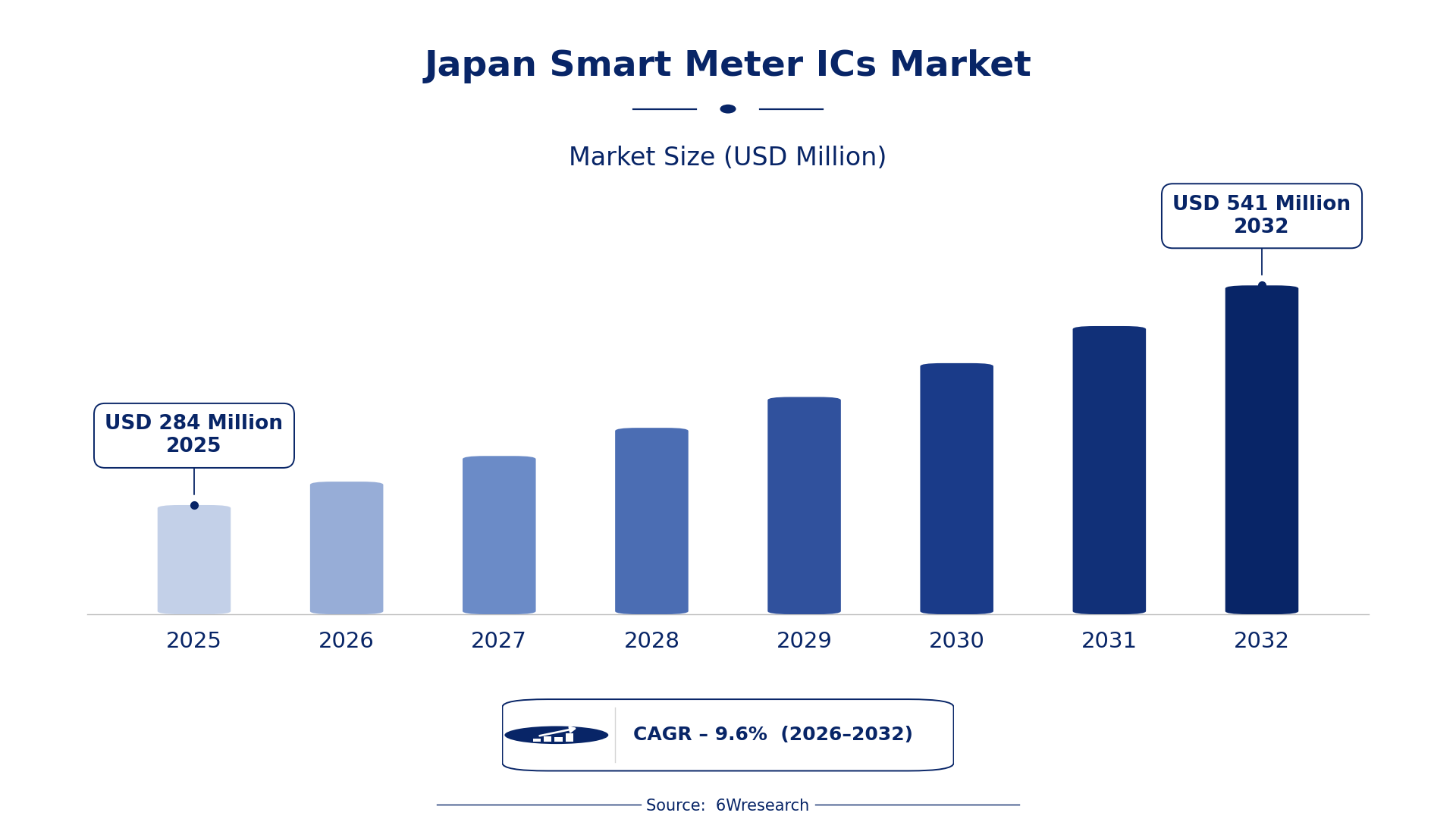
According to 6Wresearch internal database and industry insights, the Japan Smart Meter ICs Market was valued at USD 284 Million in 2025 and is projected to reach USD 541 Million by 2032, growing at a CAGR of approximately 9.6% during 2026–2032.
Japan Smart Meter ICs Market Highlights
| Report Metric | Details |
| Report Name | Japan Smart Meter ICs Market (2026-2032) |
| Market Size 2025 | USD 284 Million |
| Market Size 2032 | USD 541 Million |
| Absolute Growth 2025–2032 | USD 257 Million |
| CAGR 2026–2032 | 9.6% |
| Peak Annual Growth | 10.3% in 2028 |
| Forecast Period | 2026–2032 |
| Historical Data | 2022–2025 |
| Base Year | 2025 |
| Leading IC Type, 2025 | SoCs for Smart Meters (40% share) |
| Leading Feature Focus, 2025 | Current & Voltage Sensing (44% share) |
| Leading Target Application, 2025 | Electricity Meters (54% share) |
| Leading End User, 2025 | Utility Companies (47% share) |
| Fastest-Growing IC Type | RF Communication ICs (14.0% CAGR) |
| Fastest-Growing Feature Focus | Data Transmission (12.9% CAGR) |
| Fastest-Growing Target Application | IoT Energy Devices (13.5% CAGR) |
| Fastest-Growing End User | Smart Grid Providers (12.5% CAGR) |
| Growing Sector | Smart Metering Solutions |
| Key End Users | Utility Companies, Smart Grid Providers, Energy Meter OEMs |
Japan Smart Meter ICs Market Year-wise Growth Rate and Key Drivers (2022–2032)
This graph illustrates the annual growth rates of the market from 2022 to 2032, highlighting a steady upward trajectory and projected market expansion over the forecast period.
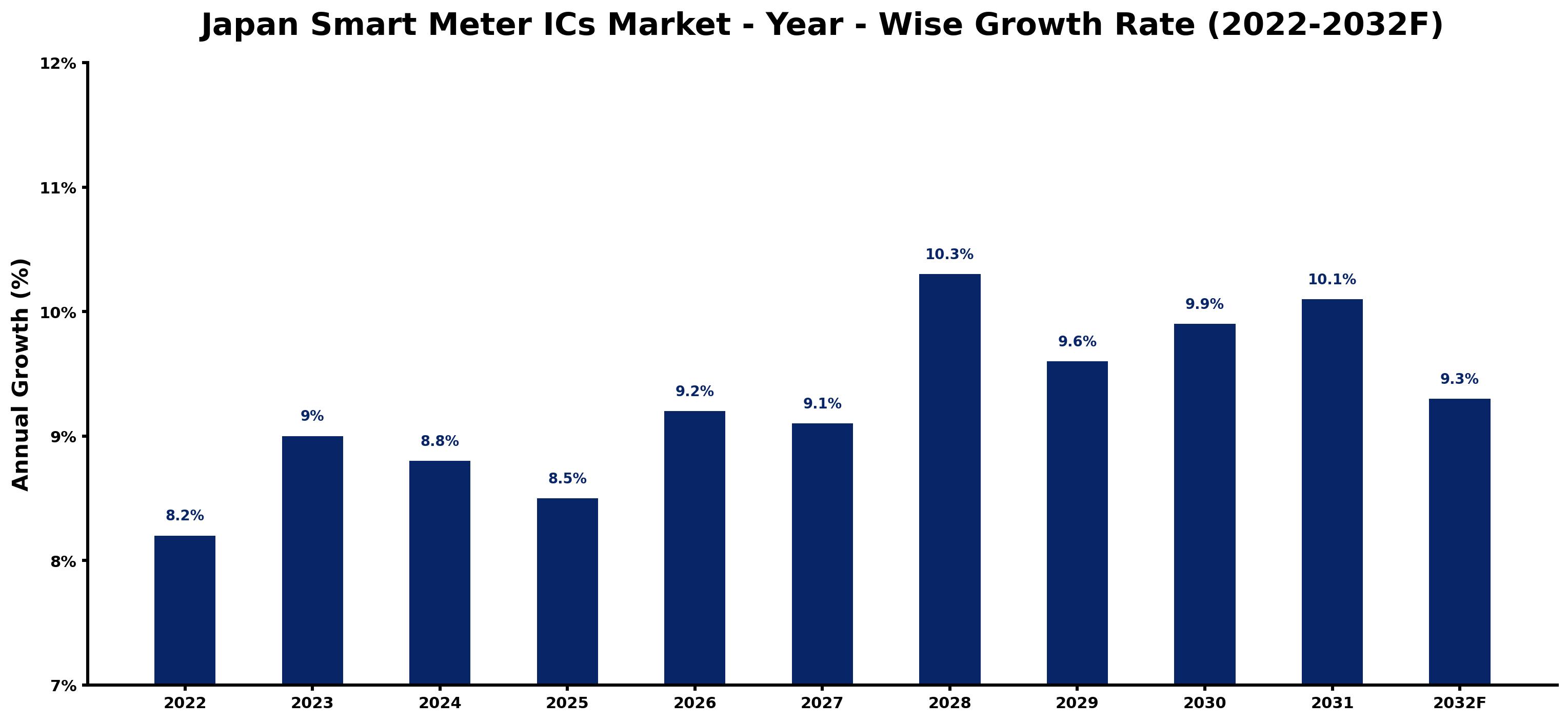
The yearly estimates that follow link every growth rate to its principal driver, so readers can see why the pace changed in each period.
| Year | Estimated Annual Growth (%) | Market Rationale |
| 2022 | 8.2 | Demand for smart meters was strong, reflecting ongoing utility upgrades. |
| 2023 | 9.0 | Growth accelerated as utility companies increased smart meter installations. |
| 2024 | 8.8 | Market growth slowed slightly due to supply chain challenges affecting production. |
| 2025 | 8.5 | Demand continued to rise, although at a slower pace than the previous year. |
| 2026 | 9.2 | Growth picked up again as investment in smart grid technologies resumed. |
| 2027 | 9.1 | Market expansion slowed as some projects faced delays in implementation. |
| 2028 | 10.3 | The peak growth year will see heightened demand from utility providers. |
| 2029 | 9.6 | Growth decelerated slightly as market saturation began to influence purchases. |
| 2030 | 9.9 | Demand increased again as the government pushed for 100% adoption. |
| 2031 | 10.1 | Growth continued as utility companies upgraded their metering infrastructure. |
| 2032 | 9.3 | Market growth slowed as the adoption rate approached saturation. |
Note: Market size estimations and growth projections presented in this report are based on 6Wresearch's proprietary forecasting methodology, utilizing the latest available industry data, government publications, and primary research inputs.
Japan Smart Meter ICs Market Synopsis
Smart Meter ICs are integrated circuits designed for utility metering applications, enabling accurate measurement and communication of consumption data. The Japan Smart Meter ICs Market is growing due to strong demand from utility companies and energy meter manufacturers, driven by initiatives like the Act on the Rational Use of Energy and the goal of 100% smart meter adoption by 2030. With approximately 27 million smart electricity meters installed in 2022, investment in smart grid technologies is likely to further stimulate market growth.
Market Dynamics Impact Analysis (2026–2032)
| Factor | Type | Impact | Primary Segment Affected |
| Increased investment in smart grid technologies | Driver | High | Smart Grid Providers |
| The push for energy efficiency and sustainability | Driver | High | Utility Companies |
| Growing demand for IoT Energy Devices | Opportunity | Medium | IoT Energy Devices |
| Expansion of smart metering in Kyoto Prefecture | Opportunity | Medium | Electricity Meters |
| Supply chain disruptions affecting IC production | Restraint | High | RF Communication ICs |
| High competition among IC manufacturers | Restraint | Medium | Analog Front-End ICs |
| Limited production capacity for advanced ICs | Challenge | High | Power Management ICs |
| Technological advancements outpacing current manufacturing | Challenge | Medium | SoCs for Smart Meters |
Evaluation of Drivers in Japan Smart Meter ICs Market (2026–2032)
The following drivers explain most of the expected growth.
| Drivers | Primary Segment Affected | Why It Matters (Evidence) |
| Rising investments in smart grid technologies | Smart Grid Providers | Investment in smart grid initiatives is expected to reach USD 2 billion by 2025, prompting increased purchases of Smart Meter ICs. |
| Growing focus on energy efficiency | Utility Companies | Utility companies are adopting smart meters to comply with energy efficiency regulations, driving demand for ICs. |
| Increase in IoT Energy Devices | IoT Energy Devices | The IoT Energy Device segment is anticipated to grow significantly, leading to higher demand for Smart Meter ICs. |
| Government initiatives promoting smart metering | Electricity Meters | The Act on the Rational Use of Energy aims for widespread smart meter deployment, boosting demand for related ICs. |
| Rising urban population density | Utility Companies | Japan's urban population density supports the need for smart metering solutions. |
The strongest pull on demand comes from rising investments in smart grid technologies, expected to reach USD 2 billion by 2025. The IoT Energy Device segment is set to expand significantly, increasing the demand for Smart Meter ICs. Japan's urban population density supports the need for advanced metering solutions.
Evaluation of Restraints in Japan Smart Meter ICs Market
Below are the constraints most often cited by buyers and suppliers, with the segment each affects.
| Market Restraint | Primary Segment Affected | Why It Matters (Evidence) |
| Supply chain disruptions affecting production capacity | RF Communication ICs | Recent supply chain issues have led to delays in IC production, impacting availability for smart meters. |
| Intense competition among IC manufacturers | Analog Front-End ICs | High competition has resulted in price pressures, limiting profit margins for manufacturers. |
| Limited production capacity for advanced ICs | Power Management ICs | Manufacturers are struggling to scale production of advanced ICs to meet rising demand. |
| Technological advancements outpacing current manufacturing capabilities | SoCs for Smart Meters | Rapid technological advancements are creating gaps in manufacturing capabilities, affecting supply. |
| Regulatory compliance costs for manufacturers | Current & Voltage Sensing | Manufacturers face high costs to comply with standards like JIS C 1500, impacting profitability. |
Japan Smart Meter ICs Market Challenges
High production costs for domestic utility companies arise from the need to comply with the JIS C 1500 standard, which can increase expenses by up to 15%. Many manufacturers face technology integration issues, as outdated semiconductor processes delay product launches, costing energy meter manufacturers valuable market opportunities. A shortage of skilled workers in the semiconductor field hampers the development of smart meter ICs, potentially extending project timelines by six months for producers. Buyers encounter supply chain uncertainties due to fluctuating demand, which can lead to stock shortages and increased operational costs of around 10%.
Trends in the Japan Smart Meter ICs Market
These developments are changing demand patterns in the Japan Smart Meter ICs Market.
- Smart Grid Strategy 2020 Driving Adoption: The Act on the Rational Use of Energy has influenced smart meter adoption in Japan, with approximately 27 million smart electricity meters installed by 2022. This initiative is likely to drive further investment in smart metering technologies.
- Utility Companies Increasingly Adopting Smart Meters: Utility companies are rapidly adopting smart meters to improve energy management and efficiency. In 2022, Japan had around 27 million smart meters, reflecting a strong shift towards modern metering solutions.
- Rise of IoT Energy Devices: The IoT Energy Device segment is anticipated to grow significantly. This trend highlights the increasing integration of smart technologies in energy management.
- Shift Towards Energy Efficiency Initiatives: The Japanese government aims for 100% smart meter adoption by 2030, promoting energy efficiency initiatives. This policy shift is likely to drive market demand for smart metering solutions.
Investment Opportunities in the Japan Smart Meter ICs Market
Several openings in the Japan Smart Meter ICs Market merit attention from investors.
- Smart Meter ICs for IoT Energy Devices: With the IoT Energy Device segment expected to grow significantly, suppliers can focus on developing Smart Meter ICs tailored for these applications. Utility companies are increasingly investing in IoT solutions.
- Investment in Smart Meter Infrastructure: The Japanese government aims for 100% smart meter adoption by 2030, creating a substantial market opportunity. Utility companies need to invest in upgrading their metering infrastructure to meet this goal.
- Partnerships with Smart Grid Providers: Collaborating with smart grid providers can facilitate entry into the growing Smart Meter IC market. These partnerships can help manufacturers align their products with emerging smart grid technologies.
- Certification for Compliance with JIS Standards: Investing in certification for compliance with JIS C 1500 standards can improve market access. Utility companies require certified Smart Meter ICs to ensure performance and reliability.
Government Initiatives in the Japan Smart Meter ICs Market
The policy framework for smart metering in Japan is shaped by several laws and strategies, including the Act on the Rational Use of Energy (1979) and the Battery Industry Strategy (2022). These measures mandate energy efficiency improvements and promote the adoption of smart grid technologies, compelling utility companies to integrate smart meters into their operations.
In 2023, the government launched a program that allocates USD 50 million to improve energy efficiency in households. The Energy Agency of Japan oversees this initiative, ensuring that smart metering solutions are effectively implemented to support energy management goals.
Future Insight of the Japan Smart Meter ICs Market
The Japanese government's goal for 100% smart meter adoption by 2030 will drive suppliers to upgrade their production capabilities. The Energy Agency's initiatives will encourage advancements in energy efficiency technologies, prompting buyers to seek out improved metering solutions. By 2032, smart meters will play a central role in energy management systems, with the IoT segment projected to grow to 12 million units. Enhanced collaboration among stakeholders will support the seamless integration of smart meters into the smart grid framework.
Market Segmentation Analysis
Japan Smart Meter ICs Market report covers a detailed analysis of the following market segments:
By IC Type – SoCs for Smart Meters Lead, RF Communication ICs Expected to Grow Fastest
According to Saurav Kr Singh, Senior Research Analyst at 6Wresearch, in 2025, SoCs for Smart Meters led the ic type split with a 40% share. SoCs for Smart Meters dominate the market due to their ability to integrate multiple functions into a single chip, which is crucial for efficient smart metering. Their extensive deployment by utility companies in Japan highlights their pivotal role in advancing smart grid initiatives. RF Communication ICs are set to record the highest CAGR in this split, 14.0% over 2026–2032. RF Communication ICs are experiencing rapid growth as they are essential for data transmission in smart metering, which is vital for real-time energy management. The rising demand for improved communication capabilities in smart meters is significantly driving this segment's expansion. Suppliers should focus on enhancing RF Communication ICs to meet the increasing demand for efficient data transmission.
By Feature Focus – Current & Voltage Sensing Leads, Data Transmission Expected to Grow Fastest
With 44% of feature focus revenue in 2025, Current & Voltage Sensing was the largest category. Current & Voltage Sensing is the leading feature focus as it is fundamental for accurate consumption measurement in smart meters. This technology is essential for utility companies to ensure precise billing and energy management. Over 2026–2032, Data Transmission is expected to post the fastest growth, at a CAGR of 12.9%. Data Transmission is the fastest-growing feature focus, driven by the need for real-time communication of data between smart meters and utility providers. The increasing emphasis on smart grid initiatives is propelling this segment forward. Buyers will benefit from investing in advanced data transmission technologies to improve the efficiency of their smart metering systems.
By Target Application – Electricity Meters Lead, IoT Energy Devices Expected to Grow Fastest
The largest target application category in 2025 was Electricity Meters, at 54% of revenue. Electricity Meters dominate the market as the primary application for smart meter ICs, reflecting the high demand from utility companies for accurate electricity consumption measurement. The existing installed base of approximately 27 million smart electricity meters in Japan supports this trend. IoT Energy Devices are projected to grow fastest, at a CAGR of 13.5% during 2026–2032. IoT Energy Devices are rapidly growing in popularity, driven by the increasing focus on energy monitoring and management in residential and commercial settings. The government's initiatives to promote energy efficiency are further accelerating this segment's growth. Suppliers should consider expanding their product offerings to include IoT Energy Devices to capture the growing market segment.
By End User – Utility Companies Lead, Smart Grid Providers Expected to Grow Fastest
Utility Companies accounted for 47% of the market by end user in 2025. Utility Companies are the primary end users of smart meter technology, serving as major consumers of smart metering solutions that enable effective energy distribution. Their ongoing investments in smart grid technologies illustrate their critical importance in this market. The quickest growth will come from Smart Grid Providers, forecast to expand at a CAGR of 12.5% between 2026 and 2032. Smart Grid Providers are the fastest-growing end user segment, as they increasingly adopt smart metering solutions to enhance energy management capabilities. The government's target for 100% smart meter adoption by 2030 is a key factor accelerating this growth. Suppliers must adapt their offerings to align with the evolving needs of Smart Grid Providers to remain competitive.
Key Attractiveness of the Report
- 10 Years of Market Numbers
- Historical Data Starting from 2022 to 2025
- Base Year 2025
- Forecast Data until 2032
- Key Performance Indicators Impacting the Market
- Major Upcoming Developments and Projects
Key Highlights of the Report:
- Japan Smart Meter ICs Market Outlook
- Market Size of Japan Smart Meter ICs Market, 2025
- Forecast of Japan Smart Meter ICs Market, 2032
- Historical Data and Forecast of Japan Smart Meter ICs Revenues & Volume for the Period 2022-2032F
- Japan Smart Meter ICs Market Trend Evolution
- Japan Smart Meter ICs Market Drivers and Challenges
- Japan Smart Meter ICs Price Trends
- Japan Smart Meter ICs Porter's Five Forces
- Japan Smart Meter ICs Industry Life Cycle
- Historical Data and Forecast of Japan Smart Meter ICs Market Revenues & Volume By IC Type for the Period 2022-2032F
- Historical Data and Forecast of Japan Smart Meter ICs Market Revenues & Volume By Analog Front-End ICs for the Period 2022-2032F
- Historical Data and Forecast of Japan Smart Meter ICs Market Revenues & Volume By RF Communication ICs for the Period 2022-2032F
- Historical Data and Forecast of Japan Smart Meter ICs Market Revenues & Volume By Power Management ICs for the Period 2022-2032F
- Historical Data and Forecast of Japan Smart Meter ICs Market Revenues & Volume By SoCs for Smart Meters for the Period 2022-2032F
- Historical Data and Forecast of Japan Smart Meter ICs Market Revenues & Volume By Feature Focus for the Period 2022-2032F
- Historical Data and Forecast of Japan Smart Meter ICs Market Revenues & Volume By Current & Voltage Sensing for the Period 2022-2032F
- Historical Data and Forecast of Japan Smart Meter ICs Market Revenues & Volume By Data Transmission for the Period 2022-2032F
- Historical Data and Forecast of Japan Smart Meter ICs Market Revenues & Volume By Low-Power Operation for the Period 2022-2032F
- Historical Data and Forecast of Japan Smart Meter ICs Market Revenues & Volume By Full-System Integration for the Period 2022-2032F
- Historical Data and Forecast of Japan Smart Meter ICs Market Revenues & Volume By Target Application for the Period 2022-2032F
- Historical Data and Forecast of Japan Smart Meter ICs Market Revenues & Volume By Electricity Meters for the Period 2022-2032F
- Historical Data and Forecast of Japan Smart Meter ICs Market Revenues & Volume By Water/Gas Meters for the Period 2022-2032F
- Historical Data and Forecast of Japan Smart Meter ICs Market Revenues & Volume By IoT Energy Devices for the Period 2022-2032F
- Historical Data and Forecast of Japan Smart Meter ICs Market Revenues & Volume By Multifunctional Meters for the Period 2022-2032F
- Historical Data and Forecast of Japan Smart Meter ICs Market Revenues & Volume By End User for the Period 2022-2032F
- Historical Data and Forecast of Japan Smart Meter ICs Market Revenues & Volume By Smart Grid Providers for the Period 2022-2032F
- Historical Data and Forecast of Japan Smart Meter ICs Market Revenues & Volume By Utility Companies for the Period 2022-2032F
- Historical Data and Forecast of Japan Smart Meter ICs Market Revenues & Volume By IC Manufacturers for the Period 2022-2032F
- Historical Data and Forecast of Japan Smart Meter ICs Market Revenues & Volume By Energy Meter OEMs for the Period 2022-2032F
- Japan Smart Meter ICs Import Export Trade Statistics
- Market Opportunity Assessment By IC Type
- Market Opportunity Assessment By Feature Focus
- Market Opportunity Assessment By Target Application
- Market Opportunity Assessment By End User
- Japan Smart Meter ICs Top Companies Market Share
- Japan Smart Meter ICs Competitive Benchmarking By Technical and Operational Parameters
- Japan Smart Meter ICs Company Profiles
- Japan Smart Meter ICs Key Strategic Recommendations
Market Covered
The following segment groups are covered in the report.
By IC Type
- Analog Front-End ICs
- RF Communication ICs
- Power Management ICs
- SoCs for Smart Meters
By Feature Focus
- Current & Voltage Sensing
- Data Transmission
- Low-Power Operation
- Full-System Integration
By Target Application
- Electricity Meters
- Water/Gas Meters
- IoT Energy Devices
- Multifunctional Meters
By End User
- Smart Grid Providers
- Utility Companies
- IC Manufacturers
- Energy Meter OEMs































