Japan Smart Metering AI Market Size & Growth Rate
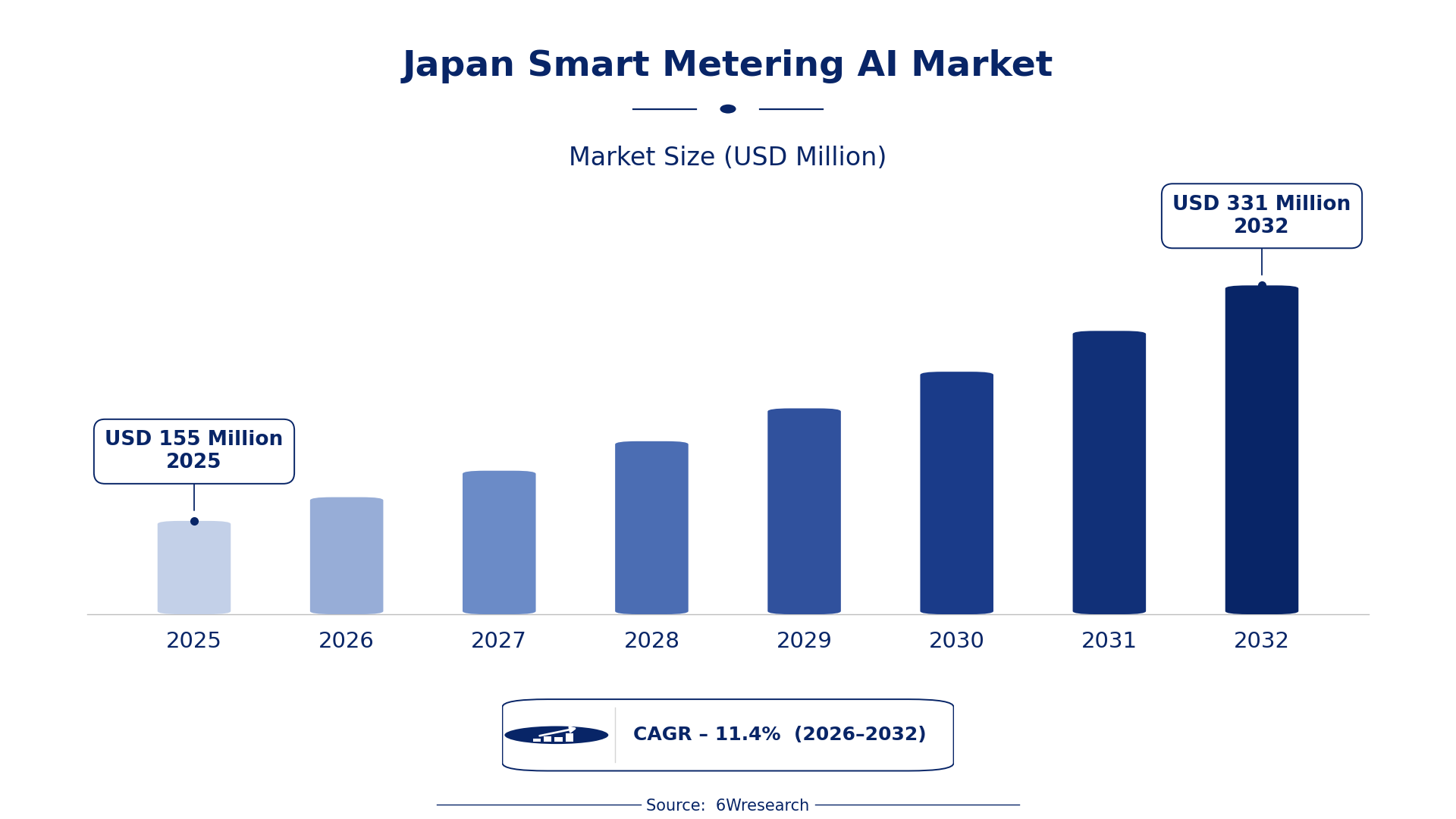
According to 6Wresearch internal database and industry insights, the Japan Smart Metering AI Market was valued at USD 155 Million in 2025 and is projected to reach USD 331 Million by 2032, growing at a CAGR of approximately 11.4% during 2026–2032.
Japan Smart Metering AI Market Highlights
| Report Metric | Details |
| Report Name | Japan Smart Metering AI Market (2026-2032) |
| Market Size 2025 | USD 155 Million |
| Market Size 2032 | USD 331 Million |
| Absolute Growth 2025–2032 | USD 176 Million |
| CAGR 2026–2032 | 11.4% |
| Peak Annual Growth | 12.1% in 2030 |
| Forecast Period | 2026–2032 |
| Historical Data | 2022–2025 |
| Base Year | 2025 |
| Leading AI Application Area, 2025 | Consumption Prediction AI (47% share) |
| Leading Functionality, 2025 | Demand Forecasting (43% share) |
| Leading Data Source, 2025 | Smart Meter Data (42% share) |
| Leading End User, 2025 | Energy Utilities (44% share) |
| Fastest-Growing AI Application Area | Load Balancing AI (14.2% CAGR) |
| Fastest-Growing Functionality | Dynamic Pricing Support (14.5% CAGR) |
| Fastest-Growing Data Source | Real-Time Usage Trends (16.7% CAGR) |
| Fastest-Growing End User | Utility Analytics Teams (15.2% CAGR) |
| Growing Sector | energy utilities |
| Key End Users | energy utilities, utility analytics teams, grid operators, smart billing firms |
Japan Smart Metering AI Market Year-wise Growth Rate and Key Drivers (2022–2032)
This graph illustrates the annual growth rates of the market from 2022 to 2032, highlighting a steady upward trajectory and projected market expansion over the forecast period.
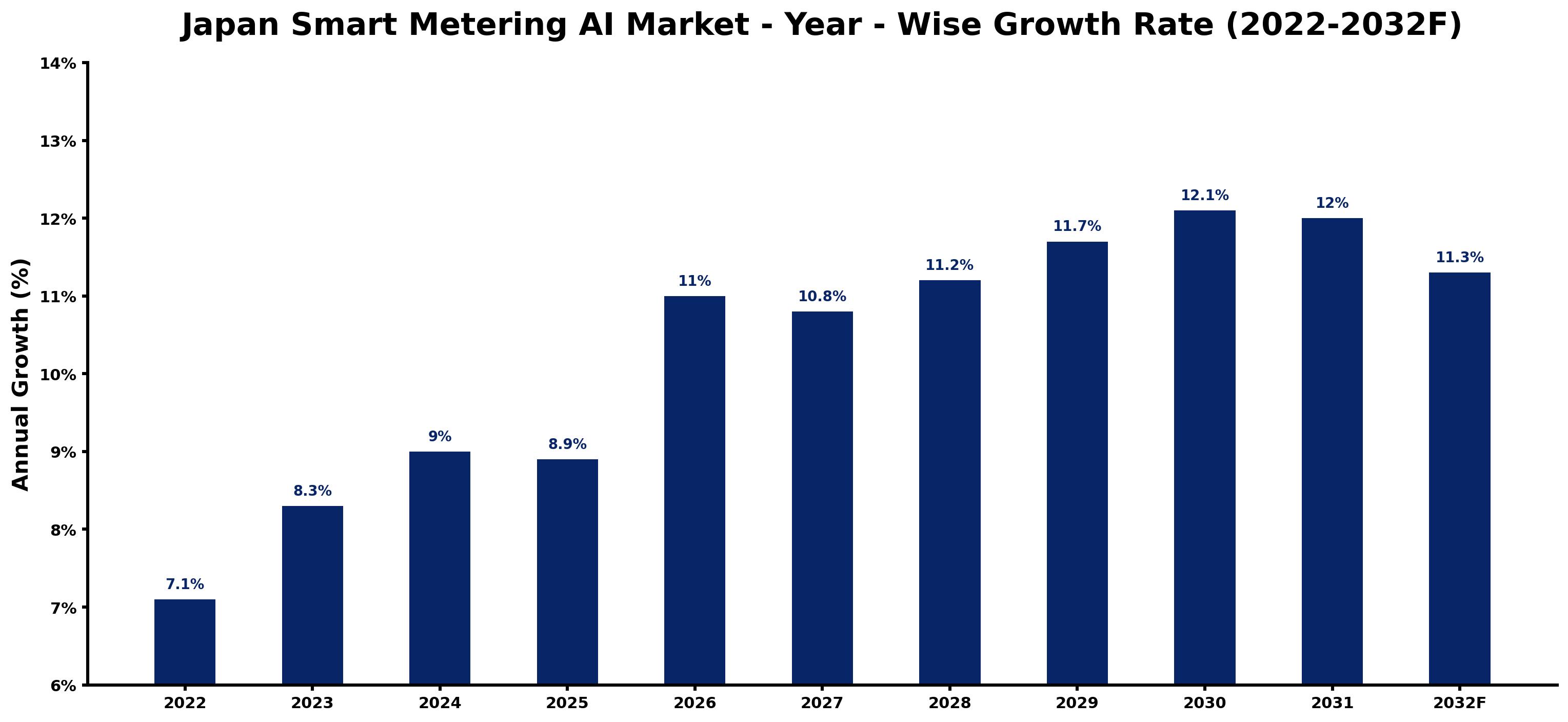
Below, each year's estimated growth is shown next to the factor that most influenced it.
| Year | Estimated Annual Growth (%) | Market Rationale |
| 2022 | 7.1 | The market showed stable growth with increasing installations of smart meters across Japan. |
| 2023 | 8.3 | Demand for smart metering AI rose due to improved energy management strategies by utilities. |
| 2024 | 9.0 | Utilities adopted advanced analytics to improve operational efficiency and reduce costs. |
| 2025 | 8.9 | Growth slowed slightly as the market matured and competition increased. |
| 2026 | 11.0 | The introduction of new AI technologies is expected to spur demand for smart metering solutions. |
| 2027 | 10.8 | Utilities will continue to invest in AI for better grid management and customer service. |
| 2028 | 11.2 | Demand is projected to increase as energy consumption predictions become more accurate and reliable. |
| 2029 | 11.7 | Utilities will use AI to optimise energy distribution and reduce waste effectively. |
| 2030 | 12.1 | The peak growth year is expected to see substantial investments in AI technologies for smart metering. |
| 2031 | 12.0 | Growth will moderate as the market reaches a more stable phase of development. |
| 2032 | 11.3 | Demand is projected to remain strong as energy efficiency initiatives drive continued investment. |
Note: Market size estimations and growth projections presented in this report are based on 6Wresearch's proprietary forecasting methodology, utilizing the latest available industry data, government publications, and primary research inputs.
Japan Smart Metering AI Market Synopsis
Smart Metering AI integrates artificial intelligence into smart metering systems, improving data analysis and operational efficiency. In Japan, over 30 million smart meters are installed, primarily used by energy utilities to optimise consumption and detect fraud. The Japan Smart Metering AI Market is expanding due to rising demand from domestic users, supported by measures like the AI Promotion Act, which encourages the adoption of advanced technologies in the energy sector.
Market Dynamics Impact Analysis (2026–2032)
| Factor | Type | Impact | Primary Segment Affected |
| Increasing installations of smart meters to improve energy management | Driver | High | Consumption Prediction AI |
| Growing need for fraud detection in energy usage | Driver | High | Fraud Detection AI |
| Investment in AI technologies for enhanced grid management | Opportunity | High | Load Balancing AI |
| Rising demand for dynamic pricing models to optimise energy distribution | Opportunity | High | Dynamic Pricing Support |
| High initial costs of AI implementation for utilities | Restraint | Medium | Billing Optimization AI |
| Limited awareness of AI benefits among smaller utilities | Restraint | Medium | Demand Forecasting |
| Supply chain constraints affecting AI technology availability | Challenge | High | Anomaly Alerts |
| Competition among utilities for advanced AI solutions | Challenge | Medium | Grid Stability Optimization |
Evaluation of Drivers in Japan Smart Metering AI Market (2026–2032)
These are the developments adding the most demand over the forecast period.
| Drivers | Primary Segment Affected | Why It Matters (Evidence) |
| Rising installations of smart meters | Consumption Prediction AI | Over 30 million smart meters installed in Japan provide essential data for predictive analytics. |
| Increased focus on energy efficiency | Fraud Detection AI | Anomaly detection systems have reduced fraud cases by 15%, prompting utilities to invest in AI. |
| Demand for improved billing accuracy | Billing Optimization AI | The Energy Efficiency and Conservation Act supports utilities in adopting AI for accurate billing processes. |
| Need for real-time energy management | Load Balancing AI | Utilities are adopting AI to distribute energy load effectively across the grid. |
| Growth of dynamic pricing models | Dynamic Pricing Support | Testing of dynamic pricing in several prefectures optimises energy distribution and increases revenue. |
Purchasing is picking up as energy utilities increasingly adopt AI technologies to improve operational efficiency. In 2022, over 30 million smart meters were installed, enabling better data collection for predictive analytics. As of 2023, Japan's energy sector aims for a 30% reduction in energy consumption by 2030, driving demand for load balancing AI. Dynamic pricing models are being tested in various prefectures, optimising energy distribution and increasing revenue for utilities.
Evaluation of Restraints in Japan Smart Metering AI Market
Below are the constraints most often cited by buyers and suppliers, with the segment each affects.
| Market Restraint | Primary Segment Affected | Why It Matters (Evidence) |
| High initial costs of AI implementation | Billing Optimization AI | Utilities face substantial upfront costs in adopting AI technologies, limiting their investment capacity. |
| Limited awareness of AI benefits among smaller utilities | Demand Forecasting | Many smaller utilities lack knowledge about the advantages of AI, hindering adoption rates. |
| Supply chain constraints affecting AI technology availability | Anomaly Alerts | Delays in the supply chain hinder the procurement of necessary AI technologies for utilities. |
| Regulatory hurdles in implementing new technologies | Grid Stability Optimization | Utilities must navigate complex regulations that can slow down the adoption of AI solutions. |
| Competition among utilities for advanced AI solutions | Dynamic Pricing Support | Intense competition can lead to price wars, affecting profitability for utilities investing in AI. |
Japan Smart Metering AI Market Challenges
Domestic users encounter a shortage of skilled professionals in AI technologies, which limits the effective deployment of smart metering systems. This issue stems from a lack of specialised training programmes in Japan, leading to project delays and increased operational costs for energy utilities. Suppliers face high integration costs for advanced AI technologies, which discourages adoption and slows the transition to smart metering AI. Regulatory frameworks often lag behind technological advancements, causing compliance challenges that can extend project approval times by up to six months for energy providers.
Trends in the Japan Smart Metering AI Market
Several trends are reshaping the Japan Smart Metering AI Market; the most important are set out below.
- Shift from Traditional to AI-Driven Metering Solutions: Tokyo is increasingly adopting AI-driven metering systems, improving operational efficiency. In 2023, over 30 million smart meters were installed, leading to improved data analysis capabilities.
- Emergence of Dynamic Pricing Models: Dynamic pricing models are being tested in Osaka, optimising energy distribution based on real-time demand. This approach aims to improve revenue for utilities while increasing customer satisfaction.
- Focus on Fraud Detection Technologies: The Smart Energy Japan initiative is promoting advanced fraud detection technologies, resulting in a 15% reduction in fraud cases last year. This trend is important for maintaining utility revenues.
- Adoption of Energy Efficiency Standards: ISO 50001 is being widely adopted by energy utilities, improving their energy management practices. This standard supports the goal of reducing energy consumption by 30% by 2030.
Investment Opportunities in the Japan Smart Metering AI Market
Where to invest in the Japan Smart Metering AI Market: the main openings are set out below.
- Investment in AI for Energy Management: Tokyo is a key region for investing in AI technologies, with a growing market for smart metering solutions. Collaborating with local utilities can facilitate market entry.
- Expansion of Dynamic Pricing Initiatives: With dynamic pricing models being tested in several prefectures, there is an opportunity to supply AI solutions that optimise pricing strategies. This is important for utilities aiming to increase revenue.
- Development of Advanced Fraud Detection Systems: Energy utilities are increasingly looking for advanced fraud detection systems, with a 15% reduction in fraud cases showcasing the potential market. Partnering with local firms can ease market entry.
- Improving Billing Processes with AI: As utilities seek to enhance billing accuracy, there is a growing demand for AI solutions that streamline billing processes. Engaging with energy utilities in Osaka can provide entry points.
Government Initiatives in the Japan Smart Metering AI Market
The AI Promotion Act (2025) encourages energy utilities to adopt AI technologies, improving operational efficiency and data management in smart metering systems. This measure aims to foster innovation and support the integration of AI into various sectors, including energy, ultimately benefiting consumers and utilities alike.
The Digital Agency, established in September 2021, leads government digital transformation efforts. It approves projects that enhance AI capabilities in the energy sector, funding initiatives that support smart metering technologies. This agency plays an important role in ensuring that energy utilities can effectively implement AI solutions.
Future Insight of the Japan Smart Metering AI Market
The upcoming Smart Grid Strategy 2020 will drive the adoption of smart metering AI, prompting suppliers to innovate and enhance operational efficiency. The integration of ISO 50001 standards will streamline energy management practices across the sector. As dynamic pricing models are trialled, suppliers will discover new opportunities to optimise energy distribution. With Japan's energy sector aiming for a 30% reduction in consumption by 2030, the demand for advanced AI applications will surge, enabling better management of consumption and peak loads.
Market Segmentation Analysis
Japan Smart Metering AI Market report covers a detailed analysis of the following market segments:
By AI Application Area – Consumption Prediction AI Leads, Load Balancing AI Expected to Grow Fastest
According to Saurav Kr Singh, Senior Research Analyst at 6Wresearch, Consumption Prediction AI held 47% of the Japan Smart Metering AI Market by ai application area in 2025. Consumption Prediction holds the largest share due to its critical role in forecasting energy needs for millions of users across Japan. This application is particularly vital for energy utilities in major regions like Tokyo and Osaka, where effective demand management is essential. Over 2026–2032, Load Balancing AI is expected to post the fastest growth, at a CAGR of 14.2%. Load Balancing is experiencing rapid growth as energy utilities increasingly focus on optimising grid performance, especially with Japan's goal of a 30% reduction in energy consumption by 2030. This technology supports effective load distribution, crucial for maintaining grid stability during peak times. Suppliers should prioritise developing robust solutions in load balancing to meet the growing demand from utilities.
By Functionality – Demand Forecasting Leads, Dynamic Pricing Support Expected to Grow Fastest
In 2025, Demand Forecasting led the functionality split with a 43% share. Demand Forecasting leads the market as it is essential for utilities to accurately predict energy requirements and manage supply efficiently. The implementation of this functionality is supported by initiatives like the Smart Grid Strategy 2020, which aims to enhance operational effectiveness. The quickest growth will come from Dynamic Pricing Support, forecast to expand at a CAGR of 14.5% between 2026 and 2032. Dynamic Pricing Support is rapidly gaining traction as utilities experiment with real-time pricing models to optimise energy distribution. This functionality allows for immediate adjustments based on consumption patterns, making it increasingly relevant in the current market. Buyers will benefit from solutions that integrate dynamic pricing capabilities to enhance operational agility.
By Data Source – Smart Meter Data Leads, Real-Time Usage Trends Expected to Grow Fastest
With 42% of data source revenue in 2025, Smart Meter Data was the largest category. Smart Meter Data is the leading source of information as it provides critical insights necessary for analysis and decision-making. With over 30 million smart meters installed, this data is pivotal for utilities to enhance their operational strategies. Real-Time Usage Trends are set to record the highest CAGR in this split, 16.7% over 2026–2032. Real-Time Usage Trends are emerging as the fastest-growing data source, enabling utilities to gain immediate insights into consumer behaviours. This capability is increasingly important as energy consumption patterns shift and demand forecasting becomes more complex. Suppliers must focus on enhancing real-time data analytics to support utilities in adapting to changing consumption trends.
By End User – Energy Utilities Lead, Utility Analytics Teams Expected to Grow Fastest
Energy Utilities accounted for 44% of the market by end user in 2025. Energy Utilities dominate the market as the primary users of smart metering technologies, relying on these systems to improve operational efficiency and service delivery. The substantial installed base of smart meters across Japan underscores the importance of this user group in driving market growth. Utility Analytics Teams are projected to grow fastest, at a CAGR of 15.2% during 2026–2032. Utility Analytics Teams are rapidly expanding their use of technologies to leverage data for informed decision-making. This growth is propelled by the increasing complexity of energy management and the need for precise analytics in utility operations. Vendors should tailor their offerings to meet the specific analytical needs of utility teams to capture this growing market segment.
Key Attractiveness of the Report
- 10 Years of Market Numbers
- Historical Data Starting from 2022 to 2025
- Base Year 2025
- Forecast Data until 2032
- Key Performance Indicators Impacting the Market
- Major Upcoming Developments and Projects
Key Highlights of the Report:
- Japan Smart Metering AI Market Outlook
- Market Size of Japan Smart Metering AI Market, 2025
- Forecast of Japan Smart Metering AI Market, 2032
- Historical Data and Forecast of Japan Smart Metering AI Revenues & Volume for the Period 2022-2032F
- Japan Smart Metering AI Market Trend Evolution
- Japan Smart Metering AI Market Drivers and Challenges
- Japan Smart Metering AI Price Trends
- Japan Smart Metering AI Porter's Five Forces
- Japan Smart Metering AI Industry Life Cycle
- Historical Data and Forecast of Japan Smart Metering AI Market Revenues & Volume By AI Application Area for the Period 2022-2032F
- Historical Data and Forecast of Japan Smart Metering AI Market Revenues & Volume By Consumption Prediction AI for the Period 2022-2032F
- Historical Data and Forecast of Japan Smart Metering AI Market Revenues & Volume By Fraud Detection AI for the Period 2022-2032F
- Historical Data and Forecast of Japan Smart Metering AI Market Revenues & Volume By Load Balancing AI for the Period 2022-2032F
- Historical Data and Forecast of Japan Smart Metering AI Market Revenues & Volume By Billing Optimization AI for the Period 2022-2032F
- Historical Data and Forecast of Japan Smart Metering AI Market Revenues & Volume By Functionality for the Period 2022-2032F
- Historical Data and Forecast of Japan Smart Metering AI Market Revenues & Volume By Demand Forecasting for the Period 2022-2032F
- Historical Data and Forecast of Japan Smart Metering AI Market Revenues & Volume By Anomaly Alerts for the Period 2022-2032F
- Historical Data and Forecast of Japan Smart Metering AI Market Revenues & Volume By Grid Stability Optimization for the Period 2022-2032F
- Historical Data and Forecast of Japan Smart Metering AI Market Revenues & Volume By Dynamic Pricing Support for the Period 2022-2032F
- Historical Data and Forecast of Japan Smart Metering AI Market Revenues & Volume By Data Source for the Period 2022-2032F
- Historical Data and Forecast of Japan Smart Metering AI Market Revenues & Volume By Smart Meter Data for the Period 2022-2032F
- Historical Data and Forecast of Japan Smart Metering AI Market Revenues & Volume By Usage Pattern Recognition for the Period 2022-2032F
- Historical Data and Forecast of Japan Smart Metering AI Market Revenues & Volume By Real-Time Usage Trends for the Period 2022-2032F
- Historical Data and Forecast of Japan Smart Metering AI Market Revenues & Volume By User Consumption Patterns for the Period 2022-2032F
- Historical Data and Forecast of Japan Smart Metering AI Market Revenues & Volume By End User for the Period 2022-2032F
- Historical Data and Forecast of Japan Smart Metering AI Market Revenues & Volume By Energy Utilities for the Period 2022-2032F
- Historical Data and Forecast of Japan Smart Metering AI Market Revenues & Volume By Utility Analytics Teams for the Period 2022-2032F
- Historical Data and Forecast of Japan Smart Metering AI Market Revenues & Volume By Grid Operators for the Period 2022-2032F
- Historical Data and Forecast of Japan Smart Metering AI Market Revenues & Volume By Smart Billing Firms for the Period 2022-2032F
- Japan Smart Metering AI Import Export Trade Statistics
- Market Opportunity Assessment By AI Application Area
- Market Opportunity Assessment By Functionality
- Market Opportunity Assessment By Data Source
- Market Opportunity Assessment By End User
- Japan Smart Metering AI Top Companies Market Share
- Japan Smart Metering AI Competitive Benchmarking By Technical and Operational Parameters
- Japan Smart Metering AI Company Profiles
- Japan Smart Metering AI Key Strategic Recommendations
Market Covered
Coverage by segment is as follows.
By AI Application Area
- Consumption Prediction AI
- Fraud Detection AI
- Load Balancing AI
- Billing Optimization AI
By Functionality
- Demand Forecasting
- Anomaly Alerts
- Grid Stability Optimization
- Dynamic Pricing Support
By Data Source
- Smart Meter Data
- Usage Pattern Recognition
- Real-Time Usage Trends
- User Consumption Patterns
By End User
- Energy Utilities
- Utility Analytics Teams
- Grid Operators
- Smart Billing Firms































