Japan Smart Metering Infrastructure Market Size & Growth Rate
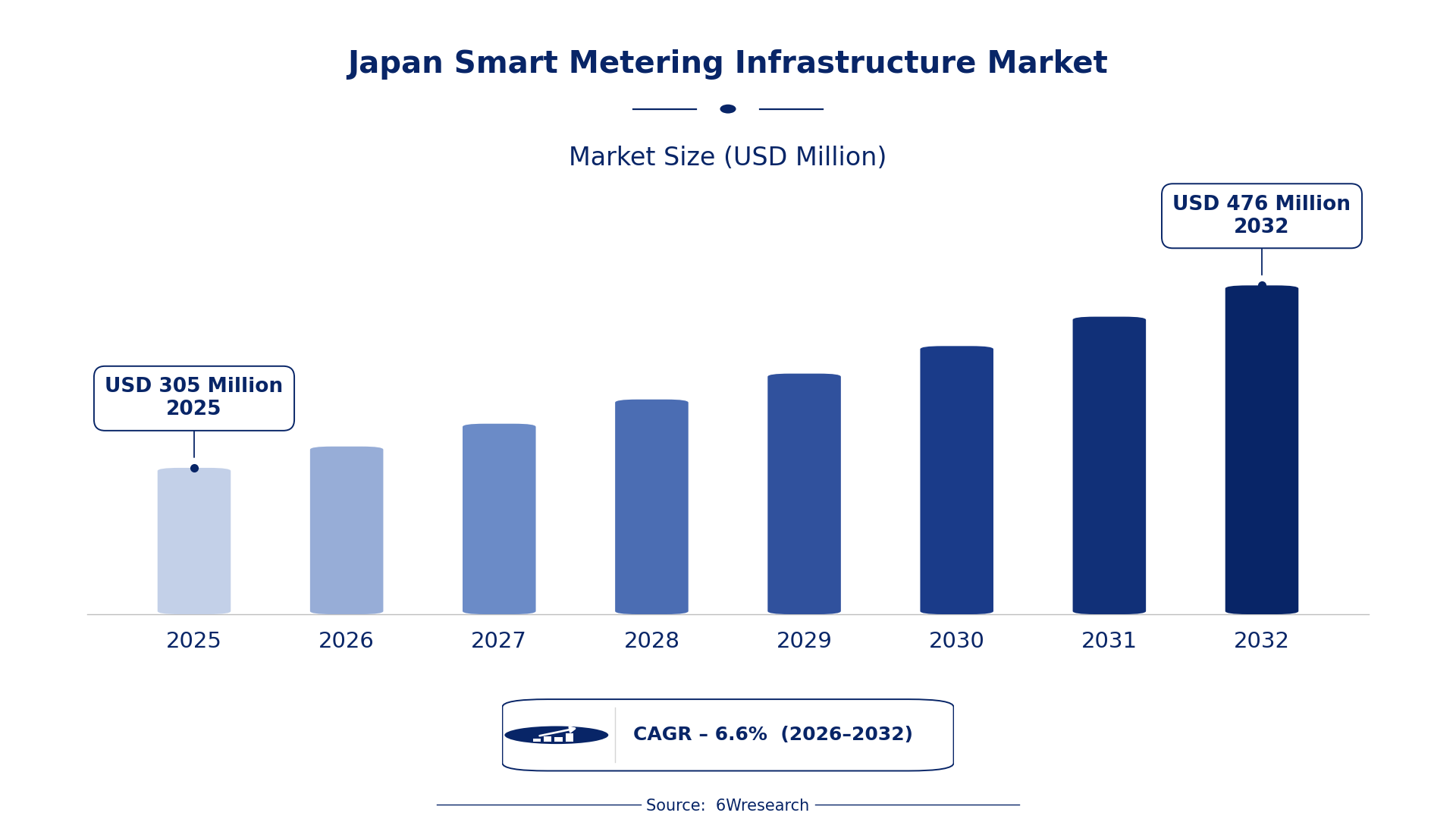
According to 6Wresearch internal database and industry insights, the Japan Smart Metering Infrastructure Market was valued at USD 305 Million in 2025 and is projected to reach USD 476 Million by 2032, growing at a CAGR of approximately 6.6% during 2026–2032.
Japan Smart Metering Infrastructure Market Highlights
| Report Metric | Details |
| Report Name | Japan Smart Metering Infrastructure Market (2026-2032) |
| Market Size 2025 | USD 305 Million |
| Market Size 2032 | USD 476 Million |
| Absolute Growth 2025–2032 | USD 171 Million |
| CAGR 2026–2032 | 6.6% |
| Peak Annual Growth | 7.8% in 2028 |
| Forecast Period | 2026–2032 |
| Historical Data | 2022–2025 |
| Base Year | 2025 |
| Leading Infrastructure Type, 2025 | AMI (Advanced Metering) (49% share) |
| Leading Smart Feature, 2025 | Two-Way Communication (40% share) |
| Leading Communication Network, 2025 | RF Mesh/Cellular (35% share) |
| Leading End User, 2025 | Utility Providers (36% share) |
| Fastest-Growing Infrastructure Type | Data Concentrators (9.4% CAGR) |
| Fastest-Growing Smart Feature | Meter Data Aggregation (8.9% CAGR) |
| Fastest-Growing Communication Network | WAN Interface (9.1% CAGR) |
| Fastest-Growing End User | Grid Integrators (8.3% CAGR) |
| Growing Sector | energy management |
| Key End Users | utility providers, grid integrators, energy infrastructure |
Japan Smart Metering Infrastructure Market Year-wise Growth Rate and Key Drivers (2022–2032)
This graph illustrates the annual growth rates of the market from 2022 to 2032, highlighting a steady upward trajectory and projected market expansion over the forecast period.
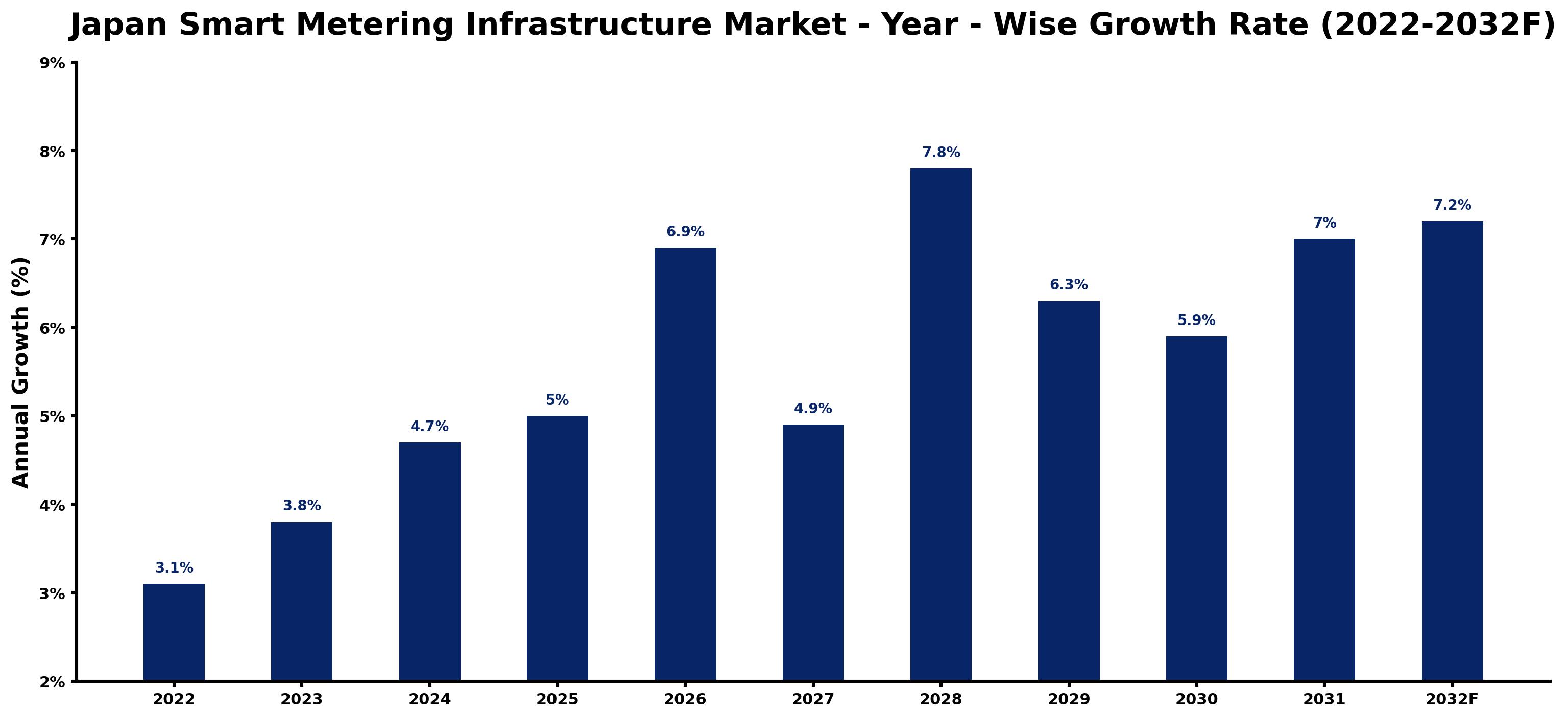
Below, each year's estimated growth is shown next to the factor that most influenced it.
| Year | Estimated Annual Growth (%) | Market Rationale |
| 2022 | 3.1 | The market showed initial growth with increasing installations of smart meters across utilities. |
| 2023 | 3.8 | Demand rose as utility providers accelerated their smart metering projects following government support. |
| 2024 | 4.7 | Growth continued with more utilities adopting advanced metering technologies to improve efficiency. |
| 2025 | 5.0 | The market peaked with installations driven by government targets for smart meter adoption. |
| 2026 | 6.9 | Demand is expected to rise as the focus on energy efficiency intensifies across urban areas. |
| 2027 | 4.9 | Growth is projected to slow as market saturation begins to impact new installations and upgrades. |
| 2028 | 7.8 | A surge in demand is expected as utilities improve grid reliability and efficiency. |
| 2029 | 6.3 | Growth is anticipated to slow again as the market stabilises after the peak in installations. |
| 2030 | 5.9 | Demand is expected to continue slowing as the market reaches a mature phase with established technologies. |
| 2031 | 7.0 | Growth is projected to resume as new innovations in smart metering technologies attract further investments. |
| 2032 | 7.2 | A steady rise is expected as utilities invest in modernisation and efficiency improvements. |
Note: Market size estimations and growth projections presented in this report are based on 6Wresearch's proprietary forecasting methodology, utilizing the latest available industry data, government publications, and primary research inputs.
Japan Smart Metering Infrastructure Market Synopsis
Smart Metering Infrastructure consists of advanced metering technologies that enable real-time data collection for utilities. The integration of smart meters and communication networks enhances grid reliability and efficiency. The Japan Smart Metering Infrastructure Market is growing due to increased demand from utility providers and energy infrastructure projects, supported by government initiatives like the Smart Grid Strategy, which aims for 100% smart meter adoption by 2025.
Market Dynamics Impact Analysis (2026–2032)
| Factor | Type | Impact | Primary Segment Affected |
| Government initiatives promoting energy efficiency | Driver | High | AMI (Advanced Metering) |
| Increased utility provider investments in smart grid technologies | Driver | High | Data Concentrators |
| Growing need for energy management systems in urban areas | Opportunity | High | Smart Grid Controllers |
| Rising demand for remote monitoring capabilities among utilities | Opportunity | High | Remote Device Management |
| High costs associated with smart meter installations | Restraint | Medium | Gateway Units |
| Regulatory compliance challenges for utility providers | Restraint | Medium | Two-Way Communication |
| Limited capacity for rapid deployment of smart meters | Challenge | High | AMI (Advanced Metering) |
| Technological integration issues with existing infrastructure | Challenge | Medium | AMI (Advanced Metering) |
Evaluation of Drivers in Japan Smart Metering Infrastructure Market (2026–2032)
These are the developments adding the most demand over the forecast period.
| Drivers | Primary Segment Affected | Why It Matters (Evidence) |
| Government support through the Energy Conservation Program | AMI (Advanced Metering) | In 2020, the program encouraged utility providers to adopt smart metering, driving installations. |
| Increased utility investments in smart grid technologies | Data Concentrators | In 2021, over 30 million smart meters were installed, reflecting heightened utility engagement. |
| Urban energy efficiency initiatives | Smart Grid Controllers | AMI systems are projected to enhance energy efficiency by 20% in urban areas by 2025. |
| Demand for remote device management capabilities | Remote Device Management | Over 60% of utility providers require remote monitoring to improve operational efficiency. |
| Growing focus on reducing greenhouse gas emissions | Two-Way Communication | The government targets a 26% reduction by 2030, increasing the need for smart metering. |
A wider customer base explains much of the growth, as utility providers increasingly invest in smart metering technologies. In 2021, Japan had over 30 million smart meters installed, reflecting a strong commitment to energy efficiency. The Smart Grid Strategy aims for 100% smart meter adoption by 2025, driving demand for advanced metering infrastructure. With AMI systems projected to improve energy efficiency by 20% in urban areas, utilities are prioritising these technologies. Over 60% of utility providers require remote device management capabilities to support operational efficiency, leading to more purchases in this segment.
Evaluation of Restraints in Japan Smart Metering Infrastructure Market
The key brakes on demand, and where they bite hardest, are shown below.
| Market Restraint | Primary Segment Affected | Why It Matters (Evidence) |
| High costs of smart meter installations | Gateway Units | Installation costs can deter utility providers from widespread adoption, limiting market growth. |
| Regulatory compliance challenges | Two-Way Communication | Utility providers face stringent regulations that complicate the implementation of smart metering. |
| Limited capacity for rapid deployment | AMI (Advanced Metering) | The existing infrastructure may not support quick installations, slowing market expansion. |
| Technological integration issues | AMI (Advanced Metering) | Compatibility challenges with legacy systems can hinder the adoption of new technologies. |
| Market saturation in urban areas | Smart Grid Controllers | As installations increase, the growth rate may decline due to limited new opportunities. |
Japan Smart Metering Infrastructure Market Challenges
In 2021, over 30 million smart meters were installed, yet many utilities face challenges with outdated technology that hampers real-time data management. This situation stems from the high costs associated with upgrading existing systems, delaying efficiency improvements for utility providers. Regulatory hurdles also complicate the rollout of smart metering solutions, as compliance with standards like ISO 50001 can extend project timelines, resulting in lost savings for these utilities. A shortage of skilled workers limits suppliers' capacity to deploy and maintain advanced metering technologies, increasing operational costs for utilities and affecting their service delivery.
Trends in the Japan Smart Metering Infrastructure Market
The trends below show where the Japan Smart Metering Infrastructure Market is heading.
- Shift from Traditional to Smart Metering: The Kanto region is leading the shift towards smart metering, with over 30 million installations recorded. This transition improves energy management and efficiency across utilities.
- Adoption of Remote Device Management: The Smart Metering Association of Japan is promoting remote device management capabilities, which are critical for over 60% of utility providers. This trend supports operational efficiency and monitoring.
- Increase in Energy Efficiency Standards: ISO 50001 is becoming increasingly relevant in Japan's smart metering sector, driving utilities to adopt energy management systems. This standard supports improved energy efficiency across installations.
- Growth of Data Concentrators in Smart Metering: Data Concentrators are emerging as a key component in smart metering, with a projected CAGR of 9.4%. This growth reflects the increasing need for data integration and analysis.
Investment Opportunities in the Japan Smart Metering Infrastructure Market
The opportunities below stand out in the Japan Smart Metering Infrastructure Market for new entrants and existing suppliers.
- Partnerships with Local Utilities: With a target of 100% smart meter adoption by 2025, partnerships with local utilities can ease market entry. This presents an opportunity for technology providers.
- Investment in Smart Grid Infrastructure: The Kanto region, featuring the highest concentration of smart metering installations, offers investment opportunities in smart grid infrastructure. This region's growth potential is considerable.
- Supply of Advanced Metering Technologies: Utility providers are increasingly pursuing advanced metering technologies to boost efficiency. Suppliers can take advantage of this demand by offering tailored solutions.
- Certification for Energy Management Systems: With the government's goal to reduce greenhouse gas emissions by 26% by 2030, there is a rising need for certified energy management systems. This creates opportunities for compliance-focused suppliers.
Government Initiatives in the Japan Smart Metering Infrastructure Market
The GX Promotion Act, enacted in 2023, builds upon the Act on the Rational Use of Energy from 1979 by establishing a comprehensive framework for energy efficiency improvements. This new legislation mandates that utility providers enhance their energy management systems, aligning with the government's target of reducing greenhouse gas emissions by 26% by 2030. The integration of smart metering technologies is essential for compliance, as it enables utilities to monitor and report energy usage effectively.
In 2022, the government allocated ¥10 billion for smart grid initiatives, overseen by the Ministry of Economy, Trade and Industry. This funding supports the deployment of smart metering infrastructure, allowing utility providers to upgrade their systems and improve energy efficiency. The Smart Grid Strategy aims for 100% smart meter adoption by 2025, ensuring that utilities can meet regulatory requirements and enhance service delivery.
Future Insight of the Japan Smart Metering Infrastructure Market
Investment in smart metering infrastructure will rise significantly, driven by government initiatives and the demand for better energy management. By 2025, the goal of 100% smart meter adoption will create a robust market for suppliers. Enhanced communication networks will become standard, improving service capabilities for utilities. As the government aims for a 26% reduction in greenhouse gas emissions by 2030, buyers will benefit from lower operational costs and greater grid reliability.
Market Segmentation Analysis
Japan Smart Metering Infrastructure Market report covers a detailed analysis of the following market segments:
By Infrastructure Type – AMI (Advanced Metering) Leads, Data Concentrators Expected to Grow Fastest
According to Saurav Kr Singh, Senior Research Analyst at 6Wresearch, the largest infrastructure type category in 2025 was AMI (Advanced Metering), at 49% of revenue. AMI holds the largest share due to its vital role in real-time data collection for utilities. The extensive implementation of AMI by utility providers across Japan highlights its importance in enhancing operational efficiency and reliability. Over 2026–2032, Data Concentrators are expected to post the fastest growth, at a CAGR of 9.4%. Data Concentrators are witnessing rapid growth as they integrate data from multiple meters, which is essential for utilities seeking streamlined operations. The 15% increase in smart meter deployment from 2020 to 2021 indicates a rising demand for these integration technologies. Suppliers should focus on developing Data Concentrators to meet the increasing needs of utility providers.
By Smart Feature – Two-Way Communication Leads, Meter Data Aggregation Expected to Grow Fastest
Two-Way Communication took 40% of smart feature revenue in 2025, more than any other category. Two-Way Communication leads the market as it enables real-time data exchange, crucial for effective energy management. This functionality is essential for many utility providers in Japan, facilitating improved operational decisions and responsiveness. Meter Data Aggregation is set to record the highest CAGR in this split, 8.9% over 2026–2032. Meter Data Aggregation is experiencing swift growth as it compiles data for utility analysis, enhancing decision-making capabilities. The rising emphasis on energy efficiency is driving the adoption of this feature among utilities. Buyers will benefit from investing in Meter Data Aggregation to optimise their energy management strategies.
By Communication Network – RF Mesh/Cellular Leads, WAN Interface Expected to Grow Fastest
RF Mesh/Cellular held 35% of the Japan Smart Metering Infrastructure Market by communication network in 2025. RF Mesh/Cellular dominates the market because it effectively facilitates data transmission over long distances, which is essential for the widespread deployment of smart metering. The high concentration of installations in the Kanto region underscores the reliance on this communication method. The quickest growth will come from WAN Interface, forecast to expand at a CAGR of 9.1% between 2026 and 2032. WAN Interface is the fastest-growing segment as it connects to wide area networks, ensuring smooth data flow for utilities. The government's investment in smart grid initiatives is driving the demand for WAN solutions. Suppliers need to enhance WAN Interface capabilities to address the expanding communication requirements of utilities.
By End User – Utility Providers Lead, Grid Integrators Expected to Grow Fastest
Utility Providers accounted for 36% of the market by end user in 2025. Utility Providers are the primary users of smart metering infrastructure, driving demand for advanced metering solutions. The government's target for 100% smart meter adoption by 2025 reflects the commitment of utilities to modernise their operations and improve efficiency. Grid Integrators are projected to grow fastest, at a CAGR of 8.3% during 2026–2032. Grid Integrators are experiencing the fastest growth as they implement smart grid solutions that require advanced metering technologies. The ongoing focus on energy efficiency and grid reliability accelerates this rapid expansion. Utilities should collaborate with Grid Integrators to effectively leverage smart metering for enhanced grid performance.
Key Attractiveness of the Report
- 10 Years of Market Numbers
- Historical Data Starting from 2022 to 2025
- Base Year 2025
- Forecast Data until 2032
- Key Performance Indicators Impacting the Market
- Major Upcoming Developments and Projects
Key Highlights of the Report:
- Japan Smart Metering Infrastructure Market Outlook
- Market Size of Japan Smart Metering Infrastructure Market, 2025
- Forecast of Japan Smart Metering Infrastructure Market, 2032
- Historical Data and Forecast of Japan Smart Metering Infrastructure Revenues & Volume for the Period 2022-2032F
- Japan Smart Metering Infrastructure Market Trend Evolution
- Japan Smart Metering Infrastructure Market Drivers and Challenges
- Japan Smart Metering Infrastructure Price Trends
- Japan Smart Metering Infrastructure Porter's Five Forces
- Japan Smart Metering Infrastructure Industry Life Cycle
- Historical Data and Forecast of Japan Smart Metering Infrastructure Market Revenues & Volume By Infrastructure Type for the Period 2022-2032F
- Historical Data and Forecast of Japan Smart Metering Infrastructure Market Revenues & Volume By AMI (Advanced Metering) for the Period 2022-2032F
- Historical Data and Forecast of Japan Smart Metering Infrastructure Market Revenues & Volume By Data Concentrators for the Period 2022-2032F
- Historical Data and Forecast of Japan Smart Metering Infrastructure Market Revenues & Volume By Smart Grid Controllers for the Period 2022-2032F
- Historical Data and Forecast of Japan Smart Metering Infrastructure Market Revenues & Volume By Gateway Units for the Period 2022-2032F
- Historical Data and Forecast of Japan Smart Metering Infrastructure Market Revenues & Volume By Smart Feature for the Period 2022-2032F
- Historical Data and Forecast of Japan Smart Metering Infrastructure Market Revenues & Volume By Two-Way Communication for the Period 2022-2032F
- Historical Data and Forecast of Japan Smart Metering Infrastructure Market Revenues & Volume By Meter Data Aggregation for the Period 2022-2032F
- Historical Data and Forecast of Japan Smart Metering Infrastructure Market Revenues & Volume By Remote Device Management for the Period 2022-2032F
- Historical Data and Forecast of Japan Smart Metering Infrastructure Market Revenues & Volume By Smart Meter Bridging for the Period 2022-2032F
- Historical Data and Forecast of Japan Smart Metering Infrastructure Market Revenues & Volume By Communication Network for the Period 2022-2032F
- Historical Data and Forecast of Japan Smart Metering Infrastructure Market Revenues & Volume By RF Mesh/Cellular for the Period 2022-2032F
- Historical Data and Forecast of Japan Smart Metering Infrastructure Market Revenues & Volume By WAN Interface for the Period 2022-2032F
- Historical Data and Forecast of Japan Smart Metering Infrastructure Market Revenues & Volume By IP-Based Protocols for the Period 2022-2032F
- Historical Data and Forecast of Japan Smart Metering Infrastructure Market Revenues & Volume By IoT/Edge Gateway for the Period 2022-2032F
- Historical Data and Forecast of Japan Smart Metering Infrastructure Market Revenues & Volume By End User for the Period 2022-2032F
- Historical Data and Forecast of Japan Smart Metering Infrastructure Market Revenues & Volume By Utility Providers for the Period 2022-2032F
- Historical Data and Forecast of Japan Smart Metering Infrastructure Market Revenues & Volume By Grid Integrators for the Period 2022-2032F
- Historical Data and Forecast of Japan Smart Metering Infrastructure Market Revenues & Volume By Energy Infrastructure for the Period 2022-2032F
- Historical Data and Forecast of Japan Smart Metering Infrastructure Market Revenues & Volume By Meter Manufacturers for the Period 2022-2032F
- Japan Smart Metering Infrastructure Import Export Trade Statistics
- Market Opportunity Assessment By Infrastructure Type
- Market Opportunity Assessment By Smart Feature
- Market Opportunity Assessment By Communication Network
- Market Opportunity Assessment By End User
- Japan Smart Metering Infrastructure Top Companies Market Share
- Japan Smart Metering Infrastructure Competitive Benchmarking By Technical and Operational Parameters
- Japan Smart Metering Infrastructure Company Profiles
- Japan Smart Metering Infrastructure Key Strategic Recommendations
Market Covered
This report examines the market across the segments below.
By Infrastructure Type
- AMI (Advanced Metering)
- Data Concentrators
- Smart Grid Controllers
- Gateway Units
By Smart Feature
- Two-Way Communication
- Meter Data Aggregation
- Remote Device Management
- Smart Meter Bridging
By Communication Network
- RF Mesh/Cellular
- WAN Interface
- IP-Based Protocols
- IoT/Edge Gateway
By End User
- Utility Providers
- Grid Integrators
- Energy Infrastructure
- Meter Manufacturers































