Japan Smart Nanomaterials Market Size, Share & Growth Rate
The Japan Smart Nanomaterials Market was estimated at USD 244 Million in 2025 and is projected to reach USD 289 Million by 2032, growing at a CAGR of 2.4% from 2026 to 2032. This anticipated growth is driven by a robust demand for advanced materials across sectors like electronics and healthcare, where innovative functionalities are increasingly valued. Moreover, governmental support in the form of research initiatives is facilitating the integration of nanotechnology into mainstream applications, further accelerating market momentum.
Japan Smart Nanomaterials Market Year-wise Growth Rate and Key Drivers
This graph highlights how the Japan Smart Nanomaterials Market has steadily grown over the years, supported by major growth factors.
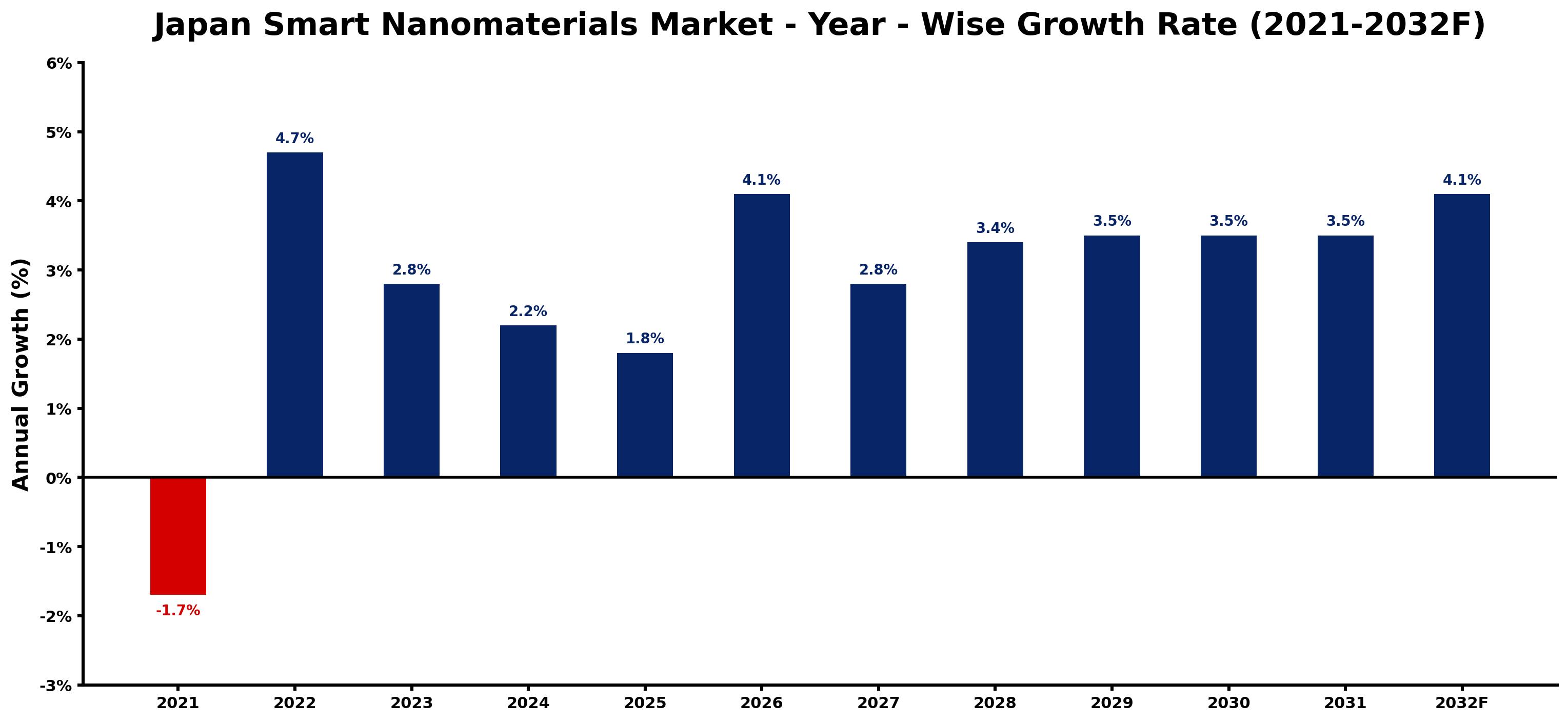
The table below presents the year‑wise growth rates along with the key drivers influencing the market
| Year | Growth Rate | Major Drivers |
| 2021 | -1.7% | Increasing industrial infrastructure investments |
| 2022 | 4.7% | Growing urbanization and commercial development |
| 2023 | 2.8% | Increasing industrial infrastructure investments |
| 2024 | 2.2% | Government infrastructure modernization initiatives |
| 2025 | 1.8% | Rapid growth in telecom and data center sectors |
| 2026 | 4.1% | Growing urbanization and commercial development |
| 2027 | 2.8% | Rapid growth in telecom and data center sectors |
| 2028 | 3.4% | Increasing adoption of advanced technologies |
| 2029 | 3.5% | Growing urbanization and commercial development |
| 2030 | 3.5% | Increasing smart city development projects |
| 2031 | 3.5% | Rapid growth in telecom and data center sectors |
| 2032 | 4.1% | Increasing smart city development projects |
Note - Market size estimations and growth projections presented in this report are based on 6Wresearch's advanced forecasting approach, validated with industry datasets as of June 2026.
Japan Smart Nanomaterials Market Synopsis
In Japan, the integration of smart nanomaterials into electronics is experiencing a notable uptick, driven by their ability to enhance device miniaturization and efficiency. As the electronics industry strives for more compact and energy-efficient products, smart nanomaterials have emerged as a key solution.
Additionally, the healthcare sector is witnessing a growing adoption of smart nanomaterials for targeted drug delivery systems and advanced diagnostic tools. These innovations not only improve treatment efficacy but also align with the Japanese government's healthcare initiatives focused on technological advancement and patient-centered care.
Japan Smart Nanomaterials Market Key Takeaways
- The market is poised for steady growth, driven by technological advancements and increasing adoption across sectors.
- Investment in research and development is a critical factor propelling innovation within the market.
- Government initiatives are fostering collaboration between academia and industry, which is vital for the market's future.
- Sustainability trends are pushing the adoption of smart nanomaterials in energy applications, enhancing their market appeal.
- High production costs and regulatory hurdles remain significant barriers that must be addressed for market expansion.
Evaluation of Restraints in Japan Smart Nanomaterials Market
While the Japan Smart Nanomaterials Market presents numerous opportunities, it is not without its challenges. The regulatory landscape surrounding nanomaterials remains complex and multifaceted, hindering the swift commercialization of innovative products. Moreover, the absence of standardized testing methods and safety regulations adds an additional layer of difficulty for companies seeking to navigate the market. These issues are compounded by the high costs associated with the production and scaling of smart nanomaterials, which can deter new entrants and restrict broader market accessibility. Addressing these challenges will require strategic collaboration among industry players, government bodies, and research institutions.
Japan Smart Nanomaterials Market Trends
Emerging trends within the Japan Smart Nanomaterials Market are indicative of a shift towards self-healing materials and advanced sensors with enhanced mechanical properties. Notably, the push for energy-efficient solutions has led to the development of nanomaterials that not only enhance performance but also minimize environmental impact. Furthermore, there is a growing focus on integrating smart nanomaterials into renewable energy technologies, which aligns with global sustainability efforts.
Japan Smart Nanomaterials Market Opportunities
Investment opportunities in the Japan Smart Nanomaterials Market are robust, particularly in companies innovating in the fields of healthcare, electronics, and energy storage. As industries increasingly recognize the value of smart nanomaterials, there is potential for substantial returns on investments targeting R&D and novel applications. Collaborations with academic institutions to create tailored solutions for specific challenges can also yield significant competitive advantages, especially for forward-thinking enterprises eager to capitalize on the market's evolution.
Government Initiatives in the Japan Smart Nanomaterials Market
The Japanese government has instituted several policies aimed at fostering innovation within the smart nanomaterials sector. Key initiatives, such as the Nanotechnology Innovation Strategy, are focused on enhancing R&D funding and supporting startups in the field. Programs like the Nanotechnology Business Creation Initiative provide essential resources to companies working on innovative solutions, promoting collaboration between industry and academia. Regulatory frameworks are also in place to ensure the safe commercialization of nanomaterials, creating a conducive environment for market growth.
Future Insights of the Japan Smart Nanomaterials Market
Looking ahead, the Japan Smart Nanomaterials Market is set to witness significant expansion, driven by ongoing advancements in technology and an increasing appetite for innovative solutions across various sectors. The demand for materials that offer superior performance characteristics is expected to rise, particularly in areas like healthcare and electronics. With supportive government policies and a focus on R&D, the market stands to benefit from a wave of innovation, positioning itself for robust growth in the years leading to 2032.
Japan Smart Nanomaterials Market Latest Developments (May 2025 - June 2026)
Recent developments in the Japan Smart Nanomaterials Market have highlighted a trend toward increased partnerships between research institutions and private companies. These collaborations aim to accelerate the development of new applications, particularly in sustainable energy and healthcare. Moreover, several initiatives are underway focusing on enhancing the scalability of production processes, making smart nanomaterials more accessible to various industries. Continuous technological advancements promise to reshape the landscape of the market, paving the way for more innovative solutions.
Japan Smart Nanomaterials Market - Key Attractiveness of the Report
- 10 Years of Market Numbers
- Historical Data Starting from 2022 to 2025
- Base Year: 2025
- Forecast Data until 2032
- Key Performance Indicators Impacting the Market
- Major Upcoming Developments and Projects
Key Highlights of the Report:
- Japan Smart Nanomaterials Market Outlook
- Market Size of Japan Smart Nanomaterials Market, 2025
- Forecast of Japan Smart Nanomaterials Market, 2032
- Historical Data and Forecast of Japan Smart Nanomaterials Revenues & Volume for the Period 2022-2032F
- Japan Smart Nanomaterials Market Trend Evolution
- Japan Smart Nanomaterials Market Drivers and Challenges
- Japan Smart Nanomaterials Price Trends
- Japan Smart Nanomaterials Porter's Five Forces
- Japan Smart Nanomaterials Industry Life Cycle
- Historical Data and Forecast of Japan Smart Nanomaterials Market Revenues & Volume By Type for the Period 2022-2032F
- Historical Data and Forecast of Japan Smart Nanomaterials Market Revenues & Volume By Metal-Based for the Period 2022-2032F
- Historical Data and Forecast of Japan Smart Nanomaterials Market Revenues & Volume By Carbon Based for the Period 2022-2032F
- Historical Data and Forecast of Japan Smart Nanomaterials Market Revenues & Volume By Polymeric for the Period 2022-2032F
- Historical Data and Forecast of Japan Smart Nanomaterials Market Revenues & Volume By Others for the Period 2022-2032F
- Historical Data and Forecast of Japan Smart Nanomaterials Market Revenues & Volume By Industry Downstream for the Period 2022-2032F
- Historical Data and Forecast of Japan Smart Nanomaterials Market Revenues & Volume By Pharmaceuticals for the Period 2022-2032F
- Historical Data and Forecast of Japan Smart Nanomaterials Market Revenues & Volume By Electronics for the Period 2022-2032F
- Historical Data and Forecast of Japan Smart Nanomaterials Market Revenues & Volume By Consumer Goods for the Period 2022-2032F
- Historical Data and Forecast of Japan Smart Nanomaterials Market Revenues & Volume By Construction for the Period 2022-2032F
- Historical Data and Forecast of Japan Smart Nanomaterials Market Revenues & Volume By Transportation for the Period 2022-2032F
- Historical Data and Forecast of Japan Smart Nanomaterials Market Revenues & Volume By Others for the Period 2022-2032F
- Japan Smart Nanomaterials Import Export Trade Statistics
- Market Opportunity Assessment By Type
- Market Opportunity Assessment By Industry Downstream
- Japan Smart Nanomaterials Top Companies Market Share
- Japan Smart Nanomaterials Competitive Benchmarking By Technical and Operational Parameters
- Japan Smart Nanomaterials Company Profiles
- Japan Smart Nanomaterials Key Strategic Recommendations






































