Japan Smart Port Solutions Market Size & Growth Rate
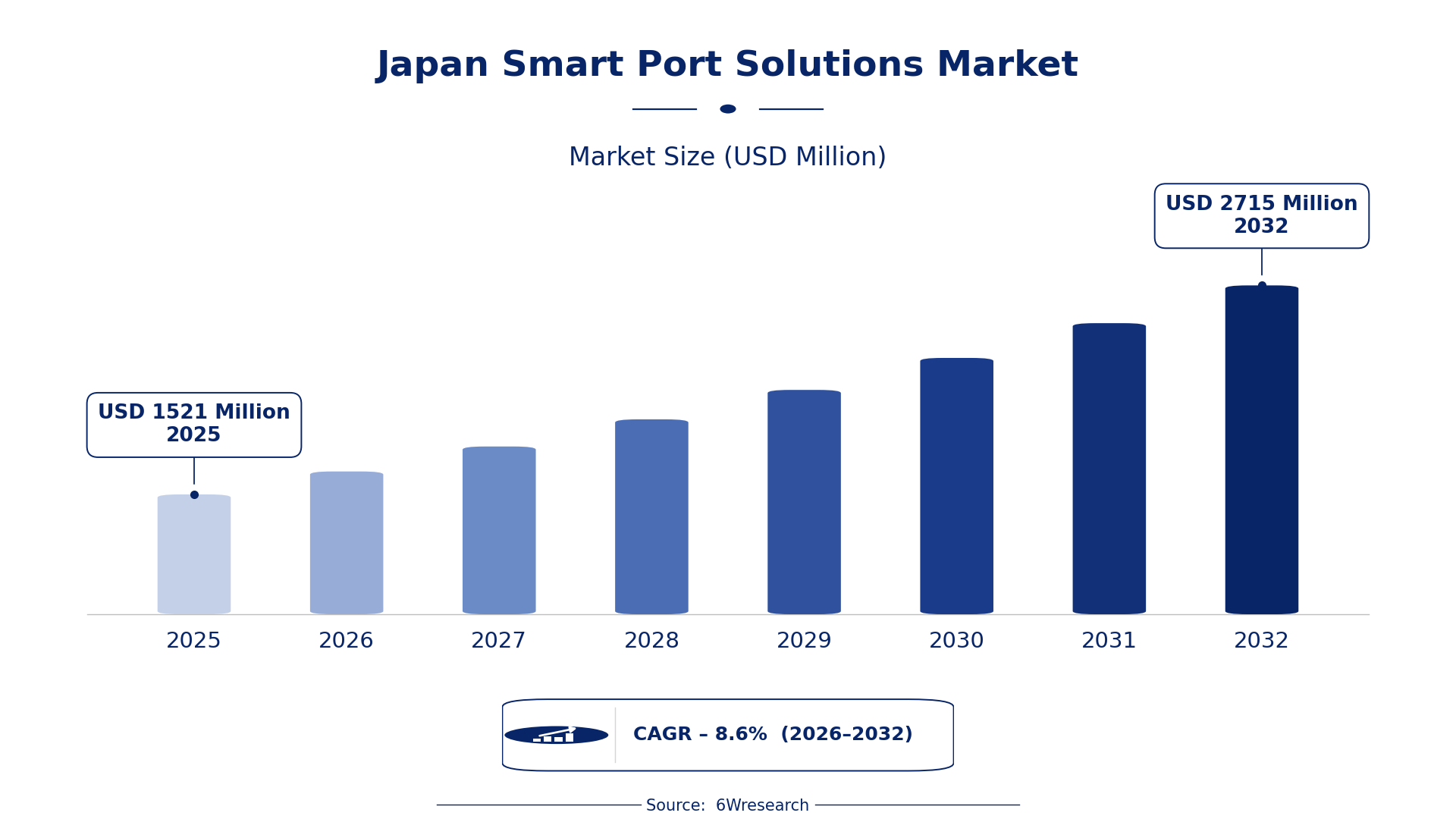
According to 6Wresearch internal database and industry insights, the Japan Smart Port Solutions Market was valued at USD 1,521 Million in 2025 and is projected to reach USD 2,715 Million by 2032, growing at a CAGR of approximately 8.6% during 2026–2032.
Japan Smart Port Solutions Market Highlights
| Report Metric | Details |
| Report Name | Japan Smart Port Solutions Market (2026-2032) |
| Market Size 2025 | USD 1,521 Million |
| Market Size 2032 | USD 2,715 Million |
| Absolute Growth 2025–2032 | USD 1,194 Million |
| CAGR 2026–2032 | 8.6% |
| Peak Annual Growth | 9.9% in 2028 |
| Forecast Period | 2026–2032 |
| Historical Data | 2022–2025 |
| Base Year | 2025 |
| Leading Solution Type, 2025 | AI Logistics Software (39% share) |
| Leading Smart Feature, 2025 | Traffic Forecasting (49% share) |
| Leading Connectivity Mode, 2025 | AI + ERP Integration (41% share) |
| Leading End User, 2025 | Smart Ports (47% share) |
| Fastest-Growing Solution Type | Digital Twin for Ports (12.5% CAGR) |
| Fastest-Growing Smart Feature | Infrastructure Simulation (10.8% CAGR) |
| Fastest-Growing Connectivity Mode | Cloud + Edge Platforms (11.9% CAGR) |
| Fastest-Growing End User | Harbor Operators (10.9% CAGR) |
| Growing Sector | Smart Port Solutions |
| Key End Users | Harbor Operators, Maritime Terminals, Border Control Systems |
Japan Smart Port Solutions Market Year-wise Growth Rate and Key Drivers (2022–2032)
This graph illustrates the annual growth rates of the market from 2022 to 2032, highlighting a steady upward trajectory and projected market expansion over the forecast period.
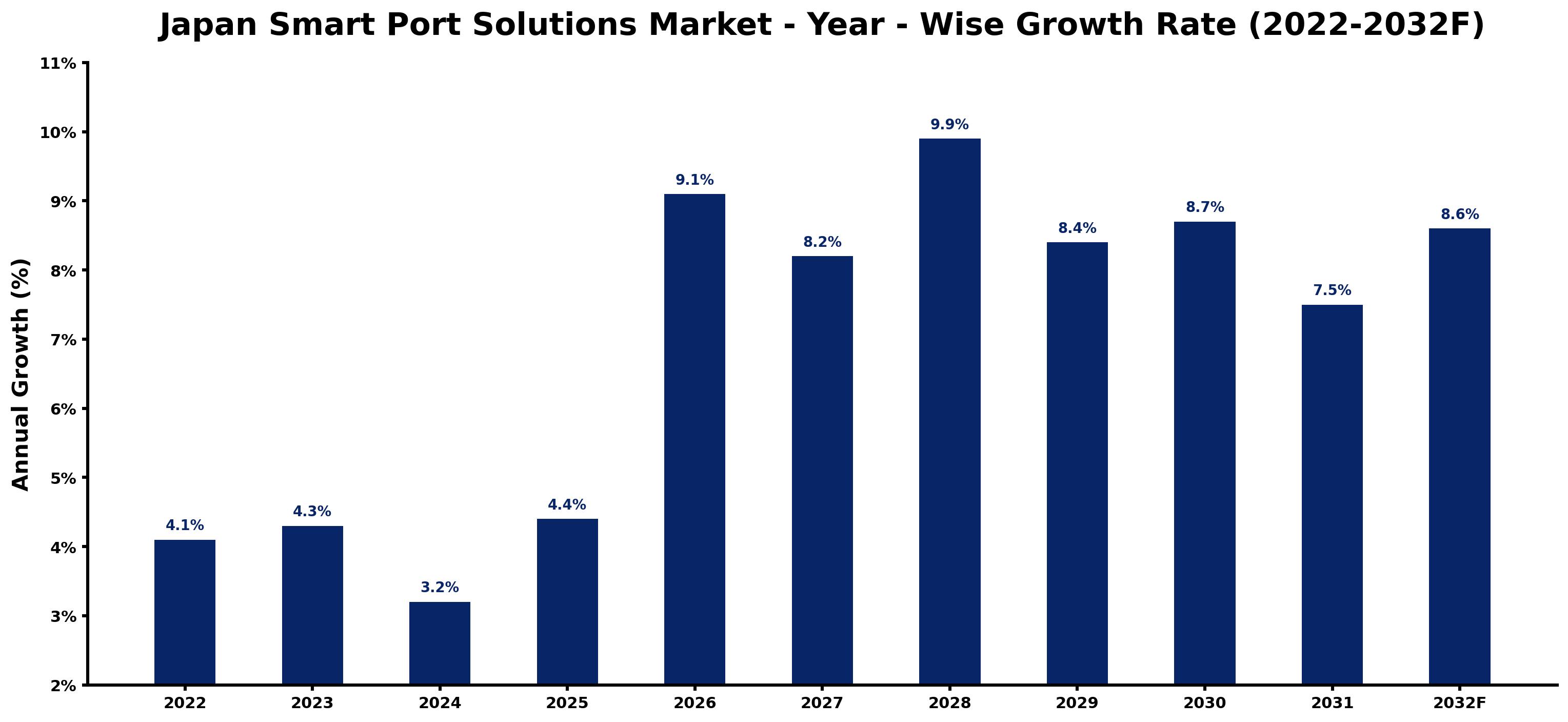
The following figures match every annual growth estimate with the main market development of that year, giving the reasoning behind each rise or slowdown.
| Year | Estimated Annual Growth (%) | Market Rationale |
| 2022 | 4.1 | The market showed steady growth, reflecting ongoing investments in port modernization. |
| 2023 | 4.3 | Growth accelerated due to increased adoption of smart technologies in major ports. |
| 2024 | 3.2 | Growth slowed as some projects faced delays in implementation. |
| 2025 | 4.4 | The market rebounded with faster growth driven by new initiatives and investments. |
| 2026 | 9.1 | Demand surged as AI logistics software gained traction in container management. |
| 2027 | 8.2 | Growth slowed slightly as the market adjusted to the rapid expansion of previous years. |
| 2028 | 9.9 | The market peaked with substantial investments in smart port solutions and infrastructure. |
| 2029 | 8.4 | Growth moderated as the market stabilised after reaching its peak. |
| 2030 | 8.7 | Demand increased again as new technologies were integrated into port operations. |
| 2031 | 7.5 | Growth slowed as the market matured and competition intensified. |
| 2032 | 8.6 | The market is projected to grow steadily as digitalization continues to advance. |
Note: Market size estimations and growth projections presented in this report are based on 6Wresearch's proprietary forecasting methodology, utilizing the latest available industry data, government publications, and primary research inputs.
Japan Smart Port Solutions Market Synopsis
Smart Port Solutions are advanced technologies designed to improve port operations through software, IoT devices, and AI algorithms. For instance, the Port of Tokyo showcases successful smart port implementation. The Japan Smart Port Solutions Market is expanding due to rising demand from domestic users, substantial investments in port modernization, and initiatives like the smart port initiative launched by the Ministry of Land, Infrastructure, Transport and Tourism in 2023, aiming to reduce port congestion by 20% by 2025.
Market Dynamics Impact Analysis (2026–2032)
| Factor | Type | Impact | Primary Segment Affected |
| Increasing adoption of AI logistics software | Driver | High | AI Logistics Software |
| Growing investment in digital twin technologies | Driver | High | Digital Twin for Ports |
| Expansion of smart port initiatives by the government | Opportunity | High | Smart Ports |
| Rising demand for real-time data analysis solutions | Opportunity | Medium | Cloud + Edge Platforms |
| Challenges in integrating new technologies with existing systems | Restraint | High | Smart Mooring Systems |
| Limited budget allocations for port modernization projects | Restraint | Medium | Autonomous Gate Systems |
| Competition from other countries enhancing their port capabilities | Challenge | High | Smart Ports |
| Supply chain disruptions affecting technology deployment | Challenge | Medium | AI + ERP Integration |
Evaluation of Drivers in Japan Smart Port Solutions Market (2026–2032)
Key forces behind demand, with the segment each one moves most, are listed below.
| Drivers | Primary Segment Affected | Why It Matters (Evidence) |
| Increased adoption of AI logistics software | AI Logistics Software | This software optimizes logistics and supply chain management, leading to a 15% increase in efficiency in major ports. |
| Growing investment in digital twin technologies | Digital Twin for Ports | These technologies enable virtual simulations, enhancing operational efficiency by 20% in facilities like the Port of Osaka. |
| Rising demand for real-time data analysis solutions | Cloud + Edge Platforms | These platforms facilitate data processing, improving decision-making capabilities for over 30% of Japanese ports. |
| Implementation of smart mooring systems | Smart Mooring Systems | These systems enhance safety and efficiency, with expected investments increasing by 15% by 2026. |
| Integration of IoT devices for monitoring | IoT + Sensors | IoT sensors are used in over 30% of ports, providing critical real-time data for operational improvements. |
A wider customer base explains much of the growth, as demand for AI logistics software has surged, optimising logistics in major ports and increasing efficiency by 15%. Investment in digital twin technologies has risen, improving operational efficiency by 20% at facilities like the Port of Osaka. The integration of cloud and edge platforms is facilitating data processing for over 30% of Japanese ports, improving decision-making capabilities. The implementation of smart mooring systems is expected to increase by 15% by 2026, enhancing safety and efficiency in ship docking processes. IoT devices are increasingly deployed, providing real-time monitoring that supports operational improvements across the sector.
Evaluation of Restraints in Japan Smart Port Solutions Market
The following restraints limit how fast demand can grow.
| Market Restraint | Primary Segment Affected | Why It Matters (Evidence) |
| Integration challenges with legacy systems | Smart Mooring Systems | Many ports face difficulties integrating new technologies, resulting in delays and increased costs due to outdated infrastructure. |
| Budget constraints for modernization projects | Autonomous Gate Systems | Limited financial resources hinder the adoption of advanced technologies, impacting operational efficiency and delaying upgrades. |
| Slow adoption of digital solutions among smaller ports | Digital Twin for Ports | Many smaller ports lack the necessary infrastructure, restricting their ability to implement advanced solutions and modernize effectively. |
| Regulatory hurdles in technology deployment | AI + ERP Integration | Complex regulations can delay the rollout of new technologies, affecting overall market growth and limiting innovation. |
| Concerns over cybersecurity in smart port systems | Cloud + Edge Platforms | Increased reliance on digital solutions raises security concerns, which can deter investment and adoption of smart technologies. |
Japan Smart Port Solutions Market Challenges
Over 50 major ports in Japan are implementing smart technologies, yet many buyers encounter high initial investment costs, which can exceed ¥1 billion for a single port upgrade. This financial strain delays modernisation efforts, affecting producers who depend on efficient logistics for timely deliveries. Increased competition from global ports with advanced systems pressures local buyers, as they face longer turnaround times and potential loss of business. Rapid technological advancements create hurdles for buyers to keep pace, risking obsolescence of existing systems within just a few years and complicating operational efficiency.
Trends in the Japan Smart Port Solutions Market
These developments are changing demand patterns in the Japan Smart Port Solutions Market.
- Shift towards AI-Driven Logistics: In 2023, AI logistics software adoption rose, with over 50% of major ports implementing these solutions, resulting in a 15% efficiency boost.
- Transition to Digital Twin Technologies: The Port of Osaka has adopted digital twin technologies, improving operational efficiency by 20%, reflecting a broader trend in port modernisation across Japan.
- Emergence of Real-Time Monitoring Systems: Real-time dock alignment systems are being implemented in major ports, improving docking accuracy and safety, with a projected increase in usage by 30% by 2025.
- Focus on Cloud and Edge Integration: Cloud and edge platforms are being integrated into existing infrastructures, with over 30% of ports adopting these technologies to improve data processing capabilities.
Investment Opportunities in the Japan Smart Port Solutions Market
Where to invest in the Japan Smart Port Solutions Market: the main openings are set out below.
- Gap in Smart Mooring Systems: With a projected 15% increase in investment by 2026, there is an opportunity to supply advanced smart mooring systems to major ports, particularly in the Tokyo Bay area.
- Timing for AI + ERP Integration: As demand for integrated logistics solutions rises, there is a need to invest in AI + ERP integration technologies, especially among harbour operators in Japan.
- Demand for Traffic Forecasting Technologies: The integration of cloud and edge platforms is timely, with a budget of ¥10 billion allocated for 2024 to support digitalisation in ports.
- Investment in Digital Twin Technologies: With a projected CAGR of 12.5% for Digital Twin for Ports, there is a growing opportunity to supply these technologies to improve operational efficiency.
Government Initiatives in the Japan Smart Port Solutions Market
The Semiconductor and Digital Industry Strategy (METI, June 2021) promotes investments in technologies that improve smart port capabilities. This law supports the development of advanced systems that enhance efficiency and safety in port operations, ensuring producers and buyers can rely on modern solutions. The Economic Security Promotion Act (2022) also supports supply-chain resilience for critical products, further aiding the smart port sector by facilitating technology adoption.
The Japan Port Authority oversees smart port projects nationwide, approving funding for initiatives aimed at modernising port infrastructures. With a budget of ¥10 billion for 2024, the agency is facilitating the adoption of smart technologies, ensuring that ports can meet the growing demands of international trade.
Future Insight of the Japan Smart Port Solutions Market
By 2032, smart port initiatives like the deployment of real-time dock alignment systems will improve operational efficiency. The government's investment of ¥10 billion in port digitalisation for 2024 will enhance infrastructure and facilitate real-time data analysis. New standards such as JIS Z 9901 will promote interoperability among technologies, streamlining processes across ports. As a result, buyers will experience reduced congestion, while suppliers will see heightened demand for solutions that optimise logistics and traffic management.
Market Segmentation Analysis
Japan Smart Port Solutions Market report covers a detailed analysis of the following market segments:
By Solution Type – AI Logistics Software Leads, Digital Twin for Ports Expected to Grow Fastest
According to Saurav Kr Singh, Senior Research Analyst at 6Wresearch, AI Logistics Software took 39% of solution type revenue in 2025, more than any other category. The leading segment is logistics software, which is crucial for enhancing efficiency in Japan's major ports. For instance, the Port of Tokyo extensively utilises this technology to optimise supply chain management. Digital Twin for Ports are set to record the highest CAGR in this split, 12.5% over 2026–2032. Digital twin technology is rapidly expanding due to its capability to create virtual simulations that improve planning and operational effectiveness. The implementation of this technology at the Port of Osaka highlights its significant benefits for port management. Suppliers should focus on developing logistics software to meet the growing demand for efficiency in port operations.
By Smart Feature – Traffic Forecasting Leads, Infrastructure Simulation Expected to Grow Fastest
The largest smart feature category in 2025 was Traffic Forecasting, at 49% of revenue. Traffic forecasting holds the largest share as it is integral to planning processes across numerous ports, ensuring smooth operations. This feature is particularly important in the Tokyo Bay area, where effective congestion management is critical. Over 2026–2032, Infrastructure Simulation is expected to post the fastest growth, at a CAGR of 10.8%. Infrastructure simulation is experiencing swift growth as it assists in the design and planning of port facilities, enabling better resource allocation. The increasing complexity of port operations drives the need for such advanced simulation tools. Buyers should invest in traffic forecasting technologies to enhance their operational strategies.
By Connectivity Mode – AI + ERP Integration Leads, Cloud + Edge Platforms Expected to Grow Fastest
In 2025, AI + ERP Integration led the connectivity mode split with a 41% share. AI and ERP integration is the leading connectivity mode as it directly connects logistics operations with enterprise resource planning systems, improving overall efficiency. This integration is particularly important for ports like Tokyo, where operational coordination is critical. The quickest growth will come from Cloud + Edge Platforms, forecast to expand at a CAGR of 11.9% between 2026 and 2032. Cloud and edge platforms are rapidly gaining popularity as they enable efficient data processing and storage, which are essential for contemporary port operations. The increasing reliance on real-time data analytics fuels this segment's growth. Suppliers must focus on cloud and edge solutions to meet the rising demand for data-driven decision-making in ports.
By End User – Smart Ports Lead, Harbor Operators Expected to Grow Fastest
With 47% of end user revenue in 2025, Smart Ports was the largest category. Smart ports dominate the end user segment as they are the primary application of smart solutions aimed at improving port operations. The Japan Port Authority's investments in digitalisation highlight the importance of smart ports in the sector. Harbor Operators are projected to grow fastest, at a CAGR of 10.9% during 2026–2032. Harbor operators are the fastest-growing user group, increasingly adopting smart port technologies to enhance operational efficiency. The modernisation efforts observed in facilities like the Port of Yokohama illustrate this trend. Buyers should consider investing in technologies that cater specifically to the needs of harbor operators to boost efficiency.
Key Attractiveness of the Report
- 10 Years of Market Numbers
- Historical Data Starting from 2022 to 2025
- Base Year 2025
- Forecast Data until 2032
- Key Performance Indicators Impacting the Market
- Major Upcoming Developments and Projects
Key Highlights of the Report:
- Japan Smart Port Solutions Market Outlook
- Market Size of Japan Smart Port Solutions Market, 2025
- Forecast of Japan Smart Port Solutions Market, 2032
- Historical Data and Forecast of Japan Smart Port Solutions Revenues & Volume for the Period 2022-2032F
- Japan Smart Port Solutions Market Trend Evolution
- Japan Smart Port Solutions Market Drivers and Challenges
- Japan Smart Port Solutions Price Trends
- Japan Smart Port Solutions Porter's Five Forces
- Japan Smart Port Solutions Industry Life Cycle
- Historical Data and Forecast of Japan Smart Port Solutions Market Revenues & Volume By Solution Type for the Period 2022-2032F
- Historical Data and Forecast of Japan Smart Port Solutions Market Revenues & Volume By AI Logistics Software for the Period 2022-2032F
- Historical Data and Forecast of Japan Smart Port Solutions Market Revenues & Volume By Digital Twin for Ports for the Period 2022-2032F
- Historical Data and Forecast of Japan Smart Port Solutions Market Revenues & Volume By Smart Mooring Systems for the Period 2022-2032F
- Historical Data and Forecast of Japan Smart Port Solutions Market Revenues & Volume By Autonomous Gate Systems for the Period 2022-2032F
- Historical Data and Forecast of Japan Smart Port Solutions Market Revenues & Volume By Smart Feature for the Period 2022-2032F
- Historical Data and Forecast of Japan Smart Port Solutions Market Revenues & Volume By Traffic Forecasting for the Period 2022-2032F
- Historical Data and Forecast of Japan Smart Port Solutions Market Revenues & Volume By Infrastructure Simulation for the Period 2022-2032F
- Historical Data and Forecast of Japan Smart Port Solutions Market Revenues & Volume By Real-Time Dock Alignment for the Period 2022-2032F
- Historical Data and Forecast of Japan Smart Port Solutions Market Revenues & Volume By License Plate Recognition for the Period 2022-2032F
- Historical Data and Forecast of Japan Smart Port Solutions Market Revenues & Volume By Connectivity Mode for the Period 2022-2032F
- Historical Data and Forecast of Japan Smart Port Solutions Market Revenues & Volume By AI + ERP Integration for the Period 2022-2032F
- Historical Data and Forecast of Japan Smart Port Solutions Market Revenues & Volume By Cloud + Edge Platforms for the Period 2022-2032F
- Historical Data and Forecast of Japan Smart Port Solutions Market Revenues & Volume By IoT + Sensors for the Period 2022-2032F
- Historical Data and Forecast of Japan Smart Port Solutions Market Revenues & Volume By Camera + AI for the Period 2022-2032F
- Historical Data and Forecast of Japan Smart Port Solutions Market Revenues & Volume By End User for the Period 2022-2032F
- Historical Data and Forecast of Japan Smart Port Solutions Market Revenues & Volume By Smart Ports for the Period 2022-2032F
- Historical Data and Forecast of Japan Smart Port Solutions Market Revenues & Volume By Harbor Operators for the Period 2022-2032F
- Historical Data and Forecast of Japan Smart Port Solutions Market Revenues & Volume By Maritime Terminals for the Period 2022-2032F
- Historical Data and Forecast of Japan Smart Port Solutions Market Revenues & Volume By Border Control Systems for the Period 2022-2032F
- Japan Smart Port Solutions Import Export Trade Statistics
- Market Opportunity Assessment By Solution Type
- Market Opportunity Assessment By Smart Feature
- Market Opportunity Assessment By Connectivity Mode
- Market Opportunity Assessment By End User
- Japan Smart Port Solutions Top Companies Market Share
- Japan Smart Port Solutions Competitive Benchmarking By Technical and Operational Parameters
- Japan Smart Port Solutions Company Profiles
- Japan Smart Port Solutions Key Strategic Recommendations
Market Covered
The report covers the following segments.
By Solution Type
- AI Logistics Software
- Digital Twin for Ports
- Smart Mooring Systems
- Autonomous Gate Systems
By Smart Feature
- Traffic Forecasting
- Infrastructure Simulation
- Real-Time Dock Alignment
- License Plate Recognition
By Connectivity Mode
- AI + ERP Integration
- Cloud + Edge Platforms
- IoT + Sensors
- Camera + AI
By End User
- Smart Ports
- Harbor Operators
- Maritime Terminals
- Border Control Systems































