Japan Smart Public Transit Systems Market Size & Growth Rate
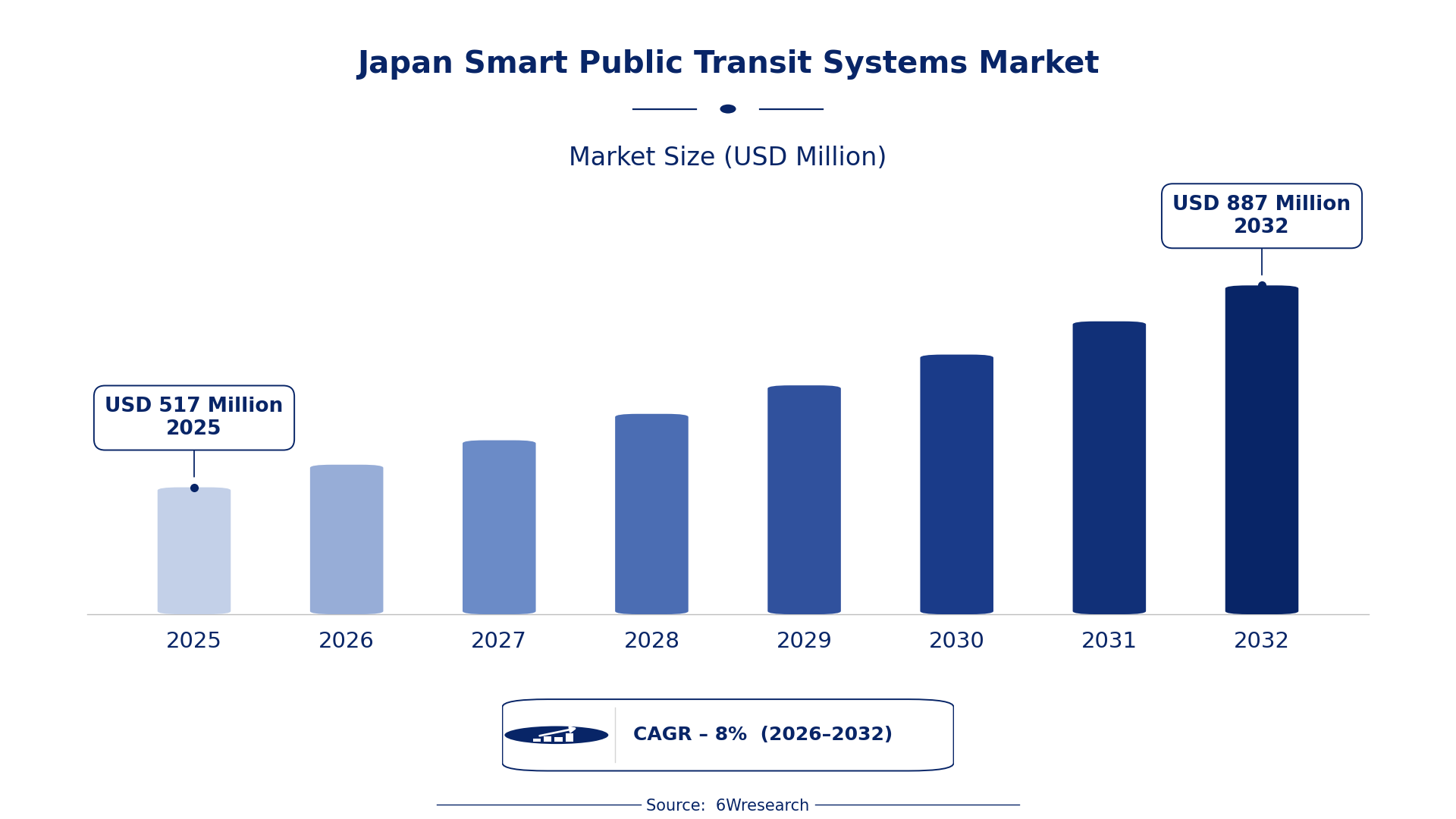
According to 6Wresearch internal database and industry insights, the Japan Smart Public Transit Systems Market was valued at USD 517 Million in 2025 and is projected to reach USD 887 Million by 2032, growing at a CAGR of approximately 8% during 2026–2032.
Japan Smart Public Transit Systems Market Highlights
| Report Metric | Details |
| Report Name | Japan Smart Public Transit Systems Market (2026-2032) |
| Market Size 2025 | USD 517 Million |
| Market Size 2032 | USD 887 Million |
| Absolute Growth 2025–2032 | USD 370 Million |
| CAGR 2026–2032 | 8% |
| Peak Annual Growth | 8.7% in 2026 |
| Forecast Period | 2026–2032 |
| Historical Data | 2022–2025 |
| Base Year | 2025 |
| Leading Transit Type, 2025 | Smart Bus Systems (36% share) |
| Leading Smart Feature, 2025 | Live Tracking & Schedule (55% share) |
| Leading User Interface, 2025 | App + GPS (43% share) |
| Leading End User, 2025 | City Authorities (48% share) |
| Fastest-Growing Transit Type | AI Traffic Control (11.5% CAGR) |
| Fastest-Growing Smart Feature | Real-Time Flow Optimization (10.5% CAGR) |
| Fastest-Growing User Interface | Central Dashboard (10.7% CAGR) |
| Fastest-Growing End User | Transport Planners (10.1% CAGR) |
| Growing Sector | Public Transport |
| Key End Users | City Authorities, Transport Planners, Commuters |
Japan Smart Public Transit Systems Market Year-wise Growth Rate and Key Drivers (2022–2032)
This graph illustrates the annual growth rates of the market from 2022 to 2032, highlighting a steady upward trajectory and projected market expansion over the forecast period.
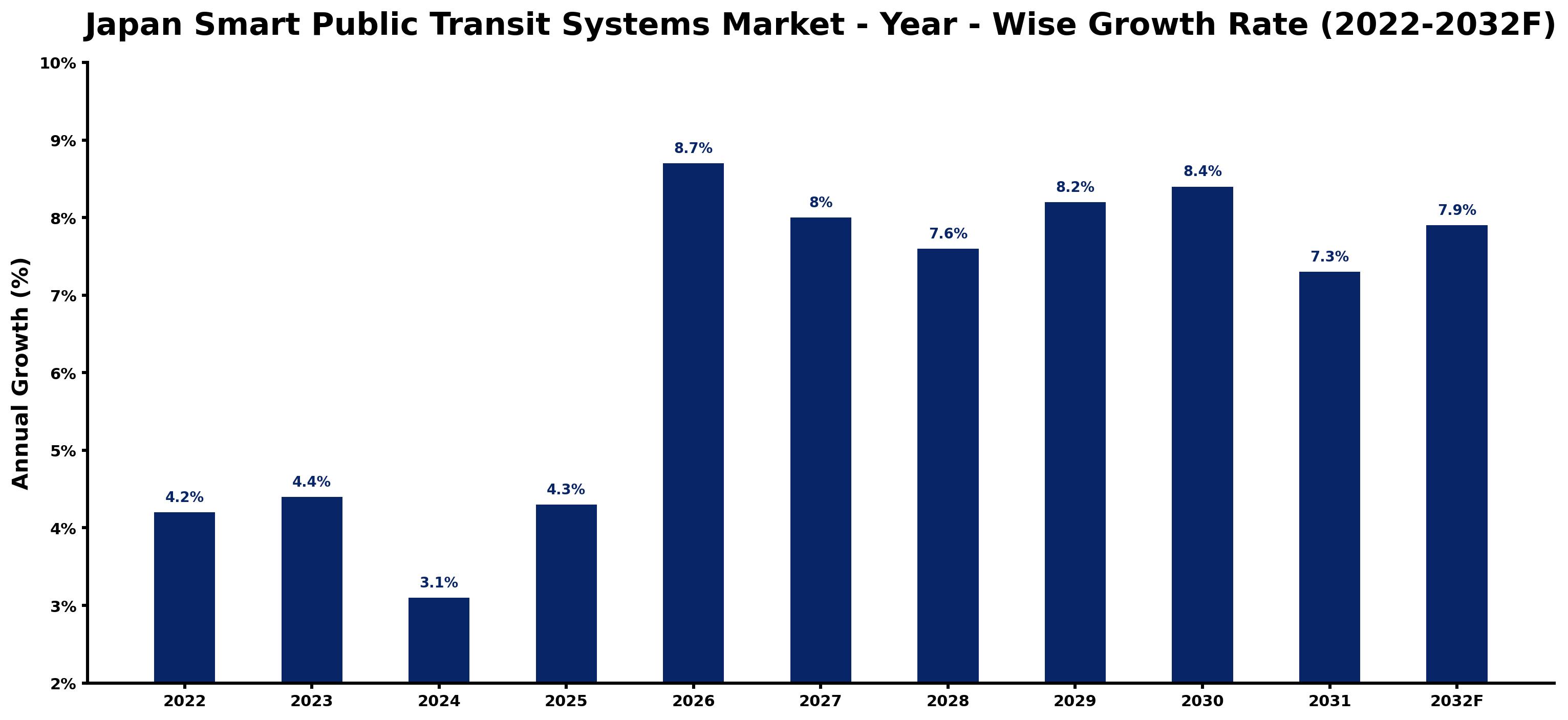
The table below sets out the estimated growth rate for each year and the main factor behind it.
| Year | Estimated Annual Growth (%) | Market Rationale |
| 2022 | 4.2 | The market showed steady growth, reflecting ongoing urbanisation trends and investment in smart technologies. |
| 2023 | 4.4 | Growth accelerated as cities focused on improving public transport efficiency and user experience. |
| 2024 | 3.1 | A slowdown occurred due to market saturation in certain areas and the need for further innovation. |
| 2025 | 4.3 | Growth rebounded as cities implemented new smart transit initiatives to improve service delivery. |
| 2026 | 8.7 | The market is expected to peak as AI traffic control systems gain traction, driving investment. |
| 2027 | 8.0 | Growth is projected to slow slightly as the market adjusts to the rapid adoption of new technologies. |
| 2028 | 7.6 | Continued growth is expected to be supported by sustained demand for real-time tracking and smart fare systems. |
| 2029 | 8.2 | Demand is projected to surge again as cities expand their smart transit capabilities and infrastructure. |
| 2030 | 8.4 | Growth is expected to remain strong, driven by the ongoing integration of smart technologies in public transport. |
| 2031 | 7.3 | A slight slowdown is projected as the market begins to stabilise after rapid expansion. |
| 2032 | 7.9 | Growth is expected to pick up again as cities aim for higher efficiency and sustainability in transit systems. |
Note: Market size estimations and growth projections presented in this report are based on 6Wresearch's proprietary forecasting methodology, utilizing the latest available industry data, government publications, and primary research inputs.
Japan Smart Public Transit Systems Market Synopsis
Smart Public Transit Systems in Japan utilise advanced technologies to improve urban transportation efficiency and user experience. City authorities and transport planners are the primary buyers, increasingly investing in smart solutions. Urbanisation, the implementation of AI traffic control systems, and the integration of contactless fare systems are driving market growth, enhancing service delivery and commuter satisfaction. In 2023, the Ministry of Land, Infrastructure, Transport and Tourism approved a new smart fare system, improving convenience for over 9 million daily passengers in Tokyo.
Market Dynamics Impact Analysis (2026–2032)
| Factor | Type | Impact | Primary Segment Affected |
| Urbanisation drives demand for efficient public transport systems. | Driver | High | Smart Bus Systems |
| The adoption of AI traffic control enhances traffic management capabilities. | Driver | High | AI Traffic Control |
| The need for seamless fare collection opens opportunities for new technologies. | Opportunity | High | Contactless Fare System |
| Growing passenger numbers create demand for enhanced transit solutions. | Opportunity | Medium | Smart Transit Terminals |
| High initial investment costs can deter new projects. | Restraint | High | Smart Bus Systems |
| Integration challenges with existing systems may slow down adoption. | Restraint | Medium | AI Traffic Control |
| Regulatory compliance can complicate the implementation process. | Challenge | High | Contactless Fare System |
| Competition among technology providers may lead to price pressures. | Challenge | Medium | Smart Transit Terminals |
Evaluation of Drivers in Japan Smart Public Transit Systems Market (2026–2032)
Demand rests on the following drivers, each shown with the segment it touches most.
| Drivers | Primary Segment Affected | Why It Matters (Evidence) |
| Urbanisation increases the need for efficient public transport. | Smart Bus Systems | Over 9 million passengers use Tokyo's public transit daily, driving demand for improved systems. |
| AI traffic control systems optimise traffic flow in urban areas. | AI Traffic Control | The government aims to increase AI adoption by 2025, enhancing operational efficiency. |
| Contactless payment systems enhance user convenience. | Contactless Fare System | Over 90% of public transport in Japan uses contactless payments, streamlining fare collection. |
| Real-time tracking improves commuter experience and planning. | Live Tracking & Schedule | Implemented in 80% of public buses in Osaka, it allows better travel planning for users. |
| Smart transit terminals enhance operational efficiency. | Smart Transit Terminals | The Smart City Strategy 2023 promotes the development of advanced transit solutions. |
Buyers are adding capacity as over 1,000 smart bus systems are deployed across major cities, reflecting the need for efficient public transport management. With contactless payment systems used in over 90% of public transport, convenience drives higher user adoption. AI traffic control systems are expected to increase by 2025, optimising traffic flow and improving commuter experiences. Real-time tracking, implemented in 80% of public buses in Osaka, enhances travel planning for users.
Evaluation of Restraints in Japan Smart Public Transit Systems Market
These are the pressures that could keep growth below its potential.
| Market Restraint | Primary Segment Affected | Why It Matters (Evidence) |
| High initial investment costs can deter new projects. | Smart Bus Systems | The deployment of smart systems requires substantial funding, limiting expansion opportunities. |
| Integration challenges with existing systems may slow down adoption. | AI Traffic Control | Legacy systems complicate the implementation of new technologies, delaying benefits and requiring additional resources. |
| Regulatory compliance can complicate the implementation process. | Contactless Fare System | Strict regulations may require extensive testing and certification, prolonging project timelines and increasing costs. |
| Limited public awareness can hinder user adoption. | Smart Transit Terminals | Without proper education on benefits, users may resist transitioning to new systems, affecting overall usage rates. |
| Competition among technology providers may lead to price pressures. | Smart Bus Systems | As more players enter the market, pricing strategies could impact profitability and market stability. |
Japan Smart Public Transit Systems Market Challenges
High implementation costs pose a burden for buyers, as smart public transit systems require substantial investment in technology and infrastructure, potentially delaying projects by up to two years. A shortage of skilled workers restricts suppliers' ability to deploy advanced systems, which can lead to project delays lasting six months for buyers. Regulatory compliance with ISO 37120 standards complicates approval processes, extending timelines for suppliers by an average of three months. Rapid technological advancements compel suppliers to innovate continuously, raising costs that ultimately result in higher prices for buyers.
Trends in the Japan Smart Public Transit Systems Market
Below are the shifts with the largest effect on the Japan Smart Public Transit Systems Market.
- Shift towards AI Integration in Traffic Management: The integration of AI in traffic management systems is gaining traction, as evidenced by the Tokyo Metropolitan Government's initiative launched in 2022. This shift aims to optimise traffic flow and improve commuter experiences, targeting increased AI adoption by 2025.
- Transition from Traditional Fare Systems to Contactless Payments: Japan is transitioning towards contactless payment systems in public transport, with over 90% adoption. This change enhances user convenience and aligns with global trends in digital payments, streamlining fare collection.
- Emergence of Real-Time Tracking Technologies: Real-time tracking technologies are becoming standard in public transit, with 80% of buses in Osaka implementing these systems. This trend improves service delivery and commuter planning, leading to greater user satisfaction.
- Prioritisation of Smart Transit Solutions: The GX Basic Policy adopted in 2023 underscores the development of smart transit solutions across Japan. This initiative aims to boost urban transportation efficiency, targeting a marked increase in smart system deployment.
Investment Opportunities in the Japan Smart Public Transit Systems Market
Below are the investment opportunities with the strongest case in the Japan Smart Public Transit Systems Market.
- Growing Demand for Smart Bus Systems: With over 1,000 smart bus systems already deployed, the demand for further improvements is strong. This presents an opportunity for technology providers to innovate and partner with city authorities for new implementations.
- Investment in AI Traffic Control Systems: The government aims to increase AI traffic control adoption by 2025, creating a demand for advanced solutions. Companies can invest in developing AI technologies tailored for urban environments.
- Expansion of Contactless Fare Systems: Contactless payment systems are used in over 90% of public transport, indicating a strong market opportunity. Suppliers can enter by partnering with local transit authorities to implement these systems.
- Enhancement of Smart Transit Terminals: The GX Basic Policy highlights the need for improved transit terminals. Suppliers can collaborate with city authorities to develop advanced terminal solutions that improve passenger experience.
Government Initiatives in the Japan Smart Public Transit Systems Market
The Electrical Appliance and Material Safety Act (1961) ensures safety standards for electrical components in smart transit systems, requiring producers to meet specific safety criteria. The Industrial Standardization Act (1949), recently amended, governs the standards for smart technologies, ensuring compliance and quality in product development.
The Ministry of Land, Infrastructure, Transport and Tourism funds various smart transit initiatives, approving projects that improve urban transport efficiency. The National Institute of Advanced Industrial Science and Technology supports innovations in smart public transit, providing grants for research and development.
Future Insight of the Japan Smart Public Transit Systems Market
Government policy will increasingly focus on adopting advanced traffic control systems, driving urban transport efficiency by 2032. Real-time tracking will become more prevalent, with 80% of public buses in Osaka already implementing this technology. Collaboration between government agencies and research institutions will spur innovation, enabling suppliers to meet evolving urban transit demands. Improved fare collection methods will streamline operations, enhancing the experience for passengers and promoting greater public transport usage.
Market Segmentation Analysis
Japan Smart Public Transit Systems Market report covers a detailed analysis of the following market segments:
By Transit Type – Smart Bus Systems Lead, AI Traffic Control Expected to Grow Fastest
According to Saurav Kr Singh, Senior Research Analyst at 6Wresearch, the largest transit type category in 2025 was Smart Bus Systems, at 36% of revenue. Smart Bus Systems dominate the market due to their extensive deployment in over 1,000 cities, facilitating efficient public transport management. The Tokyo Metropolitan Government's smart transit initiative launched in 2022 underscores their importance in enhancing urban mobility solutions. The quickest growth will come from AI Traffic Control, forecast to expand at a CAGR of 11.5% between 2026 and 2032. AI Traffic Control is witnessing rapid growth as it becomes essential for optimising traffic flow, with government plans to increase its adoption by 2025. This focus on traffic management will likely allow Smart Bus Systems to maintain their leading position in the market. Suppliers should concentrate on integrating advanced traffic management technologies to align with urban transit authorities' goals.
By Smart Feature – Live Tracking & Schedule Leads, Real-Time Flow Optimization Expected to Grow Fastest
Live Tracking & Schedule accounted for 55% of the market by smart feature in 2025. Live Tracking & Schedule leads the market by providing real-time updates to commuters, significantly enhancing their travel planning experience. This feature is crucial for systems that cater to over 9 million passengers daily in Tokyo, ensuring timely information dissemination. Real-Time Flow Optimization is projected to grow fastest, at a CAGR of 10.5% during 2026–2032. Real-Time Flow Optimization is growing swiftly as it is vital for managing traffic and alleviating congestion, aligning with the objectives of the Smart City Strategy 2023. Its increasing adoption will be essential for future advancements in urban transit systems. Buyers need to invest in sophisticated flow optimisation technologies to boost overall transit efficiency.
By User Interface – App + GPS Leads, Central Dashboard Expected to Grow Fastest
App + GPS took 43% of user interface revenue in 2025, more than any other category. App + GPS is the foremost user interface as it is essential for user navigation and service updates, thereby improving the commuter experience. The widespread utilisation of these technologies supports efficient transit operations throughout the country. Over 2026–2032, Central Dashboard is expected to post the fastest growth, at a CAGR of 10.7%. Central Dashboard is gaining traction as it is crucial for authorities to monitor and manage transit systems effectively. Its growing implementation will enhance communication and operational efficiency in urban transport. Suppliers should focus on developing comprehensive dashboard solutions to meet the requirements of transit authorities.
By End User – City Authorities Lead, Transport Planners Expected to Grow Fastest
With 48% of end user revenue in 2025, City Authorities was the largest category. City Authorities are the primary users of smart public transit systems, concentrating on urban transport management to enhance service delivery. Their significant role in deploying smart technologies across various networks drives market expansion. Transport Planners are set to record the highest CAGR in this split, 10.1% over 2026–2032. Transport Planners are experiencing the fastest growth as they are integral to the strategic planning of transit systems, ensuring alignment with urban development objectives. Their expertise will be critical for future innovations in public transit. Buyers should collaborate closely with transport planners to ensure that transit systems effectively address future urban demands.
Key Attractiveness of the Report
- 10 Years of Market Numbers
- Historical Data Starting from 2022 to 2025
- Base Year 2025
- Forecast Data until 2032
- Key Performance Indicators Impacting the Market
- Major Upcoming Developments and Projects
Key Highlights of the Report:
- Japan Smart Public Transit Systems Market Outlook
- Market Size of Japan Smart Public Transit Systems Market, 2025
- Forecast of Japan Smart Public Transit Systems Market, 2032
- Historical Data and Forecast of Japan Smart Public Transit Systems Revenues & Volume for the Period 2022-2032F
- Japan Smart Public Transit Systems Market Trend Evolution
- Japan Smart Public Transit Systems Market Drivers and Challenges
- Japan Smart Public Transit Systems Price Trends
- Japan Smart Public Transit Systems Porter's Five Forces
- Japan Smart Public Transit Systems Industry Life Cycle
- Historical Data and Forecast of Japan Smart Public Transit Systems Market Revenues & Volume By Transit Type for the Period 2022-2032F
- Historical Data and Forecast of Japan Smart Public Transit Systems Market Revenues & Volume By Smart Bus Systems for the Period 2022-2032F
- Historical Data and Forecast of Japan Smart Public Transit Systems Market Revenues & Volume By AI Traffic Control for the Period 2022-2032F
- Historical Data and Forecast of Japan Smart Public Transit Systems Market Revenues & Volume By Contactless Fare System for the Period 2022-2032F
- Historical Data and Forecast of Japan Smart Public Transit Systems Market Revenues & Volume By Smart Transit Terminals for the Period 2022-2032F
- Historical Data and Forecast of Japan Smart Public Transit Systems Market Revenues & Volume By Smart Feature for the Period 2022-2032F
- Historical Data and Forecast of Japan Smart Public Transit Systems Market Revenues & Volume By Live Tracking & Schedule for the Period 2022-2032F
- Historical Data and Forecast of Japan Smart Public Transit Systems Market Revenues & Volume By Real-Time Flow Optimization for the Period 2022-2032F
- Historical Data and Forecast of Japan Smart Public Transit Systems Market Revenues & Volume By QR/NFC Ticketing for the Period 2022-2032F
- Historical Data and Forecast of Japan Smart Public Transit Systems Market Revenues & Volume By Passenger Density Analytics for the Period 2022-2032F
- Historical Data and Forecast of Japan Smart Public Transit Systems Market Revenues & Volume By User Interface for the Period 2022-2032F
- Historical Data and Forecast of Japan Smart Public Transit Systems Market Revenues & Volume By App + GPS for the Period 2022-2032F
- Historical Data and Forecast of Japan Smart Public Transit Systems Market Revenues & Volume By Central Dashboard for the Period 2022-2032F
- Historical Data and Forecast of Japan Smart Public Transit Systems Market Revenues & Volume By Mobile Wallet for the Period 2022-2032F
- Historical Data and Forecast of Japan Smart Public Transit Systems Market Revenues & Volume By CCTV + AI for the Period 2022-2032F
- Historical Data and Forecast of Japan Smart Public Transit Systems Market Revenues & Volume By End User for the Period 2022-2032F
- Historical Data and Forecast of Japan Smart Public Transit Systems Market Revenues & Volume By City Authorities for the Period 2022-2032F
- Historical Data and Forecast of Japan Smart Public Transit Systems Market Revenues & Volume By Transport Planners for the Period 2022-2032F
- Historical Data and Forecast of Japan Smart Public Transit Systems Market Revenues & Volume By Commuters for the Period 2022-2032F
- Historical Data and Forecast of Japan Smart Public Transit Systems Market Revenues & Volume By Metro Authorities for the Period 2022-2032F
- Japan Smart Public Transit Systems Import Export Trade Statistics
- Market Opportunity Assessment By Transit Type
- Market Opportunity Assessment By Smart Feature
- Market Opportunity Assessment By User Interface
- Market Opportunity Assessment By End User
- Japan Smart Public Transit Systems Top Companies Market Share
- Japan Smart Public Transit Systems Competitive Benchmarking By Technical and Operational Parameters
- Japan Smart Public Transit Systems Company Profiles
- Japan Smart Public Transit Systems Key Strategic Recommendations
Market Covered
This report examines the market across the segments below.
By Transit Type
- Smart Bus Systems
- AI Traffic Control
- Contactless Fare System
- Smart Transit Terminals
By Smart Feature
- Live Tracking & Schedule
- Real-Time Flow Optimization
- QR/NFC Ticketing
- Passenger Density Analytics
By User Interface
- App + GPS
- Central Dashboard
- Mobile Wallet
- CCTV + AI
By End User
- City Authorities
- Transport Planners
- Commuters
- Metro Authorities































