Japan Smart Retail Solutions Market Size & Growth Rate
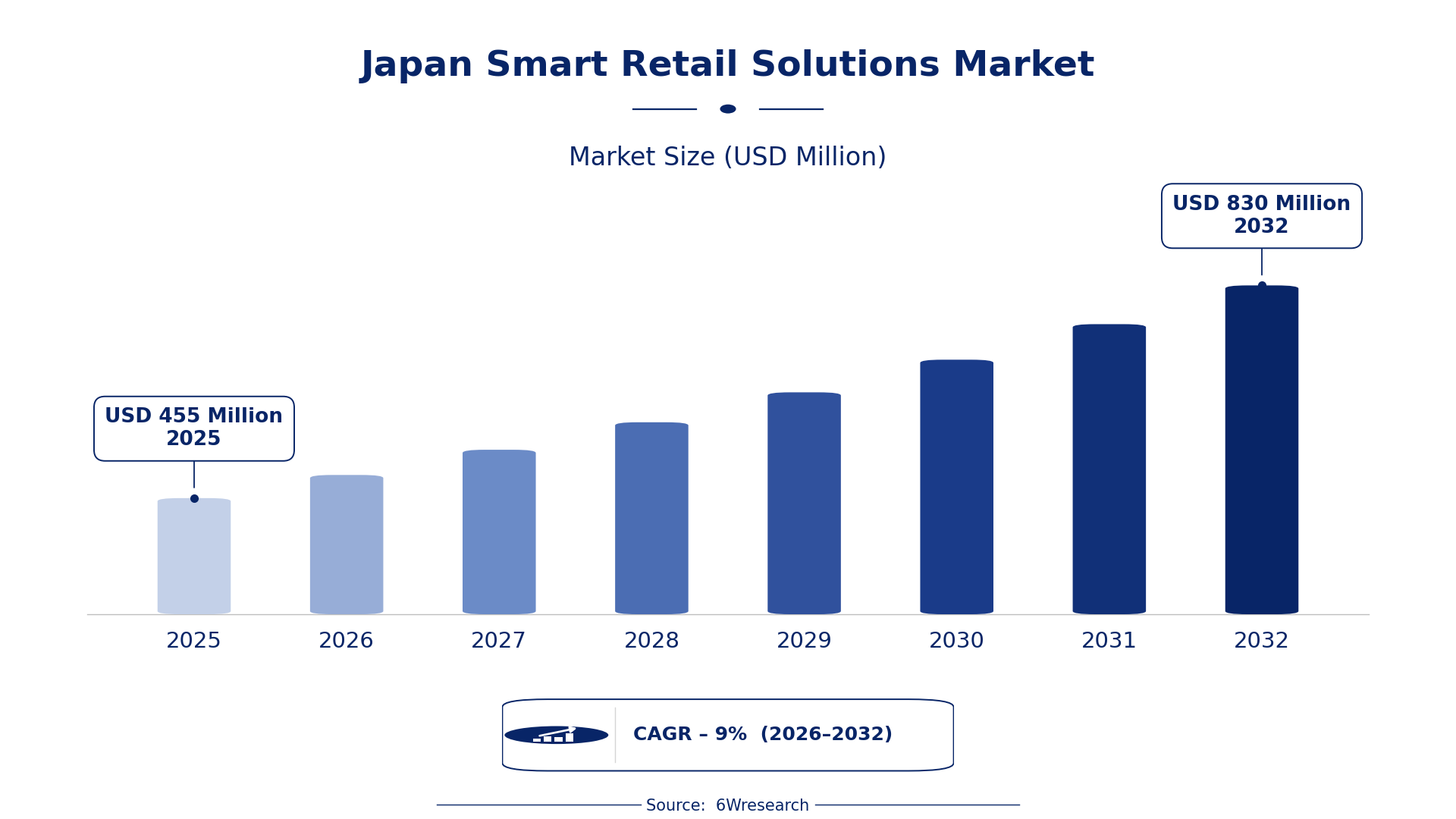
According to 6Wresearch internal database and industry insights, the Japan Smart Retail Solutions Market was valued at USD 455 Million in 2025 and is projected to reach USD 830 Million by 2032, growing at a CAGR of approximately 9% during 2026–2032.
Japan Smart Retail Solutions Market Highlights
| Report Metric | Details |
| Report Name | Japan Smart Retail Solutions Market (2026-2032) |
| Market Size 2025 | USD 455 Million |
| Market Size 2032 | USD 830 Million |
| Absolute Growth 2025–2032 | USD 375 Million |
| CAGR 2026–2032 | 9% |
| Peak Annual Growth | 11.0% in 2026 |
| Forecast Period | 2026–2032 |
| Historical Data | 2022–2025 |
| Base Year | 2025 |
| Leading Solution Type, 2025 | AI Checkout Systems (40% share) |
| Leading Smart Feature, 2025 | Queue-Free Billing (41% share) |
| Leading Integration Platform, 2025 | POS + Vision Sensors (50% share) |
| Leading End User, 2025 | Supermarkets (40% share) |
| Fastest-Growing Solution Type | Virtual Try-On Mirrors (12.6% CAGR) |
| Fastest-Growing Smart Feature | Augmented Shopping (11.2% CAGR) |
| Fastest-Growing Integration Platform | IoT Sync with Inventory (13.1% CAGR) |
| Fastest-Growing End User | Fashion Retailers (11.1% CAGR) |
| Growing Sector | retail technology |
| Key End Users | supermarkets, grocery chains, fashion retailers, mall retailers |
Japan Smart Retail Solutions Market Year-wise Growth Rate and Key Drivers (2022–2032)
This graph illustrates the annual growth rates of the market from 2022 to 2032, highlighting a steady upward trajectory and projected market expansion over the forecast period.
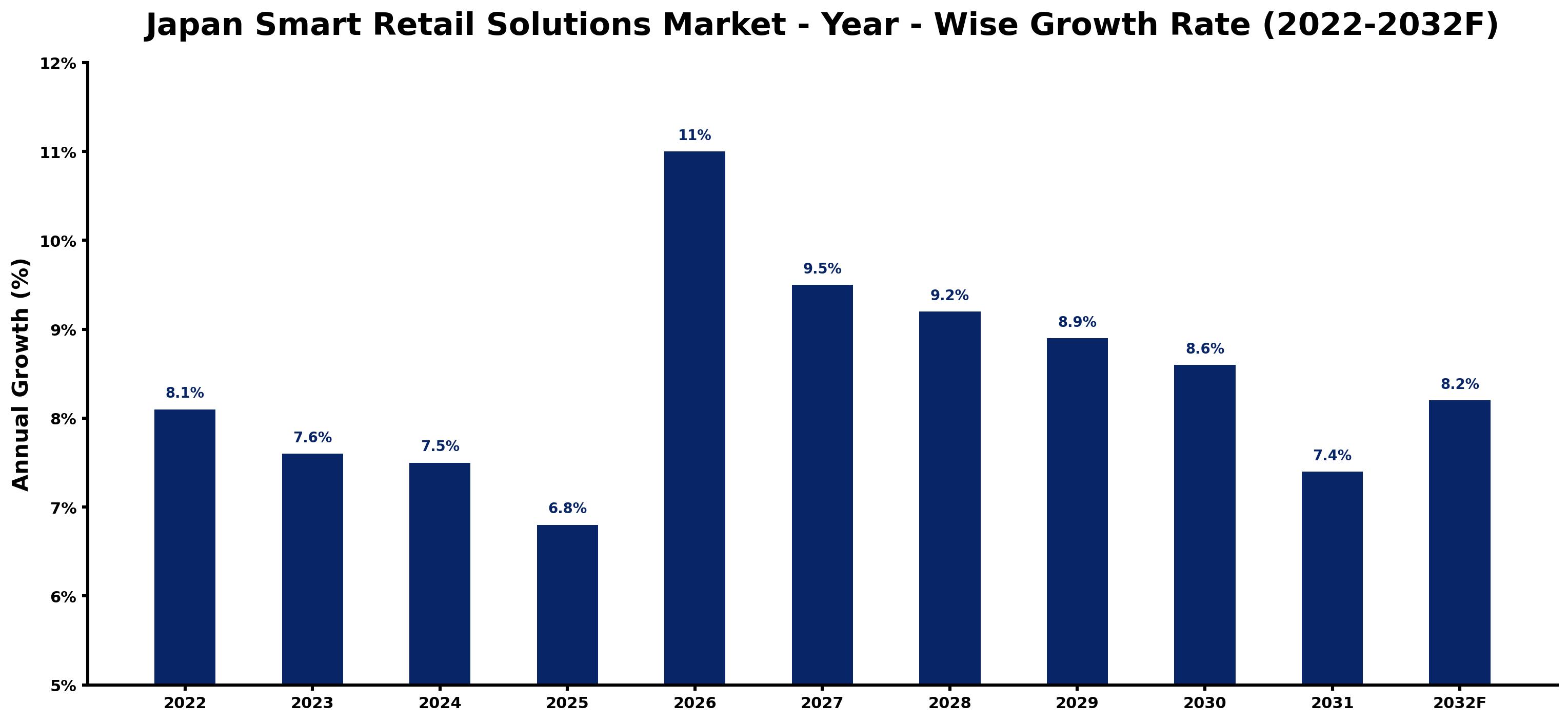
Each row of the following table gives one year's estimated growth and the event or demand shift that explains it.
| Year | Estimated Annual Growth (%) | Market Rationale |
| 2022 | 8.1 | The market exhibited strong growth, driven by increased adoption of smart technologies in retail. |
| 2023 | 7.6 | Growth slowed as retailers adjusted to economic conditions and consumer behaviour changes. |
| 2024 | 7.5 | The market continued to grow, albeit at a slower pace, as technology integration progressed. |
| 2025 | 6.8 | Growth further slowed as the retail workforce faced challenges due to demographic shifts. |
| 2026 | 11.0 | Demand surged as retailers embraced AI technologies to improve customer experiences. |
| 2027 | 9.5 | Growth slowed slightly as market saturation began to impact new technology adoption. |
| 2028 | 9.2 | The market maintained steady growth as retailers focused on improving operational efficiency. |
| 2029 | 8.9 | Growth continued to slow as competition intensified among technology providers. |
| 2030 | 8.6 | The market experienced a further slowdown as economic factors influenced retail spending. |
| 2031 | 7.4 | Growth slowed as retailers consolidated technology investments and focused on ROI. |
| 2032 | 8.2 | Demand picked up as new technologies gained traction and consumer preferences evolved. |
Note: Market size estimations and growth projections presented in this report are based on 6Wresearch's proprietary forecasting methodology, utilizing the latest available industry data, government publications, and primary research inputs.
Japan Smart Retail Solutions Market Synopsis
Smart Retail Solutions encompass technologies that improve the shopping experience through automation and data analytics. The Japan Smart Retail Solutions Market is expanding, driven by demand from supermarkets and grocery chains. Valued at approximately ¥14 trillion, the retail sector is increasingly adopting AI checkout systems and digital shelf labels to boost efficiency and customer engagement. Government support for digital transformation fuels this growth, creating a vibrant environment for retail technology innovation.
Market Dynamics Impact Analysis (2026–2032)
| Factor | Type | Impact | Primary Segment Affected |
| Rising adoption of AI technologies in retail enhances customer engagement and operational efficiency. | Driver | High | AI Checkout Systems |
| The increasing implementation of digital shelf labels provides real-time pricing and inventory management. | Driver | High | Digital Shelf Labels |
| Growing demand for personalized shopping experiences opens new avenues for technology providers. | Opportunity | High | Augmented Shopping |
| The expansion of urban retail spaces creates a need for innovative solutions to attract customers. | Opportunity | Medium | Queue-Free Billing |
| The retail workforce is projected to shrink by 10% by 2025, impacting service delivery. | Restraint | High | Customer Tracking Apps |
| High operational costs in implementing advanced technologies can deter smaller retailers. | Restraint | Medium | POS + Vision Sensors |
| Competition among technology providers can lead to price wars, affecting profitability. | Challenge | High | AI Checkout Systems |
| Rapid technological advancements require constant updates, increasing operational complexity. | Challenge | Medium | Virtual Try-On Mirrors |
Evaluation of Drivers in Japan Smart Retail Solutions Market (2026–2032)
Demand rests on the following drivers, each shown with the segment it touches most.
| Drivers | Primary Segment Affected | Why It Matters (Evidence) |
| Increased consumer demand for efficient shopping experiences drives AI checkout adoption. | AI Checkout Systems | Over 70% of grocery chains are implementing AI checkout systems to reduce wait times. |
| The need for real-time pricing information boosts the use of digital shelf labels. | Digital Shelf Labels | The installed base of digital shelf labels in Japan is growing rapidly, improving inventory management. |
| Consumer preferences for interactive shopping experiences fuel augmented shopping technologies. | Augmented Shopping | AR technology is being integrated into retail environments across major cities, attracting consumers. |
| The shift towards personalized promotions increases demand for customer tracking apps. | Customer Tracking Apps | Over 60% of supermarkets are using customer tracking apps to gather data on consumer behaviour. |
| The expansion of urban retail spaces necessitates efficient checkout solutions like queue-free billing. | Queue-Free Billing | The growing urban population in Tokyo drives the need for efficient retail solutions to manage foot traffic. |
Several shifts outside the market lift sales. In 2023, over 70% of grocery chains implemented AI checkout systems, reducing customer wait times and improving satisfaction. The installed base of digital shelf labels is growing rapidly, providing real-time pricing and inventory management. AR technology is being integrated into retail environments across major cities, creating interactive shopping experiences that attract consumers. Supermarkets are increasingly adopting customer tracking apps, with over 60% using these tools to gather data on consumer behaviour, enabling targeted marketing strategies. The expansion of urban retail spaces drives the need for queue-free billing solutions, ensuring efficient customer service in high-traffic areas.
Evaluation of Restraints in Japan Smart Retail Solutions Market
The table below lists the restraints and the evidence behind each.
| Market Restraint | Primary Segment Affected | Why It Matters (Evidence) |
| The projected 10% shrinkage of the retail workforce by 2025 limits service capabilities. | Customer Tracking Apps | This decline affects retailers' ability to implement and manage advanced technologies effectively. |
| High operational costs deter smaller retailers from adopting advanced smart solutions. | POS + Vision Sensors | Smaller retailers may struggle to invest in necessary technologies, limiting their competitiveness. |
| Intense competition among technology providers can lead to price wars, impacting margins. | AI Checkout Systems | This pressure can reduce profitability for providers, affecting their long-term viability. |
| Rapid technological advancements require constant updates, increasing operational complexity. | Virtual Try-On Mirrors | Retailers face challenges in keeping up with the latest technologies, leading to potential service disruptions. |
| Consumer reluctance to adopt new technologies can slow market penetration rates. | Augmented Shopping | Some consumers may prefer traditional shopping methods, limiting the growth of new solutions. |
Japan Smart Retail Solutions Market Challenges
Japan's retail sector faces regulatory hurdles, as compliance with JIS standards can delay technology deployment, costing retailers up to ¥2 billion in lost sales annually. Rising operational costs stem from the national minimum wage increase, which will reach JPY 1,055 per hour in October 2024, forcing businesses to allocate more budget for staffing. Intense competition among retailers leads to price wars, eroding profit margins and making it difficult for smaller players to survive. A shrinking workforce, projected to decrease by 10% by 2025, results in skill shortages that hinder the adoption of advanced technologies, impacting service quality for consumers.
Trends in the Japan Smart Retail Solutions Market
The shifts below are changing how Japan Smart Retail Solutions Market products are bought and supplied.
- Shift from Traditional to Smart Retail Solutions: Tokyo is experiencing a shift towards smart retail solutions, with over 70% of grocery chains adopting AI technologies. This trend is reshaping customer experiences, creating more efficient shopping environments.
- Emergence of Augmented Shopping Experiences: In urban malls, augmented shopping experiences are being tested, engaging consumers with interactive technology. This approach is gaining traction, with AR technology integrated into retail environments across major cities.
- Increased Use of Dynamic Pricing Strategies: Dynamic pricing strategies are increasingly adopted by major fashion retailers, allowing them to adjust prices based on demand. This shift improves revenue management and aligns pricing with consumer behaviour.
- Growing Adoption of Customer Tracking Apps: Supermarkets are increasingly using customer tracking apps to collect data on consumer preferences. Over 60% of supermarkets have implemented these apps, enhancing targeted marketing efforts.
Investment Opportunities in the Japan Smart Retail Solutions Market
Several openings in the Japan Smart Retail Solutions Market merit attention from investors.
- Partnership Opportunities in Urban Retail: Urban areas are ripe for investment in smart retail solutions, particularly in Tokyo. Collaborating with local grocery chains can facilitate entry into this growing market, valued at approximately ¥14 trillion.
- Investment in Augmented Shopping Technologies: Fashion retailers are seeking advanced solutions to improve customer engagement. Investing in augmented shopping technologies can meet this demand, especially as AR experiences gain popularity.
- Expansion of Digital Shelf Labels: The growing installed base of digital shelf labels presents an opportunity for suppliers. Collaborating with supermarkets can help integrate these technologies, improving inventory management.
- Entry into Customer Tracking Solutions: With over 60% of supermarkets using customer tracking apps, there is a strong demand for advanced solutions. Investing in this area can improve market presence and meet retailer needs.
Government Initiatives in the Japan Smart Retail Solutions Market
The AI Promotion Act, enacted in 2025, establishes a framework for the development and use of AI technologies in various sectors, including retail. This law encourages retailers to adopt AI solutions, improving operational efficiency and customer engagement. Additionally, the Semiconductor and Digital Industry Strategy, introduced by METI in June 2021, aims to secure domestic semiconductor manufacturing, supporting the growth of smart retail technologies reliant on advanced components.
The AI Promotion Act is overseen by the Ministry of Economy, Trade and Industry, ensuring compliance with the framework. Retailers can benefit from this support by accessing funding for AI integration projects, which can improve their operational capabilities. The government also promotes digital transformation initiatives, encouraging retailers to adopt smart solutions that enhance customer experiences.
Future Insight of the Japan Smart Retail Solutions Market
By 2032, advancements in augmented reality will transform customer engagement, creating immersive shopping experiences in urban centres. The government's push for IoT integration will streamline inventory management, allowing retailers to adjust stock levels in real-time. Enhanced data analytics will enable retailers to optimise pricing strategies, ensuring they remain competitive. With the installed base of digital shelf labels growing rapidly, retailers will improve product visibility and customer interaction, resulting in a more efficient shopping experience.
Market Segmentation Analysis
Japan Smart Retail Solutions Market report covers a detailed analysis of the following market segments:
By Solution Type – AI Checkout Systems Lead, Virtual Try-On Mirrors Expected to Grow Fastest
According to Saurav Kr Singh, Senior Research Analyst at 6Wresearch, the largest solution type category in 2025 was AI Checkout Systems, at 40% of revenue. AI checkout systems hold the largest share due to their ability to automate the checkout process, which significantly reduces wait times for customers. Their widespread adoption in urban retail environments, particularly in Tokyo, underscores their importance in enhancing operational efficiency. Virtual Try-On Mirrors are projected to grow fastest, at a CAGR of 12.6% during 2026–2032. The rapid growth of virtual try-on mirrors is propelled by the increasing demand for enhanced customer experiences in retail settings. As augmented shopping experiences are being trialled in urban malls, this segment is expected to expand quickly as retailers seek to attract tech-savvy consumers. Suppliers should prioritise developing solutions that improve customer interaction and streamline the checkout experience.
By Smart Feature – Queue-Free Billing Leads, Augmented Shopping Expected to Grow Fastest
In 2025, Queue-Free Billing led the smart feature split with a 41% share. Queue-free billing is the top smart feature as it effectively removes traditional checkout lines, boosting operational efficiency for retailers. This feature is particularly beneficial in bustling areas like Tokyo, where quick service is essential for customer satisfaction. The quickest growth will come from Augmented Shopping, forecast to expand at a CAGR of 11.2% between 2026 and 2032. Augmented shopping is rapidly growing due to its capacity to provide interactive shopping experiences that captivate customers. With AR technology being integrated into retail spaces in major cities, this trend is expected to accelerate, prompting more retailers to adopt such features. Buyers will gain advantages by investing in smart features that improve customer engagement and operational efficiency.
By Integration Platform – POS + Vision Sensors Lead, IoT Sync with Inventory Expected to Grow Fastest
POS + Vision Sensors took 50% of integration platform revenue in 2025, more than any other category. The integration of POS with vision sensors leads the market by combining payment processing with inventory management, providing a comprehensive solution for retailers. This integration is vital for ensuring accurate inventory levels in Japan's competitive retail landscape. IoT Sync with Inventory is set to record the highest CAGR in this split, 13.1% over 2026–2032. IoT sync with inventory is the fastest-growing integration platform, driven by the need for real-time inventory management. With government initiatives advocating for IoT in retail, this segment is set for rapid growth as retailers aim to optimise their supply chains. Suppliers must highlight IoT capabilities in their offerings to align with the market's focus on real-time data management.
By End User – Supermarkets Lead, Fashion Retailers Expected to Grow Fastest
With 40% of end user revenue in 2025, Supermarkets was the largest category. Supermarkets dominate the end-user segment as they increasingly adopt smart solutions to enhance customer experiences and improve operational efficiency. Given the projected 10% decline in the retail workforce, these technologies are crucial for maintaining service quality in supermarkets. Over 2026–2032, Fashion Retailers are expected to post the fastest growth, at a CAGR of 11.1%. Fashion retailers are the fastest-growing end-user segment, leveraging technology to enhance customer engagement and adapt to changing consumer preferences. As the interest in augmented shopping experiences rises, fashion retailers are likely to lead in the adoption of new technologies. Suppliers should tailor their products to meet the specific requirements of fashion retailers, who are progressively adopting smart technologies.
Key Attractiveness of the Report
- 10 Years of Market Numbers
- Historical Data Starting from 2022 to 2025
- Base Year 2025
- Forecast Data until 2032
- Key Performance Indicators Impacting the Market
- Major Upcoming Developments and Projects
Key Highlights of the Report:
- Japan Smart Retail Solutions Market Outlook
- Market Size of Japan Smart Retail Solutions Market, 2025
- Forecast of Japan Smart Retail Solutions Market, 2032
- Historical Data and Forecast of Japan Smart Retail Solutions Revenues & Volume for the Period 2022-2032F
- Japan Smart Retail Solutions Market Trend Evolution
- Japan Smart Retail Solutions Market Drivers and Challenges
- Japan Smart Retail Solutions Price Trends
- Japan Smart Retail Solutions Porter's Five Forces
- Japan Smart Retail Solutions Industry Life Cycle
- Historical Data and Forecast of Japan Smart Retail Solutions Market Revenues & Volume By Solution Type for the Period 2022-2032F
- Historical Data and Forecast of Japan Smart Retail Solutions Market Revenues & Volume By AI Checkout Systems for the Period 2022-2032F
- Historical Data and Forecast of Japan Smart Retail Solutions Market Revenues & Volume By Virtual Try-On Mirrors for the Period 2022-2032F
- Historical Data and Forecast of Japan Smart Retail Solutions Market Revenues & Volume By Digital Shelf Labels for the Period 2022-2032F
- Historical Data and Forecast of Japan Smart Retail Solutions Market Revenues & Volume By Customer Tracking Apps for the Period 2022-2032F
- Historical Data and Forecast of Japan Smart Retail Solutions Market Revenues & Volume By Smart Feature for the Period 2022-2032F
- Historical Data and Forecast of Japan Smart Retail Solutions Market Revenues & Volume By Queue-Free Billing for the Period 2022-2032F
- Historical Data and Forecast of Japan Smart Retail Solutions Market Revenues & Volume By Augmented Shopping for the Period 2022-2032F
- Historical Data and Forecast of Japan Smart Retail Solutions Market Revenues & Volume By Dynamic Pricing for the Period 2022-2032F
- Historical Data and Forecast of Japan Smart Retail Solutions Market Revenues & Volume By Personalized Promotions for the Period 2022-2032F
- Historical Data and Forecast of Japan Smart Retail Solutions Market Revenues & Volume By Integration Platform for the Period 2022-2032F
- Historical Data and Forecast of Japan Smart Retail Solutions Market Revenues & Volume By POS + Vision Sensors for the Period 2022-2032F
- Historical Data and Forecast of Japan Smart Retail Solutions Market Revenues & Volume By AR + Camera Systems for the Period 2022-2032F
- Historical Data and Forecast of Japan Smart Retail Solutions Market Revenues & Volume By IoT Sync with Inventory for the Period 2022-2032F
- Historical Data and Forecast of Japan Smart Retail Solutions Market Revenues & Volume By App + Bluetooth Beacons for the Period 2022-2032F
- Historical Data and Forecast of Japan Smart Retail Solutions Market Revenues & Volume By End User for the Period 2022-2032F
- Historical Data and Forecast of Japan Smart Retail Solutions Market Revenues & Volume By Grocery Chains for the Period 2022-2032F
- Historical Data and Forecast of Japan Smart Retail Solutions Market Revenues & Volume By Fashion Retailers for the Period 2022-2032F
- Historical Data and Forecast of Japan Smart Retail Solutions Market Revenues & Volume By Supermarkets for the Period 2022-2032F
- Historical Data and Forecast of Japan Smart Retail Solutions Market Revenues & Volume By Mall Retailers for the Period 2022-2032F
- Japan Smart Retail Solutions Import Export Trade Statistics
- Market Opportunity Assessment By Solution Type
- Market Opportunity Assessment By Smart Feature
- Market Opportunity Assessment By Integration Platform
- Market Opportunity Assessment By End User
- Japan Smart Retail Solutions Top Companies Market Share
- Japan Smart Retail Solutions Competitive Benchmarking By Technical and Operational Parameters
- Japan Smart Retail Solutions Company Profiles
- Japan Smart Retail Solutions Key Strategic Recommendations
Market Covered
Coverage by segment is as follows.
By Solution Type
- AI Checkout Systems
- Virtual Try-On Mirrors
- Digital Shelf Labels
- Customer Tracking Apps
By Smart Feature
- Queue-Free Billing
- Augmented Shopping
- Dynamic Pricing
- Personalized Promotions
By Integration Platform
- POS + Vision Sensors
- AR + Camera Systems
- IoT Sync with Inventory
- App + Bluetooth Beacons
By End User
- Grocery Chains
- Fashion Retailers
- Supermarkets
- Mall Retailers































