Japan Smart Retail Technology Market Size & Growth Rate
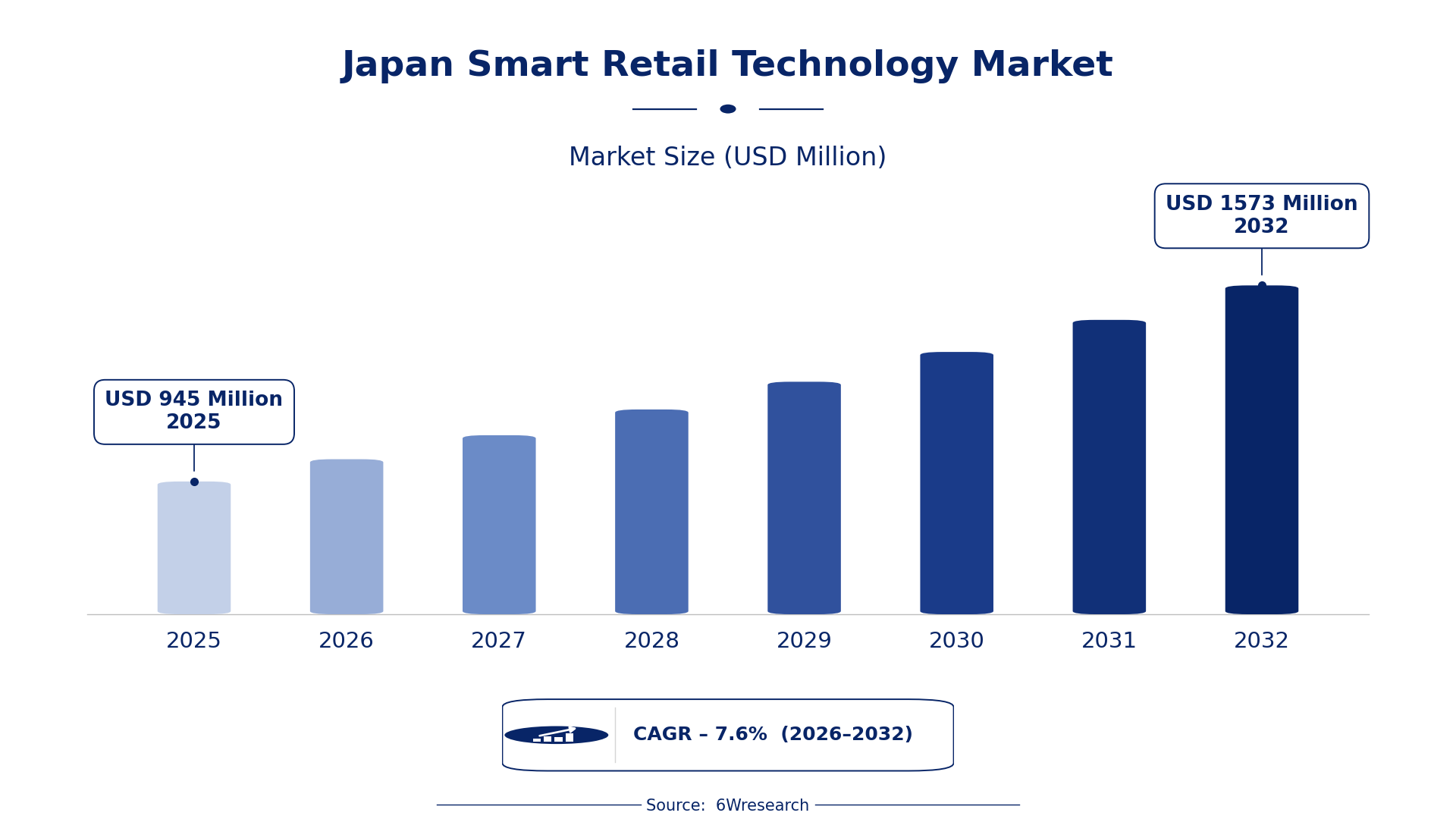
According to 6Wresearch internal database and industry insights, the Japan Smart Retail Technology Market was valued at USD 945 Million in 2025 and is projected to reach USD 1,573 Million by 2032, growing at a CAGR of approximately 7.6% during 2026–2032.
Japan Smart Retail Technology Market Highlights
| Report Metric | Details |
| Report Name | Japan Smart Retail Technology Market (2026-2032) |
| Market Size 2025 | USD 945 Million |
| Market Size 2032 | USD 1,573 Million |
| Absolute Growth 2025–2032 | USD 628 Million |
| CAGR 2026–2032 | 7.6% |
| Peak Annual Growth | 9.2% in 2030 |
| Forecast Period | 2026–2032 |
| Historical Data | 2022–2025 |
| Base Year | 2025 |
| Leading Technology Type, 2025 | Smart POS Systems (43% share) |
| Leading Smart Feature, 2025 | Contactless Payments (50% share) |
| Leading Hardware Interface, 2025 | NFC + QR Code Readers (54% share) |
| Leading End User, 2025 | Quick Service Stores (38% share) |
| Fastest-Growing Technology Type | AI Recommendation Tools (11.3% CAGR) |
| Fastest-Growing Smart Feature | Personalized Offers (10.0% CAGR) |
| Fastest-Growing Hardware Interface | RFID + AI Analytics (10.5% CAGR) |
| Fastest-Growing End User | Online Retailers (10.3% CAGR) |
| Growing Sector | Retail Technology |
| Key End Users | Quick Service Stores, Online Retailers, Retail Warehouses, Airports/Malls |
Japan Smart Retail Technology Market Year-wise Growth Rate and Key Drivers (2022–2032)
This graph illustrates the annual growth rates of the market from 2022 to 2032, highlighting a steady upward trajectory and projected market expansion over the forecast period.
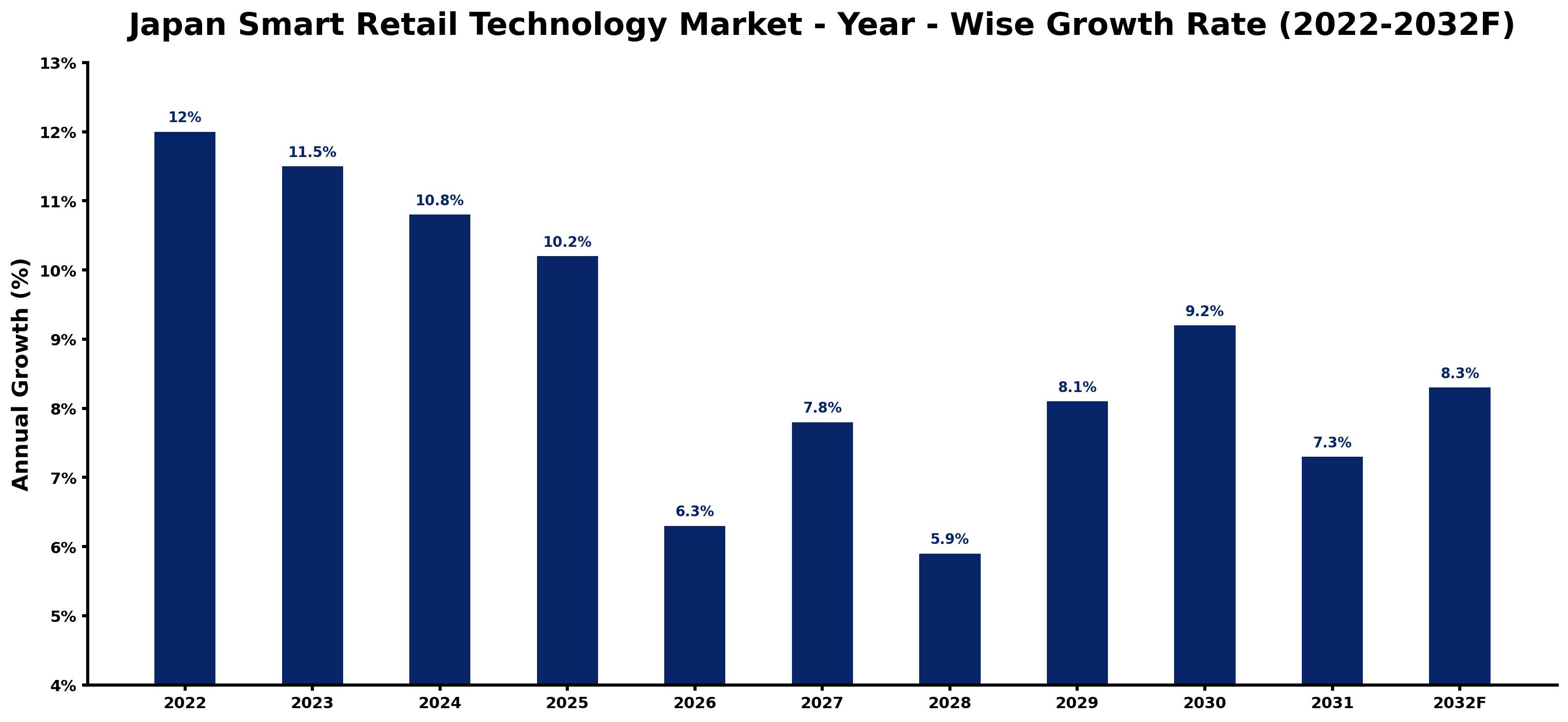
The table below sets out the estimated growth rate for each year and the main factor behind it.
| Year | Estimated Annual Growth (%) | Market Rationale |
| 2022 | 12.0 | The market experienced strong demand as retailers adopted smart technologies to improve customer engagement. |
| 2023 | 11.5 | Growth slowed due to market saturation in some segments, but demand for advanced solutions remained high. |
| 2024 | 10.8 | The market continued to grow as retailers focused on improving operational efficiency through technology. |
| 2025 | 10.2 | Growth decelerated as competition intensified, leading to a more cautious investment approach among retailers. |
| 2026 | 6.3 | Demand growth is expected to slow further as economic uncertainties prompt retailers to reassess technology investments. |
| 2027 | 7.8 | The market is projected to rebound as retailers begin to invest in advanced technologies to improve customer experiences. |
| 2028 | 5.9 | Growth is anticipated to slow again as market maturity sets in, with many retailers already adopting key technologies. |
| 2029 | 8.1 | Demand is expected to increase as new technologies and solutions emerge, driving further investment in smart retail. |
| 2030 | 9.2 | The market is projected to peak with significant investments in smart technologies, improving operational capabilities for retailers. |
| 2031 | 7.3 | Growth is anticipated to slow as the market stabilises, with retailers focusing on optimising existing technologies. |
| 2032 | 8.3 | Demand is expected to rise again as new advancements in smart retail technology are introduced. |
Note: Market size estimations and growth projections presented in this report are based on 6Wresearch's proprietary forecasting methodology, utilizing the latest available industry data, government publications, and primary research inputs.
Japan Smart Retail Technology Market Synopsis
Smart Retail Technology includes advanced systems and tools designed to improve the retail experience through automation and data analytics. The Japan Smart Retail Technology Market is expanding due to strong demand from quick service stores and online retailers, driven by technological advancements and consumer preferences for efficient transactions. With over 70% of quick service stores implementing smart POS systems and government initiatives promoting digital transformation, the market is set for continued growth.
Market Dynamics Impact Analysis (2026–2032)
| Factor | Type | Impact | Primary Segment Affected |
| Increased consumer preference for seamless transactions | Driver | High | Contactless Payments |
| Growing urbanisation and convenience-driven lifestyles | Driver | High | Automated Vending |
| Expansion of smart technology in urban retail environments | Opportunity | High | Smart POS Systems |
| Rising demand for personalised shopping experiences | Opportunity | Medium | AI Recommendation Tools |
| High initial investment costs for technology implementation | Restraint | High | Smart POS Systems |
| Limited awareness of smart technologies among smaller retailers | Restraint | Medium | Automated Vending |
| Competition from traditional retail methods | Challenge | High | Quick Service Stores |
| Rapid technological advancements leading to obsolescence | Challenge | Medium | AI Recommendation Tools |
Evaluation of Drivers in Japan Smart Retail Technology Market (2026–2032)
The following drivers explain most of the expected growth.
| Drivers | Primary Segment Affected | Why It Matters (Evidence) |
| Increased consumer preference for convenience | Contactless Payments | Over 30% of all transactions in Japan were contactless in 2022, driving retailers to adopt these systems. |
| Urbanisation leading to higher demand for automated solutions | Automated Vending | With over 5 million automated vending machines in urban areas, demand for these solutions is surging. |
| Technological advancements improving customer engagement | AI Recommendation Tools | The Japanese government supports retail innovation, encouraging investment in smart technologies. |
| Government initiatives promoting digital transformation | Smart POS Systems | The Japanese government supports retail innovation, encouraging investment in smart technologies. |
| Rising competition in the retail sector | Smart RFID Readers | Retail warehouses are adopting RFID technology for inventory management, improving efficiency and accuracy. |
The strongest pull on demand comes from increased consumer preference for convenience, with contactless payments accounting for over 30% of transactions in 2022. Urbanisation drives demand for automated vending solutions, with over 5 million units in operation across urban areas. Advances in AI recommendation tools are improving customer engagement, particularly among online retailers. Increased competition in the retail sector is driving greater adoption of smart RFID readers for inventory management, enhancing operational efficiency.
Evaluation of Restraints in Japan Smart Retail Technology Market
The main factors holding the market back are set out below.
| Market Restraint | Primary Segment Affected | Why It Matters (Evidence) |
| High initial investment costs for technology implementation | Smart POS Systems | The average cost of implementing smart POS systems can exceed JPY 500,000, deterring smaller retailers. |
| Limited awareness of smart technologies among smaller retailers | Automated Vending | Many small retailers lack knowledge about the benefits of automated vending, hindering adoption. |
| Competition from traditional retail methods | Quick Service Stores | Traditional cash transactions remain prevalent, limiting the shift to smart retail technologies. |
| Concerns over data security and privacy | AI Recommendation Tools | ISO 27001 compliance is critical, but many retailers struggle to meet these standards. |
| Technological obsolescence due to rapid advancements | Smart RFID Readers | Retailers face challenges in keeping up with the latest RFID technologies, risking outdated systems. |
Japan Smart Retail Technology Market Challenges
Producers face rising costs as Japan's minimum wage reaches JPY 1,055 per hour, which elevates operational expenses and compresses profit margins for retailers. Smaller retailers encounter fierce competition since over 70% of quick service stores have adopted smart POS systems, compelling them to invest in technology or risk losing market share. Buyers face regulatory challenges due to compliance with ISO 27001 standards, requiring substantial investments in data security and delaying technology rollouts. Declining population numbers impede technology adoption, resulting in reduced customer bases and diminished returns on investments in new retail solutions.
Trends in the Japan Smart Retail Technology Market
Several trends are reshaping the Japan Smart Retail Technology Market; the most important are set out below.
- Shift from Cash to Contactless Payments: Contactless payments accounted for over 30% of all transactions in 2022, reflecting a shift in consumer behaviour towards convenience. This trend is driving retailers to adopt smart payment solutions across Japan.
- Emergence of AI in Retail: The increasing use of AI recommendation tools by online retailers highlights a shift towards personalised shopping experiences. This trend is expected to grow, with AI tools improving user engagement and sales.
- Transition to Automated Vending Solutions: Automated vending machines are becoming more prevalent, especially in urban areas, with over 5 million units in operation. This transition caters to consumer demand for convenience and efficiency in retail.
- Rise of Smart POS Systems: The adoption of smart POS systems is on the rise, with over 70% of quick service stores implementing these technologies. This shift is improving transaction efficiency and customer engagement.
Investment Opportunities in the Japan Smart Retail Technology Market
The openings below show where demand in the Japan Smart Retail Technology Market is visible and how suppliers can enter.
- Smart POS Systems: With over 70% of quick service stores adopting smart POS systems, there exists an opportunity for suppliers to provide tailored solutions. Investing in partnerships with local retailers can facilitate market entry.
- AI Recommendation Tools: The rising demand for personalised shopping experiences offers an opportunity for AI solution providers. Online retailers are seeking advanced tools to improve user engagement, creating a promising market segment.
- Automated Vending Solutions: The prevalence of automated vending machines in urban areas presents a strong market opportunity. Suppliers can enter by collaborating with local distributors to deliver advanced vending technologies.
- Smart RFID Technology: As retail warehouses increasingly implement smart RFID technology for inventory management, there is a demand for advanced solutions. Suppliers can target this sector by forming joint ventures with logistics companies.
Government Initiatives in the Japan Smart Retail Technology Market
The AI Promotion Act, established in 2025, creates a national framework for AI research and development, impacting producers by encouraging investment in AI technologies. This act supports progress in smart retail technology, ensuring compliance with national standards. The Semiconductor and Digital Industry Strategy, administered by the Ministry of Economy, Trade and Industry, funds initiatives to secure domestic semiconductor manufacturing. This support enables retailers to access advanced technologies, improving their operational capabilities.
The Ministry of Economy, Trade and Industry's initiatives advocate for digital transformation in retail, providing funding and support for projects that enhance technological adoption. Retailers can leverage these resources to implement smart technologies, ensuring they remain competitive in the evolving market.
Future Insight of the Japan Smart Retail Technology Market
The introduction of urban smart kiosks will transform retail spaces by 2032, allowing retailers to enhance customer interaction and streamline processes. Advanced automated vending machines will offer tailored services to improve user experience. The expansion of smart inventory management systems will boost stock control efficiency, benefiting both suppliers and retailers. As contactless payments continue to rise, accounting for over 30% of all transactions, suppliers will need to adjust their offerings to meet the growing demand for convenience.
Market Segmentation Analysis
Japan Smart Retail Technology Market report covers a detailed analysis of the following market segments:
By Technology Type – Smart POS Systems Lead, AI Recommendation Tools Expected to Grow Fastest
According to Saurav Kr Singh, Senior Research Analyst at 6Wresearch, Smart POS Systems held 43% of the Japan Smart Retail Technology Market by technology type in 2025. Smart POS systems dominate the market due to their critical function in transaction processing, particularly in urban centres like Tokyo. Their implementation in over 70% of quick service stores underscores the demand for streamlined payment solutions. AI Recommendation Tools are projected to grow fastest, at a CAGR of 11.3% during 2026–2032. The rapid growth of recommendation tools stems from the increasing focus on enhancing customer engagement, particularly among online retailers seeking to tailor shopping experiences. This segment's expansion indicates a strong recognition of the importance of personalised suggestions for boosting sales. Suppliers should prioritise the development of advanced features in recommendation tools to cater to the rising demand from retailers.
By Smart Feature – Contactless Payments Lead, Personalized Offers Expected to Grow Fastest
Contactless Payments took 50% of smart feature revenue in 2025, more than any other category. Contactless payments lead the market as they offer convenience and hygiene, essential factors in the retail sector, especially post-pandemic. With over 30% of all transactions in 2022 being contactless, this trend is poised for continued growth. The quickest growth will come from Personalized Offers, forecast to expand at a CAGR of 10.0% between 2026 and 2032. Personalised offers are gaining momentum as retailers aim to boost customer loyalty and sales through tailored promotions. The segment's growth reflects a broader strategy among businesses to engage consumers on a more personal level. Buyers will gain an advantage by investing in technologies that facilitate personalised marketing to improve customer retention.
By Hardware Interface – NFC + QR Code Readers Lead, RFID + AI Analytics Expected to Grow Fastest
In 2025, NFC + QR Code Readers led the hardware interface split with a 54% share. NFC and QR code readers are crucial for enabling contactless transactions, serving as a fundamental aspect of retail technology in busy locations. Their widespread use ensures a seamless payment experience for consumers, driving adoption across various retail formats. Over 2026–2032, RFID + AI Analytics is expected to post the fastest growth, at a CAGR of 10.5%. RFID combined with analytics is experiencing rapid growth as retailers implement these technologies for effective inventory management and insights into customer behaviour. This trend is propelled by the need for more efficient operations and data-driven decision-making. Suppliers must focus on integrating advanced analytics into hardware solutions to meet evolving market demands.
By End User – Quick Service Stores Lead, Online Retailers Expected to Grow Fastest
With 38% of end user revenue in 2025, Quick Service Stores was the largest category. Quick service stores hold the largest segment as they heavily rely on smart technology to optimise operations and enhance customer service. Their significant presence in urban areas drives the demand for advanced retail solutions tailored to their specific needs. Online Retailers are set to record the highest CAGR in this split, 10.3% over 2026–2032. Online retailers are swiftly adopting smart technologies to elevate customer experiences, reflecting the ongoing shift towards e-commerce and digital shopping. This growth is fuelled by the necessity for improved engagement and satisfaction in a competitive market. Suppliers should customise their offerings to address the specific requirements of online retailers as this segment continues to grow.
Key Attractiveness of the Report
- 10 Years of Market Numbers
- Historical Data Starting from 2022 to 2025
- Base Year 2025
- Forecast Data until 2032
- Key Performance Indicators Impacting the Market
- Major Upcoming Developments and Projects
Key Highlights of the Report:
- Japan Smart Retail Technology Market Outlook
- Market Size of Japan Smart Retail Technology Market, 2025
- Forecast of Japan Smart Retail Technology Market, 2032
- Historical Data and Forecast of Japan Smart Retail Technology Revenues & Volume for the Period 2022-2032F
- Japan Smart Retail Technology Market Trend Evolution
- Japan Smart Retail Technology Market Drivers and Challenges
- Japan Smart Retail Technology Price Trends
- Japan Smart Retail Technology Porter's Five Forces
- Japan Smart Retail Technology Industry Life Cycle
- Historical Data and Forecast of Japan Smart Retail Technology Market Revenues & Volume By Technology Type for the Period 2022-2032F
- Historical Data and Forecast of Japan Smart Retail Technology Market Revenues & Volume By Smart POS Systems for the Period 2022-2032F
- Historical Data and Forecast of Japan Smart Retail Technology Market Revenues & Volume By AI Recommendation Tools for the Period 2022-2032F
- Historical Data and Forecast of Japan Smart Retail Technology Market Revenues & Volume By Automated Vending for the Period 2022-2032F
- Historical Data and Forecast of Japan Smart Retail Technology Market Revenues & Volume By Smart RFID Readers for the Period 2022-2032F
- Historical Data and Forecast of Japan Smart Retail Technology Market Revenues & Volume By Smart Feature for the Period 2022-2032F
- Historical Data and Forecast of Japan Smart Retail Technology Market Revenues & Volume By Contactless Payments for the Period 2022-2032F
- Historical Data and Forecast of Japan Smart Retail Technology Market Revenues & Volume By Personalized Offers for the Period 2022-2032F
- Historical Data and Forecast of Japan Smart Retail Technology Market Revenues & Volume By Remote Stock Refill Alerts for the Period 2022-2032F
- Historical Data and Forecast of Japan Smart Retail Technology Market Revenues & Volume By Theft Prevention for the Period 2022-2032F
- Historical Data and Forecast of Japan Smart Retail Technology Market Revenues & Volume By Hardware Interface for the Period 2022-2032F
- Historical Data and Forecast of Japan Smart Retail Technology Market Revenues & Volume By NFC + QR Code Readers for the Period 2022-2032F
- Historical Data and Forecast of Japan Smart Retail Technology Market Revenues & Volume By CRM Integration for the Period 2022-2032F
- Historical Data and Forecast of Japan Smart Retail Technology Market Revenues & Volume By Sensor-Driven for the Period 2022-2032F
- Historical Data and Forecast of Japan Smart Retail Technology Market Revenues & Volume By RFID + AI Analytics for the Period 2022-2032F
- Historical Data and Forecast of Japan Smart Retail Technology Market Revenues & Volume By End User for the Period 2022-2032F
- Historical Data and Forecast of Japan Smart Retail Technology Market Revenues & Volume By Quick Service Stores for the Period 2022-2032F
- Historical Data and Forecast of Japan Smart Retail Technology Market Revenues & Volume By Online Retailers for the Period 2022-2032F
- Historical Data and Forecast of Japan Smart Retail Technology Market Revenues & Volume By Airports/Malls for the Period 2022-2032F
- Historical Data and Forecast of Japan Smart Retail Technology Market Revenues & Volume By Retail Warehouses for the Period 2022-2032F
- Japan Smart Retail Technology Import Export Trade Statistics
- Market Opportunity Assessment By Technology Type
- Market Opportunity Assessment By Smart Feature
- Market Opportunity Assessment By Hardware Interface
- Market Opportunity Assessment By End User
- Japan Smart Retail Technology Top Companies Market Share
- Japan Smart Retail Technology Competitive Benchmarking By Technical and Operational Parameters
- Japan Smart Retail Technology Company Profiles
- Japan Smart Retail Technology Key Strategic Recommendations
Market Covered
The report covers the following segments.
By Technology Type
- Smart POS Systems
- AI Recommendation Tools
- Automated Vending
- Smart RFID Readers
By Smart Feature
- Contactless Payments
- Personalized Offers
- Remote Stock Refill Alerts
- Theft Prevention
By Hardware Interface
- NFC + QR Code Readers
- CRM Integration
- Sensor-Driven
- RFID + AI Analytics
By End User
- Quick Service Stores
- Online Retailers
- Airports/Malls
- Retail Warehouses































