Japan Smart Safety Gear Market Size & Growth Rate
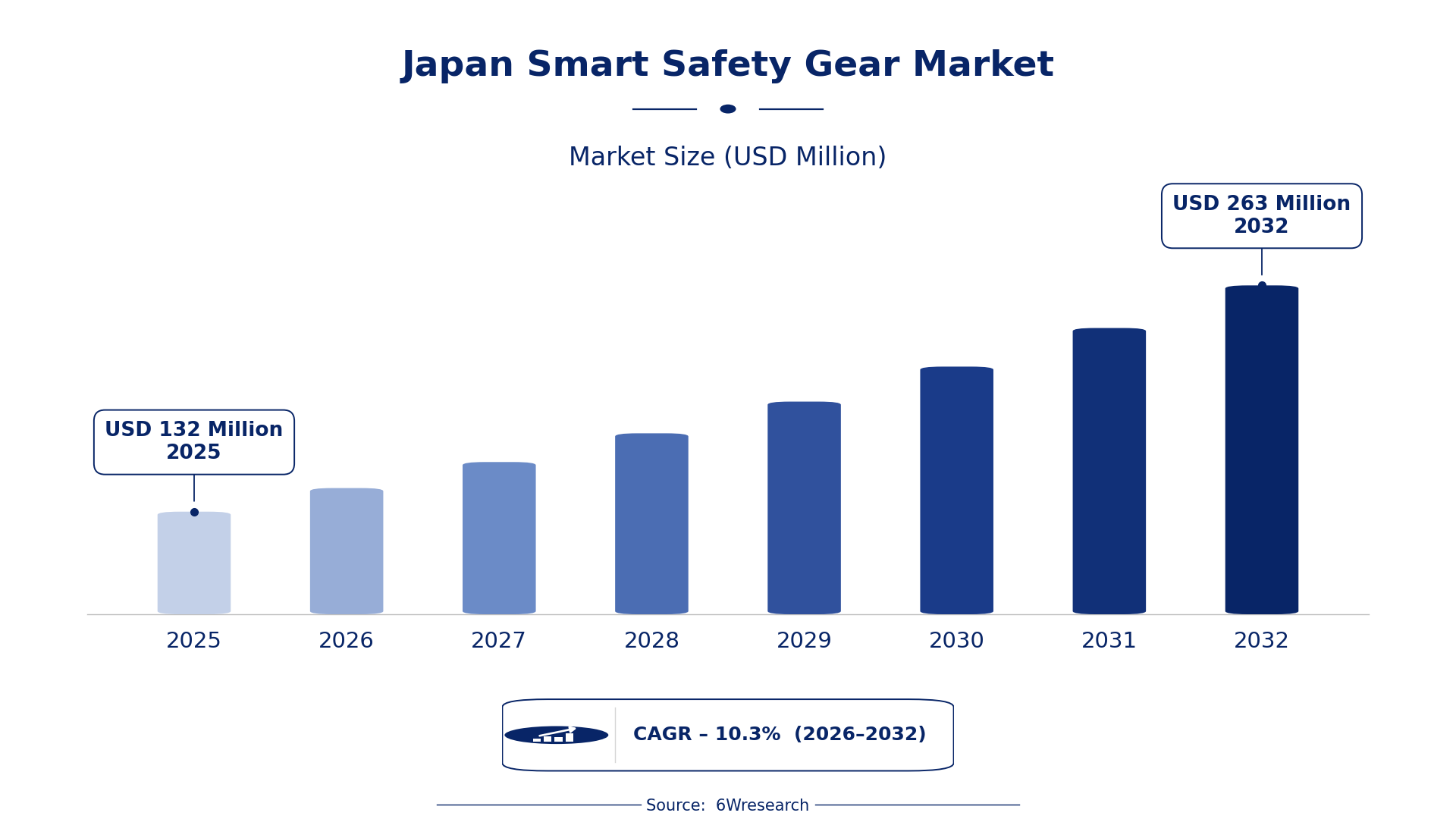
According to 6Wresearch internal database and industry insights, the Japan Smart Safety Gear Market was valued at USD 132 Million in 2025 and is projected to reach USD 263 Million by 2032, growing at a CAGR of approximately 10.3% during 2026–2032.
Japan Smart Safety Gear Market Highlights
| Report Metric | Details |
| Report Name | Japan Smart Safety Gear Market (2026-2032) |
| Market Size 2025 | USD 132 Million |
| Market Size 2032 | USD 263 Million |
| Absolute Growth 2025–2032 | USD 131 Million |
| CAGR 2026–2032 | 10.3% |
| Peak Annual Growth | 12.8% in 2032 |
| Forecast Period | 2026–2032 |
| Historical Data | 2022–2025 |
| Base Year | 2025 |
| Leading Gear Type, 2025 | Smart Helmets (43% share) |
| Leading Smart Feature, 2025 | Fall/Collision Alerts (52% share) |
| Leading Sensor Type, 2025 | Accelerometer + GPS (35% share) |
| Leading End User, 2025 | Construction Sites (43% share) |
| Fastest-Growing Gear Type | Wearable Safety Vests (15.3% CAGR) |
| Fastest-Growing Smart Feature | Visual Hazard Detection (14.0% CAGR) |
| Fastest-Growing Sensor Type | Camera + AI (15.8% CAGR) |
| Fastest-Growing End User | Manufacturing Plants (13.4% CAGR) |
| Growing Sector | Construction Sites |
| Key End Users | Construction Sites, Manufacturing Plants, Mining Workers |
Japan Smart Safety Gear Market Year-wise Growth Rate and Key Drivers (2022–2032)
This graph illustrates the annual growth rates of the market from 2022 to 2032, highlighting a steady upward trajectory and projected market expansion over the forecast period.
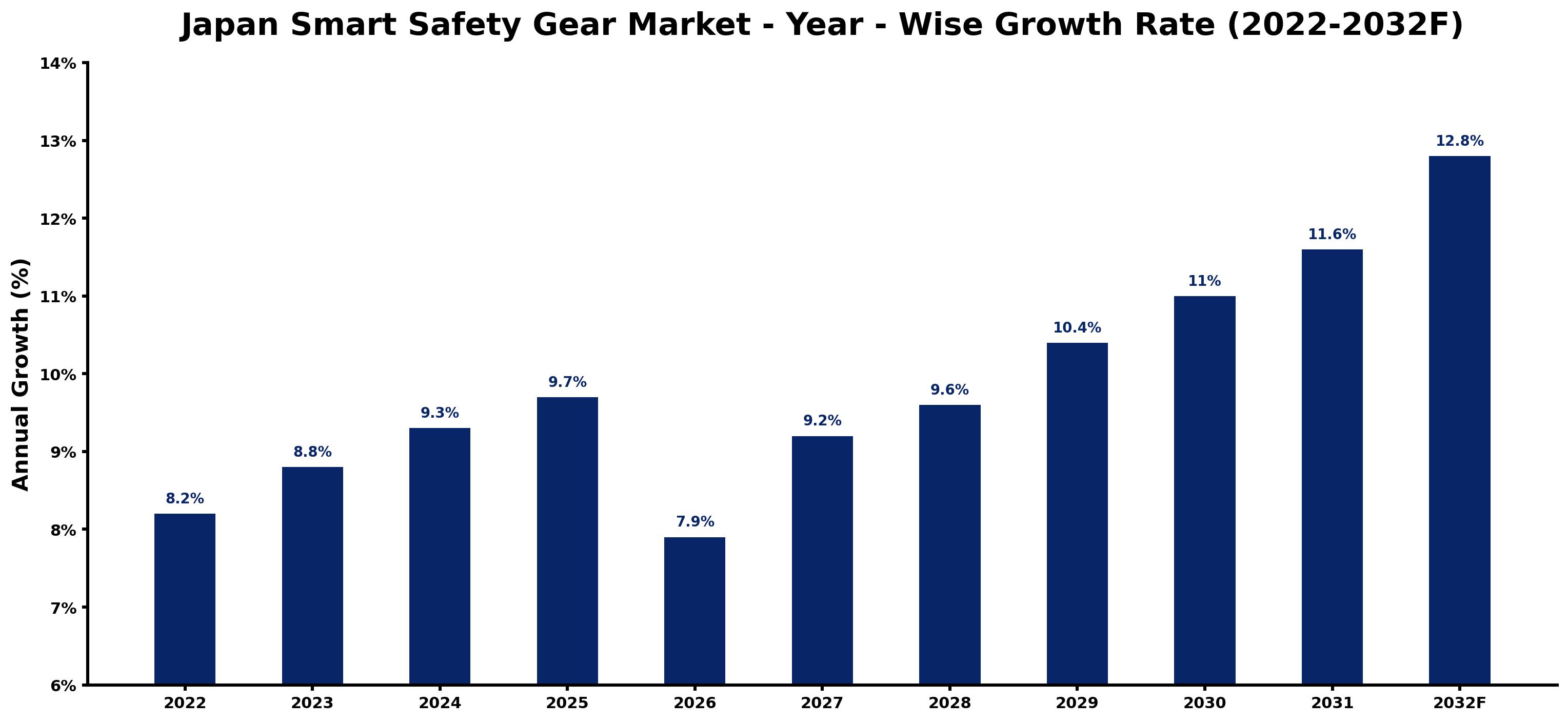
The table below sets out the estimated growth rate for each year and the main factor behind it.
| Year | Estimated Annual Growth (%) | Market Rationale |
| 2022 | 8.2 | The market experienced steady growth due to increasing awareness of worker safety. |
| 2023 | 8.8 | Demand rose as more industries adopted smart safety gear for compliance. |
| 2024 | 9.3 | Growth accelerated with advancements in wearable technology improving safety features. |
| 2025 | 9.7 | The introduction of new safety regulations further boosted market demand. |
| 2026 | 7.9 | Growth is expected to slow slightly as the market begins to stabilise after rapid expansion. |
| 2027 | 9.2 | Demand will increase again as industries seek to improve safety standards. |
| 2028 | 9.6 | Technological advancements in smart safety gear will contribute to rising sales. |
| 2029 | 10.4 | Adoption of AI-driven safety solutions in various sectors is projected to spur growth. |
| 2030 | 11.0 | Investment in safety technology will continue to rise, supporting market expansion. |
| 2031 | 11.6 | Growing focus on health monitoring in workplaces will increase demand for gear. |
| 2032 | 12.8 | The market is expected to peak as safety standards become more stringent across industries. |
Note: Market size estimations and growth projections presented in this report are based on 6Wresearch's proprietary forecasting methodology, utilizing the latest available industry data, government publications, and primary research inputs.
Japan Smart Safety Gear Market Synopsis
Smart safety gear utilises advanced technology to improve worker safety through real-time monitoring and alerts, primarily in hazardous environments like construction sites and manufacturing plants. The Japan Smart Safety Gear Market is expanding due to a construction workforce of approximately 5 million and increasing adoption of technology such as smart helmets and wearable safety vests. The government's push for safety standards, highlighted by the Industrial Safety and Health Act and the launch of a new program in 2023, drives demand and investment in this sector.
Market Dynamics Impact Analysis (2026–2032)
| Factor | Type | Impact | Primary Segment Affected |
| Growing construction workforce | Driver | High | Smart Helmets |
| Increased safety regulations | Driver | High | Wearable Safety Vests |
| Rising demand for health monitoring solutions | Opportunity | High | Wearable Safety Vests |
| Technological advancements in AI safety gear | Opportunity | Medium | AI Safety Goggles |
| High initial investment costs | Restraint | High | Smart Helmets |
| Limited awareness among smaller businesses | Restraint | Medium | Wearable Safety Vests |
| Competition from traditional safety equipment | Challenge | High | Smart Helmets |
| Slow adoption of new technologies | Challenge | Medium | AI Safety Goggles |
Evaluation of Drivers in Japan Smart Safety Gear Market (2026–2032)
Below are the drivers that matter most for revenue growth, with supporting evidence.
| Drivers | Primary Segment Affected | Why It Matters (Evidence) |
| Increasing workforce safety awareness | Smart Helmets | Japan's construction workforce of approximately 5 million drives demand for smart helmets, improving communication and safety. |
| Regulatory compliance requirements | Wearable Safety Vests | The Industrial Safety and Health Act mandates improved safety measures, leading to higher purchases of wearable safety vests. |
| Technological advancements in smart gear | AI Safety Goggles | Innovations in AI safety goggles improve hazard detection, prompting mining operations to adopt these solutions. |
| Health monitoring needs in extreme conditions | Wearable Safety Vests | The rise of health monitoring in manufacturing plants boosts demand for wearable safety vests. |
| Enhanced communication capabilities | Smart Helmets | Smart helmets facilitate real-time communication, increasing their adoption in construction sites. |
Orders keep climbing as the construction workforce in Japan, approximately 5 million, prioritises safety. Innovations in AI safety goggles improve hazard detection, prompting increased adoption in mining operations. The need for health monitoring in manufacturing plants boosts demand for wearable safety vests, while improved communication features in smart helmets support their growing use in hazardous environments. These factors contribute to substantial market expansion.
Evaluation of Restraints in Japan Smart Safety Gear Market
The key brakes on demand, and where they bite hardest, are shown below.
| Market Restraint | Primary Segment Affected | Why It Matters (Evidence) |
| High initial investment costs | Smart Helmets | The cost of implementing smart helmets can deter smaller construction firms from adoption, limiting market growth. |
| Limited awareness among smaller businesses | Wearable Safety Vests | Many smaller firms remain unaware of the benefits of wearable safety vests, hindering market penetration. |
| Competition from traditional safety equipment | Smart Helmets | Traditional safety gear remains prevalent, creating challenges for smart helmet adoption in established sectors. |
| Slow adoption of new technologies | AI Safety Goggles | Some industries are hesitant to adopt AI safety goggles due to unfamiliarity with the technology. |
| Regulatory compliance challenges | Wearable Safety Vests | Complex regulations may discourage smaller businesses from investing in wearable safety solutions. |
Japan Smart Safety Gear Market Challenges
Buyers in construction and manufacturing are facing rising costs, as smart safety gear can represent over 20% of their safety budgets. Limited availability of these products hinders buyers' efforts, with suppliers struggling to meet the needs of a workforce of around 5 million. Many smaller firms remain unaware of the advantages of smart safety solutions, delaying their adoption and integration into operations. Supply chain disruptions occur when manufacturers depend on specific components, resulting in delays that impede buyers' ability to improve workplace safety.
Trends in the Japan Smart Safety Gear Market
Four trends stand out in the Japan Smart Safety Gear Market.
- Increased Use of Smart Helmets in Construction: Construction sites are increasingly using smart helmets for communication and safety alerts, with their adoption rate reaching 43% in 2025. This trend reflects a growing commitment to worker safety.
- Wearable Safety Vests Gaining Popularity: Wearable safety vests are becoming essential in manufacturing plants for health monitoring, with a projected CAGR of 15.3% from 2026 to 2032. This shift highlights the importance of worker health in industrial settings.
- AI Safety Goggles in Mining Operations: Mining operations began testing AI safety goggles in 2023 for hazard detection, showcasing a shift towards advanced safety technology. Their adoption is expected to improve safety measures.
- Rising Demand for Visual Hazard Detection Technology: Visual hazard detection technology is gaining traction, with a CAGR of 14.0% expected from 2026 to 2032. This trend is driven by the need for proactive safety measures in various industries.
Investment Opportunities in the Japan Smart Safety Gear Market
The openings below show where demand in the Japan Smart Safety Gear Market is visible and how suppliers can enter.
- Joint Ventures with Local Firms: Establishing partnerships with local construction firms can facilitate market entry, particularly as the sector seeks advanced safety solutions. The construction industry is projected to grow, boosting investment in safety technology.
- Investment in Industrial Workshops: Industrial workshops in Japan are increasingly investing in smart safety gear, creating opportunities for suppliers. The total number of manufacturing plants is around 50,000, many of which are adopting smart safety solutions.
- Health Monitoring Solutions for Manufacturing Plants: The demand for health monitoring technologies is rising, especially in manufacturing plants. Suppliers can enter this market by providing wearable safety vests with advanced health metrics capabilities.
- Expanding AI Safety Solutions in Mining: Investment in AI safety solutions is expanding, particularly within mining operations. Suppliers can benefit by offering AI safety goggles that improve hazard detection and worker safety.
Government Initiatives in the Japan Smart Safety Gear Market
The Economic Security Promotion Act of 2022 supports supply-chain resilience for critical products, strengthening the smart safety gear market. This act complements the Industrial Safety and Health Act, which mandates employer duties regarding hazardous substances and machinery, ensuring a safer working environment. The act aims to elevate safety standards across industries, benefiting both producers and buyers of smart safety gear.
The Ministry of Health, Labour and Welfare oversees the implementation of workplace safety regulations under the Industrial Safety and Health Act. This agency promotes compliance among businesses, ensuring that smart safety gear is effectively utilised to protect workers in hazardous environments. The ministry's initiatives aim to increase the adoption of smart safety gear, contributing to improved workplace safety standards.
Future Insight of the Japan Smart Safety Gear Market
By 2032, the investment pipeline for safety technology will generate strong demand for smart safety gear, particularly in construction and manufacturing. Stricter safety standards will compel buyers to implement advanced solutions, creating a safer work environment. The government's initiative to promote technology adoption will encourage suppliers to innovate and meet evolving buyer expectations. As smart helmets and wearable safety vests gain traction, suppliers will prioritise the development of new features to maintain their competitive edge.
Market Segmentation Analysis
Japan Smart Safety Gear Market report covers a detailed analysis of the following market segments:
By Gear Type – Smart Helmets Lead, Wearable Safety Vests Expected to Grow Fastest
According to Saurav Kr Singh, Senior Research Analyst at 6Wresearch, the largest gear type category in 2025 was Smart Helmets, at 43% of revenue. Smart helmets are widely used in Japan's construction sector, where a workforce of about 5 million requires effective head protection and communication tools. Their integration of advanced technology aligns with the government's commitment to safety standards, particularly through initiatives like the Industrial Safety and Health Act. Over 2026–2032, Wearable Safety Vests are expected to post the fastest growth, at a CAGR of 15.3%. The rapid adoption of wearable safety vests in manufacturing plants is driven by the need for improved visibility and health monitoring across approximately 50,000 facilities. Recent government initiatives aimed at enhancing safety technology adoption further support this growth. Suppliers should focus on enhancing the functionality of wearable safety vests to meet the increasing demand in manufacturing.
By Smart Feature – Fall/Collision Alerts Lead, Visual Hazard Detection Expected to Grow Fastest
With 52% of smart feature revenue in 2025, Fall/Collision Alerts was the largest category. Fall and collision alerts are crucial for preventing accidents in high-risk environments like construction sites, making them a primary focus for safety gear manufacturers. Their importance is underscored by the Japanese government's commitment to enforcing stringent workplace safety regulations. Visual Hazard Detection is projected to grow fastest, at a CAGR of 14.0% during 2026–2032. Visual hazard detection is quickly gaining traction due to its ability to identify potential dangers in real-time, which is essential for maintaining safety in complex industrial settings. The growing complexity of job sites further fuels this demand. Buyers should prioritise smart safety gear that includes advanced visual hazard detection features to enhance workplace safety.
By Sensor Type – Accelerometer + GPS Leads, Camera + AI Expected to Grow Fastest
In 2025, Accelerometer + GPS led the sensor type split with a 35% share. The combination of accelerometer and GPS sensors is vital for tracking worker movement and location, making them indispensable in construction and industrial applications. Their widespread use reflects the need for real-time monitoring in hazardous environments. Camera + AI is set to record the highest CAGR in this split, 15.8% over 2026–2032. Camera and AI technology are rapidly advancing, providing real-time hazard analysis that meets the needs of modern safety protocols. This growth is driven by the increasing integration of AI in safety gear across various industries. Suppliers must invest in developing camera and AI capabilities to remain competitive in the evolving safety gear market.
By End User – Construction Sites Lead, Manufacturing Plants Expected to Grow Fastest
Construction Sites accounted for 43% of the market by end user in 2025. Construction sites represent the largest segment for smart safety gear, driven by the need to protect a workforce of around 5 million. Ongoing government initiatives to improve safety standards reinforce this segment's dominance. The quickest growth will come from Manufacturing Plants, forecast to expand at a CAGR of 13.4% between 2026 and 2032. Manufacturing plants are experiencing a significant increase in the adoption of smart safety gear as they aim to enhance worker safety and comply with regulations. The presence of approximately 50,000 manufacturing facilities in Japan accelerates this trend. Suppliers should tailor their products to meet the specific safety needs of manufacturing plants to take advantage of this growing market.
Key Attractiveness of the Report
- 10 Years of Market Numbers
- Historical Data Starting from 2022 to 2025
- Base Year 2025
- Forecast Data until 2032
- Key Performance Indicators Impacting the Market
- Major Upcoming Developments and Projects
Key Highlights of the Report:
- Japan Smart Safety Gear Market Outlook
- Market Size of Japan Smart Safety Gear Market, 2025
- Forecast of Japan Smart Safety Gear Market, 2032
- Historical Data and Forecast of Japan Smart Safety Gear Revenues & Volume for the Period 2022-2032F
- Japan Smart Safety Gear Market Trend Evolution
- Japan Smart Safety Gear Market Drivers and Challenges
- Japan Smart Safety Gear Price Trends
- Japan Smart Safety Gear Porter's Five Forces
- Japan Smart Safety Gear Industry Life Cycle
- Historical Data and Forecast of Japan Smart Safety Gear Market Revenues & Volume By Gear Type for the Period 2022-2032F
- Historical Data and Forecast of Japan Smart Safety Gear Market Revenues & Volume By Smart Helmets for the Period 2022-2032F
- Historical Data and Forecast of Japan Smart Safety Gear Market Revenues & Volume By Smart Gloves for the Period 2022-2032F
- Historical Data and Forecast of Japan Smart Safety Gear Market Revenues & Volume By Wearable Safety Vests for the Period 2022-2032F
- Historical Data and Forecast of Japan Smart Safety Gear Market Revenues & Volume By AI Safety Goggles for the Period 2022-2032F
- Historical Data and Forecast of Japan Smart Safety Gear Market Revenues & Volume By Smart Feature for the Period 2022-2032F
- Historical Data and Forecast of Japan Smart Safety Gear Market Revenues & Volume By Fall/Collision Alerts for the Period 2022-2032F
- Historical Data and Forecast of Japan Smart Safety Gear Market Revenues & Volume By Fatigue + Grip Monitoring for the Period 2022-2032F
- Historical Data and Forecast of Japan Smart Safety Gear Market Revenues & Volume By Heart Rate/Temp Alerts for the Period 2022-2032F
- Historical Data and Forecast of Japan Smart Safety Gear Market Revenues & Volume By Visual Hazard Detection for the Period 2022-2032F
- Historical Data and Forecast of Japan Smart Safety Gear Market Revenues & Volume By Sensor Type for the Period 2022-2032F
- Historical Data and Forecast of Japan Smart Safety Gear Market Revenues & Volume By Accelerometer + GPS for the Period 2022-2032F
- Historical Data and Forecast of Japan Smart Safety Gear Market Revenues & Volume By Pressure Sensors for the Period 2022-2032F
- Historical Data and Forecast of Japan Smart Safety Gear Market Revenues & Volume By Biometric Sensors for the Period 2022-2032F
- Historical Data and Forecast of Japan Smart Safety Gear Market Revenues & Volume By Camera + AI for the Period 2022-2032F
- Historical Data and Forecast of Japan Smart Safety Gear Market Revenues & Volume By End User for the Period 2022-2032F
- Historical Data and Forecast of Japan Smart Safety Gear Market Revenues & Volume By Construction Sites for the Period 2022-2032F
- Historical Data and Forecast of Japan Smart Safety Gear Market Revenues & Volume By Manufacturing Plants for the Period 2022-2032F
- Historical Data and Forecast of Japan Smart Safety Gear Market Revenues & Volume By Mining Workers for the Period 2022-2032F
- Historical Data and Forecast of Japan Smart Safety Gear Market Revenues & Volume By Industrial Workshops for the Period 2022-2032F
- Japan Smart Safety Gear Import Export Trade Statistics
- Market Opportunity Assessment By Gear Type
- Market Opportunity Assessment By Smart Feature
- Market Opportunity Assessment By Sensor Type
- Market Opportunity Assessment By End User
- Japan Smart Safety Gear Top Companies Market Share
- Japan Smart Safety Gear Competitive Benchmarking By Technical and Operational Parameters
- Japan Smart Safety Gear Company Profiles
- Japan Smart Safety Gear Key Strategic Recommendations
Market Covered
The following segment groups are covered in the report.
By Gear Type
- Smart Helmets
- Smart Gloves
- Wearable Safety Vests
- AI Safety Goggles
By Smart Feature
- Fall/Collision Alerts
- Fatigue + Grip Monitoring
- Heart Rate/Temp Alerts
- Visual Hazard Detection
By Sensor Type
- Accelerometer + GPS
- Pressure Sensors
- Biometric Sensors
- Camera + AI
By End User
- Construction Sites
- Manufacturing Plants
- Mining Workers
- Industrial Workshops































