Japan Smart Sensor Platform AI Market Size & Growth Rate
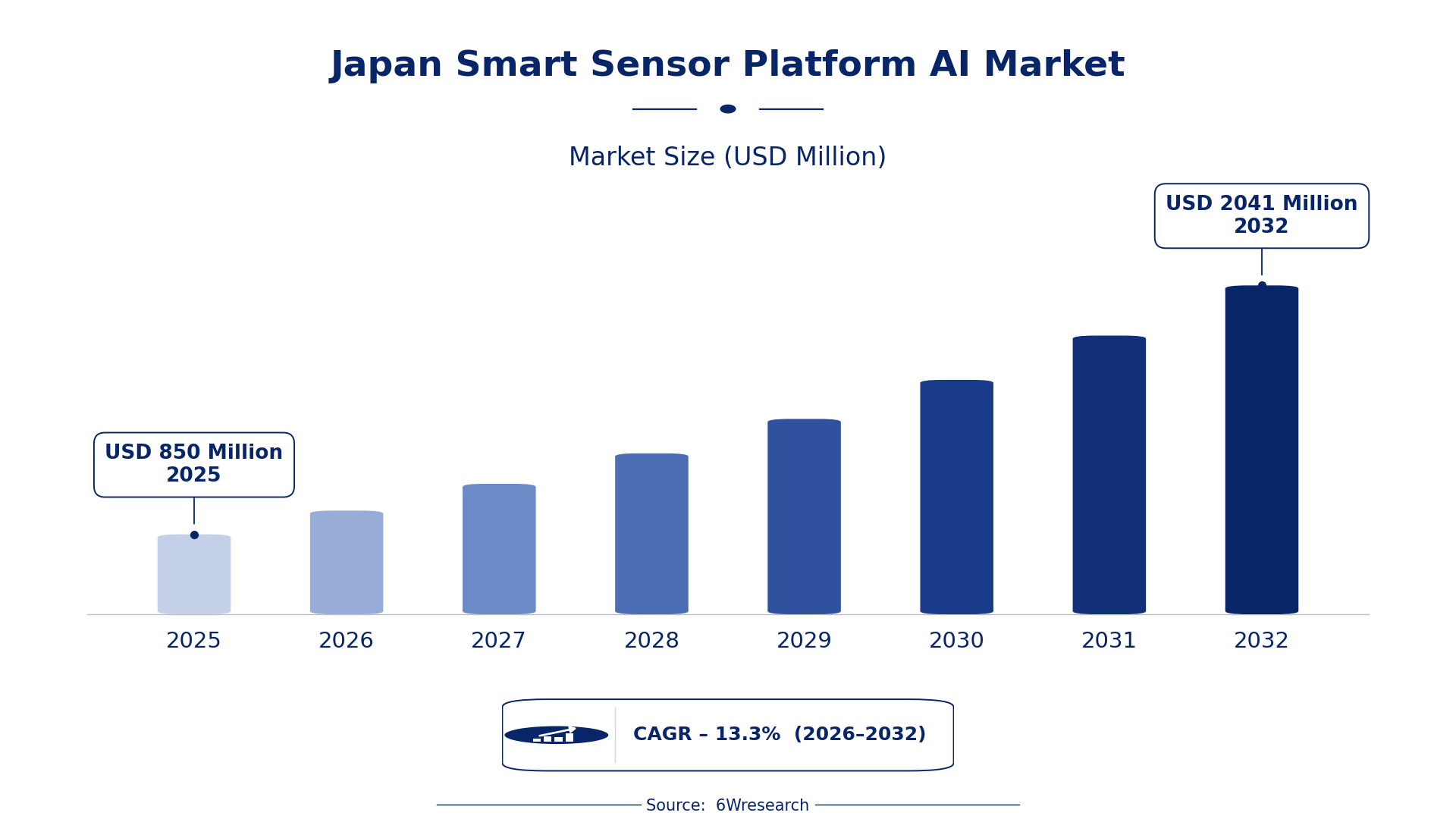
According to 6Wresearch internal database and industry insights, the Japan Smart Sensor Platform AI Market was valued at USD 850 Million in 2025 and is projected to reach USD 2,041 Million by 2032, growing at a CAGR of approximately 13.3% during 2026–2032.
Japan Smart Sensor Platform AI Market Highlights
| Report Metric | Details |
| Report Name | Japan Smart Sensor Platform AI Market (2026-2032) |
| Market Size 2025 | USD 850 Million |
| Market Size 2032 | USD 2,041 Million |
| Absolute Growth 2025–2032 | USD 1,191 Million |
| CAGR 2026–2032 | 13.3% |
| Peak Annual Growth | 14.2% in 2026 |
| Forecast Period | 2026–2032 |
| Historical Data | 2022–2025 |
| Base Year | 2025 |
| Leading Platform Type, 2025 | Industrial Sensor Hubs (37% share) |
| Leading AI Application, 2025 | Predictive Maintenance (49% share) |
| Leading Sensor Suite, 2025 | Vibration (15% share) |
| Leading End User, 2025 | OEMs & Factories (47% share) |
| Fastest-Growing Platform Type | Health Monitoring Kits (14.8% CAGR) |
| Fastest-Growing AI Application | Vitals Analytics (18.1% CAGR) |
| Fastest-Growing Sensor Suite | Temp Sensors (18.4% CAGR) |
| Fastest-Growing End User | Wearables Industry (18.0% CAGR) |
| Growing Sector | health monitoring |
| Key End Users | OEMs, healthcare providers, farmers, urban developers |
Japan Smart Sensor Platform AI Market Year-wise Growth Rate and Key Drivers (2022–2032)
This graph illustrates the annual growth rates of the market from 2022 to 2032, highlighting a steady upward trajectory and projected market expansion over the forecast period.
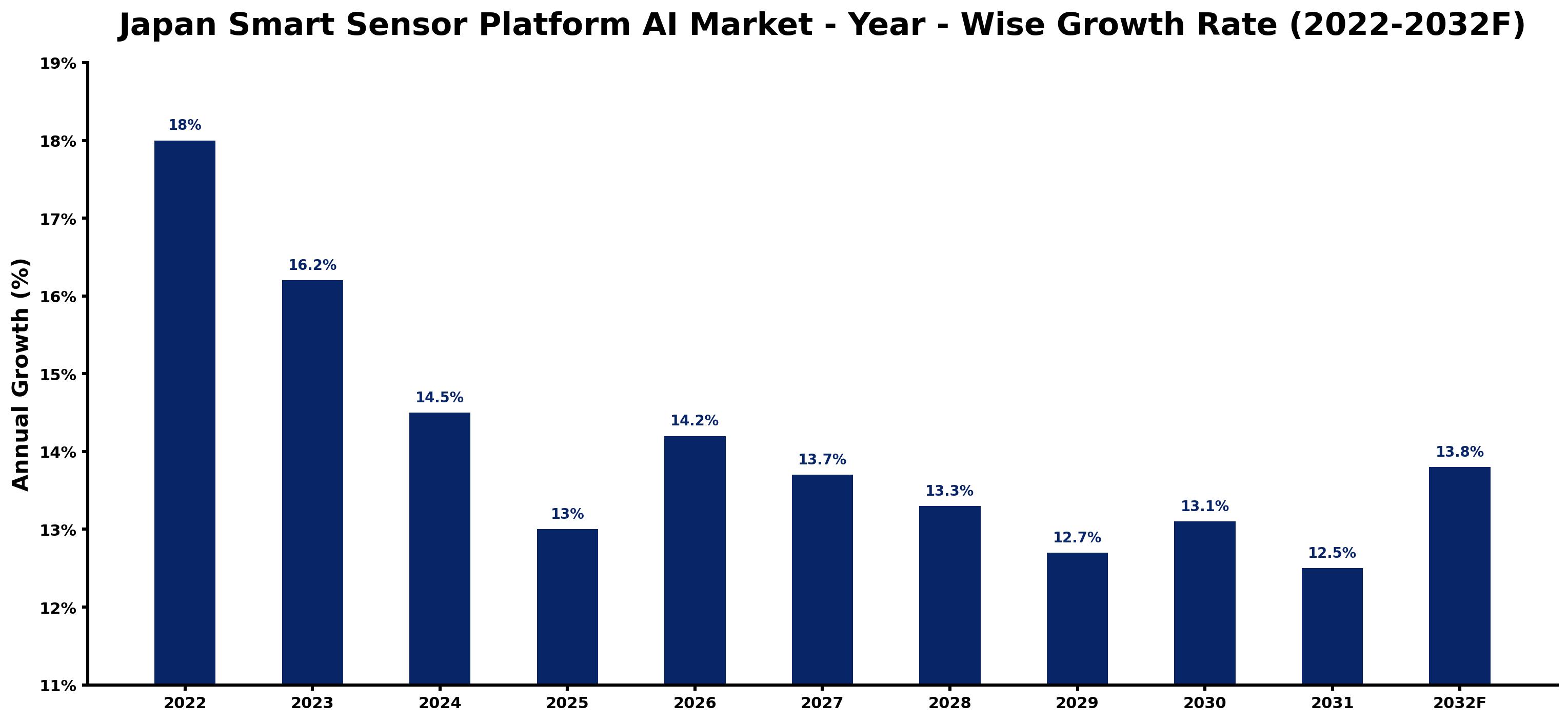
Each row of the following table gives one year's estimated growth and the event or demand shift that explains it.
| Year | Estimated Annual Growth (%) | Market Rationale |
| 2022 | 18.0 | The market experienced strong growth due to heightened investments in smart technologies. |
| 2023 | 16.2 | Demand continued to rise, although growth slowed compared to the previous year. |
| 2024 | 14.5 | A focus on automation in industries contributed to ongoing market expansion. |
| 2025 | 13.0 | The market maintained a steady growth rate as smart sensor adoption increased. |
| 2026 | 14.2 | Growth is expected to accelerate as new technologies and applications gain traction. |
| 2027 | 13.7 | The market will continue to expand, albeit at a slower rate than in 2026. |
| 2028 | 13.3 | Demand is projected to remain strong, with a slight decrease in growth rate observed. |
| 2029 | 12.7 | The market's growth is expected to slow further, yet continue to reflect positive trends. |
| 2030 | 13.1 | An uptick in technological advancements will spur renewed interest in smart sensors. |
| 2031 | 12.5 | Growth is projected to decelerate slightly as the market stabilises after rapid expansion. |
| 2032 | 13.8 | Demand is expected to rise again as new applications emerge in various sectors. |
Note: Market size estimations and growth projections presented in this report are based on 6Wresearch's proprietary forecasting methodology, utilizing the latest available industry data, government publications, and primary research inputs.
Japan Smart Sensor Platform AI Market Synopsis
Smart Sensor Platform AI integrates various sensors and AI technologies to improve data collection and analysis across industries. The Japan Smart Sensor Platform AI Market is growing due to substantial investments in smart technologies, especially in manufacturing and healthcare. With over 1,000 registered smart sensor companies, demand is robust from sectors such as predictive maintenance and health monitoring, indicating a shift towards automation and advanced analytics.
Market Dynamics Impact Analysis (2026–2032)
| Factor | Type | Impact | Primary Segment Affected |
| Increasing investments in automation technologies | Driver | High | Predictive Maintenance |
| Rising adoption of smart farming technologies | Driver | High | Agricultural Platforms |
| Growing health monitoring market driven by aging population | Opportunity | High | Health Monitoring Kits |
| Expansion of smart city initiatives across urban areas | Opportunity | Medium | Industrial Sensor Hubs |
| High costs associated with advanced sensor technologies | Restraint | High | Autonomous Systems AI |
| Limited interoperability between different sensor platforms | Restraint | Medium | Industrial Sensor Hubs |
| Challenges in securing skilled workforce for technology deployment | Challenge | High | OEMs & Factories |
| Technological obsolescence in rapidly evolving markets | Challenge | Medium | Wearables Industry |
Evaluation of Drivers in Japan Smart Sensor Platform AI Market (2026–2032)
The factors lifting demand, and the evidence behind each, are summarised below.
| Drivers | Primary Segment Affected | Why It Matters (Evidence) |
| Rising automation in manufacturing processes | Predictive Maintenance | This trend increases the need for predictive maintenance solutions, with the installed base of industrial sensors in Japan estimated at 10 million units, prompting manufacturers to invest in smart sensor platforms. |
| Health concerns among the elderly population | Health Monitoring Kits | This demographic shift is driving the health monitoring market towards a projected 200 billion yen by 2025, leading healthcare providers to adopt advanced monitoring solutions. |
| Adoption of smart farming technologies | Agricultural Platforms | Over 30% of Japanese farmers are expected to embrace smart farming technologies by 2025, creating demand for agricultural platforms that optimise crop yields. |
| Urban developments and infrastructure projects | Industrial Sensor Hubs | The Smart City Strategy initiated by the government aims to integrate smart sensors into urban infrastructure, enhancing data collection and management for city planners. |
| Advancements in sensor capabilities | Vibration | These improvements are encouraging industries to invest in vibration sensors for machinery health monitoring, ensuring operational efficiency and reducing downtime. |
Several shifts outside the market lift sales. The increased automation in manufacturing processes is driving demand for predictive maintenance solutions, with the installed base of industrial sensors in Japan estimated at 10 million units. Health concerns among the elderly population are pushing the health monitoring market towards a projected 200 billion yen by 2025. Advances in sensor capabilities are encouraging farmers to adopt agricultural platforms, particularly as over 30% of Japanese farmers are expected to embrace smart farming technologies by 2025. Urban developments are further increasing demand for industrial sensor hubs, aligning with the Semiconductor and Digital Industry Strategy.
Evaluation of Restraints in Japan Smart Sensor Platform AI Market
The key brakes on demand, and where they bite hardest, are shown below.
| Market Restraint | Primary Segment Affected | Why It Matters (Evidence) |
| High costs associated with advanced sensor technologies | Autonomous Systems AI | These costs limit adoption among smaller manufacturers, affecting their competitiveness in the market. |
| Limited interoperability between different sensor platforms | Industrial Sensor Hubs | Interoperability issues hinder integration efforts, causing delays in deployment for OEMs and factories. |
| Challenges in securing skilled workforce for technology deployment | OEMs & Factories | The shortage of skilled workers delays the implementation of smart sensor technologies, impacting production efficiency. |
| Technological obsolescence in rapidly evolving markets | Wearables Industry | Rapid advancements in technology can render existing products obsolete, increasing costs for manufacturers. |
| Regulatory compliance costs for new technologies | Health Monitoring Kits | Compliance with health regulations raises costs for manufacturers, potentially slowing down market growth. |
Japan Smart Sensor Platform AI Market Challenges
Japan's stringent regulations present a barrier for smart sensor producers, as compliance with standards like JIS Z 8801 can delay product launches by up to six months. Buyers face increased costs due to these delays, resulting in a 15% rise in procurement expenses. A shortage of skilled workers hampers production efficiency, with 40% of companies unable to find qualified personnel, ultimately reducing output for producers. Supply chain disruptions from global events can lead to essential component shortages, causing delivery delays for buyers averaging three weeks.
Trends in the Japan Smart Sensor Platform AI Market
The trends below show where the Japan Smart Sensor Platform AI Market is heading.
- Shift towards Health Monitoring Solutions: Healthcare providers are increasingly adopting health monitoring kits to track patient health, reflecting a growing demand for advanced health technologies. The health monitoring market is projected to reach 200 billion yen by 2025.
- Transition from Traditional to Smart Farming: Over 30% of Japanese farmers are adopting smart farming technologies by 2025, reflecting a shift towards precision agriculture. This trend is important for optimizing crop yields and sustainability.
- Emergence of Smart City Initiatives: The Tokyo metropolitan area is becoming a hub for smart sensor development, driven by the Semiconductor and Digital Industry Strategy. This initiative aims for widespread integration of smart sensors by 2025, improving urban living.
- Prioritisation of Predictive Maintenance: OEMs and factories are prioritising predictive maintenance solutions to reduce downtime. This focus is supported by the increasing installed base of industrial sensors, estimated at 10 million units.
Investment Opportunities in the Japan Smart Sensor Platform AI Market
Below are the investment opportunities with the strongest case in the Japan Smart Sensor Platform AI Market.
- Growing Demand for Health Monitoring Solutions: With Japan's health monitoring market projected to reach 200 billion yen by 2025, there is an opportunity for investment in health monitoring kits. Hospitals and healthcare providers are key buyers.
- Investment in Smart Agriculture Technologies: As over 30% of Japanese farmers adopt smart farming technologies by 2025, there is a gap in supply for agricultural platforms. Collaborating with local agricultural cooperatives can facilitate market entry.
- Expansion of Smart City Projects: The Semiconductor and Digital Industry Strategy aims for integration of smart sensors by 2025, presenting opportunities for suppliers. Urban developers in Tokyo are looking for advanced sensor solutions.
- Rising Interest in Environmental Monitoring: With increasing awareness of environmental issues, there is a demand for environmental sensors. Local governments are actively seeking solutions to comply with JIS Z 8801 standards.
Government Initiatives in the Japan Smart Sensor Platform AI Market
The Semiconductor and Digital Industry Strategy, established in June 2021, aims to secure domestic semiconductor manufacturing, which is essential for smart sensor production. This strategy encourages investment in local facilities, strengthening the supply chain for smart sensor technologies.
The Economic Security Promotion Act (2022) supports supply-chain resilience for critical products, benefiting buyers in the health sector. This act enables healthcare providers to access reliable health monitoring solutions, ensuring patient safety and compliance with regulations.
Future Insight of the Japan Smart Sensor Platform AI Market
The Smart City Strategy will promote the integration of smart sensors into urban infrastructure by 2025, improving data collection for city management. By 2032, the health monitoring market will grow significantly, driven by an ageing population. The Ministry of Economy, Trade and Industry's initiatives will encourage tech adoption in agriculture, benefiting farmers. Research from Tokyo University of Science will advance AI applications in smart sensors, expanding capabilities across various sectors.
Market Segmentation Analysis
Japan Smart Sensor Platform AI Market report covers a detailed analysis of the following market segments:
By Platform Type – Industrial Sensor Hubs Lead, Health Monitoring Kits Expected to Grow Fastest
According to Saurav Kr Singh, Senior Research Analyst at 6Wresearch, Industrial Sensor Hubs took 37% of platform type revenue in 2025, more than any other category. Industrial Sensor Hubs dominate the market as they are vital for data collection and analysis in manufacturing facilities. The extensive installed base of 10 million industrial sensors in Japan highlights their critical role in operational efficiency. The quickest growth will come from Health Monitoring Kits, forecast to expand at a CAGR of 14.8% between 2026 and 2032. Health Monitoring Kits are rapidly growing due to the rising demand for effective health tracking solutions, particularly in response to the ageing population. The health monitoring market is expected to reach 200 billion yen by 2025, indicating robust growth prospects. Suppliers should prioritise the development of health monitoring solutions to align with the increasing market demand.
By AI Application – Predictive Maintenance Leads, Vitals Analytics Expected to Grow Fastest
Predictive Maintenance held 49% of the Japan Smart Sensor Platform AI Market by ai application in 2025. Predictive Maintenance leads the market as it is essential for minimising downtime in manufacturing environments, thereby enhancing productivity. This application is increasingly adopted as industries focus on automation and efficiency improvements. Vitals Analytics is set to record the highest CAGR in this split, 18.1% over 2026–2032. Vitals Analytics is growing swiftly due to the urgent need for real-time health assessments in healthcare settings. The government's promotion of health monitoring solutions is further accelerating the demand for analytics in this sector. Healthcare buyers should invest in advanced analytics to optimise patient care and operational processes.
By Sensor Suite – Vibration Leads, Temp Sensors Expected to Grow Fastest
The largest sensor suite category in 2025 was Vibration, at 15% of revenue. Vibration sensors are the market leaders as they are crucial for monitoring machinery health, particularly in manufacturing. Their widespread application ensures a consistent demand, reinforcing their dominant market position. Over 2026–2032, Temp Sensors are expected to post the fastest growth, at a CAGR of 18.4%. Temperature Sensors are experiencing rapid growth because they are essential for maintaining optimal environmental conditions across various sectors. The push for smart agriculture solutions is significantly increasing the demand for accurate temperature monitoring. Suppliers should focus on advancing temperature sensing technologies to cater to the growing needs of multiple industries.
By End User – OEMs & Factories Lead, Wearables Industry Expected to Grow Fastest
OEMs & Factories accounted for 47% of the market by end user in 2025. OEMs & Factories are the primary users of smart sensor platforms, heavily relying on these technologies to improve operational efficiency. Their significant investment in automation drives the demand for advanced sensor solutions tailored to industrial applications. Wearables Industry is projected to grow fastest, at a CAGR of 18.0% during 2026–2032. The Wearables Industry is the fastest-growing segment, largely due to the rising consumer interest in health monitoring devices. This trend is particularly influenced by an ageing population increasingly focused on health and wellness. Manufacturers should consider partnerships with wearables developers to capitalise on the expanding health monitoring market.
Key Attractiveness of the Report
- 10 Years of Market Numbers
- Historical Data Starting from 2022 to 2025
- Base Year 2025
- Forecast Data until 2032
- Key Performance Indicators Impacting the Market
- Major Upcoming Developments and Projects
Key Highlights of the Report:
- Japan Smart Sensor Platform AI Market Outlook
- Market Size of Japan Smart Sensor Platform AI Market, 2025
- Forecast of Japan Smart Sensor Platform AI Market, 2032
- Historical Data and Forecast of Japan Smart Sensor Platform AI Revenues & Volume for the Period 2022-2032F
- Japan Smart Sensor Platform AI Market Trend Evolution
- Japan Smart Sensor Platform AI Market Drivers and Challenges
- Japan Smart Sensor Platform AI Price Trends
- Japan Smart Sensor Platform AI Porter's Five Forces
- Japan Smart Sensor Platform AI Industry Life Cycle
- Historical Data and Forecast of Japan Smart Sensor Platform AI Market Revenues & Volume By Platform Type for the Period 2022-2032F
- Historical Data and Forecast of Japan Smart Sensor Platform AI Market Revenues & Volume By Industrial Sensor Hubs for the Period 2022-2032F
- Historical Data and Forecast of Japan Smart Sensor Platform AI Market Revenues & Volume By Health Monitoring Kits for the Period 2022-2032F
- Historical Data and Forecast of Japan Smart Sensor Platform AI Market Revenues & Volume By Agricultural Platforms for the Period 2022-2032F
- Historical Data and Forecast of Japan Smart Sensor Platform AI Market Revenues & Volume By Autonomous Systems AI for the Period 2022-2032F
- Historical Data and Forecast of Japan Smart Sensor Platform AI Market Revenues & Volume By AI Application for the Period 2022-2032F
- Historical Data and Forecast of Japan Smart Sensor Platform AI Market Revenues & Volume By Predictive Maintenance for the Period 2022-2032F
- Historical Data and Forecast of Japan Smart Sensor Platform AI Market Revenues & Volume By Vitals Analytics for the Period 2022-2032F
- Historical Data and Forecast of Japan Smart Sensor Platform AI Market Revenues & Volume By Crop & Soil Monitoring for the Period 2022-2032F
- Historical Data and Forecast of Japan Smart Sensor Platform AI Market Revenues & Volume By Navigation & Safety Alerts for the Period 2022-2032F
- Historical Data and Forecast of Japan Smart Sensor Platform AI Market Revenues & Volume By Sensor Suite for the Period 2022-2032F
- Historical Data and Forecast of Japan Smart Sensor Platform AI Market Revenues & Volume By Vibration, Temp Sensors for the Period 2022-2032F
- Historical Data and Forecast of Japan Smart Sensor Platform AI Market Revenues & Volume By HR, O2, Temp for the Period 2022-2032F
- Historical Data and Forecast of Japan Smart Sensor Platform AI Market Revenues & Volume By Moisture, pH, Climate for the Period 2022-2032F
- Historical Data and Forecast of Japan Smart Sensor Platform AI Market Revenues & Volume By Lidar, Radar, IMU for the Period 2022-2032F
- Historical Data and Forecast of Japan Smart Sensor Platform AI Market Revenues & Volume By End User for the Period 2022-2032F
- Historical Data and Forecast of Japan Smart Sensor Platform AI Market Revenues & Volume By OEMs & Factories for the Period 2022-2032F
- Historical Data and Forecast of Japan Smart Sensor Platform AI Market Revenues & Volume By Wearables Industry for the Period 2022-2032F
- Historical Data and Forecast of Japan Smart Sensor Platform AI Market Revenues & Volume By Smart Farming for the Period 2022-2032F
- Historical Data and Forecast of Japan Smart Sensor Platform AI Market Revenues & Volume By Robotics Developers for the Period 2022-2032F
- Japan Smart Sensor Platform AI Import Export Trade Statistics
- Market Opportunity Assessment By Platform Type
- Market Opportunity Assessment By AI Application
- Market Opportunity Assessment By Sensor Suite
- Market Opportunity Assessment By End User
- Japan Smart Sensor Platform AI Top Companies Market Share
- Japan Smart Sensor Platform AI Competitive Benchmarking By Technical and Operational Parameters
- Japan Smart Sensor Platform AI Company Profiles
- Japan Smart Sensor Platform AI Key Strategic Recommendations
Market Covered
The study includes the following segmentation.
By Platform Type
- Industrial Sensor Hubs
- Health Monitoring Kits
- Agricultural Platforms
- Autonomous Systems AI
By AI Application
- Predictive Maintenance
- Vitals Analytics
- Crop & Soil Monitoring
- Navigation & Safety Alerts
By Sensor Suite
- Vibration
- Temp Sensors
- HR
- O2
- Temp
- Moisture
- pH
- Climate
- Lidar
- Radar
- IMU
By End User
- OEMs & Factories
- Wearables Industry
- Smart Farming
- Robotics Developers































