Japan Smart Shipping Market Size & Growth Rate
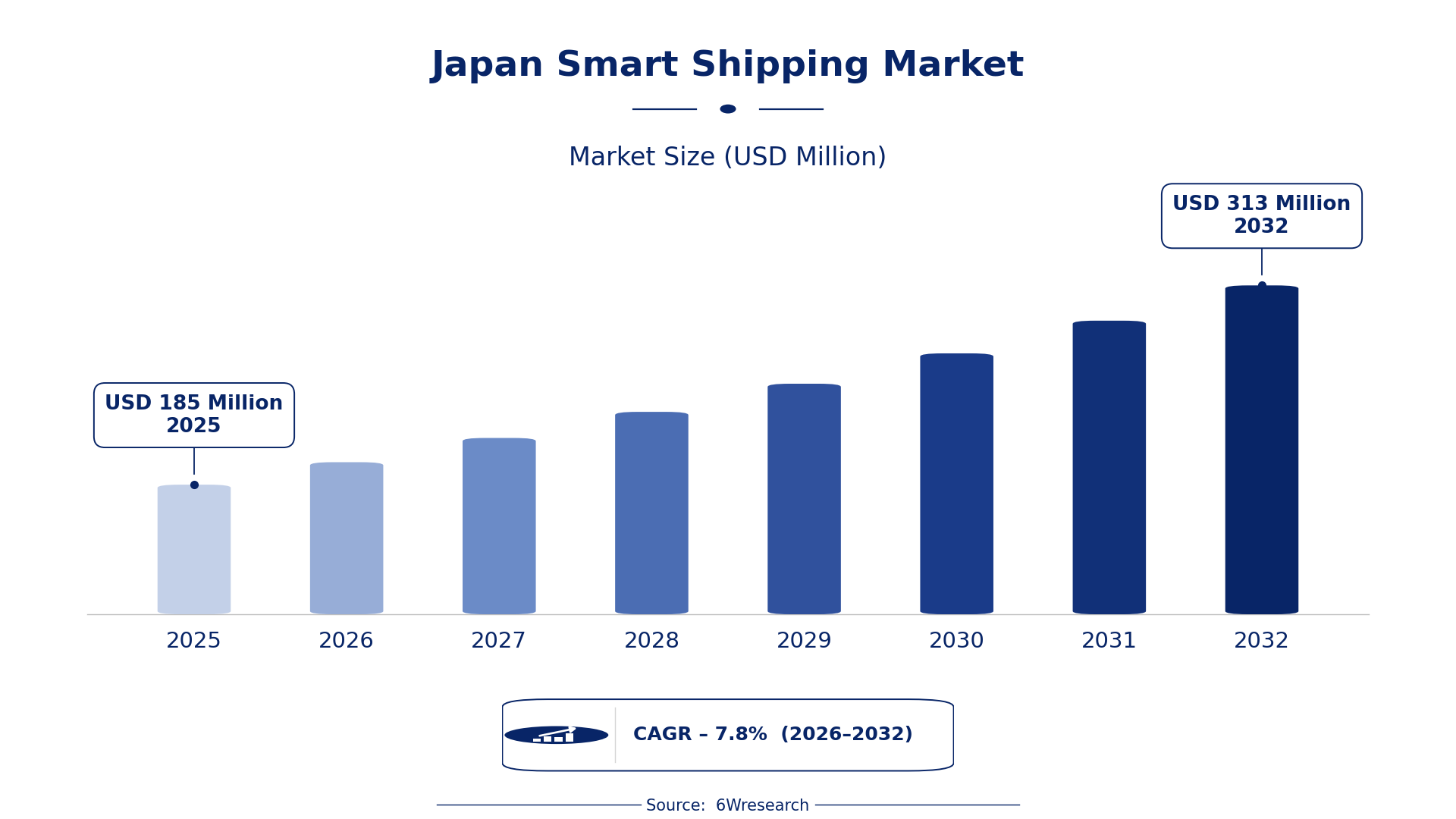
According to 6Wresearch internal database and industry insights, the Japan Smart Shipping Market was valued at USD 185 Million in 2025 and is projected to reach USD 313 Million by 2032, growing at a CAGR of approximately 7.8% during 2026–2032.
Japan Smart Shipping Market Highlights
| Report Metric | Details |
| Report Name | Japan Smart Shipping Market (2026-2032) |
| Market Size 2025 | USD 185 Million |
| Market Size 2032 | USD 313 Million |
| Absolute Growth 2025–2032 | USD 128 Million |
| CAGR 2026–2032 | 7.8% |
| Peak Annual Growth | 8.4% in 2027 |
| Forecast Period | 2026–2032 |
| Historical Data | 2022–2025 |
| Base Year | 2025 |
| Leading Shipping Component, 2025 | Container Tracking (37% share) |
| Leading Smart Feature, 2025 | GPS + Tamper Detection (50% share) |
| Leading Monitoring System, 2025 | Satellite IoT (44% share) |
| Leading End User, 2025 | Shipping Companies (33% share) |
| Fastest-Growing Shipping Component | Smart Bill of Lading (11.2% CAGR) |
| Fastest-Growing Smart Feature | Real-Time Documentation (10.2% CAGR) |
| Fastest-Growing Monitoring System | Blockchain Integration (11.7% CAGR) |
| Fastest-Growing End User | Logistics Providers (9.8% CAGR) |
| Growing Sector | maritime logistics |
| Key End Users | shipping companies, logistics providers, cold chain operators |
Japan Smart Shipping Market Year-wise Growth Rate and Key Drivers (2022–2032)
This graph illustrates the annual growth rates of the market from 2022 to 2032, highlighting a steady upward trajectory and projected market expansion over the forecast period.

The following figures match every annual growth estimate with the main market development of that year, giving the reasoning behind each rise or slowdown.
| Year | Estimated Annual Growth (%) | Market Rationale |
| 2022 | 0.1 | The market showed minimal growth as the industry adjusted to changing economic conditions. |
| 2023 | 7.4 | Demand surged due to the implementation of advanced technologies in shipping operations. |
| 2024 | 6.2 | Growth slowed slightly as companies began to consolidate technology investments. |
| 2025 | 6.7 | Increased adoption of smart features drove a faster growth rate than the previous year. |
| 2026 | 8.2 | The introduction of new AI navigation tools is expected to boost demand. |
| 2027 | 8.4 | The peak growth rate is projected as logistics providers expand their smart shipping capabilities. |
| 2028 | 7.8 | A slight slowdown is anticipated as the market stabilises after rapid expansion. |
| 2029 | 7.2 | Growth will continue to decelerate as the market matures and competition intensifies. |
| 2030 | 8.3 | Demand is expected to accelerate again as new regulations encourage technology upgrades. |
| 2031 | 6.6 | A further slowdown is projected as the market faces saturation in certain segments. |
| 2032 | 8.1 | Growth is anticipated to rebound with renewed investments in advanced shipping technologies. |
Note: Market size estimations and growth projections presented in this report are based on 6Wresearch's proprietary forecasting methodology, utilizing the latest available industry data, government publications, and primary research inputs.
Japan Smart Shipping Market Synopsis
Smart Shipping integrates advanced technologies in maritime logistics to improve efficiency and safety. This includes real-time tracking, route optimization, and cargo integrity assurance. The Japan Smart Shipping Market is expanding due to rising demand from domestic shipping companies and logistics providers, alongside the adoption of AI and IoT technologies. The Digital Port Initiative and the Smart Shipping Initiative are key drivers promoting technology integration and eco-friendly practices in the industry.
Market Dynamics Impact Analysis (2026–2032)
| Factor | Type | Impact | Primary Segment Affected |
| Increased adoption of IoT devices | Driver | High | Container Tracking |
| Growing demand for real-time data | Driver | High | Smart Bill of Lading |
| Emerging market for blockchain solutions | Opportunity | High | Blockchain Integration |
| Expansion of logistics hubs in Tokyo Bay | Opportunity | Medium | Logistics Providers |
| High initial investment costs for technology | Restraint | High | Route Optimization AI |
| Limited awareness of smart shipping benefits | Restraint | Medium | Cargo Condition Sensors |
| Shortage of skilled workforce in maritime tech | Challenge | High | AI Navigation Tools |
| Regulatory compliance complexities | Challenge | Medium | Shipping Companies |
Evaluation of Drivers in Japan Smart Shipping Market (2026–2032)
Demand rests on the following drivers, each shown with the segment it touches most.
| Drivers | Primary Segment Affected | Why It Matters (Evidence) |
| Integration of IoT devices for tracking | Container Tracking | Over 80% of Japan's trade volume is transported by sea, increasing the need for efficient tracking solutions. |
| Demand for digital documentation | Smart Bill of Lading | The shipping industry is valued at approximately 1.3 trillion JPY, driving the need for streamlined processes. |
| Focus on supply chain security | Blockchain Integration | The ISO 28000 standard for supply chain security increases the need for blockchain solutions in shipping. |
| Investment in AI for navigation | AI Navigation Tools | AI technologies are being integrated into maritime navigation systems for improved safety. |
| Need for cargo integrity monitoring | Cargo Condition Sensors | The government aims to reduce carbon emissions from shipping by 30% by 2030, increasing technology adoption. |
What keeps demand rising is the integration of IoT devices, with over 80% of Japan's trade volume transported by sea, necessitating efficient tracking solutions. The shipping industry drives demand for digital documentation through smart bill of lading systems. The adoption of blockchain solutions enhances supply chain security, while AI technologies are integrated into navigation systems, improving safety and operational efficiency.
Evaluation of Restraints in Japan Smart Shipping Market
These are the pressures that could keep growth below its potential.
| Market Restraint | Primary Segment Affected | Why It Matters (Evidence) |
| High initial investment costs for smart shipping technologies | Route Optimization AI | The average age of Japan's shipping fleet is around 15 years, making upgrades costly for operators. |
| Limited awareness of smart shipping benefits among smaller companies | Cargo Condition Sensors | Many logistics providers lack knowledge about the advantages of integrating smart shipping solutions. |
| Shortage of skilled workforce in maritime technology | AI Navigation Tools | Japan has over 200 maritime training institutions, but they may not meet current industry needs. |
| Regulatory compliance complexities for new technologies | Shipping Companies | The Ministry of Land, Infrastructure, Transport and Tourism oversees strict maritime regulations. |
| Fragmented market with numerous players | Smart Bill of Lading | Competition among logistics providers can hinder collaborative technology adoption. |
Japan Smart Shipping Market Challenges
Producers face high compliance costs, as the Ministry of Land, Infrastructure, Transport and Tourism enforces strict maritime regulations, raising operational expenses by 15%. Buyers encounter rising logistics expenses, with over 80% of trade volume transported by sea, causing costs to increase by approximately 10% annually. Technology adoption remains a hurdle for logistics providers, as advanced systems require substantial upfront investment, delaying integration by an average of 12 months. Aging fleets challenge shipping companies, with the average age of Japan's shipping fleet around 15 years, leading to increased maintenance costs and reduced operational efficiency.
Trends in the Japan Smart Shipping Market
These developments are changing demand patterns in the Japan Smart Shipping Market.
- Shift towards IoT Integration in Shipping: The Tokyo Bay area is experiencing a shift towards IoT integration in shipping logistics, with a projected 20% efficiency increase by 2025. This trend encourages logistics providers to adopt smart shipping solutions.
- Emergence of Blockchain for Documentation: In 2023, blockchain technology is increasingly used for secure shipping documentation, improving transparency. This shift is expected to enhance operational efficiency across the industry.
- Transition from Traditional to Smart Shipping: The introduction of new initiatives in 2023 marks a significant change, promoting technology adoption. This movement aims to modernise Japan's shipping practices and improve overall efficiency.
- Focus on Eco-Friendly Shipping Practices: The launch of the Smart Shipping Initiative in 2023 encourages eco-friendly practices in shipping. This initiative aims to reduce carbon emissions from shipping by 30% by 2030.
Investment Opportunities in the Japan Smart Shipping Market
The opportunities below stand out in the Japan Smart Shipping Market for new entrants and existing suppliers.
- Partnerships for Technology Integration: Local partnerships are essential for integrating smart shipping technologies. With the shipping industry valued at approximately 1.3 trillion JPY, logistics providers in Tokyo Bay are ideal partners for technology firms.
- Investment in Training Facilities: There is a growing need for skilled workforce development, with over 200 maritime training institutions available. Investing in training facilities can bridge the skills gap in smart shipping.
- Approval Pathways for New Solutions: The current regulatory environment supports new solutions, with the Ministry of Land, Infrastructure, Transport and Tourism approving technologies. This creates opportunities for companies offering smart shipping solutions.
- Timing for Eco-Friendly Technologies: With the government aiming for a 30% reduction in carbon emissions by 2030, now is the time to invest in eco-friendly shipping technologies to meet regulatory demands.
Government Initiatives in the Japan Smart Shipping Market
The Food Sanitation Act amendment of 2018 improved safety standards for materials used in shipping. This law, in force since June 2020, has implications for shipping companies in terms of compliance and material selection.
The Ministry of Land, Infrastructure, Transport and Tourism oversees shipping safety standards and funds projects aimed at improving maritime technology. Their initiatives include subsidies for research and development in smart shipping technologies, supporting the industry's transition to advanced solutions.
Future Insight of the Japan Smart Shipping Market
Logistics providers will benefit from the 'Digital Port Initiative', which will streamline operations and improve delivery times. By 2032, IoT integration will boost shipping efficiency by 20%, enabling suppliers to optimise logistics. The 'Smart Shipping Initiative' will drive technology adoption, compelling suppliers to innovate and enhance service quality. Continued government support for R&D in maritime technology will ensure that Japan remains a leader in advanced shipping solutions.
Market Segmentation Analysis
Japan Smart Shipping Market report covers a detailed analysis of the following market segments:
By Shipping Component – Container Tracking Leads, Smart Bill of Lading Expected to Grow Fastest
According to Saurav Kr Singh, Senior Research Analyst at 6Wresearch, with 37% of shipping component revenue in 2025, Container Tracking was the largest category. Container Tracking holds the largest share due to its critical role in monitoring cargo location, essential for shipping operations. With over 80% of Japan's trade volume transported by sea, effective tracking systems are vital for operational success. The quickest growth will come from Smart Bill of Lading, forecast to expand at a CAGR of 11.2% between 2026 and 2032. Smart Bill of Lading is experiencing rapid growth as it simplifies digital documentation processes, which are increasingly necessary in the shipping sector. The introduction of the 'Smart Shipping Initiative' in 2023 has further accelerated this trend. Suppliers should prioritise the development of advanced digital documentation solutions to meet the rising demand from shipping companies.
By Smart Feature – GPS + Tamper Detection Leads, Real-Time Documentation Expected to Grow Fastest
GPS + Tamper Detection accounted for 50% of the market by smart feature in 2025. GPS + Tamper Detection leads the market by significantly enhancing the security of shipments, a crucial requirement for shipping operations. This technology is particularly important for ensuring the safety of high-value cargo during transit. Over 2026–2032, Real-Time Documentation is expected to post the fastest growth, at a CAGR of 10.2%. Real-Time Documentation is the fastest-growing feature as it provides immediate access to shipping data, essential for improving operational efficiency. The ongoing digital transformation in shipping logistics is driving this rapid growth. Buyers should invest in real-time documentation capabilities to improve their operational responsiveness.
By Monitoring System – Satellite IoT Leads, Blockchain Integration Expected to Grow Fastest
In 2025, Satellite IoT led the monitoring system split with a 44% share. Satellite IoT dominates the market as it allows for remote monitoring of shipping conditions, essential for maintaining cargo integrity. This technology is particularly valued by shipping companies in Japan's busy maritime environment. Blockchain Integration is set to record the highest CAGR in this split, 11.7% over 2026–2032. Blockchain Integration is experiencing rapid growth due to its capacity to improve transparency and security in transactions, which is increasingly sought after by stakeholders. The demand for secure shipping documentation in Japan is driving this trend. Suppliers should prioritise blockchain solutions to address the increasing need for secure transaction processes.
By End User – Shipping Companies Lead, Logistics Providers Expected to Grow Fastest
Shipping Companies took 33% of end user revenue in 2025, more than any other category. Shipping Companies are the primary end users of smart shipping solutions, as they operate at the core of the maritime logistics sector. Their continuous pursuit of efficiency and reliability drives the adoption of advanced technologies in the industry. Logistics Providers are projected to grow fastest, at a CAGR of 9.8% during 2026–2032. Logistics Providers are experiencing the fastest growth as they increasingly integrate smart shipping solutions to enhance their operational efficiency. The rising complexity of supply chains necessitates the adoption of these technologies by logistics providers. Suppliers must customise their offerings to address the specific needs of logistics providers to capture this expanding market segment.
Key Attractiveness of the Report
- 10 Years of Market Numbers
- Historical Data Starting from 2022 to 2025
- Base Year 2025
- Forecast Data until 2032
- Key Performance Indicators Impacting the Market
- Major Upcoming Developments and Projects
Key Highlights of the Report:
- Japan Smart Shipping Market Outlook
- Market Size of Japan Smart Shipping Market, 2025
- Forecast of Japan Smart Shipping Market, 2032
- Historical Data and Forecast of Japan Smart Shipping Revenues & Volume for the Period 2022-2032F
- Japan Smart Shipping Market Trend Evolution
- Japan Smart Shipping Market Drivers and Challenges
- Japan Smart Shipping Price Trends
- Japan Smart Shipping Porter's Five Forces
- Japan Smart Shipping Industry Life Cycle
- Historical Data and Forecast of Japan Smart Shipping Market Revenues & Volume By Shipping Component for the Period 2022-2032F
- Historical Data and Forecast of Japan Smart Shipping Market Revenues & Volume By Container Tracking for the Period 2022-2032F
- Historical Data and Forecast of Japan Smart Shipping Market Revenues & Volume By Smart Bill of Lading for the Period 2022-2032F
- Historical Data and Forecast of Japan Smart Shipping Market Revenues & Volume By Route Optimization AI for the Period 2022-2032F
- Historical Data and Forecast of Japan Smart Shipping Market Revenues & Volume By Cargo Condition Sensors for the Period 2022-2032F
- Historical Data and Forecast of Japan Smart Shipping Market Revenues & Volume By Smart Feature for the Period 2022-2032F
- Historical Data and Forecast of Japan Smart Shipping Market Revenues & Volume By GPS + Tamper Detection for the Period 2022-2032F
- Historical Data and Forecast of Japan Smart Shipping Market Revenues & Volume By Real-Time Documentation for the Period 2022-2032F
- Historical Data and Forecast of Japan Smart Shipping Market Revenues & Volume By Weather & Traffic Insights for the Period 2022-2032F
- Historical Data and Forecast of Japan Smart Shipping Market Revenues & Volume By Temperature & Shock Alerts for the Period 2022-2032F
- Historical Data and Forecast of Japan Smart Shipping Market Revenues & Volume By Monitoring System for the Period 2022-2032F
- Historical Data and Forecast of Japan Smart Shipping Market Revenues & Volume By Satellite IoT for the Period 2022-2032F
- Historical Data and Forecast of Japan Smart Shipping Market Revenues & Volume By Blockchain Integration for the Period 2022-2032F
- Historical Data and Forecast of Japan Smart Shipping Market Revenues & Volume By AI Navigation Tools for the Period 2022-2032F
- Historical Data and Forecast of Japan Smart Shipping Market Revenues & Volume By IoT + Sensor Dashboard for the Period 2022-2032F
- Historical Data and Forecast of Japan Smart Shipping Market Revenues & Volume By End User for the Period 2022-2032F
- Historical Data and Forecast of Japan Smart Shipping Market Revenues & Volume By Shipping Companies for the Period 2022-2032F
- Historical Data and Forecast of Japan Smart Shipping Market Revenues & Volume By Logistics Providers for the Period 2022-2032F
- Historical Data and Forecast of Japan Smart Shipping Market Revenues & Volume By Maritime Transport for the Period 2022-2032F
- Historical Data and Forecast of Japan Smart Shipping Market Revenues & Volume By Cold Chain Operators for the Period 2022-2032F
- Japan Smart Shipping Import Export Trade Statistics
- Market Opportunity Assessment By Shipping Component
- Market Opportunity Assessment By Smart Feature
- Market Opportunity Assessment By Monitoring System
- Market Opportunity Assessment By End User
- Japan Smart Shipping Top Companies Market Share
- Japan Smart Shipping Competitive Benchmarking By Technical and Operational Parameters
- Japan Smart Shipping Company Profiles
- Japan Smart Shipping Key Strategic Recommendations
Market Covered
The study includes the following segmentation.
By Shipping Component
- Container Tracking
- Smart Bill of Lading
- Route Optimization AI
- Cargo Condition Sensors
By Smart Feature
- GPS + Tamper Detection
- Real-Time Documentation
- Weather & Traffic Insights
- Temperature & Shock Alerts
By Monitoring System
- Satellite IoT
- Blockchain Integration
- AI Navigation Tools
- IoT + Sensor Dashboard
By End User
- Shipping Companies
- Logistics Providers
- Maritime Transport
- Cold Chain Operators































