Japan Smart Spraying Systems Market Size & Growth Rate
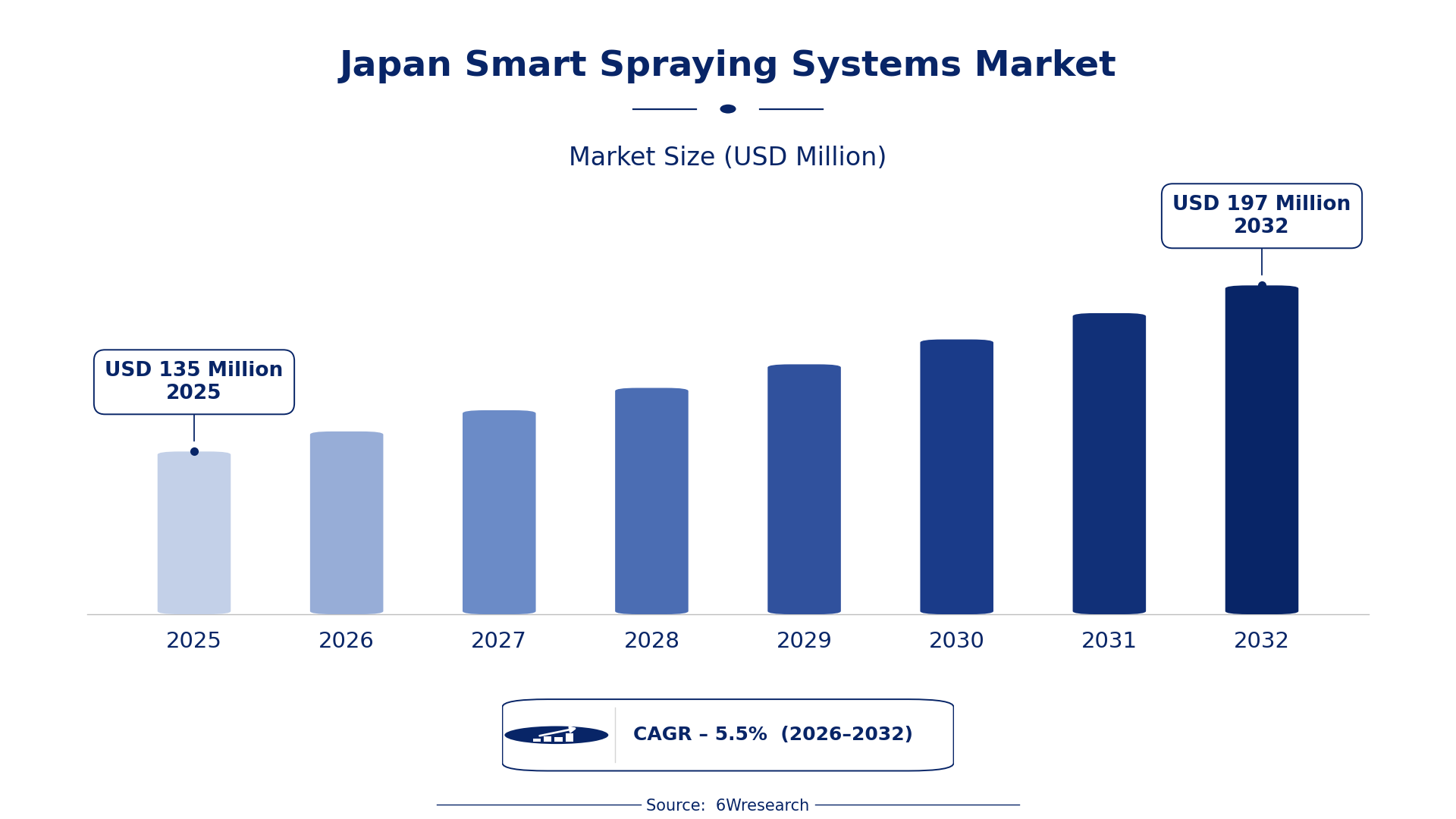
According to 6Wresearch internal database and industry insights, the Japan Smart Spraying Systems Market was valued at USD 135 Million in 2025 and is projected to reach USD 197 Million by 2032, growing at a CAGR of approximately 5.5% during 2026–2032.
Japan Smart Spraying Systems Market Highlights
| Report Metric | Details |
| Report Name | Japan Smart Spraying Systems Market (2026-2032) |
| Market Size 2025 | USD 135 Million |
| Market Size 2032 | USD 197 Million |
| Absolute Growth 2025–2032 | USD 62 Million |
| CAGR 2026–2032 | 5.5% |
| Peak Annual Growth | 6.7% in 2028 |
| Forecast Period | 2026–2032 |
| Historical Data | 2022–2025 |
| Base Year | 2025 |
| Leading System Type, 2025 | AI Crop Sprayers (41% share) |
| Leading Smart Feature, 2025 | Weed/Object Detection (40% share) |
| Leading Sensing Tech, 2025 | Vision + GPS (45% share) |
| Leading End User, 2025 | Commercial Farmers (38% share) |
| Fastest-Growing System Type | Variable Rate Sprayers (7.7% CAGR) |
| Fastest-Growing Smart Feature | Field Mapping Sync (7.5% CAGR) |
| Fastest-Growing Sensing Tech | Soil + Crop Sensors (7.4% CAGR) |
| Fastest-Growing End User | Precision Agri Users (7.2% CAGR) |
| Growing Sector | Agricultural Technology |
| Key End Users | Commercial Farmers, Agri-Tech Startups, Agrochemical Suppliers |
Japan Smart Spraying Systems Market Year-wise Growth Rate and Key Drivers (2022–2032)
This graph illustrates the annual growth rates of the market from 2022 to 2032, highlighting a steady upward trajectory and projected market expansion over the forecast period.
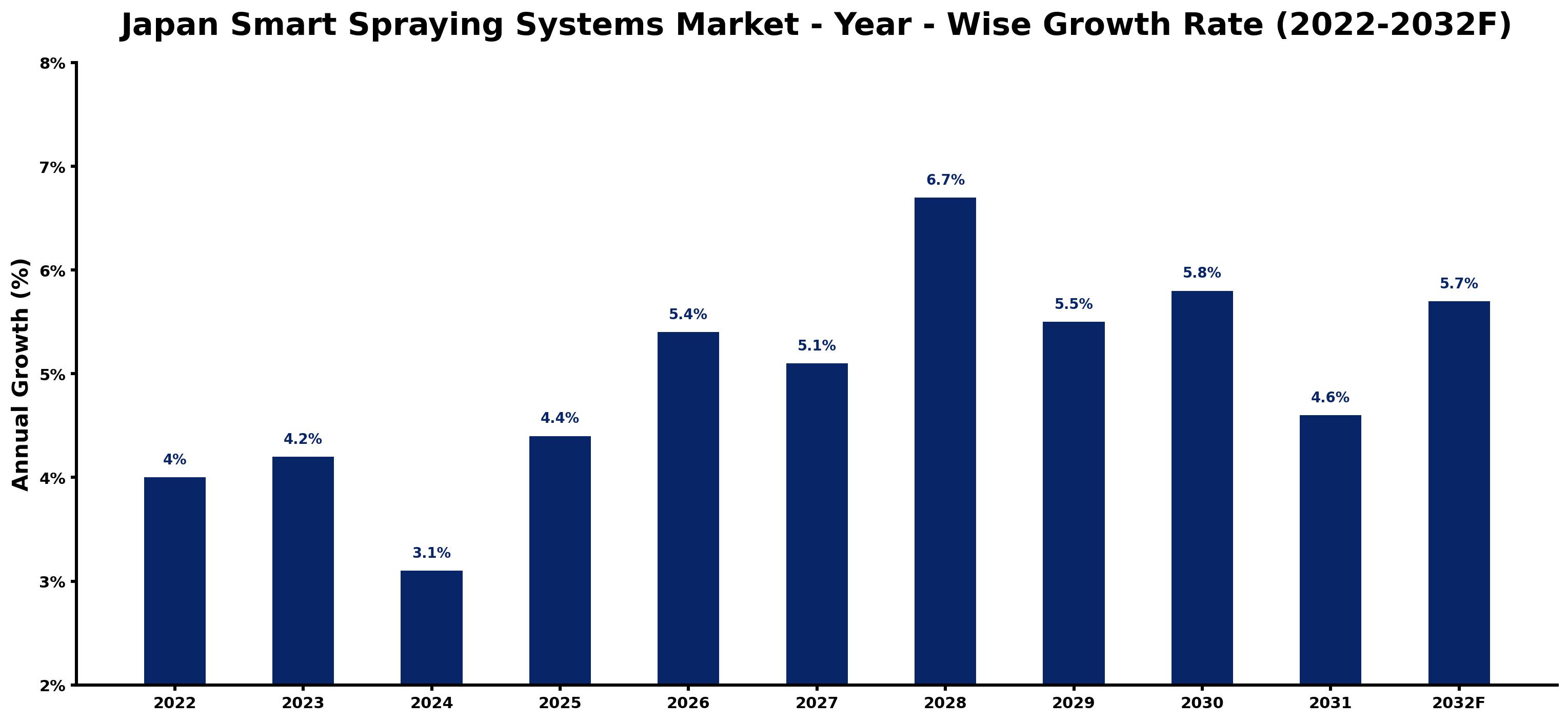
The table below sets out the estimated growth rate for each year and the main factor behind it.
| Year | Estimated Annual Growth (%) | Market Rationale |
| 2022 | 4.0 | The market showed steady growth, reflecting ongoing adoption of smart technologies in agriculture. |
| 2023 | 4.2 | Demand increased as farmers sought efficiency in operations, driven by rising input costs. |
| 2024 | 3.1 | Growth slowed due to market saturation and the need for technology upgrades among older farmers. |
| 2025 | 4.4 | The market rebounded with renewed interest in precision agriculture and government support initiatives. |
| 2026 | 5.4 | Growth is expected to accelerate as investments in smart farming technologies gain traction among commercial farmers. |
| 2027 | 5.1 | The market is projected to experience a slight slowdown as competition intensifies among agri-tech startups. |
| 2028 | 6.7 | Demand is expected to surge due to advancements in drone technology and increased operational efficiency. |
| 2029 | 5.5 | Growth will moderate as the market matures and adoption rates stabilise among existing users. |
| 2030 | 5.8 | Demand is expected to rise again as new entrants and innovations revitalise interest in smart spraying systems. |
| 2031 | 4.6 | The market will see a slowdown as farmers face challenges in adapting to new technologies. |
| 2032 | 5.7 | Growth is projected to pick up as the government pushes for a 30% increase in smart agriculture adoption. |
Note: Market size estimations and growth projections presented in this report are based on 6Wresearch's proprietary forecasting methodology, utilizing the latest available industry data, government publications, and primary research inputs.
Japan Smart Spraying Systems Market Synopsis
Smart spraying systems utilise advanced technologies such as AI and sensors to optimise agricultural spraying processes, improving crop yield and reducing chemical usage. The Japan Smart Spraying Systems Market is expanding, driven by over 1 million hectares of farmland utilising these systems and the government's promotion of precision farming technologies. With more than 200 agri-tech startups innovating in this space, demand continues to rise as farmers seek efficient solutions to improve operational efficiency and sustainability in agriculture.
Market Dynamics Impact Analysis (2026–2032)
| Factor | Type | Impact | Primary Segment Affected |
| Growing adoption of precision agriculture technologies among farmers | Driver | High | AI Crop Sprayers |
| Increased investment in agri-tech startups focusing on smart solutions | Driver | High | Variable Rate Sprayers |
| Rising demand for efficient farming practices in the Tohoku region | Opportunity | Medium | Drone Spraying Systems |
| Government initiatives promoting smart agriculture adoption | Opportunity | High | Fertilizer Sprayers |
| Aging farmer population leading to slower technology adoption | Restraint | High | Weed/Object Detection |
| Limited awareness of smart spraying benefits among traditional farmers | Restraint | Medium | Field Mapping Sync |
| High initial investment costs for advanced spraying systems | Challenge | High | Route Optimization AI |
| Competition from traditional spraying methods affecting market share | Challenge | Medium | Dosing Control |
Evaluation of Drivers in Japan Smart Spraying Systems Market (2026–2032)
The following drivers explain most of the expected growth.
| Drivers | Primary Segment Affected | Why It Matters (Evidence) |
| Integration of GPS technology in farming | Field Mapping Sync | Field Mapping Sync improves operational efficiency, with over 1 million hectares of farmland adopting smart systems. |
| Increased focus on precision agriculture | Variable Rate Sprayers | The agricultural sector contributes approximately 1% to Japan's GDP, driving demand for tailored solutions. |
| Growing number of agri-tech startups | Drone Spraying Systems | With over 200 startups, innovation in smart spraying systems is rapidly advancing, attracting investment. |
| Government initiatives promoting smart agriculture | AI Crop Sprayers | The Ministry of Agriculture launched a program in 2023 to promote precision farming technologies. |
| Rising operational costs for farmers | Fertilizer Sprayers | As input costs increase, farmers are seeking more efficient solutions to maintain profitability. |
A wider customer base explains much of the growth, as the integration of GPS technology in farming has improved operational efficiency. Over 1 million hectares of farmland are now utilising smart systems, leading to increased demand for Field Mapping Sync. The agricultural sector contributes approximately 1% to Japan's GDP, driving the need for tailored solutions that offer precision. The growing number of agri-tech startups, exceeding 200, is driving innovation in smart spraying systems, attracting significant investment.
Evaluation of Restraints in Japan Smart Spraying Systems Market
The following restraints limit how fast demand can grow.
| Market Restraint | Primary Segment Affected | Why It Matters (Evidence) |
| High initial costs of smart spraying systems | AI Crop Sprayers | The average investment for advanced systems can exceed 5 million yen, limiting access for smaller farms. |
| Limited understanding of technology benefits among older farmers | Variable Rate Sprayers | Many farmers, averaging 67 years old, are hesitant to adopt new technologies, slowing market growth. |
| Regulatory compliance requirements for chemical usage | Fertilizer Sprayers | Farmers face difficulties adapting to new systems, delaying efficiency improvements. |
| Competition from traditional spraying methods | Weed/Object Detection | Conventional methods remain prevalent, hindering the adoption of advanced solutions. |
| Insufficient training for effective technology use | Drone Spraying Systems | Farmers often lack the necessary skills to operate advanced systems, limiting their effectiveness. |
Japan Smart Spraying Systems Market Challenges
JIS Z 8401 compliance presents regulatory hurdles for manufacturers, which can postpone product launches by up to six months and restrict suppliers' market access. Intense competition among over 200 agri-tech startups drives down prices, squeezing margins for producers and risking product quality. Supply chain disruptions stem from reliance on imported components, causing production delays that can extend lead times for buyers by an average of three weeks. The average age of farmers, around 67 years, hampers the adoption of new technologies, resulting in slower operational efficiency improvements for buyers.
Trends in the Japan Smart Spraying Systems Market
The shifts below are changing how Japan Smart Spraying Systems Market products are bought and supplied.
- Shift from Traditional to Precision Agriculture: Since 2023, the focus has shifted towards precision agriculture, with the Ministry of Agriculture promoting smart technologies. This transition is reflected as over 1 million hectares of farmland now utilise smart spraying systems, improving efficiency.
- Emergence of Drone Technology in Agriculture: The use of drones for aerial spraying began gaining traction in 2023, with over 10,000 registered operators. This trend is reshaping how farmers apply pesticides and fertilizers, resulting in increased efficiency.
- Rise of AI-Driven Solutions: In 2023, AI Crop Sprayers gained popularity, accounting for 41% of the market share. This trend reflects the growing demand for precision and efficiency in agricultural practices.
- Increased Focus on Sustainability: As farmers seek to reduce chemical usage, the adoption of Variable Rate Sprayers has risen. This shift is supported by government initiatives aiming for a 30% increase in smart agriculture by 2025.
Investment Opportunities in the Japan Smart Spraying Systems Market
Several openings in the Japan Smart Spraying Systems Market merit attention from investors.
- Collaborations with Agri-Tech Startups: Partnering with over 200 agri-tech startups presents opportunities for innovation in smart spraying systems. The market gap shows a demand for advanced solutions, with potential investments exceeding 1 billion yen.
- Expansion in the Tohoku Region: The Tohoku region is a growing hub for smart agriculture adoption, with significant investments in technology. Targeting this region can yield high returns as demand for efficient farming solutions rises.
- Focus on Commercial Farmers: Commercial farmers are increasingly adopting smart spraying systems, motivated by the need for efficiency. The market gap indicates potential investments of 135 million USD by 2025.
- Government Certification Opportunities: Obtaining JIS Z 8401 certification can enhance market entry for manufacturers. This standard is important for compliance, with over 1 trillion yen in the agricultural machinery market.
Government Initiatives in the Japan Smart Spraying Systems Market
The Economic Security Promotion Act, enacted in 2022, supports supply-chain resilience for critical agricultural products. This measure encourages producers to invest in advanced technologies, ensuring a steady supply of smart spraying systems. Additionally, the Chemical Substances Control Law mandates strict evaluation and control of chemicals, impacting how manufacturers operate and ensuring compliance with safety standards.
The Ministry of Agriculture, Forestry and Fisheries implements various funding schemes to support farmers adopting smart technologies. For instance, the annual budget of 5 billion yen is allocated for research in smart agriculture, enabling farmers to access effective solutions and improve their operational efficiency.
Future Insight of the Japan Smart Spraying Systems Market
By 2032, the Japanese government will push for a 30% increase in smart agriculture adoption, prompting suppliers to innovate. The emergence of new precision farming standards will ensure better quality and safety for buyers. The growing number of over 10,000 drone operators will facilitate the integration of aerial applications in farming. Enhanced collaboration between manufacturers and technology developers will drive advancements in smart spraying systems.
Market Segmentation Analysis
Japan Smart Spraying Systems Market report covers a detailed analysis of the following market segments:
By System Type – AI Crop Sprayers Lead, Variable Rate Sprayers Expected to Grow Fastest
According to Saurav Kr Singh, Senior Research Analyst at 6Wresearch, AI Crop Sprayers took 41% of system type revenue in 2025, more than any other category. AI Crop Sprayers dominate the market as they allow for accurate chemical application, which is vital for maximising crop yields. Their widespread deployment across Japan's farmland illustrates their critical role in modern agriculture. Variable Rate Sprayers are projected to grow fastest, at a CAGR of 7.7% during 2026–2032. Variable Rate Sprayers are rapidly gaining traction due to their ability to adjust application rates based on specific crop needs, which aligns with the push for more efficient farming practices. The government's goal to boost smart agriculture adoption by 30% by 2025 will further accelerate this segment's growth. Suppliers should enhance Variable Rate Sprayers to meet the increasing demand for tailored agricultural solutions.
By Smart Feature – Weed/Object Detection Leads, Field Mapping Sync Expected to Grow Fastest
Weed/Object Detection held 40% of the Japan Smart Spraying Systems Market by smart feature in 2025. Weed/Object Detection leads the segment as it enables accurate identification and targeting of weeds, which is essential for effective crop management. This feature's integration into smart spraying systems has become a standard practice among commercial farmers. Over 2026–2032, Field Mapping Sync is expected to post the fastest growth, at a CAGR of 7.5%. Field Mapping Sync is growing quickly due to its integration with GPS technology, facilitating effective field management and optimising spraying processes. As the agricultural sector increasingly adopts precision farming technologies, this feature's relevance continues to rise. Buyers will benefit from investing in systems with advanced Field Mapping Sync capabilities for improved operational efficiency.
By Sensing Tech – Vision + GPS Leads, Soil + Crop Sensors Expected to Grow Fastest
The largest sensing tech category in 2025 was Vision + GPS, at 45% of revenue. Vision + GPS technology leads in the sensing tech segment because it is essential for accurate navigation and targeting during spraying operations. Its effectiveness has made it a trusted choice among farmers, ensuring precise application in diverse agricultural settings. Soil + Crop Sensors are set to record the highest CAGR in this split, 7.4% over 2026–2032. Soil + Crop Sensors are witnessing rapid growth as they deliver critical data for informed spraying decisions, which is essential for optimising agricultural outputs. The rising focus on data-driven methodologies in farming is significantly boosting demand for this technology. Suppliers should invest in the development of advanced Soil + Crop Sensors to capitalise on the growing trend towards data-centric agricultural practices.
By End User – Commercial Farmers Lead, Precision Agri Users Expected to Grow Fastest
In 2025, Commercial Farmers led the end user split with a 38% share. Commercial Farmers represent the largest segment of smart spraying system users, as they play a crucial role in enhancing agricultural productivity across Japan. Their established practices and dependence on advanced technology make them key players in this market. The quickest growth will come from Precision Agri Users, forecast to expand at a CAGR of 7.2% between 2026 and 2032. Precision Agri Users are the fastest-growing group, as they emphasise technology-driven methods to enhance efficiency and sustainability in farming. This trend is supported by increasing government initiatives promoting precision agriculture practices. Suppliers must tailor their offerings to meet the specific needs of Precision Agri Users to effectively penetrate this expanding market.
Key Attractiveness of the Report
- 10 Years of Market Numbers
- Historical Data Starting from 2022 to 2025
- Base Year 2025
- Forecast Data until 2032
- Key Performance Indicators Impacting the Market
- Major Upcoming Developments and Projects
Key Highlights of the Report:
- Japan Smart Spraying Systems Market Outlook
- Market Size of Japan Smart Spraying Systems Market, 2025
- Forecast of Japan Smart Spraying Systems Market, 2032
- Historical Data and Forecast of Japan Smart Spraying Systems Revenues & Volume for the Period 2022-2032F
- Japan Smart Spraying Systems Market Trend Evolution
- Japan Smart Spraying Systems Market Drivers and Challenges
- Japan Smart Spraying Systems Price Trends
- Japan Smart Spraying Systems Porter's Five Forces
- Japan Smart Spraying Systems Industry Life Cycle
- Historical Data and Forecast of Japan Smart Spraying Systems Market Revenues & Volume By System Type for the Period 2022-2032F
- Historical Data and Forecast of Japan Smart Spraying Systems Market Revenues & Volume By AI Crop Sprayers for the Period 2022-2032F
- Historical Data and Forecast of Japan Smart Spraying Systems Market Revenues & Volume By Variable Rate Sprayers for the Period 2022-2032F
- Historical Data and Forecast of Japan Smart Spraying Systems Market Revenues & Volume By Drone Spraying Systems for the Period 2022-2032F
- Historical Data and Forecast of Japan Smart Spraying Systems Market Revenues & Volume By Fertilizer Sprayers for the Period 2022-2032F
- Historical Data and Forecast of Japan Smart Spraying Systems Market Revenues & Volume By Smart Feature for the Period 2022-2032F
- Historical Data and Forecast of Japan Smart Spraying Systems Market Revenues & Volume By Weed/Object Detection for the Period 2022-2032F
- Historical Data and Forecast of Japan Smart Spraying Systems Market Revenues & Volume By Field Mapping Sync for the Period 2022-2032F
- Historical Data and Forecast of Japan Smart Spraying Systems Market Revenues & Volume By Route Optimization AI for the Period 2022-2032F
- Historical Data and Forecast of Japan Smart Spraying Systems Market Revenues & Volume By Dosing Control for the Period 2022-2032F
- Historical Data and Forecast of Japan Smart Spraying Systems Market Revenues & Volume By Sensing Tech for the Period 2022-2032F
- Historical Data and Forecast of Japan Smart Spraying Systems Market Revenues & Volume By Vision + GPS for the Period 2022-2032F
- Historical Data and Forecast of Japan Smart Spraying Systems Market Revenues & Volume By Soil + Crop Sensors for the Period 2022-2032F
- Historical Data and Forecast of Japan Smart Spraying Systems Market Revenues & Volume By Lidar + GPS for the Period 2022-2032F
- Historical Data and Forecast of Japan Smart Spraying Systems Market Revenues & Volume By Pressure + Speed Sensors for the Period 2022-2032F
- Historical Data and Forecast of Japan Smart Spraying Systems Market Revenues & Volume By End User for the Period 2022-2032F
- Historical Data and Forecast of Japan Smart Spraying Systems Market Revenues & Volume By Commercial Farmers for the Period 2022-2032F
- Historical Data and Forecast of Japan Smart Spraying Systems Market Revenues & Volume By Precision Agri Users for the Period 2022-2032F
- Historical Data and Forecast of Japan Smart Spraying Systems Market Revenues & Volume By Agri-Tech Startups for the Period 2022-2032F
- Historical Data and Forecast of Japan Smart Spraying Systems Market Revenues & Volume By Agrochemical Suppliers for the Period 2022-2032F
- Japan Smart Spraying Systems Import Export Trade Statistics
- Market Opportunity Assessment By System Type
- Market Opportunity Assessment By Smart Feature
- Market Opportunity Assessment By Sensing Tech
- Market Opportunity Assessment By End User
- Japan Smart Spraying Systems Top Companies Market Share
- Japan Smart Spraying Systems Competitive Benchmarking By Technical and Operational Parameters
- Japan Smart Spraying Systems Company Profiles
- Japan Smart Spraying Systems Key Strategic Recommendations
Market Covered
Coverage by segment is as follows.
By System Type
- AI Crop Sprayers
- Variable Rate Sprayers
- Drone Spraying Systems
- Fertilizer Sprayers
By Smart Feature
- Weed/Object Detection
- Field Mapping Sync
- Route Optimization AI
- Dosing Control
By Sensing Tech
- Vision + GPS
- Soil + Crop Sensors
- Lidar + GPS
- Pressure + Speed Sensors
By End User
- Commercial Farmers
- Precision Agri Users
- Agri-Tech Startups
- Agrochemical Suppliers































