Japan Smart Tags for Animals Market Size & Growth Rate
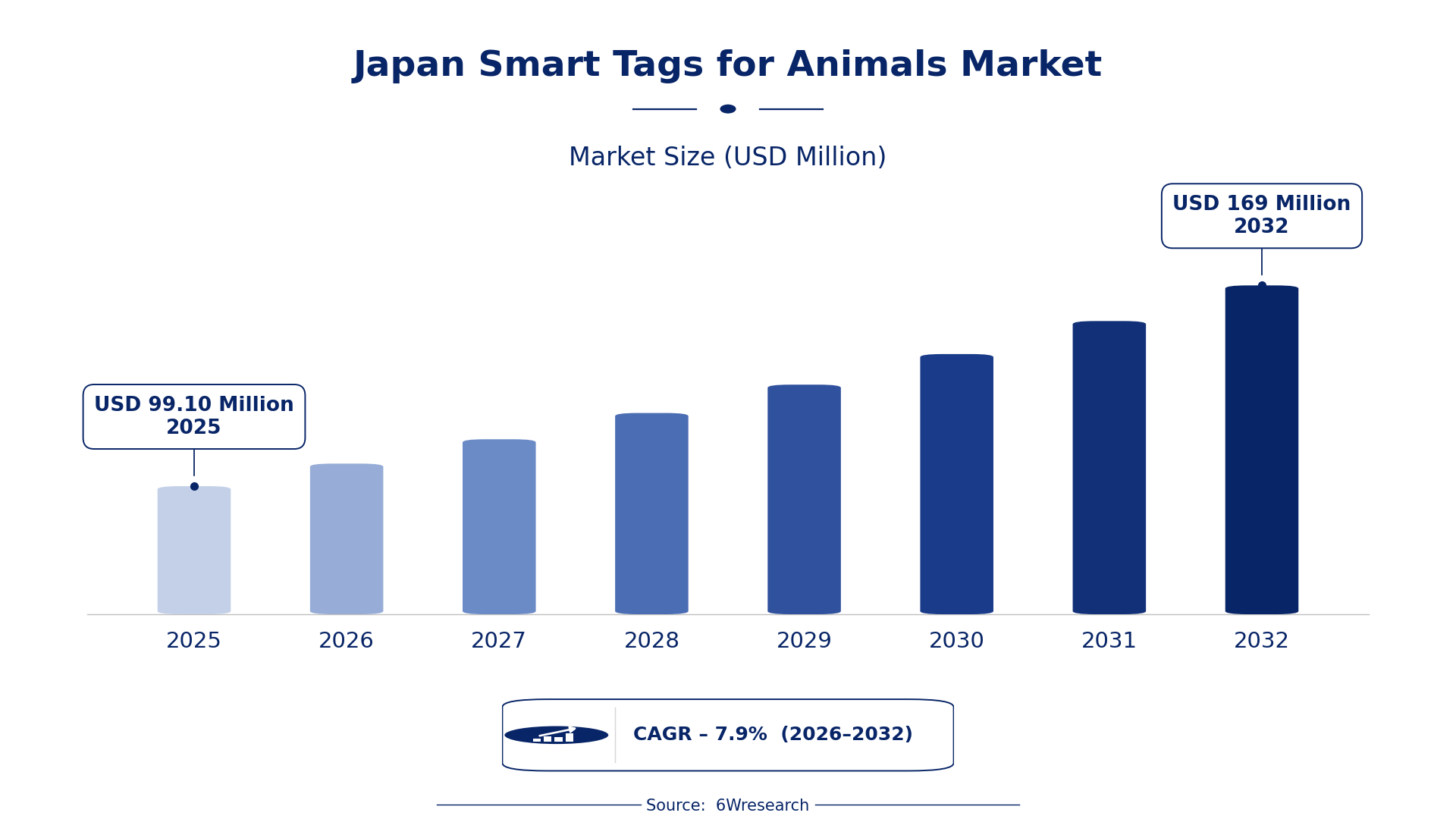
According to 6Wresearch internal database and industry insights, the Japan Smart Tags for Animals Market was valued at USD 99.10 Million in 2025 and is projected to reach USD 169 Million by 2032, growing at a CAGR of approximately 7.9% during 2026–2032.
Japan Smart Tags for Animals Market Highlights
| Report Metric | Details |
| Report Name | Japan Smart Tags for Animals Market (2026-2032) |
| Market Size 2025 | USD 99.10 Million |
| Market Size 2032 | USD 169 Million |
| Absolute Growth 2025–2032 | USD 69.90 Million |
| CAGR 2026–2032 | 7.9% |
| Peak Annual Growth | 8.7% in 2030 |
| Forecast Period | 2026–2032 |
| Historical Data | 2022–2025 |
| Base Year | 2025 |
| Leading Tag Type, 2025 | GPS Tracking Tags (41% share) |
| Leading Monitoring Feature, 2025 | Real-Time Location (44% share) |
| Leading Transmission Tech, 2025 | Satellite/Bluetooth (40% share) |
| Leading End User, 2025 | Livestock Farmers (38% share) |
| Fastest-Growing Tag Type | Health Tags (10.9% CAGR) |
| Fastest-Growing Monitoring Feature | Migration/Behavior Analysis (10.5% CAGR) |
| Fastest-Growing Transmission Tech | GSM + Satellite (10.8% CAGR) |
| Fastest-Growing End User | Veterinarians (10.1% CAGR) |
| Growing Sector | livestock management |
| Key End Users | livestock farmers, veterinarians, conservation groups, dairy farms |
Japan Smart Tags for Animals Market Year-wise Growth Rate and Key Drivers (2022–2032)
This graph illustrates the annual growth rates of the market from 2022 to 2032, highlighting a steady upward trajectory and projected market expansion over the forecast period.
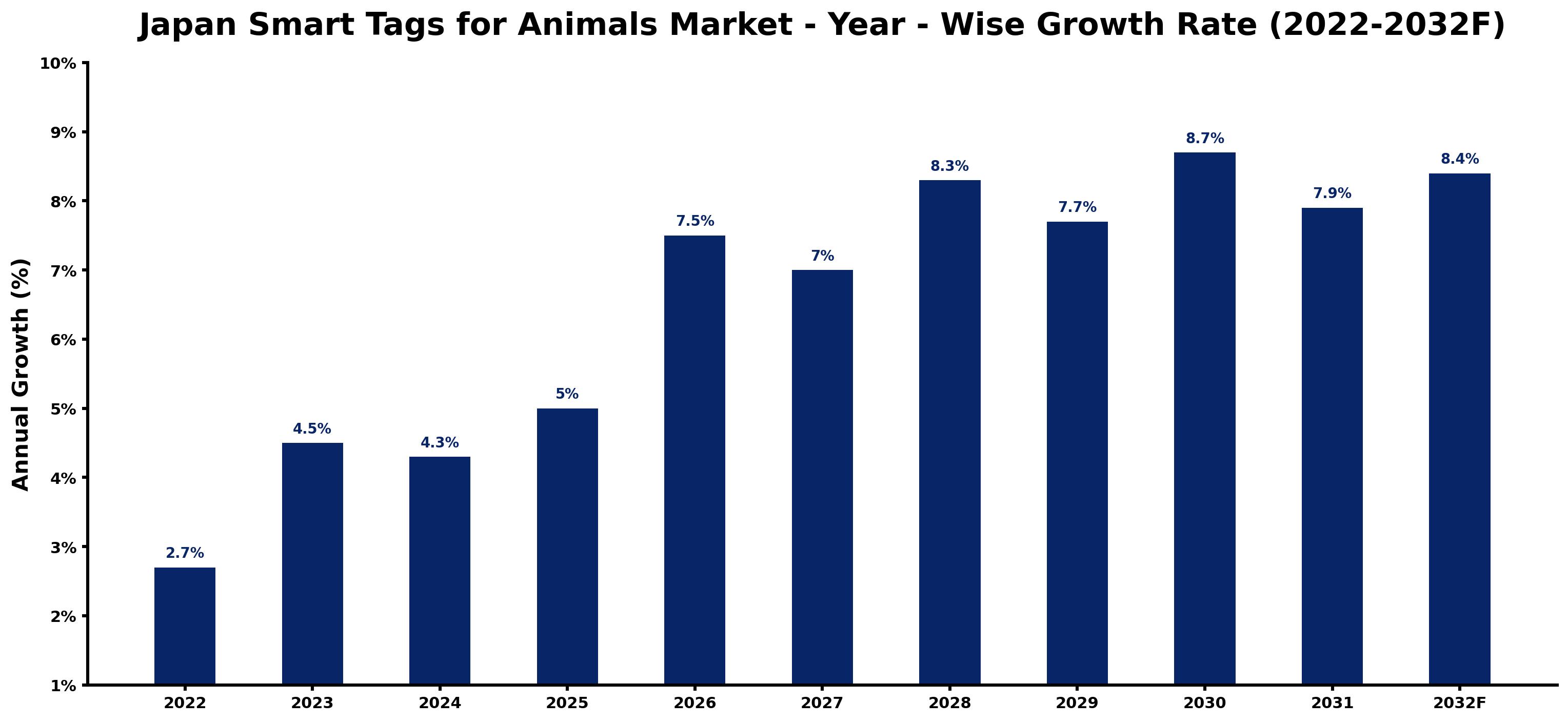
The following figures match every annual growth estimate with the main market development of that year, giving the reasoning behind each rise or slowdown.
| Year | Estimated Annual Growth (%) | Market Rationale |
| 2022 | 2.7 | The market showed moderate growth as initial adoption of smart tags began among livestock farmers. |
| 2023 | 4.5 | Growth accelerated as awareness of smart technologies increased among dairy farms and veterinarians. |
| 2024 | 4.3 | Growth slowed slightly as market saturation began to affect new adoption rates. |
| 2025 | 5.0 | The market experienced a peak in growth due to heightened demand from livestock farmers for health monitoring. |
| 2026 | 7.5 | Demand is expected to surge as more farmers adopt smart tags for real-time tracking and health metrics. |
| 2027 | 7.0 | Growth is projected to decelerate as the market begins to stabilise after rapid initial adoption. |
| 2028 | 8.3 | The market is expected to rebound as technological advancements attract new users in wildlife conservation. |
| 2029 | 7.7 | Growth is projected to slow again as the market matures and competition intensifies among suppliers. |
| 2030 | 8.7 | The market is expected to peak as new features in smart tags drive renewed interest among end users. |
| 2031 | 7.9 | Growth is projected to slow as the market stabilises, reflecting a more mature adoption phase. |
| 2032 | 8.4 | The market will continue to expand as new applications for smart tags emerge in various sectors. |
Note: Market size estimations and growth projections presented in this report are based on 6Wresearch's proprietary forecasting methodology, utilizing the latest available industry data, government publications, and primary research inputs.
Japan Smart Tags for Animals Market Synopsis
Smart Tags for Animals are tracking devices designed for livestock and wildlife management, enabling real-time location tracking, health monitoring, and behaviour analysis. In Japan, the market is driven by around 200,000 livestock farmers and a growing demand for agricultural technologies. The government allocated ¥1 billion in 2023 for agricultural technology innovation, propelling growth, with an estimated adoption rate of 25% among farmers. This combination of factors is projected to drive the market to USD 169 million by 2032.
Market Dynamics Impact Analysis (2026–2032)
| Factor | Type | Impact | Primary Segment Affected |
| Increasing adoption of smart farming technologies | Driver | High | GPS Tracking Tags |
| Growing demand for health monitoring in livestock | Driver | High | Health Tags |
| Expansion of wildlife conservation efforts | Opportunity | Medium | Wildlife Tags |
| Rising interest in agricultural technology investments | Opportunity | Medium | Health Tags |
| Limited awareness among smaller farms | Restraint | High | Reproductive Tags |
| High initial investment costs for advanced tags | Restraint | Medium | GPS Tracking Tags |
| Competition from alternative tracking solutions | Challenge | High | Wildlife Tags |
| Technological integration challenges in existing systems | Challenge | Medium | Health Tags |
Evaluation of Drivers in Japan Smart Tags for Animals Market (2026–2032)
Below are the drivers that matter most for revenue growth, with supporting evidence.
| Drivers | Primary Segment Affected | Why It Matters (Evidence) |
| Growing livestock population | GPS Tracking Tags | With approximately 4 million dairy cows in Japan, farmers increasingly require tracking solutions for effective management. |
| Rising health awareness among livestock farmers | Health Tags | The average dairy farm has about 100 cows, prompting farmers to adopt health tags for monitoring productivity. |
| Government initiatives promoting agricultural technology | Health Tags | The government allocated ¥1 billion in 2023 to support projects aimed at advancing agricultural practices, increasing demand for smart tags. |
| Technological advancements in tracking devices | GPS Tracking Tags | Recent developments in smart tags improve tracking capabilities, attracting more farmers to invest in these solutions. |
| Increased focus on animal welfare | Wildlife Tags | Conservation groups are employing smart tags to track endangered species, reflecting a growing commitment to animal welfare. |
Buyers are adding capacity as the livestock population in Japan reaches approximately 4 million dairy cows, leading to a higher demand for tracking solutions. Health awareness among livestock farmers is rising, with many adopting monitoring technologies to ensure productivity. Recent advancements in tracking devices improve usability, making these products more appealing to livestock producers. Conservation groups are increasingly employing wildlife tags to track endangered species, reflecting a growing commitment to animal welfare.
Evaluation of Restraints in Japan Smart Tags for Animals Market
These restraints slow adoption and weigh on supplier margins.
| Market Restraint | Primary Segment Affected | Why It Matters (Evidence) |
| Limited awareness among smaller farms | Reproductive Tags | Many smaller farms lack knowledge of smart tag benefits, hindering adoption rates in this segment. |
| High initial investment costs for advanced tags | GPS Tracking Tags | The cost of implementing smart tags can be prohibitive for some farmers, limiting market growth. |
| Regulatory compliance requirements | GPS Tracking Tags | Producers must navigate complex regulations, which can delay the introduction of new products. |
| Technological integration challenges in existing systems | Health Tags | Farmers face difficulties integrating new technologies with their current management systems, slowing adoption. |
| Competition from alternative tracking solutions | Wildlife Tags | Alternative technologies may appeal to conservation groups, affecting demand for smart tags. |
Japan Smart Tags for Animals Market Challenges
Producers face fierce competition from alternative tracking solutions, leading to price reductions that squeeze profit margins. High implementation costs, with initial investments potentially reaching ¥500,000 per farm, deter many livestock farmers from adopting smart tags, causing delays in modernisation. Buyers expect advanced monitoring features, and failure to meet these demands can lead to dissatisfaction, ultimately reducing sales for suppliers. Many farmers struggle with technology integration due to insufficient digital skills, resulting in ineffective use of smart tags and wasted resources, impacting around 200,000 livestock farmers in Japan.
Trends in the Japan Smart Tags for Animals Market
Buyers and suppliers in the Japan Smart Tags for Animals Market are adjusting to the following trends.
- Shift towards Real-Time Monitoring: The trend is shifting towards real-time monitoring solutions for livestock, evidenced by the adoption of GPS tracking tags. In 2023, the adoption rate among farmers reached 25%, indicating a growing preference for immediate tracking.
- Increased Use of Health Tags: Health tags are becoming more common among veterinarians, with a notable increase in usage for pet health monitoring. In 2023, veterinary clinics reported a 30% rise in health tag adoption.
- Growing Focus on Wildlife Conservation: Conservation efforts are increasingly using smart tags for tracking endangered species, with wildlife agencies reporting a 20% increase in usage for migratory studies in 2023.
- Expansion of Agricultural Technology Initiatives: Government initiatives are promoting the adoption of smart technologies among farmers, with a funding allocation of ¥1 billion in 2023 aimed at advancing agricultural innovation.
Investment Opportunities in the Japan Smart Tags for Animals Market
The following areas offer the clearest openings for investors and suppliers in the Japan Smart Tags for Animals Market.
- Partnerships with Local Farms: Now is an opportune moment to invest in partnerships with local farms to supply smart tags, as the adoption rate is estimated at 25%. Collaborating with livestock farmers in Hokkaido can facilitate market entry.
- Investment in Health Monitoring Solutions: With the rising demand for health tags, investing in health monitoring solutions presents a valuable opportunity. Targeting veterinarians can improve market penetration.
- Development of Advanced Wildlife Tracking Systems: The growing focus on wildlife conservation creates opportunities for developing advanced tracking systems. Engaging with conservation groups can lead to fruitful collaborations.
- Expansion into Emerging Markets: As the demand for smart tags increases, expanding into emerging markets within Japan can be beneficial. Targeting regions with high livestock populations, such as Hokkaido, can yield positive results.
Government Initiatives in the Japan Smart Tags for Animals Market
The Food Sanitation Act amendment, fully applied in June 2021, mandates HACCP-based hygiene management for food businesses, impacting producers of smart tags by ensuring compliance with health standards. This regulation encourages the adoption of smart technologies in livestock management, improving overall animal welfare.
The Ministry of Agriculture, Forestry and Fisheries approves funding for agricultural technology innovations, including smart tags. In 2023, the government allocated ¥1 billion to support projects aimed at advancing agricultural practices, benefiting producers and users of smart tags.
Future Insight of the Japan Smart Tags for Animals Market
A substantial shift in agricultural policy will drive the adoption of smart tags, prompting livestock farmers to invest in advanced monitoring solutions. By 2032, government funding will support the development of improved tracking systems that enhance animal welfare. As JIS Z 8801 becomes more widely recognised, compliance will elevate standards in monitoring practices. Veterinary clinics will increasingly incorporate smart tags into their services, creating a more connected approach to managing animal health.
Market Segmentation Analysis
Japan Smart Tags for Animals Market report covers a detailed analysis of the following market segments:
By Tag Type – GPS Tracking Tags Lead, Health Tags Expected to Grow Fastest
According to Saurav Kr Singh, Senior Research Analyst at 6Wresearch, GPS Tracking Tags held 41% of the Japan Smart Tags for Animals Market by tag type in 2025. GPS Tracking Tags hold the largest share as they are essential for real-time location tracking of livestock, particularly in Hokkaido, which contributes to 30% of Japan's dairy production. The extensive installed base of approximately 4 million dairy cows necessitates these tracking solutions for effective management. Health Tags are projected to grow fastest, at a CAGR of 10.9% during 2026–2032. Health Tags are experiencing the highest growth due to the increasing focus on monitoring health metrics, which is vital for optimising livestock productivity. The adoption rate of 25% among farmers highlights a clear shift towards prioritising animal health technologies. This trend suggests that suppliers should enhance their offerings in health monitoring solutions to meet the evolving needs of livestock farmers.
By Monitoring Feature – Real-Time Location Leads, Migration/Behavior Analysis Expected to Grow Fastest
With 44% of monitoring feature revenue in 2025, Real-Time Location was the largest category. Real-Time Location is the leading feature as it is essential for immediate tracking of animals, allowing farmers to manage their herds effectively. This is particularly important for the 200,000 livestock farmers in Japan who require reliable tracking solutions. Over 2026–2032, Migration/Behavior Analysis is expected to post the fastest growth, at a CAGR of 10.5%. Migration/Behavior Analysis is the fastest-growing feature, driven by conservation efforts that utilise smart tags to study migratory patterns of endangered species. This growing interest in wildlife studies is expanding the market for such analytical features. Buyers will benefit from advanced tracking features that cater to both livestock management and wildlife conservation.
By Transmission Tech – Satellite/Bluetooth Leads, GSM + Satellite Expected to Grow Fastest
The largest transmission tech category in 2025 was Satellite/Bluetooth, at 40% of revenue. Satellite/Bluetooth technology leads the segment as it is widely used for tracking and communication, providing reliable connectivity in various terrains. This technology is essential for farmers who need consistent monitoring of their livestock across expansive areas. The quickest growth will come from GSM + Satellite, forecast to expand at a CAGR of 10.8% between 2026 and 2032. GSM + Satellite is the fastest-growing transmission technology, as it allows for remote tracking capabilities that are increasingly required in diverse agricultural settings. The government's investment in agricultural technology innovation supports this trend. Suppliers should invest in developing GSM + Satellite solutions to meet the rising demand for remote tracking technologies.
By End User – Livestock Farmers Lead, Veterinarians Expected to Grow Fastest
Livestock Farmers accounted for 38% of the market by end user in 2025. Livestock Farmers account for the largest segment of users, as they are the primary adopters of smart tags for effective animal management and health monitoring. Their substantial presence in the livestock sector ensures a consistent demand for these technologies. Veterinarians are set to record the highest CAGR in this split, 10.1% over 2026–2032. Veterinarians represent the fastest-growing user group, employing smart tags for health monitoring and diagnostics, which are becoming essential in veterinary practices. As health-related concerns among animals rise, their reliance on these technologies is expected to increase. Suppliers should focus on customising their offerings to address the specific requirements of veterinarians as their influence in the market expands.
Key Attractiveness of the Report
- 10 Years of Market Numbers
- Historical Data Starting from 2022 to 2025
- Base Year 2025
- Forecast Data until 2032
- Key Performance Indicators Impacting the Market
- Major Upcoming Developments and Projects
Key Highlights of the Report:
- Japan Smart Tags for Animals Market Outlook
- Market Size of Japan Smart Tags for Animals Market, 2025
- Forecast of Japan Smart Tags for Animals Market, 2032
- Historical Data and Forecast of Japan Smart Tags for Animals Revenues & Volume for the Period 2022-2032F
- Japan Smart Tags for Animals Market Trend Evolution
- Japan Smart Tags for Animals Market Drivers and Challenges
- Japan Smart Tags for Animals Price Trends
- Japan Smart Tags for Animals Porter's Five Forces
- Japan Smart Tags for Animals Industry Life Cycle
- Historical Data and Forecast of Japan Smart Tags for Animals Market Revenues & Volume By Tag Type for the Period 2022-2032F
- Historical Data and Forecast of Japan Smart Tags for Animals Market Revenues & Volume By GPS Tracking Tags for the Period 2022-2032F
- Historical Data and Forecast of Japan Smart Tags for Animals Market Revenues & Volume By Health Tags for the Period 2022-2032F
- Historical Data and Forecast of Japan Smart Tags for Animals Market Revenues & Volume By Reproductive Tags for the Period 2022-2032F
- Historical Data and Forecast of Japan Smart Tags for Animals Market Revenues & Volume By Wildlife Tags for the Period 2022-2032F
- Historical Data and Forecast of Japan Smart Tags for Animals Market Revenues & Volume By Monitoring Feature for the Period 2022-2032F
- Historical Data and Forecast of Japan Smart Tags for Animals Market Revenues & Volume By Real-Time Location for the Period 2022-2032F
- Historical Data and Forecast of Japan Smart Tags for Animals Market Revenues & Volume By Temperature + Movement Data for the Period 2022-2032F
- Historical Data and Forecast of Japan Smart Tags for Animals Market Revenues & Volume By Heat Cycle Alerts for the Period 2022-2032F
- Historical Data and Forecast of Japan Smart Tags for Animals Market Revenues & Volume By Migration/Behavior Analysis for the Period 2022-2032F
- Historical Data and Forecast of Japan Smart Tags for Animals Market Revenues & Volume By Transmission Tech for the Period 2022-2032F
- Historical Data and Forecast of Japan Smart Tags for Animals Market Revenues & Volume By Satellite/Bluetooth for the Period 2022-2032F
- Historical Data and Forecast of Japan Smart Tags for Animals Market Revenues & Volume By RFID + App for the Period 2022-2032F
- Historical Data and Forecast of Japan Smart Tags for Animals Market Revenues & Volume By Sensor + App for the Period 2022-2032F
- Historical Data and Forecast of Japan Smart Tags for Animals Market Revenues & Volume By GSM + Satellite for the Period 2022-2032F
- Historical Data and Forecast of Japan Smart Tags for Animals Market Revenues & Volume By End User for the Period 2022-2032F
- Historical Data and Forecast of Japan Smart Tags for Animals Market Revenues & Volume By Livestock Farmers for the Period 2022-2032F
- Historical Data and Forecast of Japan Smart Tags for Animals Market Revenues & Volume By Veterinarians for the Period 2022-2032F
- Historical Data and Forecast of Japan Smart Tags for Animals Market Revenues & Volume By Dairy Farms for the Period 2022-2032F
- Historical Data and Forecast of Japan Smart Tags for Animals Market Revenues & Volume By Conservation Groups for the Period 2022-2032F
- Japan Smart Tags for Animals Import Export Trade Statistics
- Market Opportunity Assessment By Tag Type
- Market Opportunity Assessment By Monitoring Feature
- Market Opportunity Assessment By Transmission Tech
- Market Opportunity Assessment By End User
- Japan Smart Tags for Animals Top Companies Market Share
- Japan Smart Tags for Animals Competitive Benchmarking By Technical and Operational Parameters
- Japan Smart Tags for Animals Company Profiles
- Japan Smart Tags for Animals Key Strategic Recommendations
Market Covered
The following segment groups are covered in the report.
By Tag Type
- GPS Tracking Tags
- Health Tags
- Reproductive Tags
- Wildlife Tags
By Monitoring Feature
- Real-Time Location
- Temperature + Movement Data
- Heat Cycle Alerts
- Migration/Behavior Analysis
By Transmission Tech
- Satellite/Bluetooth
- RFID + App
- Sensor + App
- GSM + Satellite
By End User
- Livestock Farmers
- Veterinarians
- Dairy Farms
- Conservation Groups































