Japan Smart Tractor Systems Market Size & Growth Rate
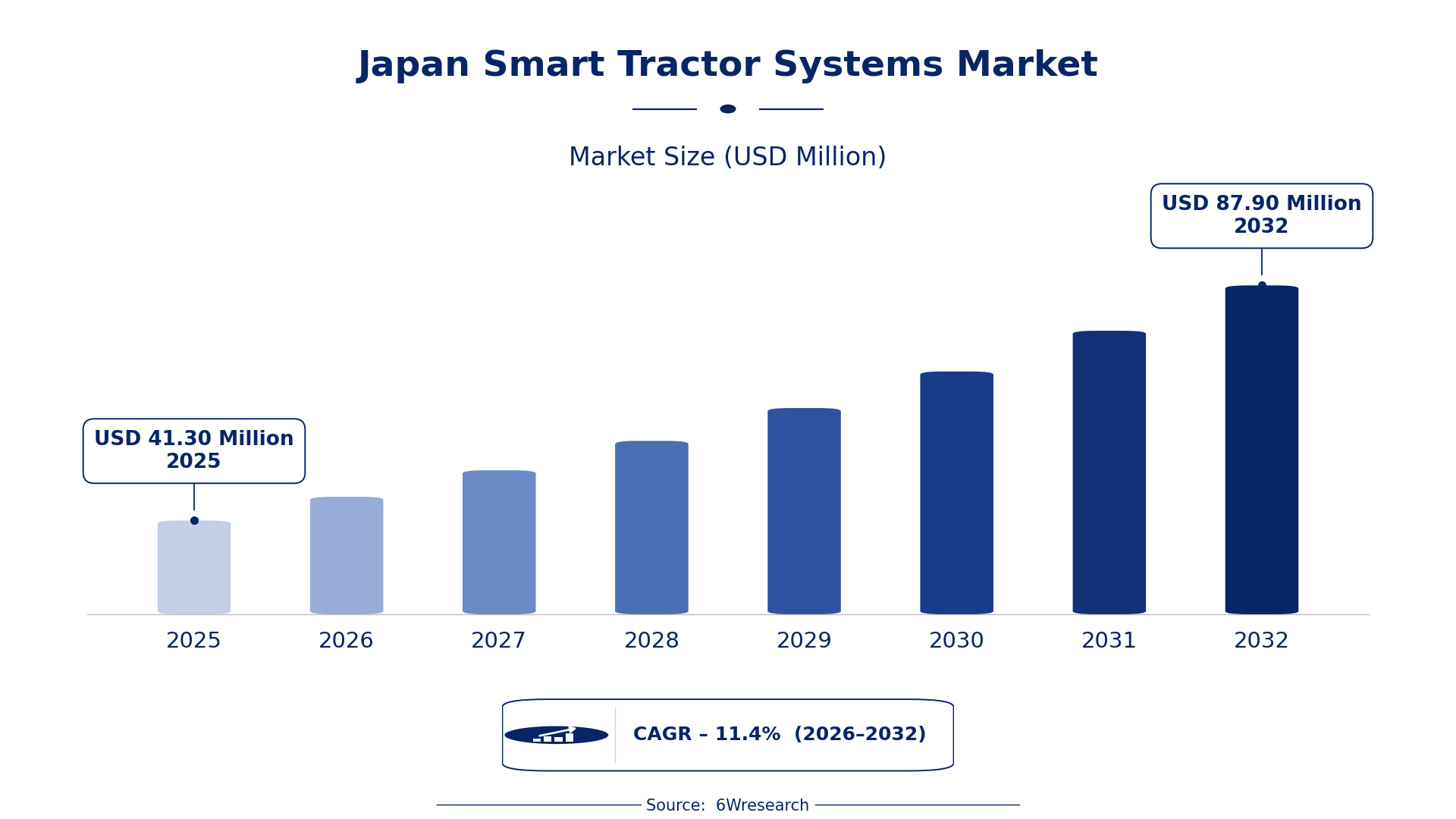
According to 6Wresearch internal database and industry insights, the Japan Smart Tractor Systems Market was valued at USD 41.30 Million in 2025 and is projected to reach USD 87.90 Million by 2032, growing at a CAGR of approximately 11.4% during 2026–2032.
Japan Smart Tractor Systems Market Highlights
| Report Metric | Details |
| Report Name | Japan Smart Tractor Systems Market (2026-2032) |
| Market Size 2025 | USD 41.30 Million |
| Market Size 2032 | USD 87.90 Million |
| Absolute Growth 2025–2032 | USD 46.60 Million |
| CAGR 2026–2032 | 11.4% |
| Peak Annual Growth | 13.3% in 2027 |
| Forecast Period | 2026–2032 |
| Historical Data | 2022–2025 |
| Base Year | 2025 |
| Leading System Type, 2025 | Auto Steering Systems (38% share) |
| Leading Smart Feature, 2025 | Route Optimization (43% share) |
| Leading GPS/AI Support, 2025 | GNSS + SLAM (49% share) |
| Leading End User, 2025 | Precision Farmers (41% share) |
| Fastest-Growing System Type | Field Mapping Software (16.1% CAGR) |
| Fastest-Growing Smart Feature | Soil + Crop Feedback (14.2% CAGR) |
| Fastest-Growing GPS/AI Support | Sensor + AI Sync (15.6% CAGR) |
| Fastest-Growing End User | Agro Tech Farms (14.3% CAGR) |
| Growing Sector | Precision Agriculture |
| Key End Users | Precision Farmers, Agro Tech Farms, Agricultural R&D |
Japan Smart Tractor Systems Market Year-wise Growth Rate and Key Drivers (2022–2032)
This graph illustrates the annual growth rates of the market from 2022 to 2032, highlighting a steady upward trajectory and projected market expansion over the forecast period.
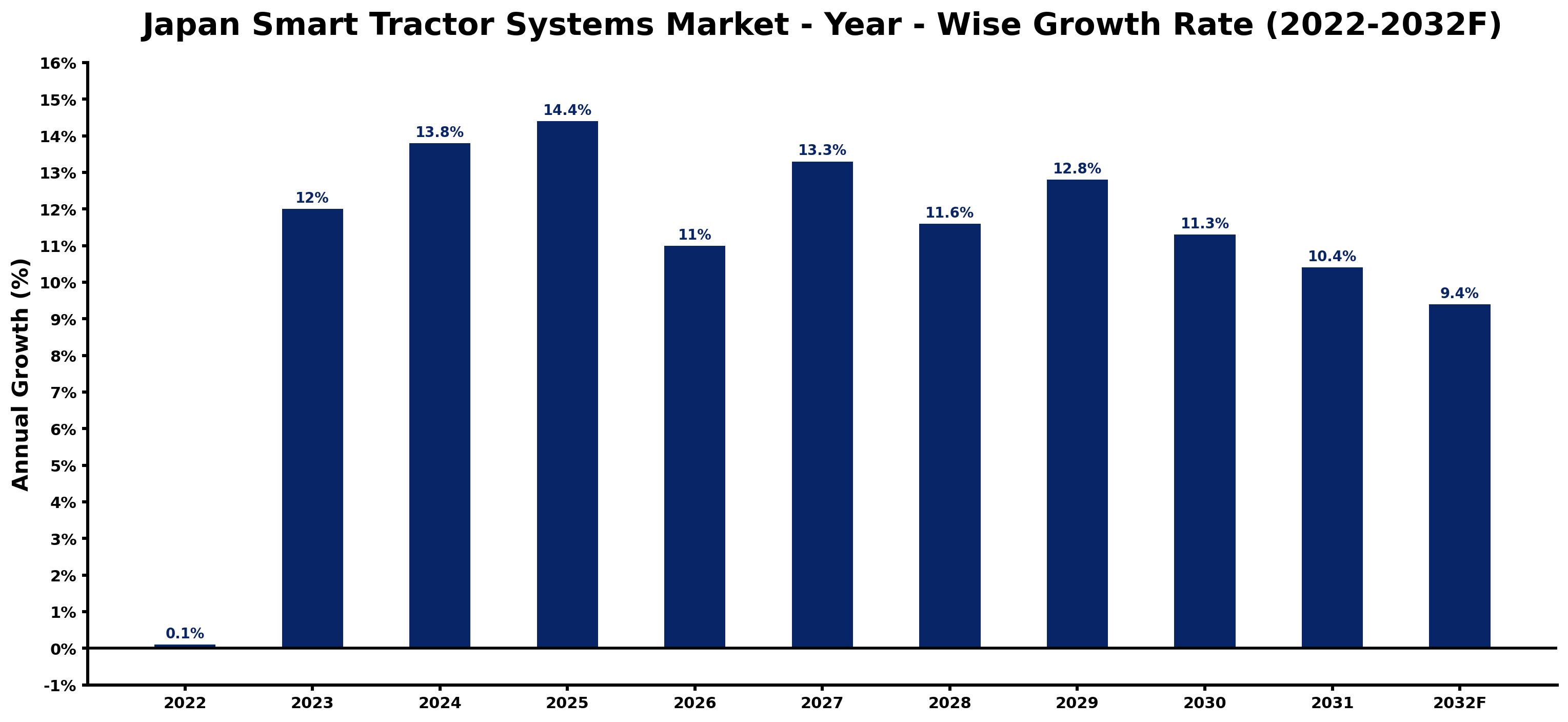
The following figures match every annual growth estimate with the main market development of that year, giving the reasoning behind each rise or slowdown.
| Year | Estimated Annual Growth (%) | Market Rationale |
| 2022 | 0.1 | The market showed minimal growth, reflecting initial adoption phases of smart technologies. |
| 2023 | 12.0 | Growth accelerated as farmers increasingly adopted smart tractor systems for efficiency. |
| 2024 | 13.8 | The rise in adoption continued, driven by advancements in precision farming technologies. |
| 2025 | 14.4 | The peak growth year was marked by substantial investments in smart agricultural practices. |
| 2026 | 11.0 | Growth is expected to slow slightly as the market adjusts to higher adoption rates and competition. |
| 2027 | 13.3 | Demand is expected to surge again, supported by ongoing technological advancements in farming. |
| 2028 | 11.6 | The market is projected to experience a slowdown as saturation begins to affect growth rates. |
| 2029 | 12.8 | Growth is expected to pick up again, driven by increased interest in precision farming solutions. |
| 2030 | 11.3 | A slight slowdown is anticipated as the market stabilises after rapid growth phases. |
| 2031 | 10.4 | The market will continue to grow, although at a reduced rate compared to previous years. |
| 2032 | 9.4 | Growth is projected to slow further as market maturity sets in. |
Note: Market size estimations and growth projections presented in this report are based on 6Wresearch's proprietary forecasting methodology, utilizing the latest available industry data, government publications, and primary research inputs.
Japan Smart Tractor Systems Market Synopsis
Smart Tractor Systems are advanced agricultural technologies that integrate GPS, AI, and IoT to improve farming efficiency. The Japan Smart Tractor Systems Market is expanding due to over 1.5 million farms increasingly adopting these technologies. Key factors include rising demand from precision farmers and agro-tech companies, supported by government initiatives like the 2023 precision farming programme and a projected 10% increase in smart tractor adoption by 2025.
Market Dynamics Impact Analysis (2026–2032)
| Factor | Type | Impact | Primary Segment Affected |
| Increasing adoption of precision farming practices | Driver | High | Auto Steering Systems |
| Government support for smart agriculture initiatives | Driver | High | Field Mapping Software |
| Growing interest in sustainability and efficiency in farming | Opportunity | High | Yield Monitoring Units |
| Expansion of precision farming technologies in rural areas | Opportunity | Medium | Soil + Crop Feedback |
| High initial investment costs for smart technologies | Restraint | High | Remote Diagnostic Tools |
| Limited awareness among traditional farmers about smart systems | Restraint | Medium | Route Optimization |
| Competition from alternative farming technologies | Challenge | High | GNSS + SLAM |
| Supply chain disruptions affecting technology availability | Challenge | Medium | Sensor + AI Sync |
Evaluation of Drivers in Japan Smart Tractor Systems Market (2026–2032)
These are the developments adding the most demand over the forecast period.
| Drivers | Primary Segment Affected | Why It Matters (Evidence) |
| Rising adoption of precision farming | Auto Steering Systems | The Japanese agricultural sector has over 1.5 million farms, increasing demand for automated navigation solutions. |
| Government initiatives promoting smart agriculture | Field Mapping Software | The Ministry of Agriculture's 2023 programme aims to enhance precision farming technologies across Japan. |
| Growing focus on sustainability in agriculture | Yield Monitoring Units | The average farm size of 1.5 hectares necessitates efficient yield assessments to optimise inputs. |
| Technological advancements in AI and IoT | Soil + Crop Feedback | The adoption rate of AI in agriculture is projected to reach 30% by 2025, driving demand for smart solutions. |
| Increased investment in agricultural R&D | Remote Diagnostic Tools | The government allocated ¥5 billion in 2022 to support R&D in smart agriculture technologies. |
Behind the steady rise in orders sits the increasing adoption of precision farming, with farmers seeking automation to improve efficiency. The average farm size of 1.5 hectares pushes demand for effective yield monitoring solutions. The projected adoption rate of AI in agriculture is expected to reach 30% by 2025, prompting farmers to invest in smart solutions. The ¥5 billion allocated for R&D in 2022 supports innovation in smart agriculture, stimulating demand for advanced farming technologies.
Evaluation of Restraints in Japan Smart Tractor Systems Market
Below are the constraints most often cited by buyers and suppliers, with the segment each affects.
| Market Restraint | Primary Segment Affected | Why It Matters (Evidence) |
| Limited awareness among traditional farmers about smart systems | Route Optimization | Many farmers remain unfamiliar with smart technologies, hindering their willingness to invest in new solutions. |
| Supply chain disruptions affecting technology availability | Sensor + AI Sync | Delays in component supply can slow down the deployment of smart tractor systems in the market. |
| Competition from alternative farming technologies | GNSS + SLAM | Emerging technologies may divert investment away from established smart tractor systems. |
| Regulatory hurdles in technology implementation | Field Mapping Software | Compliance with safety and efficiency standards can complicate the adoption of new technologies. |
| High initial investment costs for smart systems | Yield Monitoring Units | The average cost for implementing smart solutions can exceed ¥1 million, deterring some farmers. |
Japan Smart Tractor Systems Market Challenges
Farmers face high costs due to strict JIS safety and efficiency standards, which can reach ¥2 million per farm, limiting their ability to adopt smart tractor systems. Regulatory hurdles complicate compliance, extending project timelines by up to six months for producers. A lack of skilled workers hampers the effective use of advanced technologies, with only 20% of farmers trained in precision farming, leading to decreased productivity. Supply chain disruptions delay access to essential sensors and components, increasing overall project costs for buyers and hindering timely operations.
Trends in the Japan Smart Tractor Systems Market
The following changes are redrawing the Japan Smart Tractor Systems Market.
- Shift from Conventional to Precision Farming: Since 2023, Japanese farmers have increasingly adopted precision farming techniques, as remote sensing technologies are integrated into 20% of farms, improving operational efficiency.
- Emergence of AI in Agricultural Practices: The integration of AI in farming has accelerated, particularly in the Kanto region, where farmers are adopting AI dashboard systems. The projected 30% adoption rate by 2025 indicates a notable transformation in farming methodologies.
- Transition from Manual to Automated Systems: The trend towards automation in farming has gained momentum, particularly among precision farmers. With Auto Steering Systems leading the market, farmers are increasingly investing in technologies that improve operational efficiency.
- Growing Demand for Data-Driven Farming: In 2023, the focus on data-driven farming practices has intensified, particularly among Agro Tech Farms. This trend is supported by the role of Field Mapping Software in managing over 4 million hectares of arable land.
Investment Opportunities in the Japan Smart Tractor Systems Market
The following areas offer the clearest openings for investors and suppliers in the Japan Smart Tractor Systems Market.
- Partnerships with Local Agro-Tech Firms: With a projected 10% increase in smart tractor adoption by 2025, opportunities exist for partnerships with local agro-tech firms. Collaborating with these firms can facilitate market entry and improve technology distribution.
- Investment in Precision Farming Technologies: The growing interest in sustainability presents a gap for investment in precision farming technologies. Precision Farmers are seeking advanced solutions to optimise yields, creating an opportunity for suppliers.
- Expansion into Rural Areas: As precision farming technologies expand into rural areas, there is a significant opportunity for suppliers to meet the demand. The average farm size of 1.5 hectares necessitates efficient solutions, making this a prime market.
- Development of Training Programs for Farmers: With the increasing adoption of smart technologies, there is an opportunity to develop training programs for traditional farmers. Educating farmers on smart systems can boost adoption rates and improve operational efficiency.
Government Initiatives in the Japan Smart Tractor Systems Market
The Semiconductor and Digital Industry Strategy, implemented by METI in June 2021, aims to secure domestic semiconductor manufacturing. This measure impacts producers of smart tractor systems by ensuring a reliable supply of critical components, improving production capabilities in Japan. The strategy includes a funding allocation of ¥10 billion to support local manufacturers in enhancing their semiconductor capabilities.
The Economic Security Promotion Act of 2022 supports supply-chain resilience for critical products. This act benefits precision farmers by ensuring access to essential technologies and materials, facilitating the adoption of smart agricultural practices. The act has led to the approval of 50 projects aimed at improving agricultural technology access for farmers.
Future Insight of the Japan Smart Tractor Systems Market
Farmers will increasingly adopt smart tractor systems by 2032, driven by government initiatives and technological advancements. The Ministry of Agriculture's programme aims to boost precision farming adoption, enhancing operational efficiency across the sector. By 2025, 30% of farms are projected to integrate AI, transforming farming practices nationwide. The Kanto region will develop as a key innovation hub, attracting investments in smart agriculture technologies that will benefit both buyers and suppliers.
Market Segmentation Analysis
Japan Smart Tractor Systems Market report covers a detailed analysis of the following market segments:
By System Type – Auto Steering Systems Lead, Field Mapping Software Expected to Grow Fastest
According to Saurav Kr Singh, Senior Research Analyst at 6Wresearch, the largest system type category in 2025 was Auto Steering Systems, at 38% of revenue. Auto Steering Systems dominate the market due to their critical role in automated navigation for precision farming. With over 1.5 million farms in Japan, these systems are preferred by farmers aiming to improve operational efficiency. The quickest growth will come from Field Mapping Software, forecast to expand at a CAGR of 16.1% between 2026 and 2032. Field Mapping Software is on a rapid growth trajectory as it plays a vital role in planning and managing agricultural fields effectively. The recent government programme promoting precision farming technologies is expected to significantly boost this demand. Suppliers should enhance software capabilities to cater to the rising need for efficient farming solutions.
By Smart Feature – Route Optimization Leads, Soil + Crop Feedback Expected to Grow Fastest
Route Optimization took 43% of smart feature revenue in 2025, more than any other category. Route Optimization leads the market as it allows farmers to plan efficient paths for tractors, thereby reducing operational costs. This feature is essential for precision farmers who seek to maximise productivity on their fields. Soil + Crop Feedback is projected to grow fastest, at a CAGR of 14.2% during 2026–2032. Soil + Crop Feedback is witnessing rapid growth because it delivers critical data for informed farming decisions. The projected increase in AI adoption in agriculture, expected to reach 30% by 2025, is driving this segment forward. Buyers will gain advantages by investing in technologies that provide real-time feedback to optimise farming practices.
By GPS/AI Support – GNSS + SLAM Leads, Sensor + AI Sync Expected to Grow Fastest
In 2025, GNSS + SLAM led the gps/ai support split with a 49% share. GNSS + SLAM is the leading support technology as it is essential for accurate positioning and mapping in agricultural applications. Its widespread adoption among farmers ensures effective implementation of precision farming techniques across diverse terrains. Sensor + AI Sync is set to record the highest CAGR in this split, 15.6% over 2026–2032. Sensor + AI Sync is gaining popularity due to its ability to integrate data for real-time decision making. Ongoing research and development in smart agriculture technologies is further accelerating this segment's growth. Suppliers must focus on developing integrated systems that enhance data utilisation for farmers.
By End User – Precision Farmers Lead, Agro Tech Farms Expected to Grow Fastest
Precision Farmers held 41% of the Japan Smart Tractor Systems Market by end user in 2025. Precision Farmers are the primary users of smart tractor systems, utilising these technologies to enhance farming efficiency and productivity. Their substantial presence in Japan's agricultural sector drives the demand for advanced farming solutions. Over 2026–2032, Agro Tech Farms are expected to post the fastest growth, at a CAGR of 14.3%. Agro Tech Farms are experiencing the fastest growth as they increasingly adopt technology for sophisticated agricultural practices. Support from the Japan Agricultural Cooperatives is facilitating this trend and expanding their influence. Suppliers should tailor their offerings to meet the specific needs of agro tech farms, which are at the forefront of technology adoption.
Key Attractiveness of the Report
- 10 Years of Market Numbers
- Historical Data Starting from 2022 to 2025
- Base Year 2025
- Forecast Data until 2032
- Key Performance Indicators Impacting the Market
- Major Upcoming Developments and Projects
Key Highlights of the Report:
- Japan Smart Tractor Systems Market Outlook
- Market Size of Japan Smart Tractor Systems Market, 2025
- Forecast of Japan Smart Tractor Systems Market, 2032
- Historical Data and Forecast of Japan Smart Tractor Systems Revenues & Volume for the Period 2022-2032F
- Japan Smart Tractor Systems Market Trend Evolution
- Japan Smart Tractor Systems Market Drivers and Challenges
- Japan Smart Tractor Systems Price Trends
- Japan Smart Tractor Systems Porter's Five Forces
- Japan Smart Tractor Systems Industry Life Cycle
- Historical Data and Forecast of Japan Smart Tractor Systems Market Revenues & Volume By System Type for the Period 2022-2032F
- Historical Data and Forecast of Japan Smart Tractor Systems Market Revenues & Volume By Auto Steering Systems for the Period 2022-2032F
- Historical Data and Forecast of Japan Smart Tractor Systems Market Revenues & Volume By Yield Monitoring Units for the Period 2022-2032F
- Historical Data and Forecast of Japan Smart Tractor Systems Market Revenues & Volume By Remote Diagnostic Tools for the Period 2022-2032F
- Historical Data and Forecast of Japan Smart Tractor Systems Market Revenues & Volume By Field Mapping Software for the Period 2022-2032F
- Historical Data and Forecast of Japan Smart Tractor Systems Market Revenues & Volume By Smart Feature for the Period 2022-2032F
- Historical Data and Forecast of Japan Smart Tractor Systems Market Revenues & Volume By Route Optimization for the Period 2022-2032F
- Historical Data and Forecast of Japan Smart Tractor Systems Market Revenues & Volume By Soil + Crop Feedback for the Period 2022-2032F
- Historical Data and Forecast of Japan Smart Tractor Systems Market Revenues & Volume By Breakdown Alerts for the Period 2022-2032F
- Historical Data and Forecast of Japan Smart Tractor Systems Market Revenues & Volume By Terrain Adaptive Control for the Period 2022-2032F
- Historical Data and Forecast of Japan Smart Tractor Systems Market Revenues & Volume By GPS/AI Support for the Period 2022-2032F
- Historical Data and Forecast of Japan Smart Tractor Systems Market Revenues & Volume By GNSS + SLAM for the Period 2022-2032F
- Historical Data and Forecast of Japan Smart Tractor Systems Market Revenues & Volume By Sensor + AI Sync for the Period 2022-2032F
- Historical Data and Forecast of Japan Smart Tractor Systems Market Revenues & Volume By Cloud + Mobile Sync for the Period 2022-2032F
- Historical Data and Forecast of Japan Smart Tractor Systems Market Revenues & Volume By AI Dashboard for the Period 2022-2032F
- Historical Data and Forecast of Japan Smart Tractor Systems Market Revenues & Volume By End User for the Period 2022-2032F
- Historical Data and Forecast of Japan Smart Tractor Systems Market Revenues & Volume By Precision Farmers for the Period 2022-2032F
- Historical Data and Forecast of Japan Smart Tractor Systems Market Revenues & Volume By Agro Tech Farms for the Period 2022-2032F
- Historical Data and Forecast of Japan Smart Tractor Systems Market Revenues & Volume By Tractor OEMs for the Period 2022-2032F
- Historical Data and Forecast of Japan Smart Tractor Systems Market Revenues & Volume By Agricultural R&D for the Period 2022-2032F
- Japan Smart Tractor Systems Import Export Trade Statistics
- Market Opportunity Assessment By System Type
- Market Opportunity Assessment By Smart Feature
- Market Opportunity Assessment By GPS/AI Support
- Market Opportunity Assessment By End User
- Japan Smart Tractor Systems Top Companies Market Share
- Japan Smart Tractor Systems Competitive Benchmarking By Technical and Operational Parameters
- Japan Smart Tractor Systems Company Profiles
- Japan Smart Tractor Systems Key Strategic Recommendations
Market Covered
This report examines the market across the segments below.
By System Type
- Auto Steering Systems
- Yield Monitoring Units
- Remote Diagnostic Tools
- Field Mapping Software
By Smart Feature
- Route Optimization
- Soil + Crop Feedback
- Breakdown Alerts
- Terrain Adaptive Control
By GPS/AI Support
- GNSS + SLAM
- Sensor + AI Sync
- Cloud + Mobile Sync
- AI Dashboard
By End User
- Precision Farmers
- Agro Tech Farms
- Tractor OEMs
- Agricultural R&D































