Japan Smart Train Technologies Market Size & Growth Rate
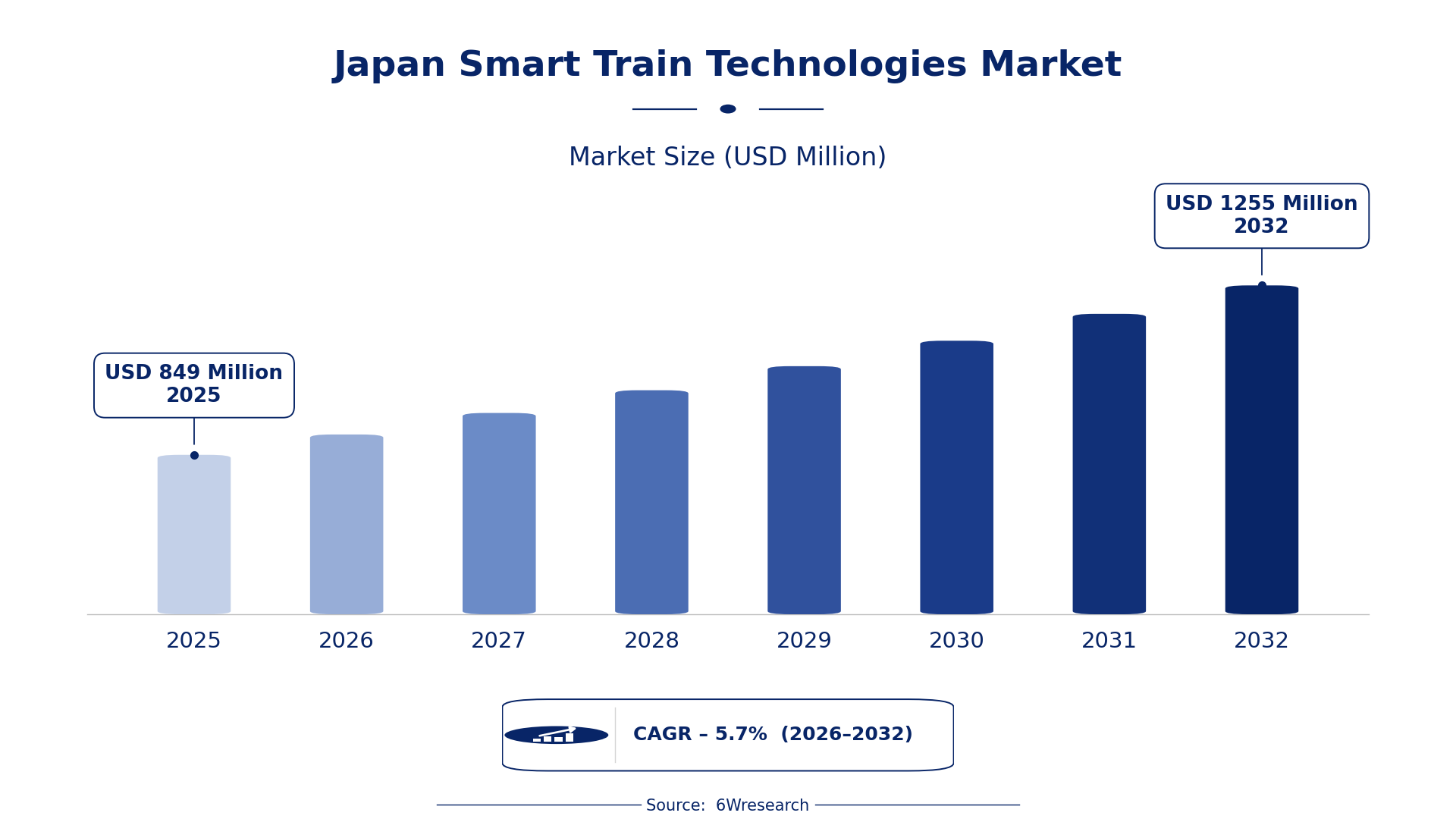
According to 6Wresearch internal database and industry insights, the Japan Smart Train Technologies Market was valued at USD 849 Million in 2025 and is projected to reach USD 1,255 Million by 2032, growing at a CAGR of approximately 5.7% during 2026–2032.
Japan Smart Train Technologies Market Highlights
| Report Metric | Details |
| Report Name | Japan Smart Train Technologies Market (2026-2032) |
| Market Size 2025 | USD 849 Million |
| Market Size 2032 | USD 1,255 Million |
| Absolute Growth 2025–2032 | USD 406 Million |
| CAGR 2026–2032 | 5.7% |
| Peak Annual Growth | 7.3% in 2026 |
| Forecast Period | 2026–2032 |
| Historical Data | 2022–2025 |
| Base Year | 2025 |
| Leading Technology Type, 2025 | Train Control Systems (33% share) |
| Leading Smart Feature, 2025 | Speed & Collision Avoidance (45% share) |
| Leading Connectivity, 2025 | GSM-R / LTE-R (44% share) |
| Leading End User, 2025 | Railway Operators (43% share) |
| Fastest-Growing Technology Type | Passenger Info Systems (8.0% CAGR) |
| Fastest-Growing Smart Feature | Real-Time Updates (7.2% CAGR) |
| Fastest-Growing Connectivity | Digital Screens + GPS (7.6% CAGR) |
| Fastest-Growing End User | Metro Rail Services (7.3% CAGR) |
| Growing Sector | Urban Rail Services |
| Key End Users | Railway Operators, Metro Rail Services, Urban Commuters |
Japan Smart Train Technologies Market Year-wise Growth Rate and Key Drivers (2022–2032)
This graph illustrates the annual growth rates of the market from 2022 to 2032, highlighting a steady upward trajectory and projected market expansion over the forecast period.
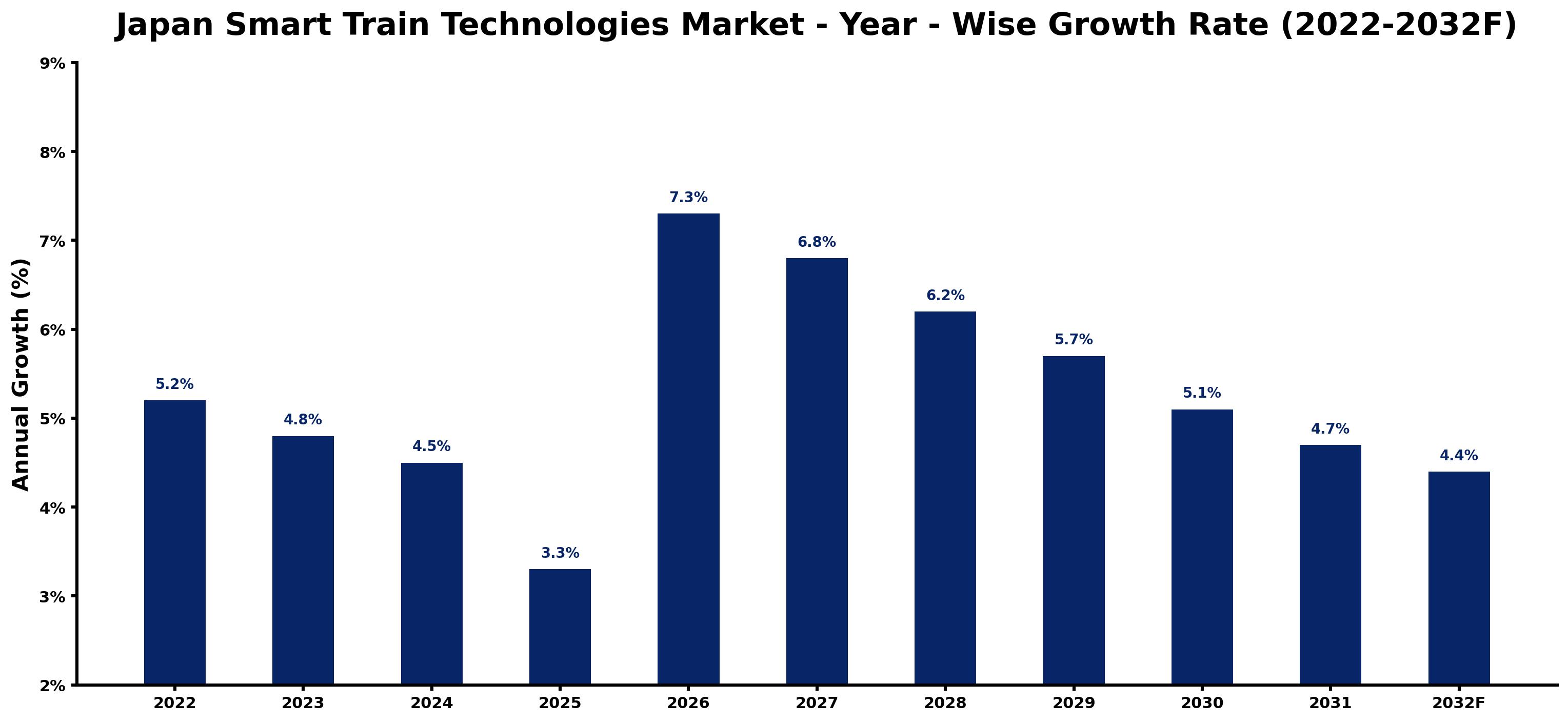
Year by year, the estimates below pair each growth rate with the development that shaped it.
| Year | Estimated Annual Growth (%) | Market Rationale |
| 2022 | 5.2 | The market experienced steady growth, driven by ongoing technology upgrades. |
| 2023 | 4.8 | Growth slowed due to a temporary reduction in investment from railway operators. |
| 2024 | 4.5 | Market expansion continued, but at a slower pace as projects were reassessed. |
| 2025 | 3.3 | Investment in modernization decreased, leading to slower growth in the sector. |
| 2026 | 7.3 | A surge in demand for smart technologies is expected to boost growth. |
| 2027 | 6.8 | Growth is projected to moderate as the market adjusts to new technology implementations. |
| 2028 | 6.2 | Demand is anticipated to continue rising, albeit at a slower rate than the previous year. |
| 2029 | 5.7 | The market is expected to maintain growth, supported by increasing urban commuter needs. |
| 2030 | 5.1 | Growth is projected to slow further as the market stabilises after rapid expansion. |
| 2031 | 4.7 | Continued investments in smart technologies will result in moderate growth. |
| 2032 | 4.4 | The market is projected to grow steadily, driven by ongoing modernization efforts. |
Note: Market size estimations and growth projections presented in this report are based on 6Wresearch's proprietary forecasting methodology, utilizing the latest available industry data, government publications, and primary research inputs.
Japan Smart Train Technologies Market Synopsis
Smart Train Technologies encompass advanced systems for train control, passenger information, predictive maintenance, and smart ticketing, which improve safety and operational efficiency. The Japan Smart Train Technologies Market is expanding due to ongoing investments in modernization, with the government allocating substantial funding for railway projects. Urban commuter demand and the implementation of smart ticketing systems in most urban rail services are driving market growth, creating opportunities for technology providers.
Market Dynamics Impact Analysis (2026–2032)
| Factor | Type | Impact | Primary Segment Affected |
| Growing urban commuter demand for efficient travel solutions | Driver | High | Passenger Info Systems |
| Increased government funding for modernization projects | Driver | High | Smart Ticketing |
| High demand for real-time updates in urban areas | Opportunity | High | Real-Time Updates |
| Expansion of smart ticketing in rural rail services | Opportunity | Medium | Smart Ticketing |
| Challenges in integrating new technologies with existing systems | Restraint | High | Train Control Systems |
| Limited budget allocations for technology upgrades among smaller operators | Restraint | Medium | Passenger Info Systems |
| High costs associated with technology implementation | Challenge | High | Predictive Maintenance AI |
| Regulatory compliance requirements delaying project timelines | Challenge | Medium | Smart Ticketing |
Evaluation of Drivers in Japan Smart Train Technologies Market (2026–2032)
Demand rests on the following drivers, each shown with the segment it touches most.
| Drivers | Primary Segment Affected | Why It Matters (Evidence) |
| Increased passenger numbers in urban areas | Passenger Info Systems | Tokyo Metro serves approximately 7 million passengers daily, driving demand for real-time information. |
| Government investments in modernization projects | Smart Ticketing | In 2023, the government allocated ¥50 billion for railway modernization, promoting technology adoption. |
| Growing adoption of predictive maintenance technologies | Predictive Maintenance AI | The Railway Safety Enhancement Programme aims to reduce accidents by 30% by 2025, increasing demand for AI solutions. |
| Rising focus on safety and efficiency in rail operations | Train Control Systems | The Shinkansen operates at speeds up to 320 km/h, necessitating advanced control systems. |
| Implementation of smart ticketing systems | Smart Ticketing | Smart ticketing systems have been implemented in over 80% of urban rail services, improving passenger convenience. |
A wider customer base explains much of the growth, as increased passenger numbers in urban areas drive demand for real-time information systems. Tokyo Metro serves approximately 7 million passengers daily, highlighting the need for advanced passenger information systems. Investments in modernization projects, with substantial funding allocated in 2023, further support technology adoption across the sector. The focus on reducing accidents by 30% by 2025 is increasing demand for predictive maintenance technologies. Smart ticketing systems have been implemented in a majority of urban rail services, facilitating travel experiences and increasing operational efficiency for railway operators.
Evaluation of Restraints in Japan Smart Train Technologies Market
Several factors work against faster growth; the main ones are summarised below.
| Market Restraint | Primary Segment Affected | Why It Matters (Evidence) |
| Integration challenges with existing rail systems | Train Control Systems | Many operators face difficulties in merging new technologies with legacy systems, slowing down modernization efforts. |
| Budget constraints for smaller railway operators | Passenger Info Systems | Limited financial resources hinder smaller operators from upgrading their information systems effectively. |
| High costs associated with technology implementation | Predictive Maintenance AI | The initial investment required for predictive maintenance technologies can be prohibitive for some operators. |
| Regulatory compliance requirements delaying projects | Smart Ticketing | Strict regulations can extend approval timelines, impacting the deployment of smart ticketing solutions. |
| Limited awareness of smart technologies among rural operators | Smart Ticketing | Operators in rural areas may lack knowledge about available smart ticketing solutions, slowing adoption. |
Japan Smart Train Technologies Market Challenges
Buyers face fierce competition as global smart train technology firms enter the market, forcing local manufacturers to lower prices and impacting profit margins. Producers contend with unpredictable demand stemming from inconsistent government funding for railway upgrades, which can delay projects by up to six months. Cost pressures arise from stringent regulations enforced by the Ministry of Land, Infrastructure, Transport and Tourism, inflating project expenses by 15% for suppliers. Skills shortages in software engineering hinder producers' ability to innovate, potentially delaying product launches and reducing operational efficiency for buyers.
Trends in the Japan Smart Train Technologies Market
Four trends stand out in the Japan Smart Train Technologies Market.
- Shift towards Real-Time Passenger Information Systems: In 2023, real-time passenger information systems were installed in 90% of major train stations, improving travel efficiency. This trend reflects the growing need for timely updates, benefiting urban commuters.
- Adoption of Smart Ticketing Solutions: The Tokyo 2020 Olympic Games accelerated investments in smart ticketing systems, with most urban rail services implementing them. This shift improves convenience for passengers, streamlining their travel experiences.
- Increased Focus on Predictive Maintenance: The aim to reduce accidents by 30% by 2025 promotes the adoption of predictive maintenance technologies. This focus improves operational efficiency and safety across the rail network.
- Expansion of GSM-R Technology: GSM-R technology is being adopted across Japan's railway network, improving communication within rail operations. This transition supports better coordination and safety for train operations.
Investment Opportunities in the Japan Smart Train Technologies Market
Investors looking at the Japan Smart Train Technologies Market should consider the following areas.
- Urban Rail Services Modernization: Tokyo is investing heavily in urban rail services, with substantial funding allocated for modernization. This presents opportunities for technology providers to supply advanced systems that improve operational efficiency.
- Expansion of Smart Ticketing in Rural Areas: Rural railway operators are seeking to modernize ticketing systems, with most urban services already implementing smart solutions. Partnering with local operators can facilitate entry into this market.
- Growing Demand for Predictive Maintenance Solutions: The aim for a 30% reduction in accidents by 2025 creates opportunities for suppliers targeting railway operators looking to invest in predictive maintenance technologies.
- Investment in Real-Time Information Systems: With most major train stations adopting real-time systems, there is a significant gap in smaller stations. Collaborating with local governments can help fill this need.
Government Initiatives in the Japan Smart Train Technologies Market
The AI Promotion Act, established in 2025, provides a framework for AI research and development in rail technologies. This law builds on the Electrical Appliance and Material Safety Act of 1961, ensuring safety standards for electrical systems used in trains, thus benefiting producers and operators.
In 2023, the government allocated substantial funding for railway modernization projects, overseen by the Ministry of Land, Infrastructure, Transport and Tourism. This funding supports the implementation of advanced technologies and ensures compliance with updated safety regulations.
Future Insight of the Japan Smart Train Technologies Market
By 2032, a policy-driven shift will compel suppliers to integrate advanced technologies for improved safety and operational efficiency. The government's commitment to modernisation will lead to real-time passenger information systems being installed in 90% of major train stations, enhancing service reliability. Ongoing investments in smart ticketing systems will streamline operations for buyers, facilitating smoother transactions. The Japan Railway Technical Research Institute's focus on pioneering rail technologies will further drive innovation throughout the industry.
Market Segmentation Analysis
Japan Smart Train Technologies Market report covers a detailed analysis of the following market segments:
By Technology Type – Train Control Systems Lead, Passenger Info Systems Expected to Grow Fastest
According to Saurav Kr Singh, Senior Research Analyst at 6Wresearch, Train Control Systems took 33% of technology type revenue in 2025, more than any other category. Train control systems dominate the market as they are essential for safe and efficient operations across Japan's extensive railway network, which spans over 27,000 kilometres. Their critical role is exemplified by the high-speed services like the Shinkansen that rely on these systems for optimal performance. Over 2026–2032, Passenger Info Systems are expected to post the fastest growth, at a CAGR of 8.0%. Passenger information systems are rapidly growing due to their integration into urban rail services, with real-time updates now available in 90% of major train stations. This growth is propelled by the increasing demand for enhanced passenger experience, particularly in high-traffic areas like Tokyo Metro. Suppliers should prioritise advancements in passenger information systems to align with the rising demand.
By Smart Feature – Speed & Collision Avoidance Leads, Real-Time Updates Expected to Grow Fastest
With 45% of smart feature revenue in 2025, Speed & Collision Avoidance was the largest category. Speed and collision avoidance technologies lead the market as they are vital for ensuring passenger safety during travel, especially in high-speed rail environments. Their implementation is crucial for railway operators aiming to comply with safety regulations enforced by the Ministry of Land, Infrastructure, Transport and Tourism. Real-Time Updates are projected to grow fastest, at a CAGR of 7.2% during 2026–2032. Real-time updates are seeing the fastest growth as they are crucial for keeping passengers informed during their journeys, a trend accelerated by investments linked to the Tokyo 2020 Olympic Games. This feature's expansion highlights the increasing focus on enhancing passenger experience in urban rail services. Buyers should invest in real-time update technologies to significantly improve service quality.
By Connectivity – GSM-R / LTE-R Leads, Digital Screens + GPS Expected to Grow Fastest
The largest connectivity category in 2025 was GSM-R / LTE-R, at 44% of revenue. GSM-R and LTE-R technologies lead the connectivity segment as they are essential for reliable communication within rail networks, ensuring seamless operations across Japan's extensive railway system. Their widespread use is critical for maintaining safety and efficiency in train operations. The quickest growth will come from Digital Screens + GPS, forecast to expand at a CAGR of 7.6% between 2026 and 2032. Digital screens and GPS are rapidly growing due to their role in displaying real-time information to passengers, which enhances the overall travel experience. This growth is particularly pronounced in urban areas where timely passenger information is crucial for operational efficiency. Suppliers must expand their offerings in digital display technologies to meet the increasing demand.
By End User – Railway Operators Lead, Metro Rail Services Expected to Grow Fastest
In 2025, Railway Operators led the end user split with a 43% share. Railway operators account for the largest share as they are the primary users of smart train technologies, implementing these systems to enhance operational efficiency across their networks. Their significant investments in modernization projects underscore their commitment to adopting advanced technologies. Metro Rail Services are set to record the highest CAGR in this split, 7.3% over 2026–2032. Metro rail services represent the fastest growing end user segment, utilising smart technologies to improve urban transportation efficiency, particularly in densely populated regions like Tokyo. The ongoing demand for efficient public transport solutions drives this rapid growth. Suppliers should tailor their solutions to meet the specific needs of metro rail services to capitalise on this growth.
Key Attractiveness of the Report
- 10 Years of Market Numbers
- Historical Data Starting from 2022 to 2025
- Base Year 2025
- Forecast Data until 2032
- Key Performance Indicators Impacting the Market
- Major Upcoming Developments and Projects
Key Highlights of the Report:
- Japan Smart Train Technologies Market Outlook
- Market Size of Japan Smart Train Technologies Market, 2025
- Forecast of Japan Smart Train Technologies Market, 2032
- Historical Data and Forecast of Japan Smart Train Technologies Revenues & Volume for the Period 2022-2032F
- Japan Smart Train Technologies Market Trend Evolution
- Japan Smart Train Technologies Market Drivers and Challenges
- Japan Smart Train Technologies Price Trends
- Japan Smart Train Technologies Porter's Five Forces
- Japan Smart Train Technologies Industry Life Cycle
- Historical Data and Forecast of Japan Smart Train Technologies Market Revenues & Volume By Technology Type for the Period 2022-2032F
- Historical Data and Forecast of Japan Smart Train Technologies Market Revenues & Volume By Train Control Systems for the Period 2022-2032F
- Historical Data and Forecast of Japan Smart Train Technologies Market Revenues & Volume By Passenger Info Systems for the Period 2022-2032F
- Historical Data and Forecast of Japan Smart Train Technologies Market Revenues & Volume By Predictive Maintenance AI for the Period 2022-2032F
- Historical Data and Forecast of Japan Smart Train Technologies Market Revenues & Volume By Smart Ticketing for the Period 2022-2032F
- Historical Data and Forecast of Japan Smart Train Technologies Market Revenues & Volume By Smart Feature for the Period 2022-2032F
- Historical Data and Forecast of Japan Smart Train Technologies Market Revenues & Volume By Speed & Collision Avoidance for the Period 2022-2032F
- Historical Data and Forecast of Japan Smart Train Technologies Market Revenues & Volume By Real-Time Updates for the Period 2022-2032F
- Historical Data and Forecast of Japan Smart Train Technologies Market Revenues & Volume By Fault Forecasting for the Period 2022-2032F
- Historical Data and Forecast of Japan Smart Train Technologies Market Revenues & Volume By Contactless Boarding for the Period 2022-2032F
- Historical Data and Forecast of Japan Smart Train Technologies Market Revenues & Volume By Connectivity for the Period 2022-2032F
- Historical Data and Forecast of Japan Smart Train Technologies Market Revenues & Volume By GSM-R / LTE-R for the Period 2022-2032F
- Historical Data and Forecast of Japan Smart Train Technologies Market Revenues & Volume By Digital Screens + GPS for the Period 2022-2032F
- Historical Data and Forecast of Japan Smart Train Technologies Market Revenues & Volume By Sensor + Analytics for the Period 2022-2032F
- Historical Data and Forecast of Japan Smart Train Technologies Market Revenues & Volume By QR + NFC + Mobile App for the Period 2022-2032F
- Historical Data and Forecast of Japan Smart Train Technologies Market Revenues & Volume By End User for the Period 2022-2032F
- Historical Data and Forecast of Japan Smart Train Technologies Market Revenues & Volume By Railway Operators for the Period 2022-2032F
- Historical Data and Forecast of Japan Smart Train Technologies Market Revenues & Volume By Metro Rail Services for the Period 2022-2032F
- Historical Data and Forecast of Japan Smart Train Technologies Market Revenues & Volume By Smart Rail Operators for the Period 2022-2032F
- Historical Data and Forecast of Japan Smart Train Technologies Market Revenues & Volume By Urban Commuters for the Period 2022-2032F
- Japan Smart Train Technologies Import Export Trade Statistics
- Market Opportunity Assessment By Technology Type
- Market Opportunity Assessment By Smart Feature
- Market Opportunity Assessment By Connectivity
- Market Opportunity Assessment By End User
- Japan Smart Train Technologies Top Companies Market Share
- Japan Smart Train Technologies Competitive Benchmarking By Technical and Operational Parameters
- Japan Smart Train Technologies Company Profiles
- Japan Smart Train Technologies Key Strategic Recommendations
Market Covered
Segments analysed in this report are listed below.
By Technology Type
- Train Control Systems
- Passenger Info Systems
- Predictive Maintenance AI
- Smart Ticketing
By Smart Feature
- Speed & Collision Avoidance
- Real-Time Updates
- Fault Forecasting
- Contactless Boarding
By Connectivity
- GSM-R / LTE-R
- Digital Screens + GPS
- Sensor + Analytics
- QR + NFC + Mobile App
By End User
- Railway Operators
- Metro Rail Services
- Smart Rail Operators
- Urban Commuters































