Japan Smart Transport Systems Market Size & Growth Rate
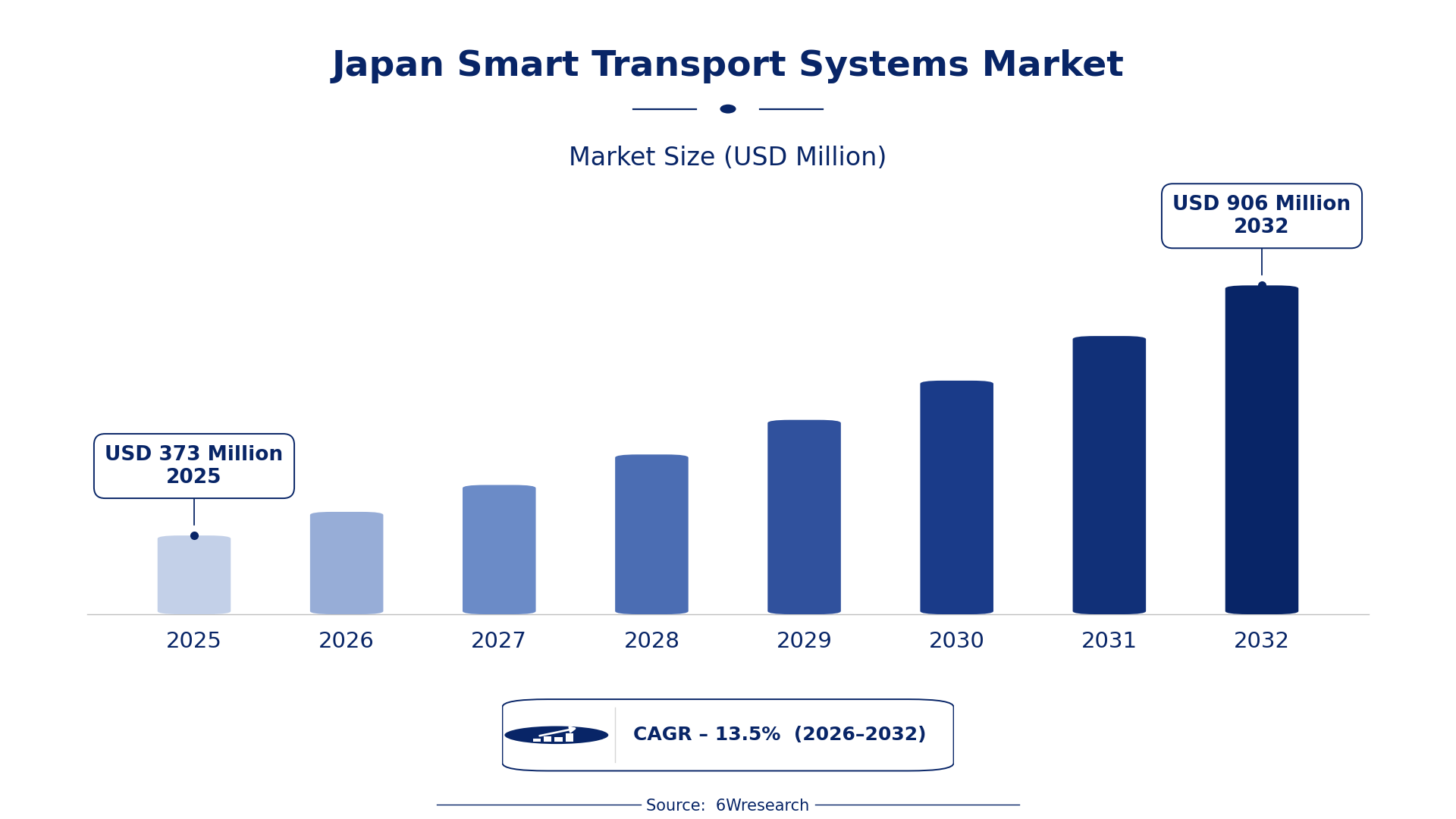
According to 6Wresearch internal database and industry insights, the Japan Smart Transport Systems Market was valued at USD 373 Million in 2025 and is projected to reach USD 906 Million by 2032, growing at a CAGR of approximately 13.5% during 2026–2032.
Japan Smart Transport Systems Market Highlights
| Report Metric | Details |
| Report Name | Japan Smart Transport Systems Market (2026-2032) |
| Market Size 2025 | USD 373 Million |
| Market Size 2032 | USD 906 Million |
| Absolute Growth 2025–2032 | USD 533 Million |
| CAGR 2026–2032 | 13.5% |
| Peak Annual Growth | 14.5% in 2029 |
| Forecast Period | 2026–2032 |
| Historical Data | 2022–2025 |
| Base Year | 2025 |
| Leading System Type, 2025 | Integrated Mobility Apps (39% share) |
| Leading Smart Feature, 2025 | Real-Time Route Optimization (49% share) |
| Leading Tech Stack, 2025 | Cloud + GPS + AI (51% share) |
| Leading End User, 2025 | Citizens (50% share) |
| Fastest-Growing System Type | Smart Tolling Systems (19.2% CAGR) |
| Fastest-Growing Smart Feature | Fleet Movement Analytics (17.2% CAGR) |
| Fastest-Growing Tech Stack | V2I + 5G (18.1% CAGR) |
| Fastest-Growing End User | Smart City Admin (17.5% CAGR) |
| Growing Sector | Smart Transport Systems |
| Key End Users | Citizens, Traffic Controllers, Smart City Administrators, Highway Authorities |
Japan Smart Transport Systems Market Year-wise Growth Rate and Key Drivers (2022–2032)
This graph illustrates the annual growth rates of the market from 2022 to 2032, highlighting a steady upward trajectory and projected market expansion over the forecast period.
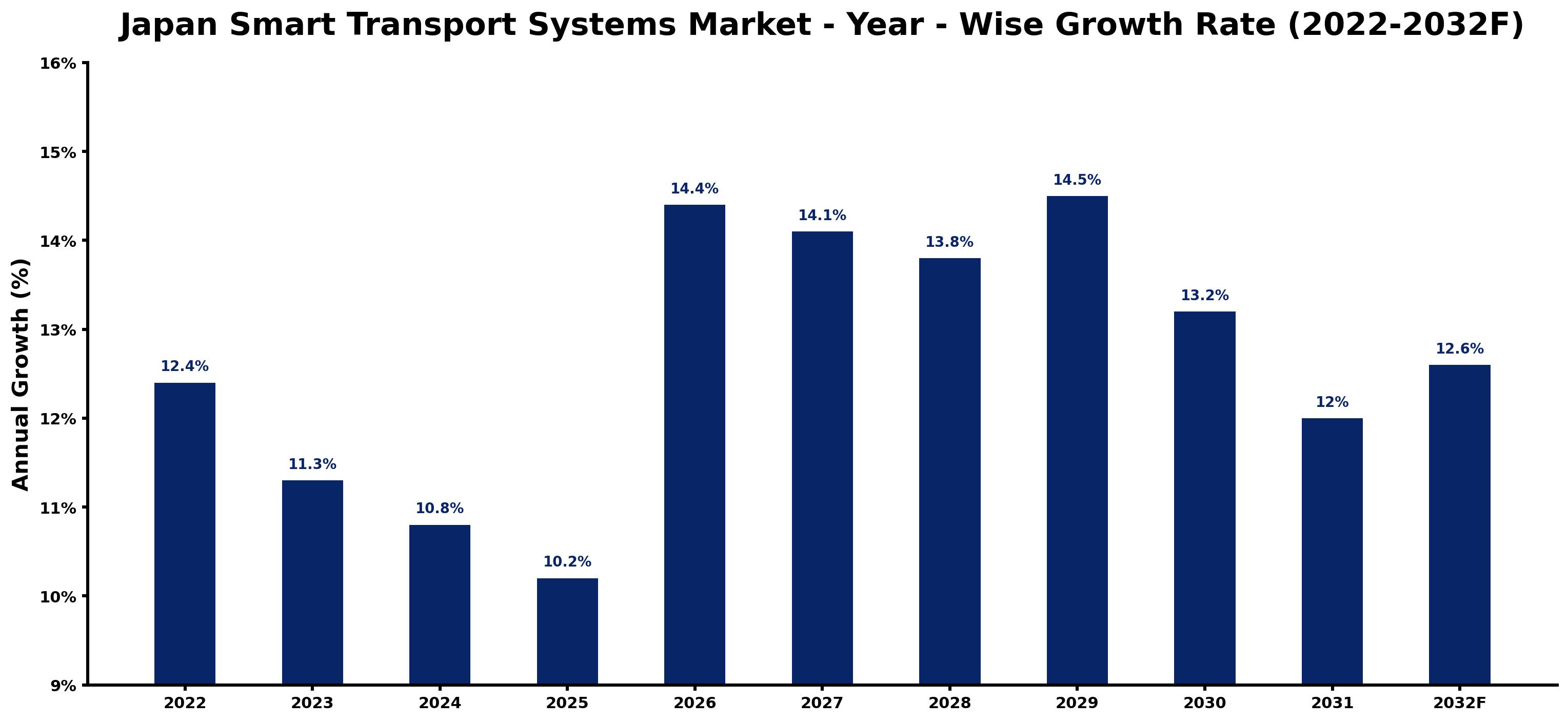
The table below sets out the estimated growth rate for each year and the main factor behind it.
| Year | Estimated Annual Growth (%) | Market Rationale |
| 2022 | 12.4 | The market experienced strong demand driven by urbanisation and smart city initiatives. |
| 2023 | 11.3 | Growth slowed due to market saturation in initial smart transport projects. |
| 2024 | 10.8 | Demand continued to slow as competition increased among technology providers. |
| 2025 | 10.2 | Market growth decelerated as existing systems reached maturity in urban centres. |
| 2026 | 14.4 | Growth is expected to accelerate with the introduction of new technologies and 5G deployment. |
| 2027 | 14.1 | Demand is projected to slow slightly as the market adjusts to new technology integrations. |
| 2028 | 13.8 | Investment in smart transport systems is expected to support steady growth. |
| 2029 | 14.5 | Growth will peak as urban areas expand smart transport initiatives. |
| 2030 | 13.2 | Demand is anticipated to moderate as the market stabilises after rapid technological advancements. |
| 2031 | 12.0 | Growth is expected to slow as the focus shifts to system optimisation and maintenance. |
| 2032 | 12.6 | Demand is projected to rise again with increased urban population and infrastructure needs. |
Note: Market size estimations and growth projections presented in this report are based on 6Wresearch's proprietary forecasting methodology, utilizing the latest available industry data, government publications, and primary research inputs.
Japan Smart Transport Systems Market Synopsis
Smart Transport Systems improve transportation efficiency and safety through advanced technologies like real-time data analytics and automated systems. In Japan, Tokyo leads with numerous pilot projects, reflecting a growing market driven by high urban transportation demand and substantial investments in infrastructure. The deployment of 5G technology significantly enhances communication between vehicles and infrastructure, resulting in more efficient transport solutions and increased purchasing activity across the sector.
Market Dynamics Impact Analysis (2026–2032)
| Factor | Type | Impact | Primary Segment Affected |
| Urbanisation drives demand for efficient transport solutions. | Driver | High | Integrated Mobility Apps |
| Investment in smart city initiatives boosts technology adoption. | Driver | High | Smart Tolling Systems |
| Growing urban population increases demand for smart transport solutions. | Opportunity | High | Vehicle-to-Infrastructure |
| Technological advancements in communication enhance system capabilities. | Opportunity | Medium | Centralized Control Hubs |
| High initial costs limit adoption of advanced systems in some areas. | Restraint | Medium | Smart Tolling Systems |
| Complex integration of new technologies can delay implementation. | Restraint | Medium | Real-Time Route Optimization |
| Limited infrastructure investment in rural areas hinders market growth. | Challenge | High | Vehicle-to-Infrastructure |
| Competition among technology providers can lead to market fragmentation. | Challenge | Medium | Integrated Mobility Apps |
Evaluation of Drivers in Japan Smart Transport Systems Market (2026–2032)
The factors lifting demand, and the evidence behind each, are summarised below.
| Drivers | Primary Segment Affected | Why It Matters (Evidence) |
| High urban population density increases demand for transport efficiency. | Integrated Mobility Apps | Japan's population of approximately 125 million drives the need for real-time travel solutions. |
| Government initiatives promote smart transport technologies. | Smart Tolling Systems | The Smart Mobility Challenge 2023 encourages new solutions in urban areas, stimulating investment. |
| Deployment of 5G technology improves communication between vehicles and infrastructure. | Vehicle-to-Infrastructure | 5G implementation supports better traffic management and data sharing, improving system effectiveness. |
| Investment in smart city projects boosts infrastructure modernization. | Centralized Control Hubs | Tokyo's investment in smart transport technologies aims to reduce congestion and improve efficiency. |
| Increased focus on road safety drives demand for advanced systems. | Real-Time Route Optimization | Over 80% of urban transport agencies utilise real-time traffic data for safety and efficiency. |
Volumes grow on the back of Japan's high urban population, which is approximately 125 million, driving demand for real-time travel information. Investment in smart transport technologies, particularly in Tokyo, aims to reduce congestion and improve efficiency. The deployment of 5G technology improves communication between vehicles and infrastructure, allowing for better traffic management. These factors lead to increased purchasing of advanced transport solutions across the market.
Evaluation of Restraints in Japan Smart Transport Systems Market
The following restraints limit how fast demand can grow.
| Market Restraint | Primary Segment Affected | Why It Matters (Evidence) |
| High initial costs limit the adoption of smart transport systems. | Smart Tolling Systems | The average cost of implementing smart tolling systems can exceed several million dollars. |
| Complex integration of new technologies can delay implementation. | Real-Time Route Optimization | Many municipalities face challenges in integrating new systems with existing infrastructure, causing delays. |
| Insufficient funding for rural infrastructure limits market growth. | Vehicle-to-Infrastructure | Rural areas often lack the necessary funding for advanced transport solutions, restricting development. |
| Regulatory hurdles can slow down the deployment of new technologies. | Centralized Control Hubs | Compliance with safety standards often delays the rollout of new systems, affecting timelines. |
| Market fragmentation due to competition among technology providers. | Integrated Mobility Apps | Numerous providers lead to inconsistent service quality and user experience, complicating market entry. |
Japan Smart Transport Systems Market Challenges
High urban transportation demand raises costs for public transport agencies, with budget constraints causing project delays. Limited access to advanced technologies hampers the growth of smart transport systems, resulting in slower implementation in cities focused on modernisation. Intense competition among local stakeholders drives rapid innovation, often compromising project quality and safety. Buyers face rising operational costs due to ongoing investments in solutions, with over 10 million vehicles in daily traffic in Tokyo underscoring the urgent need for effective transport management.
Trends in the Japan Smart Transport Systems Market
Buyers and suppliers in the Japan Smart Transport Systems Market are adjusting to the following trends.
- Transition from Traditional to Smart Tolling Systems: Japan is shifting from traditional toll collection methods to automated smart tolling systems. The implementation of these systems on major expressways has improved traffic flow by 15%, demonstrating their effectiveness.
- Increase in Real-Time Data Utilization: Urban transport agencies in Japan are increasingly employing real-time data analytics to enhance traffic management. Over 80% of agencies now depend on this data, which improves response times and safety measures.
- Expansion of Integrated Mobility Applications: Cities are adopting Integrated Mobility Apps to streamline public transport and enhance user experience. In Tokyo, these apps have improved travel efficiency for over 10 million daily commuters, showcasing their impact.
- Rising Adoption of Vehicle-to-Infrastructure Communication: There is a growing trend towards Vehicle-to-Infrastructure communication technologies in urban areas. The rollout of 5G is enabling better connectivity, with over 60% of urban areas expected to adopt this technology by 2025.
Investment Opportunities in the Japan Smart Transport Systems Market
The openings below show where demand in the Japan Smart Transport Systems Market is visible and how suppliers can enter.
- Tokyo as a Hub for Smart Transport Solutions: Tokyo's focus on smart city initiatives creates opportunities for suppliers of smart transport systems. With an investment of over USD 100 million in 2023, companies can enter through partnerships with local governments.
- Citizens Driving Demand for Integrated Mobility Apps: The increasing demand from citizens for efficient transport solutions presents an opportunity. With 50% of the population using public transport, suppliers can concentrate on app development and integration.
- Timing for Smart Tolling Systems Implementation: Now is a prime time to invest in smart tolling systems, as urban areas seek to reduce congestion. The Tokyo Metropolitan Government has allocated funds for this purpose, improving market entry prospects.
- Growing Need for Fleet Movement Analytics: The demand for Fleet Movement Analytics is rising as companies seek to optimise operations. Urban logistics firms are investing heavily in these analytics tools to boost efficiency.
Government Initiatives in the Japan Smart Transport Systems Market
The Electrical Appliance and Material Safety Act ensures that Smart Transport Systems meet safety standards in Japan. This legislation impacts producers by mandating compliance testing and certification for all systems deployed in urban areas, which helps maintain safety and reliability in transport. The act also requires regular inspections to ensure ongoing compliance, building confidence among users and stakeholders.
The Digital Agency oversees government digital transformation efforts and approves funding for smart transport projects. This support facilitates the development of integrated systems, improving urban mobility and ensuring that smart transport solutions are effectively implemented. By providing financial backing, the agency drives innovation and collaboration among stakeholders in the smart transport sector.
Future Insight of the Japan Smart Transport Systems Market
By 2032, buyers will experience increased adoption of 5G technology, improving vehicle-to-infrastructure communication for better traffic management. The national strategy for smart city development will enhance collaboration among stakeholders, leading to innovative transport solutions. Smart tolling systems will advance, streamlining traffic flow on expressways. These changes will create more efficient networks for buyers and open new opportunities for suppliers in the expanding market.
Market Segmentation Analysis
Japan Smart Transport Systems Market report covers a detailed analysis of the following market segments:
By System Type – Integrated Mobility Apps Lead, Smart Tolling Systems Expected to Grow Fastest
According to Saurav Kr Singh, Senior Research Analyst at 6Wresearch, in 2025, Integrated Mobility Apps led the system type split with a 39% share. Integrated Mobility Apps dominate the market as they are widely adopted by urban commuters, providing crucial real-time travel information. For instance, these apps are utilised by over 80% of urban transport agencies in Japan to enhance user experience and travel efficiency. Smart Tolling Systems are projected to grow fastest, at a CAGR of 19.2% during 2026–2032. Smart Tolling Systems are experiencing rapid growth as municipalities implement automated toll collection to alleviate congestion and improve traffic flow. Recent investments in smart tolling infrastructure by local authorities have significantly accelerated this trend. Suppliers should focus on creating solutions that integrate seamlessly with existing urban transport systems to meet rising demand.
By Smart Feature – Real-Time Route Optimization Leads, Fleet Movement Analytics Expected to Grow Fastest
The largest smart feature category in 2025 was Real-Time Route Optimization, at 49% of revenue. Real-Time Route Optimization holds the largest market share due to its effectiveness in assisting users to navigate efficiently in congested urban environments, particularly in cities like Tokyo. This feature is essential for commuters who rely on accurate traffic data to plan their routes effectively. Over 2026–2032, Fleet Movement Analytics is expected to post the fastest growth, at a CAGR of 17.2%. Fleet Movement Analytics is growing swiftly as businesses increasingly seek to optimise their logistics and transportation operations. The demand for improved efficiency in fleet management is driving the rapid adoption of this analytics tool. Buyers should invest in advanced analytics solutions that enhance operational efficiency and reduce costs.
By Tech Stack – Cloud + GPS + AI Leads, V2I + 5G Expected to Grow Fastest
Cloud + GPS + AI took 51% of tech stack revenue in 2025, more than any other category. The combination of Cloud, GPS, and other technologies leads the market as it provides a robust foundation for real-time data processing and decision-making in smart transport systems. This integration is vital for developing scalable and effective transport solutions. V2I + 5G is set to record the highest CAGR in this split, 18.1% over 2026–2032. V2I and 5G technologies are set for rapid growth, enabling seamless communication between vehicles and infrastructure, which is crucial for the future of smart transport. The rollout of 5G networks is expected to significantly enhance the capabilities of existing systems. Suppliers must focus on developing solutions that leverage advanced technologies to remain competitive in the market.
By End User – Citizens Lead, Smart City Admin Expected to Grow Fastest
With 50% of end user revenue in 2025, Citizens was the largest category. Citizens represent the largest market share as they are the primary users of smart transport systems, seeking improved travel experiences in urban areas. Their demand for efficient public transport and traffic management solutions drives market growth. The quickest growth will come from Smart City Admin, forecast to expand at a CAGR of 17.5% between 2026 and 2032. Smart City Administrators are the fastest-growing segment as they increasingly adopt smart transport solutions to enhance urban mobility. The recent national strategy for smart city development highlights their critical role in shaping transport policies. Suppliers should tailor their offerings to address the specific needs of urban administrators to capitalise on this expanding segment.
Key Attractiveness of the Report
- 10 Years of Market Numbers
- Historical Data Starting from 2022 to 2025
- Base Year 2025
- Forecast Data until 2032
- Key Performance Indicators Impacting the Market
- Major Upcoming Developments and Projects
Key Highlights of the Report:
- Japan Smart Transport Systems Market Outlook
- Market Size of Japan Smart Transport Systems Market, 2025
- Forecast of Japan Smart Transport Systems Market, 2032
- Historical Data and Forecast of Japan Smart Transport Systems Revenues & Volume for the Period 2022-2032F
- Japan Smart Transport Systems Market Trend Evolution
- Japan Smart Transport Systems Market Drivers and Challenges
- Japan Smart Transport Systems Price Trends
- Japan Smart Transport Systems Porter's Five Forces
- Japan Smart Transport Systems Industry Life Cycle
- Historical Data and Forecast of Japan Smart Transport Systems Market Revenues & Volume By System Type for the Period 2022-2032F
- Historical Data and Forecast of Japan Smart Transport Systems Market Revenues & Volume By Integrated Mobility Apps for the Period 2022-2032F
- Historical Data and Forecast of Japan Smart Transport Systems Market Revenues & Volume By Vehicle-to-Infrastructure for the Period 2022-2032F
- Historical Data and Forecast of Japan Smart Transport Systems Market Revenues & Volume By Centralized Control Hubs for the Period 2022-2032F
- Historical Data and Forecast of Japan Smart Transport Systems Market Revenues & Volume By Smart Tolling Systems for the Period 2022-2032F
- Historical Data and Forecast of Japan Smart Transport Systems Market Revenues & Volume By Smart Feature for the Period 2022-2032F
- Historical Data and Forecast of Japan Smart Transport Systems Market Revenues & Volume By Real-Time Route Optimization for the Period 2022-2032F
- Historical Data and Forecast of Japan Smart Transport Systems Market Revenues & Volume By Signal & Hazard Response for the Period 2022-2032F
- Historical Data and Forecast of Japan Smart Transport Systems Market Revenues & Volume By Fleet Movement Analytics for the Period 2022-2032F
- Historical Data and Forecast of Japan Smart Transport Systems Market Revenues & Volume By License Plate Recognition for the Period 2022-2032F
- Historical Data and Forecast of Japan Smart Transport Systems Market Revenues & Volume By Tech Stack for the Period 2022-2032F
- Historical Data and Forecast of Japan Smart Transport Systems Market Revenues & Volume By Cloud + GPS + AI for the Period 2022-2032F
- Historical Data and Forecast of Japan Smart Transport Systems Market Revenues & Volume By V2I + 5G for the Period 2022-2032F
- Historical Data and Forecast of Japan Smart Transport Systems Market Revenues & Volume By IoT + Dashboard for the Period 2022-2032F
- Historical Data and Forecast of Japan Smart Transport Systems Market Revenues & Volume By Camera + AI for the Period 2022-2032F
- Historical Data and Forecast of Japan Smart Transport Systems Market Revenues & Volume By End User for the Period 2022-2032F
- Historical Data and Forecast of Japan Smart Transport Systems Market Revenues & Volume By Citizens for the Period 2022-2032F
- Historical Data and Forecast of Japan Smart Transport Systems Market Revenues & Volume By Traffic Controllers for the Period 2022-2032F
- Historical Data and Forecast of Japan Smart Transport Systems Market Revenues & Volume By Smart City Admin for the Period 2022-2032F
- Historical Data and Forecast of Japan Smart Transport Systems Market Revenues & Volume By Highway Authorities for the Period 2022-2032F
- Japan Smart Transport Systems Import Export Trade Statistics
- Market Opportunity Assessment By System Type
- Market Opportunity Assessment By Smart Feature
- Market Opportunity Assessment By Tech Stack
- Market Opportunity Assessment By End User
- Japan Smart Transport Systems Top Companies Market Share
- Japan Smart Transport Systems Competitive Benchmarking By Technical and Operational Parameters
- Japan Smart Transport Systems Company Profiles
- Japan Smart Transport Systems Key Strategic Recommendations
Market Covered
This report examines the market across the segments below.
By System Type
- Integrated Mobility Apps
- Vehicle-to-Infrastructure
- Centralized Control Hubs
- Smart Tolling Systems
By Smart Feature
- Real-Time Route Optimization
- Signal & Hazard Response
- Fleet Movement Analytics
- License Plate Recognition
By Tech Stack
- Cloud + GPS + AI
- V2I + 5G
- IoT + Dashboard
- Camera + AI
By End User
- Citizens
- Traffic Controllers
- Smart City Admin
- Highway Authorities































