Japan Smart TV Technology Market Size & Growth Rate
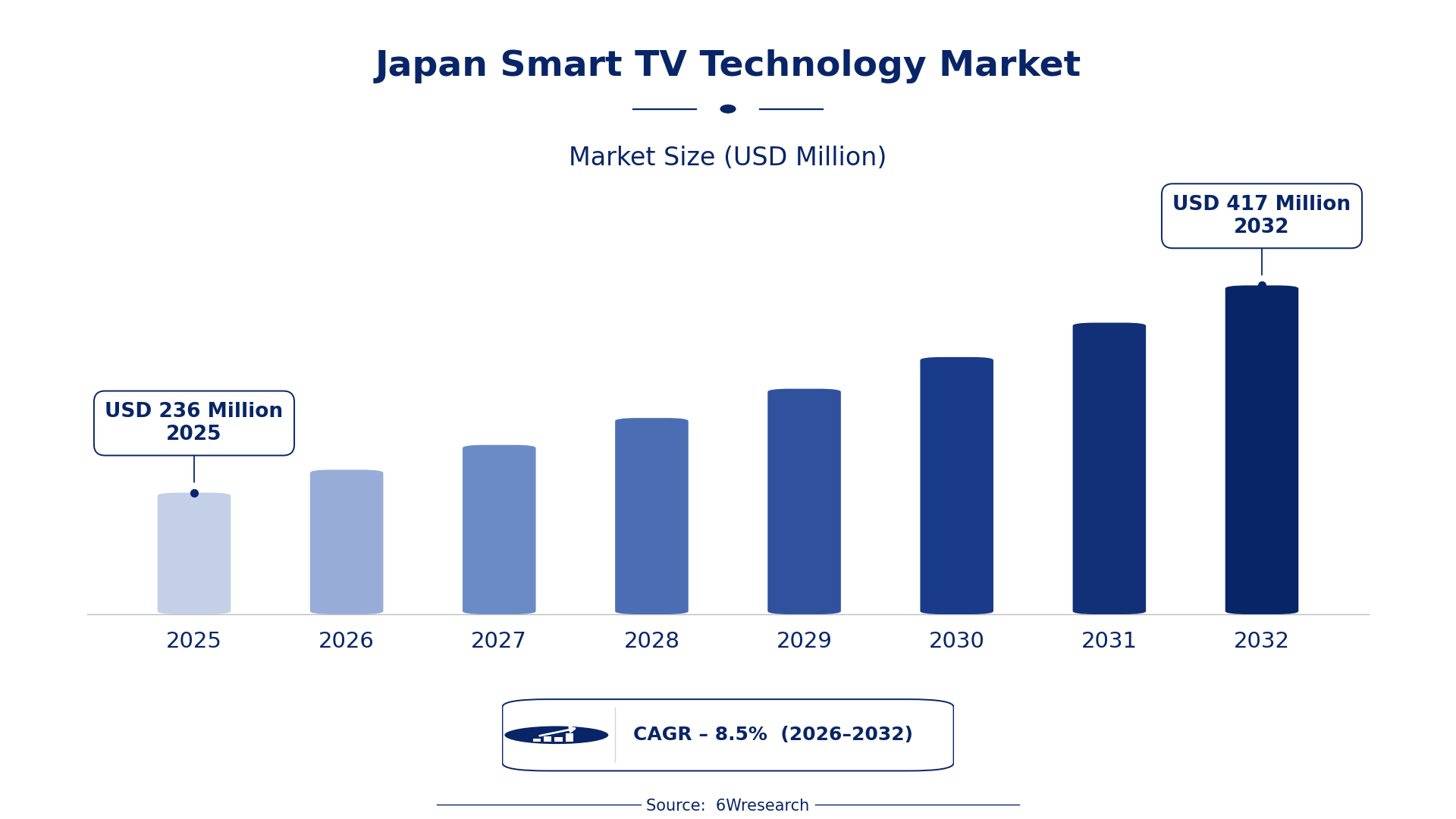
According to 6Wresearch internal database and industry insights, the Japan Smart TV Technology Market was valued at USD 236 Million in 2025 and is projected to reach USD 417 Million by 2032, growing at a CAGR of approximately 8.5% during 2026–2032.
Japan Smart TV Technology Market Highlights
| Report Metric | Details |
| Report Name | Japan Smart TV Technology Market (2026-2032) |
| Market Size 2025 | USD 236 Million |
| Market Size 2032 | USD 417 Million |
| Absolute Growth 2025–2032 | USD 181 Million |
| CAGR 2026–2032 | 8.5% |
| Peak Annual Growth | 9.2% in 2028 |
| Forecast Period | 2026–2032 |
| Historical Data | 2022–2025 |
| Base Year | 2025 |
| Leading Technology Type, 2025 | Voice-Control AI (38% share) |
| Leading Smart Feature, 2025 | Smart Home Control (50% share) |
| Leading Integration Layer, 2025 | Google/Alexa (38% share) |
| Leading End User, 2025 | OEMs & TV Brands (51% share) |
| Fastest-Growing Technology Type | Smart UI OS (11.9% CAGR) |
| Fastest-Growing Smart Feature | Personalized Recommendations (11.0% CAGR) |
| Fastest-Growing Integration Layer | Embedded OS (11.4% CAGR) |
| Fastest-Growing End User | Tech Manufacturers (10.9% CAGR) |
| Growing Sector | consumer electronics |
| Key End Users | OEMs, tech manufacturers, panel manufacturers |
Japan Smart TV Technology Market Year-wise Growth Rate and Key Drivers (2022–2032)
This graph illustrates the annual growth rates of the market from 2022 to 2032, highlighting a steady upward trajectory and projected market expansion over the forecast period.
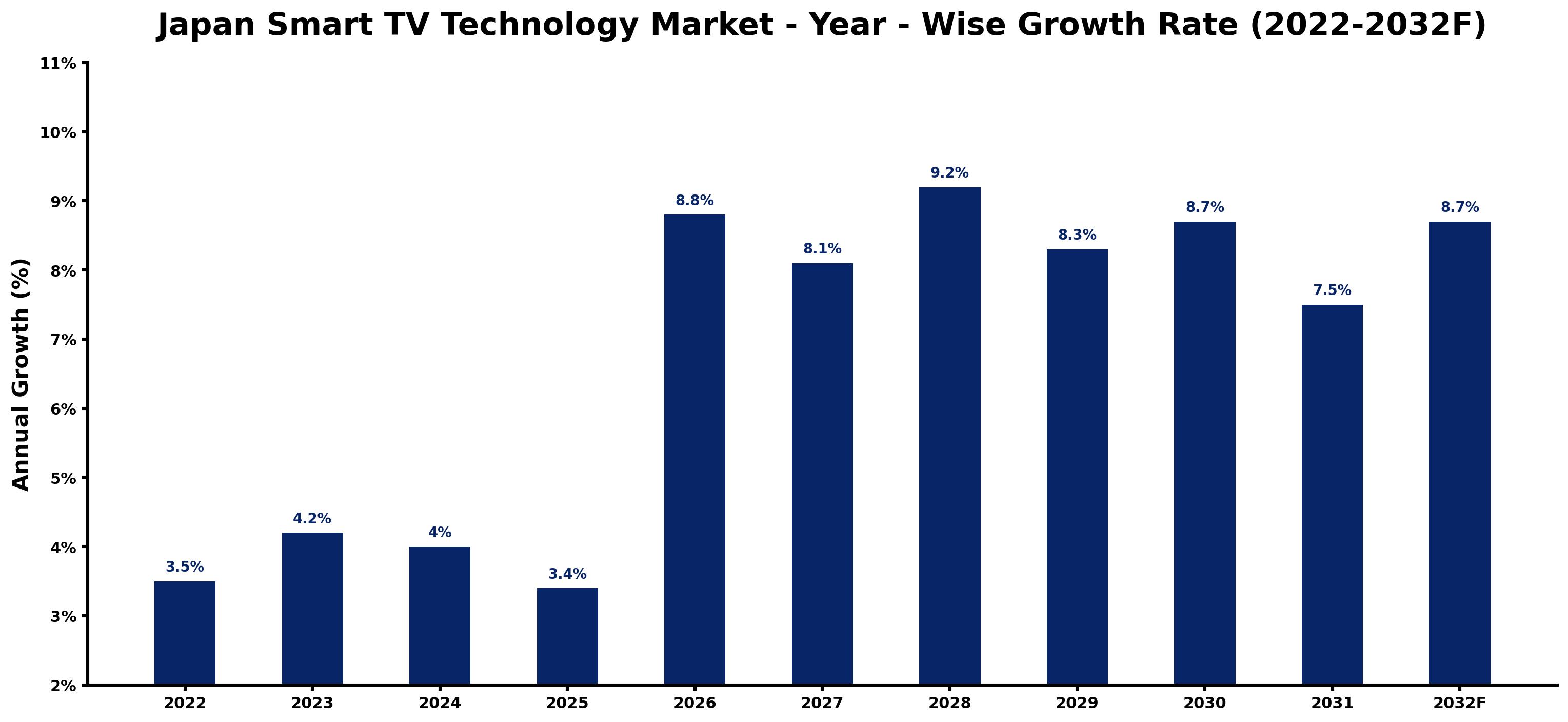
The table below sets out the estimated growth rate for each year and the main factor behind it.
| Year | Estimated Annual Growth (%) | Market Rationale |
| 2022 | 3.5 | The market showed steady growth with increasing smart TV adoption among households. |
| 2023 | 4.2 | Demand rose as the adoption rate reached 65% among households, indicating consumer interest. |
| 2024 | 4.0 | Growth slowed slightly due to market saturation as many households already owned smart TVs. |
| 2025 | 3.4 | Continued growth was observed, though at a reduced pace as competition intensified. |
| 2026 | 8.8 | Investment in new features is expected to spark renewed consumer interest. |
| 2027 | 8.1 | Growth is projected to moderate as the market adjusts to technological advancements and user expectations. |
| 2028 | 9.2 | The introduction of new features is expected to lead to peak growth as consumer demand surges. |
| 2029 | 8.3 | Growth is projected to slow again as the market stabilises following the peak in 2028. |
| 2030 | 8.7 | Demand is expected to rise due to the integration of Wi-Fi 6 technology in new models. |
| 2031 | 7.5 | The market is projected to continue growing, driven by ongoing technological advancements and consumer preferences. |
| 2032 | 8.7 | Demand is expected to rise as smart home integration becomes more prevalent. |
Note: Market size estimations and growth projections presented in this report are based on 6Wresearch's proprietary forecasting methodology, utilizing the latest available industry data, government publications, and primary research inputs.
Japan Smart TV Technology Market Synopsis
Smart TV technology integrates internet connectivity, interactive features, and multimedia capabilities, enabling streaming, gaming, and home automation. The Japan Smart TV Technology Market is expanding, driven by a strong consumer electronics industry, with over 30 million smart TV users. Factors such as the adoption of Wi-Fi 6 technology and government initiatives to improve broadband access are fuelling this growth, alongside the rising demand for energy-efficient models among tech-savvy consumers.
Market Dynamics Impact Analysis (2026–2032)
| Factor | Type | Impact | Primary Segment Affected |
| Growing adoption of AI-Driven SoCs enhances performance and user experience. | Driver | High | AI-Driven SoCs |
| Increasing integration of smart home features drives consumer interest. | Driver | High | Smart Home Control |
| Urban areas are seeing a rise in smart home integration, creating new demand. | Opportunity | High | Smart Home Control |
| The Tokyo Metropolitan Government's smart city initiative promotes advanced technology adoption. | Opportunity | High | Smart UI OS |
| Market saturation limits growth potential as many households already own smart TVs. | Restraint | Medium | Smart Home Control |
| Intense competition among over 50 smart TV brands can lead to price wars. | Restraint | Medium | AI-Driven SoCs |
| Supply chain disruptions can delay product availability and increase costs for manufacturers. | Challenge | High | AI-Driven SoCs |
| Rapid technological advancements require constant updates and adaptations from producers. | Challenge | High | Smart UI OS |
Evaluation of Drivers in Japan Smart TV Technology Market (2026–2032)
The factors lifting demand, and the evidence behind each, are summarised below.
| Drivers | Primary Segment Affected | Why It Matters (Evidence) |
| Investment in AI-Driven SoCs improves processing capabilities and performance. | AI-Driven SoCs | As of 2023, premium models increasingly adopt AI-Driven SoCs, improving user experience and driving consumer purchases. |
| Integration of Wi-Fi 6 technology boosts connectivity and streaming capabilities. | Connectivity Modules | Wi-Fi 6 technology is widely adopted in new smart TVs, enabling faster streaming and better connectivity. |
| Growing consumer interest in energy-efficient technologies aligns with market trends. | Smart Home Control | Japan's focus on energy efficiency has led to increased demand for energy-efficient smart TVs. |
| Government initiatives to improve broadband access support smart TV usage. | Smart UI OS | Programs aim to improve digital literacy and broadband access, facilitating smart TV adoption. |
| Urbanisation trends drive demand for integrated smart home solutions. | Smart Home Control | Smart home integration is a growing trend in urban areas, leading to increased smart TV sales. |
Several shifts outside the market lift sales. Investment in new features is rising, improving processing capabilities and driving purchases among tech-savvy consumers. In 2023, Wi-Fi 6 technology became standard in new smart TVs, boosting connectivity and streaming capabilities. Increased consumer interest in energy-efficient technologies aligns with market trends, leading to higher demand for energy-efficient smart TVs.
Evaluation of Restraints in Japan Smart TV Technology Market
These are the pressures that could keep growth below its potential.
| Market Restraint | Primary Segment Affected | Why It Matters (Evidence) |
| Market saturation limits growth potential as many households already own smart TVs. | Smart Home Control | With a 65% adoption rate, many households have already invested in smart TVs, reducing new purchases. |
| Intense competition among over 50 smart TV brands can lead to price wars. | AI-Driven SoCs | The high number of brands in the market drives prices down, affecting profitability for manufacturers. |
| Supply chain disruptions can delay product availability and increase costs for manufacturers. | Smart UI OS | Recent global supply chain issues have impacted the availability of essential components for smart TVs. |
| Rapid technological advancements require constant updates and adaptations from producers. | Smart Home Control | Producers must continuously innovate to keep up with consumer expectations, increasing operational costs. |
| Consumer preferences shift quickly, making it hard to predict demand. | AI-Driven SoCs | The fast pace of technological change can lead to mismatches between production and market needs. |
Japan Smart TV Technology Market Challenges
Producers struggle with compliance to JIS standards for electronic appliances, causing delays of up to six months in product launches for manufacturers. Increased expenses from the push for energy-efficient technologies raise costs by around 15% for buyers developing new models. A lack of skilled workers in embedded OS development compels local firms to rely on foreign expertise, prolonging project timelines by a year for producers. Competition among over 50 smart TV brands in Japan escalates market pressures, resulting in price wars that can slash profit margins by 20% for smaller manufacturers.
Trends in the Japan Smart TV Technology Market
These developments are changing demand patterns in the Japan Smart TV Technology Market.
- Shift towards Smart Home Integration in Tokyo: Tokyo is experiencing a shift towards smart home integration, with 30% of households adopting smart home technologies by 2023. This trend is driving demand for smart TVs that can connect with other devices.
- Transition from Traditional to AI-Enhanced Features: Since 2023, the focus has shifted from traditional features to AI-enhanced functionalities in smart TVs. Approximately 40% of new models now incorporate AI-Driven SoCs, improving user experience and engagement.
- Emergence of Energy-Efficient Smart TVs: The trend towards energy-efficient smart TVs has gained momentum, with 60% of new models adhering to energy standards. This shift aligns with Japan's commitment to sustainability and energy conservation.
- Prioritisation of Enhanced Connectivity: In 2023, enhanced connectivity features became a priority for consumers, with 70% of new smart TVs equipped with Wi-Fi 6. This shift reflects the growing need for efficient streaming and connectivity.
Investment Opportunities in the Japan Smart TV Technology Market
The following areas offer the clearest openings for investors and suppliers in the Japan Smart TV Technology Market.
- Investment in Smart Home Control Solutions: Urban areas are experiencing a surge in demand for smart home control solutions, with 50% of new households seeking integration. Investing in smart home technologies can tap into this growing market.
- Partnerships for AI-Driven SoCs Development: Now is the time to invest in AI-Driven SoCs, as local tech firms focus on development. Collaborating with these firms can improve product offerings and market presence.
- Expansion of Digital Literacy Programs: The Ministry of Internal Affairs and Communications is promoting digital literacy, creating opportunities for smart TV manufacturers to engage with consumers. Investing in educational initiatives can boost brand visibility.
- Entry into the GX Basic Policy Initiative: The GX Basic Policy aims at JPY 150 trillion of public-private decarbonisation investment over 10 years, providing a platform for smart TV manufacturers to showcase energy-efficient products.
Government Initiatives in the Japan Smart TV Technology Market
The Electrical Appliance and Material Safety Act regulates the safety of electrical appliances, ensuring that all smart TVs meet stringent safety standards. Compliance with this act is essential for manufacturers to sell their products in Japan. The Building Energy Efficiency Act mandates that all new buildings meet energy standards, impacting the design and functionality of smart TVs in the future. The GX Basic Policy, adopted in 2023, aims at JPY 150 trillion of public-private decarbonisation investment over 10 years, supporting the development of energy-efficient technologies.
The Ministry of Internal Affairs and Communications oversees initiatives that promote digital technology adoption, providing funding for projects that improve smart TV technology. These initiatives aim to support local manufacturers and improve the overall quality of smart TVs available in the market.
Future Insight of the Japan Smart TV Technology Market
Investment in broadband access will stimulate demand for advanced smart TV technologies, creating opportunities for suppliers in urban areas. By 2032, the integration of smart home features will encourage buyers to upgrade devices more frequently. Government initiatives promoting digital literacy will improve consumer understanding of smart TV functionalities, boosting adoption rates. With over 30 million smart TV users, the market will evolve towards more interactive and integrated multimedia experiences, aligning with consumer preferences for connected living.
Market Segmentation Analysis
Japan Smart TV Technology Market report covers a detailed analysis of the following market segments:
By Technology Type – Voice-Control AI Leads, Smart UI OS Expected to Grow Fastest
According to Saurav Kr Singh, Senior Research Analyst at 6Wresearch, with 38% of technology type revenue in 2025, Voice-Control AI was the largest category. Voice-Control technology commands the largest share due to its widespread adoption for hands-free operation, which enhances user convenience. This feature is particularly favoured in urban areas where seamless interaction is increasingly desired by consumers. Smart UI OS is set to record the highest CAGR in this split, 11.9% over 2026–2032. Smart UI OS is witnessing rapid growth as it significantly improves user interaction and accessibility. The substantial number of smart TV users in Japan underscores the rising demand for intuitive operating systems, which will further widen its lead. Suppliers should prioritise advancements in user interface technologies to capture the growing market.
By Smart Feature – Smart Home Control Leads, Personalized Recommendations Expected to Grow Fastest
Smart Home Control held 50% of the Japan Smart TV Technology Market by smart feature in 2025. Smart Home Control leads the market as it facilitates integration with various home automation devices, appealing to tech-savvy consumers. This feature is especially popular in urban regions where smart home adoption is rising, driving demand. Over 2026–2032, Personalized Recommendations are expected to post the fastest growth, at a CAGR of 11.0%. Personalized Recommendations are growing quickly as they enhance user experience by tailoring content to individual preferences. The increasing number of smart TV users seeking customised viewing options is fuelling this trend. Buyers will benefit from smart TVs that offer enhanced personalisation features, improving overall satisfaction.
By Integration Layer – Google/Alexa Leads, Embedded OS Expected to Grow Fastest
In 2025, Google/Alexa led the integration layer split with a 38% share. Voice-Activated platforms dominate this segment as they are widely recognised and essential for user engagement. Their integration into smart TVs aligns with the increasing demand for voice-activated technology in Japan, particularly among younger demographics. The quickest growth will come from Embedded OS, forecast to expand at a CAGR of 11.4% between 2026 and 2032. Embedded OS is rapidly gaining traction as it is critical for the functionality of smart TVs, ensuring smooth operation. The average household owning multiple smart TVs highlights the need for efficient operating systems, which will further drive this segment's growth. Suppliers must focus on developing robust embedded systems to meet the rising demand for smart TV functionalities.
By End User – OEMs & TV Brands Lead, Tech Manufacturers Expected to Grow Fastest
OEMs & TV Brands took 51% of end user revenue in 2025, more than any other category. OEMs & TV Brands represent the largest share as they are the primary users involved in the production and sales of smart TVs. Their established presence in the market allows them to effectively leverage consumer demand, particularly in metropolitan areas. Tech Manufacturers are projected to grow fastest, at a CAGR of 10.9% during 2026–2032. Tech Manufacturers are experiencing the fastest growth as they integrate advanced technologies into their products, responding to the evolving market needs. The push for innovation in smart TV technology is driving this segment's expansion, ensuring their competitive edge. Manufacturers should collaborate closely with tech firms to ensure their products remain competitive in a rapidly changing market.
Key Attractiveness of the Report
- 10 Years of Market Numbers
- Historical Data Starting from 2022 to 2025
- Base Year 2025
- Forecast Data until 2032
- Key Performance Indicators Impacting the Market
- Major Upcoming Developments and Projects
Key Highlights of the Report:
- Japan Smart TV Technology Market Outlook
- Market Size of Japan Smart TV Technology Market, 2025
- Forecast of Japan Smart TV Technology Market, 2032
- Historical Data and Forecast of Japan Smart TV Technology Revenues & Volume for the Period 2022-2032F
- Japan Smart TV Technology Market Trend Evolution
- Japan Smart TV Technology Market Drivers and Challenges
- Japan Smart TV Technology Price Trends
- Japan Smart TV Technology Porter's Five Forces
- Japan Smart TV Technology Industry Life Cycle
- Historical Data and Forecast of Japan Smart TV Technology Market Revenues & Volume By Technology Type for the Period 2022-2032F
- Historical Data and Forecast of Japan Smart TV Technology Market Revenues & Volume By Voice-Control AI for the Period 2022-2032F
- Historical Data and Forecast of Japan Smart TV Technology Market Revenues & Volume By Smart UI OS for the Period 2022-2032F
- Historical Data and Forecast of Japan Smart TV Technology Market Revenues & Volume By Image Enhancement Engine for the Period 2022-2032F
- Historical Data and Forecast of Japan Smart TV Technology Market Revenues & Volume By Connectivity Modules for the Period 2022-2032F
- Historical Data and Forecast of Japan Smart TV Technology Market Revenues & Volume By Smart Feature for the Period 2022-2032F
- Historical Data and Forecast of Japan Smart TV Technology Market Revenues & Volume By Smart Home Control for the Period 2022-2032F
- Historical Data and Forecast of Japan Smart TV Technology Market Revenues & Volume By Personalized Recommendations for the Period 2022-2032F
- Historical Data and Forecast of Japan Smart TV Technology Market Revenues & Volume By Scene-Adaptive Quality for the Period 2022-2032F
- Historical Data and Forecast of Japan Smart TV Technology Market Revenues & Volume By Wi-Fi 6 / Bluetooth 5.0 for the Period 2022-2032F
- Historical Data and Forecast of Japan Smart TV Technology Market Revenues & Volume By Integration Layer for the Period 2022-2032F
- Historical Data and Forecast of Japan Smart TV Technology Market Revenues & Volume By Google/Alexa for the Period 2022-2032F
- Historical Data and Forecast of Japan Smart TV Technology Market Revenues & Volume By Embedded OS for the Period 2022-2032F
- Historical Data and Forecast of Japan Smart TV Technology Market Revenues & Volume By AI-Driven SoCs for the Period 2022-2032F
- Historical Data and Forecast of Japan Smart TV Technology Market Revenues & Volume By Embedded Hardware for the Period 2022-2032F
- Historical Data and Forecast of Japan Smart TV Technology Market Revenues & Volume By End User for the Period 2022-2032F
- Historical Data and Forecast of Japan Smart TV Technology Market Revenues & Volume By OEMs & TV Brands for the Period 2022-2032F
- Historical Data and Forecast of Japan Smart TV Technology Market Revenues & Volume By Tech Manufacturers for the Period 2022-2032F
- Historical Data and Forecast of Japan Smart TV Technology Market Revenues & Volume By Panel Manufacturers for the Period 2022-2032F
- Historical Data and Forecast of Japan Smart TV Technology Market Revenues & Volume By TV Designers for the Period 2022-2032F
- Japan Smart TV Technology Import Export Trade Statistics
- Market Opportunity Assessment By Technology Type
- Market Opportunity Assessment By Smart Feature
- Market Opportunity Assessment By Integration Layer
- Market Opportunity Assessment By End User
- Japan Smart TV Technology Top Companies Market Share
- Japan Smart TV Technology Competitive Benchmarking By Technical and Operational Parameters
- Japan Smart TV Technology Company Profiles
- Japan Smart TV Technology Key Strategic Recommendations
Market Covered
This report examines the market across the segments below.
By Technology Type
- Voice-Control AI
- Smart UI OS
- Image Enhancement Engine
- Connectivity Modules
By Smart Feature
- Smart Home Control
- Personalized Recommendations
- Scene-Adaptive Quality
- Wi-Fi 6 / Bluetooth 5.0
By Integration Layer
- Google/Alexa
- Embedded OS
- AI-Driven SoCs
- Embedded Hardware
By End User
- OEMs & TV Brands
- Tech Manufacturers
- Panel Manufacturers
- TV Designers































