Japan Smart Urban Transit Market Size & Growth Rate
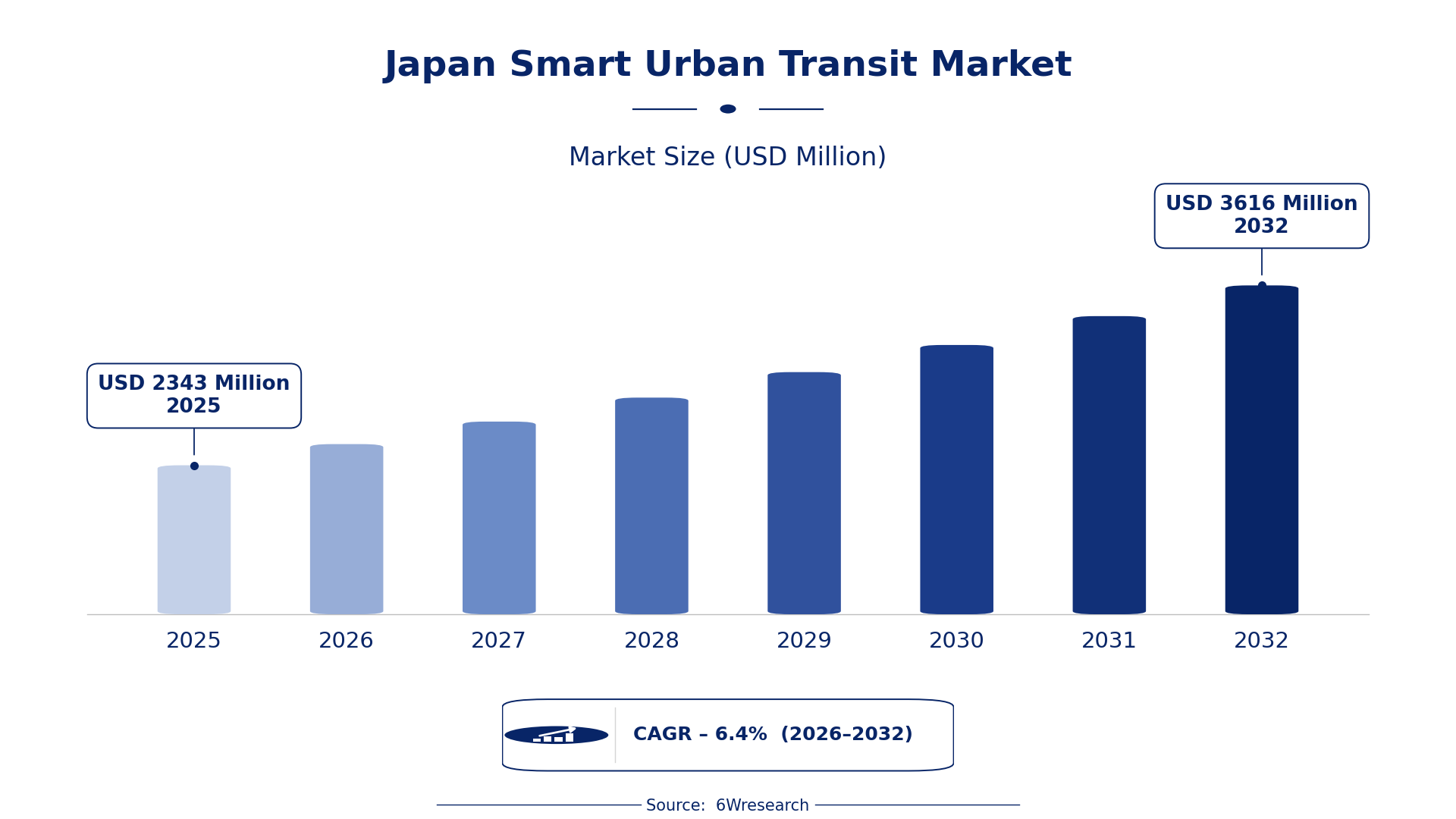
According to 6Wresearch internal database and industry insights, the Japan Smart Urban Transit Market was valued at USD 2,343 Million in 2025 and is projected to reach USD 3,616 Million by 2032, growing at a CAGR of approximately 6.4% during 2026–2032.
Japan Smart Urban Transit Market Highlights
| Report Metric | Details |
| Report Name | Japan Smart Urban Transit Market (2026-2032) |
| Market Size 2025 | USD 2,343 Million |
| Market Size 2032 | USD 3,616 Million |
| Absolute Growth 2025–2032 | USD 1,273 Million |
| CAGR 2026–2032 | 6.4% |
| Peak Annual Growth | 7.6% in 2031 |
| Forecast Period | 2026–2032 |
| Historical Data | 2022–2025 |
| Base Year | 2025 |
| Leading Transit Type, 2025 | Metro & Light Rail (50% share) |
| Leading Smart Feature, 2025 | Live Route Optimization (40% share) |
| Leading Communication System, 2025 | GPS + Cloud (47% share) |
| Leading End User, 2025 | City Transport Boards (50% share) |
| Fastest-Growing Transit Type | Last-Mile Vehicles (9.1% CAGR) |
| Fastest-Growing Smart Feature | AI Delay Prediction (8.9% CAGR) |
| Fastest-Growing Communication System | Centralized AI (9.2% CAGR) |
| Fastest-Growing End User | Urban Developers (8.2% CAGR) |
| Growing Sector | Urban Mobility Solutions |
| Key End Users | City Transport Boards, Urban Developers, Commuters, Urban Planners |
Japan Smart Urban Transit Market Year-wise Growth Rate and Key Drivers (2022–2032)
This graph illustrates the annual growth rates of the market from 2022 to 2032, highlighting a steady upward trajectory and projected market expansion over the forecast period.
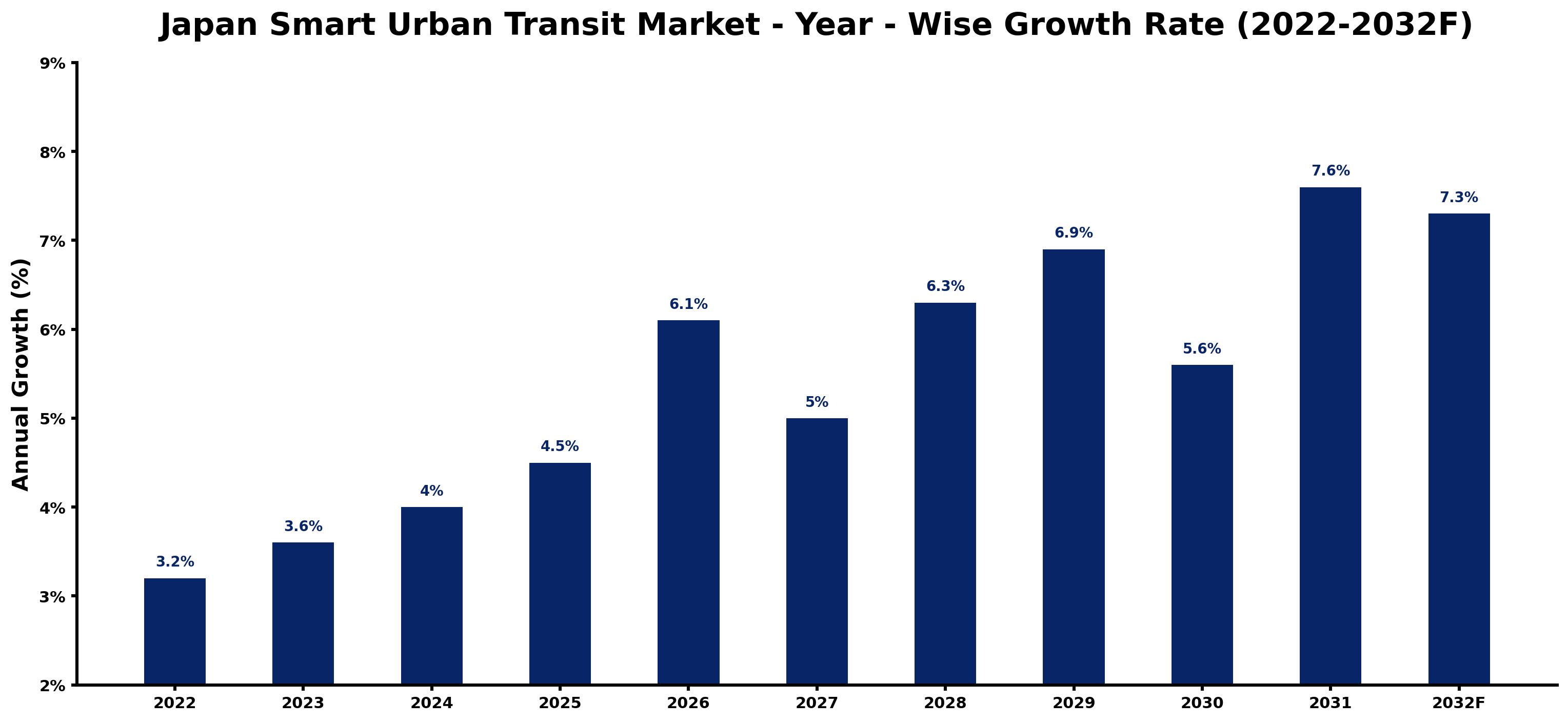
Year by year, the estimates below pair each growth rate with the development that shaped it.
| Year | Estimated Annual Growth (%) | Market Rationale |
| 2022 | 3.2 | The market experienced steady demand from city transport boards in urban areas. |
| 2023 | 3.6 | Growth was spurred by increased investments in smart transit solutions and infrastructure. |
| 2024 | 4.0 | The introduction of new technologies further accelerated market expansion and efficiency. |
| 2025 | 4.5 | The Tokyo 2020 Olympics boosted interest and funding in urban transit upgrades. |
| 2026 | 6.1 | A surge in urban population is expected to heighten demand for efficient transit systems. |
| 2027 | 5.0 | Growth is projected to slow slightly as market adjustments take place after peak investments. |
| 2028 | 6.3 | The implementation of advanced technologies is expected to revitalise interest and investments in transit. |
| 2029 | 6.9 | Demand is anticipated to increase as urban developers focus on integrating smart transit systems. |
| 2030 | 5.6 | A slight slowdown is projected due to market saturation in certain urban areas. |
| 2031 | 7.6 | The market is expected to peak as innovative solutions gain widespread adoption and usage. |
| 2032 | 7.3 | Growth is projected to moderate as the market stabilises, reflecting mature urban transit solutions. |
Note: Market size estimations and growth projections presented in this report are based on 6Wresearch's proprietary forecasting methodology, utilizing the latest available industry data, government publications, and primary research inputs.
Japan Smart Urban Transit Market Synopsis
Smart Urban Transit encompasses advanced systems that enhance urban mobility through technology, including integrated ticketing and real-time data analytics. The Japan Smart Urban Transit Market is growing due to increasing urban populations and substantial investments in infrastructure. Key buyers such as city transport boards and urban developers are driving demand for efficient transit solutions. The AI Promotion Act supports the integration of advanced technologies in urban transit systems, further stimulating market growth.
Market Dynamics Impact Analysis (2026–2032)
| Factor | Type | Impact | Primary Segment Affected |
| Increased urban population drives demand for efficient transit solutions. | Driver | High | Metro & Light Rail |
| Investments in smart technologies enhance operational efficiency. | Driver | High | Live Route Optimization |
| Growing urban congestion creates a need for improved transit systems. | Opportunity | High | App-Based Ticketing |
| The Tokyo Bay Area is emerging as a hub for transit innovation. | Opportunity | Medium | Bus Rapid Transit |
| High costs of implementing smart technologies can deter investment. | Restraint | High | Last-Mile Vehicles |
| Regulatory compliance can slow down project timelines. | Restraint | Medium | Metro & Light Rail |
| Limited funding for urban transit projects can restrict growth. | Challenge | High | App-Based Ticketing |
| Technological integration challenges may delay system upgrades. | Challenge | Medium | Live Route Optimization |
Evaluation of Drivers in Japan Smart Urban Transit Market (2026–2032)
The table below links each growth driver to the segment it affects and the evidence for it.
| Drivers | Primary Segment Affected | Why It Matters (Evidence) |
| Rising urban population | Metro & Light Rail | Tokyo's urban population is approximately 126 million, necessitating efficient mass transit solutions. |
| Technological advancements | Live Route Optimization | The launch of a new app for integrated urban mobility in 2023 improves user experience. |
| Government initiatives | App-Based Ticketing | The AI Promotion Act aims to support the integration of advanced technologies in urban transit systems. |
| Investment in infrastructure | Bus Rapid Transit | The Tokyo Metropolitan Government has invested ¥50 billion in transit upgrades. |
| Demand for integrated transit experiences | Last-Mile Vehicles | Integrated ticketing solutions improve accessibility and user satisfaction. |
What keeps demand rising is the growing urban population, approximately 126 million in Tokyo, creating a pressing need for efficient transit solutions. The launch of a new app for integrated urban mobility in 2023 improves user experience, driving demand for smart transit systems. These factors lead to heightened demand for integrated ticketing and real-time data analytics in urban transit systems.
Evaluation of Restraints in Japan Smart Urban Transit Market
Below are the constraints most often cited by buyers and suppliers, with the segment each affects.
| Market Restraint | Primary Segment Affected | Why It Matters (Evidence) |
| High costs of implementing smart technologies | Last-Mile Vehicles | The financial burden of adopting advanced systems can deter city transport boards from investing. |
| Regulatory compliance issues | Metro & Light Rail | Strict regulations can delay project approvals and implementation timelines. |
| Limited funding for urban transit projects | App-Based Ticketing | Budget constraints faced by city transport boards may restrict the rollout of new technologies. |
| Technological integration challenges | Live Route Optimization | Difficulties in integrating new systems with existing infrastructure can slow upgrades. |
| Market saturation in urban areas | Bus Rapid Transit | An oversupply of transit options can lead to diminished returns on investment. |
Japan Smart Urban Transit Market Challenges
Tokyo's metro system struggles with outdated technology, limiting real-time data analytics for transport authorities and delaying service improvements for over 13 million daily users. Supply chains for urban transit components face disruptions, as delays in sourcing critical parts hinder upgrades for city transport boards. Rising infrastructure costs, illustrated by the ¥50 billion investment in transit enhancements, strain budgets and limit service expansion for urban developers. A shortage of skilled workers in advanced transit systems complicates the adoption of new technologies, impacting the overall quality of urban mobility for commuters.
Trends in the Japan Smart Urban Transit Market
The shifts below are changing how Japan Smart Urban Transit Market products are bought and supplied.
- Shift from Traditional to Smart Transit Solutions: Since 2023, urban areas have increasingly adopted smart transit technologies, driven by the launch of integrated mobility apps. This shift is evident in Tokyo, where over 13 million daily users benefit from improved transit efficiency.
- Emergence of AI in Transit Operations: The introduction of AI Delay Prediction systems in 2026 has transformed operational reliability in urban transit. This technology is being implemented across various cities, improving user trust in schedules.
- Transition to Real-Time Data Analytics: Real-time data analytics has become essential in urban transit, with cities like Tokyo leading the way. This change improves service efficiency and user satisfaction, evident in the growing adoption of smart ticketing solutions.
- Focus on Sustainable Urban Mobility: The AI Promotion Act, launched in 2025, prioritises sustainable transit solutions. This initiative aims to improve urban transit systems, influencing investment decisions among urban developers.
Investment Opportunities in the Japan Smart Urban Transit Market
The following opportunities in the Japan Smart Urban Transit Market pair current demand with a clear way in.
- Investment in Urban Transit Infrastructure: The Tokyo Bay Area is a prime location for investment in smart urban transit solutions, with a projected funding gap of ¥50 billion. Collaborating with local urban developers can facilitate market entry.
- Expansion of App-Based Ticketing Solutions: With urban congestion expected to rise, there is a growing demand for app-based ticketing solutions. City transport boards are seeking partners to improve user experience and streamline fare collection.
- Development of Last-Mile Connectivity Solutions: As urban areas expand, the need for last-mile connectivity is increasing. Urban developers are focusing on integrating these solutions, creating opportunities for technology providers.
- Adoption of Centralized AI Systems: The demand for centralized AI systems is increasing, with a projected rise in adoption rates. Collaborating with city transport boards can help technology firms penetrate this market.
Government Initiatives in the Japan Smart Urban Transit Market
The AI Promotion Act, enacted in 2025, improves the capacity of urban transit systems to adopt advanced technologies. This law complements existing regulations by promoting innovation in smart transit solutions, ensuring compliance with safety and operational standards.
City transport boards utilise the Battery Industry Strategy, which targets 150 GWh of domestic battery manufacturing capacity by 2030. This initiative supports the integration of electric vehicles into urban transit, enabling sustainable transport options for commuters.
Future Insight of the Japan Smart Urban Transit Market
Investment in urban transit will accelerate as the Tokyo Metropolitan Government continues to prioritise infrastructure upgrades, creating demand for advanced solutions. Integrated ticketing systems will improve user experience and operational efficiency. Adoption of ISO 37120 will align urban transport with global sustainability standards. Continued advancements in NFC technology will streamline contactless payments, enhancing accessibility for the urban population, which is approximately 126 million.
Market Segmentation Analysis
Japan Smart Urban Transit Market report covers a detailed analysis of the following market segments:
By Transit Type – Metro & Light Rail Leads, Last-Mile Vehicles Expected to Grow Fastest
According to Saurav Kr Singh, Senior Research Analyst at 6Wresearch, with 50% of transit type revenue in 2025, Metro & Light Rail was the largest category. Metro and Light Rail systems hold the largest market share due to their extensive networks that are essential for mass transit in major cities like Tokyo. With over 13 million daily users, these systems are vital for efficient urban mobility and reducing congestion. The quickest growth will come from Last-Mile Vehicles, forecast to expand at a CAGR of 9.1% between 2026 and 2032. Last-Mile Vehicles are experiencing rapid growth as urban populations increasingly demand convenient transport options for completing their journeys. The Tokyo Bay Area's development initiatives have spurred investments in these vehicles, driving their adoption in urban environments. Suppliers should focus on enhancing last-mile solutions to meet the growing demand for integrated urban mobility.
By Smart Feature – Live Route Optimization Leads, AI Delay Prediction Expected to Grow Fastest
Live Route Optimization held 40% of the Japan Smart Urban Transit Market by smart feature in 2025. Live Route Optimization leads the market as it significantly enhances service efficiency, resulting in higher user satisfaction among passengers. This feature is essential for transit systems that aim to provide timely and reliable services in bustling urban areas. AI Delay Prediction is projected to grow fastest, at a CAGR of 8.9% during 2026–2032. AI Delay Prediction is quickly gaining popularity as it boosts operational reliability and builds user trust in transit schedules. The need for effective delay management in increasingly complex urban transit networks is propelling its adoption. Investing in advanced predictive technologies will be crucial for suppliers to maintain competitiveness in the smart transit sector.
By Communication System – GPS + Cloud Leads, Centralized AI Expected to Grow Fastest
GPS + Cloud accounted for 47% of the market by communication system in 2025. GPS and Cloud technology lead the market because they provide essential real-time tracking and operational management capabilities for urban transit systems. This technology is vital for ensuring efficient service delivery in high-traffic areas. Centralized AI is set to record the highest CAGR in this split, 9.2% over 2026–2032. Centralized AI is on the rise as it optimizes transit operations and resource allocation, responding to the increasing demand for smarter urban mobility solutions. The integration of AI into existing systems is becoming a priority for urban transit authorities. Suppliers must prioritise the development of AI-driven solutions to align with the future needs of urban transit systems.
By End User – City Transport Boards Lead, Urban Developers Expected to Grow Fastest
In 2025, City Transport Boards led the end user split with a 50% share. City Transport Boards dominate the market as they play a critical role in planning and implementing urban transit initiatives. Their strategic decisions significantly affect the development and funding allocation for transit infrastructure in urban settings. Over 2026–2032, Urban Developers are expected to post the fastest growth, at a CAGR of 8.2%. Urban Developers are rapidly emerging as a key growth segment, greatly influencing transit infrastructure through their urban planning efforts. Their importance is growing as cities expand and require integrated transit solutions to support this growth. Collaborating with urban developers will be essential for suppliers to ensure their offerings align with the changing demands of future urban transit projects.
Key Attractiveness of the Report
- 10 Years of Market Numbers
- Historical Data Starting from 2022 to 2025
- Base Year 2025
- Forecast Data until 2032
- Key Performance Indicators Impacting the Market
- Major Upcoming Developments and Projects
Key Highlights of the Report:
- Japan Smart Urban Transit Market Outlook
- Market Size of Japan Smart Urban Transit Market, 2025
- Forecast of Japan Smart Urban Transit Market, 2032
- Historical Data and Forecast of Japan Smart Urban Transit Revenues & Volume for the Period 2022-2032F
- Japan Smart Urban Transit Market Trend Evolution
- Japan Smart Urban Transit Market Drivers and Challenges
- Japan Smart Urban Transit Price Trends
- Japan Smart Urban Transit Porter's Five Forces
- Japan Smart Urban Transit Industry Life Cycle
- Historical Data and Forecast of Japan Smart Urban Transit Market Revenues & Volume By Transit Type for the Period 2022-2032F
- Historical Data and Forecast of Japan Smart Urban Transit Market Revenues & Volume By Bus Rapid Transit for the Period 2022-2032F
- Historical Data and Forecast of Japan Smart Urban Transit Market Revenues & Volume By Metro & Light Rail for the Period 2022-2032F
- Historical Data and Forecast of Japan Smart Urban Transit Market Revenues & Volume By App-Based Ticketing for the Period 2022-2032F
- Historical Data and Forecast of Japan Smart Urban Transit Market Revenues & Volume By Last-Mile Vehicles for the Period 2022-2032F
- Historical Data and Forecast of Japan Smart Urban Transit Market Revenues & Volume By Smart Feature for the Period 2022-2032F
- Historical Data and Forecast of Japan Smart Urban Transit Market Revenues & Volume By Live Route Optimization for the Period 2022-2032F
- Historical Data and Forecast of Japan Smart Urban Transit Market Revenues & Volume By AI Delay Prediction for the Period 2022-2032F
- Historical Data and Forecast of Japan Smart Urban Transit Market Revenues & Volume By QR & App Integration for the Period 2022-2032F
- Historical Data and Forecast of Japan Smart Urban Transit Market Revenues & Volume By Shared Micro-Mobility Data for the Period 2022-2032F
- Historical Data and Forecast of Japan Smart Urban Transit Market Revenues & Volume By Communication System for the Period 2022-2032F
- Historical Data and Forecast of Japan Smart Urban Transit Market Revenues & Volume By GPS + Cloud for the Period 2022-2032F
- Historical Data and Forecast of Japan Smart Urban Transit Market Revenues & Volume By Centralized AI for the Period 2022-2032F
- Historical Data and Forecast of Japan Smart Urban Transit Market Revenues & Volume By NFC/QR for the Period 2022-2032F
- Historical Data and Forecast of Japan Smart Urban Transit Market Revenues & Volume By Dockless + App for the Period 2022-2032F
- Historical Data and Forecast of Japan Smart Urban Transit Market Revenues & Volume By End User for the Period 2022-2032F
- Historical Data and Forecast of Japan Smart Urban Transit Market Revenues & Volume By City Transport Boards for the Period 2022-2032F
- Historical Data and Forecast of Japan Smart Urban Transit Market Revenues & Volume By Urban Developers for the Period 2022-2032F
- Historical Data and Forecast of Japan Smart Urban Transit Market Revenues & Volume By Commuters for the Period 2022-2032F
- Historical Data and Forecast of Japan Smart Urban Transit Market Revenues & Volume By Urban Planners for the Period 2022-2032F
- Japan Smart Urban Transit Import Export Trade Statistics
- Market Opportunity Assessment By Transit Type
- Market Opportunity Assessment By Smart Feature
- Market Opportunity Assessment By Communication System
- Market Opportunity Assessment By End User
- Japan Smart Urban Transit Top Companies Market Share
- Japan Smart Urban Transit Competitive Benchmarking By Technical and Operational Parameters
- Japan Smart Urban Transit Company Profiles
- Japan Smart Urban Transit Key Strategic Recommendations
Market Covered
This report examines the market across the segments below.
By Transit Type
- Bus Rapid Transit
- Metro & Light Rail
- App-Based Ticketing
- Last-Mile Vehicles
By Smart Feature
- Live Route Optimization
- AI Delay Prediction
- QR & App Integration
- Shared Micro-Mobility Data
By Communication System
- GPS + Cloud
- Centralized AI
- NFC/QR
- Dockless + App
By End User
- City Transport Boards
- Urban Developers
- Commuters
- Urban Planners































