Japan Smart Vision Systems Market Size & Growth Rate
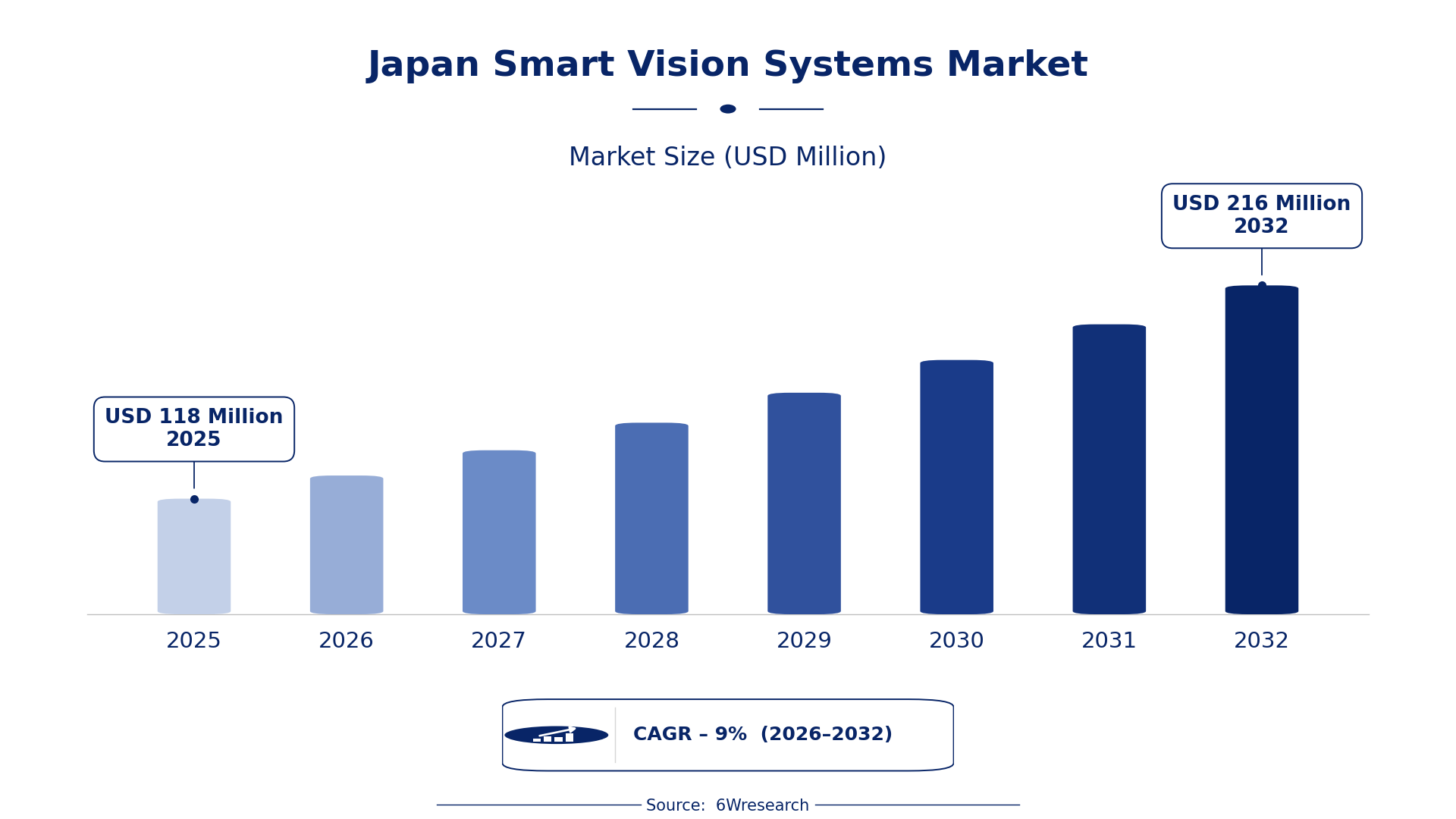
According to 6Wresearch internal database and industry insights, the Japan Smart Vision Systems Market was valued at USD 118 Million in 2025 and is projected to reach USD 216 Million by 2032, growing at a CAGR of approximately 9% during 2026–2032.
Japan Smart Vision Systems Market Highlights
| Report Metric | Details |
| Report Name | Japan Smart Vision Systems Market (2026-2032) |
| Market Size 2025 | USD 118 Million |
| Market Size 2032 | USD 216 Million |
| Absolute Growth 2025–2032 | USD 98 Million |
| CAGR 2026–2032 | 9% |
| Peak Annual Growth | 10.6% in 2028 |
| Forecast Period | 2026–2032 |
| Historical Data | 2022–2025 |
| Base Year | 2025 |
| Leading Vision Type, 2025 | Machine Vision (45% share) |
| Leading Smart Feature, 2025 | Object Detection + Sorting (42% share) |
| Leading Application Area, 2025 | Robotics + Packaging (42% share) |
| Leading End User, 2025 | Factories (38% share) |
| Fastest-Growing Vision Type | Automotive Vision AI (12.7% CAGR) |
| Fastest-Growing Application Area | ADAS (10.9% CAGR) |
| Fastest-Growing End User | Smart Cities (11.8% CAGR) |
| Growing Sector | Healthcare |
| Key End Users | Manufacturers, Hospitals, Automotive Industry, Smart City Developers |
Japan Smart Vision Systems Market Year-wise Growth Rate and Key Drivers (2022–2032)
This graph illustrates the annual growth rates of the market from 2022 to 2032, highlighting a steady upward trajectory and projected market expansion over the forecast period.
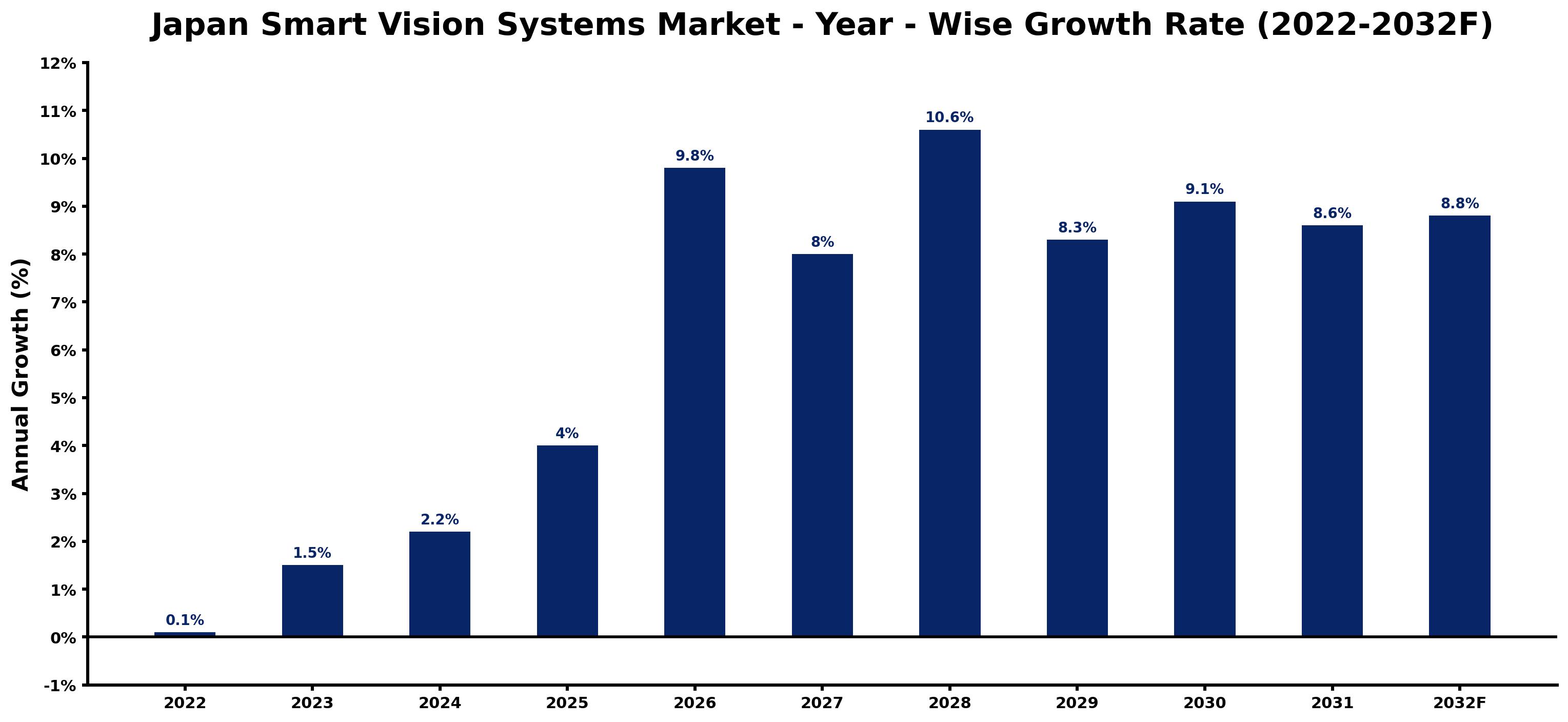
Year by year, the estimates below pair each growth rate with the development that shaped it.
| Year | Estimated Annual Growth (%) | Market Rationale |
| 2022 | 0.1 | The market maintained steady activity with initial adoption of smart vision systems. |
| 2023 | 1.5 | Growth accelerated as manufacturers increasingly integrated smart vision technologies into production lines. |
| 2024 | 2.2 | Continued investment in automation drove further adoption of smart vision systems in factories. |
| 2025 | 4.0 | The market peaked in growth due to rising demand from the automotive sector for safety features. |
| 2026 | 9.8 | The introduction of advanced robotics in factories is expected to boost demand for smart vision systems. |
| 2027 | 8.0 | Growth is projected to slow as the market adjusts to previous high levels of investment and adoption. |
| 2028 | 10.6 | A surge in automotive production and smart city initiatives will lead to a peak in growth rates. |
| 2029 | 8.3 | The market is expected to experience a slowdown as the growth rate moderates after reaching its peak. |
| 2030 | 9.1 | Demand will increase again as new smart city projects begin integrating vision systems. |
| 2031 | 8.6 | The growth rate is projected to slow slightly as the market stabilises after several years of rapid expansion. |
| 2032 | 8.8 | Continued urban development and healthcare advancements will sustain demand for smart vision systems. |
Note: Market size estimations and growth projections presented in this report are based on 6Wresearch's proprietary forecasting methodology, utilizing the latest available industry data, government publications, and primary research inputs.
Japan Smart Vision Systems Market Synopsis
Smart Vision Systems enable machines to interpret visual data through advanced algorithms and imaging technologies. The Japan Smart Vision Systems Market is growing due to demand from manufacturing, healthcare, and automotive sectors. Investments in technology and infrastructure are driving this expansion. In 2023, the automotive sector produced over 8 million vehicles, which increases the need for advanced vision systems to improve safety and efficiency in vehicles.
Market Dynamics Impact Analysis (2026–2032)
| Factor | Type | Impact | Primary Segment Affected |
| Increased automation in factories is driving demand for smart vision systems. | Driver | High | Machine Vision |
| Growing healthcare investments enhance the need for advanced imaging technologies. | Driver | High | Medical Imaging Vision |
| The gap in smart city infrastructure presents opportunities for smart vision system integration. | Opportunity | High | Surveillance Vision |
| Rising demand for robotics in manufacturing creates openings for smart vision applications. | Opportunity | High | Robotics + Packaging |
| High initial costs of implementation may deter some manufacturers from adopting these systems. | Restraint | Medium | Machine Vision |
| Limited awareness of the benefits of smart vision systems can restrict market growth. | Restraint | Medium | Medical Imaging Vision |
| The need for continuous technological upgrades can strain budgets for buyers. | Challenge | High | Automotive Vision AI |
| Competition among local and international suppliers can lead to price pressures. | Challenge | Medium | Surveillance Vision |
Evaluation of Drivers in Japan Smart Vision Systems Market (2026–2032)
The factors lifting demand, and the evidence behind each, are summarised below.
| Drivers | Primary Segment Affected | Why It Matters (Evidence) |
| Increased production efficiency is driving demand for machine vision systems in factories. | Machine Vision | In 2023, Japan's market for machine vision systems is estimated at $1 billion, prompting factories to invest in automation. |
| The need for accurate diagnostics is boosting the adoption of medical imaging technologies. | Medical Imaging Vision | With over 8,000 hospitals in Japan, the healthcare sector is increasingly utilising advanced imaging systems to improve patient outcomes. |
| Growing safety regulations in the automotive sector are increasing demand for vision AI technologies. | Automotive Vision AI | The Japanese automotive industry produced over 8 million vehicles in 2023, necessitating enhanced safety features through smart vision systems. |
| Urban development initiatives are driving the integration of smart vision systems in smart cities. | Surveillance Vision | Tokyo is a leading region for smart city initiatives, integrating smart vision systems for urban management and safety. |
| The robotics sector's growth is creating demand for automation technologies, including smart vision systems. | Robotics + Packaging | Valued at over $6 billion, the robotics sector is heavily investing in smart vision technologies to enhance operational efficiency. |
Orders keep climbing as the Japanese automotive industry produced over 8 million vehicles in 2023, driving the need for advanced safety features through automotive vision AI. The healthcare sector, with more than 8,000 hospitals, increasingly adopts medical imaging technologies to improve diagnostic accuracy. In factories, the market for machine vision systems is estimated at $1 billion, prompting manufacturers to invest in automation. Urban development projects are integrating smart vision systems for urban management and safety, further boosting demand. The robotics sector, valued at over $6 billion, is increasingly utilising smart vision technologies to streamline operations and enhance productivity.
Evaluation of Restraints in Japan Smart Vision Systems Market
These are the pressures that could keep growth below its potential.
| Market Restraint | Primary Segment Affected | Why It Matters (Evidence) |
| High initial costs of smart vision systems can deter manufacturers from adoption. | Machine Vision | The investment required for implementation can limit uptake among smaller factories, affecting overall market growth. |
| Limited awareness of smart vision system benefits restricts market expansion. | Medical Imaging Vision | Many hospitals may not fully understand the advantages of advanced imaging technologies, leading to slower adoption rates. |
| Technological obsolescence requires continuous upgrades, straining budgets. | Automotive Vision AI | The automotive sector faces pressure to keep up with rapid technological advancements, which can lead to increased costs for buyers. |
| Integration challenges with existing systems may hinder adoption. | Surveillance Vision | Smart cities may struggle to incorporate new vision technologies with legacy systems, delaying implementation. |
| Regulatory compliance can complicate the deployment of smart vision technologies. | Robotics + Packaging | Manufacturers must navigate complex regulations, which can slow down the adoption process. |
Japan Smart Vision Systems Market Challenges
Japan's automotive industry faces supply chain disruptions due to reliance on imported sensors for smart vision systems, delaying production timelines for manufacturers by up to three months. A lack of specialised training programmes leads to skills shortages in advanced imaging technologies, hindering adoption rates in clinics and hospitals, which can slow down patient diagnostics. Integration of AI-driven solutions presents technology challenges, causing operational inefficiencies in factories that can extend project completion times by approximately 20%. Compliance with ISO 13485 standards incurs rising costs for healthcare providers, increasing expenses associated with advanced imaging technologies by around 10%.
Trends in the Japan Smart Vision Systems Market
Below are the shifts with the largest effect on the Japan Smart Vision Systems Market.
- Shift towards Smart City Integration: The Tokyo Metropolitan Government has initiated projects to improve surveillance capabilities using smart vision. The number of smart cities is projected to increase, creating demand for integrated solutions.
- Transition from Traditional to Advanced Medical Imaging: Since 2022, hospitals have been adopting advanced imaging technologies to improve diagnostic accuracy. This shift is important as the healthcare sector seeks to improve patient outcomes and operational efficiency.
- Emergence of Robotics in Manufacturing: The robotics sector is increasingly prioritising smart vision systems for automation. With a valuation exceeding $6 billion, this trend is reshaping production processes across various industries.
- Growing Focus on Automotive Safety Features: The automotive industry is prioritising advanced driver-assistance systems (ADAS) to improve vehicle safety. Investments planned for 2024 underscore this trend's importance.
Investment Opportunities in the Japan Smart Vision Systems Market
The following opportunities in the Japan Smart Vision Systems Market pair current demand with a clear way in.
- $500 million allocated for AI research in healthcare: The Japanese government has allocated $500 million for AI research and development in healthcare, creating opportunities for suppliers of smart vision systems to improve medical imaging capabilities.
- Gap in smart city infrastructure presents opportunities: With increasing urbanisation, there is a gap in smart city infrastructure. Suppliers can target Tokyo's smart city initiatives to provide integrated smart vision solutions.
- Rising demand for robotics in factories: The growing robotics sector presents opportunities for smart vision system suppliers. Collaborating with factories in Japan can facilitate the adoption of these technologies.
- Need for advanced safety features in automotive: The automotive industry's focus on safety features creates opportunities for suppliers of smart vision systems. Partnerships with EV makers can improve product offerings.
Government Initiatives in the Japan Smart Vision Systems Market
The 'Healthcare Innovation Strategy' launched in 2022 promotes AI in healthcare, improving the capabilities of medical imaging systems. This initiative builds on existing regulations like the Industrial Safety and Health Act, which ensures safety standards in medical technologies. The government allocated $500 million for AI research and development in healthcare, benefiting hospitals and manufacturers integrating smart vision systems.
The Ministry of Economy, Trade and Industry (METI) supports the integration of AI in public services, approving funding for projects that utilise smart vision technologies. This funding is essential for manufacturers looking to improve automation and efficiency.
Future Insight of the Japan Smart Vision Systems Market
By 2032, urban management will increasingly incorporate smart vision systems through the 'Smart City Strategy' aimed at enhancing urban living. The Japanese government allocated $500 million for AI research and development in healthcare, which will significantly improve diagnostic capabilities in hospitals. Robotics advancements will encourage more companies to implement smart vision systems, streamlining manufacturing processes. As urban areas expand, demand for enhanced surveillance capabilities will create new opportunities for suppliers to innovate and meet the needs of smart cities.
Market Segmentation Analysis
Japan Smart Vision Systems Market report covers a detailed analysis of the following market segments:
By Vision Type – Machine Vision Leads, Automotive Vision AI Expected to Grow Fastest
According to Saurav Kr Singh, Senior Research Analyst at 6Wresearch, Machine Vision held 45% of the Japan Smart Vision Systems Market by vision type in 2025. Machine vision maintains the largest share due to its critical role in factories for quality control and automation. The extensive use of these systems in Japan's manufacturing sector, which produces millions of goods annually, highlights their importance. The quickest growth will come from Automotive Vision AI, forecast to expand at a CAGR of 12.7% between 2026 and 2032. Automotive vision is growing rapidly as manufacturers prioritise enhancing safety features in vehicles. With over 8 million vehicles produced in 2023, the demand for these technologies is likely to escalate further. Suppliers should tailor their solutions to meet the specific needs of the automotive sector to seize this growth opportunity.
By Smart Feature – Object Detection + Sorting Leads and Records the Fastest Growth
Object Detection + Sorting accounted for 42% of the market by smart feature in 2025. Object detection and sorting lead the market as they are vital for efficient product sorting in manufacturing. This feature is widely implemented across various industries, significantly boosting productivity and accuracy. Its lead should widen, with a projected CAGR of 11.5% during 2026–2032, the highest in this split. Object detection and sorting also represent the fastest-growing feature due to their increasing application in automated systems and smart factories. The ongoing push for automation in Japan's manufacturing sector ensures a sustained demand for these technologies. This trend presents a strong opportunity for suppliers to innovate and provide advanced object detection solutions.
By Application Area – Robotics + Packaging Leads, ADAS Expected to Grow Fastest
In 2025, Robotics + Packaging led the application area split with a 42% share. Robotics and packaging dominate the market as they are essential for streamlining factory automation processes. The high volume of manufacturing activities in Japan heavily relies on these systems to enhance operational efficiency. ADAS is set to record the highest CAGR in this split, 10.9% over 2026–2032. ADAS is the fastest-growing application area, driven by the automotive industry's emphasis on improving safety features in vehicles. With substantial investments planned for 2024, the demand for these systems is expected to rise significantly. This suggests that suppliers should focus on developing ADAS technologies to align with emerging market needs.
By End User – Factories Lead, Smart Cities Expected to Grow Fastest
The largest end user category in 2025 was Factories, at 38% of revenue. Factories are the primary users of smart vision systems, utilising them for automation and improving operational efficiency. The extensive installed base in manufacturing facilities across Japan underscores their critical role in this sector. Smart Cities are projected to grow fastest, at a CAGR of 11.8% during 2026–2032. Smart cities are rapidly growing as urban development initiatives increase the demand for safety monitoring and management technologies. The government's commitment to smart city strategies further accelerates this growth, indicating a robust market potential. Suppliers should consider expanding their offerings to address the smart city segment, which presents new opportunities.
Key Attractiveness of the Report
- 10 Years of Market Numbers
- Historical Data Starting from 2022 to 2025
- Base Year 2025
- Forecast Data until 2032
- Key Performance Indicators Impacting the Market
- Major Upcoming Developments and Projects
Key Highlights of the Report:
- Japan Smart Vision Systems Market Outlook
- Market Size of Japan Smart Vision Systems Market, 2025
- Forecast of Japan Smart Vision Systems Market, 2032
- Historical Data and Forecast of Japan Smart Vision Systems Revenues & Volume for the Period 2022-2032F
- Japan Smart Vision Systems Market Trend Evolution
- Japan Smart Vision Systems Market Drivers and Challenges
- Japan Smart Vision Systems Price Trends
- Japan Smart Vision Systems Porter's Five Forces
- Japan Smart Vision Systems Industry Life Cycle
- Historical Data and Forecast of Japan Smart Vision Systems Market Revenues & Volume By Vision Type for the Period 2022-2032F
- Historical Data and Forecast of Japan Smart Vision Systems Market Revenues & Volume By Machine Vision for the Period 2022-2032F
- Historical Data and Forecast of Japan Smart Vision Systems Market Revenues & Volume By Medical Imaging Vision for the Period 2022-2032F
- Historical Data and Forecast of Japan Smart Vision Systems Market Revenues & Volume By Automotive Vision AI for the Period 2022-2032F
- Historical Data and Forecast of Japan Smart Vision Systems Market Revenues & Volume By Surveillance Vision for the Period 2022-2032F
- Historical Data and Forecast of Japan Smart Vision Systems Market Revenues & Volume By Smart Feature for the Period 2022-2032F
- Historical Data and Forecast of Japan Smart Vision Systems Market Revenues & Volume By Object Detection + Sorting for the Period 2022-2032F
- Historical Data and Forecast of Japan Smart Vision Systems Market Revenues & Volume By Diagnostic Assistance for the Period 2022-2032F
- Historical Data and Forecast of Japan Smart Vision Systems Market Revenues & Volume By Lane, Traffic Sign Detection for the Period 2022-2032F
- Historical Data and Forecast of Japan Smart Vision Systems Market Revenues & Volume By Movement Heatmaps for the Period 2022-2032F
- Historical Data and Forecast of Japan Smart Vision Systems Market Revenues & Volume By Application Area for the Period 2022-2032F
- Historical Data and Forecast of Japan Smart Vision Systems Market Revenues & Volume By Robotics + Packaging for the Period 2022-2032F
- Historical Data and Forecast of Japan Smart Vision Systems Market Revenues & Volume By MRI/CT AI Sync for the Period 2022-2032F
- Historical Data and Forecast of Japan Smart Vision Systems Market Revenues & Volume By ADAS for the Period 2022-2032F
- Historical Data and Forecast of Japan Smart Vision Systems Market Revenues & Volume By Video Analytics for the Period 2022-2032F
- Historical Data and Forecast of Japan Smart Vision Systems Market Revenues & Volume By End User for the Period 2022-2032F
- Historical Data and Forecast of Japan Smart Vision Systems Market Revenues & Volume By Factories for the Period 2022-2032F
- Historical Data and Forecast of Japan Smart Vision Systems Market Revenues & Volume By Hospitals for the Period 2022-2032F
- Historical Data and Forecast of Japan Smart Vision Systems Market Revenues & Volume By EV Makers for the Period 2022-2032F
- Historical Data and Forecast of Japan Smart Vision Systems Market Revenues & Volume By Smart Cities for the Period 2022-2032F
- Japan Smart Vision Systems Import Export Trade Statistics
- Market Opportunity Assessment By Vision Type
- Market Opportunity Assessment By Smart Feature
- Market Opportunity Assessment By Application Area
- Market Opportunity Assessment By End User
- Japan Smart Vision Systems Top Companies Market Share
- Japan Smart Vision Systems Competitive Benchmarking By Technical and Operational Parameters
- Japan Smart Vision Systems Company Profiles
- Japan Smart Vision Systems Key Strategic Recommendations
Market Covered
The following segment groups are covered in the report.
By Vision Type
- Machine Vision
- Medical Imaging Vision
- Automotive Vision AI
- Surveillance Vision
By Smart Feature
- Object Detection + Sorting
- Diagnostic Assistance
- Lane
- Traffic Sign Detection
- Movement Heatmaps
By Application Area
- Robotics + Packaging
- MRI/CT AI Sync
- ADAS
- Video Analytics
By End User
- Factories
- Hospitals
- EV Makers
- Smart Cities































