Japan Smart Warehouse Equipment Market Size & Growth Rate
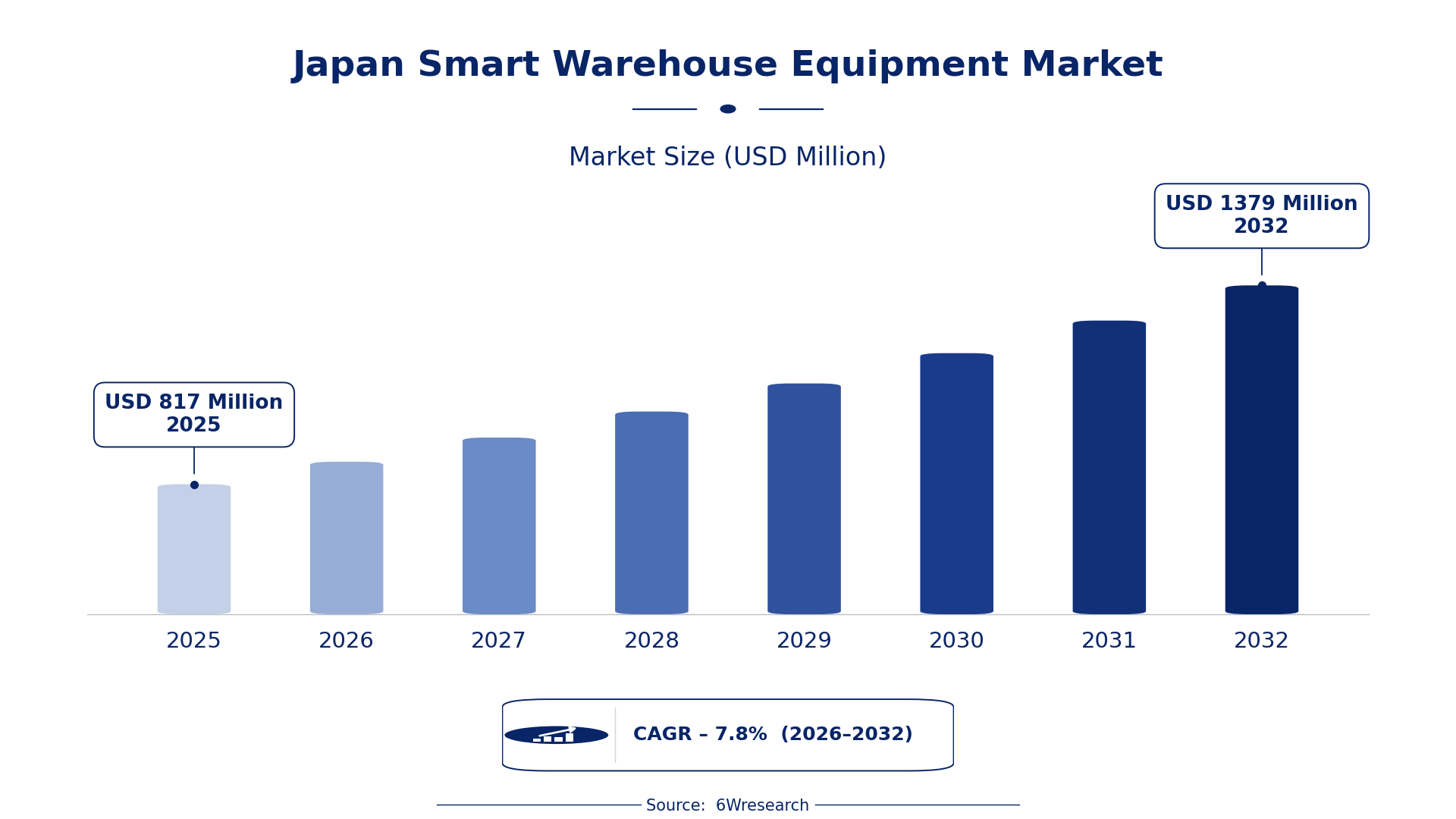
According to 6Wresearch internal database and industry insights, the Japan Smart Warehouse Equipment Market was valued at USD 817 Million in 2025 and is projected to reach USD 1,379 Million by 2032, growing at a CAGR of approximately 7.8% during 2026–2032.
Japan Smart Warehouse Equipment Market Highlights
| Report Metric | Details |
| Report Name | Japan Smart Warehouse Equipment Market (2026-2032) |
| Market Size 2025 | USD 817 Million |
| Market Size 2032 | USD 1,379 Million |
| Absolute Growth 2025–2032 | USD 562 Million |
| CAGR 2026–2032 | 7.8% |
| Peak Annual Growth | 9.1% in 2026 |
| Forecast Period | 2026–2032 |
| Historical Data | 2022–2025 |
| Base Year | 2025 |
| Leading Equipment Type, 2025 | Smart Conveyors (39% share) |
| Leading Smart Feature, 2025 | Auto Inventory Tracking (41% share) |
| Leading Automation Interface, 2025 | RFID + Cloud (51% share) |
| Leading End User, 2025 | E-commerce Warehouses (39% share) |
| Fastest-Growing Equipment Type | Robotic Picking Arms (11.2% CAGR) |
| Fastest-Growing Smart Feature | Route + Load Optimization (10.0% CAGR) |
| Fastest-Growing Automation Interface | AI Vision (10.4% CAGR) |
| Fastest-Growing End User | Logistics Providers (10.1% CAGR) |
| Growing Sector | Logistics |
| Key End Users | E-commerce Warehouses, Fulfillment Centers, Logistics Providers, Retail Warehouses |
Japan Smart Warehouse Equipment Market Year-wise Growth Rate and Key Drivers (2022–2032)
This graph illustrates the annual growth rates of the market from 2022 to 2032, highlighting a steady upward trajectory and projected market expansion over the forecast period.
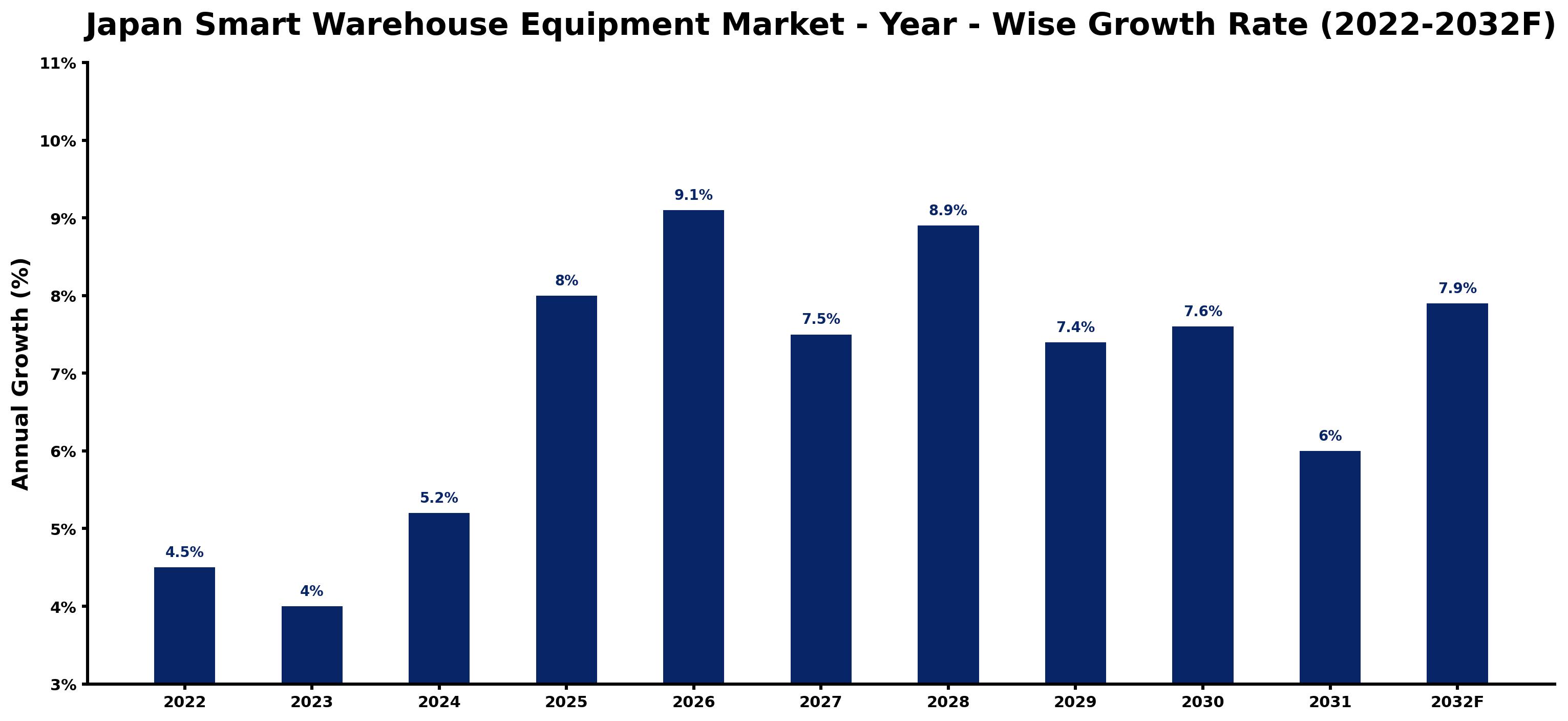
Each row of the following table gives one year's estimated growth and the event or demand shift that explains it.
| Year | Estimated Annual Growth (%) | Market Rationale |
| 2022 | 4.5 | The market experienced steady growth due to increasing automation in logistics. |
| 2023 | 4.0 | Growth slowed slightly as companies adjusted to new technologies and investments. |
| 2024 | 5.2 | Demand rose as businesses sought to improve operational efficiency through automation. |
| 2025 | 8.0 | The market expanded rapidly, driven by heightened e-commerce activity and logistics innovation. |
| 2026 | 9.1 | Demand surged as automation technologies became critical for competitive advantage. |
| 2027 | 7.5 | Growth is expected to moderate as the market begins to stabilise after a peak in investment. |
| 2028 | 8.9 | Demand is projected to increase again, supported by ongoing advancements in smart technologies. |
| 2029 | 7.4 | Growth will slow as the market approaches maturity, with fewer new entrants. |
| 2030 | 7.6 | Demand is expected to pick up as companies upgrade aging warehouse facilities. |
| 2031 | 6.0 | Growth is projected to decelerate slightly as the market adjusts to saturation in some areas. |
| 2032 | 7.9 | Demand is expected to rise again due to new technological innovations. |
Note: Market size estimations and growth projections presented in this report are based on 6Wresearch's proprietary forecasting methodology, utilizing the latest available industry data, government publications, and primary research inputs.
Japan Smart Warehouse Equipment Market Synopsis
Smart warehouse equipment encompasses advanced technologies such as robotics and automation systems that improve efficiency in logistics and supply chain management. The Japan Smart Warehouse Equipment Market is growing, supported by a logistics sector valued at around 15 trillion yen and a thriving e-commerce market that reached 20 trillion yen in 2022. Substantial investments in automation technology and the rising adoption of smart solutions in fulfillment centres are driving this growth.
Market Dynamics Impact Analysis (2026–2032)
| Factor | Type | Impact | Primary Segment Affected |
| Increasing investments in automation technology | Driver | High | Robotic Picking Arms |
| Growing e-commerce sector driving demand for efficient logistics solutions | Driver | High | E-commerce Warehouses |
| High demand for smart warehouse solutions in fulfillment centers | Opportunity | High | Fulfillment Centers |
| Rising need for space optimization in warehouses | Opportunity | Medium | Smart Shelving Units |
| High initial investment costs for smart technologies | Restraint | High | Smart Conveyors |
| Challenges in integrating new technologies with existing systems | Restraint | Medium | Autonomous Forklifts |
| Limited skilled workforce for operating advanced technologies | Challenge | High | AI Vision |
| Competition from traditional warehouse solutions | Challenge | Medium | Load Detection & Sorting |
Evaluation of Drivers in Japan Smart Warehouse Equipment Market (2026–2032)
Key forces behind demand, with the segment each one moves most, are listed below.
| Drivers | Primary Segment Affected | Why It Matters (Evidence) |
| Rising e-commerce demand | E-commerce Warehouses | The e-commerce market in Japan reached 20 trillion yen in 2022, prompting investments in smart warehouse technologies. |
| Automation technology investments | Robotic Picking Arms | Investment in smart warehouse technology is projected to exceed 1 trillion yen by 2025, improving operational efficiency. |
| Need for efficient inventory management | Auto Inventory Tracking | Fulfillment centers are increasingly adopting automation technologies to streamline inventory processes. |
| Technological advancements in AI and robotics | AI Vision | AI vision systems are being integrated into new warehouse setups, improving operational efficiency. |
| Space optimization requirements | Smart Shelving Units | The average warehouse size in Japan necessitates better space utilization. |
Spending rises because the e-commerce sector reached 20 trillion yen in 2022, prompting logistics providers to invest in advanced warehouse technologies. Investment in smart warehouse technology is expected to surpass 1 trillion yen by 2025, leading to enhanced efficiency in operations. Many fulfillment centers are adopting automation to streamline inventory management, with AI vision systems integrated into new setups. The average warehouse size drives demand for smart shelving solutions to optimize space utilization. These factors compel logistics providers to upgrade their systems and processes.
Evaluation of Restraints in Japan Smart Warehouse Equipment Market
These restraints slow adoption and weigh on supplier margins.
| Market Restraint | Primary Segment Affected | Why It Matters (Evidence) |
| High initial investment costs | Smart Conveyors | The average cost of implementing smart technologies can deter smaller logistics providers from upgrading. |
| Integration challenges with existing systems | Autonomous Forklifts | Many warehouses struggle to integrate new technologies with outdated infrastructure, slowing adoption rates. |
| Limited skilled workforce availability | AI Vision | The logistics industry faces a shortage of skilled workers capable of operating advanced technologies. |
| Competition from traditional solutions | Load Detection & Sorting | Established methods still dominate, making it difficult for new technologies to gain market share. |
| Regulatory compliance costs | Smart Shelving Units | Compliance with standards such as JIS B 8410 can increase operational costs for warehouse operators. |
Japan Smart Warehouse Equipment Market Challenges
Buyers in Japan's logistics sector are contending with rising operational costs as the national minimum wage climbs to JPY 1,055 per hour, resulting in higher service fees and tighter budgets. Technology adoption is hindered by the average age of logistics facilities surpassing 20 years, complicating the integration of modern smart warehouse solutions. Producers face skills shortages in advanced automation, restricting their ability to implement efficient systems, which leads to operational inefficiencies and increased reliance on external consultants. Importers struggle to meet standards like JIS B 8410, potentially causing compliance delays and additional costs for logistics providers.
Trends in the Japan Smart Warehouse Equipment Market
The following changes are redrawing the Japan Smart Warehouse Equipment Market.
- Shift in Logistics Hubs to Tokyo Bay Area: The Tokyo Bay area is emerging as a central hub for logistics activities, accounting for 30% of Japan's logistics in 2023, drawing investments in smart warehouse technologies.
- Transition from Manual to Automated Systems: Since 2023, fulfillment centres have increasingly embraced automation technologies, resulting in a rise in the installed base of autonomous forklifts, which enhances operational efficiency.
- E-commerce Warehouses Prioritising Automation: E-commerce warehouses are at the forefront of the shift towards automation, holding a 39% market share in 2025, driven by the demand for quicker order fulfillment and inventory management.
- Growing Adoption of AI Vision Systems: AI vision systems are being incorporated into new warehouse setups, reflecting a trend towards better monitoring and operational efficiency in logistics.
Investment Opportunities in the Japan Smart Warehouse Equipment Market
The opportunities below stand out in the Japan Smart Warehouse Equipment Market for new entrants and existing suppliers.
- Gap in Automation Technology Adoption: With investment in smart warehouse technology expected to surpass 1 trillion yen by 2025, there is an opportunity for suppliers to deliver advanced solutions to logistics providers.
- Supply of Smart Shelving Units: The average warehouse size generates demand for smart shelving solutions that optimise storage space and accessibility.
- Investment in Robotics for Fulfillment Centers: Fulfillment centres are increasingly adopting automation technologies, creating opportunities for suppliers of robotic picking arms and smart conveyors.
- Timing for Upgrading Aging Facilities: As the average age of logistics facilities exceeds 20 years, there is an urgent need for upgrades, presenting a market opportunity for modern smart warehouse solutions.
Government Initiatives in the Japan Smart Warehouse Equipment Market
The 2023 initiative to promote smart logistics solutions builds on the existing Industrial Safety and Health Act, which mandates safety standards for machinery and equipment. This programme encourages investments in automation technologies, improving compliance and safety in warehouse operations, with a focus on advancing smart warehouse equipment.
In 2023, the Ministry of Land, Infrastructure, Transport and Tourism allocated 5 billion yen to support logistics innovation projects. This funding aims to enhance efficiency and reduce costs in the logistics sector, benefiting producers and buyers alike.
Future Insight of the Japan Smart Warehouse Equipment Market
The launch of smart logistics programmes will transform warehouse operations by 2032. Investment in smart warehouse technology is projected to exceed 1 trillion yen, enabling suppliers to provide more efficient solutions. The integration of AI vision systems in 50% of new warehouse setups will improve inventory management and order fulfillment. The government's goal to reduce logistics costs by 10% by 2025 will motivate suppliers to adopt automation, encouraging innovation and improving service delivery.
Market Segmentation Analysis
Japan Smart Warehouse Equipment Market report covers a detailed analysis of the following market segments:
By Equipment Type – Smart Conveyors Lead, Robotic Picking Arms Expected to Grow Fastest
According to Saurav Kr Singh, Senior Research Analyst at 6Wresearch, Smart Conveyors accounted for 39% of the market by equipment type in 2025. Smart Conveyors dominate the market due to their essential role in facilitating the efficient movement of goods within warehouses, particularly in regions like Tokyo where logistics activities are concentrated. Their extensive use across various facilities underscores their importance in maintaining operational fluidity. The quickest growth will come from Robotic Picking Arms, forecast to expand at a CAGR of 11.2% between 2026 and 2032. Robotic Picking Arms are experiencing rapid growth as they automate the picking process, significantly improving speed and accuracy in warehouse workflows. The rising e-commerce market, valued at 20 trillion yen in 2022, is driving the demand for these advanced systems. Suppliers should focus on developing innovative robotic solutions to meet the increasing needs of the e-commerce sector.
By Smart Feature – Auto Inventory Tracking Leads, Route + Load Optimization Expected to Grow Fastest
The largest smart feature category in 2025 was Auto Inventory Tracking, at 41% of revenue. Auto Inventory Tracking leads the segment due to its critical function in maintaining accurate stock levels, which is vital for effective warehouse management. Its widespread adoption across logistics operations highlights its necessity in optimising inventory control processes. Route + Load Optimization is projected to grow fastest, at a CAGR of 10.0% during 2026–2032. Route + Load Optimization is rapidly gaining traction as it enhances efficiency in logistics operations, particularly with the government's initiative to reduce logistics costs by 10% by 2025. This focus on cost efficiency is accelerating the adoption of this feature. Buyers should invest in advanced tracking technologies to optimise inventory management and reduce operational costs.
By Automation Interface – RFID + Cloud Leads, AI Vision Expected to Grow Fastest
RFID + Cloud took 51% of automation interface revenue in 2025, more than any other category. RFID + Cloud technology holds the largest share by enabling real-time tracking and effective data management, which are essential for operational efficiency in logistics. This technology is particularly beneficial in key logistics areas such as the Tokyo Bay region. AI Vision is set to record the highest CAGR in this split, 10.4% over 2026–2032. AI Vision is emerging as the fastest-growing interface due to its ability to improve operational efficiency through effective monitoring. As more warehouses incorporate these systems, the demand for this technology is expected to rise significantly. Suppliers must innovate and provide advanced tracking solutions to stay competitive in the rapidly changing automation landscape.
By End User – E-commerce Warehouses Lead, Logistics Providers Expected to Grow Fastest
In 2025, E-commerce Warehouses led the end user split with a 39% share. E-commerce Warehouses are the largest end user segment as they heavily rely on automation for efficient operations, driven by the robust e-commerce market valued at 20 trillion yen. Their need for rapid and precise order fulfillment solidifies their leading position in the market. Over 2026–2032, Logistics Providers are expected to post the fastest growth, at a CAGR of 10.1%. Logistics Providers are witnessing the fastest growth as they increasingly adopt smart equipment to enhance service delivery in response to rising consumer demands. Ongoing investments in automation technology are propelling this segment forward. Buyers in the logistics sector should prioritise acquiring smart equipment to improve operational efficiency and satisfy growing market requirements.
Key Attractiveness of the Report
- 10 Years of Market Numbers
- Historical Data Starting from 2022 to 2025
- Base Year 2025
- Forecast Data until 2032
- Key Performance Indicators Impacting the Market
- Major Upcoming Developments and Projects
Key Highlights of the Report:
- Japan Smart Warehouse Equipment Market Outlook
- Market Size of Japan Smart Warehouse Equipment Market, 2025
- Forecast of Japan Smart Warehouse Equipment Market, 2032
- Historical Data and Forecast of Japan Smart Warehouse Equipment Revenues & Volume for the Period 2022-2032F
- Japan Smart Warehouse Equipment Market Trend Evolution
- Japan Smart Warehouse Equipment Market Drivers and Challenges
- Japan Smart Warehouse Equipment Price Trends
- Japan Smart Warehouse Equipment Porter's Five Forces
- Japan Smart Warehouse Equipment Industry Life Cycle
- Historical Data and Forecast of Japan Smart Warehouse Equipment Market Revenues & Volume By Equipment Type for the Period 2022-2032F
- Historical Data and Forecast of Japan Smart Warehouse Equipment Market Revenues & Volume By Smart Conveyors for the Period 2022-2032F
- Historical Data and Forecast of Japan Smart Warehouse Equipment Market Revenues & Volume By Robotic Picking Arms for the Period 2022-2032F
- Historical Data and Forecast of Japan Smart Warehouse Equipment Market Revenues & Volume By Autonomous Forklifts for the Period 2022-2032F
- Historical Data and Forecast of Japan Smart Warehouse Equipment Market Revenues & Volume By Smart Shelving Units for the Period 2022-2032F
- Historical Data and Forecast of Japan Smart Warehouse Equipment Market Revenues & Volume By Smart Feature for the Period 2022-2032F
- Historical Data and Forecast of Japan Smart Warehouse Equipment Market Revenues & Volume By Load Detection & Sorting for the Period 2022-2032F
- Historical Data and Forecast of Japan Smart Warehouse Equipment Market Revenues & Volume By Object Identification for the Period 2022-2032F
- Historical Data and Forecast of Japan Smart Warehouse Equipment Market Revenues & Volume By Route + Load Optimization for the Period 2022-2032F
- Historical Data and Forecast of Japan Smart Warehouse Equipment Market Revenues & Volume By Auto Inventory Tracking for the Period 2022-2032F
- Historical Data and Forecast of Japan Smart Warehouse Equipment Market Revenues & Volume By Automation Interface for the Period 2022-2032F
- Historical Data and Forecast of Japan Smart Warehouse Equipment Market Revenues & Volume By Sensors + PLC for the Period 2022-2032F
- Historical Data and Forecast of Japan Smart Warehouse Equipment Market Revenues & Volume By AI Vision for the Period 2022-2032F
- Historical Data and Forecast of Japan Smart Warehouse Equipment Market Revenues & Volume By Lidar + Mapping AI for the Period 2022-2032F
- Historical Data and Forecast of Japan Smart Warehouse Equipment Market Revenues & Volume By RFID + Cloud for the Period 2022-2032F
- Historical Data and Forecast of Japan Smart Warehouse Equipment Market Revenues & Volume By End User for the Period 2022-2032F
- Historical Data and Forecast of Japan Smart Warehouse Equipment Market Revenues & Volume By Fulfillment Centers for the Period 2022-2032F
- Historical Data and Forecast of Japan Smart Warehouse Equipment Market Revenues & Volume By E-commerce Warehouses for the Period 2022-2032F
- Historical Data and Forecast of Japan Smart Warehouse Equipment Market Revenues & Volume By Logistics Providers for the Period 2022-2032F
- Historical Data and Forecast of Japan Smart Warehouse Equipment Market Revenues & Volume By Retail Warehouses for the Period 2022-2032F
- Japan Smart Warehouse Equipment Import Export Trade Statistics
- Market Opportunity Assessment By Equipment Type
- Market Opportunity Assessment By Smart Feature
- Market Opportunity Assessment By Automation Interface
- Market Opportunity Assessment By End User
- Japan Smart Warehouse Equipment Top Companies Market Share
- Japan Smart Warehouse Equipment Competitive Benchmarking By Technical and Operational Parameters
- Japan Smart Warehouse Equipment Company Profiles
- Japan Smart Warehouse Equipment Key Strategic Recommendations
Market Covered
The report covers the following segments.
By Equipment Type
- Smart Conveyors
- Robotic Picking Arms
- Autonomous Forklifts
- Smart Shelving Units
By Smart Feature
- Load Detection & Sorting
- Object Identification
- Route + Load Optimization
- Auto Inventory Tracking
By Automation Interface
- Sensors + PLC
- AI Vision
- Lidar + Mapping AI
- RFID + Cloud
By End User
- Fulfillment Centers
- E-commerce Warehouses
- Logistics Providers
- Retail Warehouses































