Japan Smart Warehouse Infrastructure Market Size & Growth Rate
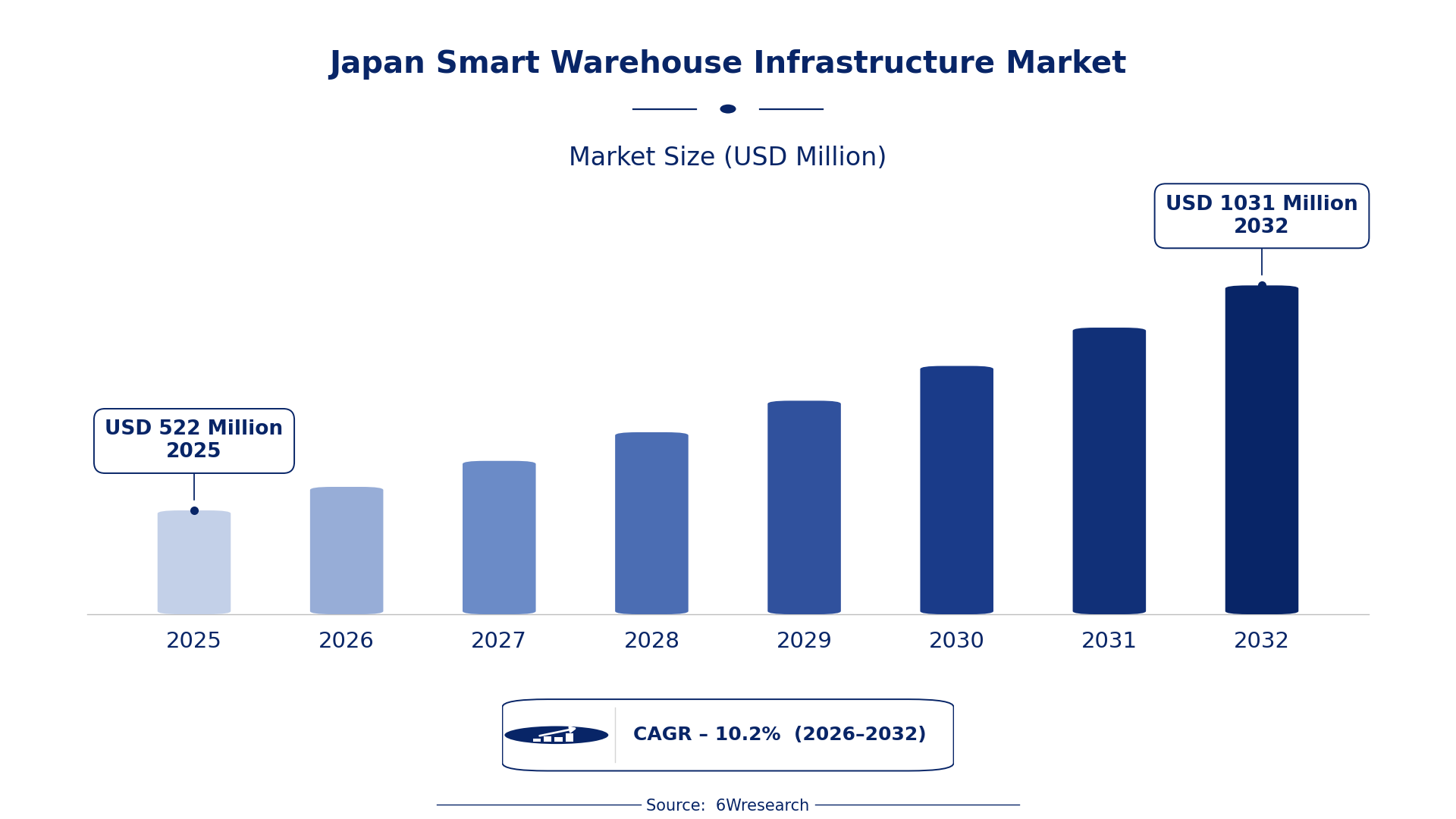
According to 6Wresearch internal database and industry insights, the Japan Smart Warehouse Infrastructure Market was valued at USD 522 Million in 2025 and is projected to reach USD 1,031 Million by 2032, growing at a CAGR of approximately 10.2% during 2026–2032.
Japan Smart Warehouse Infrastructure Market Highlights
| Report Metric | Details |
| Report Name | Japan Smart Warehouse Infrastructure Market (2026-2032) |
| Market Size 2025 | USD 522 Million |
| Market Size 2032 | USD 1,031 Million |
| Absolute Growth 2025–2032 | USD 509 Million |
| CAGR 2026–2032 | 10.2% |
| Peak Annual Growth | 11.1% in 2030 |
| Forecast Period | 2026–2032 |
| Historical Data | 2022–2025 |
| Base Year | 2025 |
| Leading Infrastructure Type, 2025 | IoT Warehouse Sensors (47% share) |
| Leading Smart Feature, 2025 | Environment + Asset Tracking (35% share) |
| Leading Network Tech, 2025 | Wi-Fi + RFID (44% share) |
| Leading End User, 2025 | Cold Storage Units (36% share) |
| Fastest-Growing Infrastructure Type | Smart Entry & Access (15.0% CAGR) |
| Fastest-Growing Smart Feature | Facial/ID Recognition (13.2% CAGR) |
| Fastest-Growing Network Tech | NFC + AI (14.4% CAGR) |
| Fastest-Growing End User | High-Security Warehouses (12.9% CAGR) |
| Growing Sector | High-Security Warehouses |
| Key End Users | Cold Storage Units, High-Security Warehouses, Large-Scale Hubs, Distribution Centers |
Japan Smart Warehouse Infrastructure Market Year-wise Growth Rate and Key Drivers (2022–2032)
This graph illustrates the annual growth rates of the market from 2022 to 2032, highlighting a steady upward trajectory and projected market expansion over the forecast period.
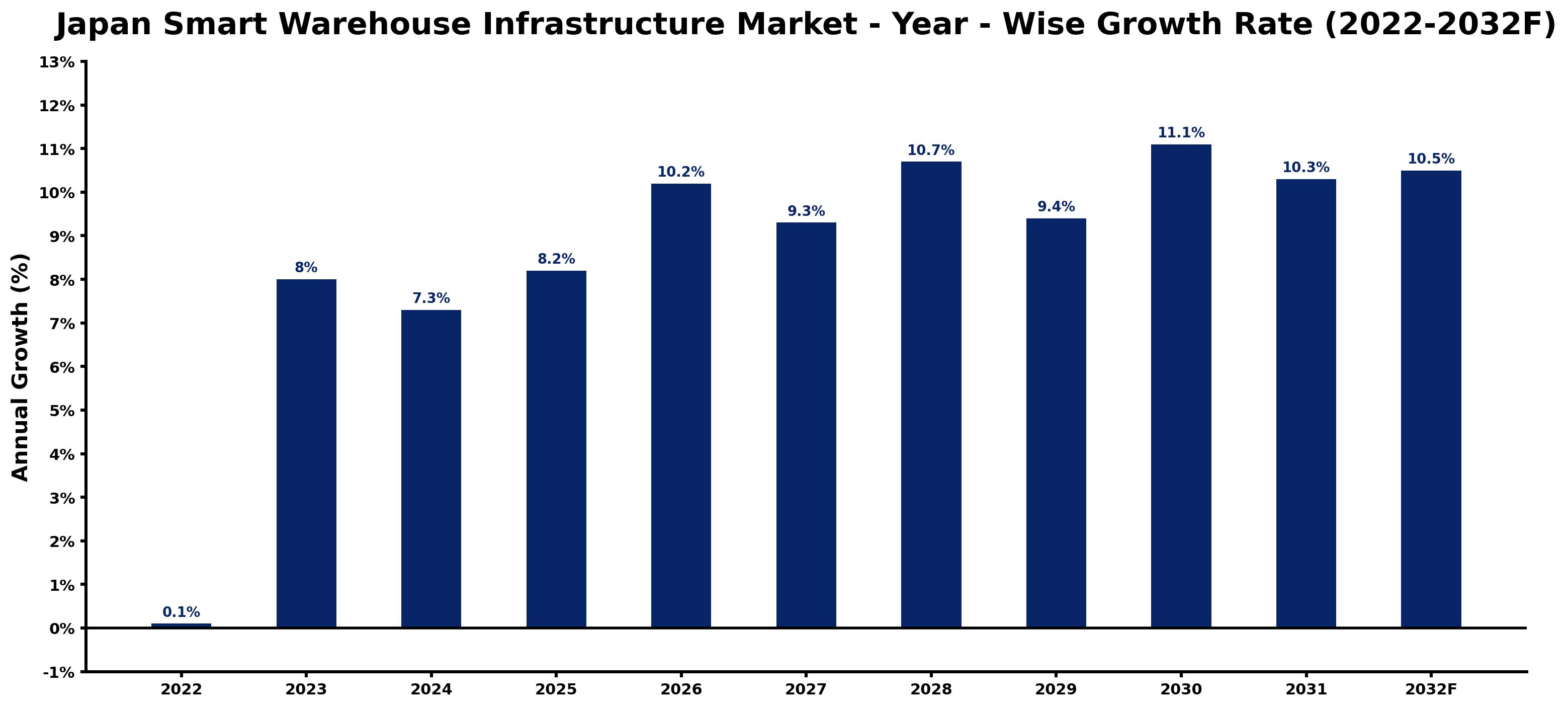
Annual growth estimates for each year appear below with the principal reason behind them, explaining the shifts that set the pace of the market.
| Year | Estimated Annual Growth (%) | Market Rationale |
| 2022 | 0.1 | The market showed minimal growth due to initial technology adoption phases. |
| 2023 | 8.0 | Demand surged as logistics companies increasingly invested in automation solutions. |
| 2024 | 7.3 | Growth slowed as market players adjusted to new operational standards. |
| 2025 | 8.2 | Increased investments in smart technologies drove growth higher than before. |
| 2026 | 10.2 | The market is expected to expand rapidly as adoption of IoT solutions gains traction. |
| 2027 | 9.3 | Growth is projected to slow slightly as companies focus on optimising existing systems. |
| 2028 | 10.7 | Demand will rise again as new technologies are integrated into operations. |
| 2029 | 9.4 | The market is expected to experience a slowdown as competition intensifies among providers. |
| 2030 | 11.1 | Growth is projected to peak as major logistics hubs adopt advanced smart technologies. |
| 2031 | 10.3 | The market will continue to grow, albeit at a slower pace than the previous year. |
| 2032 | 10.5 | Demand is expected to remain strong as companies seek to improve operational efficiency. |
Note: Market size estimations and growth projections presented in this report are based on 6Wresearch's proprietary forecasting methodology, utilizing the latest available industry data, government publications, and primary research inputs.
Japan Smart Warehouse Infrastructure Market Synopsis
Smart Warehouse Infrastructure integrates advanced technologies such as IoT, AI, and automation to improve logistics and supply chain efficiency. The Japan Smart Warehouse Infrastructure Market is expanding due to substantial investments from domestic users and government initiatives aimed at reducing logistics costs by 10% by 2025. With a logistics market valued at approximately 15 trillion yen, demand for smart solutions is increasing as companies strive to optimise operations and manage inventory effectively.
Market Dynamics Impact Analysis (2026–2032)
| Factor | Type | Impact | Primary Segment Affected |
| Increased automation in logistics operations | Driver | High | IoT Warehouse Sensors |
| Growing demand for real-time inventory management | Driver | High | Digital Twin Dashboards |
| Expansion of cold storage facilities | Opportunity | Medium | Cold Storage Units |
| Rising adoption of AI-driven solutions | Opportunity | Medium | High-Security Warehouses |
| High initial investment costs for smart technologies | Restraint | High | Smart Entry & Access |
| Limited awareness of technology benefits among smaller firms | Restraint | Medium | Environment + Asset Tracking |
| Challenges in integrating new systems with legacy infrastructure | Challenge | High | Wi-Fi + RFID |
| Compliance with evolving industry standards and regulations | Challenge | Medium | Smart Lighting |
Evaluation of Drivers in Japan Smart Warehouse Infrastructure Market (2026–2032)
Demand rests on the following drivers, each shown with the segment it touches most.
| Drivers | Primary Segment Affected | Why It Matters (Evidence) |
| Investment in IoT technologies | IoT Warehouse Sensors | The adoption rate of IoT in logistics is around 30%, leading to more efficient inventory management. |
| Demand for predictive maintenance solutions | Digital Twin Dashboards | Digital twin technology is gaining traction, improving decision-making and operational efficiency. |
| Increase in e-commerce activities | Cold Storage Units | Distribution centers handle over 1 billion packages annually, driving the need for temperature-sensitive storage. |
| Government initiatives promoting automation | High-Security Warehouses | The Economic Security Promotion Act supports supply-chain resilience, encouraging investment in security technologies. |
| Integration of AI for operational efficiency | Smart Entry & Access | AI-driven solutions are expected to improve efficiency by 20% in warehousing by 2025. |
A wider customer base explains much of the growth, as the logistics sector in Japan is undergoing a transformation with IoT technologies reaching approximately 30% adoption in 2023. This shift prompts logistics companies to invest in IoT Warehouse Sensors for real-time inventory management, resulting in increased efficiency. The rise in e-commerce activities leads to greater demand for Cold Storage Units, as distribution centres handle over 1 billion packages annually. Integration of AI technologies is projected to improve operational efficiency by 20% in warehousing by 2025, prompting more companies to adopt these solutions.
Evaluation of Restraints in Japan Smart Warehouse Infrastructure Market
The table below lists the restraints and the evidence behind each.
| Market Restraint | Primary Segment Affected | Why It Matters (Evidence) |
| Limited technology adoption in smaller firms | IoT Warehouse Sensors | Only 30% of logistics operations currently utilise IoT, which hampers efficiency. |
| High competition among providers | Cold Storage Units | New entrants adopting advanced solutions force traditional players to invest heavily. |
| Rising costs for automation technologies | High-Security Warehouses | Logistics firms face increased expenses that can exceed 50 billion yen annually. |
| Inefficient warehouse operations | Distribution Centers | Delays in order fulfilment impact customer satisfaction and potentially reduce sales. |
| Regulatory compliance costs | Smart Entry & Access | Meeting JIS standards adds financial burdens for logistics companies. |
Japan Smart Warehouse Infrastructure Market Challenges
Buyers in Japan's logistics market struggle with outdated technology, as only 30% of operations currently utilise IoT, resulting in inefficient inventory management that can delay order processing by up to 20%. Producers face intense competition from new entrants adopting advanced solutions, forcing traditional players to invest heavily or risk losing market share, which could reduce operational effectiveness by 10%. Rising costs for automation technologies strain logistics budgets, with firms potentially incurring additional expenses exceeding 50 billion yen annually. Buyers experience delays in order fulfilment due to inefficient warehouse operations, impacting customer satisfaction and potentially reducing sales by 15%.
Trends in the Japan Smart Warehouse Infrastructure Market
Buyers and suppliers in the Japan Smart Warehouse Infrastructure Market are adjusting to the following trends.
- Launch of the Smart Logistics Strategy: The Japanese government initiated the Smart Logistics Strategy in 2022 to promote automation in logistics. This initiative aims to reduce logistics costs by 10% by 2025, encouraging firms to invest in smart technologies.
- Increase in Cold Storage Facilities: Cold storage facilities are increasing by 5% annually to meet rising demand for temperature-sensitive goods. This growth is driven by the need for efficient inventory management in distribution centres handling over 1 billion packages.
- Adoption of Digital Twin Technology: Digital twin technology is gaining traction in warehouses for simulation purposes, enhancing operational efficiency. This trend supports logistics firms in visualising operations and improving decision-making processes.
- Integration of Smart Lighting Systems: Smart lighting systems are being integrated into 40% of new warehouses, contributing to energy efficiency. This shift reflects a growing emphasis on sustainable practices within the logistics sector.
Investment Opportunities in the Japan Smart Warehouse Infrastructure Market
Where to invest in the Japan Smart Warehouse Infrastructure Market: the main openings are set out below.
- E-commerce firms seeking automation solutions: E-commerce companies require advanced logistics solutions to handle increasing volumes, with distribution centres projected to reach 5,000 by 2025. Investing in smart warehouse technologies will help meet this demand.
- Partnerships for technology integration: Local partnerships can facilitate the adoption of IoT technologies in logistics. Collaborating with regional firms will streamline market entry and improve operations.
- Expansion in Tokyo and Osaka: Tokyo and Osaka are major industrial regions for smart warehouse technology. Investing in infrastructure improvements in these areas will support logistics efficiency.
- Government funding for logistics infrastructure: The government allocated 50 billion yen for logistics infrastructure improvements in 2023. This funding presents opportunities for firms to access resources for technology upgrades.
Government Initiatives in the Japan Smart Warehouse Infrastructure Market
The Semiconductor and Digital Industry Strategy, enacted in June 2021, introduces measures to secure domestic semiconductor manufacturing, benefiting producers by ensuring a stable supply chain for smart warehouse technologies. This law complements the Logistics Efficiency Law of 2020, which improves supply chain operations through enhanced standards.
In 2023, the government allocated 50 billion yen for logistics infrastructure improvements, administered by the Ministry of Economy, Trade and Industry. This funding supports automation initiatives, helping logistics firms improve operational efficiency and reduce costs.
Future Insight of the Japan Smart Warehouse Infrastructure Market
By 2032, advancements in smart warehouse infrastructure will reshape logistics operations, benefiting suppliers through improved efficiency. The government aims to reduce logistics costs by 10% by 2025, enabling buyers to optimise their spending. Cold storage facilities are projected to grow by 5% annually, improving inventory management capabilities. RFID technology will be adopted in over 70% of large distribution centres, allowing for quicker tracking and better service levels for end users.
Market Segmentation Analysis
Japan Smart Warehouse Infrastructure Market report covers a detailed analysis of the following market segments:
By Infrastructure Type – IoT Warehouse Sensors Lead, Smart Entry & Access Expected to Grow Fastest
According to Saurav Kr Singh, Senior Research Analyst at 6Wresearch, IoT Warehouse Sensors took 47% of infrastructure type revenue in 2025, more than any other category. IoT Warehouse Sensors dominate the market as they are essential for real-time inventory monitoring and environmental condition management, significantly enhancing operational efficiency. Their importance is underscored by the robust logistics market in Japan, valued at approximately 15 trillion yen, which relies heavily on these sensors for effective supply chain processes. Smart Entry & Access is projected to grow fastest, at a CAGR of 15.0% during 2026–2032. Smart Entry & Access is experiencing rapid growth due to increasing security requirements and the demand for controlled access in warehouses. The government's initiatives to promote automation in logistics further accelerate this segment's development, ensuring its continued expansion. Suppliers should focus on developing advanced security features to meet the rising demand for smart entry solutions.
By Smart Feature – Environment + Asset Tracking Leads, Facial/ID Recognition Expected to Grow Fastest
With 35% of smart feature revenue in 2025, Environment + Asset Tracking was the largest category. Environment + Asset Tracking is the leading feature as it is vital for managing assets and maintaining optimal conditions within warehouses. The extensive application of RFID technology in over 70% of large distribution centers highlights the critical role of this feature in enhancing operational effectiveness. The quickest growth will come from Facial/ID Recognition, forecast to expand at a CAGR of 13.2% between 2026 and 2032. Facial/ID Recognition is growing swiftly as security becomes a priority in warehouse operations, driven by the need for improved asset protection. This trend aligns with government efforts to enhance logistics efficiency, further boosting this segment's growth. Buyers will benefit from suppliers that integrate advanced security features to protect their operations.
By Network Tech – Wi-Fi + RFID Leads, NFC + AI Expected to Grow Fastest
The largest network tech category in 2025 was Wi-Fi + RFID, at 44% of revenue. Wi-Fi + RFID is the leading network technology, fundamental for connectivity and inventory tracking in warehouses. The adoption rate of IoT in logistics, around 30%, illustrates the reliance on these technologies for efficient warehouse operations. Over 2026–2032, NFC + AI is expected to post the fastest growth, at a CAGR of 14.4%. NFC + AI is emerging as a rapidly growing network technology, driven by the increasing demand for smarter solutions in logistics. As companies seek to leverage these technologies for operational efficiency, this segment is expected to gain momentum. Suppliers should invest in NFC technologies to meet the evolving market demands.
By End User – Cold Storage Units Lead, High-Security Warehouses Expected to Grow Fastest
In 2025, Cold Storage Units led the end user split with a 36% share. Cold Storage Units hold the largest share as they are critical for managing temperature-sensitive goods across various industries. The annual growth of cold storage facilities at 5% underscores their essential role in the logistics sector, catering to rising demand. High-Security Warehouses are set to record the highest CAGR in this split, 12.9% over 2026–2032. High-Security Warehouses are witnessing the fastest growth due to the increasing need for protecting high-value assets in a competitive market. This demand is further supported by government initiatives aimed at improving supply chain security, ensuring ongoing expansion. Suppliers must prioritise solutions designed for high-security environments to capture this growing market segment.
Key Attractiveness of the Report
- 10 Years of Market Numbers
- Historical Data Starting from 2022 to 2025
- Base Year 2025
- Forecast Data until 2032
- Key Performance Indicators Impacting the Market
- Major Upcoming Developments and Projects
Key Highlights of the Report:
- Japan Smart Warehouse Infrastructure Market Outlook
- Market Size of Japan Smart Warehouse Infrastructure Market, 2025
- Forecast of Japan Smart Warehouse Infrastructure Market, 2032
- Historical Data and Forecast of Japan Smart Warehouse Infrastructure Revenues & Volume for the Period 2022-2032F
- Japan Smart Warehouse Infrastructure Market Trend Evolution
- Japan Smart Warehouse Infrastructure Market Drivers and Challenges
- Japan Smart Warehouse Infrastructure Price Trends
- Japan Smart Warehouse Infrastructure Porter's Five Forces
- Japan Smart Warehouse Infrastructure Industry Life Cycle
- Historical Data and Forecast of Japan Smart Warehouse Infrastructure Market Revenues & Volume By Infrastructure Type for the Period 2022-2032F
- Historical Data and Forecast of Japan Smart Warehouse Infrastructure Market Revenues & Volume By IoT Warehouse Sensors for the Period 2022-2032F
- Historical Data and Forecast of Japan Smart Warehouse Infrastructure Market Revenues & Volume By Smart Entry & Access for the Period 2022-2032F
- Historical Data and Forecast of Japan Smart Warehouse Infrastructure Market Revenues & Volume By Smart Lighting for the Period 2022-2032F
- Historical Data and Forecast of Japan Smart Warehouse Infrastructure Market Revenues & Volume By Digital Twin Dashboards for the Period 2022-2032F
- Historical Data and Forecast of Japan Smart Warehouse Infrastructure Market Revenues & Volume By Smart Feature for the Period 2022-2032F
- Historical Data and Forecast of Japan Smart Warehouse Infrastructure Market Revenues & Volume By Environment + Asset Tracking for the Period 2022-2032F
- Historical Data and Forecast of Japan Smart Warehouse Infrastructure Market Revenues & Volume By Facial/ID Recognition for the Period 2022-2032F
- Historical Data and Forecast of Japan Smart Warehouse Infrastructure Market Revenues & Volume By Energy + Motion Detection for the Period 2022-2032F
- Historical Data and Forecast of Japan Smart Warehouse Infrastructure Market Revenues & Volume By Simulation + Monitoring for the Period 2022-2032F
- Historical Data and Forecast of Japan Smart Warehouse Infrastructure Market Revenues & Volume By Network Tech for the Period 2022-2032F
- Historical Data and Forecast of Japan Smart Warehouse Infrastructure Market Revenues & Volume By Wi-Fi + RFID for the Period 2022-2032F
- Historical Data and Forecast of Japan Smart Warehouse Infrastructure Market Revenues & Volume By NFC + AI for the Period 2022-2032F
- Historical Data and Forecast of Japan Smart Warehouse Infrastructure Market Revenues & Volume By App + Auto Schedulers for the Period 2022-2032F
- Historical Data and Forecast of Japan Smart Warehouse Infrastructure Market Revenues & Volume By AI + 3D Mapping for the Period 2022-2032F
- Historical Data and Forecast of Japan Smart Warehouse Infrastructure Market Revenues & Volume By End User for the Period 2022-2032F
- Historical Data and Forecast of Japan Smart Warehouse Infrastructure Market Revenues & Volume By Cold Storage Units for the Period 2022-2032F
- Historical Data and Forecast of Japan Smart Warehouse Infrastructure Market Revenues & Volume By High-Security Warehouses for the Period 2022-2032F
- Historical Data and Forecast of Japan Smart Warehouse Infrastructure Market Revenues & Volume By Large-Scale Hubs for the Period 2022-2032F
- Historical Data and Forecast of Japan Smart Warehouse Infrastructure Market Revenues & Volume By Distribution Centers for the Period 2022-2032F
- Japan Smart Warehouse Infrastructure Import Export Trade Statistics
- Market Opportunity Assessment By Infrastructure Type
- Market Opportunity Assessment By Smart Feature
- Market Opportunity Assessment By Network Tech
- Market Opportunity Assessment By End User
- Japan Smart Warehouse Infrastructure Top Companies Market Share
- Japan Smart Warehouse Infrastructure Competitive Benchmarking By Technical and Operational Parameters
- Japan Smart Warehouse Infrastructure Company Profiles
- Japan Smart Warehouse Infrastructure Key Strategic Recommendations
Market Covered
Coverage by segment is as follows.
By Infrastructure Type
- IoT Warehouse Sensors
- Smart Entry & Access
- Smart Lighting
- Digital Twin Dashboards
By Smart Feature
- Environment + Asset Tracking
- Facial/ID Recognition
- Energy + Motion Detection
- Simulation + Monitoring
By Network Tech
- Wi-Fi + RFID
- NFC + AI
- App + Auto Schedulers
- AI + 3D Mapping
By End User
- Cold Storage Units
- High-Security Warehouses
- Large-Scale Hubs
- Distribution Centers































