Japan Smart Warehousing Technologies Market Size & Growth Rate
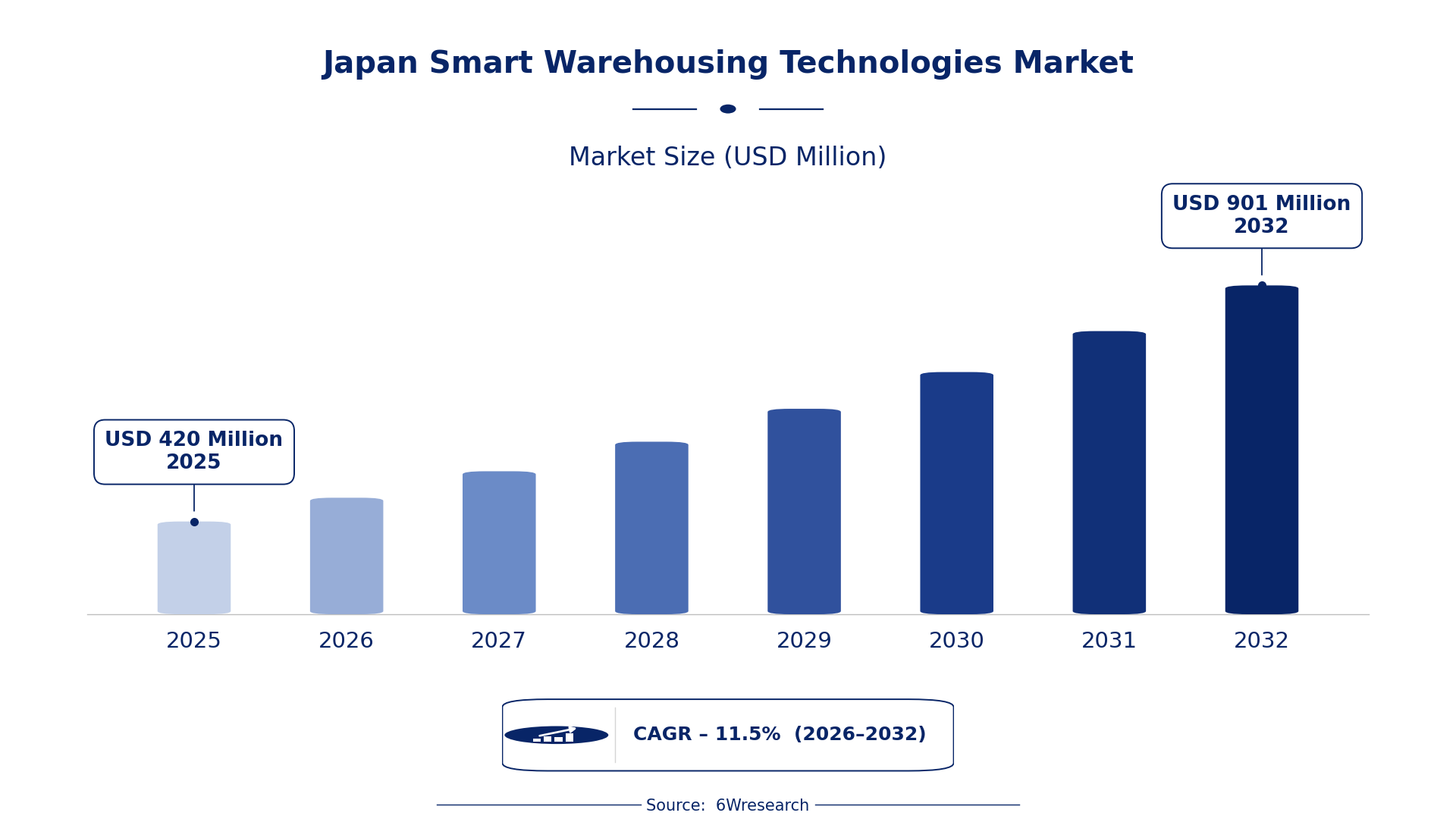
According to 6Wresearch internal database and industry insights, the Japan Smart Warehousing Technologies Market was valued at USD 420 Million in 2025 and is projected to reach USD 901 Million by 2032, growing at a CAGR of approximately 11.5% during 2026–2032.
Japan Smart Warehousing Technologies Market Highlights
| Report Metric | Details |
| Report Name | Japan Smart Warehousing Technologies Market (2026-2032) |
| Market Size 2025 | USD 420 Million |
| Market Size 2032 | USD 901 Million |
| Absolute Growth 2025–2032 | USD 481 Million |
| CAGR 2026–2032 | 11.5% |
| Peak Annual Growth | 12.1% in 2030 |
| Forecast Period | 2026–2032 |
| Historical Data | 2022–2025 |
| Base Year | 2025 |
| Leading Technology Type, 2025 | Integrated WMS Systems (40% share) |
| Leading Smart Feature, 2025 | Inventory + Order Sync (45% share) |
| Leading Automation Layer, 2025 | Cloud-Based Intelligence (41% share) |
| Leading End User, 2025 | E-commerce Giants (40% share) |
| Fastest-Growing Technology Type | Robotics & Drones (16.4% CAGR) |
| Fastest-Growing Smart Feature | Forecasting + Route Planning (14.9% CAGR) |
| Fastest-Growing End User | 3PL Companies (15.4% CAGR) |
| Growing Sector | logistics |
| Key End Users | e-commerce companies, logistics providers, online retailers, 3PL companies |
Japan Smart Warehousing Technologies Market Year-wise Growth Rate and Key Drivers (2022–2032)
This graph illustrates the annual growth rates of the market from 2022 to 2032, highlighting a steady upward trajectory and projected market expansion over the forecast period.
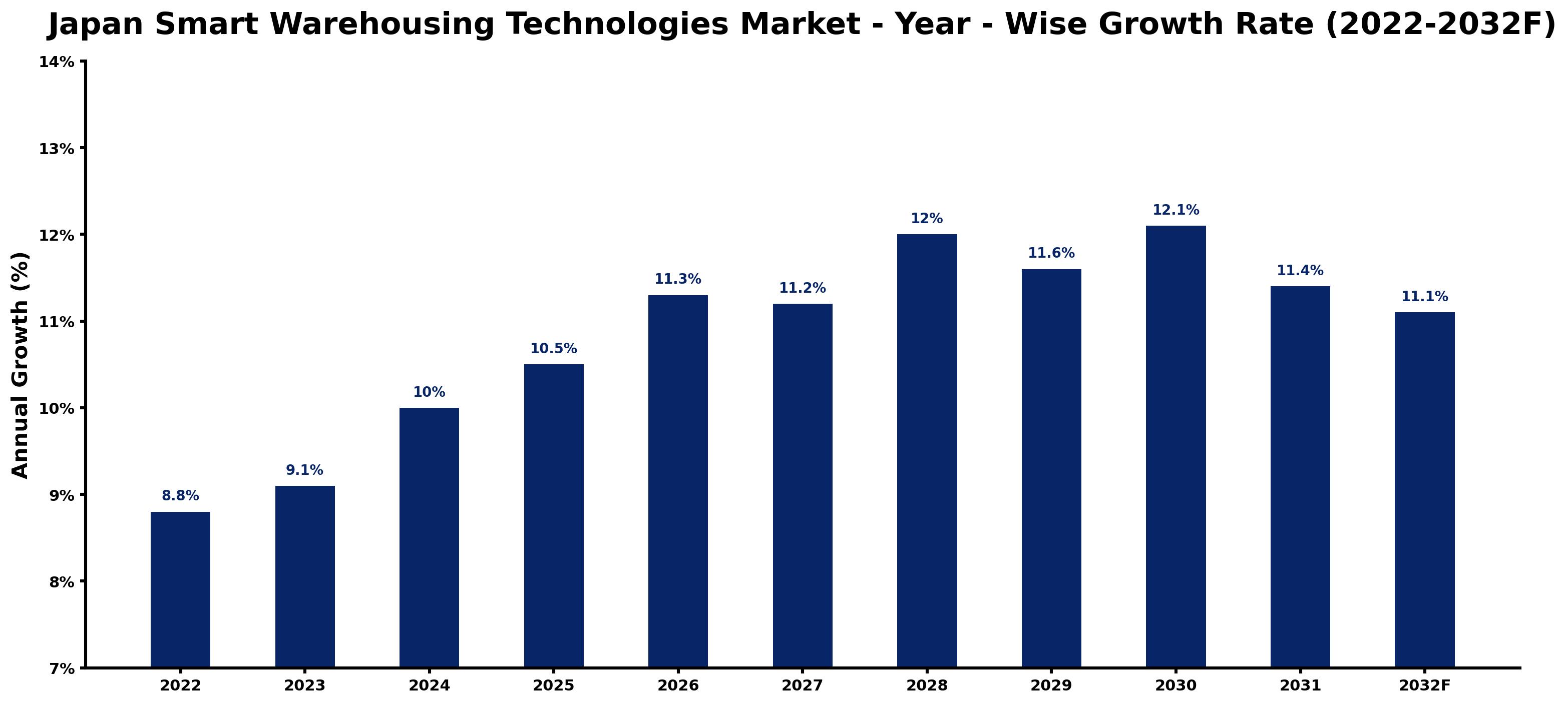
Annual growth estimates for each year appear below with the principal reason behind them, explaining the shifts that set the pace of the market.
| Year | Estimated Annual Growth (%) | Market Rationale |
| 2022 | 8.8 | The logistics sector was adapting to increased e-commerce demands and technological integration. |
| 2023 | 9.1 | Growth accelerated as more companies adopted smart warehousing solutions to improve efficiency. |
| 2024 | 10.0 | The rise in online shopping further boosted the need for advanced inventory management systems. |
| 2025 | 10.5 | The Tokyo 2020 Olympics spurred investments in logistics technologies, driving market growth. |
| 2026 | 11.3 | Demand for automation technologies is expected to increase as companies seek to optimise operations. |
| 2027 | 11.2 | Growth is projected to slow slightly due to market saturation in some technology segments. |
| 2028 | 12.0 | A surge in e-commerce will continue to fuel the adoption of smart warehousing technologies. |
| 2029 | 11.6 | The market is expected to experience a slowdown as companies focus on consolidating existing systems. |
| 2030 | 12.1 | Peak growth will be achieved as logistics companies fully embrace automation and AI. |
| 2031 | 11.4 | A slight slowdown is anticipated as the market matures and competition intensifies. |
| 2032 | 11.1 | Growth is projected to stabilise as the market reaches a more mature phase with established players. |
Note: Market size estimations and growth projections presented in this report are based on 6Wresearch's proprietary forecasting methodology, utilizing the latest available industry data, government publications, and primary research inputs.
Japan Smart Warehousing Technologies Market Synopsis
Smart warehousing technologies optimise warehouse operations through automation and data analytics, utilising AI, robotics, and integrated software solutions. In Japan, the logistics market is valued at approximately 20 trillion yen, with e-commerce sales reaching 19 trillion yen in 2022. The increasing demand is driven by domestic users, particularly in the logistics and e-commerce sectors, as companies invest in advanced systems to improve efficiency and streamline operations. Government initiatives, such as the 'Smart Logistics' program, support this growth by promoting technological adoption across the sector.
Market Dynamics Impact Analysis (2026–2032)
| Factor | Type | Impact | Primary Segment Affected |
| Increasing e-commerce sales drive demand for smart warehousing technologies. | Driver | High | Integrated WMS Systems |
| Adoption of robotics in warehouses enhances operational efficiency. | Driver | High | Robotics & Drones |
| Growing logistics workforce supports the need for advanced technologies. | Opportunity | Medium | AI Logistics Algorithms |
| Investment in smart logistics initiatives opens new market avenues. | Opportunity | Medium | Cloud-Based Intelligence |
| High initial investment costs can deter smaller companies from adopting technologies. | Restraint | High | Integrated WMS Systems |
| Limited awareness of benefits may slow technology adoption in some sectors. | Restraint | Medium | Robotics & Drones |
| Compliance with evolving standards can increase operational costs. | Challenge | High | AI Logistics Algorithms |
| Capacity constraints in existing infrastructure may hinder growth. | Challenge | Medium | Cloud-Based Intelligence |
Evaluation of Drivers in Japan Smart Warehousing Technologies Market (2026–2032)
These are the developments adding the most demand over the forecast period.
| Drivers | Primary Segment Affected | Why It Matters (Evidence) |
| Rising e-commerce sales | Integrated WMS Systems | Japan's e-commerce sales reached 19 trillion yen in 2022, driving the need for efficient inventory management. |
| Increased automation in logistics | Robotics & Drones | The logistics workforce in Japan is projected to exceed 1.5 million by 2025, increasing demand for automated solutions. |
| Government initiatives promoting smart logistics | Cloud-Based Intelligence | The 'Smart Logistics' program aims to improve efficiency in supply chains, encouraging technology adoption. |
| Technological advancements in AI and robotics | AI Logistics Algorithms | Robotics technology is increasingly integrated into warehouses in the Kanto region, boosting operational efficiency. |
| Demand for real-time data analytics | Forecasting + Route Planning | Companies seek to improve delivery efficiency, leading to higher investments in data-driven solutions. |
Buyers are adding capacity as e-commerce sales surged to 19 trillion yen in 2022, prompting logistics firms to invest in smart warehousing technologies. The logistics workforce is projected to exceed 1.5 million by 2025, driving demand for automation solutions. Integration of robotics is becoming more common in the Kanto region, improving operational capabilities. Firms are also focusing on real-time data analytics to boost delivery efficiency, resulting in greater investments in forecasting and route planning technologies.
Evaluation of Restraints in Japan Smart Warehousing Technologies Market
Several factors work against faster growth; the main ones are summarised below.
| Market Restraint | Primary Segment Affected | Why It Matters (Evidence) |
| High initial investment costs for smart warehousing technologies. | Integrated WMS Systems | The average cost of implementing advanced systems can exceed several million yen, deterring smaller firms. |
| Limited awareness of smart warehousing benefits among potential users. | Robotics & Drones | Many companies remain unaware of how these technologies can improve efficiency and reduce costs. |
| Compliance with evolving regulations can increase operational costs. | AI Logistics Algorithms | Adhering to standards such as ISO 9001 requires additional investments in quality management systems. |
| Capacity constraints in existing infrastructure may hinder technology adoption. | Cloud-Based Intelligence | Many warehouses lack the necessary infrastructure to support advanced smart technologies. |
| Market saturation in certain technology segments may slow growth. | Forecasting + Route Planning | As more companies adopt similar technologies, differentiation becomes challenging. |
Japan Smart Warehousing Technologies Market Challenges
Japan's logistics sector faces a shortage of skilled workers due to an ageing population and insufficient training programmes, which can delay project timelines for producers by up to six months. Intense competition among logistics firms leads to aggressive pricing strategies, resulting in reduced profit margins for suppliers and hindering their capacity to invest in technological advancements. Compliance with regulations, such as ISO 9001 standards, imposes additional costs, causing operational expenses for buyers to increase by 15%. Rapid technological advancements create challenges for buyers, as they struggle to adapt, risking inefficiencies in their supply chains.
Trends in the Japan Smart Warehousing Technologies Market
These developments are changing demand patterns in the Japan Smart Warehousing Technologies Market.
- Shift towards Automation in Logistics: The Tokyo metropolitan area is increasingly adopting automation technologies in warehouses, with 40% of logistics companies integrating robotics solutions. This shift is improving operational efficiency and reducing labour costs.
- Growing Demand for Real-Time Data Analytics: In 2022, the demand for data-driven decision-making tools surged, with 60% of logistics firms investing in analytics solutions. This trend is important for improving inventory management and order fulfillment.
- Transition from Traditional to Smart Warehousing: Since 2021, many logistics companies have transitioned to smart warehousing, driven by the need for efficiency. Approximately 30% of warehouses now utilise integrated WMS systems to optimise operations.
- Emergence of AI-Driven Logistics Solutions: The adoption of AI logistics algorithms has increased significantly since 2020, with a reported growth rate of 12% annually. This trend is reshaping inventory management and logistics processes.
Investment Opportunities in the Japan Smart Warehousing Technologies Market
Where to invest in the Japan Smart Warehousing Technologies Market: the main openings are set out below.
- Gap in Smart Warehousing Adoption: With Japan's logistics market valued at 20 trillion yen, there is an opportunity for investment in smart warehousing technologies. E-commerce giants are seeking local partners to improve their logistics capabilities.
- Investment in Robotics and Automation: The projected growth of the logistics workforce to over 1.5 million by 2025 presents an opportunity for suppliers of robotics solutions. Collaborating with 3PL companies can facilitate market entry.
- Expansion of Cloud-Based Solutions: As companies seek to optimise operations, the demand for cloud-based intelligence solutions is rising. Engaging with logistics firms in the Tokyo metropolitan area can provide entry points.
- Improving Data Analytics Capabilities: The increasing need for real-time data analytics in logistics creates opportunities for technology providers. Partnering with online retailers can help suppliers meet this demand.
Government Initiatives in the Japan Smart Warehousing Technologies Market
The Building Energy Efficiency Act, amended in 2022, mandates that all new buildings meet energy standards from April 2025, impacting logistics facilities. Compliance requires investments in energy-efficient technologies, which can improve operational efficiency in smart warehousing.
The 'Smart Logistics' program, overseen by the Ministry of Land, Infrastructure, Transport and Tourism, funds projects aimed at improving supply chain efficiency. This initiative supports logistics companies in adopting advanced technologies, facilitating their transition to smart warehousing.
Future Insight of the Japan Smart Warehousing Technologies Market
The government's 'Smart Logistics' programme will drive a shift towards advanced warehousing technologies, prompting suppliers to invest in robotics and automation for improved efficiency. By 2032, the logistics workforce will surpass 1.5 million, providing a larger talent pool for implementing these systems. As e-commerce sales reach 19 trillion yen, buyers will increasingly demand sophisticated inventory management solutions. Enhanced data analytics will enable better decision-making, leading to streamlined operations and reduced costs across the logistics sector.
Market Segmentation Analysis
Japan Smart Warehousing Technologies Market report covers a detailed analysis of the following market segments:
By Technology Type – Integrated WMS Systems Lead, Robotics & Drones Expected to Grow Fastest
According to Saurav Kr Singh, Senior Research Analyst at 6Wresearch, in 2025, Integrated WMS Systems led the technology type split with a 40% share. Integrated WMS Systems dominate the market as they are crucial for effectively managing warehouse operations. Their extensive adoption among logistics providers in the Tokyo metropolitan area highlights their vital role in enhancing operational efficiency. Over 2026–2032, Robotics & Drones are expected to post the fastest growth, at a CAGR of 16.4%. Robotics & Drones are experiencing rapid growth due to their increasing use for automated picking and inventory tracking. The remarkable rise in e-commerce sales, reaching 19 trillion yen in 2022, significantly fuels the demand for these technologies. Suppliers should concentrate on advancing robotics solutions to address the growing needs of the logistics sector.
By Smart Feature – Inventory + Order Sync Leads, Forecasting + Route Planning Expected to Grow Fastest
Inventory + Order Sync held 45% of the Japan Smart Warehousing Technologies Market by smart feature in 2025. Inventory + Order Sync leads the market because it is essential for maintaining real-time stock levels and efficient order processing. This feature is particularly important for large-scale operations that handle substantial volumes of online orders. Forecasting + Route Planning is projected to grow fastest, at a CAGR of 14.9% during 2026–2032. Forecasting + Route Planning is the fastest-growing feature as it significantly improves delivery efficiency and inventory turnover. The increasing complexity of logistics operations in Japan necessitates advanced planning capabilities to meet consumer expectations. Buyers should focus on features that enhance operational efficiency to remain competitive in the market.
By Automation Layer – Cloud-Based Intelligence Leads and Records the Fastest Growth
Cloud-Based Intelligence accounted for 41% of the market by automation layer in 2025. Cloud-Based Intelligence is the leading layer as it enables centralised data management and analytics, which are critical for optimising warehouse operations. Its widespread implementation across various logistics facilities underscores its essential role in improving performance. The same category is also set to grow fastest, at a CAGR of 15.5% during 2026–2032. Cloud-Based Intelligence is also the fastest-growing layer because it meets real-time data needs effectively. As logistics operations become more intricate, the demand for integrated cloud solutions will continue to expand, further solidifying its lead. Suppliers must invest in cloud technologies to satisfy the increasing demand for data-driven warehouse solutions.
By End User – E-commerce Giants Lead, 3PL Companies Expected to Grow Fastest
The largest end user category in 2025 was E-commerce Giants, at 40% of revenue. E-commerce Giants constitute the largest user group due to their substantial demand for smart warehousing technologies to manage high volumes of online transactions. Their significant presence in Japan's logistics sector emphasises their influence on technology adoption. The quickest growth will come from 3PL Companies, forecast to expand at a CAGR of 15.4% between 2026 and 2032. 3PL Companies are the fastest-growing user group, primarily as they are key users of smart warehousing technologies for improving logistics efficiency. The anticipated growth of the logistics workforce to over 1.5 million by 2025 indicates a rising need for these services. Suppliers should customise their offerings to meet the specific needs of 3PL companies to capture this expanding market segment.
Key Attractiveness of the Report
- 10 Years of Market Numbers
- Historical Data Starting from 2022 to 2025
- Base Year 2025
- Forecast Data until 2032
- Key Performance Indicators Impacting the Market
- Major Upcoming Developments and Projects
Key Highlights of the Report:
- Japan Smart Warehousing Technologies Market Outlook
- Market Size of Japan Smart Warehousing Technologies Market, 2025
- Forecast of Japan Smart Warehousing Technologies Market, 2032
- Historical Data and Forecast of Japan Smart Warehousing Technologies Revenues & Volume for the Period 2022-2032F
- Japan Smart Warehousing Technologies Market Trend Evolution
- Japan Smart Warehousing Technologies Market Drivers and Challenges
- Japan Smart Warehousing Technologies Price Trends
- Japan Smart Warehousing Technologies Porter's Five Forces
- Japan Smart Warehousing Technologies Industry Life Cycle
- Historical Data and Forecast of Japan Smart Warehousing Technologies Market Revenues & Volume By Technology Type for the Period 2022-2032F
- Historical Data and Forecast of Japan Smart Warehousing Technologies Market Revenues & Volume By AI Logistics Algorithms for the Period 2022-2032F
- Historical Data and Forecast of Japan Smart Warehousing Technologies Market Revenues & Volume By Robotics & Drones for the Period 2022-2032F
- Historical Data and Forecast of Japan Smart Warehousing Technologies Market Revenues & Volume By Integrated WMS Systems for the Period 2022-2032F
- Historical Data and Forecast of Japan Smart Warehousing Technologies Market Revenues & Volume By Edge Computing Nodes for the Period 2022-2032F
- Historical Data and Forecast of Japan Smart Warehousing Technologies Market Revenues & Volume By Smart Feature for the Period 2022-2032F
- Historical Data and Forecast of Japan Smart Warehousing Technologies Market Revenues & Volume By Forecasting + Route Planning for the Period 2022-2032F
- Historical Data and Forecast of Japan Smart Warehousing Technologies Market Revenues & Volume By Auto Scanning & Delivery for the Period 2022-2032F
- Historical Data and Forecast of Japan Smart Warehousing Technologies Market Revenues & Volume By Inventory + Order Sync for the Period 2022-2032F
- Historical Data and Forecast of Japan Smart Warehousing Technologies Market Revenues & Volume By Real-Time Local Analysis for the Period 2022-2032F
- Historical Data and Forecast of Japan Smart Warehousing Technologies Market Revenues & Volume By Automation Layer for the Period 2022-2032F
- Historical Data and Forecast of Japan Smart Warehousing Technologies Market Revenues & Volume By Cloud-Based Intelligence for the Period 2022-2032F
- Historical Data and Forecast of Japan Smart Warehousing Technologies Market Revenues & Volume By Vision + Mapping Sensors for the Period 2022-2032F
- Historical Data and Forecast of Japan Smart Warehousing Technologies Market Revenues & Volume By ERP + API Integration for the Period 2022-2032F
- Historical Data and Forecast of Japan Smart Warehousing Technologies Market Revenues & Volume By IoT Gateway for the Period 2022-2032F
- Historical Data and Forecast of Japan Smart Warehousing Technologies Market Revenues & Volume By End User for the Period 2022-2032F
- Historical Data and Forecast of Japan Smart Warehousing Technologies Market Revenues & Volume By 3PL Companies for the Period 2022-2032F
- Historical Data and Forecast of Japan Smart Warehousing Technologies Market Revenues & Volume By E-commerce Giants for the Period 2022-2032F
- Historical Data and Forecast of Japan Smart Warehousing Technologies Market Revenues & Volume By Online Retailers for the Period 2022-2032F
- Historical Data and Forecast of Japan Smart Warehousing Technologies Market Revenues & Volume By Smart Infrastructure for the Period 2022-2032F
- Japan Smart Warehousing Technologies Import Export Trade Statistics
- Market Opportunity Assessment By Technology Type
- Market Opportunity Assessment By Smart Feature
- Market Opportunity Assessment By Automation Layer
- Market Opportunity Assessment By End User
- Japan Smart Warehousing Technologies Top Companies Market Share
- Japan Smart Warehousing Technologies Competitive Benchmarking By Technical and Operational Parameters
- Japan Smart Warehousing Technologies Company Profiles
- Japan Smart Warehousing Technologies Key Strategic Recommendations
Market Covered
Segments analysed in this report are listed below.
By Technology Type
- AI Logistics Algorithms
- Robotics & Drones
- Integrated WMS Systems
- Edge Computing Nodes
By Smart Feature
- Forecasting + Route Planning
- Auto Scanning & Delivery
- Inventory + Order Sync
- Real-Time Local Analysis
By Automation Layer
- Cloud-Based Intelligence
- Vision + Mapping Sensors
- ERP + API Integration
- IoT Gateway
By End User
- 3PL Companies
- E-commerce Giants
- Online Retailers
- Smart Infrastructure































