Japan Smart Water Management Systems Market Size & Growth Rate
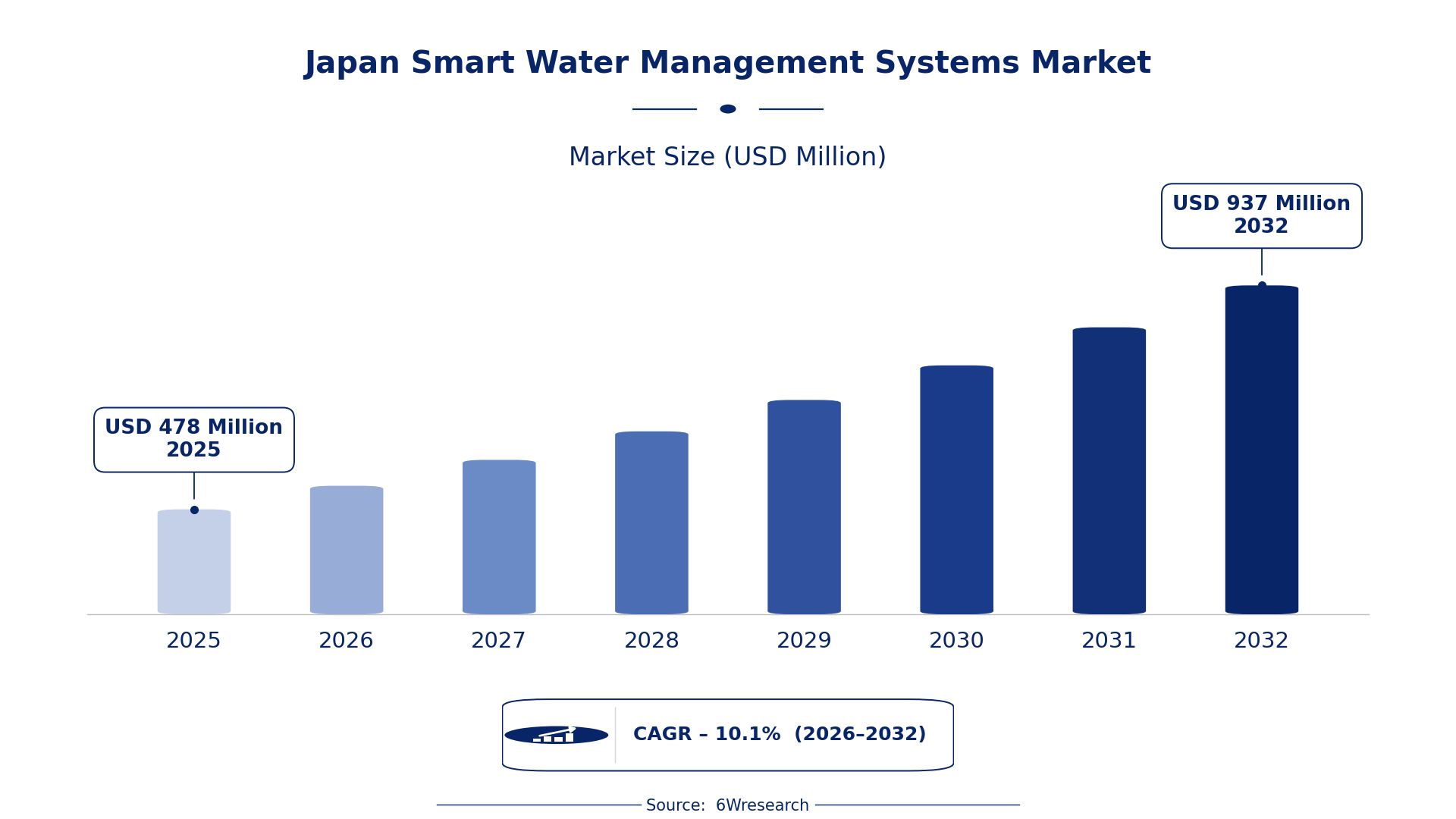
According to 6Wresearch internal database and industry insights, the Japan Smart Water Management Systems Market was valued at USD 478 Million in 2025 and is projected to reach USD 937 Million by 2032, growing at a CAGR of approximately 10.1% during 2026–2032.
Japan Smart Water Management Systems Market Highlights
| Report Metric | Details |
| Report Name | Japan Smart Water Management Systems Market (2026-2032) |
| Market Size 2025 | USD 478 Million |
| Market Size 2032 | USD 937 Million |
| Absolute Growth 2025–2032 | USD 459 Million |
| CAGR 2026–2032 | 10.1% |
| Peak Annual Growth | 10.8% in 2032 |
| Forecast Period | 2026–2032 |
| Historical Data | 2022–2025 |
| Base Year | 2025 |
| Leading System Type, 2025 | Leak Detection Systems (51% share) |
| Leading Smart Feature, 2025 | Real-Time Alerts (33% share) |
| Leading Monitoring Tech, 2025 | Pressure + Flow Sensors (46% share) |
| Leading End User, 2025 | City Utilities (40% share) |
| Fastest-Growing System Type | Smart Water Meters (14.4% CAGR) |
| Fastest-Growing Smart Feature | Usage & Billing Insights (13.3% CAGR) |
| Fastest-Growing Monitoring Tech | IoT + App (13.8% CAGR) |
| Fastest-Growing End User | Residential Areas (13.0% CAGR) |
| Growing Sector | urban utilities |
| Key End Users | City Utilities, Residential Areas, Water Boards, Industrial Plants |
Japan Smart Water Management Systems Market Year-wise Growth Rate and Key Drivers (2022–2032)
This graph illustrates the annual growth rates of the market from 2022 to 2032, highlighting a steady upward trajectory and projected market expansion over the forecast period.
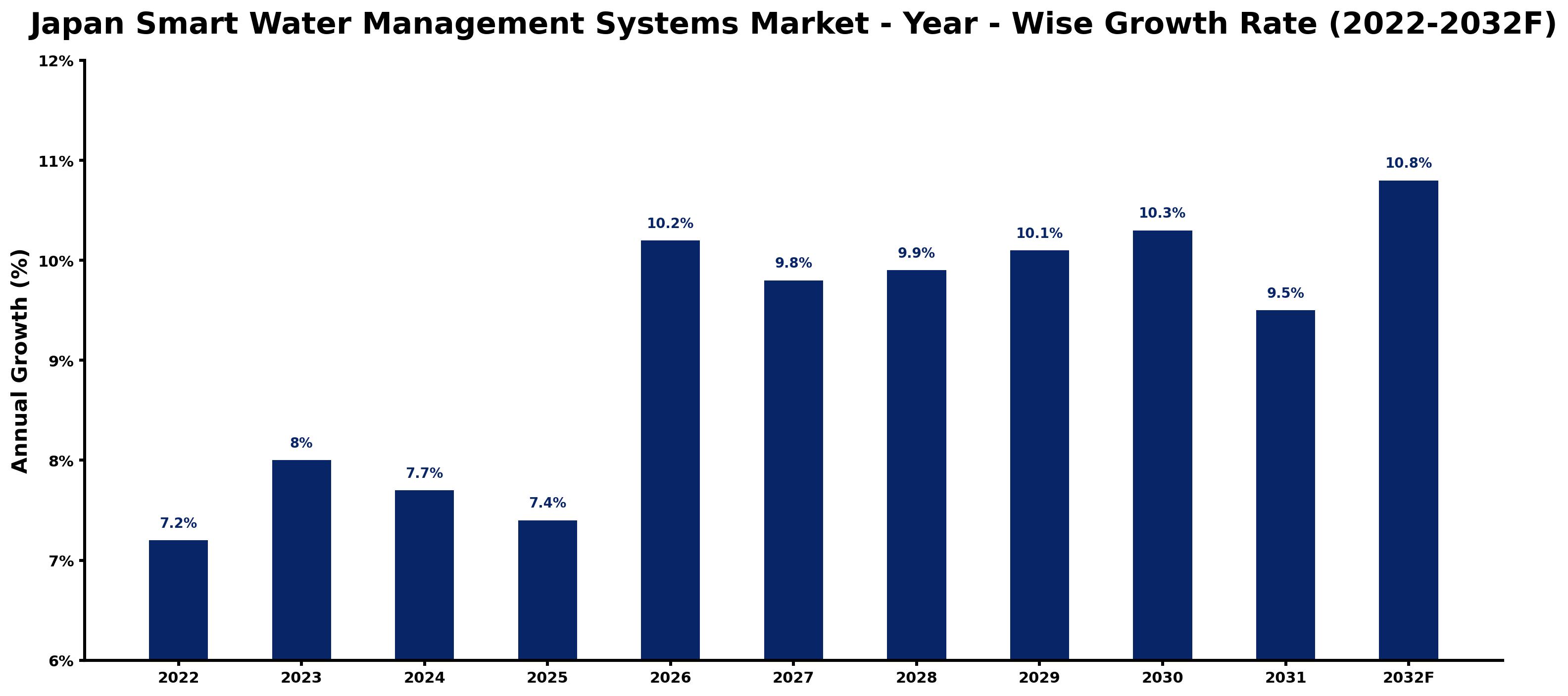
Year by year, the estimates below pair each growth rate with the development that shaped it.
| Year | Estimated Annual Growth (%) | Market Rationale |
| 2022 | 7.2 | The market experienced steady growth due to ongoing urbanisation and infrastructure investments. |
| 2023 | 8.0 | Demand increased as smart water technologies gained traction among urban utilities and industrial sectors. |
| 2024 | 7.7 | Growth slowed slightly as some utilities reassessed their technology investments amid budget constraints. |
| 2025 | 7.4 | A further slowdown occurred as utilities focused on optimising existing systems rather than new implementations. |
| 2026 | 10.2 | Growth is expected to accelerate as the government launches initiatives to digitise water infrastructure across cities. |
| 2027 | 9.8 | The market will continue to grow, supported by increased adoption of smart water meters in urban areas. |
| 2028 | 9.9 | Demand is projected to rise again as residential areas embrace smart technologies for efficient water usage. |
| 2029 | 10.1 | Growth is expected to remain strong as utilities expand their smart water management capabilities. |
| 2030 | 10.3 | The market will continue to thrive, driven by technological advancements in monitoring and leak detection. |
| 2031 | 9.5 | Growth is projected to slow as market maturity sets in and utilities focus on system optimisation. |
| 2032 | 10.8 | The market is expected to peak as new solutions and increased investments in smart technologies emerge. |
Note: Market size estimations and growth projections presented in this report are based on 6Wresearch's proprietary forecasting methodology, utilizing the latest available industry data, government publications, and primary research inputs.
Japan Smart Water Management Systems Market Synopsis
Smart Water Management Systems optimise water distribution and usage through IoT devices, sensors, and data analytics. These systems improve efficiency, minimise wastage, and ensure safe drinking water. The Japan Smart Water Management Systems Market is expanding due to an urban population of approximately 92 million, the installation of smart water meters in over 1 million households, and government initiatives promoting advanced technologies for water management.
Market Dynamics Impact Analysis (2026–2032)
| Factor | Type | Impact | Primary Segment Affected |
| Urban population growth drives demand for efficient water management solutions. | Driver | High | Leak Detection Systems |
| Government initiatives promote the adoption of smart technologies in public utilities. | Driver | High | Smart Water Meters |
| Investment in leak detection technologies is increasing due to high water loss rates. | Opportunity | High | Leak Detection Systems |
| Residential areas are increasingly adopting smart meters for efficient water usage. | Opportunity | High | Smart Water Meters |
| Budget constraints among utilities may limit technology investments. | Restraint | Medium | Distribution Management |
| The average water loss in utilities remains around 10%, indicating a need for improvements. | Restraint | High | Leak Detection Systems |
| Limited awareness of smart technologies among smaller utilities hampers adoption. | Challenge | Medium | Quality Monitoring Units |
| High initial costs of implementing smart water management systems can deter investments. | Challenge | High | Distribution Management |
Evaluation of Drivers in Japan Smart Water Management Systems Market (2026–2032)
The main growth drivers and the segments they affect most are set out below.
| Drivers | Primary Segment Affected | Why It Matters (Evidence) |
| Urban population growth | Leak Detection Systems | Japan's urban population of approximately 92 million increases the need for efficient water management solutions. |
| Government initiatives | Smart Water Meters | The 'Smart Water Management Program' aims to digitise water infrastructure in 50 cities by 2025. |
| High water loss rates | Leak Detection Systems | The average water loss in Japanese utilities is around 10%, prompting investments in leak detection technologies. |
| Increased adoption of smart meters | Smart Water Meters | Smart water meters can reduce water consumption by up to 15% in residential areas, driving demand. |
| Technological advancements | Quality Monitoring Units | The Tokyo Waterworks Bureau's pilot program for AI-based water quality monitoring in 2023 highlights innovation. |
Purchasing is picking up as Japan's urban population of approximately 92 million drives demand for efficient water management solutions. The average water loss in Japanese utilities is around 10%, which encourages investments in leak detection technologies. In residential areas, smart water meters can reduce consumption by up to 15%, leading to increased adoption.
Evaluation of Restraints in Japan Smart Water Management Systems Market
Below are the constraints most often cited by buyers and suppliers, with the segment each affects.
| Market Restraint | Primary Segment Affected | Why It Matters (Evidence) |
| Budget constraints among utilities | Distribution Management | Utilities may limit technology investments due to financial pressures, affecting system upgrades. |
| Limited awareness of smart technologies | Quality Monitoring Units | Smaller utilities often lack knowledge about the benefits of smart technologies, hindering adoption. |
| Average water loss remains high | Leak Detection Systems | With around 10% water loss, utilities may struggle to prioritise investments in leak detection. |
| High initial costs of implementation | Distribution Management | The upfront costs of smart water management systems can deter utilities from making investments. |
| Slow integration of new technologies | Quality Monitoring Units | Utilities may face challenges in integrating new technologies into existing systems, delaying improvements. |
Japan Smart Water Management Systems Market Challenges
Urban utilities in Japan lose substantial revenue due to a skills shortage in advanced technology, delaying the adoption of smart water systems and costing them approximately ¥5 billion annually. Intense competition among suppliers drives down prices, which can lead to compromised quality of smart water solutions, ultimately affecting service reliability for utilities. Many producers struggle to effectively integrate IoT devices, resulting in inefficiencies that waste around 10% of water resources, impacting operational costs for utilities. Compliance with ISO 50001 standards increases financial burdens on water utilities, making it challenging for them to invest in necessary upgrades and innovations.
Trends in the Japan Smart Water Management Systems Market
Several trends are reshaping the Japan Smart Water Management Systems Market; the most important are set out below.
- Launch of Water Management Innovation Strategy: The Water Management Innovation Strategy initiated in 2021 aims to digitise water infrastructure in 50 cities by 2025. This initiative is projected to improve operational efficiency and reduce wastage, encouraging utilities to adopt advanced technologies.
- Shift towards AI-based Monitoring: AI-based water quality monitoring is gaining traction, as demonstrated by the Tokyo Waterworks Bureau's pilot program in 2023. This shift is expected to improve water safety and quality management across urban utilities.
- Increased Adoption of Smart Water Meters: Smart water meters are being implemented in over 1 million households in the Tokyo metropolitan area. This trend is leading to better billing accuracy and reduced water consumption, benefiting both utilities and consumers.
- Pressure Regulation Systems Gaining Popularity: Pressure regulation systems are increasingly adopted in industrial plants to improve efficiency and reduce costs. This trend reflects a growing focus on optimising water flow and pressure management.
Investment Opportunities in the Japan Smart Water Management Systems Market
Investors looking at the Japan Smart Water Management Systems Market should consider the following areas.
- Local partnerships for technology integration: Utilities can benefit from partnering with local tech firms to integrate smart water management solutions. The Tokyo metropolitan area has implemented smart water meters in over 1 million households, indicating a demand for collaboration.
- Supply of leak detection systems: With an average water loss of around 10%, there is a notable opportunity to supply advanced leak detection systems. City utilities are primary buyers, seeking solutions to minimise wastage.
- Investment in quality monitoring technologies: The government allocated ¥5 billion for developing advanced water monitoring technologies, creating opportunities for suppliers. Utilities will seek innovative solutions to improve water quality management.
- Expansion of smart meter installations: As residential areas increasingly adopt smart meters, suppliers can focus on providing these devices. The potential to reduce water consumption by up to 15% presents a promising market opportunity.
Government Initiatives in the Japan Smart Water Management Systems Market
The Water Supply Act (1957) establishes standards for drinking-water quality and supply, ensuring safe water for consumers. This law mandates that producers adhere to strict quality controls, impacting how water management systems are implemented. The Sewerage Act (1958) governs sewerage systems and wastewater treatment, further influencing water management practices.
In 2023, the government allocated ¥5 billion for the development of advanced water monitoring technologies, overseen by the Ministry of Land, Infrastructure, Transport and Tourism. This funding supports innovations that improve water quality management and efficiency.
Future Insight of the Japan Smart Water Management Systems Market
By 2032, a government-led initiative will accelerate the transition to smart water management, prompting suppliers to innovate in response to new regulations. The adoption of AI-based water quality monitoring will become commonplace, improving system efficiency across urban utilities. The Ministry of Land, Infrastructure, Transport and Tourism's strategy aims to digitise water infrastructure in 50 cities by 2025, enhancing operational capabilities. With smart water meters reducing consumption by up to 15% in residential areas, buyers will benefit from lower utility costs and better resource management.
Market Segmentation Analysis
Japan Smart Water Management Systems Market report covers a detailed analysis of the following market segments:
By System Type – Leak Detection Systems Lead, Smart Water Meters Expected to Grow Fastest
According to Saurav Kr Singh, Senior Research Analyst at 6Wresearch, the largest system type category in 2025 was Leak Detection Systems, at 51% of revenue. Leak detection systems are essential for identifying leaks and minimising water loss, making them vital for urban utilities managing extensive water networks. The average water loss in Japanese utilities is around 10%, demonstrating a clear need for effective leak detection solutions. Smart Water Meters are set to record the highest CAGR in this split, 14.4% over 2026–2032. The increasing adoption of smart meters is driven by their capacity to reduce water consumption by up to 15% in residential areas, appealing to both consumers and utilities. As urban populations expand, the demand for accurate billing and usage tracking will further propel this segment's growth. Suppliers should focus on advancing smart meter technologies to satisfy the rising demand from urban utilities.
By Smart Feature – Real-Time Alerts Lead, Usage & Billing Insights Expected to Grow Fastest
Real-Time Alerts accounted for 33% of the market by smart feature in 2025. Real-time alerts play a vital role in optimising water management, allowing utilities to address issues proactively. This feature is essential for city utilities that depend on immediate data to ensure service reliability. The quickest growth will come from Usage & Billing Insights, forecast to expand at a CAGR of 13.3% between 2026 and 2032. Usage and billing insights are gaining traction as they facilitate informed decision-making for both utilities and consumers, indicating a shift towards data-centric management. As demand for transparency in water usage rises, this segment is set for rapid growth. Suppliers should focus on developing systems that deliver comprehensive usage insights to enhance water management efficiency.
By Monitoring Tech – Pressure + Flow Sensors Lead, IoT + App Expected to Grow Fastest
Pressure + Flow Sensors held 46% of the Japan Smart Water Management Systems Market by monitoring tech in 2025. Pressure and flow sensors are vital for monitoring system performance, ensuring efficient water distribution in urban areas. Their widespread deployment among city utilities highlights their importance in maintaining service reliability. Over 2026–2032, IoT + App is expected to post the fastest growth, at a CAGR of 13.8%. The integration of IoT and app technologies is improving user experience, facilitating better engagement with water management systems. As consumers demand greater connectivity, this segment's growth will be fuelled by the need for accessible monitoring solutions. Suppliers must prioritise the development of IoT-enabled solutions to meet the evolving preferences of end-users.
By End User – City Utilities Lead, Residential Areas Expected to Grow Fastest
In 2025, City Utilities led the end user split with a 40% share. City utilities are the primary users of smart water management systems, tasked with maintaining public water supply and infrastructure. Their significant investments in smart technologies highlight the pressing need to improve efficiency and minimise wastage. Residential Areas are projected to grow fastest, at a CAGR of 13.0% during 2026–2032. Residential areas are swiftly embracing smart meters, which provide direct benefits through improved billing accuracy and water conservation. This trend is likely to continue as more households become aware of the benefits of smart water management. Suppliers must customise their products to meet the specific requirements of residential customers to seize this growing market opportunity.
Key Attractiveness of the Report
- 10 Years of Market Numbers
- Historical Data Starting from 2022 to 2025
- Base Year 2025
- Forecast Data until 2032
- Key Performance Indicators Impacting the Market
- Major Upcoming Developments and Projects
Key Highlights of the Report:
- Japan Smart Water Management Systems Market Outlook
- Market Size of Japan Smart Water Management Systems Market, 2025
- Forecast of Japan Smart Water Management Systems Market, 2032
- Historical Data and Forecast of Japan Smart Water Management Systems Revenues & Volume for the Period 2022-2032F
- Japan Smart Water Management Systems Market Trend Evolution
- Japan Smart Water Management Systems Market Drivers and Challenges
- Japan Smart Water Management Systems Price Trends
- Japan Smart Water Management Systems Porter's Five Forces
- Japan Smart Water Management Systems Industry Life Cycle
- Historical Data and Forecast of Japan Smart Water Management Systems Market Revenues & Volume By System Type for the Period 2022-2032F
- Historical Data and Forecast of Japan Smart Water Management Systems Market Revenues & Volume By Leak Detection Systems for the Period 2022-2032F
- Historical Data and Forecast of Japan Smart Water Management Systems Market Revenues & Volume By Smart Water Meters for the Period 2022-2032F
- Historical Data and Forecast of Japan Smart Water Management Systems Market Revenues & Volume By Distribution Management for the Period 2022-2032F
- Historical Data and Forecast of Japan Smart Water Management Systems Market Revenues & Volume By Quality Monitoring Units for the Period 2022-2032F
- Historical Data and Forecast of Japan Smart Water Management Systems Market Revenues & Volume By Smart Feature for the Period 2022-2032F
- Historical Data and Forecast of Japan Smart Water Management Systems Market Revenues & Volume By Real-Time Alerts for the Period 2022-2032F
- Historical Data and Forecast of Japan Smart Water Management Systems Market Revenues & Volume By Usage & Billing Insights for the Period 2022-2032F
- Historical Data and Forecast of Japan Smart Water Management Systems Market Revenues & Volume By Pressure Regulation for the Period 2022-2032F
- Historical Data and Forecast of Japan Smart Water Management Systems Market Revenues & Volume By Contaminant Analysis for the Period 2022-2032F
- Historical Data and Forecast of Japan Smart Water Management Systems Market Revenues & Volume By Monitoring Tech for the Period 2022-2032F
- Historical Data and Forecast of Japan Smart Water Management Systems Market Revenues & Volume By Pressure + Flow Sensors for the Period 2022-2032F
- Historical Data and Forecast of Japan Smart Water Management Systems Market Revenues & Volume By IoT + App for the Period 2022-2032F
- Historical Data and Forecast of Japan Smart Water Management Systems Market Revenues & Volume By Cloud + Edge Sync for the Period 2022-2032F
- Historical Data and Forecast of Japan Smart Water Management Systems Market Revenues & Volume By AI Chemical Sensing for the Period 2022-2032F
- Historical Data and Forecast of Japan Smart Water Management Systems Market Revenues & Volume By End User for the Period 2022-2032F
- Historical Data and Forecast of Japan Smart Water Management Systems Market Revenues & Volume By City Utilities for the Period 2022-2032F
- Historical Data and Forecast of Japan Smart Water Management Systems Market Revenues & Volume By Residential Areas for the Period 2022-2032F
- Historical Data and Forecast of Japan Smart Water Management Systems Market Revenues & Volume By Water Boards for the Period 2022-2032F
- Historical Data and Forecast of Japan Smart Water Management Systems Market Revenues & Volume By Industrial Plants for the Period 2022-2032F
- Japan Smart Water Management Systems Import Export Trade Statistics
- Market Opportunity Assessment By System Type
- Market Opportunity Assessment By Smart Feature
- Market Opportunity Assessment By Monitoring Tech
- Market Opportunity Assessment By End User
- Japan Smart Water Management Systems Top Companies Market Share
- Japan Smart Water Management Systems Competitive Benchmarking By Technical and Operational Parameters
- Japan Smart Water Management Systems Company Profiles
- Japan Smart Water Management Systems Key Strategic Recommendations
Market Covered
This report examines the market across the segments below.
By System Type
- Leak Detection Systems
- Smart Water Meters
- Distribution Management
- Quality Monitoring Units
By Smart Feature
- Real-Time Alerts
- Usage & Billing Insights
- Pressure Regulation
- Contaminant Analysis
By Monitoring Tech
- Pressure + Flow Sensors
- IoT + App
- Cloud + Edge Sync
- AI Chemical Sensing
By End User
- City Utilities
- Residential Areas
- Water Boards
- Industrial Plants































