Japan Smart Water Pump Systems Market Size & Growth Rate
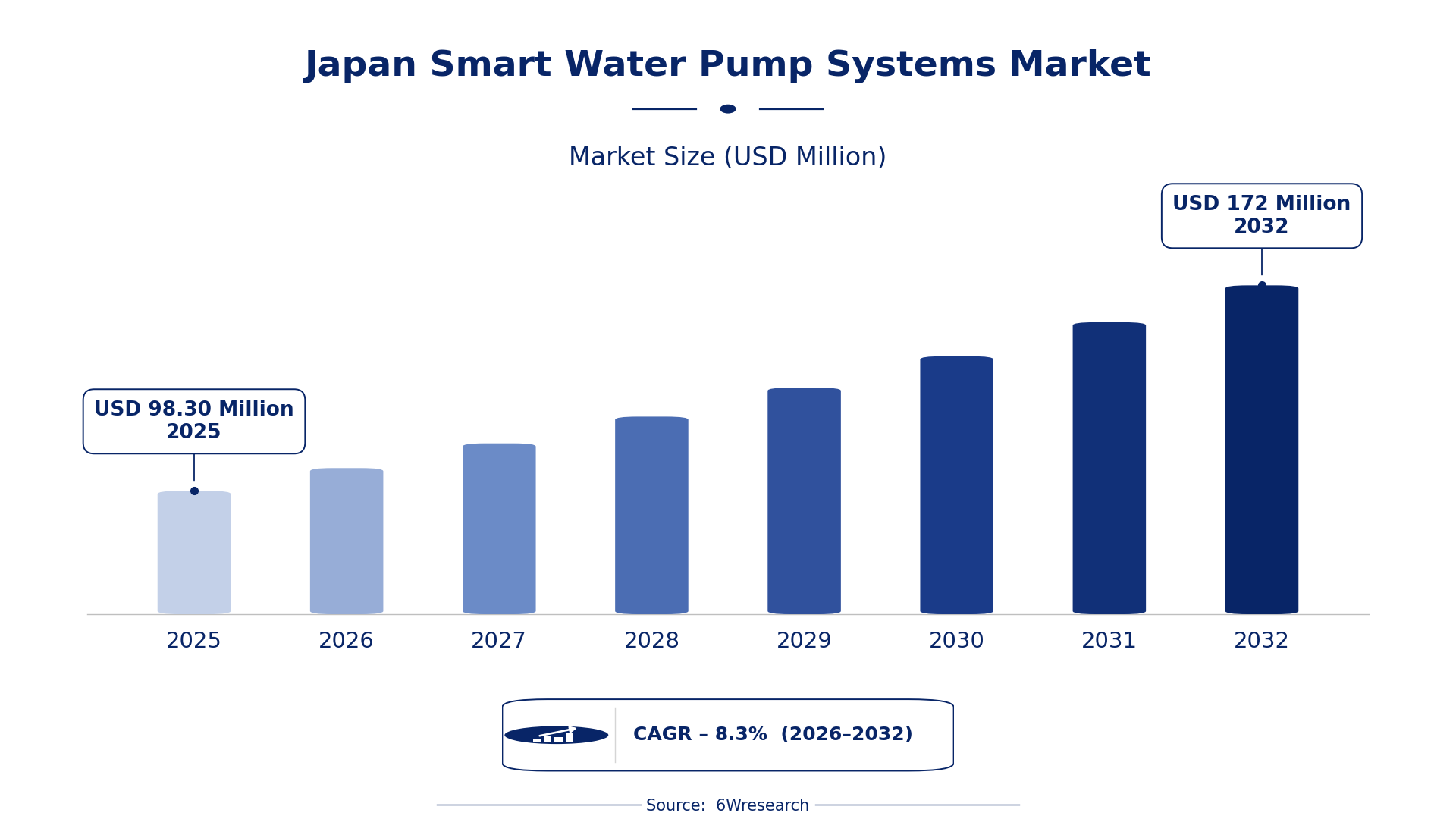
According to 6Wresearch internal database and industry insights, the Japan Smart Water Pump Systems Market was valued at USD 98.30 Million in 2025 and is projected to reach USD 172 Million by 2032, growing at a CAGR of approximately 8.3% during 2026–2032.
Japan Smart Water Pump Systems Market Highlights
| Report Metric | Details |
| Report Name | Japan Smart Water Pump Systems Market (2026-2032) |
| Market Size 2025 | USD 98.30 Million |
| Market Size 2032 | USD 172 Million |
| Absolute Growth 2025–2032 | USD 73.70 Million |
| CAGR 2026–2032 | 8.3% |
| Peak Annual Growth | 9.2% in 2028 |
| Forecast Period | 2026–2032 |
| Historical Data | 2022–2025 |
| Base Year | 2025 |
| Leading Pump Type, 2025 | Agricultural Pumps (39% share) |
| Leading Smart Feature, 2025 | Soil Moisture Sync (45% share) |
| Leading Control Platform, 2025 | Sensor + App (43% share) |
| Leading End User, 2025 | Irrigation Farms (46% share) |
| Fastest-Growing Pump Type | Urban Water Pumps (11.5% CAGR) |
| Fastest-Growing Smart Feature | Demand-Based Start/Stop (11.3% CAGR) |
| Fastest-Growing Control Platform | AI Flow Optimization (12.1% CAGR) |
| Fastest-Growing End User | City Water Networks (11.2% CAGR) |
| Growing Sector | urban water supply |
| Key End Users | municipal water services, agricultural operators, residential users |
Japan Smart Water Pump Systems Market Year-wise Growth Rate and Key Drivers (2022–2032)
This graph illustrates the annual growth rates of the market from 2022 to 2032, highlighting a steady upward trajectory and projected market expansion over the forecast period.
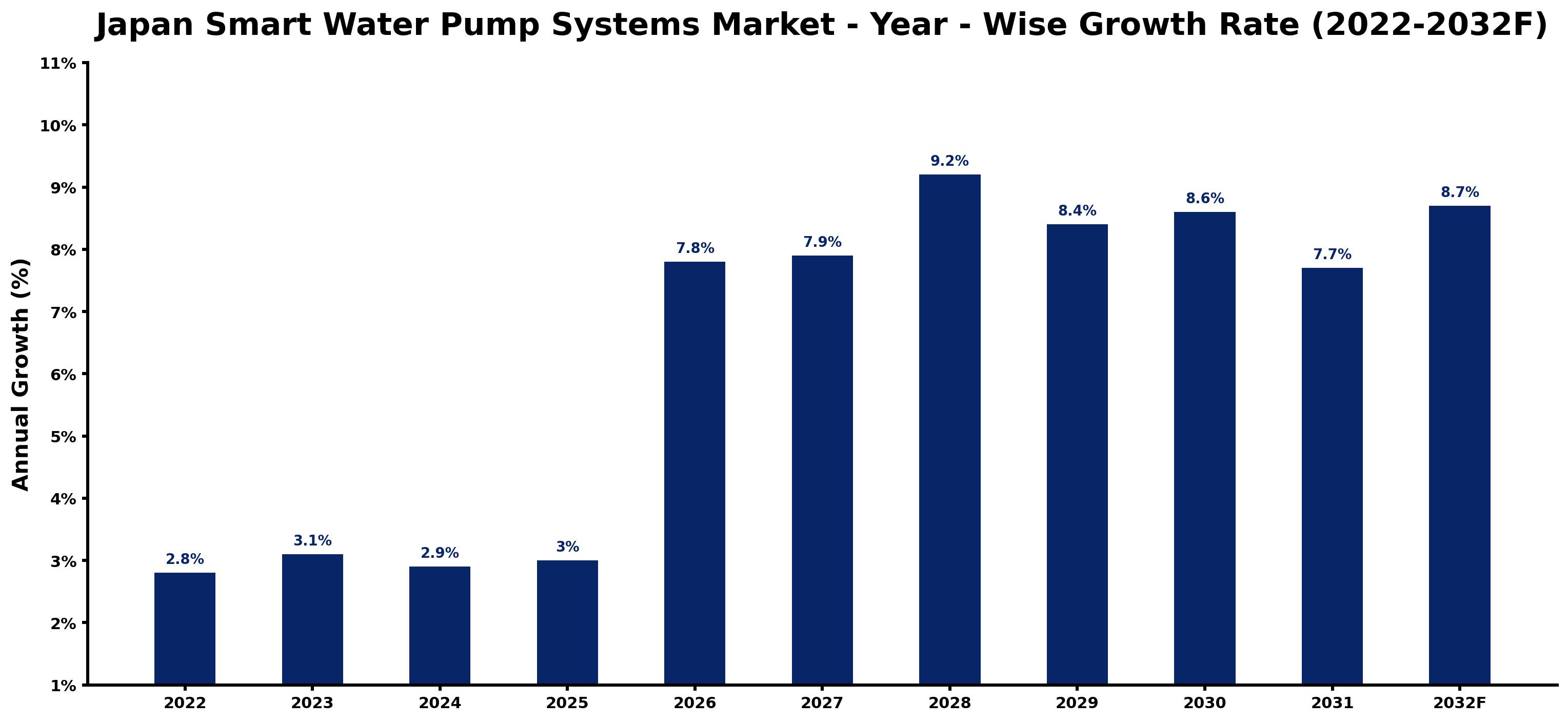
Each row of the following table gives one year's estimated growth and the event or demand shift that explains it.
| Year | Estimated Annual Growth (%) | Market Rationale |
| 2022 | 2.8 | The market experienced steady growth, reflecting ongoing investments in smart irrigation technologies. |
| 2023 | 3.1 | Growth accelerated as urban water systems improved efficiency and smart technologies gained traction. |
| 2024 | 2.9 | A slight slowdown occurred due to market saturation in certain urban areas, yet demand remained strong. |
| 2025 | 3.0 | Demand increased as municipalities adopted advanced water management practices for sustainability. |
| 2026 | 7.8 | Growth is expected to surge as urban water pumps become essential for managing Japan's dense population. |
| 2027 | 7.9 | Continued investment in smart technologies is projected to support further market expansion and efficiency improvements. |
| 2028 | 9.2 | The peak growth year will see a rise in smart water pump installations across sectors. |
| 2029 | 8.4 | A slowdown in growth is anticipated as the market begins to stabilise after rapid expansion. |
| 2030 | 8.6 | Demand is expected to remain strong as urban areas continue to upgrade their water supply systems. |
| 2031 | 7.7 | Growth will slow slightly due to market maturity, yet smart technologies will still drive demand. |
| 2032 | 8.7 | The market is projected to grow as residential pump adoption rises with smart home trends. |
Note: Market size estimations and growth projections presented in this report are based on 6Wresearch's proprietary forecasting methodology, utilizing the latest available industry data, government publications, and primary research inputs.
Japan Smart Water Pump Systems Market Synopsis
Smart water pump systems integrate advanced technology for efficient water management, utilising sensors and IoT for real-time control. These systems are essential for irrigation, urban water supply, and industrial applications. The Japan Smart Water Pump Systems Market is expanding due to urbanisation, with approximately 126 million people served by city water networks. The government promotes smart irrigation technologies, while investments in urban water systems improve efficiency, driving demand from municipalities and agricultural sectors.
Market Dynamics Impact Analysis (2026–2032)
| Factor | Type | Impact | Primary Segment Affected |
| Increasing urbanisation drives demand for efficient water distribution systems. | Driver | High | Urban Water Pumps |
| Growing adoption of smart irrigation technologies optimises water usage in agriculture. | Driver | High | Agricultural Pumps |
| Rising urban population density creates a need for advanced water management solutions. | Opportunity | High | Urban Water Pumps |
| The shift towards smart homes increases demand for residential water pumps. | Opportunity | High | Residential Water Pumps |
| Aging infrastructure in water supply systems necessitates upgrades and replacements. | Restraint | High | Urban Water Pumps |
| High initial investment costs for smart water pump systems may deter some buyers. | Restraint | Medium | Residential Water Pumps |
| Challenges in integrating new technologies with existing infrastructure can delay projects. | Challenge | High | Industrial Pumps |
| Limited awareness among smaller agricultural operators about smart technologies hinders adoption. | Challenge | Medium | Agricultural Pumps |
Evaluation of Drivers in Japan Smart Water Pump Systems Market (2026–2032)
Demand rests on the following drivers, each shown with the segment it touches most.
| Drivers | Primary Segment Affected | Why It Matters (Evidence) |
| Urbanisation increases the need for efficient water management. | Urban Water Pumps | Tokyo's investment in smart urban water systems has improved supply efficiency, driving demand. |
| Smart irrigation technologies optimise water usage. | Agricultural Pumps | The average farm size of 1.5 hectares necessitates efficient irrigation solutions. |
| Growing residential smart home adoption boosts demand for water pumps. | Residential Water Pumps | Smart homes in Japan are projected to increase by 15% by 2025, raising pump demand. |
| Government initiatives promote smart water management technologies. | Urban Water Pumps | The Tokyo Metropolitan Government's 2023 project aims to improve urban water efficiency. |
| Predictive maintenance AI improves reliability in water systems. | Industrial Pumps | The expected rise in predictive maintenance AI usage by 2026 will enhance operational efficiency. |
Most of the extra volume comes from the increasing urban population density, which drives demand for efficient water distribution systems. Approximately 126 million people are served by city water networks, necessitating upgrades to existing infrastructure. The average household in Japan uses about 280 litres of water daily, prompting municipalities to adopt smart technologies. With smart homes projected to increase by 15% by 2025, demand for residential water pumps is set to rise. The promotion of smart irrigation technologies supports agricultural pump adoption, improving water management efficiency for irrigation farms and urban water networks.
Evaluation of Restraints in Japan Smart Water Pump Systems Market
The main factors holding the market back are set out below.
| Market Restraint | Primary Segment Affected | Why It Matters (Evidence) |
| Aging infrastructure in water supply systems complicates upgrades. | Urban Water Pumps | Japan's water supply systems require significant investments to modernise aging infrastructure. |
| High initial costs deter smaller agricultural operators from adopting smart technologies. | Agricultural Pumps | The average cost of smart water pump systems ranges from 100,000 to 500,000 JPY per unit. |
| Integration challenges with existing systems can delay implementation. | Industrial Pumps | Many factories struggle to incorporate new smart technologies into their current operations. |
| Limited awareness among smaller operators hampers technology adoption. | Agricultural Pumps | Many small-scale farmers lack knowledge about the benefits of smart irrigation systems. |
| Regulatory compliance can slow down the deployment of new technologies. | Urban Water Pumps | The Water Supply Act sets strict standards for drinking-water quality and supply. |
Japan Smart Water Pump Systems Market Challenges
Tokyo's urban water supply faces intense competition for resources, leading to inefficiencies that can delay service improvements for municipal water services. Aging infrastructure complicates technology upgrades, causing maintenance costs to rise for city water networks, which struggle to keep pace with modern demands. The average cost of smart water pump systems, ranging from 100,000 to 500,000 JPY per unit, poses a financial barrier for many agricultural producers looking to invest in efficient irrigation solutions. Regulatory pressures from the Ministry of the Environment to reduce water wastage by 20% by 2030 create additional compliance costs for suppliers, impacting their pricing strategies.
Trends in the Japan Smart Water Pump Systems Market
The trends below show where the Japan Smart Water Pump Systems Market is heading.
- Initiative for Urban Water Efficiency: In 2023, the Tokyo Metropolitan Government initiated a project to enhance urban water efficiency for approximately 14 million residents, aiming to reduce wastage and improve service delivery.
- Shift Towards Smart Homes: Residential water pumps are increasingly adopted as smart home technology gains traction. By 2025, smart homes in Japan are projected to grow by 15%, boosting demand for efficient water systems.
- Rise of Predictive Maintenance AI: The use of predictive maintenance AI in water systems is projected to rise by 2026, improving reliability and reducing downtime for urban water pumps.
- Increased Focus on Water Conservation: The Ministry of the Environment promotes water conservation practices nationwide, aiming to reduce water wastage by 20% by 2030 through smart technologies.
Investment Opportunities in the Japan Smart Water Pump Systems Market
Below are the investment opportunities with the strongest case in the Japan Smart Water Pump Systems Market.
- Collaborations with Local Governments: Local governments are seeking partnerships to improve water management systems. With a projected 20% reduction in water wastage by 2030, suppliers can collaborate with city water networks for smart upgrades.
- Investment in Smart Irrigation Solutions: Agricultural operators are increasingly looking for efficient irrigation technologies. The average farm size of 1.5 hectares presents an opportunity for suppliers to provide tailored smart solutions.
- Development of App-Based Control Systems: The demand for app-based flow control systems is rising as users seek convenience. Suppliers can target urban water networks to integrate these technologies effectively.
- Expansion of Smart Home Solutions: With smart homes projected to grow by 15% by 2025, there is a market gap for residential water pumps. Suppliers can enter this market through local partnerships.
Government Initiatives in the Japan Smart Water Pump Systems Market
The Water Supply Act sets standards for drinking-water quality and supply, ensuring that smart water pump systems meet regulatory requirements. This law mandates that producers adhere to strict guidelines, impacting the design and implementation of new technologies.
In 2023, Japan launched a programme to increase smart water management in urban areas, funded by the Ministry of the Environment. This initiative aims to improve water efficiency and reduce wastage, benefiting both producers and municipal buyers.
Future Insight of the Japan Smart Water Pump Systems Market
Urban water services will experience a shift as municipalities adopt advanced technologies, increasing the efficiency of distribution systems. By 2032, the average household in Japan is expected to consume approximately 300 litres of water daily, driving demand for efficient solutions. The Tokyo Metropolitan Government's smart water management project will set benchmarks for future urban systems, encouraging municipalities to follow suit. The rise of predictive maintenance AI in water systems will further optimise operational efficiency, benefiting both buyers and suppliers.
Market Segmentation Analysis
Japan Smart Water Pump Systems Market report covers a detailed analysis of the following market segments:
By Pump Type – Agricultural Pumps Lead, Urban Water Pumps Expected to Grow Fastest
According to Saurav Kr Singh, Senior Research Analyst at 6Wresearch, the largest pump type category in 2025 was Agricultural Pumps, at 39% of revenue. Agricultural pumps dominate the market as they are vital for irrigation in Japan's farming sector, with over 1 million units deployed annually. This high usage is largely due to the average farm size of 1.5 hectares, which necessitates effective irrigation solutions. Urban Water Pumps are projected to grow fastest, at a CAGR of 11.5% during 2026–2032. Urban water pumps are experiencing rapid growth due to significant investments in modern water supply systems, particularly in cities like Tokyo. The increasing urban population density further fuels the demand for efficient water distribution, ensuring this segment's continued expansion. Suppliers should focus on developing products tailored to urban water pump needs to leverage growing municipal investments.
By Smart Feature – Soil Moisture Sync Leads, Demand-Based Start/Stop Expected to Grow Fastest
Soil Moisture Sync accounted for 45% of the market by smart feature in 2025. Soil moisture sync technology leads the market because it optimally adjusts irrigation based on real-time soil conditions, which is essential for effective agricultural practices. This feature is widely adopted, aligning with government initiatives that promote smart irrigation technologies. Over 2026–2032, Demand-Based Start/Stop is expected to post the fastest growth, at a CAGR of 11.3%. Demand-based start/stop features are rapidly gaining traction as they enhance energy efficiency, making them attractive to both agricultural and urban users. The increasing focus on sustainability and cost savings drives the adoption of this technology. Buyers should invest in smart features that improve efficiency and lower operational costs.
By Control Platform – Sensor + App Leads, AI Flow Optimization Expected to Grow Fastest
Sensor + App took 43% of control platform revenue in 2025, more than any other category. The sensor and app combination is the leading control platform, providing real-time data and control that is crucial for users needing immediate feedback on pump performance. This capability is essential for both agricultural and urban applications, ensuring optimal operation. AI Flow Optimization is set to record the highest CAGR in this split, 12.1% over 2026–2032. AI flow optimization is advancing quickly, driven by the necessity for smarter resource management in water systems. Its ability to adjust water flow based on demand patterns positions it as a key tool for future efficiency improvements. Suppliers must prioritise the development of advanced solutions to meet the rising demand for intelligent control platforms.
By End User – Irrigation Farms Lead, City Water Networks Expected to Grow Fastest
Irrigation Farms held 46% of the Japan Smart Water Pump Systems Market by end user in 2025. Irrigation farms are the largest user group for smart water pump systems, heavily relying on these technologies for efficient water management in agriculture. The consistent demand from this sector highlights its crucial role in Japan's overall water management efforts. The quickest growth will come from City Water Networks, forecast to expand at a CAGR of 11.2% between 2026 and 2032. City water networks are the fastest-growing end user segment, propelled by urbanisation and the need for modernised water distribution systems. Government initiatives aimed at enhancing urban water supply efficiency further accelerate this growth. Suppliers need to tailor their strategies to meet the specific requirements of city water networks to seize emerging opportunities.
Key Attractiveness of the Report
- 10 Years of Market Numbers
- Historical Data Starting from 2022 to 2025
- Base Year 2025
- Forecast Data until 2032
- Key Performance Indicators Impacting the Market
- Major Upcoming Developments and Projects
Key Highlights of the Report:
- Japan Smart Water Pump Systems Market Outlook
- Market Size of Japan Smart Water Pump Systems Market, 2025
- Forecast of Japan Smart Water Pump Systems Market, 2032
- Historical Data and Forecast of Japan Smart Water Pump Systems Revenues & Volume for the Period 2022-2032F
- Japan Smart Water Pump Systems Market Trend Evolution
- Japan Smart Water Pump Systems Market Drivers and Challenges
- Japan Smart Water Pump Systems Price Trends
- Japan Smart Water Pump Systems Porter's Five Forces
- Japan Smart Water Pump Systems Industry Life Cycle
- Historical Data and Forecast of Japan Smart Water Pump Systems Market Revenues & Volume By Pump Type for the Period 2022-2032F
- Historical Data and Forecast of Japan Smart Water Pump Systems Market Revenues & Volume By Agricultural Pumps for the Period 2022-2032F
- Historical Data and Forecast of Japan Smart Water Pump Systems Market Revenues & Volume By Urban Water Pumps for the Period 2022-2032F
- Historical Data and Forecast of Japan Smart Water Pump Systems Market Revenues & Volume By Industrial Pumps for the Period 2022-2032F
- Historical Data and Forecast of Japan Smart Water Pump Systems Market Revenues & Volume By Residential Water Pumps for the Period 2022-2032F
- Historical Data and Forecast of Japan Smart Water Pump Systems Market Revenues & Volume By Smart Feature for the Period 2022-2032F
- Historical Data and Forecast of Japan Smart Water Pump Systems Market Revenues & Volume By Soil Moisture Sync for the Period 2022-2032F
- Historical Data and Forecast of Japan Smart Water Pump Systems Market Revenues & Volume By Demand-Based Start/Stop for the Period 2022-2032F
- Historical Data and Forecast of Japan Smart Water Pump Systems Market Revenues & Volume By Predictive Maintenance AI for the Period 2022-2032F
- Historical Data and Forecast of Japan Smart Water Pump Systems Market Revenues & Volume By App-Based Flow Control for the Period 2022-2032F
- Historical Data and Forecast of Japan Smart Water Pump Systems Market Revenues & Volume By Control Platform for the Period 2022-2032F
- Historical Data and Forecast of Japan Smart Water Pump Systems Market Revenues & Volume By Sensor + App for the Period 2022-2032F
- Historical Data and Forecast of Japan Smart Water Pump Systems Market Revenues & Volume By AI Flow Optimization for the Period 2022-2032F
- Historical Data and Forecast of Japan Smart Water Pump Systems Market Revenues & Volume By Vibration + Temp Sensors for the Period 2022-2032F
- Historical Data and Forecast of Japan Smart Water Pump Systems Market Revenues & Volume By IoT Dashboard for the Period 2022-2032F
- Historical Data and Forecast of Japan Smart Water Pump Systems Market Revenues & Volume By End User for the Period 2022-2032F
- Historical Data and Forecast of Japan Smart Water Pump Systems Market Revenues & Volume By Irrigation Farms for the Period 2022-2032F
- Historical Data and Forecast of Japan Smart Water Pump Systems Market Revenues & Volume By City Water Networks for the Period 2022-2032F
- Historical Data and Forecast of Japan Smart Water Pump Systems Market Revenues & Volume By Factories for the Period 2022-2032F
- Historical Data and Forecast of Japan Smart Water Pump Systems Market Revenues & Volume By Smart Homes for the Period 2022-2032F
- Japan Smart Water Pump Systems Import Export Trade Statistics
- Market Opportunity Assessment By Pump Type
- Market Opportunity Assessment By Smart Feature
- Market Opportunity Assessment By Control Platform
- Market Opportunity Assessment By End User
- Japan Smart Water Pump Systems Top Companies Market Share
- Japan Smart Water Pump Systems Competitive Benchmarking By Technical and Operational Parameters
- Japan Smart Water Pump Systems Company Profiles
- Japan Smart Water Pump Systems Key Strategic Recommendations
Market Covered
The report covers the following segments.
By Pump Type
- Agricultural Pumps
- Urban Water Pumps
- Industrial Pumps
- Residential Water Pumps
By Smart Feature
- Soil Moisture Sync
- Demand-Based Start/Stop
- Predictive Maintenance AI
- App-Based Flow Control
By Control Platform
- Sensor + App
- AI Flow Optimization
- Vibration + Temp Sensors
- IoT Dashboard
By End User
- Irrigation Farms
- City Water Networks
- Factories
- Smart Homes































