Japan Smart Water Purification Devices Market Size & Growth Rate
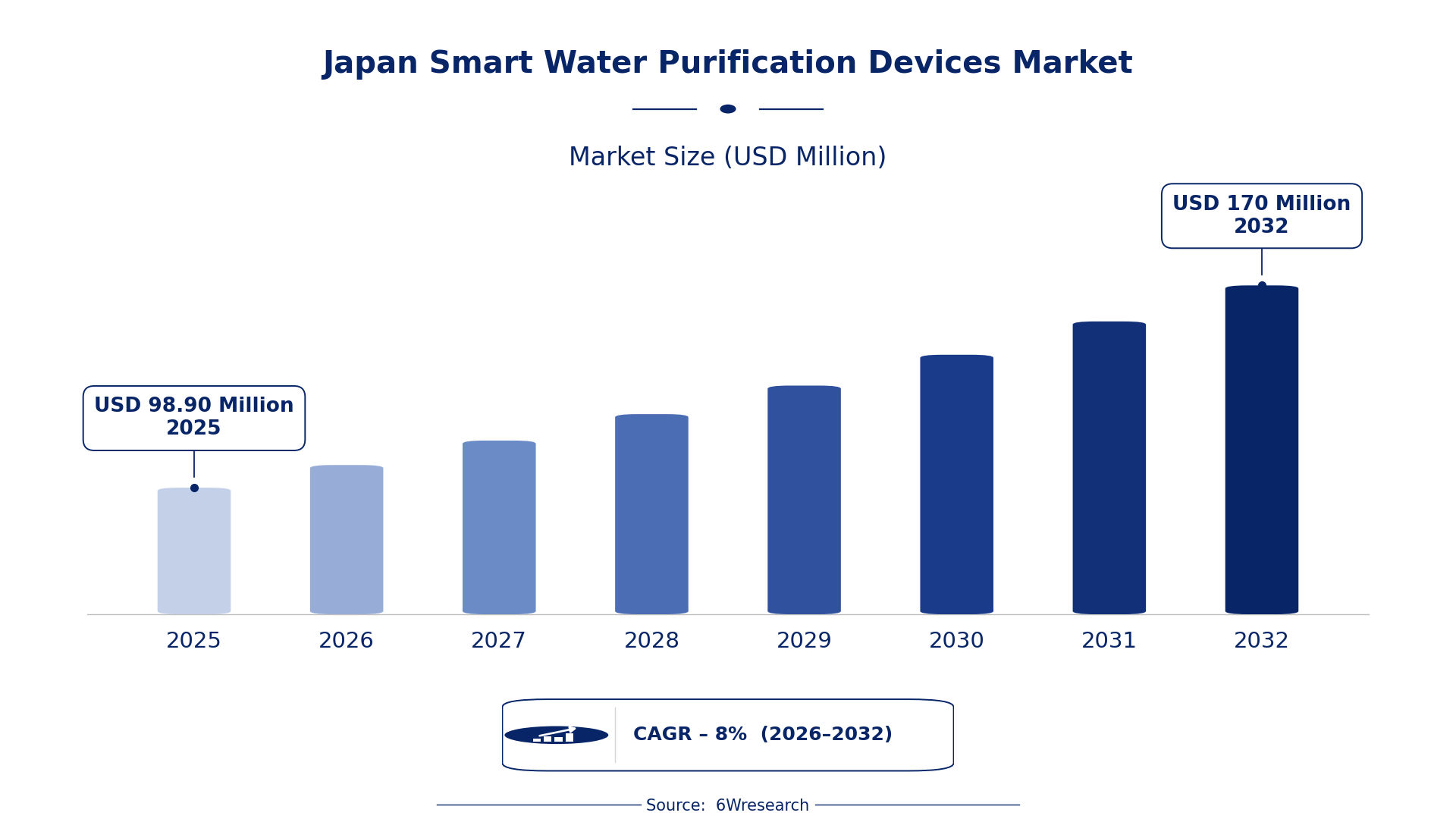
According to 6Wresearch internal database and industry insights, the Japan Smart Water Purification Devices Market was valued at USD 98.90 Million in 2025 and is projected to reach USD 170 Million by 2032, growing at a CAGR of approximately 8% during 2026–2032.
Japan Smart Water Purification Devices Market Highlights
| Report Metric | Details |
| Report Name | Japan Smart Water Purification Devices Market (2026-2032) |
| Market Size 2025 | USD 98.90 Million |
| Market Size 2032 | USD 170 Million |
| Absolute Growth 2025–2032 | USD 71.10 Million |
| CAGR 2026–2032 | 8% |
| Peak Annual Growth | 8.6% in 2032 |
| Forecast Period | 2026–2032 |
| Historical Data | 2022–2025 |
| Base Year | 2025 |
| Leading Purifier Type, 2025 | RO + UV Systems (40% share) |
| Leading Smart Feature, 2025 | Filter Life Alerts (46% share) |
| Leading Detection Mechanism, 2025 | TDS/UV Sensors (34% share) |
| Leading End User, 2025 | Households (51% share) |
| Fastest-Growing Purifier Type | AI-Based Purifiers (11.7% CAGR) |
| Fastest-Growing Smart Feature | Water Quality Classification (10.4% CAGR) |
| Fastest-Growing Detection Mechanism | ML + Real-Time Sensing (11.8% CAGR) |
| Fastest-Growing End User | Apartments (10.5% CAGR) |
| Growing Sector | Apartments |
| Key End Users | Households, Offices, Apartments, Rural/Urban Kiosks |
Japan Smart Water Purification Devices Market Year-wise Growth Rate and Key Drivers (2022–2032)
This graph illustrates the annual growth rates of the market from 2022 to 2032, highlighting a steady upward trajectory and projected market expansion over the forecast period.
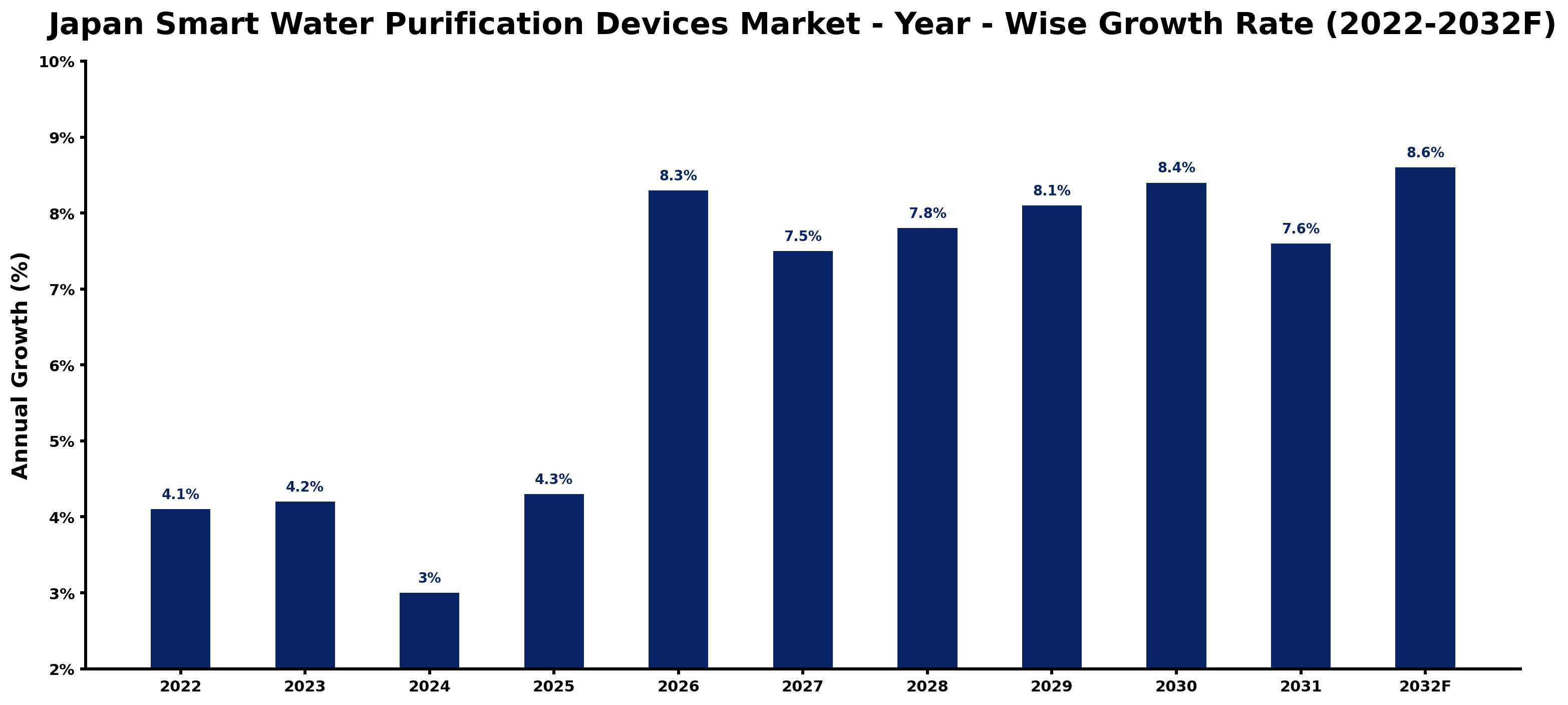
Below, each year's estimated growth is shown next to the factor that most influenced it.
| Year | Estimated Annual Growth (%) | Market Rationale |
| 2022 | 4.1 | The market maintained steady growth as consumers increasingly sought safe drinking water solutions. |
| 2023 | 4.2 | Demand rose further as households prioritised health and water quality in urban areas. |
| 2024 | 3.0 | Growth slowed due to market saturation in some segments, yet demand remained strong overall. |
| 2025 | 4.3 | A resurgence in growth occurred as new technologies gained traction among consumers. |
| 2026 | 8.3 | The introduction of AI-based purifiers is expected to spur market expansion this year. |
| 2027 | 7.5 | Growth is projected to slow as competition intensifies among existing purification technologies. |
| 2028 | 7.8 | Demand is expected to increase as urban households adopt more advanced purification systems. |
| 2029 | 8.1 | The market is projected to experience a boost from rising awareness of water quality issues. |
| 2030 | 8.4 | Growth will continue as public health campaigns promote the benefits of smart purification. |
| 2031 | 7.6 | A slight slowdown is expected as the market approaches maturity in some segments. |
| 2032 | 8.6 | Demand will surge again, driven by innovations in smart water purification technologies. |
Note: Market size estimations and growth projections presented in this report are based on 6Wresearch's proprietary forecasting methodology, utilizing the latest available industry data, government publications, and primary research inputs.
Japan Smart Water Purification Devices Market Synopsis
Smart Water Purification Devices ensure safe drinking water through advanced technologies like reverse osmosis and UV filtration. The market is expanding due to rising demand from households, which account for about 60% of total demand. Factors such as the introduction of AI-based purifiers and public water ATMs are driving investment in water purification technologies, particularly in urban areas where access to clean water is critical. The Tokyo region is a major hub for this technological development, further supporting market growth.
Market Dynamics Impact Analysis (2026–2032)
| Factor | Type | Impact | Primary Segment Affected |
| Growing household demand for clean drinking water | Driver | High | Households |
| Increasing adoption of AI-based purification technologies | Driver | High | AI-Based Purifiers |
| Expansion of public water ATMs in urban areas | Opportunity | Medium | Public Water ATMs |
| Rising urbanisation leading to higher purifier adoption | Opportunity | Medium | Apartments |
| High initial costs of advanced purification systems | Restraint | High | AI-Based Purifiers |
| Regulatory compliance requirements for water quality standards | Restraint | Medium | RO + UV Systems |
| Limited awareness of advanced purification technologies | Challenge | Medium | App-Connected Filters |
| Competition among various purification technologies | Challenge | High | RO + UV Systems |
Evaluation of Drivers in Japan Smart Water Purification Devices Market (2026–2032)
Below are the drivers that matter most for revenue growth, with supporting evidence.
| Drivers | Primary Segment Affected | Why It Matters (Evidence) |
| Increased health consciousness among consumers | Households | This trend leads to higher purchases of smart purification devices, with households accounting for about 60% of demand. |
| Government initiatives promoting clean water access | Public Water ATMs | These initiatives boost the installation of public water ATMs, improving community health and increasing demand. |
| Technological advancements in water purification | AI-Based Purifiers | Innovations such as AI-based systems improve filtration efficiency, attracting tech-savvy consumers in urban areas. |
| Rising disposable income in urban households | Apartments | Higher disposable income encourages investments in advanced water purification solutions for better health. |
| Growing urbanisation and population density | Rural/Urban Kiosks | Urbanisation drives the need for accessible clean water solutions, increasing the installation of purification kiosks. |
Volumes grow on the back of increased health consciousness among consumers, with households accounting for about 60% of demand for smart water purification devices. Innovations in purification, particularly AI-based systems, attract tech-savvy consumers in urban areas. Higher disposable income encourages investments in advanced solutions, while growing urbanisation drives the need for accessible clean water, increasing the installation of purification kiosks in underserved regions.
Evaluation of Restraints in Japan Smart Water Purification Devices Market
The following restraints limit how fast demand can grow.
| Market Restraint | Primary Segment Affected | Why It Matters (Evidence) |
| High initial costs of advanced purification systems | AI-Based Purifiers | The upfront investment required can deter some consumers from adopting these technologies. |
| Regulatory compliance requirements for water quality standards | RO + UV Systems | Strict regulations necessitate investments in compliance, impacting operational costs for manufacturers. |
| Limited awareness of advanced purification technologies | App-Connected Filters | Many consumers are unaware of the benefits of smart features, limiting market growth. |
| Competition among various purification technologies | RO + UV Systems | Intense competition can lead to price wars, impacting profit margins for manufacturers. |
| Supply chain disruptions affecting component availability | RO + UV Systems | Disruptions can delay production and increase costs, affecting overall market growth. |
Japan Smart Water Purification Devices Market Challenges
Dependence on specific suppliers for key components like TDS sensors leads to production delays for manufacturers, impacting their ability to meet market demands. Urban households experience financial strain as average monthly expenses on water purification solutions reach 10,000 JPY, affecting their overall spending capacity. Stringent JIS standards create regulatory hurdles, resulting in prolonged approval times for new devices, which can delay market entry for producers. Increased competition among local manufacturers pressures prices downward, restricting the variety and quality of products available to consumers, ultimately limiting their choices.
Trends in the Japan Smart Water Purification Devices Market
The shifts below are changing how Japan Smart Water Purification Devices Market products are bought and supplied.
- Shift from Traditional to Smart Water Purification: Since 2023, urban households have increasingly adopted smart water purification devices, with over 5 million units now installed in Japan, reflecting a shift in consumer preferences.
- Transition from Standalone to Connected Devices: The trend towards app-connected filters began in 2023, with urban consumers seeking convenience. These devices integrate with mobile applications, driving demand for smart features.
- Emergence of Public Water ATMs: The installation of public water ATMs has accelerated since 2023, particularly in urban areas. Local municipalities are investing in these facilities to improve community health, with numerous units deployed across major cities.
- Focus on Water Quality Monitoring Technologies: In 2023, the Japanese government launched a program to promote water quality monitoring technologies. This initiative aims to enhance public awareness and ensure compliance with safety standards.
Investment Opportunities in the Japan Smart Water Purification Devices Market
The openings below show where demand in the Japan Smart Water Purification Devices Market is visible and how suppliers can enter.
- Growing Demand for AI-Based Purifiers: With an estimated 8% annual growth in AI-based purifiers, suppliers can target urban households seeking advanced solutions. Partnering with local distributors can facilitate market entry.
- Investment in Public Water ATMs: As urban areas see a rise in public water ATMs, suppliers can invest in these facilities to meet community needs. Collaborating with local municipalities can enhance outreach.
- Expansion of App-Connected Filters: The growing popularity of app-connected filters presents an opportunity for suppliers to develop innovative products. Engaging with tech-savvy consumers in metropolitan areas can drive adoption.
- Focus on Water Quality Classification Features: With water quality classification becoming standard in new models, suppliers can invest in this technology to meet consumer expectations. Certification with relevant standards can aid market entry.
Government Initiatives in the Japan Smart Water Purification Devices Market
The PMDA oversees the approval and monitoring of water purification devices, ensuring compliance with safety standards. This agency's stringent review process builds consumer trust and promotes market stability, as seen with the introduction of new technologies in recent years. The PMDA's regulations require manufacturers to adhere to strict quality controls, impacting the overall market environment.
The Ministry of Health, Labour and Welfare funds initiatives to improve water quality monitoring. This includes supporting research and development projects aimed at enhancing public health, with allocations reaching JPY 5 billion in the latest fiscal year. These measures directly benefit manufacturers by ensuring compliance with safety standards and encouraging innovation in purification technologies.
Future Insight of the Japan Smart Water Purification Devices Market
By 2032, domestic users will increasingly adopt advanced purification technologies, driving a shift towards smart devices that provide enhanced monitoring capabilities. The expansion of public water ATMs will improve access to clean water for communities, especially in urban areas. The government's initiative to reduce water wastage by 20% by 2025 will encourage investment in innovative purification solutions. With over 5 million smart water purification devices currently installed, suppliers will prioritise the development of integrated systems that enhance user experience and operational efficiency.
Market Segmentation Analysis
Japan Smart Water Purification Devices Market report covers a detailed analysis of the following market segments:
By Purifier Type – RO + UV Systems Lead, AI-Based Purifiers Expected to Grow Fastest
According to Saurav Kr Singh, Senior Research Analyst at 6Wresearch, RO + UV Systems took 40% of purifier type revenue in 2025, more than any other category. RO + UV systems dominate the market in Japan due to their proven effectiveness in ensuring safe drinking water. Their popularity is highlighted by the extensive installed base of over 5 million units, primarily serving households and offices. AI-Based Purifiers are projected to grow fastest, at a CAGR of 11.7% during 2026–2032. AI-based purifiers are experiencing rapid growth as they incorporate advanced technologies that appeal to consumers seeking efficiency and convenience. Their rising adoption in urban households indicates a shift towards smarter solutions in water purification. Suppliers must innovate to include advanced features in their products to cater to the growing preference for smart purification technologies.
By Smart Feature – Filter Life Alerts Lead, Water Quality Classification Expected to Grow Fastest
Filter Life Alerts accounted for 46% of the market by smart feature in 2025. Filter life alerts are crucial for maintaining the efficiency of purification devices, keeping users informed about when to replace filters. This feature is widely adopted across various models, particularly in urban households where water quality is a priority. The quickest growth will come from Water Quality Classification, forecast to expand at a CAGR of 10.4% between 2026 and 2032. Water quality classification is gaining traction as it informs users about the safety of their drinking water, especially in metropolitan areas. The increasing consumer demand for transparency in water quality is propelling this feature's rapid growth. Suppliers should prioritise the integration of water quality classification features to align with consumer expectations.
By Detection Mechanism – TDS/UV Sensors Lead, ML + Real-Time Sensing Expected to Grow Fastest
The largest detection mechanism category in 2025 was TDS/UV Sensors, at 34% of revenue. TDS and UV sensors are integral for accurately measuring water quality, making them standard in most purification devices sold in Japan. Their essential function in ensuring safe drinking water solidifies their position as market leaders. ML + Real-Time Sensing is set to record the highest CAGR in this split, 11.8% over 2026–2032. The adoption of machine learning and real-time sensing technologies is enhancing the capabilities of water purification systems, attracting consumers who seek advanced monitoring solutions. This trend indicates a rising demand for sophisticated detection methods in the market. Suppliers must invest in advanced detection technologies to remain competitive in the evolving market.
By End User – Households Lead, Apartments Expected to Grow Fastest
Households held 51% of the Japan Smart Water Purification Devices Market by end user in 2025. Households constitute the largest segment of end users for smart water purification devices, accounting for around 60% of total demand. This strong consumer base is driven by the essential need for clean drinking water in domestic environments. Over 2026–2032, Apartments are expected to post the fastest growth, at a CAGR of 10.5%. The apartment segment is growing rapidly, influenced by urban living trends where space is limited and efficient solutions are increasingly sought. This shift highlights changing consumer preferences towards compact and effective purification systems. Suppliers should adapt their products to meet the specific needs of apartment residents.
Key Attractiveness of the Report
- 10 Years of Market Numbers
- Historical Data Starting from 2022 to 2025
- Base Year 2025
- Forecast Data until 2032
- Key Performance Indicators Impacting the Market
- Major Upcoming Developments and Projects
Key Highlights of the Report:
- Japan Smart Water Purification Devices Market Outlook
- Market Size of Japan Smart Water Purification Devices Market, 2025
- Forecast of Japan Smart Water Purification Devices Market, 2032
- Historical Data and Forecast of Japan Smart Water Purification Devices Revenues & Volume for the Period 2022-2032F
- Japan Smart Water Purification Devices Market Trend Evolution
- Japan Smart Water Purification Devices Market Drivers and Challenges
- Japan Smart Water Purification Devices Price Trends
- Japan Smart Water Purification Devices Porter's Five Forces
- Japan Smart Water Purification Devices Industry Life Cycle
- Historical Data and Forecast of Japan Smart Water Purification Devices Market Revenues & Volume By Purifier Type for the Period 2022-2032F
- Historical Data and Forecast of Japan Smart Water Purification Devices Market Revenues & Volume By RO + UV Systems for the Period 2022-2032F
- Historical Data and Forecast of Japan Smart Water Purification Devices Market Revenues & Volume By AI-Based Purifiers for the Period 2022-2032F
- Historical Data and Forecast of Japan Smart Water Purification Devices Market Revenues & Volume By App-Connected Filters for the Period 2022-2032F
- Historical Data and Forecast of Japan Smart Water Purification Devices Market Revenues & Volume By Public Water ATMs for the Period 2022-2032F
- Historical Data and Forecast of Japan Smart Water Purification Devices Market Revenues & Volume By Smart Feature for the Period 2022-2032F
- Historical Data and Forecast of Japan Smart Water Purification Devices Market Revenues & Volume By Filter Life Alerts for the Period 2022-2032F
- Historical Data and Forecast of Japan Smart Water Purification Devices Market Revenues & Volume By Water Quality Classification for the Period 2022-2032F
- Historical Data and Forecast of Japan Smart Water Purification Devices Market Revenues & Volume By Usage + Maintenance Logs for the Period 2022-2032F
- Historical Data and Forecast of Japan Smart Water Purification Devices Market Revenues & Volume By Payment + Monitoring for the Period 2022-2032F
- Historical Data and Forecast of Japan Smart Water Purification Devices Market Revenues & Volume By Detection Mechanism for the Period 2022-2032F
- Historical Data and Forecast of Japan Smart Water Purification Devices Market Revenues & Volume By TDS/UV Sensors for the Period 2022-2032F
- Historical Data and Forecast of Japan Smart Water Purification Devices Market Revenues & Volume By ML + Real-Time Sensing for the Period 2022-2032F
- Historical Data and Forecast of Japan Smart Water Purification Devices Market Revenues & Volume By IoT + Cloud Sync for the Period 2022-2032F
- Historical Data and Forecast of Japan Smart Water Purification Devices Market Revenues & Volume By Smart Card/QR + IoT for the Period 2022-2032F
- Historical Data and Forecast of Japan Smart Water Purification Devices Market Revenues & Volume By End User for the Period 2022-2032F
- Historical Data and Forecast of Japan Smart Water Purification Devices Market Revenues & Volume By Households for the Period 2022-2032F
- Historical Data and Forecast of Japan Smart Water Purification Devices Market Revenues & Volume By Offices for the Period 2022-2032F
- Historical Data and Forecast of Japan Smart Water Purification Devices Market Revenues & Volume By Apartments for the Period 2022-2032F
- Historical Data and Forecast of Japan Smart Water Purification Devices Market Revenues & Volume By Rural/Urban Kiosks for the Period 2022-2032F
- Japan Smart Water Purification Devices Import Export Trade Statistics
- Market Opportunity Assessment By Purifier Type
- Market Opportunity Assessment By Smart Feature
- Market Opportunity Assessment By Detection Mechanism
- Market Opportunity Assessment By End User
- Japan Smart Water Purification Devices Top Companies Market Share
- Japan Smart Water Purification Devices Competitive Benchmarking By Technical and Operational Parameters
- Japan Smart Water Purification Devices Company Profiles
- Japan Smart Water Purification Devices Key Strategic Recommendations
Market Covered
The following segment groups are covered in the report.
By Purifier Type
- RO + UV Systems
- AI-Based Purifiers
- App-Connected Filters
- Public Water ATMs
By Smart Feature
- Filter Life Alerts
- Water Quality Classification
- Usage + Maintenance Logs
- Payment + Monitoring
By Detection Mechanism
- TDS/UV Sensors
- ML + Real-Time Sensing
- IoT + Cloud Sync
- Smart Card/QR + IoT
By End User
- Households
- Offices
- Apartments
- Rural/Urban Kiosks































