Japan Smartphone Sensor Market Size & Growth Rate
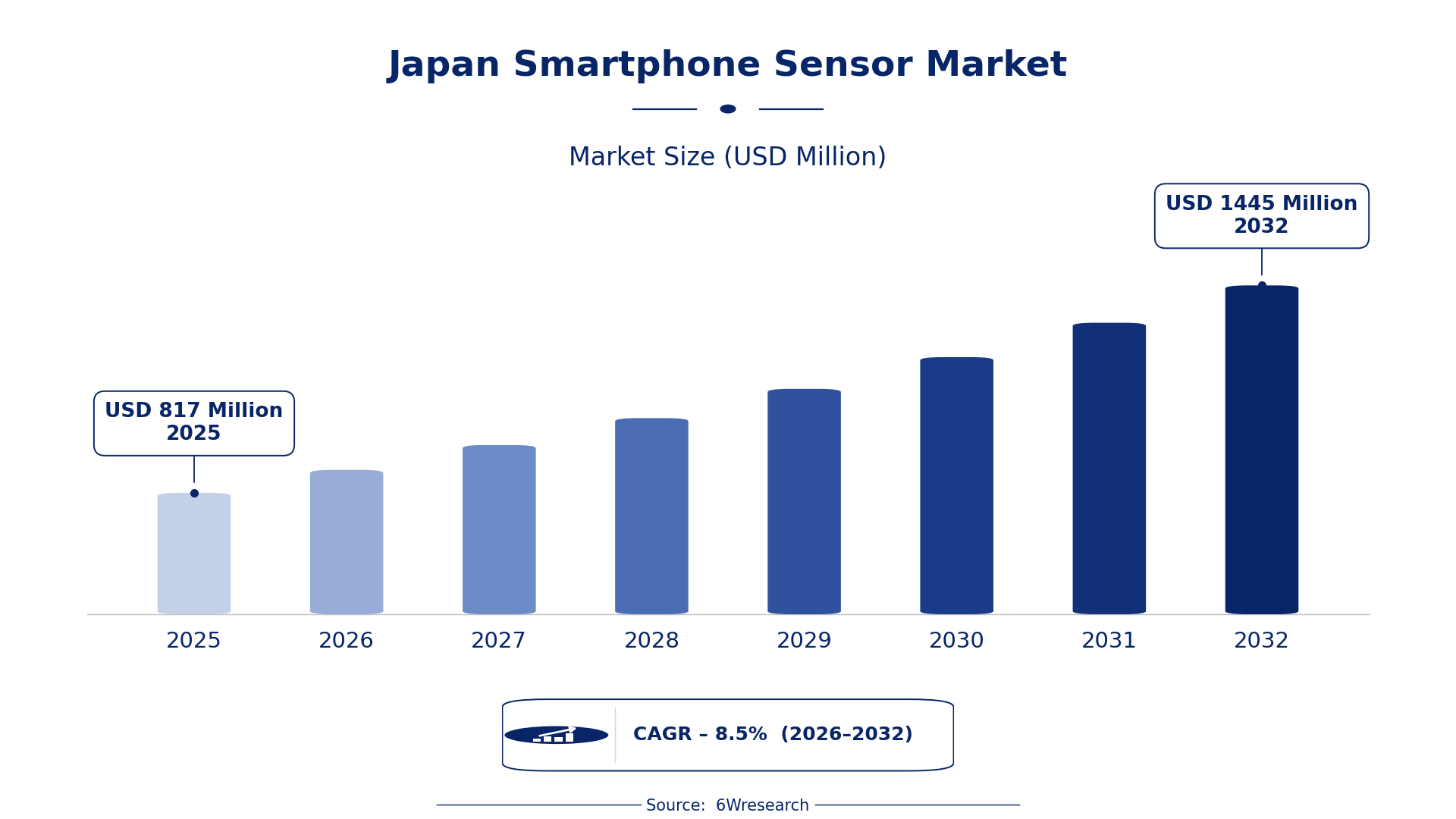
According to 6Wresearch internal database and industry insights, the Japan Smartphone Sensor Market was valued at USD 817 Million in 2025 and is projected to reach USD 1,445 Million by 2032, growing at a CAGR of approximately 8.5% during 2026–2032.
Japan Smartphone Sensor Market Highlights
| Report Metric | Details |
| Report Name | Japan Smartphone Sensor Market (2026-2032) |
| Market Size 2025 | USD 817 Million |
| Market Size 2032 | USD 1,445 Million |
| Absolute Growth 2025–2032 | USD 628 Million |
| CAGR 2026–2032 | 8.5% |
| Peak Annual Growth | 9.3% in 2032 |
| Forecast Period | 2026–2032 |
| Historical Data | 2022–2025 |
| Base Year | 2025 |
| Leading Sensor Type, 2025 | Gyroscope (39% share) |
| Leading Application Area, 2025 | Motion Tracking (49% share) |
| Leading Integration Type, 2025 | On-Board Chipset (47% share) |
| Leading End User Device, 2025 | Mid-Range Smartphones (36% share) |
| Fastest-Growing Sensor Type | Ambient Light Sensor (12.3% CAGR) |
| Fastest-Growing Application Area | Brightness Control (10.0% CAGR) |
| Fastest-Growing Integration Type | Embedded (11.7% CAGR) |
| Fastest-Growing End User Device | Flagship Phones (12.0% CAGR) |
| Growing Sector | Smartphone technology |
| Key End Users | Smartphone manufacturers, IoT device producers, gaming companies, technology developers |
Japan Smartphone Sensor Market Year-wise Growth Rate and Key Drivers (2022–2032)
This graph illustrates the annual growth rates of the market from 2022 to 2032, highlighting a steady upward trajectory and projected market expansion over the forecast period.
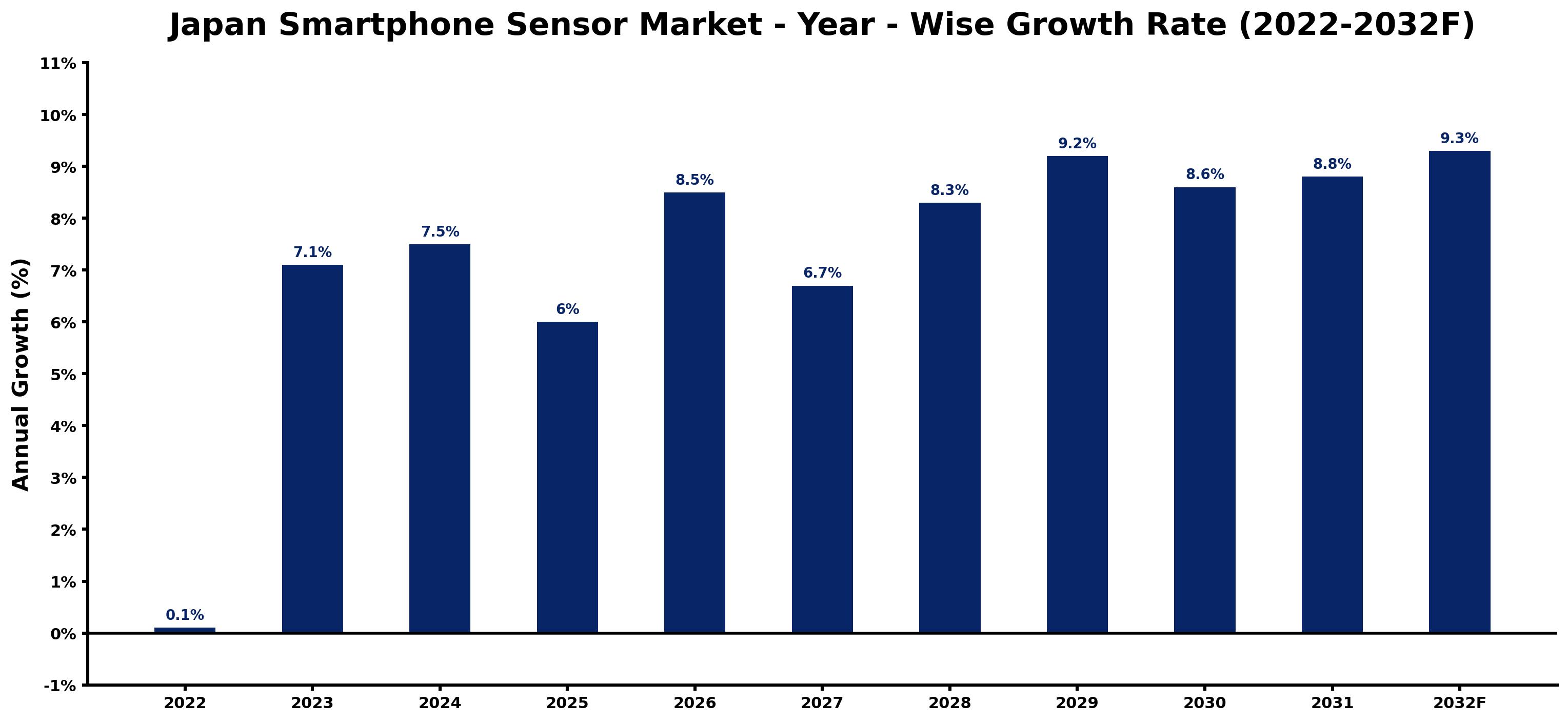
For each year, the table pairs the estimated growth rate with the leading influence on demand, showing how the drivers changed across the period.
| Year | Estimated Annual Growth (%) | Market Rationale |
| 2022 | 0.1 | The market experienced minimal growth due to stable demand from existing users. |
| 2023 | 7.1 | Growth accelerated as smartphone adoption continued to rise among consumers. |
| 2024 | 7.5 | Increased sales were driven by new model launches and technological advancements. |
| 2025 | 6.0 | Growth slowed as market saturation began to impact new purchases. |
| 2026 | 8.5 | Demand surged with the introduction of new sensor technologies. |
| 2027 | 6.7 | Growth decelerated as competition intensified among manufacturers. |
| 2028 | 8.3 | A rebound occurred as consumer interest in upgraded features increased. |
| 2029 | 9.2 | Demand continued to rise with the popularity of flagship models. |
| 2030 | 8.6 | Growth slowed again as the market reached a more mature stage. |
| 2031 | 8.8 | An increase in demand for advanced features boosted market activity. |
| 2032 | 9.3 | The market peaked with heightened interest in smart device innovations. |
Note: Market size estimations and growth projections presented in this report are based on 6Wresearch's proprietary forecasting methodology, utilizing the latest available industry data, government publications, and primary research inputs.
Japan Smartphone Sensor Market Synopsis
Smartphone sensors are electronic components that detect and respond to physical stimuli, crucial for improving smartphone functionality. In Japan, the smartphone market is thriving, with around 100 million users and a penetration rate of approximately 80%. The Japan Smartphone Sensor Market is expanding due to rising demand for advanced features in mid-range and flagship smartphones, supported by investments in sensor technology and initiatives like the 2023 programme promoting smart device innovation.
Market Dynamics Impact Analysis (2026–2032)
| Factor | Type | Impact | Primary Segment Affected |
| Increased smartphone penetration drives demand for sensors in new models. | Driver | High | Motion Tracking |
| Technological advancements in sensor integration enhance smartphone capabilities. | Driver | High | Ambient Light Sensor |
| Growing consumer preference for advanced security features creates opportunities for biometric sensors. | Opportunity | High | Fingerprint Sensor |
| The rising trend of smart devices in IoT applications opens new markets for sensors. | Opportunity | High | Embedded |
| Market saturation limits growth potential in the mid-range smartphone segment. | Restraint | High | Mid-Range Smartphones |
| Intense competition among manufacturers can lead to price wars, affecting margins. | Restraint | Medium | Flagship Phones |
| Supply chain disruptions can delay sensor availability for manufacturers. | Challenge | High | On-Board Chipset |
| Rapid technological changes require constant adaptation from producers. | Challenge | Medium | Proximity Sensor |
Evaluation of Drivers in Japan Smartphone Sensor Market (2026–2032)
These are the developments adding the most demand over the forecast period.
| Drivers | Primary Segment Affected | Why It Matters (Evidence) |
| Rising smartphone penetration rate of approximately 80% increases sensor demand. | Motion Tracking | This drives manufacturers to integrate more sensors into new models. |
| Technological advancements in sensor design improve functionality and performance. | Ambient Light Sensor | Manufacturers are adopting these innovations to attract tech-savvy consumers. |
| Consumer interest in biometric security features boosts fingerprint sensor adoption. | Fingerprint Sensor | Over 60% of flagship smartphones now include these sensors, increasing demand. |
| The growing IoT market drives demand for embedded sensors in devices. | Embedded | This trend encourages manufacturers to diversify their product offerings. |
| Investment in smart device innovation supports the development of new sensor technologies. | On-Board Chipset | The 2023 programme promotes advancements in sensor integration. |
Most of the extra volume comes from Japan's smartphone penetration rate, which is approximately 80%, prompting manufacturers to improve device capabilities. The introduction of advanced sensor technologies has led to increased functionality in smartphones, particularly in motion tracking and security features. In 2022, over 60% of flagship smartphones featured fingerprint sensors, reflecting consumer demand for biometric authentication. The growing Internet of Things market has created opportunities for embedded sensors, encouraging manufacturers to innovate and expand their offerings.
Evaluation of Restraints in Japan Smartphone Sensor Market
These restraints slow adoption and weigh on supplier margins.
| Market Restraint | Primary Segment Affected | Why It Matters (Evidence) |
| Market saturation limits the introduction of new models, affecting sensor sales. | Mid-Range Smartphones | As the market matures, fewer new users are entering the smartphone market. |
| Intense competition can lead to price reductions, impacting profit margins for producers. | Flagship Phones | Manufacturers are compelled to lower prices to maintain market share. |
| Supply chain disruptions can delay sensor production and delivery timelines. | On-Board Chipset | These delays affect manufacturers' ability to meet consumer demand. |
| Rapid technological advancements require constant updates to production processes. | Proximity Sensor | Manufacturers must invest in new technologies to remain competitive. |
| Consumer preferences shift quickly, making it hard to predict market trends. | Ambient Light Sensor | This unpredictability can lead to overproduction or stock shortages. |
Japan Smartphone Sensor Market Challenges
Producers face higher production costs as Japan's national minimum wage rises to JPY 1,055 per hour, leading to increased prices for consumers. Regulatory challenges arise from the Ministry of Internal Affairs and Communications enforcing strict telecommunications regulations, which cause delays in product launches and result in lost market opportunities for manufacturers. Competition compels producers to invest heavily in R&D, limiting their ability to lower prices and pushing the average price of a mid-range smartphone to around 40,000 JPY. Consequently, some consumers are postponing purchases, affecting overall sales volumes.
Trends in the Japan Smartphone Sensor Market
The following changes are redrawing the Japan Smartphone Sensor Market.
- Shift in Focus to Biometric Security Features: The Tokyo metropolitan area is increasingly adopting biometric security features in smartphones, with over 60% of flagship models now incorporating fingerprint sensors. This trend reflects consumer demand for enhanced security and privacy.
- Rise of Embedded Sensors in IoT Devices: In 2023, the integration of embedded sensors into IoT devices gained momentum, with a notable increase in their application alongside smartphones. This shift supports the development of smarter, more connected environments.
- Transition from Traditional to Smart Sensors: The introduction of smart sensors is transforming the market, with ambient light sensors now standard in 90% of new smartphone models. This change enhances user experience by automatically adjusting screen brightness.
- Growing Demand for Motion Tracking in Gaming: The gaming sector in Japan is increasingly employing motion tracking sensors, with a notable rise in their application within mobile gaming. This trend boosts user engagement and interactivity.
Investment Opportunities in the Japan Smartphone Sensor Market
Below are the investment opportunities with the strongest case in the Japan Smartphone Sensor Market.
- Local Partnerships for Sensor Development: Now is an ideal time for local partnerships to develop advanced sensors, particularly with the government's support for R&D in sensor technologies. Collaborating with manufacturers in the Tokyo area can yield effective solutions.
- Investment in Security Features for Flagship Phones: With over 60% of flagship smartphones using fingerprint sensors, there is a strong opportunity to invest in security technology. Targeting manufacturers focused on high-end devices can provide substantial returns.
- Expansion into the IoT Market: The increasing demand for embedded sensors in IoT devices presents a promising opportunity. Focusing on partnerships with tech firms developing smart home solutions can facilitate market entry.
- Development of Advanced Motion Tracking Solutions: Investing in motion tracking technology is timely, as it is crucial for gaming and navigation. Collaborating with gaming developers in Japan can improve product offerings.
Government Initiatives in the Japan Smartphone Sensor Market
The Semiconductor and Digital Industry Strategy, introduced in June 2021, strengthens domestic semiconductor manufacturing capabilities. This measure builds on the Industrial Standardization Act, ensuring that quality standards are upheld while boosting local production of smartphone sensors.
In 2023, the government allocated JPY 150 trillion towards public-private decarbonisation investment, overseen by the Ministry of Economy, Trade and Industry. This funding supports innovation in sensor technologies, promoting growth in the smartphone sensor sector.
Future Insight of the Japan Smartphone Sensor Market
By 2032, a policy-driven shift will stimulate advancements in sensor technologies, compelling suppliers to innovate and diversify their offerings. The government's focus on R&D subsidies will improve the quality of smartphone sensors, providing consumers with enhanced functionality. As the smartphone user base grows to around 100 million, manufacturers will increasingly adopt JIS standards to ensure product reliability. Annual events like the Tokyo Electronics Show will showcase cutting-edge technologies, shaping consumer preferences and influencing future market trends.
Market Segmentation Analysis
Japan Smartphone Sensor Market report covers a detailed analysis of the following market segments:
By Sensor Type – Gyroscope Leads, Ambient Light Sensor Expected to Grow Fastest
According to Saurav Kr Singh, Senior Research Analyst at 6Wresearch, the largest sensor type category in 2025 was Gyroscope, at 39% of revenue. The gyroscope holds the largest share in the sensor type segment due to its critical role in motion tracking, which enhances functionalities like gaming and navigation. With over 60% of flagship smartphones featuring gyroscopes, it is a key component for users in Japan. Ambient Light Sensor is set to record the highest CAGR in this split, 12.3% over 2026–2032. The ambient light sensor is experiencing rapid growth, being standard in 90% of new smartphone models, as manufacturers increasingly prioritise automatic brightness adjustment. This trend is expected to persist as consumer preferences shift towards energy-efficient devices. Suppliers should focus on developing ambient light sensors to meet the growing demand in the smartphone market.
By Application Area – Motion Tracking Leads, Brightness Control Expected to Grow Fastest
Motion Tracking took 49% of application area revenue in 2025, more than any other category. Motion tracking is the leading application area, extensively utilised in gaming and navigation, making it an essential feature for smartphone users. This functionality is particularly valued in Japan, where smartphone gaming is immensely popular. Over 2026–2032, Brightness Control is expected to post the fastest growth, at a CAGR of 10.0%. Brightness control is the fastest-growing application area, driven by the rising need for automatic display adjustments that improve user experience in varying light conditions. As manufacturers adopt this feature more frequently, its growth is anticipated to accelerate. Buyers will gain from smartphones that provide superior brightness control, enhancing usability in diverse environments.
By Integration Type – On-Board Chipset Leads, Embedded Expected to Grow Fastest
With 47% of integration type revenue in 2025, On-Board Chipset was the largest category. The on-board chipset is the leading integration type, facilitating seamless sensor integration into the main smartphone chipset, which ensures efficient performance. This integration is crucial for maintaining the sleek design of modern smartphones. Embedded is projected to grow fastest, at a CAGR of 11.7% during 2026–2032. Embedded sensors are rapidly gaining popularity as they are directly incorporated into the device's hardware, allowing for more compact designs and improved functionality. This trend aligns with the industry's focus on miniaturisation and enhanced device performance. Suppliers must prioritise embedded sensor technologies to remain competitive in the smartphone market.
By End User Device – Mid-Range Smartphones Lead, Flagship Phones Expected to Grow Fastest
Mid-Range Smartphones accounted for 36% of the market by end user device in 2025. Mid-range smartphones dominate the end user device segment, widely adopted by a large segment of the population, making them a primary market for smartphone sensors. With around 100 million smartphone users in Japan, this category caters to a substantial consumer base. The quickest growth will come from Flagship Phones, forecast to expand at a CAGR of 12.0% between 2026 and 2032. Flagship phones represent the fastest-growing segment, driven by high demand for advanced sensors that enhance user experience and functionality. As consumers increasingly seek premium features, this segment's growth is expected to outpace others. Suppliers should align their products with the flagship phone segment to capitalise on the rising demand for advanced sensor technologies.
Key Attractiveness of the Report
- 10 Years of Market Numbers
- Historical Data Starting from 2022 to 2025
- Base Year 2025
- Forecast Data until 2032
- Key Performance Indicators Impacting the Market
- Major Upcoming Developments and Projects
Key Highlights of the Report:
- Japan Smartphone Sensor Market Outlook
- Market Size of Japan Smartphone Sensor Market, 2025
- Forecast of Japan Smartphone Sensor Market, 2032
- Historical Data and Forecast of Japan Smartphone Sensor Revenues & Volume for the Period 2022-2032F
- Japan Smartphone Sensor Market Trend Evolution
- Japan Smartphone Sensor Market Drivers and Challenges
- Japan Smartphone Sensor Price Trends
- Japan Smartphone Sensor Porter's Five Forces
- Japan Smartphone Sensor Industry Life Cycle
- Historical Data and Forecast of Japan Smartphone Sensor Market Revenues & Volume By Sensor Type for the Period 2022-2032F
- Historical Data and Forecast of Japan Smartphone Sensor Market Revenues & Volume By Gyroscope for the Period 2022-2032F
- Historical Data and Forecast of Japan Smartphone Sensor Market Revenues & Volume By Ambient Light Sensor for the Period 2022-2032F
- Historical Data and Forecast of Japan Smartphone Sensor Market Revenues & Volume By Proximity Sensor for the Period 2022-2032F
- Historical Data and Forecast of Japan Smartphone Sensor Market Revenues & Volume By Fingerprint Sensor for the Period 2022-2032F
- Historical Data and Forecast of Japan Smartphone Sensor Market Revenues & Volume By Application Area for the Period 2022-2032F
- Historical Data and Forecast of Japan Smartphone Sensor Market Revenues & Volume By Motion Tracking for the Period 2022-2032F
- Historical Data and Forecast of Japan Smartphone Sensor Market Revenues & Volume By Brightness Control for the Period 2022-2032F
- Historical Data and Forecast of Japan Smartphone Sensor Market Revenues & Volume By Call Detection for the Period 2022-2032F
- Historical Data and Forecast of Japan Smartphone Sensor Market Revenues & Volume By Security for the Period 2022-2032F
- Historical Data and Forecast of Japan Smartphone Sensor Market Revenues & Volume By Integration Type for the Period 2022-2032F
- Historical Data and Forecast of Japan Smartphone Sensor Market Revenues & Volume By On-Board Chipset for the Period 2022-2032F
- Historical Data and Forecast of Japan Smartphone Sensor Market Revenues & Volume By Embedded for the Period 2022-2032F
- Historical Data and Forecast of Japan Smartphone Sensor Market Revenues & Volume By Front Module for the Period 2022-2032F
- Historical Data and Forecast of Japan Smartphone Sensor Market Revenues & Volume By Under Display for the Period 2022-2032F
- Historical Data and Forecast of Japan Smartphone Sensor Market Revenues & Volume By End User Device for the Period 2022-2032F
- Historical Data and Forecast of Japan Smartphone Sensor Market Revenues & Volume By Mid-Range Smartphones for the Period 2022-2032F
- Historical Data and Forecast of Japan Smartphone Sensor Market Revenues & Volume By Flagship Phones for the Period 2022-2032F
- Historical Data and Forecast of Japan Smartphone Sensor Market Revenues & Volume By Entry-Level Phones for the Period 2022-2032F
- Historical Data and Forecast of Japan Smartphone Sensor Market Revenues & Volume By Premium Smartphones for the Period 2022-2032F
- Japan Smartphone Sensor Import Export Trade Statistics
- Market Opportunity Assessment By Sensor Type
- Market Opportunity Assessment By Application Area
- Market Opportunity Assessment By Integration Type
- Market Opportunity Assessment By End User Device
- Japan Smartphone Sensor Top Companies Market Share
- Japan Smartphone Sensor Competitive Benchmarking By Technical and Operational Parameters
- Japan Smartphone Sensor Company Profiles
- Japan Smartphone Sensor Key Strategic Recommendations
Market Covered
The study includes the following segmentation.
By Sensor Type
- Gyroscope
- Ambient Light Sensor
- Proximity Sensor
- Fingerprint Sensor
By Application Area
- Motion Tracking
- Brightness Control
- Call Detection
- Security
By Integration Type
- On-Board Chipset
- Embedded
- Front Module
- Under Display
By End User Device
- Mid-Range Smartphones
- Flagship Phones
- Entry-Level Phones
- Premium Smartphones































