Japan Snack Food Market Size & Growth Rate
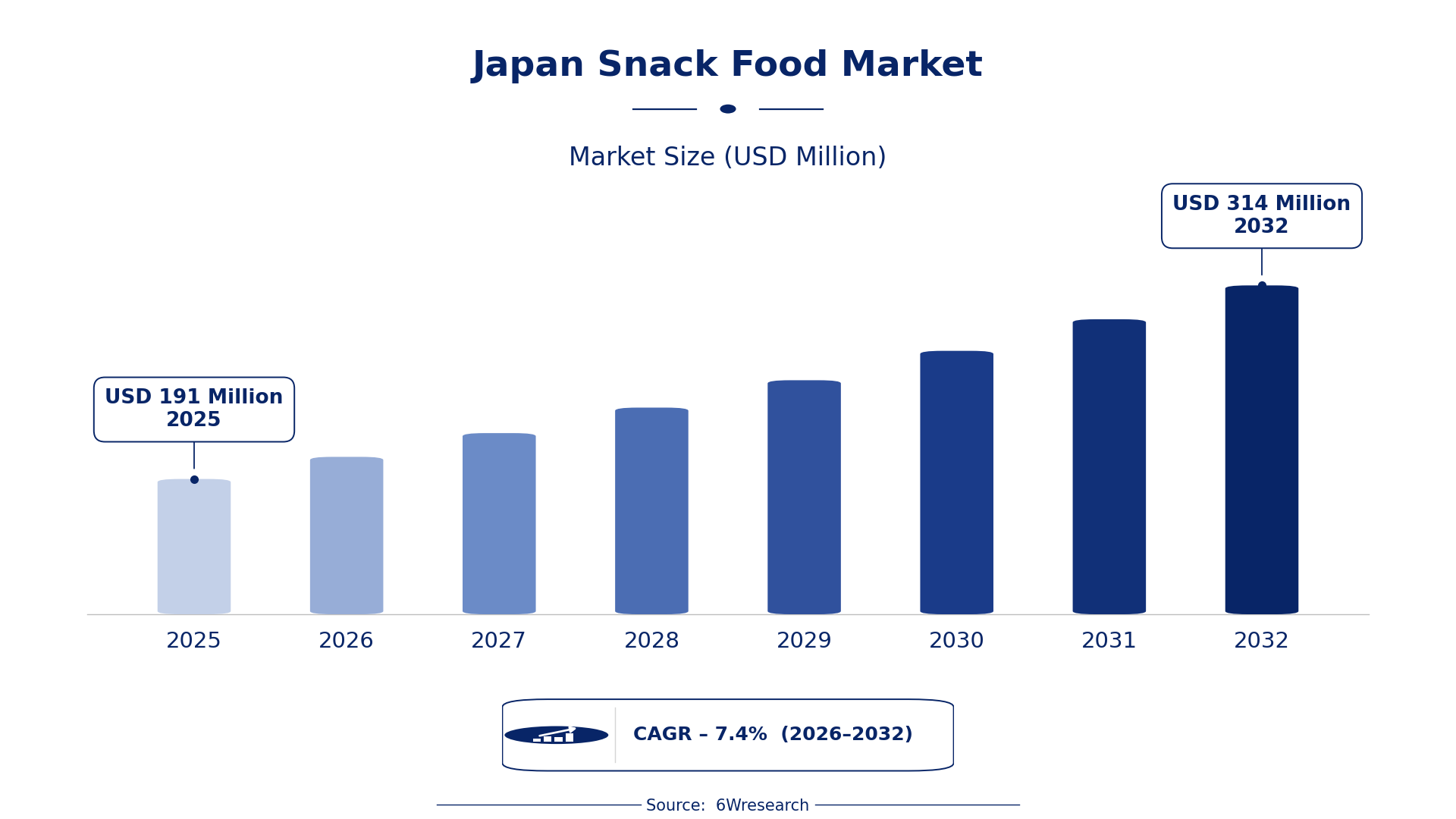
According to 6Wresearch internal database and industry insights, the Japan Snack Food Market was valued at USD 191 Million in 2025 and is projected to reach USD 314 Million by 2032, growing at a CAGR of approximately 7.4% during 2026–2032.
Japan Snack Food Market Highlights
| Report Metric | Details |
| Report Name | Japan Snack Food Market (2026-2032) |
| Market Size 2025 | USD 191 Million |
| Market Size 2032 | USD 314 Million |
| Absolute Growth 2025–2032 | USD 123 Million |
| CAGR 2026–2032 | 7.4% |
| Peak Annual Growth | 8.7% in 2027 |
| Forecast Period | 2026–2032 |
| Historical Data | 2022–2025 |
| Base Year | 2025 |
| Leading Product Type, 2025 | Savory Snacks (41% share) |
| Leading Distribution Channel, 2025 | Supermarkets and Hypermarkets (41% share) |
| Fastest-Growing Product Type | Frozen Snacks (10.4% CAGR) |
| Fastest-Growing Distribution Channel | Convenience Stores (9.7% CAGR) |
| Growing Sector | health-conscious snack foods |
| Key End Users | urban consumers, families, health-conscious individuals, busy professionals |
Japan Snack Food Market Year-wise Growth Rate and Key Drivers (2022–2032)
This graph illustrates the annual growth rates of the market from 2022 to 2032, highlighting a steady upward trajectory and projected market expansion over the forecast period.
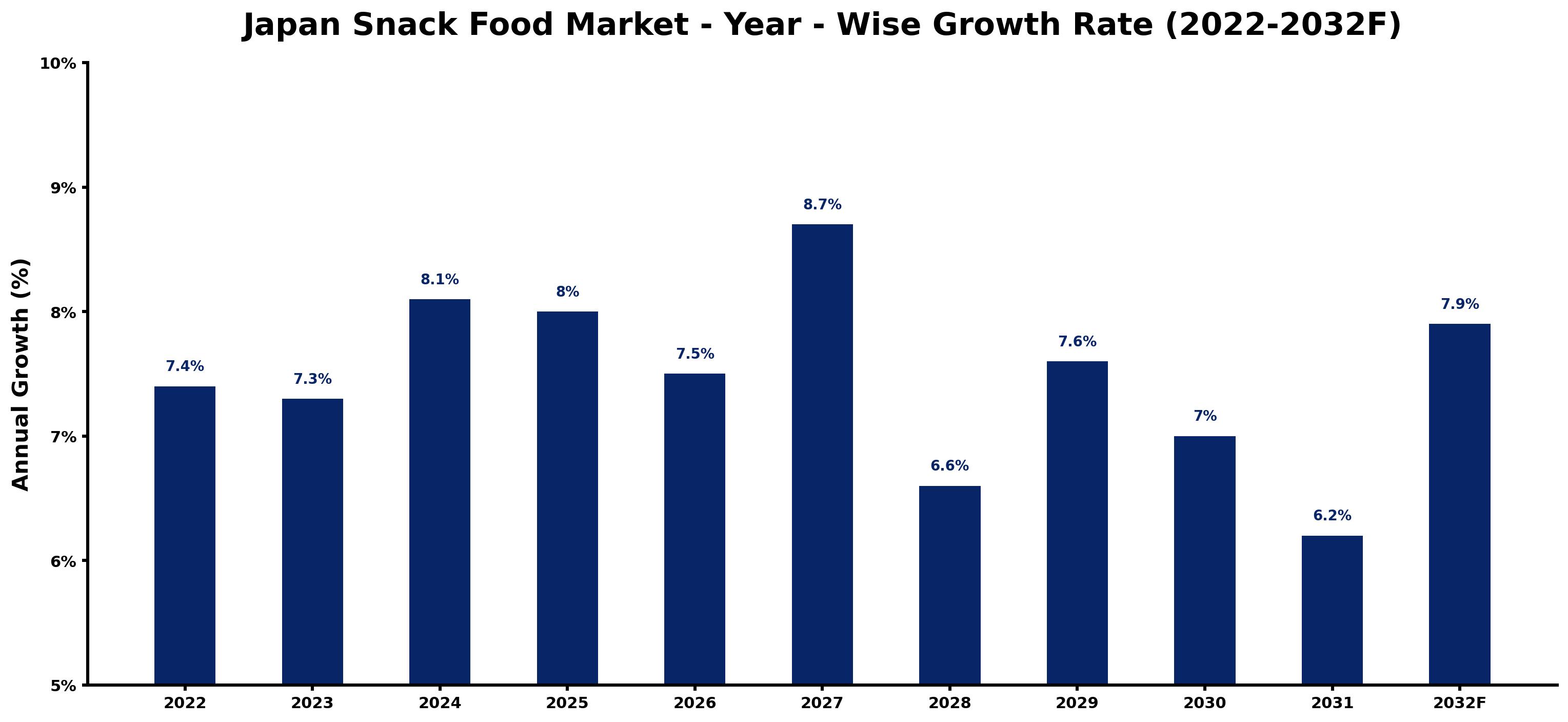
Below, each year's estimated growth is shown next to the factor that most influenced it.
| Year | Estimated Annual Growth (%) | Market Rationale |
| 2022 | 7.4 | The market showed steady growth due to increased consumer interest in snack foods. |
| 2023 | 7.3 | Growth slowed slightly as consumers faced rising prices and economic uncertainty. |
| 2024 | 8.1 | Demand accelerated as new product launches attracted more consumers to the market. |
| 2025 | 8.0 | Competition intensified among snack food producers, moderating growth rates. |
| 2026 | 7.5 | A shift towards healthier options is expected to slow growth as consumers become more selective. |
| 2027 | 8.7 | The introduction of new frozen snack products is projected to drive demand significantly. |
| 2028 | 6.6 | Market saturation will likely decelerate growth as new purchases become less frequent. |
| 2029 | 7.6 | Promotional campaigns are anticipated to revive consumer interest and increase demand. |
| 2030 | 7.0 | Consumer selectivity is expected to slow growth as preferences evolve. |
| 2031 | 6.2 | Emerging trends will continue to support market growth, albeit at a slower pace. |
| 2032 | 7.9 | Health-conscious products are projected to gain popularity, driving demand upward. |
Note: Market size estimations and growth projections presented in this report are based on 6Wresearch's proprietary forecasting methodology, utilizing the latest available industry data, government publications, and primary research inputs.
Japan Snack Food Market Synopsis
Snack food in Japan includes a variety of processed items designed for quick consumption, made from grains, nuts, and fruits. Valued at approximately 1.2 trillion yen, the Japan Snack Food Market is experiencing growth driven by domestic consumers and imports. Increasing health awareness is pushing demand for healthier options, while busy lifestyles are boosting sales of frozen snacks. The average consumer spends around 30,000 yen annually on snacks, reflecting the market's vitality and growth potential. Tokyo and Osaka are key markets, showcasing diverse product offerings and trends.
Market Dynamics Impact Analysis (2026–2032)
| Factor | Type | Impact | Primary Segment Affected |
| Rising health awareness among consumers | Driver | High | Fruit Snacks |
| Increasing demand for convenience foods | Driver | High | Frozen Snacks |
| Health-conscious consumers seeking nutritious options | Opportunity | High | Fruit Snacks |
| Growing urban population leading to higher snack consumption | Opportunity | High | Savory Snacks |
| Intense competition among snack food producers | Restraint | Medium | Savory Snacks |
| Economic uncertainty affecting disposable income | Restraint | Medium | Confectionery Snacks |
| High production costs due to rising minimum wage | Challenge | High | Bakery Snacks |
| Changing consumer preferences towards healthier products | Challenge | Medium | Frozen Snacks |
Evaluation of Drivers in Japan Snack Food Market (2026–2032)
Below are the drivers that matter most for revenue growth, with supporting evidence.
| Drivers | Primary Segment Affected | Why It Matters (Evidence) |
| Health awareness campaigns are increasing demand for nutritious options | Fruit Snacks | As consumers seek healthier choices, sales of fruit snacks have risen, reflecting changing preferences. |
| Busy lifestyles are driving demand for convenient meal solutions | Frozen Snacks | The popularity of frozen snacks has surged by 10% in the last year, catering to professionals and families. |
| Urban populations are spending more on snacks due to rising disposable income | Savory Snacks | With an average annual spend of 30,000 yen, urban consumers are purchasing more savoury snacks. |
| Unique flavour offerings are attracting consumers seeking new experiences | Confectionery Snacks | The introduction of innovative flavours is driving interest and increasing sales in the confectionery segment. |
| Convenience stores are expanding their snack offerings to meet demand | Convenience Stores | With approximately 30% of snack food sales, convenience stores are enhancing their product range to attract buyers. |
Purchasing is picking up as health awareness campaigns promote nutritious snacks, leading to increased sales of fruit snacks. Busy lifestyles are driving demand for quick meal solutions, reflected in a 10% rise in frozen snack sales last year. Urban populations are spending more on snacks, with consumers averaging around 30,000 yen annually. The introduction of unique flavours is attracting consumers eager for new savoury snacks, while convenience stores are expanding their offerings to meet rising demand.
Evaluation of Restraints in Japan Snack Food Market
The main factors holding the market back are set out below.
| Market Restraint | Primary Segment Affected | Why It Matters (Evidence) |
| High production costs due to increased minimum wage | Bakery Snacks | Japan's national weighted-average minimum wage rose to JPY 1,055 per hour, impacting profitability. |
| Economic uncertainty affecting consumer spending | Confectionery Snacks | As Japan's population declines, disposable income pressures limit spending on non-essential snacks. |
| Intense competition among snack food producers | Savory Snacks | Market saturation leads to price wars, affecting profit margins for producers. |
| Limited innovation in product offerings | Other Product Types | A lack of new product development restricts growth opportunities in niche segments. |
| Changing consumer preferences towards healthier options | Frozen Snacks | Health trends are evolving, leading to declining interest in traditional frozen snacks. |
Japan Snack Food Market Challenges
Producers contend with rising input costs due to Japan's national minimum wage increase to JPY 1,055 per hour, which may compress profit margins and limit investments in production efficiency. Supply chain challenges arise from reliance on specific ingredient imports, leading to delays that can elevate prices for manufacturers and impact their ability to meet consumer demand. Technology adoption remains slow, as many producers hesitate to invest in modern equipment, resulting in inefficiencies that hinder competitiveness. Buyers face a limited selection of healthier snack options, as only a small percentage of products align with the 'Healthy Japan 21' initiative, constraining their choices.
Trends in the Japan Snack Food Market
Several trends are reshaping the Japan Snack Food Market; the most important are set out below.
- Shift towards Healthier Snack Options: Consumers are prioritising health-conscious choices, leading to a rise in fruit snacks. In 2023, sales of these snacks increased by 15%, reflecting changing preferences.
- Growth of Frozen Snacks: Frozen snacks have gained popularity, especially among busy professionals and families. Sales increased by 10% in the last year, highlighting the demand for convenience.
- Emergence of Premium Snack Foods: The trend of premium snack foods is on the rise, targeting affluent consumers. This shift is evident in Tokyo, where high-end snack options are becoming more prevalent.
- Expansion of Online Retail Channels: Online retail channels for snack foods have seen a 15% increase in 2023, reshaping how consumers purchase snacks.
Investment Opportunities in the Japan Snack Food Market
Investors looking at the Japan Snack Food Market should consider the following areas.
- Growing Demand for Health-Conscious Snacks: With 29.3% of Japan's population aged 65 or older, there is a growing demand for healthier snack options. Targeting this demographic can lead to market opportunities, especially in urban areas.
- Expansion of Convenience Store Offerings: Convenience stores, which account for approximately 30% of snack food sales, present a prime opportunity for suppliers to expand their product lines, particularly in urban regions.
- Investment in Unique Snack Products: The increasing interest in unique flavours and healthier options creates a gap for innovative snack products. Suppliers can enter through partnerships with local distributors, enhancing market presence.
- Growth in Online Sales of Snack Foods: With online retail channels growing by 15% in 2023, there is an opportunity for brands to enhance their e-commerce presence and reach more consumers effectively.
Government Initiatives in the Japan Snack Food Market
The Food Recycling Law, enacted in 2000, mandates food businesses to reduce waste and recycle it into feed, fertiliser, and energy. This law promotes sustainability within the snack food sector, encouraging producers to adopt eco-friendly practices. The Food Sanitation Act amendment in 2018 established a system for regulating synthetic resins used in food packaging, enhancing safety standards for snack food producers. Compliance with these regulations ensures that products meet consumer safety expectations.
The Japan Snack Food Association promotes industry standards and quality control, ensuring compliance with the Food Sanitation Act. The Ministry of Health, Labour and Welfare oversees these regulations, benefiting both producers and consumers. In 2022, over 100 snack food products received approval under these standards, reflecting the commitment to quality and safety.
Future Insight of the Japan Snack Food Market
By 2032, suppliers will adapt to changing consumer preferences for premium snack foods, leading to a focus on quality and unique offerings. The integration of ISO 22000 standards will improve food safety management, ensuring higher quality products and boosting consumer confidence. Demand for healthier snacks will drive innovation, with suppliers developing new products that align with health initiatives. Online retail channels are expected to grow significantly, with a projected 15% increase in sales, facilitating easier access for consumers to a wider variety of snack options.
Market Segmentation Analysis
Japan Snack Food Market report covers a detailed analysis of the following market segments:
By Product Type – Savory Snacks Lead, Frozen Snacks Expected to Grow Fastest
According to Summon Dutta, Assistant Manager at 6Wresearch, Savory Snacks held 41% of the Japan Snack Food Market by product type in 2025. Savory snacks hold the largest share due to their widespread consumption for casual snacking, appealing to a broad demographic. For instance, they are a staple in the diets of many Japanese consumers, particularly in urban areas like Tokyo and Osaka. Frozen Snacks are set to record the highest CAGR in this split, 10.4% over 2026–2032. Frozen snacks are experiencing rapid growth as busy professionals and families seek convenient meal options, with sales having increased by 10% in the last year. This trend indicates a shift towards ready-to-eat products that align with modern lifestyles. Suppliers should focus on expanding their frozen snack offerings to capture the growing demand for convenience.
By Distribution Channel – Supermarkets and Hypermarkets Lead, Convenience Stores Expected to Grow Fastest
With 41% of distribution channel revenue in 2025, Supermarkets and Hypermarkets was the largest category. Supermarkets and hypermarkets dominate the market as they provide a comprehensive range of snack options, catering to various consumer preferences. Their extensive reach in urban areas, where diverse tastes are common, solidifies their position as the primary distribution channel. Over 2026–2032, Convenience Stores are expected to post the fastest growth, at a CAGR of 9.7%. Convenience stores are rapidly expanding due to their ability to satisfy the demand for quick and accessible snacks, particularly in high-density urban locations. Their growth is further supported by the increasing number of these outlets, making them a go-to choice for immediate snacking needs. This trend indicates that suppliers must prioritise partnerships with convenience stores to effectively tap into the growing consumer preference for quick snack solutions.
Key Attractiveness of the Report
- 10 Years of Market Numbers
- Historical Data Starting from 2022 to 2025
- Base Year 2025
- Forecast Data until 2032
- Key Performance Indicators Impacting the Market
- Major Upcoming Developments and Projects
Key Highlights of the Report:
- Japan Snack Food Market Outlook
- Market Size of Japan Snack Food Market, 2025
- Forecast of Japan Snack Food Market, 2032
- Historical Data and Forecast of Japan Snack Food Revenues & Volume for the Period 2022-2032
- Japan Snack Food Market Trend Evolution
- Japan Snack Food Market Drivers and Challenges
- Japan Snack Food Price Trends
- Japan Snack Food Porter's Five Forces
- Japan Snack Food Industry Life Cycle
- Historical Data and Forecast of Japan Snack Food Market Revenues & Volume By Product Type for the Period 2022-2032
- Historical Data and Forecast of Japan Snack Food Market Revenues & Volume By Savory Snacks for the Period 2022-2032
- Historical Data and Forecast of Japan Snack Food Market Revenues & Volume By Frozen Snacks for the Period 2022-2032
- Historical Data and Forecast of Japan Snack Food Market Revenues & Volume By Confectionery Snacks for the Period 2022-2032
- Historical Data and Forecast of Japan Snack Food Market Revenues & Volume By Fruit Snacks for the Period 2022-2032
- Historical Data and Forecast of Japan Snack Food Market Revenues & Volume By Bakery Snacks for the Period 2022-2032
- Historical Data and Forecast of Japan Snack Food Market Revenues & Volume By Other Product Types for the Period 2022-2032
- Historical Data and Forecast of Japan Snack Food Market Revenues & Volume By Distribution Channel for the Period 2022-2032
- Historical Data and Forecast of Japan Snack Food Market Revenues & Volume By Supermarkets and Hypermarkets for the Period 2022-2032
- Historical Data and Forecast of Japan Snack Food Market Revenues & Volume By Convenience Stores for the Period 2022-2032
- Historical Data and Forecast of Japan Snack Food Market Revenues & Volume By Online Retail Channels for the Period 2022-2032
- Historical Data and Forecast of Japan Snack Food Market Revenues & Volume By Other Distribution Channels for the Period 2022-2032
- Japan Snack Food Import Export Trade Statistics
- Market Opportunity Assessment By Product Type
- Market Opportunity Assessment By Distribution Channel
- Japan Snack Food Top Companies Market Share
- Japan Snack Food Competitive Benchmarking By Technical and Operational Parameters
- Japan Snack Food Company Profiles
- Japan Snack Food Key Strategic Recommendations
Market Covered
Segments analysed in this report are listed below.
By Product Type
- Savory Snacks
- Frozen Snacks
- Confectionery Snacks
- Fruit Snacks
- Bakery Snacks
- Other Product Types
By Distribution Channel
- Supermarkets and Hypermarkets
- Convenience Stores
- Online Retail Channels
- Other Distribution Channels































