Japan Software Defined Radio (SDR) Market Size & Growth Rate
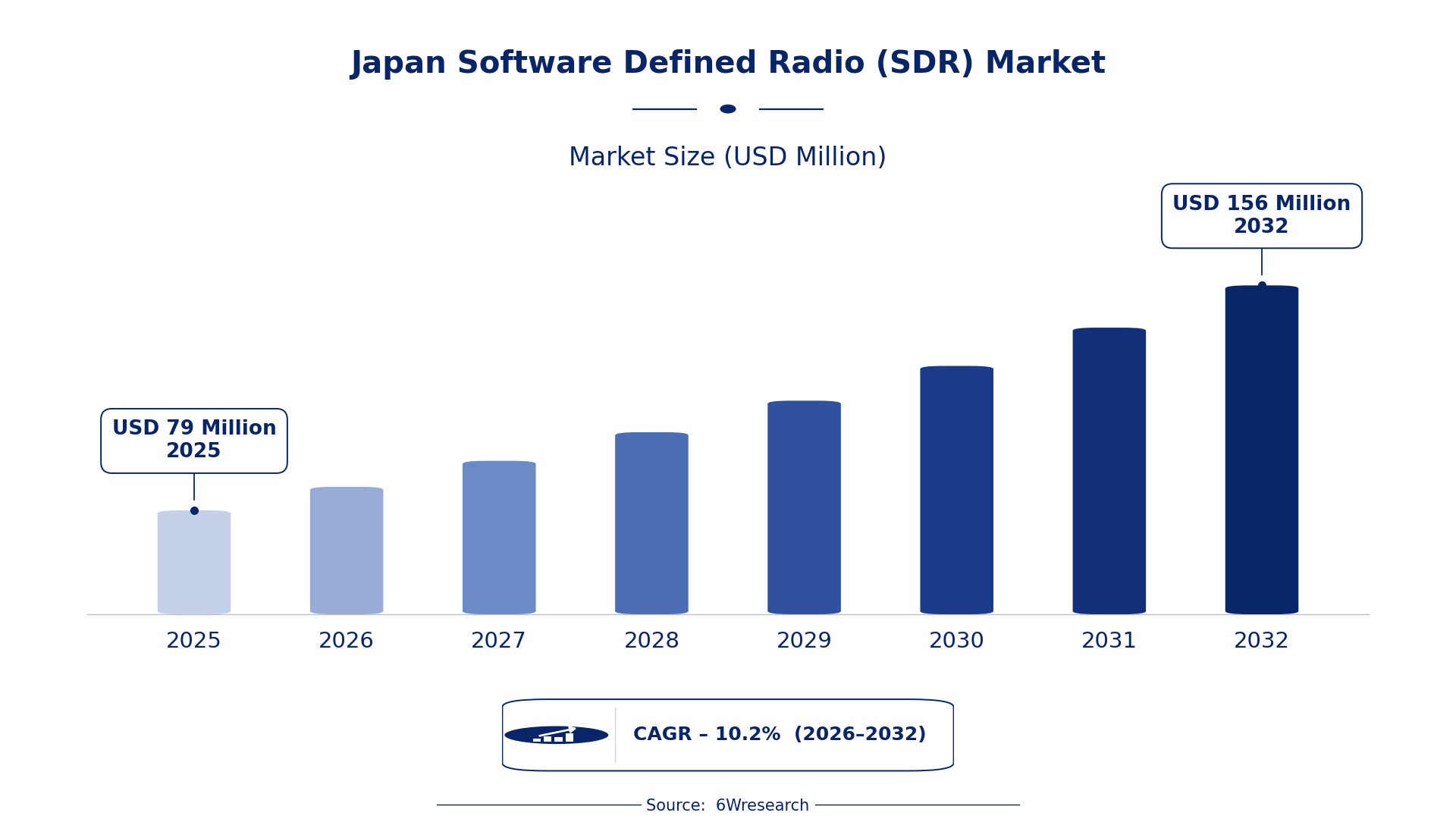
According to 6Wresearch internal database and industry insights, the Japan Software Defined Radio (SDR) Market was valued at USD 79 Million in 2025 and is projected to reach USD 156 Million by 2032, growing at a CAGR of approximately 10.2% during 2026–2032.
Japan Software Defined Radio (SDR) Market Highlights
| Report Metric | Details |
| Report Name | Japan Software Defined Radio (SDR) Market (2026-2032) |
| Market Size 2025 | USD 79 Million |
| Market Size 2032 | USD 156 Million |
| Absolute Growth 2025–2032 | USD 77 Million |
| CAGR 2026–2032 | 10.2% |
| Peak Annual Growth | 11.7% in 2032 |
| Forecast Period | 2026–2032 |
| Historical Data | 2022–2025 |
| Base Year | 2025 |
| Leading Platform, 2025 | Airborne (46% share) |
| Leading Application, 2025 | Government & Defense (65% share) |
| Leading Component, 2025 | Hardware (61% share) |
| Leading Type, 2025 | General Purpose Radio (36% share) |
| Leading Frequency, 2025 | Single Band (59% share) |
| Fastest-Growing Platform | Maritime (14.4% CAGR) |
| Fastest-Growing Application | Commercial (13.6% CAGR) |
| Fastest-Growing Component | Software (14.7% CAGR) |
| Fastest-Growing Type | Joint Tactical Radio System (JTRS) (14.6% CAGR) |
| Fastest-Growing Frequency | Multi-band (12.9% CAGR) |
| Growing Sector | Commercial |
| Key End Users | Government & Defense, Commercial |
Japan Software Defined Radio (SDR) Market Year-wise Growth Rate and Key Drivers (2022–2032)
This graph illustrates the annual growth rates of the market from 2022 to 2032, highlighting a steady upward trajectory and projected market expansion over the forecast period.
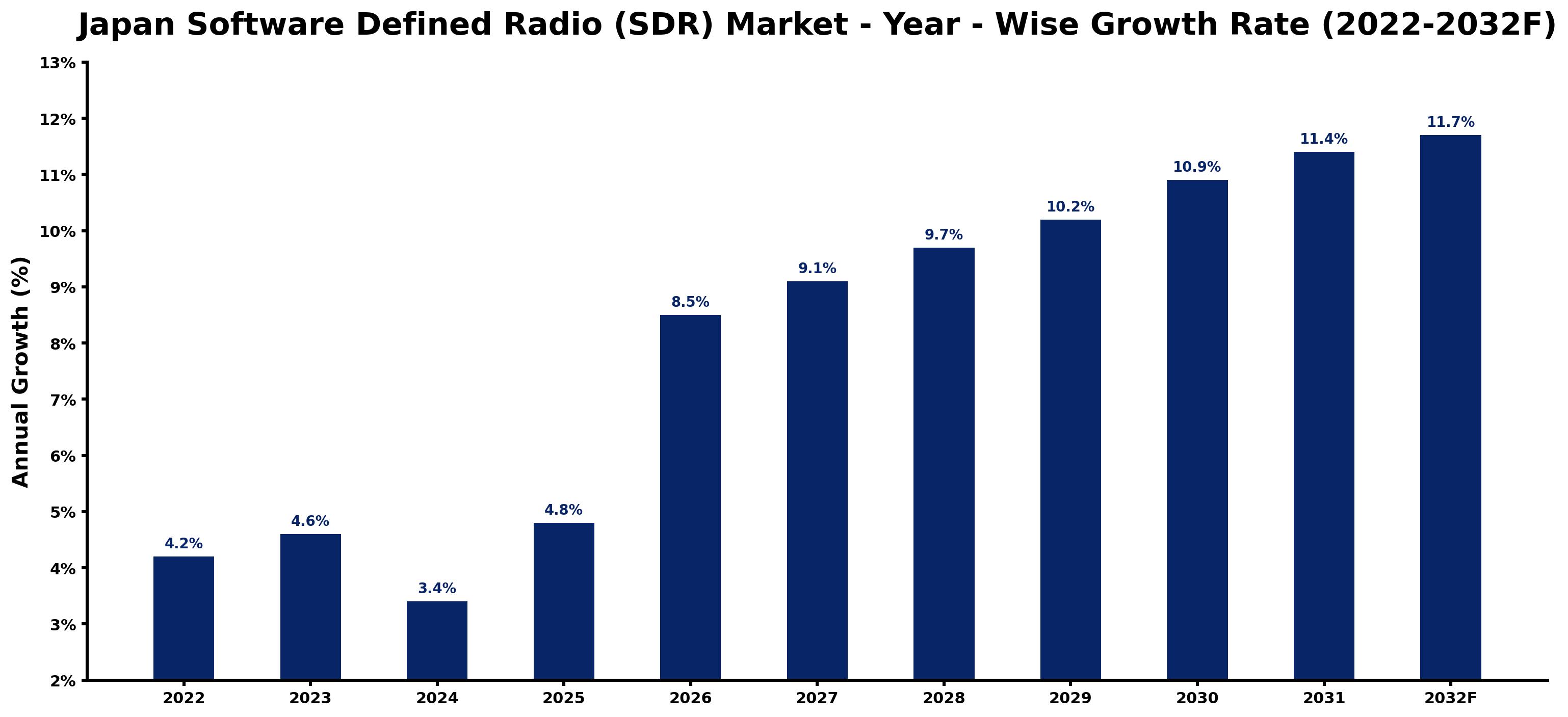
The yearly estimates that follow link every growth rate to its principal driver, so readers can see why the pace changed in each period.
| Year | Estimated Annual Growth (%) | Market Rationale |
| 2022 | 4.2 | The market exhibited steady growth, driven by existing demand from government contracts. |
| 2023 | 4.6 | Growth accelerated due to increased defense spending and technology upgrades. |
| 2024 | 3.4 | Growth slowed as the market adjusted to previous years' rapid expansion. |
| 2025 | 4.8 | The market experienced a faster growth rate, supported by new military projects. |
| 2026 | 8.5 | Demand surged as the Self-Defense Forces expand their SDR capabilities. |
| 2027 | 9.1 | Growth will continue, reflecting rising investments in communication technologies. |
| 2028 | 9.7 | The market will maintain its upward trend, driven by maritime operations integration. |
| 2029 | 10.2 | Increased demand from both military and commercial sectors will support growth. |
| 2030 | 10.9 | Growth will persist, driven by advancements in software-defined technologies. |
| 2031 | 11.4 | The market will continue to grow, fueled by ongoing defense modernization efforts. |
| 2032 | 11.7 | A peak growth rate will be reached, reflecting heightened military communication needs. |
Note: Market size estimations and growth projections presented in this report are based on 6Wresearch's proprietary forecasting methodology, utilizing the latest available industry data, government publications, and primary research inputs.
Japan Software Defined Radio (SDR) Market Synopsis
Software Defined Radio (SDR) technology allows flexible communication across various frequencies through software management. It integrates hardware with advanced algorithms, primarily used in military communications, emergency services, and commercial broadcasting. The Japan Software Defined Radio (SDR) Market is expanding due to increased defense budgets, with a 2023 budget of approximately 6.8 trillion yen supporting SDR development. Initiatives to improve SDR capabilities for joint operations are driving demand, alongside the Tokyo region's concentration of defense contractors and technology firms.
Market Dynamics Impact Analysis (2026–2032)
| Factor | Type | Impact | Primary Segment Affected |
| Increased defense spending | Driver | High | Government & Defense |
| Expansion of SDR capabilities in military operations | Driver | High | Land |
| Growing need for secure communications in maritime operations | Opportunity | High | Maritime |
| Emerging commercial applications for SDR technology | Opportunity | Medium | Commercial |
| Regulatory challenges in frequency allocation | Restraint | High | General Purpose Radio |
| High costs associated with SDR technology implementation | Restraint | Medium | Hardware |
| Limited adoption in satellite communications | Challenge | Medium | Space |
| Competition from alternative communication technologies | Challenge | High | Cognitive/intelligent Radio |
Evaluation of Drivers in Japan Software Defined Radio (SDR) Market (2026–2032)
The table below links each growth driver to the segment it affects and the evidence for it.
| Drivers | Primary Segment Affected | Why It Matters (Evidence) |
| Increased defense budget allocations | Government & Defense | Japan's defense budget for 2023 is approximately 6.8 trillion yen, driving demand for SDR. |
| Integration of SDR in military operations | Land | The Self-Defense Forces are expanding SDR capabilities to improve communication efficiency. |
| Enhanced maritime operations through SDR | Maritime | In 2023, Japan's Maritime Self-Defense Force is integrating SDR in its fleet. |
| Growing commercial broadcasting needs | Commercial | Emerging applications for SDR technology are increasing demand among broadcasters. |
| Development of advanced SDR software | Software | ISO/IEC 24748 standard is relevant to SDR software development in Japan. |
Spending rises because Japan's defense budget for 2023 is approximately 6.8 trillion yen, which drives demand for SDR technology in military communications. The expansion of SDR capabilities by the Self-Defense Forces leads to increased purchases of hardware and software components. Integration of SDR technology in naval operations prompts further investments in secure communication systems. The growing need for versatile communication solutions among broadcasters reflects the rising demand for SDR technology. Development of advanced SDR software is gaining traction, facilitating market growth.
Evaluation of Restraints in Japan Software Defined Radio (SDR) Market
Below are the constraints most often cited by buyers and suppliers, with the segment each affects.
| Market Restraint | Primary Segment Affected | Why It Matters (Evidence) |
| Regulatory challenges in frequency allocation | General Purpose Radio | The frequency allocation for SDR in Japan is regulated, complicating deployment for users. |
| High costs associated with SDR technology implementation | Hardware | Investments in SDR hardware can be substantial, limiting adoption among smaller entities. |
| Limited adoption in satellite communications | Space | The use of SDR in satellite communications remains restricted, affecting overall market growth. |
| Competition from alternative communication technologies | Cognitive/intelligent Radio | Alternative technologies may offer comparable benefits, impacting SDR market share. |
| Slow integration of SDR in public safety communications | Terrestrial Trunked Radio (TETRA) | The TETRA standard's adoption restricts the growth of SDR in public safety applications. |
Japan Software Defined Radio (SDR) Market Challenges
Japan's defence budget for 2023 is approximately 6.8 trillion yen, creating intense competition among producers for limited government contracts and squeezing profit margins. A shortage of skilled software developers persists, as many are drawn to more rewarding tech sectors, resulting in project delays that can cost producers up to 20% in lost revenue. Buyers encounter challenges navigating the complex licensing process for SDR systems, potentially extending deployment timelines by six months and raising operational costs. Technology integration issues arise as the Self-Defense Forces expand SDR capabilities, leading to additional training costs for personnel and slower operational readiness.
Trends in the Japan Software Defined Radio (SDR) Market
Below are the shifts with the largest effect on the Japan Software Defined Radio (SDR) Market.
- Shift in Military Communication Strategies: The Tokyo region is experiencing a shift towards integrating SDR technology in military communications, with the Self-Defense Forces aiming to fully integrate SDR by 2025. This change is backed by a defence budget of 6.8 trillion yen.
- Emerging Applications in Commercial Broadcasting: Commercial broadcasters are increasingly adopting SDR technology to meet evolving communication needs. In 2023, the demand for versatile broadcasting solutions surged, reflecting a broader trend towards digital transformation in the media sector.
- Increased Focus on Maritime Operations: The Maritime Self-Defense Force began integrating SDR technology in 2023, enhancing operational capabilities. This integration is expected to improve communication efficiency, with substantial investments directed towards maritime safety.
- Advancements in Software Development for SDR: The development of advanced SDR software is gaining traction, guided by industry standards. This trend is anticipated to improve functionality and flexibility in communication systems.
Investment Opportunities in the Japan Software Defined Radio (SDR) Market
Where to invest in the Japan Software Defined Radio (SDR) Market: the main openings are set out below.
- Partnering with Defense Contractors: Now is an ideal time to establish partnerships with defense contractors in the Tokyo region, where demand for SDR technology is increasing. The market is expected to grow, with government contracts driving investments.
- Investing in Software Development: With the growing emphasis on advanced SDR software, investing in software development is essential. The demand for innovative solutions is rising, particularly among government and defense sectors.
- Expanding into Maritime Applications: The Maritime Self-Defense Force's integration of SDR technology presents opportunities for suppliers. With significant investments in maritime safety, entering this sector can yield substantial returns.
- Certification for Public Safety Communications: Achieving certification for SDR applications in public safety communications is vital. The TETRA standard's adoption is creating a demand for compliant SDR solutions, particularly among emergency services.
Government Initiatives in the Japan Software Defined Radio (SDR) Market
The AI Promotion Act, established in 2025, enhances the existing framework for SDR technology development by promoting research and innovation in artificial intelligence applications. This law complements the Industrial Standardization Act, which governs product and test standards, ensuring that SDR systems meet rigorous quality and performance benchmarks. These measures aim to create a more competitive environment for SDR producers, enabling them to develop advanced solutions that align with national security objectives and technological advancements.
The Digital Agency, established in September 2021, plays a crucial role in approving and funding digital transformation initiatives related to SDR technology. With an annual budget of around 1 trillion yen, the agency supports projects that enhance communication systems for the Self-Defense Forces and emergency services. This funding is vital for advancing SDR capabilities, ensuring that producers can meet the evolving demands of military and public safety communications.
Future Insight of the Japan Software Defined Radio (SDR) Market
The policy-driven shift towards enhanced SDR capabilities will transform communication technology in Japan. The Ministry of Defense's emphasis on cognitive radio technologies will improve military communication efficiency. Integration of SDR within emergency services will streamline operations for public safety agencies. With the Tokyo region's concentration of technology firms, collaboration will spur innovation, ultimately delivering superior products and services to buyers and suppliers.
Market Segmentation Analysis
Japan Software Defined Radio (SDR) Market report covers a detailed analysis of the following market segments:
By Platform – Airborne Leads, Maritime Expected to Grow Fastest
According to Ravi Bhandari, Research Head at 6Wresearch, Airborne took 46% of platform revenue in 2025, more than any other category. Airborne SDR systems hold the largest share due to their critical function in military aircraft, facilitating secure communications during operations. The Japanese Self-Defense Forces extensively rely on airborne platforms to fulfil their complex communication needs. Over 2026–2032, Maritime is expected to post the fastest growth, at a CAGR of 14.4%. Maritime SDR is growing rapidly as the Maritime Self-Defense Force integrates these systems into its fleet, enhancing operational efficiency. This trend is expected to continue as naval operations increasingly demand flexible communication solutions. Suppliers should focus on developing advanced maritime SDR solutions to meet the rising demand in naval applications.
By Application – Government & Defense Leads, Commercial Expected to Grow Fastest
The largest application category in 2025 was Government & Defense, at 65% of revenue. The Government & Defense sector leads the SDR market as it is the primary user of these technologies for secure communications and operational effectiveness. The substantial Japanese defense budget supports extensive SDR applications within military operations. Commercial is projected to grow fastest, at a CAGR of 13.6% during 2026–2032. Commercial applications are experiencing the fastest growth as the demand for SDR in broadcasting and telecommunications increases. This reflects a broader trend towards adopting flexible communication technologies across various industries. Buyers in the commercial sector should consider SDR solutions to improve their communication capabilities and maintain competitiveness.
By Component – Hardware Leads, Software Expected to Grow Fastest
Hardware accounted for 61% of the market by component in 2025. Hardware components lead the market as they are vital for SDR systems, providing the necessary physical infrastructure for effective communication. The integration of advanced hardware is essential for military and emergency communication systems. Software is set to record the highest CAGR in this split, 14.7% over 2026–2032. Software is experiencing rapid growth as it defines the operational capabilities of SDR systems, allowing for greater flexibility and adaptability. As technology advances, the need for sophisticated software solutions will keep increasing. Suppliers should invest in software development to capitalise on the growing demand for advanced SDR functionalities.
By Type – General Purpose Radio Leads, Joint Tactical Radio System (JTRS) Expected to Grow Fastest
With 36% of type revenue in 2025, General Purpose Radio was the largest category. General Purpose Radio holds the largest share as it is widely used across various communication needs in both military and civilian applications. Its versatility makes it a preferred choice for many users in Japan. The quickest growth will come from Joint Tactical Radio System (JTRS), forecast to expand at a CAGR of 14.6% between 2026 and 2032. The Joint Tactical Radio System (JTRS) is growing quickly due to its design for military interoperability, which is increasingly important for joint operations. This trend will likely expand as defence strategies evolve. Suppliers should focus on developing JTRS-compatible systems to meet the rising demand for military communication interoperability.
By Frequency – Single Band Leads, Multi-band Expected to Grow Fastest
In 2025, Single Band led the frequency split with a 59% share. Single Band SDR is the leading segment, primarily used in specialised scenarios where specific frequency requirements are addressed. Its targeted application makes it a staple in certain military operations, ensuring effective communication. Over 2026–2032, Multi-band is expected to post the fastest growth, at a CAGR of 12.9%. Multi-band SDR is witnessing the fastest growth due to its versatile communication capabilities across various frequencies, which are essential for modern military and emergency services. This adaptability is crucial for responding to changing operational environments. Buyers should prioritise multi-band SDR solutions to ensure comprehensive communication capabilities across diverse operational scenarios.
Key Attractiveness of the Report
- 10 Years of Market Numbers
- Historical Data Starting from 2022 to 2025
- Base Year 2025
- Forecast Data until 2032
- Key Performance Indicators Impacting the Market
- Major Upcoming Developments and Projects
Key Highlights of the Report:
- Japan Software Defined Radio (SDR) Market Outlook
- Market Size of Japan Software Defined Radio (SDR) Market, 2025
- Forecast of Japan Software Defined Radio (SDR) Market, 2032
- Historical Data and Forecast of Japan Software Defined Radio (SDR) Revenues & Volume for the Period 2022-2032
- Japan Software Defined Radio (SDR) Market Trend Evolution
- Japan Software Defined Radio (SDR) Market Drivers and Challenges
- Japan Software Defined Radio (SDR) Price Trends
- Japan Software Defined Radio (SDR) Porter's Five Forces
- Japan Software Defined Radio (SDR) Industry Life Cycle
- Historical Data and Forecast of Japan Software Defined Radio (SDR) Market Revenues & Volume By Platform for the Period 2022-2032
- Historical Data and Forecast of Japan Software Defined Radio (SDR) Market Revenues & Volume By Airborne for the Period 2022-2032
- Historical Data and Forecast of Japan Software Defined Radio (SDR) Market Revenues & Volume By Maritime for the Period 2022-2032
- Historical Data and Forecast of Japan Software Defined Radio (SDR) Market Revenues & Volume By Land for the Period 2022-2032
- Historical Data and Forecast of Japan Software Defined Radio (SDR) Market Revenues & Volume By Space for the Period 2022-2032
- Historical Data and Forecast of Japan Software Defined Radio (SDR) Market Revenues & Volume By Application for the Period 2022-2032
- Historical Data and Forecast of Japan Software Defined Radio (SDR) Market Revenues & Volume By Government & Defense for the Period 2022-2032
- Historical Data and Forecast of Japan Software Defined Radio (SDR) Market Revenues & Volume By Commercial for the Period 2022-2032
- Historical Data and Forecast of Japan Software Defined Radio (SDR) Market Revenues & Volume By Component for the Period 2022-2032
- Historical Data and Forecast of Japan Software Defined Radio (SDR) Market Revenues & Volume By Hardware for the Period 2022-2032
- Historical Data and Forecast of Japan Software Defined Radio (SDR) Market Revenues & Volume By Software for the Period 2022-2032
- Historical Data and Forecast of Japan Software Defined Radio (SDR) Market Revenues & Volume By Type for the Period 2022-2032
- Historical Data and Forecast of Japan Software Defined Radio (SDR) Market Revenues & Volume By General Purpose Radio for the Period 2022-2032
- Historical Data and Forecast of Japan Software Defined Radio (SDR) Market Revenues & Volume By Joint Tactical Radio System (JTRS) for the Period 2022-2032
- Historical Data and Forecast of Japan Software Defined Radio (SDR) Market Revenues & Volume By Cognitive/intelligent Radio for the Period 2022-2032
- Historical Data and Forecast of Japan Software Defined Radio (SDR) Market Revenues & Volume By Terrestrial Trunked Radio (TETRA) for the Period 2022-2032
- Historical Data and Forecast of Japan Software Defined Radio (SDR) Market Revenues & Volume By Frequency for the Period 2022-2032
- Historical Data and Forecast of Japan Software Defined Radio (SDR) Market Revenues & Volume By Single Band for the Period 2022-2032
- Historical Data and Forecast of Japan Software Defined Radio (SDR) Market Revenues & Volume By Multi-band for the Period 2022-2032
- Japan Software Defined Radio (SDR) Import Export Trade Statistics
- Market Opportunity Assessment By Platform
- Market Opportunity Assessment By Application
- Market Opportunity Assessment By Component
- Market Opportunity Assessment By Type
- Market Opportunity Assessment By Frequency
- Japan Software Defined Radio (SDR) Top Companies Market Share
- Japan Software Defined Radio (SDR) Competitive Benchmarking By Technical and Operational Parameters
- Japan Software Defined Radio (SDR) Company Profiles
- Japan Software Defined Radio (SDR) Key Strategic Recommendations
Market Covered
Coverage by segment is as follows.
By Platform
- Airborne
- Maritime
- Land
- Space
By Application
- Government & Defense
- Commercial
By Component
- Hardware
- Software
By Type
- General Purpose Radio
- Joint Tactical Radio System (JTRS)
- Cognitive/intelligent Radio
- Terrestrial Trunked Radio (TETRA)
By Frequency
- Single Band
- Multi-band






































