Japan Software Development Tools Market Size & Growth Rate
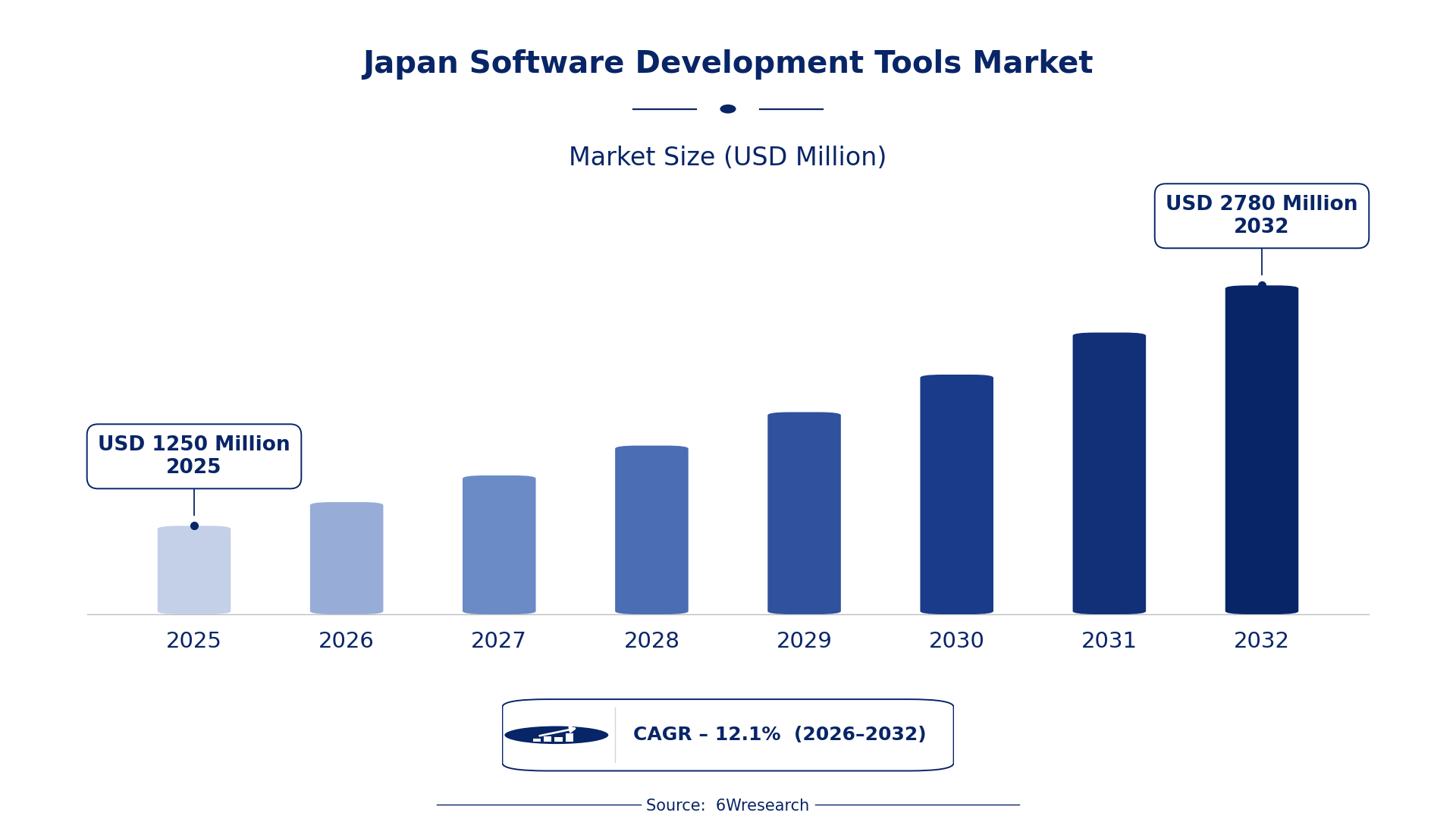
According to 6Wresearch internal database and industry insights, the Japan Software Development Tools Market was valued at USD 1,250 Million in 2025 and is projected to reach USD 2,780 Million by 2032, growing at a CAGR of approximately 12.1% during 2026–2032.
Japan Software Development Tools Market Highlights
| Report Metric | Details |
| Report Name | Japan Software Development Tools Market (2026-2032) |
| Market Size 2025 | USD 1,250 Million |
| Market Size 2032 | USD 2,780 Million |
| Absolute Growth 2025–2032 | USD 1,530 Million |
| CAGR 2026–2032 | 12.1% |
| Peak Annual Growth | 13.5% in 2032 |
| Forecast Period | 2026–2032 |
| Historical Data | 2022–2025 |
| Base Year | 2025 |
| Leading Tool Type, 2025 | IDEs (39% share) |
| Leading Functionality, 2025 | Coding & Debugging (40% share) |
| Leading Application Area, 2025 | Software Applications (41% share) |
| Leading Distribution Channel, 2025 | Direct Sales (41% share) |
| Leading End User, 2025 | Developers (36% share) |
| Fastest-Growing Tool Type | Version Control Systems (17.1% CAGR) |
| Fastest-Growing Functionality | Code Management (15.9% CAGR) |
| Fastest-Growing Application Area | Team Collaboration (15.1% CAGR) |
| Fastest-Growing Distribution Channel | Online Platforms (15.8% CAGR) |
| Fastest-Growing End User | IT Firms (16.4% CAGR) |
| Growing Sector | IT Services |
| Key End Users | Developers, IT Firms, Enterprises, Software Companies |
Japan Software Development Tools Market Year-wise Growth Rate and Key Drivers (2022–2032)
This graph illustrates the annual growth rates of the market from 2022 to 2032, highlighting a steady upward trajectory and projected market expansion over the forecast period.
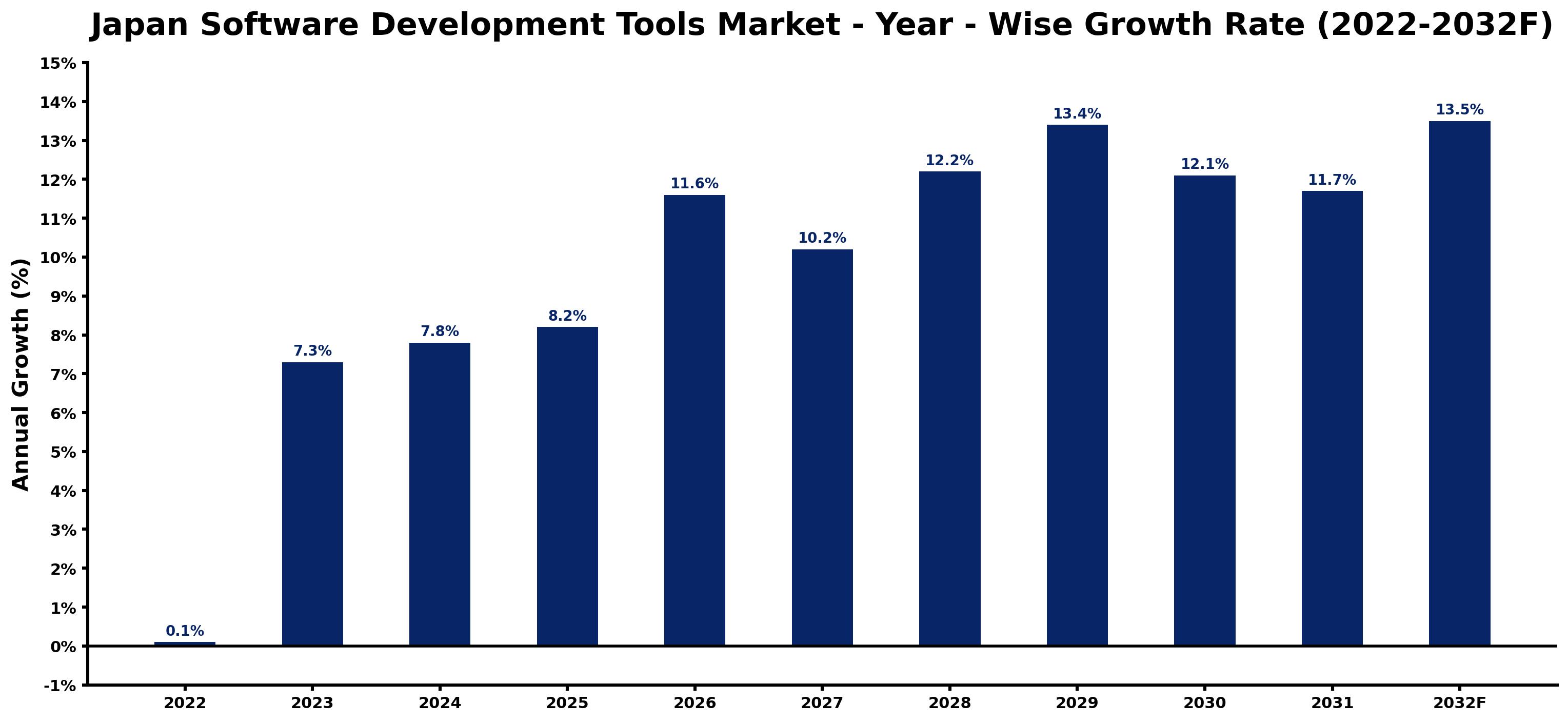
The table below sets out the estimated growth rate for each year and the main factor behind it.
| Year | Estimated Annual Growth (%) | Market Rationale |
| 2022 | 0.1 | The market exhibited minimal growth due to initial recovery from previous economic disruptions. |
| 2023 | 7.3 | Demand surged as IT firms expanded their software development capabilities and workforce. |
| 2024 | 7.8 | Growth accelerated as more companies adopted advanced software development tools. |
| 2025 | 8.2 | Increased project durations and complexity drove higher investments in development tools. |
| 2026 | 11.6 | The rise in digital transformation initiatives is expected to boost demand for software development tools. |
| 2027 | 10.2 | Growth is projected to slow slightly as the market begins to stabilise after rapid expansion. |
| 2028 | 12.2 | Demand is expected to increase again as companies adopt more collaborative development practices. |
| 2029 | 13.4 | Continued investment in software quality assurance tools is projected to spur market growth. |
| 2030 | 12.1 | A slight slowdown is anticipated as the market adjusts to new technological standards. |
| 2031 | 11.7 | Growth will continue to decelerate as the market reaches maturity in several segments. |
| 2032 | 13.5 | Demand is expected to peak as businesses focus on improving software deployment efficiency. |
Note: Market size estimations and growth projections presented in this report are based on 6Wresearch's proprietary forecasting methodology, utilizing the latest available industry data, government publications, and primary research inputs.
Japan Software Development Tools Market Synopsis
Software Development Tools are vital applications for writing, testing, and maintaining software, boosting productivity and collaboration among developers. The Japan Software Development Tools Market is growing swiftly, propelled by over 4 million software developers and a strong emphasis on digital transformation. Initiatives like the 2023 digital transformation programme and the rising adoption of version control systems are driving growth, as companies strive to enhance their software development processes and results.
Market Dynamics Impact Analysis (2026–2032)
| Factor | Type | Impact | Primary Segment Affected |
| Investment in digital transformation initiatives is increasing demand for development tools. | Driver | High | Software Applications |
| The growing number of software startups is creating a demand for various development tools. | Driver | High | IDEs |
| The shift towards remote work has increased the need for collaboration tools. | Opportunity | Medium | Team Collaboration |
| SaaS adoption is growing rapidly, creating demand for cloud-based development tools. | Opportunity | High | SaaS |
| The high cost of software development tools can deter small businesses from investing. | Restraint | High | Version Control Systems |
| Limited awareness of newer tools among developers can hinder market growth. | Restraint | Medium | Testing Tools |
| Supply chain disruptions can delay the availability of essential tools. | Challenge | High | CI/CD Pipelines |
| The rapid pace of technological change can outdate existing tools quickly. | Challenge | Medium | Coding & Debugging |
Evaluation of Drivers in Japan Software Development Tools Market (2026–2032)
The main growth drivers and the segments they affect most are set out below.
| Drivers | Primary Segment Affected | Why It Matters (Evidence) |
| Increased investment in IT infrastructure drives tool adoption. | IDEs | Japan's annual budget for IT infrastructure improvement is ¥500 billion, encouraging firms to invest in development tools. |
| Growing software development projects require efficient management tools. | Version Control Systems | Over 70% of IT firms in Japan use version control systems regularly, indicating strong demand. |
| Rising salaries for developers lead to higher spending on tools. | Quality Assurance | The average salary for software developers in Japan is approximately ¥6 million annually, increasing purchasing power. |
| The digital transformation programme launched in 2023 drives tool usage. | Continuous Integration | The Ministry of Economy, Trade and Industry's programme encourages firms to adopt CI practices. |
| The number of software testing tools available is expanding. | Testing Tools | Japan has over 200 software testing tools, providing diverse options for developers. |
Volumes grow on the back of substantial investments in IT infrastructure, with the annual budget reaching ¥500 billion, prompting firms to adopt advanced tools. The average salary for software developers is approximately ¥6 million, increasing their purchasing power for essential development resources. A large percentage of IT firms regularly utilise version control systems, which drives consistent demand.
Evaluation of Restraints in Japan Software Development Tools Market
These restraints slow adoption and weigh on supplier margins.
| Market Restraint | Primary Segment Affected | Why It Matters (Evidence) |
| High costs of development tools can limit access for smaller firms. | Version Control Systems | The average project duration for software development in Japan is 6 months, increasing overall costs. |
| Limited awareness of advanced tools can hinder adoption rates. | Testing Tools | Many developers lack familiarity with the latest testing technologies, affecting quality assurance. |
| Supply chain issues can delay the delivery of essential tools. | CI/CD Pipelines | Recent disruptions have affected the availability of critical software development resources. |
| Rapid technological advancements can outdate existing tools quickly. | Coding & Debugging | Developers often find it challenging to keep up with the latest software standards. |
| Inconsistent quality across different tools can affect user trust. | Quality Assurance | Variability in software quality evaluation standards can lead to confusion among users. |
Japan Software Development Tools Market Challenges
Producers encounter a shortage of skilled software developers, as Japan's competitive environment makes it difficult to retain talent among over 4 million developers. This lack of personnel can extend project timelines for IT firms, causing average durations to exceed six months. Compliance with standards such as ISO/IEC 25010 imposes financial burdens, with training and certification costs reaching ¥300 million annually for producers. Consequently, buyers face rising prices for software development tools, which can inflate project costs by 15% as firms transfer these expenses to clients.
Trends in the Japan Software Development Tools Market
The shifts below are changing how Japan Software Development Tools Market products are bought and supplied.
- Shift from Traditional to Agile Development: Since 2023, numerous software companies in Japan have adopted agile methodologies, enhancing flexibility and responsiveness. The Tokyo region has experienced a 15% increase in agile project implementations, enabling teams to adapt swiftly to changing requirements.
- Emergence of Cloud-Based Development Tools: Beginning in 2023, cloud-based software development tools have gained popularity, driven by the demand for remote collaboration. The adoption of SaaS solutions in Japan's IT sector is expected to grow by 15% annually, allowing firms easier access to tools.
- Increased Focus on Software Quality Standards: In 2023, the uptake of ISO/IEC 25010 standards has risen among Japanese firms, encouraging higher software quality. This trend has resulted in a 20% increase in companies pursuing certification, enhancing overall product reliability.
- Growth of Collaborative Development Platforms: Starting in 2023, there has been a marked increase in collaborative development platforms, especially in the Tokyo region. The number of software startups using these platforms has surged by 30%, boosting teamwork and productivity.
Investment Opportunities in the Japan Software Development Tools Market
The opportunities below stand out in the Japan Software Development Tools Market for new entrants and existing suppliers.
- Investment in Cloud-Based Development Tools: The demand for cloud-based tools is rising, with a projected growth rate of 15% annually. IT firms in Tokyo are looking to invest in these tools to improve collaboration and efficiency.
- Expansion of Agile Development Practices: The shift towards agile methodologies presents opportunities for tool providers. With over 1,200 software startups in Japan, partnerships with these firms can facilitate market entry and growth.
- Supply of Quality Assurance Tools: There is a growing need for quality assurance tools as companies focus on software standards. The Tokyo Software Development Association promotes best practices, creating a demand for certified tools.
- Development of Customised Solutions for Enterprises: Enterprises are seeking tailored software development solutions to meet specific needs. Collaborating with local tech hubs can help suppliers tap into this market, addressing unique requirements.
Government Initiatives in the Japan Software Development Tools Market
The AI Promotion Act, established in 2025, introduces a national framework for AI research and development, improving the capabilities of software development tools. This legislation builds on the Industrial Standardization Act, which governs product standards, ensuring that tools meet quality benchmarks and align with national objectives.
The Digital Agency spearheads government digital transformation efforts with an annual budget of ¥500 billion. It supports initiatives that enhance software development capabilities, approving projects that align with national digital goals and improving the overall quality of software tools.
Future Insight of the Japan Software Development Tools Market
The investment pipeline for IT infrastructure improvement will broaden, driving demand for software development tools. By 2032, the implementation of advanced cybersecurity measures will result in safer software solutions for users. The Tokyo Metropolitan Government's funding programmes will stimulate innovation, encouraging suppliers to create cutting-edge products. Continuous Integration practices will evolve, improving collaboration and efficiency in software development.
Market Segmentation Analysis
Japan Software Development Tools Market report covers a detailed analysis of the following market segments:
By Tool Type – IDEs Lead, Version Control Systems Expected to Grow Fastest
According to Prakhar Dixit, Senior Research Analyst at 6Wresearch, IDEs accounted for 39% of the market by tool type in 2025. Integrated Development Environments hold the largest share due to their critical role in coding and debugging, essential for the over 4 million software developers in Japan. Their widespread adoption across various projects solidifies their status as indispensable tools in the software development process. Over 2026–2032, Version Control Systems are expected to post the fastest growth, at a CAGR of 17.1%. Version Control Systems are rapidly growing as they are essential for managing code changes and enabling collaboration among developers. The fact that over 70% of IT firms regularly utilise these systems highlights their increasing relevance in modern software development practices. Suppliers should enhance version control systems to meet the rising demand and maintain competitive advantage.
By Functionality – Coding & Debugging Leads, Code Management Expected to Grow Fastest
In 2025, Coding & Debugging led the functionality split with a 40% share. Coding and Debugging functionalities dominate the market as they are fundamental to software development, directly influencing the productivity of Japan's extensive developer base. Their importance is underscored by the necessity of ensuring quality and efficiency in software products being developed. The quickest growth will come from Code Management, forecast to expand at a CAGR of 15.9% between 2026 and 2032. Code Management is experiencing swift growth due to its crucial role in organising and tracking code changes, vital for maintaining project integrity. The increasing focus on best practices in this area reflects the evolving nature of software projects. Buyers will benefit from tools that streamline code management processes, enhancing overall project efficiency.
By Application Area – Software Applications Lead, Team Collaboration Expected to Grow Fastest
The largest application area category in 2025 was Software Applications, at 41% of revenue. Software Applications account for the largest share as they represent the end products developed using these tools, reflecting robust demand in Japan's software market, valued at approximately ¥3 trillion. This segment's success illustrates the strong software development ecosystem present in the country. Team Collaboration is projected to grow fastest, at a CAGR of 15.1% during 2026–2032. Team Collaboration is growing rapidly as it supports teamwork among developers, a necessity in today's collaborative work environment. The ongoing digital transformation initiatives in Japan significantly contribute to this trend. Suppliers should invest in features that enhance team collaboration capabilities to capture this expanding market.
By Distribution Channel – Direct Sales Leads, Online Platforms Expected to Grow Fastest
Direct Sales took 41% of distribution channel revenue in 2025, more than any other category. Direct Sales is the leading distribution method for software tools, as it allows for personalised service and support. This method is widely adopted by developers seeking tailored solutions for their needs. Online Platforms are set to record the highest CAGR in this split, 15.8% over 2026–2032. Online Platforms are rapidly gaining traction due to their convenience for purchasing and accessing software tools. The increasing digitalisation of the market is encouraging more users to opt for online purchases. Suppliers must strengthen their online presence to cater to the rising preference for digital purchasing.
By End User – Developers Lead, IT Firms Expected to Grow Fastest
Developers held 36% of the Japan Software Development Tools Market by end user in 2025. Developers are the primary users of software development tools, establishing them as the largest segment in the market. Their direct engagement with these tools ensures a consistent demand for effective solutions tailored to their needs. Over 2026–2032, IT Firms are expected to post the fastest growth, at a CAGR of 16.4%. IT Firms are experiencing the fastest growth as they increasingly rely on development tools to improve their software offerings. The rise in the number of software startups further fuels this demand for advanced development solutions. Suppliers should customise their offerings to meet the specific needs of IT firms to capitalise on this growth opportunity.
Key Attractiveness of the Report
- 10 Years of Market Numbers
- Historical Data Starting from 2022 to 2025
- Base Year 2025
- Forecast Data until 2032
- Key Performance Indicators Impacting the Market
- Major Upcoming Developments and Projects
Key Highlights of the Report:
- Japan Software Development Tools Market Outlook
- Market Size of Japan Software Development Tools Market, 2025
- Forecast of Japan Software Development Tools Market, 2032
- Historical Data and Forecast of Japan Software Development Tools Market Revenues & Volume for the Period 2022-2032F
- Japan Software Development Tools Market Trend Evolution
- Japan Software Development Tools Market Drivers and Challenges
- Japan Software Development Tools Market Price Trends
- Japan Software Development Tools Market Porter's Five Forces
- Japan Software Development Tools Market Industry Life Cycle
- Historical Data and Forecast of Japan Software Development Tools Market Revenues & Volume By Tool Type for the Period 2022-2032F
- Historical Data and Forecast of Japan Software Development Tools Market Revenues & Volume By IDEs for the Period 2022-2032F
- Historical Data and Forecast of Japan Software Development Tools Market Revenues & Volume By Version Control Systems for the Period 2022-2032F
- Historical Data and Forecast of Japan Software Development Tools Market Revenues & Volume By Testing Tools for the Period 2022-2032F
- Historical Data and Forecast of Japan Software Development Tools Market Revenues & Volume By CI/CD Pipelines for the Period 2022-2032F
- Historical Data and Forecast of Japan Software Development Tools Market Revenues & Volume By Functionality for the Period 2022-2032F
- Historical Data and Forecast of Japan Software Development Tools Market Revenues & Volume By Coding & Debugging for the Period 2022-2032F
- Historical Data and Forecast of Japan Software Development Tools Market Revenues & Volume By Code Management for the Period 2022-2032F
- Historical Data and Forecast of Japan Software Development Tools Market Revenues & Volume By Quality Assurance for the Period 2022-2032F
- Historical Data and Forecast of Japan Software Development Tools Market Revenues & Volume By Continuous Integration for the Period 2022-2032F
- Historical Data and Forecast of Japan Software Development Tools Market Revenues & Volume By Application Area for the Period 2022-2032F
- Historical Data and Forecast of Japan Software Development Tools Market Revenues & Volume By Software Applications for the Period 2022-2032F
- Historical Data and Forecast of Japan Software Development Tools Market Revenues & Volume By Team Collaboration for the Period 2022-2032F
- Historical Data and Forecast of Japan Software Development Tools Market Revenues & Volume By Software QA for the Period 2022-2032F
- Historical Data and Forecast of Japan Software Development Tools Market Revenues & Volume By Application Deployment for the Period 2022-2032F
- Historical Data and Forecast of Japan Software Development Tools Market Revenues & Volume By Distribution Channel for the Period 2022-2032F
- Historical Data and Forecast of Japan Software Development Tools Market Revenues & Volume By Direct Sales for the Period 2022-2032F
- Historical Data and Forecast of Japan Software Development Tools Market Revenues & Volume By Online Platforms for the Period 2022-2032F
- Historical Data and Forecast of Japan Software Development Tools Market Revenues & Volume By SaaS for the Period 2022-2032F
- Historical Data and Forecast of Japan Software Development Tools Market Revenues & Volume By Managed Services for the Period 2022-2032F
- Historical Data and Forecast of Japan Software Development Tools Market Revenues & Volume By End User for the Period 2022-2032F
- Historical Data and Forecast of Japan Software Development Tools Market Revenues & Volume By Developers for the Period 2022-2032F
- Historical Data and Forecast of Japan Software Development Tools Market Revenues & Volume By IT Firms for the Period 2022-2032F
- Historical Data and Forecast of Japan Software Development Tools Market Revenues & Volume By Enterprises for the Period 2022-2032F
- Historical Data and Forecast of Japan Software Development Tools Market Revenues & Volume By Software Companies for the Period 2022-2032F
- Japan Software Development Tools Market Import Export Trade Statistics
- Market Opportunity Assessment By Tool Type
- Market Opportunity Assessment By Functionality
- Market Opportunity Assessment By Application Area
- Market Opportunity Assessment By Distribution Channel
- Market Opportunity Assessment By End User
- Japan Software Development Tools Market Top Companies Market Share
- Japan Software Development Tools Market Competitive Benchmarking By Technical and Operational Parameters
- Japan Software Development Tools Market Company Profiles
- Japan Software Development Tools Market Key Strategic Recommendations
Market Covered
Segments analysed in this report are listed below.
By Tool Type
- IDEs
- Version Control Systems
- Testing Tools
- CI/CD Pipelines
By Functionality
- Coding & Debugging
- Code Management
- Quality Assurance
- Continuous Integration
By Application Area
- Software Applications
- Team Collaboration
- Software QA
- Application Deployment
By Distribution Channel
- Direct Sales
- Online Platforms
- SaaS
- Managed Services
By End User
- Developers
- IT Firms
- Enterprises
- Software Companies































