Japan Software Engineering Tools Market Size & Growth Rate
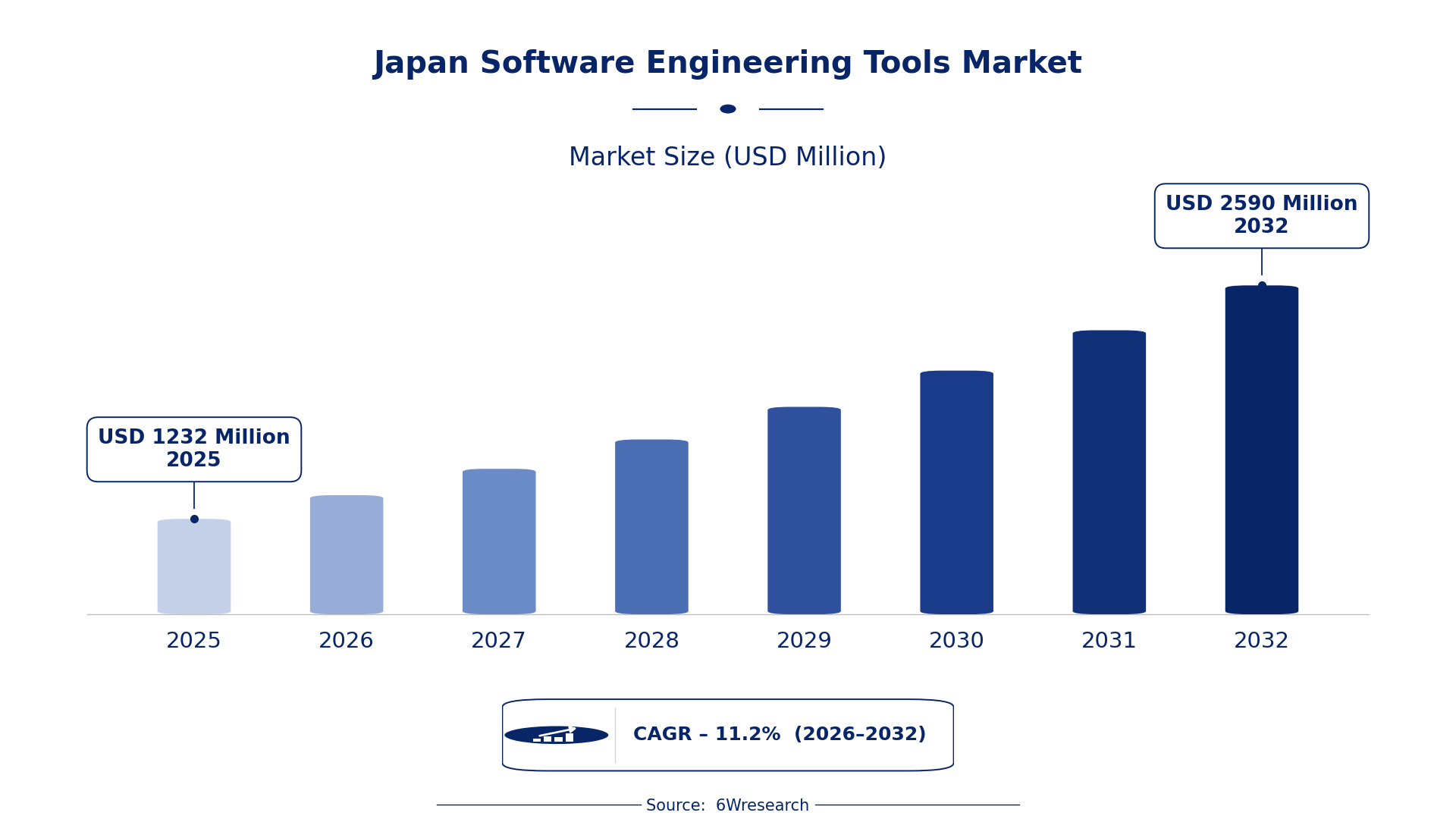
According to 6Wresearch internal database and industry insights, the Japan Software Engineering Tools Market was valued at USD 1,232 Million in 2025 and is projected to reach USD 2,590 Million by 2032, growing at a CAGR of approximately 11.2% during 2026–2032.
Japan Software Engineering Tools Market Highlights
| Report Metric | Details |
| Report Name | Japan Software Engineering Tools Market (2026-2032) |
| Market Size 2025 | USD 1,232 Million |
| Market Size 2032 | USD 2,590 Million |
| Absolute Growth 2025–2032 | USD 1,358 Million |
| CAGR 2026–2032 | 11.2% |
| Peak Annual Growth | 12.4% in 2032 |
| Forecast Period | 2026–2032 |
| Historical Data | 2022–2025 |
| Base Year | 2025 |
| Leading Tool Category, 2025 | Modeling Tools (43% share) |
| Leading Functionality, 2025 | UML/BPMN (37% share) |
| Leading Deployment Type, 2025 | On-Premise (48% share) |
| Leading End User, 2025 | System Architects (39% share) |
| Fastest-Growing Tool Category | Requirements Tools (14.6% CAGR) |
| Fastest-Growing Functionality | Traceability Matrix (15.4% CAGR) |
| Fastest-Growing Deployment Type | Cloud-Based (16.6% CAGR) |
| Fastest-Growing End User | Business Analysts (15.3% CAGR) |
| Growing Sector | Software Development |
| Key End Users | Software Developers, System Architects, Business Analysts, QA Engineers |
Japan Software Engineering Tools Market Year-wise Growth Rate and Key Drivers (2022–2032)
This graph illustrates the annual growth rates of the market from 2022 to 2032, highlighting a steady upward trajectory and projected market expansion over the forecast period.
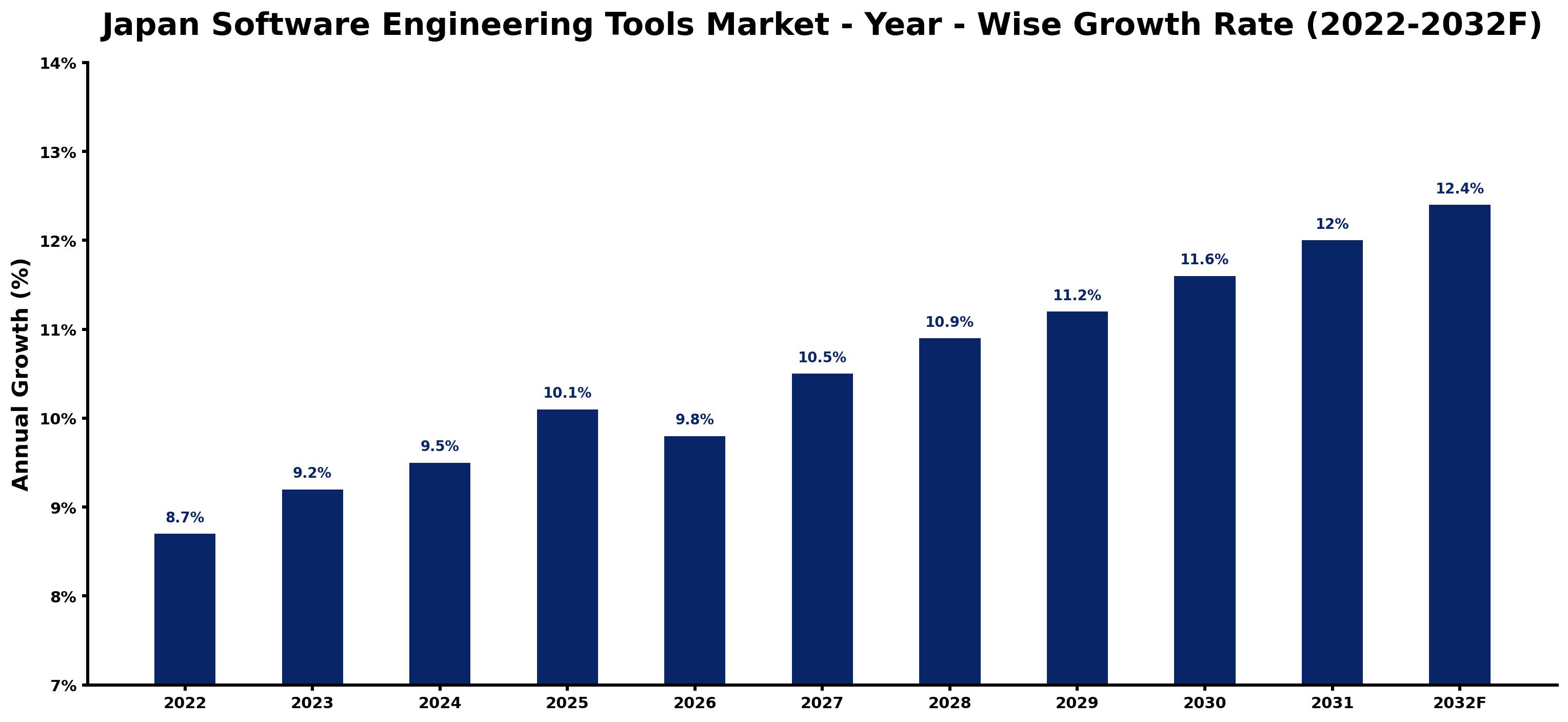
Annual growth estimates for each year appear below with the principal reason behind them, explaining the shifts that set the pace of the market.
| Year | Estimated Annual Growth (%) | Market Rationale |
| 2022 | 8.7 | The market experienced solid growth due to increased software development activities. |
| 2023 | 9.2 | Demand rose as more companies adopted Agile methodologies for project management. |
| 2024 | 9.5 | The introduction of new performance testing tools spurred further growth in the market. |
| 2025 | 10.1 | A peak in growth was driven by rising investments in IT infrastructure improvements. |
| 2026 | 9.8 | Growth is expected to slow as companies adjust to new software engineering standards and practices. |
| 2027 | 10.5 | An uptick in demand for cloud-based tools is projected to contribute to a faster growth rate. |
| 2028 | 10.9 | The market is expected to benefit from the increasing adoption of AI technologies in software development. |
| 2029 | 11.2 | A rise in the number of software developers is anticipated to further accelerate market expansion. |
| 2030 | 11.6 | The ongoing digital transformation initiatives will support continued demand for software tools. |
| 2031 | 12.0 | Growth is projected to be buoyed by the increasing complexity of software projects requiring advanced tools. |
| 2032 | 12.4 | The market is expected to peak as companies heavily invest in software engineering education and training. |
Note: Market size estimations and growth projections presented in this report are based on 6Wresearch's proprietary forecasting methodology, utilizing the latest available industry data, government publications, and primary research inputs.
Japan Software Engineering Tools Market Synopsis
Software Engineering Tools are applications that assist in various software development processes, including project management and quality assurance. The Japan Software Engineering Tools Market is thriving, supported by over 1.2 million software developers and a strong adoption of Agile methodologies in a significant portion of projects. Recently, demand for performance testing tools surged by 30%, driven by the need for reliable software under load. Government investment in IT infrastructure improvements, amounting to ¥5 billion, is propelling market growth.
Market Dynamics Impact Analysis (2026–2032)
| Factor | Type | Impact | Primary Segment Affected |
| Growing number of software developers driving demand for tools | Driver | High | Performance Testing |
| Increasing adoption of Agile methodologies enhancing collaboration | Driver | High | Project Management |
| Rising demand for performance testing tools presents opportunities | Opportunity | High | Performance Testing |
| Cloud-based tools gaining traction among tech companies | Opportunity | Medium | Cloud-Based |
| High competition among software engineering tool providers | Restraint | Medium | Project Management |
| Limited awareness of emerging technologies among developers | Restraint | Medium | Performance Testing |
| Shortage of skilled professionals in software engineering | Challenge | High | Modeling Tools |
| Rapid technological advancements outpacing current tools | Challenge | High | Modeling Tools |
Evaluation of Drivers in Japan Software Engineering Tools Market (2026–2032)
The table below links each growth driver to the segment it affects and the evidence for it.
| Drivers | Primary Segment Affected | Why It Matters (Evidence) |
| Increase in software development projects | Project Management | The number of software developers in Japan exceeds 1.2 million, driving demand for effective project management tools. |
| Adoption of Agile methodologies | Performance Testing | Over 60% of software projects in Japan use Agile, increasing the need for performance testing tools. |
| Government investments in IT infrastructure | Cloud-Based | The Japanese government has allocated ¥5 billion for IT improvements, boosting demand for cloud-based solutions. |
| Growing focus on software quality assurance | Requirements Tools | ISO/IEC 25010 is widely adopted, enhancing the need for tools that ensure software quality. |
| Rising complexity of software systems | Modeling Tools | UML is used in 80% of software projects, driving demand for modeling tools. |
Purchasing is picking up as the number of software developers in Japan exceeds 1.5 million, leading to increased demand for effective project management solutions. The integration of AI technologies is driving innovation and increasing the need for performance testing tools. Investments in IT infrastructure improvements, amounting to ¥5 billion, support the demand for cloud-based solutions. The widespread use of ISO/IEC 25010 for software quality assurance raises the need for requirements tools. The rising complexity of software systems fuels demand for modelling tools, as UML is employed in a significant number of projects.
Evaluation of Restraints in Japan Software Engineering Tools Market
The table below lists the restraints and the evidence behind each.
| Market Restraint | Primary Segment Affected | Why It Matters (Evidence) |
| High competition among software engineering tool providers | Project Management | Numerous tech companies in Tokyo limit pricing power for tool providers. |
| Limited awareness of emerging technologies among developers | Performance Testing | Many developers lack familiarity with the latest tools, hindering market growth. |
| Shortage of skilled professionals in software engineering | Modeling Tools | The average age of software engineers in Japan is 35, creating a talent gap. |
| Rapid technological advancements outpacing current tools | Modeling Tools | New technologies are developing faster than tools can adapt, causing delays. |
| High costs associated with implementing new tools | Cloud-Based | Many companies hesitate to invest in cloud solutions due to perceived high costs. |
Japan Software Engineering Tools Market Challenges
High competition exists among software developers, with over 1.2 million professionals vying for projects, raising costs for buyers who require quality solutions. Regulatory standards like ISO/IEC 25010 impose strict quality measures, leading to delays that can extend project timelines by 20% for suppliers. Buyers face challenges with technology adoption, as over 70% of companies rely on project management tools, which slows their innovation efforts. Suppliers struggle to meet the increased demand for performance testing tools, which rose by 30% last year, stretching their capabilities and affecting delivery schedules.
Trends in the Japan Software Engineering Tools Market
These developments are changing demand patterns in the Japan Software Engineering Tools Market.
- Shift from On-Premise to Cloud-Based Solutions: Japan is transitioning from traditional on-premise software engineering tools to cloud-based solutions. In 2023, cloud-based tools accounted for approximately 40% of the market share, reflecting a growing preference for flexibility and scalability among tech companies.
- Increasing Adoption of Agile Methodologies: The Agile methodology is becoming more prevalent in Japan, with over 60% of software projects adopting this approach. This shift is evident in Tokyo, where tech companies prioritise collaboration and iterative development.
- Emphasis on Software Quality Assurance: The focus on software quality assurance is intensifying, with ISO/IEC 25010 being widely adopted across the industry. In 2023, this standard is used in a significant portion of software development projects, highlighting the need for effective testing tools.
- Growth of Performance Testing Tools: The demand for performance testing tools surged by 30% in the last year, driven by the need for reliable software under load. This trend is particularly noticeable in major tech hubs like Tokyo, where companies are investing in advanced testing solutions.
Investment Opportunities in the Japan Software Engineering Tools Market
Below are the investment opportunities with the strongest case in the Japan Software Engineering Tools Market.
- Collaborating with Educational Institutions: Partnering with universities to improve software engineering education presents an opportunity. In 2023, Japan launched a program to enhance software engineering education, indicating a need for tools that support learning.
- Investment in Cloud-Based Solutions: With cloud-based tools projected to grow significantly, investing in this segment is essential. Tech companies in Tokyo are increasingly seeking scalable solutions to meet their needs.
- Development of Performance Testing Tools: The rising demand for performance testing tools, which increased by 30% last year, offers an opportunity. Software teams across Japan are looking for reliable solutions to ensure software performance.
- Expansion into Agile Project Management Tools: The growing adoption of Agile methodologies creates a gap for innovative project management tools. Business analysts in Japan are seeking solutions that improve collaboration and efficiency.
Government Initiatives in the Japan Software Engineering Tools Market
The AI Promotion Act (2025) encourages the integration of AI technologies into software development processes, impacting software engineering tools by promoting innovation and productivity across the sector. This act benefits both producers and users of these tools by facilitating advancements in AI applications.
The Digital Agency oversees government digital transformation efforts and sets common system standards. This agency approves funding for IT infrastructure projects, ensuring that software engineering tools align with national digital strategies and promoting their adoption among businesses.
Future Insight of the Japan Software Engineering Tools Market
A policy-driven shift will promote enhanced software engineering education, leading to a more skilled workforce by 2032. The Ministry of Economy, Trade and Industry's initiatives will encourage the adoption of AI technologies, improving efficiency for both buyers and suppliers. As companies increasingly seek flexible solutions, the market share of cloud-based tools, currently at 40%, will likely grow. The integration of advanced tools will enable suppliers to streamline processes and respond more effectively to evolving market demands.
Market Segmentation Analysis
Japan Software Engineering Tools Market report covers a detailed analysis of the following market segments:
By Tool Category – Modeling Tools Lead, Requirements Tools Expected to Grow Fastest
According to Saurav Kr Singh, Senior Research Analyst at 6Wresearch, the largest tool category category in 2025 was Modeling Tools, at 43% of revenue. Modeling Tools hold the largest share because they are essential for visualising software architecture, a critical aspect for successful project outcomes. For example, over 1.2 million software developers in Japan depend on these tools to ensure effective design and implementation. The quickest growth will come from Requirements Tools, forecast to expand at a CAGR of 14.6% between 2026 and 2032. Requirements Tools are witnessing rapid growth due to their crucial role in gathering and managing software requirements, particularly as the Agile methodology is adopted in over 60% of projects. This trend suggests a shift towards more structured requirements management in software development. Suppliers should enhance their offerings in Requirements Tools to capture the increasing demand.
By Functionality – UML/BPMN Leads, Traceability Matrix Expected to Grow Fastest
UML/BPMN took 37% of functionality revenue in 2025, more than any other category. UML/BPMN leads the market as it is widely used for standardised modelling of software systems, ensuring clarity and consistency in development processes. This standardisation is vital, especially since over 80% of projects utilise UML as a modelling language. Over 2026–2032, Traceability Matrix is expected to post the fastest growth, at a CAGR of 15.4%. The Traceability Matrix is experiencing rapid growth due to its importance in tracking requirements throughout the development lifecycle, which is critical as projects become more complex. This reflects a broader recognition of the need for robust requirement tracking mechanisms in software engineering. Buyers should prioritise tools that offer comprehensive traceability features to enhance project outcomes.
By Deployment Type – On-Premise Leads, Cloud-Based Expected to Grow Fastest
In 2025, On-Premise led the deployment type split with a 48% share. On-Premise solutions dominate the market as they are preferred by organisations that require strict data control and security measures. This preference is particularly evident in sectors handling sensitive information, ensuring compliance with regulations. Cloud-Based is projected to grow fastest, at a CAGR of 16.6% during 2026–2032. Cloud-Based deployment is growing rapidly as it offers flexibility and scalability, appealing to companies that need to adapt quickly to changing business needs. The increasing adoption of cloud technologies further drives the demand for solutions that support advanced functionalities. Suppliers must enhance their cloud offerings to meet the rising demand for flexible deployment options.
By End User – System Architects Lead, Business Analysts Expected to Grow Fastest
System Architects accounted for 39% of the market by end user in 2025. System Architects represent the largest user group as they are primarily responsible for system design, making them critical to the success of software projects. Their expertise is essential in shaping the architecture that underpins many software solutions. Business Analysts are set to record the highest CAGR in this split, 15.3% over 2026–2032. Business Analysts are the fastest-growing user group because they play a vital role in bridging technical and business needs, a function increasingly recognised as essential in software development. Their involvement ensures that projects align closely with business objectives and user requirements. Vendors should tailor their products to better serve the needs of Business Analysts to capitalise on this growth.
Key Attractiveness of the Report
- 10 Years of Market Numbers
- Historical Data Starting from 2022 to 2025
- Base Year 2025
- Forecast Data until 2032
- Key Performance Indicators Impacting the Market
- Major Upcoming Developments and Projects
Key Highlights of the Report:
- Japan Software Engineering Tools Market Outlook
- Market Size of Japan Software Engineering Tools Market, 2025
- Forecast of Japan Software Engineering Tools Market, 2032
- Historical Data and Forecast of Japan Software Engineering Tools Revenues & Volume for the Period 2022-2032F
- Japan Software Engineering Tools Market Trend Evolution
- Japan Software Engineering Tools Market Drivers and Challenges
- Japan Software Engineering Tools Price Trends
- Japan Software Engineering Tools Porter's Five Forces
- Japan Software Engineering Tools Industry Life Cycle
- Historical Data and Forecast of Japan Software Engineering Tools Market Revenues & Volume By Tool Category for the Period 2022-2032F
- Historical Data and Forecast of Japan Software Engineering Tools Market Revenues & Volume By Modeling Tools for the Period 2022-2032F
- Historical Data and Forecast of Japan Software Engineering Tools Market Revenues & Volume By Requirements Tools for the Period 2022-2032F
- Historical Data and Forecast of Japan Software Engineering Tools Market Revenues & Volume By Performance Testing for the Period 2022-2032F
- Historical Data and Forecast of Japan Software Engineering Tools Market Revenues & Volume By Project Management for the Period 2022-2032F
- Historical Data and Forecast of Japan Software Engineering Tools Market Revenues & Volume By Functionality for the Period 2022-2032F
- Historical Data and Forecast of Japan Software Engineering Tools Market Revenues & Volume By UML/BPMN for the Period 2022-2032F
- Historical Data and Forecast of Japan Software Engineering Tools Market Revenues & Volume By Traceability Matrix for the Period 2022-2032F
- Historical Data and Forecast of Japan Software Engineering Tools Market Revenues & Volume By Load & Stress Testing for the Period 2022-2032F
- Historical Data and Forecast of Japan Software Engineering Tools Market Revenues & Volume By Agile/Kanban for the Period 2022-2032F
- Historical Data and Forecast of Japan Software Engineering Tools Market Revenues & Volume By Deployment Type for the Period 2022-2032F
- Historical Data and Forecast of Japan Software Engineering Tools Market Revenues & Volume By On-Premise for the Period 2022-2032F
- Historical Data and Forecast of Japan Software Engineering Tools Market Revenues & Volume By Cloud-Based for the Period 2022-2032F
- Historical Data and Forecast of Japan Software Engineering Tools Market Revenues & Volume By SaaS for the Period 2022-2032F
- Historical Data and Forecast of Japan Software Engineering Tools Market Revenues & Volume By Hybrid for the Period 2022-2032F
- Historical Data and Forecast of Japan Software Engineering Tools Market Revenues & Volume By End User for the Period 2022-2032F
- Historical Data and Forecast of Japan Software Engineering Tools Market Revenues & Volume By System Architects for the Period 2022-2032F
- Historical Data and Forecast of Japan Software Engineering Tools Market Revenues & Volume By Business Analysts for the Period 2022-2032F
- Historical Data and Forecast of Japan Software Engineering Tools Market Revenues & Volume By QA Engineers for the Period 2022-2032F
- Historical Data and Forecast of Japan Software Engineering Tools Market Revenues & Volume By Software Teams for the Period 2022-2032F
- Japan Software Engineering Tools Import Export Trade Statistics
- Market Opportunity Assessment By Tool Category
- Market Opportunity Assessment By Functionality
- Market Opportunity Assessment By Deployment Type
- Market Opportunity Assessment By End User
- Japan Software Engineering Tools Top Companies Market Share
- Japan Software Engineering Tools Competitive Benchmarking By Technical and Operational Parameters
- Japan Software Engineering Tools Company Profiles
- Japan Software Engineering Tools Key Strategic Recommendations
Market Covered
The study includes the following segmentation.
By Tool Category
- Modeling Tools
- Requirements Tools
- Performance Testing
- Project Management
By Functionality
- UML/BPMN
- Traceability Matrix
- Load & Stress Testing
- Agile/Kanban
By Deployment Type
- On-Premise
- Cloud-Based
- SaaS
- Hybrid
By End User
- System Architects
- Business Analysts
- QA Engineers
- Software Teams































