Japan Software Testing Automation Tools Market Size & Growth Rate
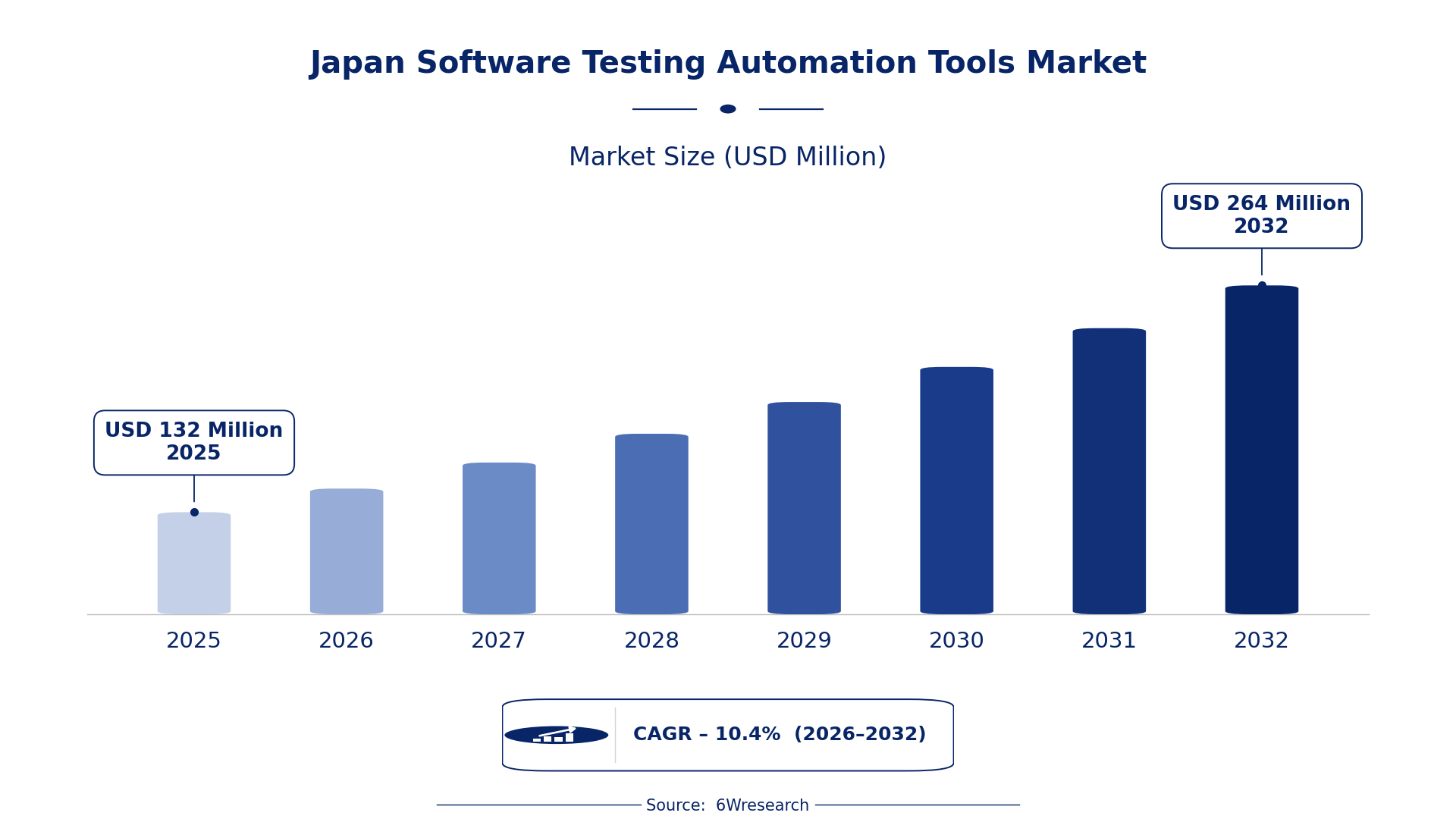
According to 6Wresearch internal database and industry insights, the Japan Software Testing Automation Tools Market was valued at USD 132 Million in 2025 and is projected to reach USD 264 Million by 2032, growing at a CAGR of approximately 10.4% during 2026–2032.
Japan Software Testing Automation Tools Market Highlights
| Report Metric | Details |
| Report Name | Japan Software Testing Automation Tools Market (2026-2032) |
| Market Size 2025 | USD 132 Million |
| Market Size 2032 | USD 264 Million |
| Absolute Growth 2025–2032 | USD 132 Million |
| CAGR 2026–2032 | 10.4% |
| Peak Annual Growth | 11.6% in 2032 |
| Forecast Period | 2026–2032 |
| Historical Data | 2022–2025 |
| Base Year | 2025 |
| Leading Testing Type, 2025 | Functional Testing (53% share) |
| Leading Script Type, 2025 | Selenium/Python (40% share) |
| Leading Integration, 2025 | CI/CD Tools (44% share) |
| Leading End User, 2025 | QA Teams (44% share) |
| Fastest-Growing Testing Type | Regression Testing (15.1% CAGR) |
| Fastest-Growing Script Type | Low-Code Platforms (15.0% CAGR) |
| Fastest-Growing Integration | Jenkins/GitLab (14.5% CAGR) |
| Fastest-Growing End User | Automation Engineers (13.6% CAGR) |
| Growing Sector | Automation Engineers |
| Key End Users | QA Teams, Automation Engineers, DevOps, App Developers |
Japan Software Testing Automation Tools Market Year-wise Growth Rate and Key Drivers (2022–2032)
This graph illustrates the annual growth rates of the market from 2022 to 2032, highlighting a steady upward trajectory and projected market expansion over the forecast period.
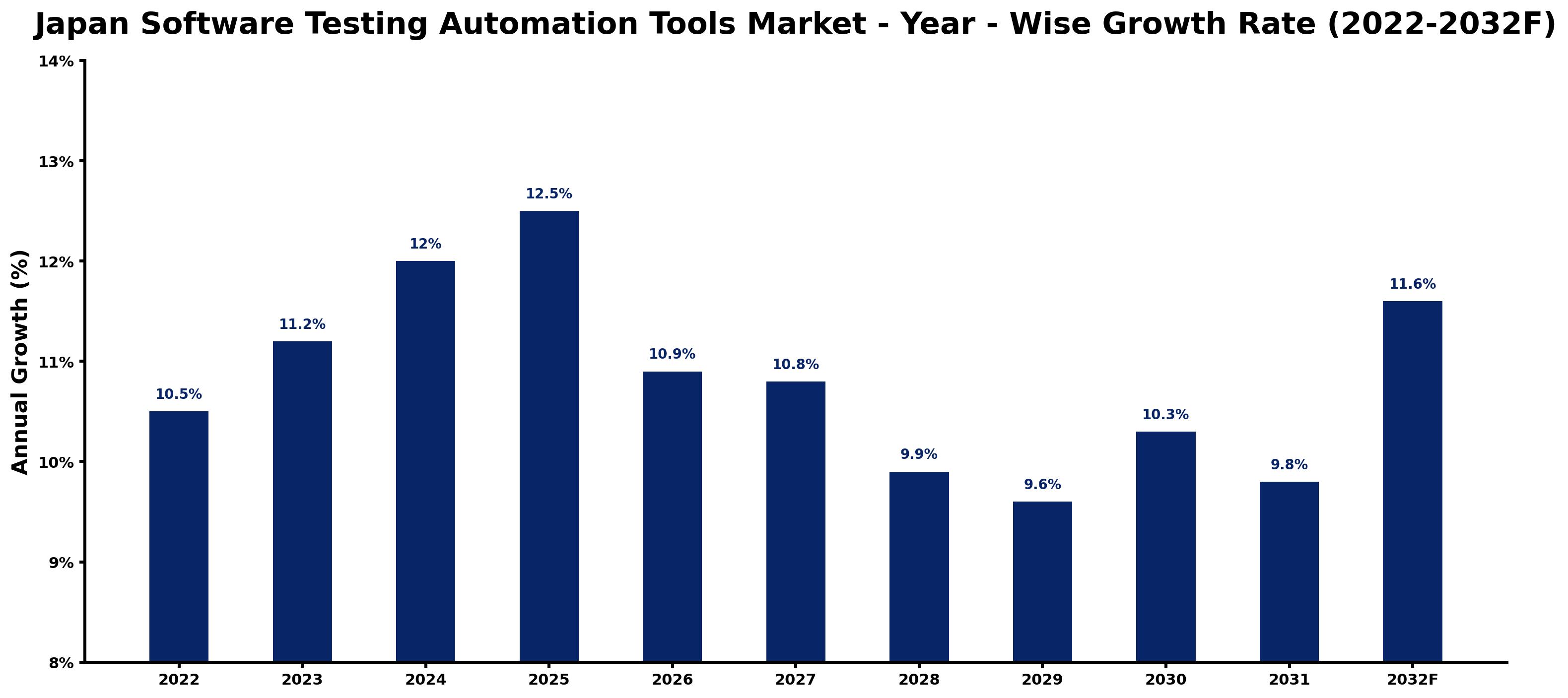
For each year, the table pairs the estimated growth rate with the leading influence on demand, showing how the drivers changed across the period.
| Year | Estimated Annual Growth (%) | Market Rationale |
| 2022 | 10.5 | The market experienced steady demand from the technology sector, reflecting a mature environment. |
| 2023 | 11.2 | Growth was driven by increased automation adoption among software developers and QA teams. |
| 2024 | 12.0 | The rise in mobile app development led to heightened demand for testing tools. |
| 2025 | 12.5 | The peak growth year saw substantial investments in software quality assurance processes. |
| 2026 | 10.9 | A slowdown is expected as the market stabilises after the previous peak. |
| 2027 | 10.8 | The market will continue to expand, albeit at a slower pace than before. |
| 2028 | 9.9 | Growth is projected to decelerate as the market adjusts to new norms. |
| 2029 | 9.6 | Demand will remain steady, but growth is expected to slow compared to prior years. |
| 2030 | 10.3 | An uptick in growth is expected as companies renew their focus on automation strategies. |
| 2031 | 9.8 | The market will see a slowdown as saturation in certain segments begins to take hold. |
| 2032 | 11.6 | The market is anticipated to peak again, driven by advancements in testing technologies. |
Note: Market size estimations and growth projections presented in this report are based on 6Wresearch's proprietary forecasting methodology, utilizing the latest available industry data, government publications, and primary research inputs.
Japan Software Testing Automation Tools Market Synopsis
Software Testing Automation Tools automate the testing of software applications, improving quality and efficiency. The Japan Software Testing Automation Tools Market is expanding due to rising investments in software quality assurance, projected to reach USD 264 million by 2032. The increasing number of mobile app developers and the adoption of agile methodologies further drive this growth, particularly within the technology and finance sectors.
Market Dynamics Impact Analysis (2026–2032)
| Factor | Type | Impact | Primary Segment Affected |
| Rising automation adoption among QA teams | Driver | High | Functional Testing |
| Increased mobile app development | Driver | High | Mobile App Testing |
| Growing demand for CI/CD tools | Opportunity | High | CI/CD Tools |
| Expansion of tech startups in Tokyo | Opportunity | Medium | Automation Engineers |
| Limited skilled workforce in automation | Restraint | High | Automation Engineers |
| High initial investment costs for automation tools | Restraint | Medium | Functional Testing |
| Competition from low-code platforms | Challenge | High | Low-Code Platforms |
| Rapid technological advancements requiring constant updates | Challenge | Medium | Performance Testing |
Evaluation of Drivers in Japan Software Testing Automation Tools Market (2026–2032)
Below are the drivers that matter most for revenue growth, with supporting evidence.
| Drivers | Primary Segment Affected | Why It Matters (Evidence) |
| Increased investment in software quality assurance | Functional Testing | Japan's software development sector is expanding, leading to higher spending on testing tools, with a focus on quality assurance. |
| Surge in mobile applications | Mobile App Testing | An estimated 150,000 mobile app developers in Japan are driving demand for effective testing solutions. |
| Adoption of CI/CD practices | Regression Testing | The increasing number of QA teams adopting agile practices is driving the need for regression testing tools. |
| Government support for digital transformation | Automation Engineers | The digital transformation initiative is boosting demand for skilled automation engineers. |
| Growing emphasis on software quality | Performance Testing | With the rise of mobile applications, companies are prioritising performance testing to ensure optimal user experiences. |
A wider customer base explains much of the growth, as the software development sector expands in Japan. The demand for effective mobile app testing solutions is rising due to the increasing number of mobile app developers, estimated at 150,000. Companies are investing in CI/CD tools to streamline their processes, with a notable 70% adoption rate of CI/CD practices among tech firms. The focus on quality assurance is becoming paramount, with investments flowing into functional testing tools, further supporting market growth.
Evaluation of Restraints in Japan Software Testing Automation Tools Market
These restraints slow adoption and weigh on supplier margins.
| Market Restraint | Primary Segment Affected | Why It Matters (Evidence) |
| Shortage of skilled automation professionals | Automation Engineers | The average salary for automation engineers is approximately 8 million JPY, making it challenging to attract talent. |
| High costs associated with implementing automation tools | Functional Testing | Initial investments can deter smaller companies from adopting necessary testing solutions. |
| Competition from low-code platforms | Low-Code Platforms | Low-code solutions appeal to non-technical users, diverting demand from traditional automation tools. |
| Rapid technological changes | Performance Testing | Keeping up with advancements requires constant updates and training, straining resources for many companies. |
| Limited awareness of testing automation benefits | Regression Testing | Some organizations remain unaware of the efficiency gains, hindering wider adoption. |
Japan Software Testing Automation Tools Market Challenges
Many QA teams in Tokyo struggle to recruit skilled automation engineers, which delays project timelines and increases costs for technology users. This skills gap exists because Japan's education system is not producing enough graduates with the necessary technical expertise, leading to project overruns of up to 20%. Buyers also face difficulties in sourcing software testing automation tools due to strict adherence to ISO/IEC 29119, which can extend procurement timelines by 15%. Regulatory compliance with JIS Q 15000 adds complexity, resulting in additional costs that can consume 10% of project budgets. Lastly, intense competition among domestic software development firms raises prices, compelling clients to allocate up to 30% more of their budgets for testing solutions.
Trends in the Japan Software Testing Automation Tools Market
Several trends are reshaping the Japan Software Testing Automation Tools Market; the most important are set out below.
- AI Promotion Act Driving Testing Automation: The AI Promotion Act, established in 2025, encourages the integration of AI in software testing. This trend is reflected in the growing adoption of AI-based testing tools, with a reported 30% increase in usage.
- Shift Towards Agile Methodologies: QA teams are increasingly adopting agile methodologies, leading to a rise in demand for automation tools that support rapid development cycles. This shift is particularly pronounced in Tokyo's tech startups.
- Growth of CI/CD Practices: The adoption of CI/CD practices is reshaping testing, with a 70% uptake among tech firms. This trend highlights the need for integrated testing solutions that streamline development and deployment processes.
- Expansion of Mobile App Testing: The number of mobile app developers in Japan is estimated at 150,000, driving demand for mobile app testing tools. This growth reflects a notable increase in mobile application launches over the past year.
Investment Opportunities in the Japan Software Testing Automation Tools Market
Several openings in the Japan Software Testing Automation Tools Market merit attention from investors.
- QA Teams Seeking Advanced Tools: QA teams are looking for advanced testing automation tools to improve efficiency. With a projected growth of 12.5% in 2025, suppliers can target this segment to meet rising demands.
- Tokyo's Tech Startups Needing Support: Tokyo's tech startups are rapidly expanding, creating opportunities for suppliers of automation tools. The local government supports these startups through funding programs, facilitating entry into this market.
- Investment in CI/CD Tools: With a 70% adoption rate of CI/CD practices, there is an opportunity to supply tools that enhance integration and delivery processes. This demand is particularly strong among technology firms.
- Mobile App Testing Tools in Demand: The growing number of mobile app developers indicates a need for effective testing tools. Suppliers can enter this market by partnering with development agencies in urban areas.
Government Initiatives in the Japan Software Testing Automation Tools Market
The GX Promotion Act, enacted in 2023, establishes a framework for promoting green technologies, including software testing automation tools. This law complements previous measures by providing a clearer pathway for companies to invest in sustainable practices, improving operational efficiency. The act aims to facilitate JPY 150 trillion of public and private decarbonisation investment over 10 years, improving the overall market environment.
In 2023, the Japanese government allocated 5 billion JPY for IT skill development programs, administered by the Ministry of Economy, Trade and Industry. This funding aims to improve the workforce's capabilities in software testing and automation, ensuring a steady supply of skilled professionals for the industry.
Future Insight of the Japan Software Testing Automation Tools Market
Japan's policy-driven shift towards decarbonisation will reshape software testing practices by 2032, prompting companies to adopt more efficient methodologies. With an estimated JPY 150 trillion in public and private investment, firms will likely increase their reliance on automation tools to improve testing processes. The adoption of agile methodologies is expected to rise, benefiting both technology users and providers. As the number of mobile app developers grows, the demand for high-quality software testing will push suppliers to innovate and meet evolving industry standards.
Market Segmentation Analysis
Japan Software Testing Automation Tools Market report covers a detailed analysis of the following market segments:
By Testing Type – Functional Testing Leads, Regression Testing Expected to Grow Fastest
According to Saurav Kr Singh, Senior Research Analyst at 6Wresearch, Functional Testing held 53% of the Japan Software Testing Automation Tools Market by testing type in 2025. Functional Testing holds the largest share as it is essential for verifying software functionality across a wide range of applications. The high concentration of software development activities in Tokyo significantly drives the demand for this type of testing. Over 2026–2032, Regression Testing is expected to post the fastest growth, at a CAGR of 15.1%. Regression Testing is experiencing rapid growth because it is necessary to ensure that existing functionalities remain intact after software updates. The increasing focus on agile methodologies among QA teams in Japan is a key factor in this growth. Suppliers should prioritise the development of Functional Testing solutions to meet the strong demand from QA teams.
By Script Type – Selenium/Python Leads, Low-Code Platforms Expected to Grow Fastest
Selenium/Python accounted for 40% of the market by script type in 2025. Selenium/Python dominates the market as it is widely used for creating automated testing scripts, making it a preferred choice among developers. Its versatility and strong community support contribute to its substantial installed base in Japan. Low-Code Platforms are set to record the highest CAGR in this split, 15.0% over 2026–2032. Low-Code Platforms are growing quickly as they simplify the testing process, enabling users with limited coding skills to create tests efficiently. This trend aligns with the increasing number of QA teams adopting agile methodologies. Buyers may benefit from investing in Low-Code Platforms to streamline their testing processes and reduce dependency on highly skilled programmers.
By Integration – CI/CD Tools Lead, Jenkins/GitLab Expected to Grow Fastest
In 2025, CI/CD Tools led the integration split with a 44% share. CI/CD Tools lead the market as they are integral for continuous integration and delivery, which are critical for modern software development. Their widespread adoption among technology companies in Japan, particularly in Tokyo, reinforces their dominant position. Jenkins/GitLab is projected to grow fastest, at a CAGR of 14.5% during 2026–2032. Jenkins/GitLab are quickly gaining popularity as preferred automation tools within development environments. The high adoption rate of CI/CD practices, estimated at 70%, significantly contributes to the increasing usage of these tools. Suppliers need to focus on improving CI/CD Tool functionalities to align with the growing needs of developers.
By End User – QA Teams Lead, Automation Engineers Expected to Grow Fastest
With 44% of end user revenue in 2025, QA Teams was the largest category. QA Teams represent the largest user group for testing tools, as they are the primary professionals responsible for ensuring software quality. The increasing number of QA teams in Japan highlights the sustained demand for effective testing solutions. The quickest growth will come from Automation Engineers, forecast to expand at a CAGR of 13.6% between 2026 and 2032. Automation Engineers are seeing the fastest growth as specialists in implementing automation within testing processes. Their role is becoming increasingly vital as companies seek to improve efficiency and reduce testing time. Suppliers should tailor their offerings to meet the specific needs of Automation Engineers to capitalise on this growth.
Key Attractiveness of the Report
- 10 Years of Market Numbers
- Historical Data Starting from 2022 to 2025
- Base Year 2025
- Forecast Data until 2032
- Key Performance Indicators Impacting the Market
- Major Upcoming Developments and Projects
Key Highlights of the Report:
- Japan Software Testing Automation Tools Market Outlook
- Market Size of Japan Software Testing Automation Tools Market, 2025
- Forecast of Japan Software Testing Automation Tools Market, 2032
- Historical Data and Forecast of Japan Software Testing Automation Tools Revenues & Volume for the Period 2022-2032F
- Japan Software Testing Automation Tools Market Trend Evolution
- Japan Software Testing Automation Tools Market Drivers and Challenges
- Japan Software Testing Automation Tools Price Trends
- Japan Software Testing Automation Tools Porter's Five Forces
- Japan Software Testing Automation Tools Industry Life Cycle
- Historical Data and Forecast of Japan Software Testing Automation Tools Market Revenues & Volume By Testing Type for the Period 2022-2032F
- Historical Data and Forecast of Japan Software Testing Automation Tools Market Revenues & Volume By Functional Testing for the Period 2022-2032F
- Historical Data and Forecast of Japan Software Testing Automation Tools Market Revenues & Volume By Regression Testing for the Period 2022-2032F
- Historical Data and Forecast of Japan Software Testing Automation Tools Market Revenues & Volume By Performance Testing for the Period 2022-2032F
- Historical Data and Forecast of Japan Software Testing Automation Tools Market Revenues & Volume By Mobile App Testing for the Period 2022-2032F
- Historical Data and Forecast of Japan Software Testing Automation Tools Market Revenues & Volume By Script Type for the Period 2022-2032F
- Historical Data and Forecast of Japan Software Testing Automation Tools Market Revenues & Volume By Selenium/Python for the Period 2022-2032F
- Historical Data and Forecast of Japan Software Testing Automation Tools Market Revenues & Volume By Low-Code Platforms for the Period 2022-2032F
- Historical Data and Forecast of Japan Software Testing Automation Tools Market Revenues & Volume By JMeter/Postman for the Period 2022-2032F
- Historical Data and Forecast of Japan Software Testing Automation Tools Market Revenues & Volume By Appium/Katalon for the Period 2022-2032F
- Historical Data and Forecast of Japan Software Testing Automation Tools Market Revenues & Volume By Integration for the Period 2022-2032F
- Historical Data and Forecast of Japan Software Testing Automation Tools Market Revenues & Volume By CI/CD Tools for the Period 2022-2032F
- Historical Data and Forecast of Japan Software Testing Automation Tools Market Revenues & Volume By Jenkins/GitLab for the Period 2022-2032F
- Historical Data and Forecast of Japan Software Testing Automation Tools Market Revenues & Volume By Load Test Environments for the Period 2022-2032F
- Historical Data and Forecast of Japan Software Testing Automation Tools Market Revenues & Volume By Cloud Labs for the Period 2022-2032F
- Historical Data and Forecast of Japan Software Testing Automation Tools Market Revenues & Volume By End User for the Period 2022-2032F
- Historical Data and Forecast of Japan Software Testing Automation Tools Market Revenues & Volume By QA Teams for the Period 2022-2032F
- Historical Data and Forecast of Japan Software Testing Automation Tools Market Revenues & Volume By Automation Engineers for the Period 2022-2032F
- Historical Data and Forecast of Japan Software Testing Automation Tools Market Revenues & Volume By DevOps for the Period 2022-2032F
- Historical Data and Forecast of Japan Software Testing Automation Tools Market Revenues & Volume By App Developers for the Period 2022-2032F
- Japan Software Testing Automation Tools Import Export Trade Statistics
- Market Opportunity Assessment By Testing Type
- Market Opportunity Assessment By Script Type
- Market Opportunity Assessment By Integration
- Market Opportunity Assessment By End User
- Japan Software Testing Automation Tools Top Companies Market Share
- Japan Software Testing Automation Tools Competitive Benchmarking By Technical and Operational Parameters
- Japan Software Testing Automation Tools Company Profiles
- Japan Software Testing Automation Tools Key Strategic Recommendations
Market Covered
The following segment groups are covered in the report.
By Testing Type
- Functional Testing
- Regression Testing
- Performance Testing
- Mobile App Testing
By Script Type
- Selenium/Python
- Low-Code Platforms
- JMeter/Postman
- Appium/Katalon
By Integration
- CI/CD Tools
- Jenkins/GitLab
- Load Test Environments
- Cloud Labs
By End User
- QA Teams
- Automation Engineers
- DevOps
- App Developers































