Japan Soil Analysis Market Size & Growth Rate
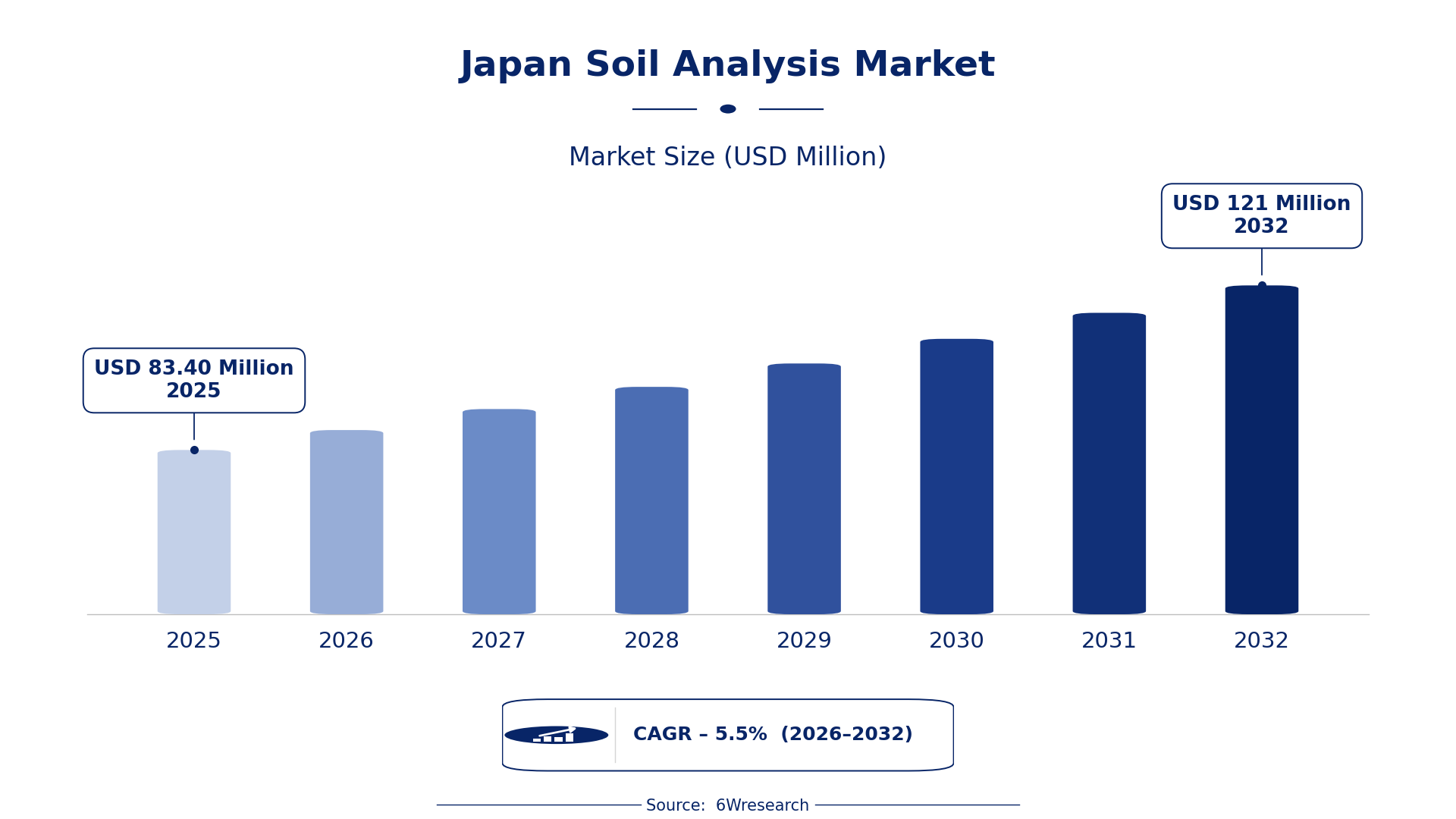
According to 6Wresearch internal database and industry insights, the Japan Soil Analysis Market was valued at USD 83.40 Million in 2025 and is projected to reach USD 121 Million by 2032, growing at a CAGR of approximately 5.5% during 2026–2032.
Japan Soil Analysis Market Highlights
| Report Metric | Details |
| Report Name | Japan Soil Analysis Market (2026-2032) |
| Market Size 2025 | USD 83.40 Million |
| Market Size 2032 | USD 121 Million |
| Absolute Growth 2025–2032 | USD 37.60 Million |
| CAGR 2026–2032 | 5.5% |
| Peak Annual Growth | 6.8% in 2026 |
| Forecast Period | 2026–2032 |
| Historical Data | 2022–2025 |
| Base Year | 2025 |
| Leading Analysis Type, 2025 | Physical Analysis (38% share) |
| Leading Testing Parameter, 2025 | Texture/Structure (38% share) |
| Leading Technology Used, 2025 | Lab Testing (42% share) |
| Leading End User Industry, 2025 | Agriculture (47% share) |
| Fastest-Growing Analysis Type | Chemical Analysis (7.8% CAGR) |
| Fastest-Growing Testing Parameter | pH (7.5% CAGR) |
| Fastest-Growing Technology Used | Spectroscopy (8.0% CAGR) |
| Fastest-Growing End User Industry | Soil Testing Labs (7.2% CAGR) |
| Growing Sector | Agriculture |
| Key End Users | Farmers, Environmental Agencies, Soil Testing Labs, Agricultural Cooperatives |
Japan Soil Analysis Market Year-wise Growth Rate and Key Drivers (2022–2032)
This graph illustrates the annual growth rates of the market from 2022 to 2032, highlighting a steady upward trajectory and projected market expansion over the forecast period.
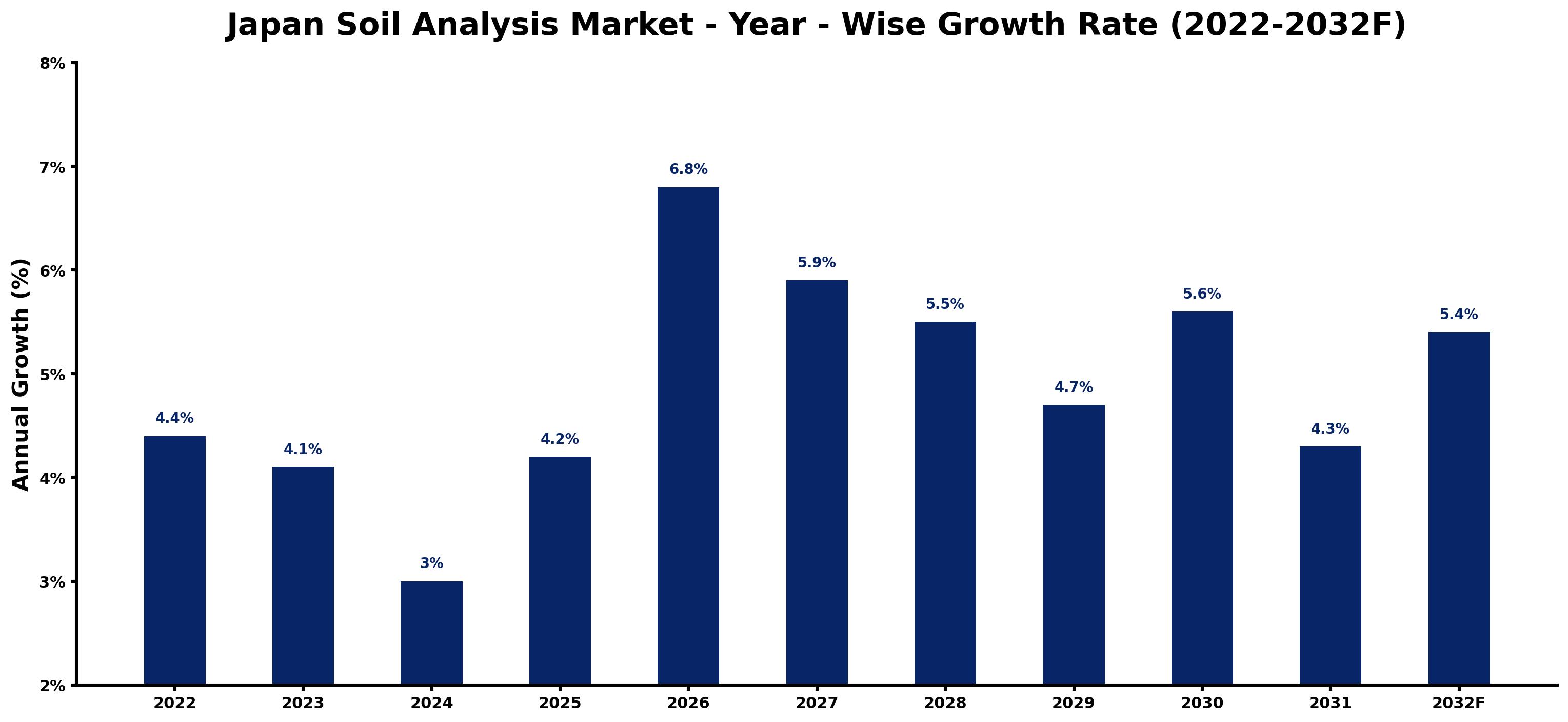
The following figures match every annual growth estimate with the main market development of that year, giving the reasoning behind each rise or slowdown.
| Year | Estimated Annual Growth (%) | Market Rationale |
| 2022 | 4.4 | The market showed steady growth, reflecting ongoing agricultural demands. |
| 2023 | 4.1 | Growth slowed slightly due to market saturation in certain regions. |
| 2024 | 3.0 | The market continued to grow, but at a reduced pace as farmers adjusted strategies. |
| 2025 | 4.2 | Growth accelerated as more farmers adopted advanced soil testing methods. |
| 2026 | 6.8 | The market is expected to peak due to heightened investment in sustainable practices. |
| 2027 | 5.9 | Growth is projected to slow as the market begins to stabilise after rapid expansion. |
| 2028 | 5.5 | The market is anticipated to maintain a steady growth rate amid consistent agricultural needs. |
| 2029 | 4.7 | Growth is expected to slow further as the market matures and competition increases. |
| 2030 | 5.6 | The market will rebound with renewed interest in soil health initiatives. |
| 2031 | 4.3 | Growth is projected to slow again as established practices become standard. |
| 2032 | 5.4 | The market is expected to grow as new technologies are integrated into soil analysis. |
Note: Market size estimations and growth projections presented in this report are based on 6Wresearch's proprietary forecasting methodology, utilizing the latest available industry data, government publications, and primary research inputs.
Japan Soil Analysis Market Synopsis
Soil analysis involves assessing soil properties to determine its health and composition, primarily through laboratory tests and field assessments. In Japan, over 4 million hectares of farmland require regular soil analysis, driven by the agricultural sector's need for effective crop management. The market is expanding due to the increasing adoption of smart farming technologies, with a reported 15% rise in usage in 2023, alongside support from government initiatives aimed at improving soil health and sustainability.
Market Dynamics Impact Analysis (2026–2032)
| Factor | Type | Impact | Primary Segment Affected |
| Rising adoption of smart farming technologies | Driver | High | Lab Testing |
| Increased awareness of soil health among farmers | Driver | High | Chemical Analysis |
| Growing demand for sustainable agricultural practices | Opportunity | High | Biological Analysis |
| Investment in soil health programs by environmental agencies | Opportunity | Medium | Soil Testing Labs |
| High costs associated with advanced testing methods | Restraint | High | Physical Analysis |
| Limited access to testing facilities in rural areas | Restraint | Medium | Remote Analysis |
| Compliance with stringent environmental regulations | Challenge | High | Environmental Agencies |
| Capacity constraints in soil testing laboratories | Challenge | Medium | Soil Testing Labs |
Evaluation of Drivers in Japan Soil Analysis Market (2026–2032)
The following drivers explain most of the expected growth.
| Drivers | Primary Segment Affected | Why It Matters (Evidence) |
| Increased investment in smart farming technologies | Lab Testing | This investment leads to higher demand for precise soil assessments, with a 15% growth in technology adoption in 2023. |
| Growing awareness of soil health importance | Chemical Analysis | As farmers recognise the role of nutrients in crop yield, demand for chemical analysis rises, with 70% of farmers using soil analysis for planning. |
| Environmental agencies promoting soil health | Biological Analysis | These agencies conduct assessments to monitor pollution, increasing demand for biological analysis to ensure soil fertility. |
| Government initiatives supporting sustainable practices | Soil Testing Labs | Subsidy programs for farmers adopting soil health practices boost demand for testing services. |
| Rising agricultural productivity needs | Physical Analysis | Farmers require detailed soil structure data to manage crops effectively, with over 4 million hectares needing regular analysis. |
Much of the new demand traces back to rising investments in smart farming technologies, which have increased by 15% in 2023. This shift encourages farmers to seek precise soil assessments, improving crop productivity. Awareness of soil health has led to 70% of farmers using soil analysis for planning.
Evaluation of Restraints in Japan Soil Analysis Market
These are the pressures that could keep growth below its potential.
| Market Restraint | Primary Segment Affected | Why It Matters (Evidence) |
| High costs associated with advanced testing methods | Physical Analysis | The average cost of soil testing is around 10,000 JPY per sample, which can deter some farmers. |
| Limited access to testing facilities in rural areas | Remote Analysis | Soil testing labs are concentrated in regions like Hokkaido and Tohoku, making access difficult for farmers in other areas. |
| Compliance with stringent environmental regulations | Environmental Agencies | Producers must adhere to local government regulations, increasing operational costs and complexity. |
| Capacity constraints in soil testing laboratories | Soil Testing Labs | With rising demand, many labs struggle to keep up, leading to delays in testing results. |
| Inconsistent quality of soil analysis services | Chemical Analysis | Variability in service quality can lead to unreliable results, affecting farmers' confidence in testing. |
Japan Soil Analysis Market Challenges
Soil analysis costs can escalate quickly, with an average testing fee of 10,000 JPY per sample, impacting farmers' budgets and limiting the frequency of assessments. Stricter environmental regulations from local governments complicate compliance for agricultural producers, often delaying necessary testing by several weeks. Competition among soil testing labs, particularly in regions like Hokkaido and Tohoku, forces some providers to reduce prices, which can compromise service quality for farmers. Many producers struggle to access timely soil assessments, with over 60% relying on laboratory tests, hindering effective crop planning and reducing yield potential.
Trends in the Japan Soil Analysis Market
Several trends are reshaping the Japan Soil Analysis Market; the most important are set out below.
- Agricultural Agencies Prioritising Soil Health: Agricultural agencies in Japan are increasingly focusing on soil health initiatives, with 70% of farmers reporting soil analysis usage. This shift is essential for sustainable farming practices.
- Transition to Smart Farming: The adoption of smart farming technologies is transforming agricultural practices, with a 15% increase in 2023. This change improves data-driven decision-making for farmers.
- Hokkaido Leading in Soil Testing Facilities: Hokkaido has emerged as a hub for soil testing labs, concentrating resources to meet the needs of local farmers. This region accounts for a significant portion of soil analysis services.
- Implementation of National Soil Database: The establishment of a National Soil Database aims to improve resource management across Japan, enhancing data accessibility for farmers and researchers.
Investment Opportunities in the Japan Soil Analysis Market
Where to invest in the Japan Soil Analysis Market: the main openings are set out below.
- Soil Health Assessment Services: There is a growing need for soil health assessment services, particularly among environmental agencies. With over 4 million hectares of farmland requiring analysis, this presents a valuable market opportunity.
- Advanced Soil Testing Technologies: Farmers are increasingly seeking advanced soil testing technologies to improve crop yields. The agricultural sector, employing about 1.5 million people, is a key target for suppliers.
- Investment in Sustainable Agriculture Practices: With Japan targeting a 46% cut in greenhouse-gas emissions by 2030, there is a pressing need for sustainable agriculture solutions. Collaborating with local agricultural cooperatives can facilitate market entry.
- Expansion of Soil Testing Laboratories: The demand for soil testing services is rising, especially in rural areas. Establishing partnerships with local soil testing labs can help meet this growing need.
Government Initiatives in the Japan Soil Analysis Market
The Waste Management and Public Cleansing Act regulates the treatment and disposal of waste, impacting soil analysis by ensuring compliance with environmental standards. This law mandates that producers adhere to specific testing protocols, improving the quality of soil assessments.
The Ministry of Agriculture, Forestry and Fisheries funds soil health programs, promoting sustainable practices among farmers. This agency also approves initiatives aimed at improving soil management, ensuring that the agricultural sector aligns with national environmental goals.
Future Insight of the Japan Soil Analysis Market
New soil health initiatives will emerge by 2032, driven by advancements in technology and data management. Insights from the National Soil Database will enable farmers to make informed decisions about land use and crop strategies. Subsidy programs for farmers adopting sustainable practices will encourage adherence to environmental regulations. Improved testing methods will deepen understanding of soil composition, boosting agricultural productivity and resource stewardship.
Market Segmentation Analysis
Japan Soil Analysis Market report covers a detailed analysis of the following market segments:
By Analysis Type – Physical Analysis Leads, Chemical Analysis Expected to Grow Fastest
According to Ayushi Shukla, Senior Research Analyst at 6Wresearch, Physical Analysis held 38% of the Japan Soil Analysis Market by analysis type in 2025. Physical Analysis holds the largest share because it provides essential data on soil structure, which is vital for agricultural productivity. Farmers across Japan, especially in diverse regions, depend on this method to optimise crop yields and manage their farmland effectively. Chemical Analysis is projected to grow fastest, at a CAGR of 7.8% during 2026–2032. Chemical Analysis is experiencing rapid growth as farmers focus on understanding nutrient availability and soil health, with 70% of farmers using soil analysis for crop planning. Government initiatives promoting sustainable practices are accelerating the adoption of chemical testing methods. This trend indicates that suppliers must prioritise advancements in chemical analysis to meet the rising demand from the agricultural sector.
By Testing Parameter – Texture/Structure Leads, pH Expected to Grow Fastest
The largest testing parameter category in 2025 was Texture/Structure, at 38% of revenue. Texture/Structure testing is the leading parameter as it is vital for determining soil suitability for various crops, a primary concern for farmers in Japan. The extensive farmland necessitates this analysis to optimise crop planning and irrigation strategies effectively. pH is set to record the highest CAGR in this split, 7.5% over 2026–2032. pH testing is the fastest-growing parameter, as it is critical for nutrient uptake and crop yield, with farmers becoming more aware of its significance in soil health management. The government's promotion of soil health programs has accelerated the demand for pH assessments among agricultural stakeholders. Buyers should prioritise pH testing to improve crop productivity and align with national soil health initiatives.
By Technology Used – Lab Testing Leads, Spectroscopy Expected to Grow Fastest
Lab Testing accounted for 42% of the market by technology used in 2025. Lab Testing is the predominant technology used as it is the standard method for accurate soil assessment, widely adopted by testing facilities across Japan. The established infrastructure for laboratory testing supports its dominance in the market. The quickest growth will come from Spectroscopy, forecast to expand at a CAGR of 8.0% between 2026 and 2032. Spectroscopy is growing rapidly due to its ability to provide quick chemical composition analysis, appealing to users who require timely results for effective decision-making. The increasing integration of advanced technologies in soil analysis is likely to boost its adoption further. Suppliers should invest in spectroscopy technologies to cater to the demand for faster and more efficient soil analysis solutions.
By End User Industry – Agriculture Leads, Soil Testing Labs Expected to Grow Fastest
With 47% of end user industry revenue in 2025, Agriculture was the largest category. Agriculture is the largest end user of soil analysis, employing it extensively for crop management and planning, which is vital for ensuring food security in Japan. With around 1.5 million people working in this sector, the demand for soil analysis remains consistently high. Over 2026–2032, Soil Testing Labs are expected to post the fastest growth, at a CAGR of 7.2%. Soil Testing Labs are experiencing the fastest growth as specialised facilities increasingly conduct soil assessments to meet the rising demands of farmers. The establishment of new labs in response to the expanding agricultural sector is propelling this trend forward. Suppliers should consider forming partnerships with soil testing labs to broaden their reach within the agricultural market.
Key Attractiveness of the Report
- 10 Years of Market Numbers
- Historical Data Starting from 2022 to 2025
- Base Year 2025
- Forecast Data until 2032
- Key Performance Indicators Impacting the Market
- Major Upcoming Developments and Projects
Key Highlights of the Report:
- Japan Soil Analysis Market Outlook
- Market Size of Japan Soil Analysis Market, 2025
- Forecast of Japan Soil Analysis Market, 2032
- Historical Data and Forecast of Japan Soil Analysis Revenues & Volume for the Period 2022-2032F
- Japan Soil Analysis Market Trend Evolution
- Japan Soil Analysis Market Drivers and Challenges
- Japan Soil Analysis Price Trends
- Japan Soil Analysis Porter's Five Forces
- Japan Soil Analysis Industry Life Cycle
- Historical Data and Forecast of Japan Soil Analysis Market Revenues & Volume By Analysis Type for the Period 2022-2032F
- Historical Data and Forecast of Japan Soil Analysis Market Revenues & Volume By Physical Analysis for the Period 2022-2032F
- Historical Data and Forecast of Japan Soil Analysis Market Revenues & Volume By Chemical Analysis for the Period 2022-2032F
- Historical Data and Forecast of Japan Soil Analysis Market Revenues & Volume By Biological Analysis for the Period 2022-2032F
- Historical Data and Forecast of Japan Soil Analysis Market Revenues & Volume By Remote Analysis for the Period 2022-2032F
- Historical Data and Forecast of Japan Soil Analysis Market Revenues & Volume By Testing Parameter for the Period 2022-2032F
- Historical Data and Forecast of Japan Soil Analysis Market Revenues & Volume By Texture/Structure for the Period 2022-2032F
- Historical Data and Forecast of Japan Soil Analysis Market Revenues & Volume By pH, Nutrients for the Period 2022-2032F
- Historical Data and Forecast of Japan Soil Analysis Market Revenues & Volume By Microbial Activity for the Period 2022-2032F
- Historical Data and Forecast of Japan Soil Analysis Market Revenues & Volume By Satellite Data for the Period 2022-2032F
- Historical Data and Forecast of Japan Soil Analysis Market Revenues & Volume By Technology Used for the Period 2022-2032F
- Historical Data and Forecast of Japan Soil Analysis Market Revenues & Volume By Lab Testing for the Period 2022-2032F
- Historical Data and Forecast of Japan Soil Analysis Market Revenues & Volume By Spectroscopy for the Period 2022-2032F
- Historical Data and Forecast of Japan Soil Analysis Market Revenues & Volume By DNA-Based Testing for the Period 2022-2032F
- Historical Data and Forecast of Japan Soil Analysis Market Revenues & Volume By GIS Tools for the Period 2022-2032F
- Historical Data and Forecast of Japan Soil Analysis Market Revenues & Volume By End User Industry for the Period 2022-2032F
- Historical Data and Forecast of Japan Soil Analysis Market Revenues & Volume By Agriculture for the Period 2022-2032F
- Historical Data and Forecast of Japan Soil Analysis Market Revenues & Volume By Soil Testing Labs for the Period 2022-2032F
- Historical Data and Forecast of Japan Soil Analysis Market Revenues & Volume By Environmental Agencies for the Period 2022-2032F
- Historical Data and Forecast of Japan Soil Analysis Market Revenues & Volume By Smart Farming for the Period 2022-2032F
- Japan Soil Analysis Import Export Trade Statistics
- Market Opportunity Assessment By Analysis Type
- Market Opportunity Assessment By Testing Parameter
- Market Opportunity Assessment By Technology Used
- Market Opportunity Assessment By End User Industry
- Japan Soil Analysis Top Companies Market Share
- Japan Soil Analysis Competitive Benchmarking By Technical and Operational Parameters
- Japan Soil Analysis Company Profiles
- Japan Soil Analysis Key Strategic Recommendations
Market Covered
This report examines the market across the segments below.
By Analysis Type
- Physical Analysis
- Chemical Analysis
- Biological Analysis
- Remote Analysis
By Testing Parameter
- Texture/Structure
- pH
- Nutrients
- Microbial Activity
- Satellite Data
By Technology Used
- Lab Testing
- Spectroscopy
- DNA-Based Testing
- GIS Tools
By End User Industry
- Agriculture
- Soil Testing Labs
- Environmental Agencies
- Smart Farming






































