Japan Soil Erosion Control Market Size & Growth Rate
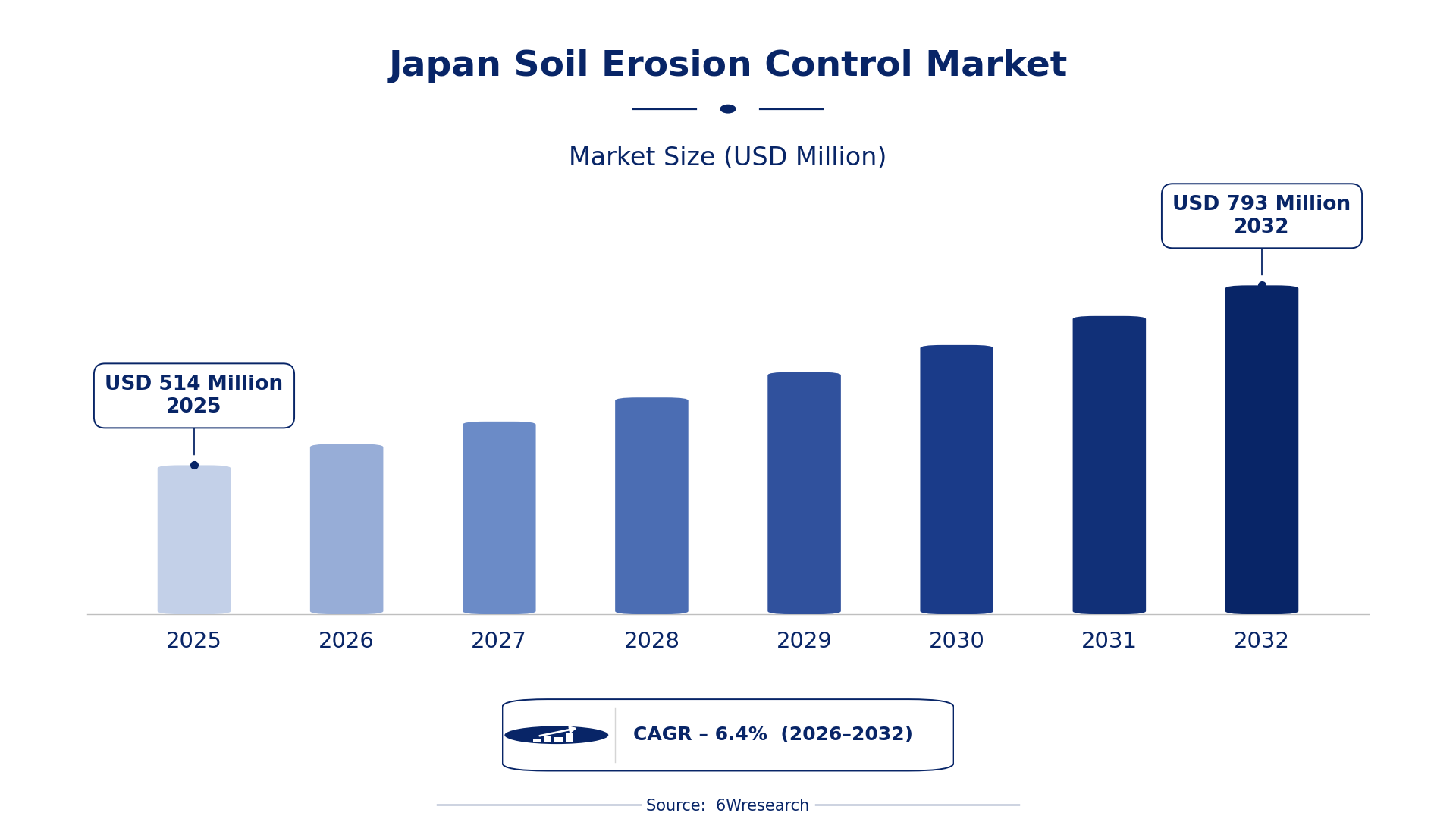
According to 6Wresearch internal database and industry insights, the Japan Soil Erosion Control Market was valued at USD 514 Million in 2025 and is projected to reach USD 793 Million by 2032, growing at a CAGR of approximately 6.4% during 2026–2032.
Japan Soil Erosion Control Market Highlights
| Report Metric | Details |
| Report Name | Japan Soil Erosion Control Market (2026-2032) |
| Market Size 2025 | USD 514 Million |
| Market Size 2032 | USD 793 Million |
| Absolute Growth 2025–2032 | USD 279 Million |
| CAGR 2026–2032 | 6.4% |
| Peak Annual Growth | 7.1% in 2032 |
| Forecast Period | 2026–2032 |
| Historical Data | 2022–2025 |
| Base Year | 2025 |
| Leading Solution Type, 2025 | Erosion Control Blankets (47% share) |
| Leading Material Used, 2025 | Coir/Straw (48% share) |
| Leading Installation Type, 2025 | Temporary (41% share) |
| Leading End User, 2025 | Road Construction Firms (39% share) |
| Fastest-Growing Solution Type | Geotextiles (8.9% CAGR) |
| Fastest-Growing Material Used | Synthetic Fiber (9.8% CAGR) |
| Fastest-Growing Installation Type | Permanent (9.0% CAGR) |
| Fastest-Growing End User | Infrastructure Agencies (8.2% CAGR) |
| Growing Sector | infrastructure development |
| Key End Users | construction firms, infrastructure agencies, agricultural landowners, environmental organisations |
Japan Soil Erosion Control Market Year-wise Growth Rate and Key Drivers (2022–2032)
This graph illustrates the annual growth rates of the market from 2022 to 2032, highlighting a steady upward trajectory and projected market expansion over the forecast period.
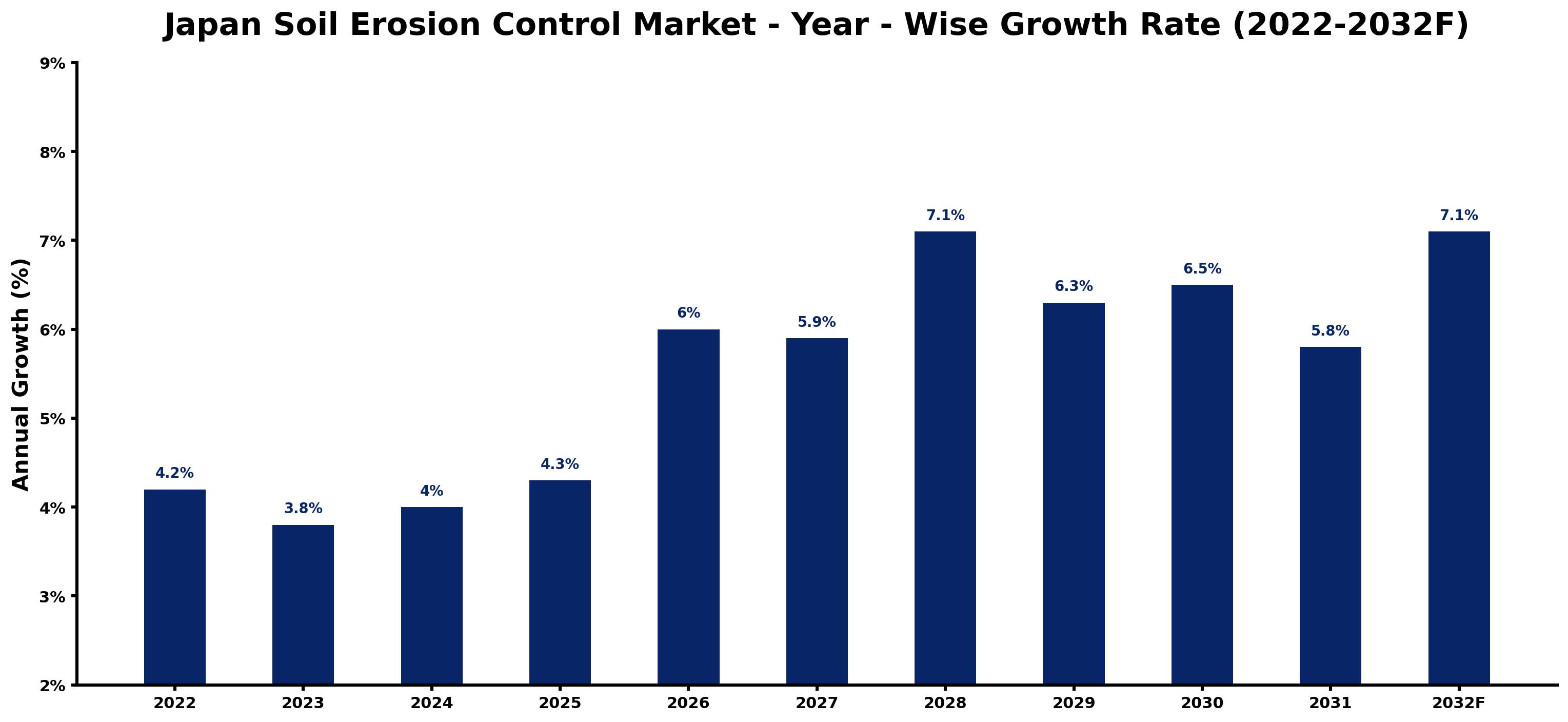
The table below sets out the estimated growth rate for each year and the main factor behind it.
| Year | Estimated Annual Growth (%) | Market Rationale |
| 2022 | 4.2 | The market showed steady growth due to ongoing urban development and environmental initiatives. |
| 2023 | 3.8 | Growth slowed as construction projects faced delays from supply chain disruptions. |
| 2024 | 4.0 | Increased investment in infrastructure projects spurred demand for erosion control solutions. |
| 2025 | 4.3 | The market experienced faster growth driven by heightened awareness of soil conservation. |
| 2026 | 6.0 | Demand is expected to surge as new road construction projects begin, boosting the use of geotextiles. |
| 2027 | 5.9 | Growth is projected to slow slightly as the market adjusts to new regulatory standards. |
| 2028 | 7.1 | The market is expected to rebound with increased focus on sustainable practices in construction. |
| 2029 | 6.3 | A slowdown is anticipated as projects face completion delays, impacting material demand. |
| 2030 | 6.5 | Growth is projected to accelerate with new government initiatives promoting eco-friendly infrastructure. |
| 2031 | 5.8 | The market is expected to experience a slowdown as competition intensifies among suppliers. |
| 2032 | 7.1 | Rising demand for effective erosion control solutions will drive significant market growth. |
Note: Market size estimations and growth projections presented in this report are based on 6Wresearch's proprietary forecasting methodology, utilizing the latest available industry data, government publications, and primary research inputs.
Japan Soil Erosion Control Market Synopsis
Soil erosion control products are essential for preventing soil degradation and are made from natural or synthetic materials. In Japan, the construction and infrastructure sectors are the primary consumers, driven by urban development and environmental conservation efforts. The Japan Soil Erosion Control Market is growing due to the increasing population, which creates a strong demand for effective erosion control solutions. In 2023, the government allocated funds for infrastructure improvement, amounting to JPY 150 trillion, further boosting demand for these products.
Market Dynamics Impact Analysis (2026–2032)
| Factor | Type | Impact | Primary Segment Affected |
| Urban development projects require effective erosion control measures to prevent soil loss. | Driver | High | Erosion Control Blankets |
| Growing awareness of environmental sustainability drives demand for eco-friendly materials. | Driver | High | Coir/Straw |
| Investment in infrastructure projects is increasing, creating a need for erosion control solutions. | Opportunity | High | Geotextiles |
| The government’s Green Growth Strategy encourages the use of sustainable materials. | Opportunity | Medium | Organic Material |
| Competition among suppliers may lead to price pressures affecting profitability. | Restraint | Medium | Synthetic Fiber |
| Regulatory compliance for materials can complicate procurement processes. | Restraint | High | Concrete |
| Supply chain disruptions can delay project timelines, impacting demand. | Challenge | High | Temporary |
| Technological advancements require continuous investment from suppliers to remain competitive. | Challenge | Medium | Engineered |
Evaluation of Drivers in Japan Soil Erosion Control Market (2026–2032)
These are the developments adding the most demand over the forecast period.
| Drivers | Primary Segment Affected | Why It Matters (Evidence) |
| Increased urbanisation leads to higher demand for erosion control products in construction projects. | Geotextiles | Japan's population of approximately 125 million creates a strong need for effective solutions. |
| The government’s focus on environmental conservation drives the adoption of sustainable materials. | Coir/Straw | The Waste Management and Public Cleansing Act regulates waste treatment, encouraging eco-friendly materials. |
| Rising awareness of soil erosion impacts leads to more projects focusing on effective control measures. | Erosion Control Blankets | The Japan Road Association promotes best practices for erosion control, increasing demand. |
| Investment in infrastructure improvement initiatives boosts demand for erosion control solutions. | Concrete | In 2023, the government allocated JPY 150 trillion for infrastructure projects, including erosion control measures. |
| Technological advancements in materials improve the effectiveness of erosion control solutions. | Synthetic Fiber | The Japan Geosynthetics Society provides guidelines for effective applications in civil engineering. |
The strongest pull on demand comes from urbanisation, with Japan's population of approximately 125 million creating a pressing need for effective erosion control solutions in construction projects. Advancements in materials enhance effectiveness, leading to greater purchasing from construction firms, particularly in road construction and infrastructure projects.
Evaluation of Restraints in Japan Soil Erosion Control Market
The following restraints limit how fast demand can grow.
| Market Restraint | Primary Segment Affected | Why It Matters (Evidence) |
| Intense competition among suppliers can lead to price pressures, affecting profitability. | Synthetic Fiber | Increased competition may result in lower profit margins for suppliers. |
| Regulatory compliance for materials complicates procurement processes for buyers. | Concrete | Buyers must navigate complex regulations, which can delay project timelines. |
| Supply chain disruptions can impact the availability of erosion control products. | Temporary | Delays in material supply can hinder project completion and increase costs. |
| Market saturation in certain regions may limit growth opportunities for suppliers. | Geotextiles | An oversupply of products can lead to reduced demand and lower prices. |
| Limited awareness of effective solutions may restrict market penetration. | Erosion Control Blankets | Buyers may be hesitant to adopt new technologies without proven benefits. |
Japan Soil Erosion Control Market Challenges
Japan's stringent erosion control regulations from the Ministry of Land, Infrastructure, Transport and Tourism delay project approvals for contractors, potentially extending timelines by up to six months. Compliance costs have risen, inflating project budgets by 15%, impacting construction firms reliant on cost efficiency. A shortage of skilled workers knowledgeable in erosion control techniques limits suppliers' ability to meet rising demands, especially in urban regions. Increased competition among local producers for government contracts can lower prices by 10%, which may reduce profit margins and affect product quality.
Trends in the Japan Soil Erosion Control Market
Four trends stand out in the Japan Soil Erosion Control Market.
- Shift towards Sustainable Materials in Construction: In 2023, the Tokyo Metropolitan Government initiated projects promoting sustainable erosion control measures, resulting in a notable increase in the use of eco-friendly materials in construction.
- Growing Adoption of Geotextiles in Road Construction: Since 2022, geotextiles have gained popularity in road construction projects across Japan, with a reported rise in usage due to their effectiveness.
- Increase in Awareness of Soil Conservation Practices: The Ministry of the Environment launched a campaign in 2023 to raise awareness about soil conservation, resulting in a marked increase in public engagement on the topic.
- Expansion of Infrastructure Projects in Urban Areas: In 2023, the government allocated substantial funds for infrastructure improvement, leading to an increase in erosion control measures in urban development.
Investment Opportunities in the Japan Soil Erosion Control Market
The opportunities below stand out in the Japan Soil Erosion Control Market for new entrants and existing suppliers.
- Timing for Investment in Sustainable Solutions: With the government's focus on sustainability, now is an ideal time to invest in eco-friendly erosion control products, targeting construction firms needing compliant solutions.
- Gap in Advanced Erosion Control Technologies: A growing need for effective solutions presents an opportunity to supply advanced erosion control technologies, particularly to infrastructure agencies focused on sustainable practices.
- Infrastructure Agencies Seeking Effective Solutions: Infrastructure agencies are increasingly looking for effective erosion control measures, creating opportunities for suppliers to provide tailored solutions that meet regulatory standards.
- Entry through Local Partnerships: Establishing local partnerships can facilitate entry into the market, especially for firms looking to supply erosion control products to road construction firms.
Government Initiatives in the Japan Soil Erosion Control Market
The Waste Management and Public Cleansing Act (1970) mandates measures to ensure proper waste treatment, impacting producers by requiring compliance with environmental standards. This law has shaped the erosion control framework in Japan, driving compliance among stakeholders and promoting soil preservation efforts. The Ministry of Land, Infrastructure, Transport and Tourism oversees erosion control projects, ensuring adherence to regulations and standards across the country, with a focus on sustainable practices.
In 2023, the government allocated JPY 150 trillion for public-private decarbonisation investment, overseen by the Ministry of the Environment. This funding supports various projects, including erosion control measures, promoting sustainable practices among producers and ensuring compliance with environmental standards.
Future Insight of the Japan Soil Erosion Control Market
New sustainable infrastructure projects will emerge by 2032, driven by government funding and environmental initiatives. The Tokyo Metropolitan Government's goal to cut soil erosion by 20% by 2025 will stimulate the use of effective erosion control solutions. Research from the National Institute for Land and Infrastructure Management will develop methods suited to Japan's geography, improving soil stability. The adoption of advanced materials in road construction will further strengthen resilience against climate change impacts.
Market Segmentation Analysis
Japan Soil Erosion Control Market report covers a detailed analysis of the following market segments:
By Solution Type – Erosion Control Blankets Lead, Geotextiles Expected to Grow Fastest
According to Saurav Kr Singh, Senior Research Analyst at 6Wresearch, in 2025, Erosion Control Blankets led the solution type split with a 47% share. Erosion control blankets have the largest share because they are extensively used for slope stabilization and vegetation support, especially in urban regions like Kanto. Their proven effectiveness during construction projects makes them vital for urban development efforts. Over 2026–2032, Geotextiles are expected to post the fastest growth, at a CAGR of 8.9%. Geotextiles are growing rapidly as they are increasingly employed for soil separation and reinforcement in the construction of new roads and highways across Japan. This surge is propelled by the government's commitment to sustainable infrastructure improvements and adherence to best practices. Suppliers must prioritise the availability of geotextiles to satisfy the increasing demand from construction initiatives.
By Material Used – Coir/Straw Leads, Synthetic Fiber Expected to Grow Fastest
Coir/Straw held 48% of the Japan Soil Erosion Control Market by material used in 2025. Coir/straw materials lead the market due to their eco-friendly applications and alignment with Japan's environmental objectives, including the Green Growth Strategy. Their natural composition attracts buyers looking for sustainable erosion control solutions. Synthetic Fiber is set to record the highest CAGR in this split, 9.8% over 2026–2032. Synthetic fibers are experiencing the fastest growth owing to their durability and effectiveness in various erosion control applications. This material's robustness is particularly attractive as infrastructure projects expand and demand long-lasting solutions. Buyers can expect a broader selection of durable synthetic options as demand continues to increase.
By Installation Type – Temporary Leads, Permanent Expected to Grow Fastest
With 41% of installation type revenue in 2025, Temporary was the largest category. Temporary installations lead the market as they are commonly used for short-term projects requiring immediate stabilization, particularly in disaster-prone areas. Their flexibility in application makes them a preferred choice for quick response measures. The quickest growth will come from Permanent, forecast to expand at a CAGR of 9.0% between 2026 and 2032. Permanent installations are growing rapidly as they provide long-lasting erosion control solutions that align with Japan's infrastructure improvement goals. The increasing emphasis on sustainable practices in construction is driving this trend. Suppliers should prepare for increased demand for permanent solutions as infrastructure projects prioritise long-term stability.
By End User – Road Construction Firms Lead, Infrastructure Agencies Expected to Grow Fastest
Road Construction Firms accounted for 39% of the market by end user in 2025. Road construction firms are the largest users of soil erosion control products, primarily for their critical role in infrastructure projects across Japan. The ongoing urban development and government initiatives ensure a steady demand from this sector. Infrastructure Agencies are projected to grow fastest, at a CAGR of 8.2% during 2026–2032. Infrastructure agencies are the fastest-growing end users as they implement regulatory measures for erosion control in various projects. Their active involvement in promoting best practices is essential for meeting national sustainability targets. Suppliers must engage with infrastructure agencies to align their offerings with regulatory requirements and sustainability initiatives.
Key Attractiveness of the Report
- 10 Years of Market Numbers
- Historical Data Starting from 2022 to 2025
- Base Year 2025
- Forecast Data until 2032
- Key Performance Indicators Impacting the Market
- Major Upcoming Developments and Projects
Key Highlights of the Report:
- Japan Soil Erosion Control Market Outlook
- Market Size of Japan Soil Erosion Control Market, 2025
- Forecast of Japan Soil Erosion Control Market, 2032
- Historical Data and Forecast of Japan Soil Erosion Control Revenues & Volume for the Period 2022-2032F
- Japan Soil Erosion Control Market Trend Evolution
- Japan Soil Erosion Control Market Drivers and Challenges
- Japan Soil Erosion Control Price Trends
- Japan Soil Erosion Control Porter's Five Forces
- Japan Soil Erosion Control Industry Life Cycle
- Historical Data and Forecast of Japan Soil Erosion Control Market Revenues & Volume By Solution Type for the Period 2022-2032F
- Historical Data and Forecast of Japan Soil Erosion Control Market Revenues & Volume By Erosion Control Blankets for the Period 2022-2032F
- Historical Data and Forecast of Japan Soil Erosion Control Market Revenues & Volume By Geotextiles for the Period 2022-2032F
- Historical Data and Forecast of Japan Soil Erosion Control Market Revenues & Volume By Mulching for the Period 2022-2032F
- Historical Data and Forecast of Japan Soil Erosion Control Market Revenues & Volume By Retaining Walls for the Period 2022-2032F
- Historical Data and Forecast of Japan Soil Erosion Control Market Revenues & Volume By Material Used for the Period 2022-2032F
- Historical Data and Forecast of Japan Soil Erosion Control Market Revenues & Volume By Coir/Straw for the Period 2022-2032F
- Historical Data and Forecast of Japan Soil Erosion Control Market Revenues & Volume By Synthetic Fiber for the Period 2022-2032F
- Historical Data and Forecast of Japan Soil Erosion Control Market Revenues & Volume By Organic Material for the Period 2022-2032F
- Historical Data and Forecast of Japan Soil Erosion Control Market Revenues & Volume By Concrete for the Period 2022-2032F
- Historical Data and Forecast of Japan Soil Erosion Control Market Revenues & Volume By Installation Type for the Period 2022-2032F
- Historical Data and Forecast of Japan Soil Erosion Control Market Revenues & Volume By Temporary for the Period 2022-2032F
- Historical Data and Forecast of Japan Soil Erosion Control Market Revenues & Volume By Permanent for the Period 2022-2032F
- Historical Data and Forecast of Japan Soil Erosion Control Market Revenues & Volume By Manual for the Period 2022-2032F
- Historical Data and Forecast of Japan Soil Erosion Control Market Revenues & Volume By Engineered for the Period 2022-2032F
- Historical Data and Forecast of Japan Soil Erosion Control Market Revenues & Volume By End User for the Period 2022-2032F
- Historical Data and Forecast of Japan Soil Erosion Control Market Revenues & Volume By Road Construction Firms for the Period 2022-2032F
- Historical Data and Forecast of Japan Soil Erosion Control Market Revenues & Volume By Infrastructure Agencies for the Period 2022-2032F
- Historical Data and Forecast of Japan Soil Erosion Control Market Revenues & Volume By Plantation Owners for the Period 2022-2032F
- Historical Data and Forecast of Japan Soil Erosion Control Market Revenues & Volume By Mining Companies for the Period 2022-2032F
- Japan Soil Erosion Control Import Export Trade Statistics
- Market Opportunity Assessment By Solution Type
- Market Opportunity Assessment By Material Used
- Market Opportunity Assessment By Installation Type
- Market Opportunity Assessment By End User
- Japan Soil Erosion Control Top Companies Market Share
- Japan Soil Erosion Control Competitive Benchmarking By Technical and Operational Parameters
- Japan Soil Erosion Control Company Profiles
- Japan Soil Erosion Control Key Strategic Recommendations
Market Covered
The following segment groups are covered in the report.
By Solution Type
- Erosion Control Blankets
- Geotextiles
- Mulching
- Retaining Walls
By Material Used
- Coir/Straw
- Synthetic Fiber
- Organic Material
- Concrete
By Installation Type
- Temporary
- Permanent
- Manual
- Engineered
By End User
- Road Construction Firms
- Infrastructure Agencies
- Plantation Owners
- Mining Companies































