Japan Solar Mounting Systems Market Size & Growth Rate
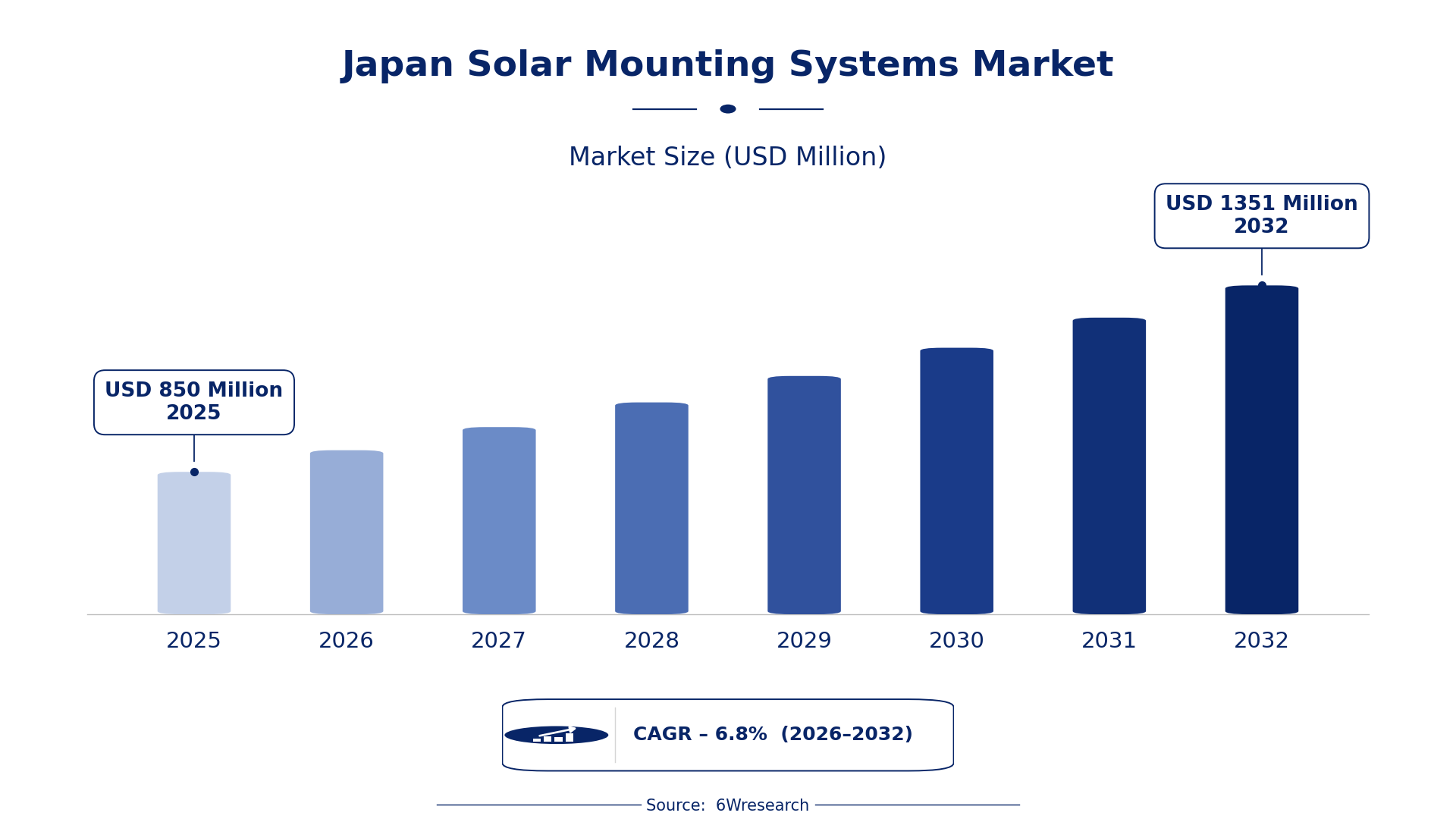
According to 6Wresearch internal database and industry insights, the Japan Solar Mounting Systems Market was valued at USD 850 Million in 2025 and is projected to reach USD 1,351 Million by 2032, growing at a CAGR of approximately 6.8% during 2026–2032.
Japan Solar Mounting Systems Market Highlights
| Report Metric | Details |
| Report Name | Japan Solar Mounting Systems Market (2026-2032) |
| Market Size 2025 | USD 850 Million |
| Market Size 2032 | USD 1,351 Million |
| Absolute Growth 2025–2032 | USD 501 Million |
| CAGR 2026–2032 | 6.8% |
| Peak Annual Growth | 7.8% in 2030 |
| Forecast Period | 2026–2032 |
| Historical Data | 2022–2025 |
| Base Year | 2025 |
| Leading Mounting Type, 2025 | Ground-Mounted (44% share) |
| Leading Structure Material, 2025 | Galvanized Steel (49% share) |
| Leading Orientation Type, 2025 | Fixed Tilt (50% share) |
| Leading End User, 2025 | Solar Farms (49% share) |
| Fastest-Growing Mounting Type | Floating Mounting (9.5% CAGR) |
| Fastest-Growing Structure Material | Aluminum Frames (9.6% CAGR) |
| Fastest-Growing Orientation Type | Adjustable Tilt (9.9% CAGR) |
| Fastest-Growing End User | Commercial Buildings (8.9% CAGR) |
| Growing Sector | Solar Farms |
| Key End Users | Commercial Buildings, Solar Farms, Residential Users |
Japan Solar Mounting Systems Market Year-wise Growth Rate and Key Drivers (2022–2032)
This graph illustrates the annual growth rates of the market from 2022 to 2032, highlighting a steady upward trajectory and projected market expansion over the forecast period.
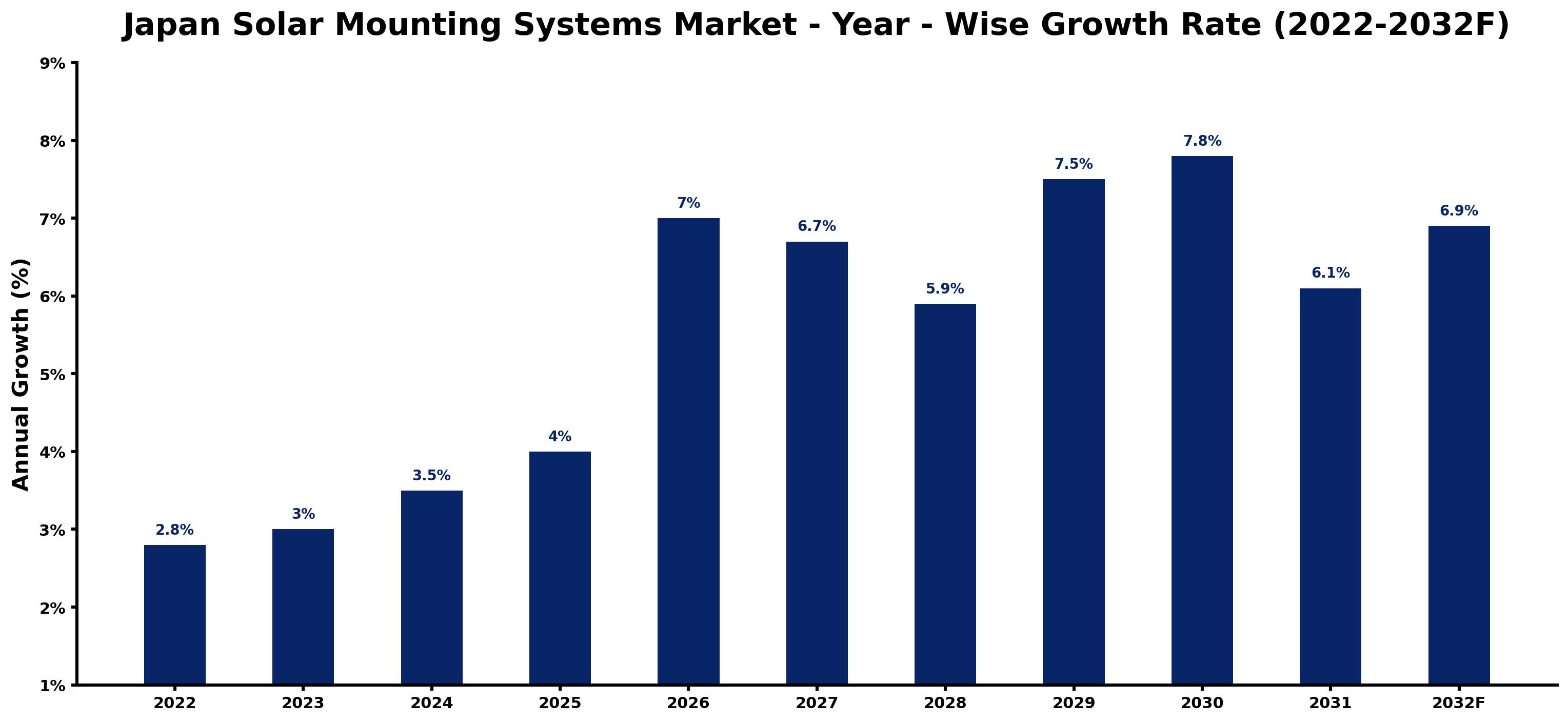
The following figures match every annual growth estimate with the main market development of that year, giving the reasoning behind each rise or slowdown.
| Year | Estimated Annual Growth (%) | Market Rationale |
| 2022 | 2.8 | The market experienced steady growth as solar capacity reached 75 GW in Japan. |
| 2023 | 3.0 | Demand increased due to rising installations in commercial buildings across Tokyo. |
| 2024 | 3.5 | The market continued to grow with more solar farms being established in the Tohoku region. |
| 2025 | 4.0 | Growth peaked as the government aimed for 36% renewable energy by 2030. |
| 2026 | 7.0 | The market is expected to see a rise driven by new investments in solar technology. |
| 2027 | 6.7 | Growth is projected to slow slightly as the market adjusts to previous high demand levels. |
| 2028 | 5.9 | Demand is anticipated to continue slowing, but installations remain strong in urban areas. |
| 2029 | 7.5 | A resurgence in growth is expected as floating solar systems gain popularity. |
| 2030 | 7.8 | The market is projected to peak with a surge in orders for ground-mounted systems. |
| 2031 | 6.1 | Growth is expected to slow as the market stabilises after reaching peak capacity. |
| 2032 | 6.9 | Demand is projected to rise again as new projects come online. |
Note: Market size estimations and growth projections presented in this report are based on 6Wresearch's proprietary forecasting methodology, utilizing the latest available industry data, government publications, and primary research inputs.
Japan Solar Mounting Systems Market Synopsis
Solar mounting systems are structures that support solar panels, typically constructed from galvanized steel or aluminium. Japan's solar capacity reached 75 GW in 2022, reflecting strong demand from domestic users and ongoing investments in renewable energy initiatives. The Japan Solar Mounting Systems Market is expanding due to government targets for renewable energy, increased installations in commercial buildings, and rising interest in solar farms, particularly in the Tohoku region.
Market Dynamics Impact Analysis (2026–2032)
| Factor | Type | Impact | Primary Segment Affected |
| Government targets for renewable energy adoption | Driver | High | Ground-Mounted |
| Increased investment in solar technology and infrastructure | Driver | High | Rooftop Mounting |
| Growing demand for renewable energy sources | Opportunity | High | Solar Farms |
| Expansion of floating solar systems in water bodies | Opportunity | Medium | Floating Mounting |
| High installation costs for rooftop systems | Restraint | High | Rooftop Mounting |
| Limited applications of floating mounting systems | Restraint | Medium | Floating Mounting |
| Supply chain disruptions affecting material availability | Challenge | High | Ground-Mounted |
| Regulatory compliance costs for new installations | Challenge | Medium | Rooftop Mounting |
Evaluation of Drivers in Japan Solar Mounting Systems Market (2026–2032)
The factors lifting demand, and the evidence behind each, are summarised below.
| Drivers | Primary Segment Affected | Why It Matters (Evidence) |
| Government targets for renewable energy | Solar Farms | The commitment to achieving 36% renewable energy by 2030 drives demand for solar farms, leading to increased installations in regions like Tohoku. |
| Rising energy costs in urban areas | Rooftop Mounting | As energy prices rise, commercial buildings are increasingly adopting rooftop mounting systems to reduce energy expenses, with Tokyo having over 10,000 installations. |
| Technological advancements in materials | Aluminum Frames | Innovations in aluminum frames enhance their appeal due to lightweight and corrosion-resistant properties, encouraging buyers to invest in these systems. |
| Increased interest in floating solar systems | Floating Mounting | Growing installations in over 20 water bodies across Japan highlight the demand for floating solar systems, particularly in specific applications. |
| Expansion of solar farm installations | Ground-Mounted | The Tohoku region's significant solar farm installations contribute to the overall market growth, with Japan's solar capacity reaching 75 GW in 2022. |
Behind the steady rise in orders sits the increasing interest in solar energy solutions across Japan. The commitment to achieving 36% renewable energy by 2030 is driving demand for solar farms, particularly in the Tohoku region, where installations are expanding. In urban areas, rising energy costs are prompting commercial buildings to adopt rooftop mounting systems, while floating solar systems are gaining traction in over 20 water bodies. Advances in technology are making aluminum frames more appealing due to their lightweight and durable nature, encouraging buyers to invest in these systems. This combination of factors is boosting demand across various segments of the market, with the average installation cost for rooftop systems around ¥300,000 per kW.
Evaluation of Restraints in Japan Solar Mounting Systems Market
The main factors holding the market back are set out below.
| Market Restraint | Primary Segment Affected | Why It Matters (Evidence) |
| High installation costs for rooftop systems | Rooftop Mounting | The average installation cost for rooftop systems is around ¥300,000 per kW, limiting adoption. |
| Limited applications of floating mounting systems | Floating Mounting | Floating systems are niche and not widely adopted, affecting overall market growth. |
| Supply chain disruptions affecting material availability | Ground-Mounted | Material shortages can delay project timelines and increase costs for buyers, impacting installations. |
| Regulatory compliance costs for new installations | Rooftop Mounting | Compliance with standards like ISO 9001 raises costs for producers and installers, affecting pricing. |
| Competition from alternative energy sources | Solar Farms | Emerging technologies in energy generation may divert investments away from solar, impacting market share. |
Japan Solar Mounting Systems Market Challenges
High demand for solar mounting systems is straining supply chains, causing production delays for manufacturers. Limited availability of galvanized steel has resulted in increased lead times of up to three months for system delivery. Skills shortages in the workforce hinder installation processes, extending project timelines by over 20% for buyers. Many installers lack the necessary training, complicating installations and raising costs, with average installation prices reaching ¥300,000 per kW. Outdated technology in manufacturing processes restricts efficiency, impacting overall production capacity for manufacturers and leading to potential project cancellations.
Trends in the Japan Solar Mounting Systems Market
Several trends are reshaping the Japan Solar Mounting Systems Market; the most important are set out below.
- Shift from Ground-Mounted to Floating Systems: Since 2025, there has been a notable shift towards floating solar systems as they address land scarcity. Over 20 water bodies now host these systems, reflecting a growing trend in renewable energy solutions.
- Increase in Commercial Rooftop Installations: In 2023, over 50% of new commercial buildings included solar panels, showcasing a shift towards sustainable energy use. This trend is driven by rising energy costs and government incentives.
- Adoption of Aluminum Frames Over Steel: The preference for aluminium frames has increased due to their lightweight and corrosion-resistant properties. This shift is projected to grow at a CAGR of 9.6%.
- Growing Demand for Adjustable Tilt Systems: Since 2026, adjustable tilt mounting systems have gained traction, with a CAGR of 9.9%. This trend is driven by the need for optimised solar energy capture in varying conditions.
Investment Opportunities in the Japan Solar Mounting Systems Market
The opportunities below stand out in the Japan Solar Mounting Systems Market for new entrants and existing suppliers.
- Supply of Galvanized Steel for Mounting Systems: With galvanized steel being the most used material, suppliers can target solar farms, which accounted for 49% of installations in 2025. This presents an opportunity to partner with local manufacturers.
- Expansion in the Tohoku Region: The Tohoku region is a key area for solar farm installations, making it an ideal location for new projects. Suppliers can enter through joint ventures with local firms.
- Investment in Floating Solar Technology: Now is the time to invest in floating solar systems, which are gaining popularity across Japan. Collaborating with regional authorities can facilitate approvals and project launches.
- Development of Adjustable Tilt Systems: Investing in adjustable tilt systems aligns with the growing need for optimised solar energy capture. Engaging with commercial building developers can open new market avenues.
Government Initiatives in the Japan Solar Mounting Systems Market
The Economic Security Promotion Act (2022) enhances supply-chain resilience for critical materials, building on earlier laws like the PRTR Law (1999). This measure ensures that producers of solar mounting systems can secure necessary materials more reliably, thus supporting market stability.
The government aims for 36% renewable energy by 2030, with the Ministry of the Environment overseeing initiatives that fund solar energy projects. This includes subsidies that encourage the adoption of solar mounting systems, benefiting both producers and buyers.
Future Insight of the Japan Solar Mounting Systems Market
New ground-mounted solar farms will emerge across the Tohoku region by 2032, driven by government initiatives to enhance renewable energy capacity. This expansion will provide buyers with more options and potentially lower costs due to economies of scale. Automation in manufacturing will streamline production processes, allowing suppliers to meet rising demand more effectively. The adoption of advanced materials will improve system durability and performance, benefiting both buyers and suppliers in the long term.
Market Segmentation Analysis
Japan Solar Mounting Systems Market report covers a detailed analysis of the following market segments:
By Mounting Type – Ground-Mounted Leads, Floating Mounting Expected to Grow Fastest
According to Saurav Kr Singh, Senior Research Analyst at 6Wresearch, in 2025, Ground-Mounted led the mounting type split with a 44% share. Ground-mounted systems hold the largest share as they are extensively used in solar farms, ensuring stability and efficiency for large-scale energy production. The Tohoku region illustrates this trend with numerous solar farm projects relying on these mounting structures. Over 2026–2032, Floating Mounting is expected to post the fastest growth, at a CAGR of 9.5%. Floating mounting systems are rapidly gaining traction as they are deployed in over 20 water bodies across Japan, effectively utilising otherwise unused spaces for solar energy generation. This growth is expected to continue as more aquatic projects are initiated. Suppliers should prioritise the development of floating systems to seize emerging market opportunities.
By Structure Material – Galvanized Steel Leads, Aluminum Frames Expected to Grow Fastest
Galvanized Steel held 49% of the Japan Solar Mounting Systems Market by structure material in 2025. Galvanized steel holds the largest share because it is preferred for its durability and corrosion resistance, making it ideal for various environmental conditions. Its widespread use in installations across Japan solidifies its position as the leading material. The quickest growth will come from Aluminum Frames, forecast to expand at a CAGR of 9.6% between 2026 and 2032. Aluminum frames are growing quickly due to their lightweight nature and resistance to corrosion, appealing to installers seeking efficient solutions. This trend is likely to expand as more projects prioritise ease of handling and installation. Buyers may benefit from considering aluminum options for projects requiring lightweight and corrosion-resistant materials.
By Orientation Type – Fixed Tilt Leads, Adjustable Tilt Expected to Grow Fastest
With 50% of orientation type revenue in 2025, Fixed Tilt was the largest category. Fixed tilt systems lead the market as they are the most common orientation for solar installations, effectively maximising sunlight exposure. Their straightforward design is preferred for numerous projects, particularly in regions like Tohoku where solar farms are prevalent. Adjustable Tilt is set to record the highest CAGR in this split, 9.9% over 2026–2032. Adjustable tilt systems are rapidly gaining traction as they allow for optimisation of angle in specific scenarios, which enhances energy capture. This growth reflects a trend towards flexible solutions that can adapt to varying environmental conditions. Suppliers must consider offering adjustable tilt systems to meet the increasing demand for optimised solar energy solutions.
By End User – Solar Farms Lead, Commercial Buildings Expected to Grow Fastest
Solar Farms accounted for 49% of the market by end user in 2025. Solar farms represent the largest segment due to their design for large-scale energy production, significantly contributing to Japan's renewable energy goals. The substantial solar capacity of 75 GW in 2022 highlights the importance of this end user in the market. Commercial Buildings are projected to grow fastest, at a CAGR of 8.9% during 2026–2032. Commercial buildings are experiencing the fastest growth driven by the rising number of installations aimed at energy savings, with over 50% of new buildings incorporating solar panels. This trend indicates a growing awareness of energy efficiency among businesses. Suppliers should prioritise the commercial sector to take advantage of the increasing trend of solar installations in buildings.
Key Attractiveness of the Report
- 10 Years of Market Numbers
- Historical Data Starting from 2022 to 2025
- Base Year 2025
- Forecast Data until 2032
- Key Performance Indicators Impacting the Market
- Major Upcoming Developments and Projects
Key Highlights of the Report:
- Japan Solar Mounting Systems Market Outlook
- Market Size of Japan Solar Mounting Systems Market, 2025
- Forecast of Japan Solar Mounting Systems Market, 2032
- Historical Data and Forecast of Japan Solar Mounting Systems Revenues & Volume for the Period 2022-2032F
- Japan Solar Mounting Systems Market Trend Evolution
- Japan Solar Mounting Systems Market Drivers and Challenges
- Japan Solar Mounting Systems Price Trends
- Japan Solar Mounting Systems Porter's Five Forces
- Japan Solar Mounting Systems Industry Life Cycle
- Historical Data and Forecast of Japan Solar Mounting Systems Market Revenues & Volume By Mounting Type for the Period 2022-2032F
- Historical Data and Forecast of Japan Solar Mounting Systems Market Revenues & Volume By Ground-Mounted for the Period 2022-2032F
- Historical Data and Forecast of Japan Solar Mounting Systems Market Revenues & Volume By Rooftop Mounting for the Period 2022-2032F
- Historical Data and Forecast of Japan Solar Mounting Systems Market Revenues & Volume By Floating Mounting for the Period 2022-2032F
- Historical Data and Forecast of Japan Solar Mounting Systems Market Revenues & Volume By Pole-Mounted for the Period 2022-2032F
- Historical Data and Forecast of Japan Solar Mounting Systems Market Revenues & Volume By Structure Material for the Period 2022-2032F
- Historical Data and Forecast of Japan Solar Mounting Systems Market Revenues & Volume By Galvanized Steel for the Period 2022-2032F
- Historical Data and Forecast of Japan Solar Mounting Systems Market Revenues & Volume By Aluminum Frames for the Period 2022-2032F
- Historical Data and Forecast of Japan Solar Mounting Systems Market Revenues & Volume By High-Density Polymer for the Period 2022-2032F
- Historical Data and Forecast of Japan Solar Mounting Systems Market Revenues & Volume By Steel/Concrete Base for the Period 2022-2032F
- Historical Data and Forecast of Japan Solar Mounting Systems Market Revenues & Volume By Orientation Type for the Period 2022-2032F
- Historical Data and Forecast of Japan Solar Mounting Systems Market Revenues & Volume By Fixed Tilt for the Period 2022-2032F
- Historical Data and Forecast of Japan Solar Mounting Systems Market Revenues & Volume By Adjustable Tilt for the Period 2022-2032F
- Historical Data and Forecast of Japan Solar Mounting Systems Market Revenues & Volume By Horizontal for the Period 2022-2032F
- Historical Data and Forecast of Japan Solar Mounting Systems Market Revenues & Volume By Vertical Axis for the Period 2022-2032F
- Historical Data and Forecast of Japan Solar Mounting Systems Market Revenues & Volume By End User for the Period 2022-2032F
- Historical Data and Forecast of Japan Solar Mounting Systems Market Revenues & Volume By Solar Farms for the Period 2022-2032F
- Historical Data and Forecast of Japan Solar Mounting Systems Market Revenues & Volume By Commercial Buildings for the Period 2022-2032F
- Historical Data and Forecast of Japan Solar Mounting Systems Market Revenues & Volume By Water Bodies for the Period 2022-2032F
- Historical Data and Forecast of Japan Solar Mounting Systems Market Revenues & Volume By Telecom Towers for the Period 2022-2032F
- Japan Solar Mounting Systems Import Export Trade Statistics
- Market Opportunity Assessment By Mounting Type
- Market Opportunity Assessment By Structure Material
- Market Opportunity Assessment By Orientation Type
- Market Opportunity Assessment By End User
- Japan Solar Mounting Systems Top Companies Market Share
- Japan Solar Mounting Systems Competitive Benchmarking By Technical and Operational Parameters
- Japan Solar Mounting Systems Company Profiles
- Japan Solar Mounting Systems Key Strategic Recommendations
Market Covered
Coverage by segment is as follows.
By Mounting Type
- Ground-Mounted
- Rooftop Mounting
- Floating Mounting
- Pole-Mounted
By Structure Material
- Galvanized Steel
- Aluminum Frames
- High-Density Polymer
- Steel/Concrete Base
By Orientation Type
- Fixed Tilt
- Adjustable Tilt
- Horizontal
- Vertical Axis
By End User
- Solar Farms
- Commercial Buildings
- Water Bodies
- Telecom Towers































