Japan Solar Panel Cleaning Equipment Market Size & Growth Rate
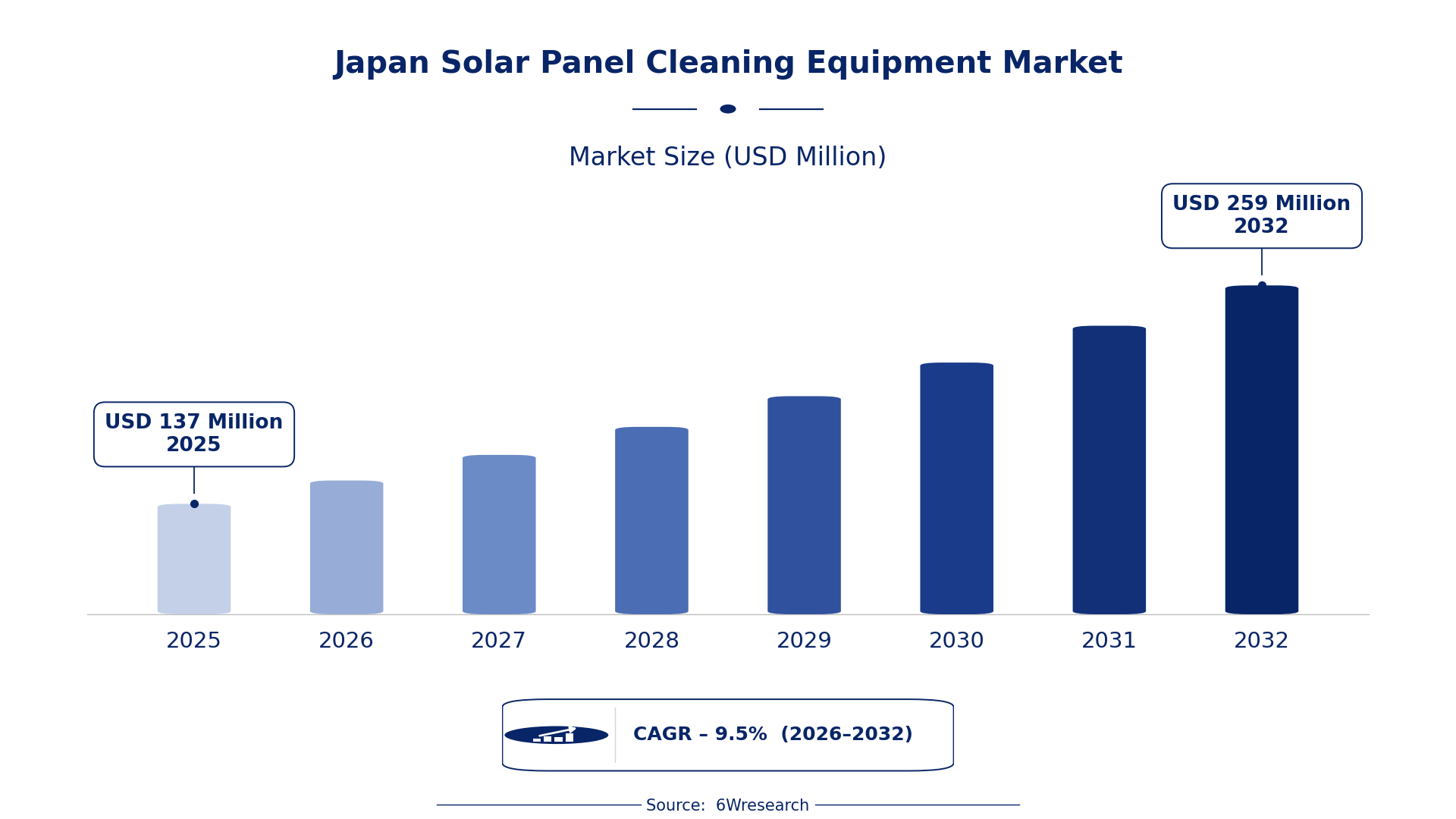
According to 6Wresearch internal database and industry insights, the Japan Solar Panel Cleaning Equipment Market was valued at USD 137 Million in 2025 and is projected to reach USD 259 Million by 2032, growing at a CAGR of approximately 9.5% during 2026–2032.
Japan Solar Panel Cleaning Equipment Market Highlights
| Report Metric | Details |
| Report Name | Japan Solar Panel Cleaning Equipment Market (2026-2032) |
| Market Size 2025 | USD 137 Million |
| Market Size 2032 | USD 259 Million |
| Absolute Growth 2025–2032 | USD 122 Million |
| CAGR 2026–2032 | 9.5% |
| Peak Annual Growth | 10.3% in 2032 |
| Forecast Period | 2026–2032 |
| Historical Data | 2022–2025 |
| Base Year | 2025 |
| Leading Type, 2025 | Water-based Systems (55% share) |
| Leading Installation, 2025 | Rooftops (44% share) |
| Leading Land Utility Scale, 2025 | Up to 10 MW (40% share) |
| Leading Application, 2025 | Residential (43% share) |
| Leading Distribution Channel, 2025 | Online (58% share) |
| Fastest-Growing Type | Robotic (11.4% CAGR) |
| Fastest-Growing Installation | Floating PV (12.1% CAGR) |
| Fastest-Growing Land Utility Scale | 11 - 50 MW (12.5% CAGR) |
| Fastest-Growing Application | Commercial/Industrial (12.7% CAGR) |
| Fastest-Growing Distribution Channel | Offline (12.0% CAGR) |
| Growing Sector | Residential solar installations |
| Key End Users | Residential users, commercial operators, utility companies |
Japan Solar Panel Cleaning Equipment Market Year-wise Growth Rate and Key Drivers (2022–2032)
This graph illustrates the annual growth rates of the market from 2022 to 2032, highlighting a steady upward trajectory and projected market expansion over the forecast period.
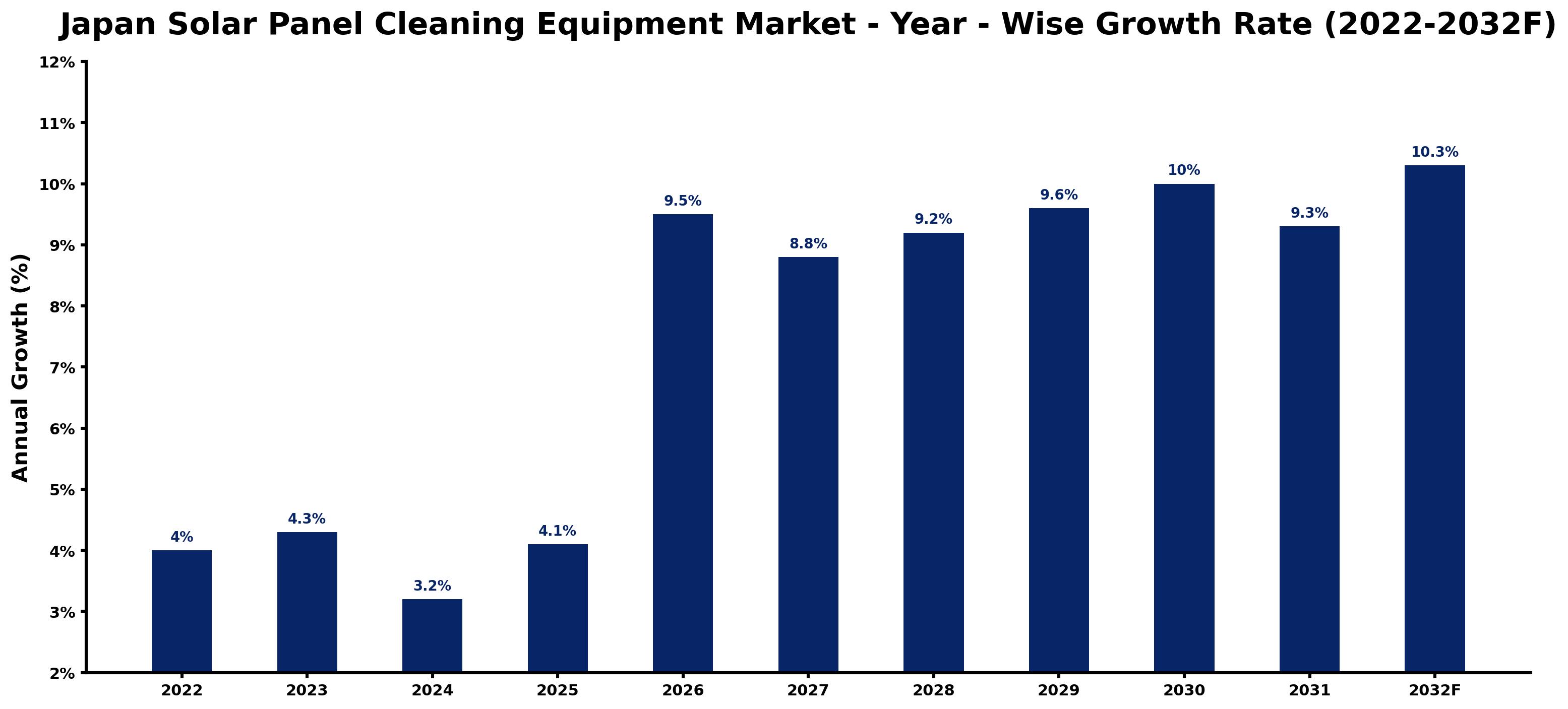
For each year, the table pairs the estimated growth rate with the leading influence on demand, showing how the drivers changed across the period.
| Year | Estimated Annual Growth (%) | Market Rationale |
| 2022 | 4.0 | The market showed moderate growth due to steady solar panel installations. |
| 2023 | 4.3 | Growth accelerated as awareness of cleaning equipment benefits increased. |
| 2024 | 3.2 | A slowdown occurred as some users delayed equipment purchases. |
| 2025 | 4.1 | Demand picked up again with rising residential solar installations. |
| 2026 | 9.5 | Growth surged as robotic cleaning systems gained popularity. |
| 2027 | 8.8 | A slight slowdown followed as market saturation began to set in. |
| 2028 | 9.2 | Demand increased again with more floating PV installations. |
| 2029 | 9.6 | Growth continued as efficiency losses prompted more purchases. |
| 2030 | 10.0 | The market expanded rapidly as government targets boosted installations. |
| 2031 | 9.3 | A slowdown occurred as competition intensified among suppliers. |
| 2032 | 10.3 | Growth peaked due to a surge in utility-scale projects. |
Note: Market size estimations and growth projections presented in this report are based on 6Wresearch's proprietary forecasting methodology, utilizing the latest available industry data, government publications, and primary research inputs.
Japan Solar Panel Cleaning Equipment Market Synopsis
Solar panel cleaning equipment is essential for maintaining the efficiency of photovoltaic systems by removing dirt and debris. The Japan Solar Panel Cleaning Equipment Market is expanding due to a surge in solar power capacity, which reached 75 GW in 2023, alongside a government target to raise solar energy's share to 36-38% of total electricity by 2030. The rise of robotic cleaning systems and the expansion of floating PV installations are also contributing to new demand, with the residential solar market accounting for 30% of total installations in 2023.
Market Dynamics Impact Analysis (2026–2032)
| Factor | Type | Impact | Primary Segment Affected |
| Growing solar installations in residential areas | Driver | High | Rooftops |
| Increasing adoption of robotic cleaning technologies | Driver | High | Robotic |
| Emerging demand for cleaning equipment in floating PV projects | Opportunity | Medium | Floating PV |
| Rising online sales channels for cleaning equipment | Opportunity | Medium | Online |
| High initial investment costs for robotic systems | Restraint | High | Robotic |
| Limited awareness of cleaning equipment benefits among users | Restraint | Medium | Water-based Systems |
| Competition from low-cost alternatives | Challenge | High | Water-based Systems |
| Dependence on fluctuating solar energy policies | Challenge | Medium | Utility |
Evaluation of Drivers in Japan Solar Panel Cleaning Equipment Market (2026–2032)
Below are the drivers that matter most for revenue growth, with supporting evidence.
| Drivers | Primary Segment Affected | Why It Matters (Evidence) |
| Increasing residential solar installations | Rooftops | The residential solar market accounted for 30% of total installations in 2023, driving demand for cleaning equipment. |
| Popularity of robotic cleaning systems | Robotic | Robotic systems are gaining traction in commercial installations, improving efficiency and reducing labor costs. |
| Government initiatives promoting solar energy | Utility | The government aims to increase solar energy to 36-38% of total electricity by 2030, boosting demand for cleaning solutions. |
| Efficiency losses due to dirt on panels | Water-based Systems | The average efficiency loss due to dirt can be up to 20%, prompting users to invest in cleaning equipment. |
| Growth in online sales channels | Online | Online sales of solar cleaning equipment grew by 15% in 2023, reflecting changing purchasing habits. |
Purchasing is picking up as the residential solar market accounted for 30% of total installations in 2023, driving demand for cleaning equipment. The popularity of robotic cleaning systems is rising in commercial installations, improving efficiency and reducing labor costs. Efficiency losses due to dirt can reach up to 20%, prompting users to invest in cleaning solutions. Online sales of solar cleaning equipment grew by 15% in 2023, reflecting changing purchasing habits.
Evaluation of Restraints in Japan Solar Panel Cleaning Equipment Market
The table below lists the restraints and the evidence behind each.
| Market Restraint | Primary Segment Affected | Why It Matters (Evidence) |
| High initial investment costs for robotic systems | Robotic | Robotic cleaning systems require substantial upfront investment, limiting their adoption among smaller solar operators. |
| Limited awareness of cleaning equipment benefits among users | Water-based Systems | Many potential users lack knowledge about the efficiency gains from regular cleaning, hindering market growth. |
| Competition from low-cost alternatives | Water-based Systems | Low-cost cleaning options deter users from investing in more effective solutions, impacting sales. |
| Dependence on fluctuating solar energy policies | Utility | Changes in government policies can affect investment in solar projects, influencing demand for cleaning equipment. |
| Slow adoption of new technologies in traditional sectors | Robotic | Traditional sectors may resist adopting robotic systems due to perceived risks and costs. |
Japan Solar Panel Cleaning Equipment Market Challenges
Robotic cleaning systems are becoming more popular in commercial installations, yet their high initial cost can deter potential buyers, resulting in a 15% delay in efficiency improvements for solar energy providers. Residential buyers often face an average efficiency loss of up to 20% due to dirt accumulation on panels, leading to revenue losses that can amount to JPY 1 million annually. A shortage of skilled technicians in specialised cleaning methods hampers suppliers' ability to meet rising demand, causing project delays of up to six months. Technology adoption remains slow, with only 30% of installations utilising advanced cleaning systems, restricting overall market performance.
Trends in the Japan Solar Panel Cleaning Equipment Market
The trends below show where the Japan Solar Panel Cleaning Equipment Market is heading.
- Shift Towards Robotic Cleaning Systems: Commercial installations are increasingly adopting robotic cleaning systems, which improve efficiency and reduce labor costs. This shift began in 2023, reflecting changing buyer preferences.
- Growth of Floating PV Installations: Floating PV installations are on the rise in regions with limited land availability. This segment began expanding in 2023, prompting increased demand for specialized cleaning equipment.
- Increase in Online Sales Channels: Online sales of solar cleaning equipment grew by 15% in 2023, indicating a shift in purchasing behaviour. Buyers are increasingly turning to digital platforms for convenience.
- Rising Awareness of Efficiency Losses: Awareness of efficiency losses due to dirt on panels is growing among solar panel owners. The average efficiency loss can be up to 20%, driving demand for cleaning solutions.
Investment Opportunities in the Japan Solar Panel Cleaning Equipment Market
Investors looking at the Japan Solar Panel Cleaning Equipment Market should consider the following areas.
- Gap in Robotic Cleaning Solutions: With robotic cleaning systems expected to grow at a CAGR of 11.4%, a supply gap exists. Targeting commercial installations in urban areas can yield substantial returns.
- Entry Through Partnerships: Establishing partnerships with local distributors can facilitate entry into the Japanese market. The expanding residential sector presents opportunities for cleaning equipment suppliers.
- Demand from Utility-Scale Projects: Utility-scale projects are projected to dominate the market, creating a need for efficient cleaning solutions. Suppliers can focus on large-scale solar farms for potential contracts.
- Expansion in Floating PV Regions: Regions with limited land availability are increasingly adopting floating PV technology. Suppliers should concentrate on providing cleaning solutions tailored for these installations.
Government Initiatives in the Japan Solar Panel Cleaning Equipment Market
The Industrial Safety and Health Act (1972) mandates employer responsibilities regarding hazardous substances and machinery, ensuring that producers of solar panel cleaning equipment meet safety standards. Compliance with these regulations is essential for market participants to operate effectively and maintain quality.
The GX Basic Policy, adopted in 2023, aims for about JPY 150 trillion of public-private decarbonisation investment over 10 years. This investment supports solar energy projects, indirectly benefiting buyers of solar panel cleaning equipment by increasing market demand.
Future Insight of the Japan Solar Panel Cleaning Equipment Market
The investment pipeline for solar energy is set to expand, driven by government initiatives targeting a 36% share of total electricity from solar by 2030. This transition will generate increased demand for cleaning equipment, especially in regions like Tokyo and Osaka. The adoption of JIS standards will improve equipment quality, enhancing supplier competitiveness. As floating PV installations increase, suppliers will need to create tailored cleaning solutions to ensure optimal performance across diverse solar panel setups.
Market Segmentation Analysis
Japan Solar Panel Cleaning Equipment Market report covers a detailed analysis of the following market segments:
By Type – Water-based Systems Lead, Robotic Expected to Grow Fastest
According to Summon Dutta, Assistant Manager at 6Wresearch, with 55% of type revenue in 2025, Water-based Systems was the largest category. Water-based systems dominate the market due to their effectiveness in cleaning solar panels using water and cleaning agents. This method is particularly prevalent in regions with high solar panel installations such as Tokyo and Osaka, ensuring optimal performance. The quickest growth will come from Robotic, forecast to expand at a CAGR of 11.4% between 2026 and 2032. Robotic cleaning systems are rapidly gaining traction as they automate the cleaning process, which reduces labour costs and enhances efficiency. The increasing number of commercial installations is driving this trend, with demand for automated solutions rising significantly. Suppliers should focus on developing robotic cleaning technologies to meet the growing demand in commercial sectors.
By Installation – Rooftops Lead, Floating PV Expected to Grow Fastest
Rooftops accounted for 44% of the market by installation in 2025. Rooftop installations dominate the market as they are the most common type for residential and commercial buildings, especially in urban areas. The substantial share is supported by the high number of solar panel installations in cities like Tokyo and Osaka, which favour rooftop setups. Over 2026–2032, Floating PV is expected to post the fastest growth, at a CAGR of 12.1%. Floating PV installations are emerging as a fast-growing segment, utilising water surfaces for solar setups and addressing land scarcity issues. This trend is particularly appealing in regions where traditional installations face land availability challenges. Suppliers should consider diversifying their product lines to include floating PV solutions to capitalise on this expanding market.
By Land Utility Scale – Up to 10 MW Leads, 11 - 50 MW Expected to Grow Fastest
The largest land utility scale category in 2025 was Up to 10 MW, at 40% of revenue. The segment for projects up to 10 MW holds the largest share as it is the typical scale for smaller utility projects, which are common in Japan's solar landscape. This scale aligns with the country's commitment to renewable energy adoption and sustainability goals. 11 - 50 MW is set to record the highest CAGR in this split, 12.5% over 2026–2032. The segment for 11 to 50 MW is experiencing rapid growth, supported by the establishment of mid-sized solar farms that cater to rising energy demands. Government initiatives aimed at expanding solar energy capacity further accelerate this trend. Investors should consider mid-sized solar projects to capitalise on the increasing demand in this segment.
By Application – Residential Leads, Commercial/Industrial Expected to Grow Fastest
Residential held 43% of the Japan Solar Panel Cleaning Equipment Market by application in 2025. The residential application leads the market due to the significant uptake of home solar installations, supported by government incentives and rising consumer awareness. This segment accounted for 30% of total installations in 2023, reflecting strong consumer interest in solar energy. Commercial/Industrial is projected to grow fastest, at a CAGR of 12.7% during 2026–2032. Commercial and industrial applications are expanding quickly as businesses adopt solar solutions to reduce energy costs and improve sustainability. This trend is particularly pronounced in sectors actively seeking to lower their carbon footprint and energy expenses. Suppliers should tailor their marketing strategies to effectively engage the commercial and industrial sectors.
By Distribution Channel – Online Leads, Offline Expected to Grow Fastest
In 2025, Online led the distribution channel split with a 58% share. Online sales channels are leading the market as they provide convenience and accessibility for customers seeking solar cleaning equipment. The 15% growth in online sales in 2023 indicates a shift in consumer purchasing behaviour towards digital platforms. The quickest growth will come from Offline, forecast to expand at a CAGR of 12.0% between 2026 and 2032. Offline distribution channels are seeing the fastest growth, as traditional sales methods remain vital for reaching specific customer segments. This trend highlights the importance of a balanced approach between online and offline sales strategies for market success. Suppliers should maintain a strong presence in both online and offline channels to maximise their market reach.
Key Attractiveness of the Report
- 10 Years of Market Numbers
- Historical Data Starting from 2022 to 2025
- Base Year 2025
- Forecast Data until 2032
- Key Performance Indicators Impacting the Market
- Major Upcoming Developments and Projects
Key Highlights of the Report:
- Japan Solar Panel Cleaning Equipment Market Outlook
- Market Size of Japan Solar Panel Cleaning Equipment Market, 2025
- Forecast of Japan Solar Panel Cleaning Equipment Market, 2032
- Historical Data and Forecast of Japan Solar Panel Cleaning Equipment Revenues & Volume for the Period 2022-2032
- Japan Solar Panel Cleaning Equipment Market Trend Evolution
- Japan Solar Panel Cleaning Equipment Market Drivers and Challenges
- Japan Solar Panel Cleaning Equipment Price Trends
- Japan Solar Panel Cleaning Equipment Porter's Five Forces
- Japan Solar Panel Cleaning Equipment Industry Life Cycle
- Historical Data and Forecast of Japan Solar Panel Cleaning Equipment Market Revenues & Volume By Type for the Period 2022-2032
- Historical Data and Forecast of Japan Solar Panel Cleaning Equipment Market Revenues & Volume By Water-based Systems for the Period 2022-2032
- Historical Data and Forecast of Japan Solar Panel Cleaning Equipment Market Revenues & Volume By Robotic for the Period 2022-2032
- Historical Data and Forecast of Japan Solar Panel Cleaning Equipment Market Revenues & Volume By Installation for the Period 2022-2032
- Historical Data and Forecast of Japan Solar Panel Cleaning Equipment Market Revenues & Volume By Rooftops for the Period 2022-2032
- Historical Data and Forecast of Japan Solar Panel Cleaning Equipment Market Revenues & Volume By Floating PV for the Period 2022-2032
- Historical Data and Forecast of Japan Solar Panel Cleaning Equipment Market Revenues & Volume By Ground PV for the Period 2022-2032
- Historical Data and Forecast of Japan Solar Panel Cleaning Equipment Market Revenues & Volume By Land Utility Scale for the Period 2022-2032
- Historical Data and Forecast of Japan Solar Panel Cleaning Equipment Market Revenues & Volume By Up to 10 MW for the Period 2022-2032
- Historical Data and Forecast of Japan Solar Panel Cleaning Equipment Market Revenues & Volume By 11 - 50 MW for the Period 2022-2032
- Historical Data and Forecast of Japan Solar Panel Cleaning Equipment Market Revenues & Volume By 51 - 100 MW for the Period 2022-2032
- Historical Data and Forecast of Japan Solar Panel Cleaning Equipment Market Revenues & Volume By 101-250 MW for the Period 2022-2032
- Historical Data and Forecast of Japan Solar Panel Cleaning Equipment Market Revenues & Volume By Above 250 MW for the Period 2022-2032
- Historical Data and Forecast of Japan Solar Panel Cleaning Equipment Market Revenues & Volume By Application for the Period 2022-2032
- Historical Data and Forecast of Japan Solar Panel Cleaning Equipment Market Revenues & Volume By Residential for the Period 2022-2032
- Historical Data and Forecast of Japan Solar Panel Cleaning Equipment Market Revenues & Volume By Commercial/Industrial for the Period 2022-2032
- Historical Data and Forecast of Japan Solar Panel Cleaning Equipment Market Revenues & Volume By Utility for the Period 2022-2032
- Historical Data and Forecast of Japan Solar Panel Cleaning Equipment Market Revenues & Volume By Distribution Channel for the Period 2022-2032
- Historical Data and Forecast of Japan Solar Panel Cleaning Equipment Market Revenues & Volume By Online for the Period 2022-2032
- Historical Data and Forecast of Japan Solar Panel Cleaning Equipment Market Revenues & Volume By Offline for the Period 2022-2032
- Japan Solar Panel Cleaning Equipment Import Export Trade Statistics
- Market Opportunity Assessment By Type
- Market Opportunity Assessment By Installation
- Market Opportunity Assessment By Land Utility Scale
- Market Opportunity Assessment By Application
- Market Opportunity Assessment By Distribution Channel
- Japan Solar Panel Cleaning Equipment Top Companies Market Share
- Japan Solar Panel Cleaning Equipment Competitive Benchmarking By Technical and Operational Parameters
- Japan Solar Panel Cleaning Equipment Company Profiles
- Japan Solar Panel Cleaning Equipment Key Strategic Recommendations
Market Covered
The report covers the following segments.
By Type
- Water-based Systems
- Robotic
By Installation
- Rooftops
- Floating PV
- Ground PV
By Land Utility Scale
- Up to 10 MW
- 11 - 50 MW
- 51 - 100 MW
- 101-250 MW
- Above 250 MW
By Application
- Residential
- Commercial/Industrial
- Utility
By Distribution Channel
- Online
- Offline






































