Japan Solar Panel Recycling Market Size & Growth Rate
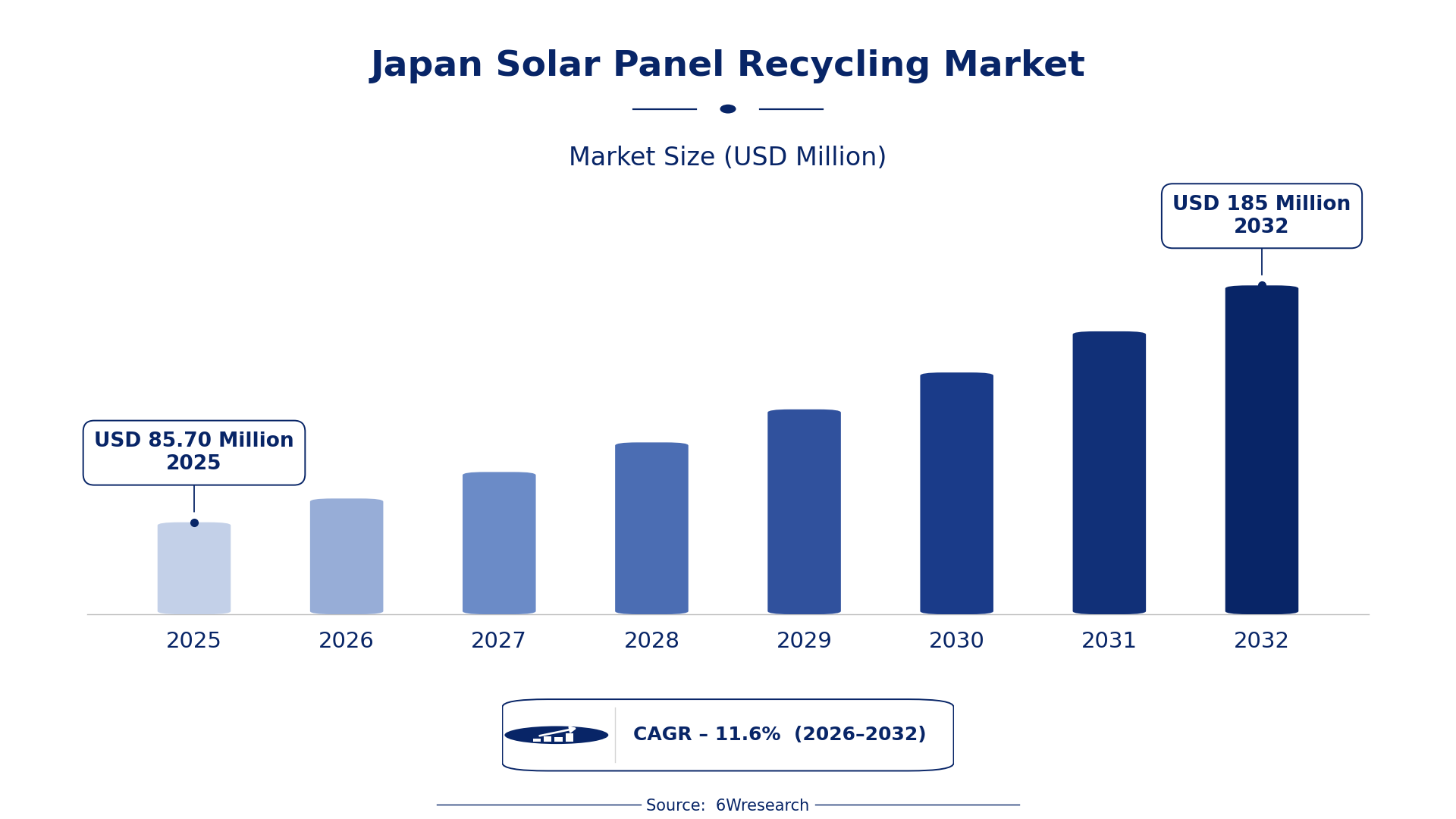
According to 6Wresearch internal database and industry insights, the Japan Solar Panel Recycling Market was valued at USD 85.70 Million in 2025 and is projected to reach USD 185 Million by 2032, growing at a CAGR of approximately 11.6% during 2026–2032.
Japan Solar Panel Recycling Market Highlights
| Report Metric | Details |
| Report Name | Japan Solar Panel Recycling Market (2026-2032) |
| Market Size 2025 | USD 85.70 Million |
| Market Size 2032 | USD 185 Million |
| Absolute Growth 2025–2032 | USD 99.30 Million |
| CAGR 2026–2032 | 11.6% |
| Peak Annual Growth | 15.0% in 2032 |
| Forecast Period | 2026–2032 |
| Historical Data | 2022–2025 |
| Base Year | 2025 |
| Leading Material, 2025 | Glass (40% share) |
| Leading Product, 2025 | Silicon Based PV (54% share) |
| Leading Process, 2025 | Thermal (48% share) |
| Fastest-Growing Material | Plastic (16.6% CAGR) |
| Fastest-Growing Product | Thin Film PV (15.9% CAGR) |
| Fastest-Growing Process | Mechanical (17.1% CAGR) |
| Growing Sector | Mechanical |
| Key End Users | Thermal, Mechanical, Chemical, Combination |
Japan Solar Panel Recycling Market Year-wise Growth Rate and Key Drivers (2022–2032)
This graph illustrates the annual growth rates of the market from 2022 to 2032, highlighting a steady upward trajectory and projected market expansion over the forecast period.
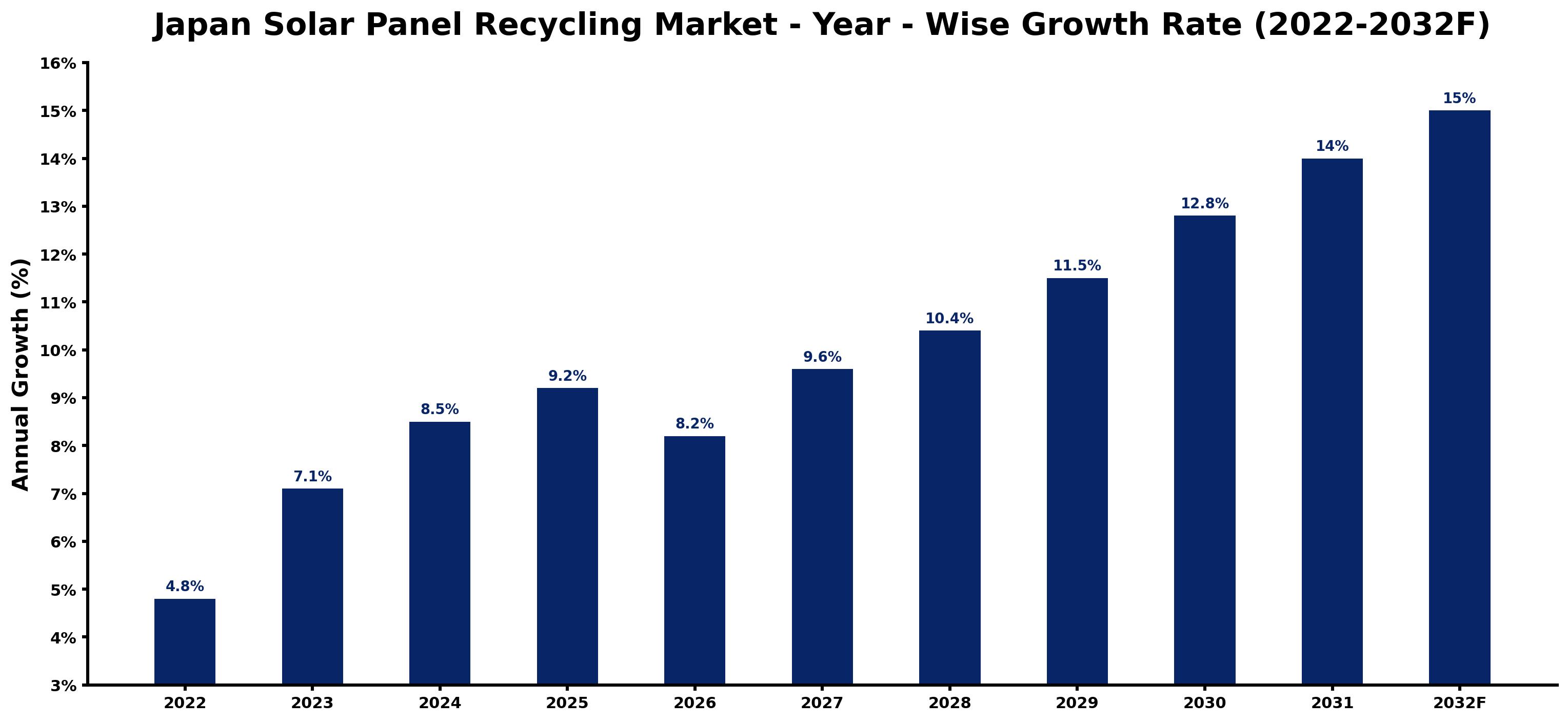
The table below sets out the estimated growth rate for each year and the main factor behind it.
| Year | Estimated Annual Growth (%) | Market Rationale |
| 2022 | 4.8 | The market experienced steady growth, reflecting increasing awareness of recycling benefits. |
| 2023 | 7.1 | Growth accelerated as more facilities became operational in Tokyo, boosting capacity. |
| 2024 | 8.5 | The market continued to expand due to rising demand for sustainable practices. |
| 2025 | 9.2 | Growth peaked as the government set ambitious recycling targets for solar panels. |
| 2026 | 8.2 | Growth is expected to slow slightly as the market adjusts to new regulations and standards. |
| 2027 | 9.6 | Demand is projected to increase again with more investments in recycling technologies. |
| 2028 | 10.4 | The market will see further growth driven by rising consumer awareness of sustainability. |
| 2029 | 11.5 | Continued investments in recycling infrastructure will support market expansion. |
| 2030 | 12.8 | The market is projected to grow as the government pushes for higher recycling rates. |
| 2031 | 14.0 | Growth is expected to remain strong as technological advancements improve recycling efficiency. |
| 2032 | 15.0 | The market is anticipated to peak as recycling becomes a standard practice. |
Note: Market size estimations and growth projections presented in this report are based on 6Wresearch's proprietary forecasting methodology, utilizing the latest available industry data, government publications, and primary research inputs.
Japan Solar Panel Recycling Market Synopsis
Solar panel recycling involves recovering valuable materials such as glass, metals, and silicon from end-of-life solar panels. In Japan, the recycling industry is expanding, particularly in Tokyo, where facilities are rapidly increasing. The Japan Solar Panel Recycling Market is growing due to rising domestic demand, government initiatives promoting sustainability, and a target for a 50% recycling rate by 2025. With an installed base of over 70 GW of solar panels, effective recycling solutions are essential for managing waste and supporting environmental goals.
Market Dynamics Impact Analysis (2026–2032)
| Factor | Type | Impact | Primary Segment Affected |
| Increasing installed solar capacity | Driver | High | Silicon Based PV |
| Government initiatives promoting recycling | Driver | High | Glass |
| Growing demand for sustainable practices | Opportunity | High | Aluminum |
| Investment in recycling technologies | Opportunity | Medium | Silicon |
| High operational costs of recycling facilities | Restraint | High | Mechanical |
| Limited public awareness about recycling benefits | Restraint | Medium | Chemical |
| Competition from alternative waste management solutions | Challenge | High | Combination |
| Technological barriers in recycling processes | Challenge | Medium | Laser |
Evaluation of Drivers in Japan Solar Panel Recycling Market (2026–2032)
The main growth drivers and the segments they affect most are set out below.
| Drivers | Primary Segment Affected | Why It Matters (Evidence) |
| Expansion of solar panel installations | Silicon Based PV | With over 70 GW installed, demand for recycling rises to manage waste effectively. |
| Government recycling targets | Glass | The aim for a 50% recycling rate by 2025 drives investments in recycling facilities. |
| Increased consumer awareness of sustainability | Aluminum | As consumers demand greener practices, aluminum recycling becomes more prevalent. |
| Technological advancements in recycling processes | Silicon | New methods improve material recovery, prompting more investments in recycling operations. |
| Support from industry associations | Metals | Initiatives by industry groups promote recycling, leading to higher recovery rates. |
Buyers are adding capacity as Tokyo's recycling facilities expand, responding to the installed base of over 70 GW of solar panels. With consumer awareness rising, demand for aluminum recycling is increasing, supported by industry associations promoting best practices. Technological advancements improve material recovery, driving further investment in recycling operations. As a result, the market is projected to grow at an annual rate of 8% until 2030, reflecting the increasing focus on sustainability.
Evaluation of Restraints in Japan Solar Panel Recycling Market
Several factors work against faster growth; the main ones are summarised below.
| Market Restraint | Primary Segment Affected | Why It Matters (Evidence) |
| High operational costs associated with recycling processes | Mechanical | Recycling facilities face high costs, limiting their ability to scale operations effectively. |
| Limited public awareness about the benefits of recycling | Chemical | Lack of consumer knowledge hinders participation in recycling programs, affecting recovery rates. |
| Regulatory complexities in waste management | Combination | Navigating multiple regulations can delay the implementation of recycling initiatives. |
| Competition from alternative waste management solutions | Laser | Emerging technologies may divert attention and funding away from solar panel recycling efforts. |
| Inconsistent quality of recycled materials | Silicon | Variability in material quality can reduce demand from manufacturers seeking reliable inputs. |
Japan Solar Panel Recycling Market Challenges
Japan's solar panel recycling capacity reached 200,000 tons in 2022, yet producers struggle with a shortage of skilled workers, delaying operations and increasing labour costs for facilities. Intense competition among recycling facilities leads to price undercutting, which reduces profit margins for producers and limits their ability to invest in technology. Many facilities lack access to advanced recycling methods, resulting in inefficient processes that can waste up to 30% of recoverable materials, affecting profitability for producers. Buyers face rising costs as the government mandates a 50% recycling rate by 2025, compelling them to seek more expensive recycling solutions to comply with regulations.
Trends in the Japan Solar Panel Recycling Market
Below are the shifts with the largest effect on the Japan Solar Panel Recycling Market.
- Shift towards Advanced Recycling Technologies: Tokyo is experiencing a shift towards advanced recycling technologies, with facilities upgrading their processes. In 2023, a new subsidy program was launched to support these technologies, improving recovery efficiency.
- Emergence of Public Awareness Campaigns: Public awareness campaigns are gaining traction, particularly in urban areas. The Japan Photovoltaic Energy Association has initiated efforts to educate consumers about the importance of solar panel recycling, resulting in increased participation.
- Transition from Mechanical to Chemical Processes: Recycling facilities are transitioning from mechanical to chemical processes for better material recovery. This change is evidenced by the growing adoption of chemical methods, which are expected to improve efficiency.
- Growth of Collaborative Recycling Initiatives: Collaborative recycling initiatives are emerging across Japan, with over 1,000 registered facilities for electronic waste. These partnerships are improving resource recovery and supporting sustainability goals.
Investment Opportunities in the Japan Solar Panel Recycling Market
The opportunities below stand out in the Japan Solar Panel Recycling Market for new entrants and existing suppliers.
- Investment in Recycling Facilities in Tokyo: Tokyo's recycling facilities are expanding, necessitating investment in advanced technologies. With a target of a 50% recycling rate by 2025, local governments are encouraging partnerships with private investors.
- Growing Demand for Aluminum Recycling: With aluminum frames being widely used in solar panels, the demand for recycling is rising. The government supports initiatives that promote aluminum recovery, making it a prime investment opportunity.
- Expansion of Subsidy Programs for Recycling Technologies: The recent launch of subsidy programs in 2023 provides an opportunity for stakeholders to invest in efficient recycling technologies. This initiative is aimed at improving the efficiency of recycling processes.
- Collaboration with Industry Associations: Collaborating with industry associations can facilitate access to best practices and resources. Such partnerships are important for companies looking to improve their recycling capabilities.
Government Initiatives in the Japan Solar Panel Recycling Market
The Waste Management and Public Cleansing Act of 1970 establishes a framework for recycling practices in Japan, mandating that producers are responsible for the end-of-life management of their products, including solar panels. This law ensures proper recycling and waste minimisation, contributing to sustainability efforts. The Plastic Resource Circulation Act of 2021 promotes the reduction, reuse, and recycling of plastics, further supporting the recycling ecosystem by encouraging sustainable practices across industries.
The Ministry of the Environment oversees the implementation of various recycling initiatives, including the GX Basic Policy adopted in 2023, which aims for JPY 150 trillion in public-private decarbonisation investment over the next decade. This policy encourages buyers to invest in sustainable practices, including solar panel recycling, improving resource recovery efforts.
Future Insight of the Japan Solar Panel Recycling Market
By 2032, buyers will benefit from the new subsidy programme that supports advanced recycling technologies, enhancing efficiency in material recovery. The adoption of JIS Q 0101 will standardise recycling processes, ensuring higher recovery rates for valuable materials. As Japan's installed solar capacity exceeds 70 GW, the demand for recycling will surge, prompting suppliers to invest in modern facilities. Collaboration between producers and technology providers will yield improved recycling outcomes, aligning with Japan's commitment to a 46% reduction in greenhouse-gas emissions by 2030.
Market Segmentation Analysis
Japan Solar Panel Recycling Market report covers a detailed analysis of the following market segments:
By Material – Glass Leads, Plastic Expected to Grow Fastest
According to Summon Dutta, Assistant Manager at 6Wresearch, with 40% of material revenue in 2025, Glass was the largest category. Glass captures the largest share in the market because it is a primary component of solar panels and is fully recyclable. The extensive installed base of over 70 GW in Japan ensures a continuous supply of glass for recycling efforts. Plastic is set to record the highest CAGR in this split, 16.6% over 2026–2032. Plastic is witnessing notable growth as the industry focuses on improving recycling processes, with new technologies emerging to address its role in solar panels. The launch of a subsidy program in 2023 is expected to bolster advancements in recycling technologies, including those for plastics. Suppliers must enhance their recycling capabilities for glass and plastic to align with regulatory targets and market needs.
By Product – Silicon Based PV Leads, Thin Film PV Expected to Grow Fastest
In 2025, Silicon Based PV led the product split with a 54% share. Silicon-based PV panels dominate the market, representing 90% of the installed base, which makes their recycling essential for sustainability initiatives. The large volume of these panels necessitates effective recycling solutions to responsibly manage end-of-life products. Thin Film PV is projected to grow fastest, at a CAGR of 15.9% during 2026–2032. Thin film PV is experiencing rapid growth as the market diversifies and explores alternative recycling methods, supported by government initiatives that promote sustainability. This segment's growth indicates a broader trend towards integrating various solar technologies into recycling practices. Buyers should stay informed about the advancements in recycling technologies to ensure compliance and sustainability in their solar panel disposal.
By Process – Thermal Leads, Mechanical Expected to Grow Fastest
Thermal held 48% of the Japan Solar Panel Recycling Market by process in 2025. Thermal processes are the most widely used in the recycling of solar panels, effectively recovering valuable materials such as glass and metals. This method is favoured due to its efficiency and compatibility with the predominant materials found in solar panels. The quickest growth will come from Mechanical, forecast to expand at a CAGR of 17.1% between 2026 and 2032. Mechanical methods are gaining traction as they offer a cost-effective and efficient approach to recycling, particularly for the growing volume of end-of-life solar panels. The increasing installed capacity of solar panels in Japan is driving the need for more mechanical recycling solutions. Suppliers must invest in advanced mechanical and thermal technologies to keep pace with the increasing demand for efficient recycling processes.
Key Attractiveness of the Report
- 10 Years of Market Numbers
- Historical Data Starting from 2022 to 2025
- Base Year 2025
- Forecast Data until 2032
- Key Performance Indicators Impacting the Market
- Major Upcoming Developments and Projects
Key Highlights of the Report:
- Japan Solar Panel Recycling Market Outlook
- Market Size of Japan Solar Panel Recycling Market, 2025
- Forecast of Japan Solar Panel Recycling Market, 2032
- Historical Data and Forecast of Japan Solar Panel Recycling Revenues & Volume for the Period 2022-2032
- Japan Solar Panel Recycling Market Trend Evolution
- Japan Solar Panel Recycling Market Drivers and Challenges
- Japan Solar Panel Recycling Price Trends
- Japan Solar Panel Recycling Porter's Five Forces
- Japan Solar Panel Recycling Industry Life Cycle
- Historical Data and Forecast of Japan Solar Panel Recycling Market Revenues & Volume By Material for the Period 2022-2032
- Historical Data and Forecast of Japan Solar Panel Recycling Market Revenues & Volume By Glass for the Period 2022-2032
- Historical Data and Forecast of Japan Solar Panel Recycling Market Revenues & Volume By Plastic for the Period 2022-2032
- Historical Data and Forecast of Japan Solar Panel Recycling Market Revenues & Volume By Aluminum for the Period 2022-2032
- Historical Data and Forecast of Japan Solar Panel Recycling Market Revenues & Volume By Silicon for the Period 2022-2032
- Historical Data and Forecast of Japan Solar Panel Recycling Market Revenues & Volume By Metals for the Period 2022-2032
- Historical Data and Forecast of Japan Solar Panel Recycling Market Revenues & Volume By Product for the Period 2022-2032
- Historical Data and Forecast of Japan Solar Panel Recycling Market Revenues & Volume By Silicon Based PV for the Period 2022-2032
- Historical Data and Forecast of Japan Solar Panel Recycling Market Revenues & Volume By Thin Film PV for the Period 2022-2032
- Historical Data and Forecast of Japan Solar Panel Recycling Market Revenues & Volume By Others for the Period 2022-2032
- Historical Data and Forecast of Japan Solar Panel Recycling Market Revenues & Volume By Process for the Period 2022-2032
- Historical Data and Forecast of Japan Solar Panel Recycling Market Revenues & Volume By Thermal for the Period 2022-2032
- Historical Data and Forecast of Japan Solar Panel Recycling Market Revenues & Volume By Mechanical for the Period 2022-2032
- Historical Data and Forecast of Japan Solar Panel Recycling Market Revenues & Volume By Chemical for the Period 2022-2032
- Historical Data and Forecast of Japan Solar Panel Recycling Market Revenues & Volume By Combination for the Period 2022-2032
- Historical Data and Forecast of Japan Solar Panel Recycling Market Revenues & Volume By Laser for the Period 2022-2032
- Japan Solar Panel Recycling Import Export Trade Statistics
- Market Opportunity Assessment By Material
- Market Opportunity Assessment By Product
- Market Opportunity Assessment By Process
- Japan Solar Panel Recycling Top Companies Market Share
- Japan Solar Panel Recycling Competitive Benchmarking By Technical and Operational Parameters
- Japan Solar Panel Recycling Company Profiles
- Japan Solar Panel Recycling Key Strategic Recommendations
Market Covered
The following segment groups are covered in the report.
By Material
- Glass
- Plastic
- Aluminum
- Silicon
- Metals
By Product
- Silicon Based PV
- Thin Film PV
- Others
By Process
- Thermal
- Mechanical
- Chemical
- Combination
- Laser






































