Japan Solar Roofing Market Size & Growth Rate
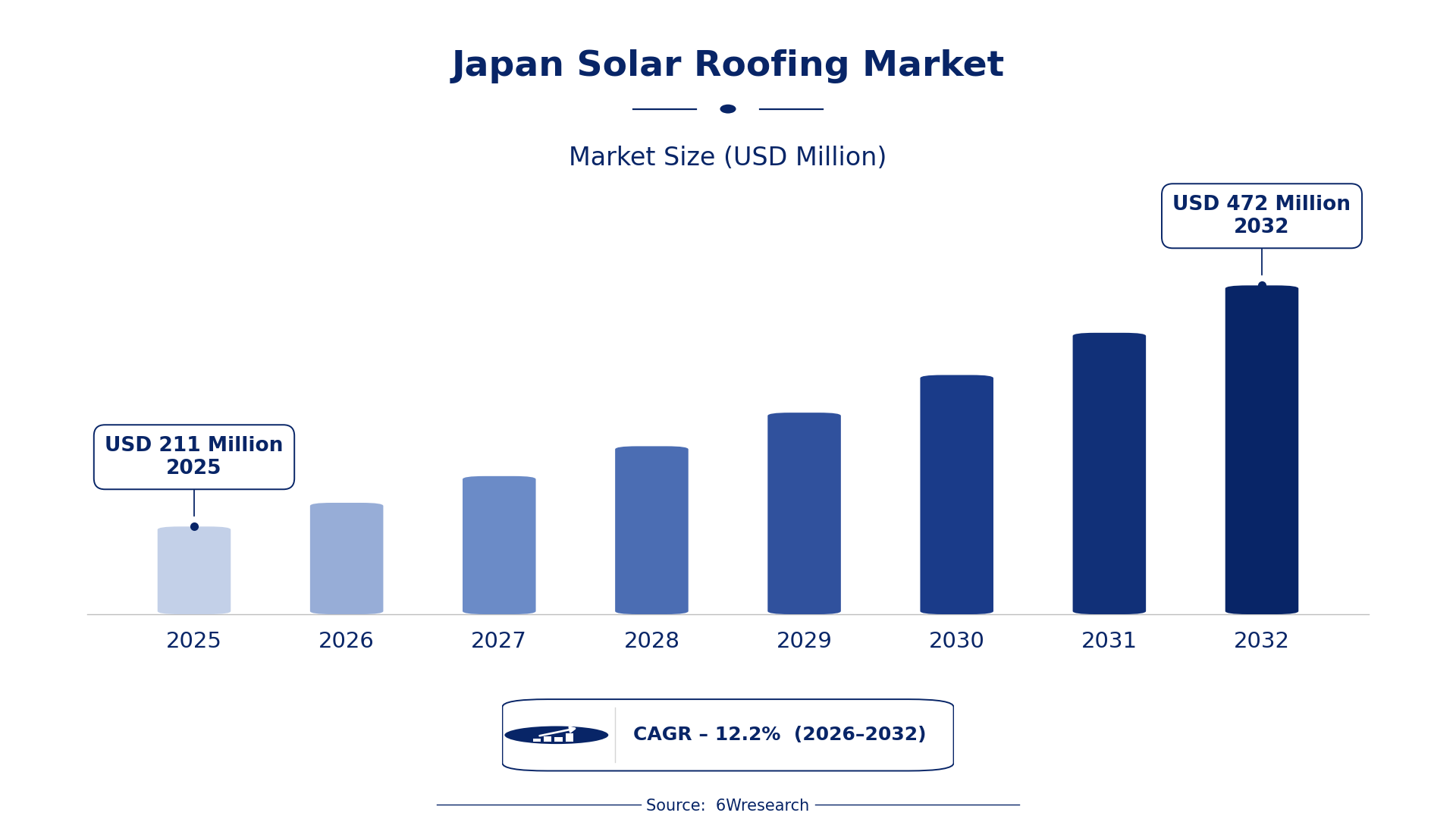
According to 6Wresearch internal database and industry insights, the Japan Solar Roofing Market was valued at USD 211 Million in 2025 and is projected to reach USD 472 Million by 2032, growing at a CAGR of approximately 12.2% during 2026–2032.
Japan Solar Roofing Market Highlights
| Report Metric | Details |
| Report Name | Japan Solar Roofing Market (2026-2032) |
| Market Size 2025 | USD 211 Million |
| Market Size 2032 | USD 472 Million |
| Absolute Growth 2025–2032 | USD 261 Million |
| CAGR 2026–2032 | 12.2% |
| Peak Annual Growth | 13.9% in 2030 |
| Forecast Period | 2026–2032 |
| Historical Data | 2022–2025 |
| Base Year | 2025 |
| Leading Roofing Type, 2025 | Solar Tiles (58% share) |
| Leading Panel Material, 2025 | Solar Shingles (52% share) |
| Leading Power Capacity, 2025 | Low Power (48% share) |
| Leading Application, 2025 | Residential (56% share) |
| Leading Technology, 2025 | Integrated PV (48% share) |
| Fastest-Growing Roofing Type | Solar Panels (17.3% CAGR) |
| Fastest-Growing Panel Material | Thin film (17.1% CAGR) |
| Fastest-Growing Power Capacity | Medium Power (14.2% CAGR) |
| Fastest-Growing Application | Commercial (15.9% CAGR) |
| Fastest-Growing Technology | Standalone Roof (16.7% CAGR) |
| Growing Sector | Commercial |
| Key End Users | Residential, Commercial, Industrial |
Japan Solar Roofing Market Year-wise Growth Rate and Key Drivers (2022–2032)
This graph illustrates the annual growth rates of the market from 2022 to 2032, highlighting a steady upward trajectory and projected market expansion over the forecast period.
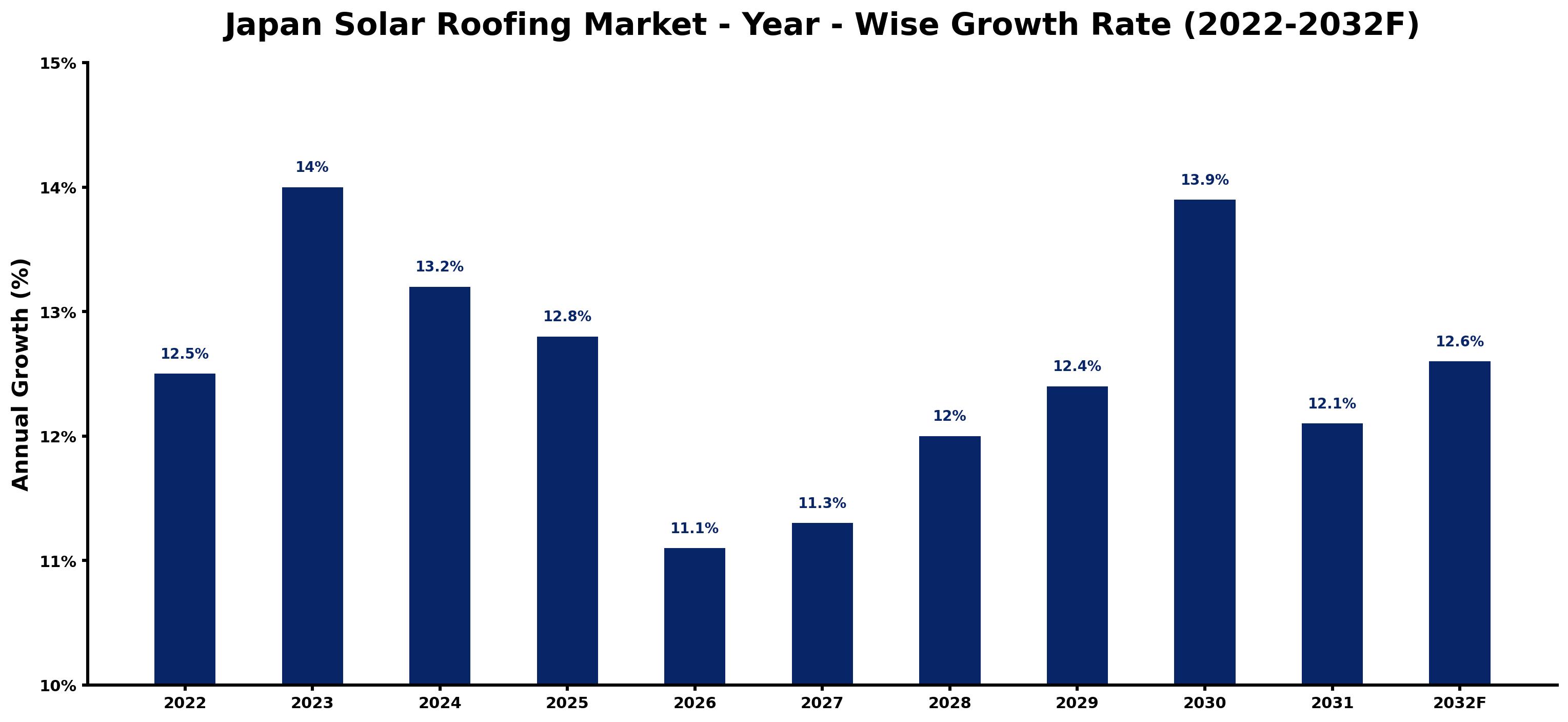
Each row of the following table gives one year's estimated growth and the event or demand shift that explains it.
| Year | Estimated Annual Growth (%) | Market Rationale |
| 2022 | 12.5 | The market experienced steady growth due to increased awareness of renewable energy. |
| 2023 | 14.0 | Demand accelerated as the government implemented supportive incentives for solar energy. |
| 2024 | 13.2 | Growth slowed as market saturation began to affect new installations. |
| 2025 | 12.8 | The pace of growth continued to slow as competition intensified among suppliers. |
| 2026 | 11.1 | Market expansion slowed further as buyers became more selective in investments. |
| 2027 | 11.3 | Demand increased slightly as technological advancements made systems more efficient. |
| 2028 | 12.0 | Growth picked up as urban areas began adopting flexible solar roofing solutions. |
| 2029 | 12.4 | The market experienced a rise as consumer interest in sustainability grew. |
| 2030 | 13.9 | Demand surged due to heightened government initiatives and ambitious targets. |
| 2031 | 12.1 | Growth moderated as the market matured and competition intensified. |
| 2032 | 12.6 | Demand is expected to increase as new energy storage solutions become available. |
Note: Market size estimations and growth projections presented in this report are based on 6Wresearch's proprietary forecasting methodology, utilizing the latest available industry data, government publications, and primary research inputs.
Japan Solar Roofing Market Synopsis
Solar roofing integrates photovoltaic technology into roofing materials to generate electricity from sunlight, primarily using silicon-based products. The market thrives on residential demand, with 60% of installations in 2022 originating from this sector. Government initiatives, including the Feed-in Tariff program and a target for 36% renewable energy by 2030, are stimulating growth. With Japan's solar energy capacity reaching 74 GW in 2023, the market is set for continued expansion as more households adopt solar solutions.
Market Dynamics Impact Analysis (2026–2032)
| Factor | Type | Impact | Primary Segment Affected |
| Growing residential installations driven by energy savings | Driver | High | Residential |
| Government incentives and subsidies for renewable energy | Driver | High | Solar Panels |
| Increasing demand for sustainable energy solutions | Opportunity | High | Solar Shingles |
| Expansion of urban areas adopting flexible solar solutions | Opportunity | Medium | Flexible Roofing |
| Market saturation leading to intense competition | Restraint | High | Solar Panels |
| High initial installation costs for solar systems | Restraint | Medium | Solar Tiles |
| Regulatory hurdles affecting installation processes | Challenge | High | Integrated PV |
| Supply chain disruptions impacting material availability | Challenge | Medium | Monocrystalline |
Evaluation of Drivers in Japan Solar Roofing Market (2026–2032)
The following drivers explain most of the expected growth.
| Drivers | Primary Segment Affected | Why It Matters (Evidence) |
| Increased energy savings from solar installations | Residential | The average household saves ¥100,000 annually, encouraging more installations. |
| Government subsidies promoting solar energy adoption | Solar Panels | The government allocated ¥200 billion for renewable energy subsidies in 2023. |
| Technological advancements in solar efficiency | Monocrystalline | Monocrystalline panels dominate the market due to high efficiency, driving demand for installations. |
| Rising consumer awareness of sustainability | Solar Shingles | The residential market accounted for 60% of total installations in 2022. |
| Urban development encouraging flexible solar solutions | Flexible Roofing | Flexible solar roofing is gaining traction in urban areas, expanding market reach. |
Buyers are adding capacity as Japan's solar energy capacity reached 74 GW in 2023, prompting homeowners to invest in solar roofing for energy savings. The average household savings from solar energy reach ¥100,000 annually, driving demand for residential installations. Advancements in solar panels have improved efficiency, leading to increased purchases from eco-conscious consumers. Urban areas are embracing flexible solar solutions, expanding the market's potential.
Evaluation of Restraints in Japan Solar Roofing Market
Several factors work against faster growth; the main ones are summarised below.
| Market Restraint | Primary Segment Affected | Why It Matters (Evidence) |
| High initial costs for solar installations | Solar Panels | The average payback period for residential solar systems is around 7 years, deterring some buyers. |
| Market saturation limiting new installations | Solar Tiles | With over 10 million units installed, competition has intensified, affecting growth. |
| Regulatory hurdles complicating installation processes | Integrated PV | Compliance with JIS standards can delay project timelines, impacting buyer decisions. |
| Supply chain disruptions affecting material availability | Monocrystalline | Global supply chain issues have led to increased lead times for solar panel deliveries. |
| Limited awareness of flexible solar solutions | Flexible Roofing | Niche applications have restricted broader adoption, impacting market growth. |
Japan Solar Roofing Market Challenges
Buyers face regulatory challenges due to strict JIS standards, which can delay project approvals and raise costs by 15% for residential installations. Fluctuating demand affects buyers, as the residential solar market accounted for 60% of installations in 2022, resulting in potential overproduction and resource wastage. Contractors experience project delays from skills shortages, extending timelines by three months for installations. Rising material costs, particularly for monocrystalline panels, inflate prices by 20%, making solar roofing less affordable for buyers seeking to invest in renewable solutions.
Trends in the Japan Solar Roofing Market
The shifts below are changing how Japan Solar Roofing Market products are bought and supplied.
- Growing Adoption of Flexible Solar Roofing: Urban areas are increasingly adopting flexible solar roofing, enhancing aesthetic appeal and functionality. In 2023, installations of flexible roofing rose significantly, indicating a shift in consumer preferences.
- Transition from Traditional Panels to Integrated Solutions: The market is moving from traditional solar panels to integrated solutions, with solar shingles gaining popularity. In 2023, solar shingles accounted for 52% of the panel material market.
- Emergence of Energy Storage Solutions: The introduction of enhanced solar energy storage solutions in 2023 has transformed how households manage energy. This shift supports the growing demand for solar roofing systems.
- Surge in Interest for Sustainable Energy: Consumer interest in sustainability has surged, with more households opting for solar solutions. In 2023, over 3 million homes had solar installations, reflecting this trend.
Investment Opportunities in the Japan Solar Roofing Market
Several openings in the Japan Solar Roofing Market merit attention from investors.
- Urban Development Projects: Tokyo is seeing a rise in urban development projects that incorporate solar roofing. With over 3 million homes equipped with solar systems, there is a strong opportunity for suppliers.
- Supply of Solar Shingles: Investing in solar shingles is timely as they gained a 52% market share in 2025. Targeting residential builders in major cities can yield substantial returns.
- Partnerships for Renewable Energy Solutions: Forming joint ventures with local contractors can facilitate market entry. With the government allocating substantial funding for renewable energy subsidies, this is an opportune time.
- Expansion in Commercial Installations: As commercial installations grow, suppliers can focus on providing integrated solar solutions. The commercial sector is projected to expand significantly by 2032.
Government Initiatives in the Japan Solar Roofing Market
The GX Promotion Act, enacted in 2023, establishes the framework for promoting renewable energy, including solar roofing. This act obliges producers to comply with new energy efficiency standards and encourages investments in sustainable technologies. The government aims for 36% of energy to come from renewables by 2030, driving demand for solar solutions.
The Ministry of the Environment oversees the implementation of the GX Promotion Act, ensuring compliance and funding for renewable energy projects. The agency supports various initiatives, including subsidies for solar installations, which benefit residential and commercial buyers. In 2023, the government allocated substantial resources to support these renewable energy initiatives, enhancing market growth.
Future Insight of the Japan Solar Roofing Market
Japan's policy-driven shift will transform the renewable sector by 2032, targeting a 46% reduction in greenhouse-gas emissions from 2013 levels. The government has allocated ¥200 billion for renewable energy subsidies, which will improve conditions for suppliers. New programmes for solar energy storage solutions will optimise energy management for buyers, increasing system efficiency. With over 10 million solar roofing units installed, the market will likely see advancements in roofing technologies and increased competition among producers.
Market Segmentation Analysis
Japan Solar Roofing Market report covers a detailed analysis of the following market segments:
By Roofing Type – Solar Tiles Lead, Solar Panels Expected to Grow Fastest
According to Sumit Sagar, AM at 6Wresearch, Solar Tiles took 58% of roofing type revenue in 2025, more than any other category. Solar Tiles hold the largest share because they blend aesthetic appeal with functionality, making them popular in urban areas. Their use in regions like Tokyo and Osaka demonstrates a strong preference for roofing solutions that enhance both appearance and energy generation. Solar Panels are set to record the highest CAGR in this split, 17.3% over 2026–2032. Solar Panels are experiencing rapid growth due to their widespread application for energy generation on rooftops, driven by government incentives like the Feed-in Tariff program. With Japan's solar energy capacity reaching 74 GW in 2023, this segment's expansion is expected to continue. Suppliers must focus on creating solar roofing products that combine efficiency with visual appeal to meet market demands.
By Panel Material – Solar Shingles Lead, Thin film Expected to Grow Fastest
With 52% of panel material revenue in 2025, Solar Shingles was the largest category. Solar Shingles dominate the market as they are seamlessly integrated into roofing systems, making them ideal for new residential constructions. Their capacity to generate energy without compromising on design attracts many homeowners looking for functional yet stylish options. The quickest growth will come from Thin film, forecast to expand at a CAGR of 17.1% between 2026 and 2032. Thin film technology is rapidly gaining traction due to its lightweight and flexible characteristics, which cater to specific urban applications. As cities seek adaptable energy solutions, this segment is likely to see accelerated adoption. Buyers should explore diverse panel materials to improve energy efficiency while ensuring design coherence.
By Power Capacity – Low Power Leads, Medium Power Expected to Grow Fastest
In 2025, Low Power led the power capacity split with a 48% share. Low Power systems hold a considerable share as they cater to small-scale installations, appealing to homeowners with limited energy requirements. This segment often serves as an entry point for first-time solar users looking to adopt renewable energy solutions. Medium Power is projected to grow fastest, at a CAGR of 14.2% during 2026–2032. Medium Power systems are experiencing rapid growth, primarily because they are widely used in residential and commercial installations, offering a practical balance between efficiency and capacity. Their increasing adoption signals a shift towards more substantial energy solutions in the market. Suppliers should expand their product offerings to include a diverse range of power capacities to meet varying consumer demands.
By Application – Residential Leads, Commercial Expected to Grow Fastest
Residential accounted for 56% of the market by application in 2025. The Residential segment leads the market as it accounts for 60% of total installations, driven by homeowners seeking renewable energy solutions. With over 3 million homes equipped with solar installations, this segment is well-established and continues to grow. Over 2026–2032, Commercial is expected to post the fastest growth, at a CAGR of 15.9%. Commercial applications are experiencing the fastest growth, as businesses increasingly recognise the potential for energy savings and sustainability. The push for renewable energy in commercial sectors aligns with Japan's government targets for energy generation from renewables. Suppliers must tailor their products to meet the specific requirements of both residential and commercial customers to maximise market reach.
By Technology – Integrated PV Leads, Standalone Roof Expected to Grow Fastest
Integrated PV held 48% of the Japan Solar Roofing Market by technology in 2025. Integrated PV technology leads the market as it allows for seamless energy generation while maintaining the aesthetic integrity of buildings. Its popularity in new construction projects aligns with modern architectural preferences, ensuring strong demand. Standalone Roof is set to record the highest CAGR in this split, 16.7% over 2026–2032. Standalone Roof technology is gaining traction due to its unique applications, particularly in retrofitting existing structures. As awareness of solar energy benefits increases, this segment is expected to see greater adoption. Suppliers should invest in both integrated and standalone technologies to enhance performance and appeal in the market.
Key Attractiveness of the Report
- 10 Years of Market Numbers
- Historical Data Starting from 2022 to 2025
- Base Year 2025
- Forecast Data until 2032
- Key Performance Indicators Impacting the Market
- Major Upcoming Developments and Projects
Key Highlights of the Report:
- Japan Solar Roofing Market Outlook
- Market Size of Japan Solar Roofing Market,2025
- Forecast of Japan Solar Roofing Market, 2032
- Historical Data and Forecast of Japan Solar Roofing Revenues & Volume for the Period 2022-2032
- Japan Solar Roofing Market Trend Evolution
- Japan Solar Roofing Market Drivers and Challenges
- Japan Solar Roofing Price Trends
- Japan Solar Roofing Porter's Five Forces
- Japan Solar Roofing Industry Life Cycle
- Historical Data and Forecast of Japan Solar Roofing Market Revenues & Volume By Roofing Type for the Period 2022-2032
- Historical Data and Forecast of Japan Solar Roofing Market Revenues & Volume By Solar Tiles for the Period 2022-2032
- Historical Data and Forecast of Japan Solar Roofing Market Revenues & Volume By Solar Panels for the Period 2022-2032
- Historical Data and Forecast of Japan Solar Roofing Market Revenues & Volume By Flexible Roofing for the Period 2022-2032
- Historical Data and Forecast of Japan Solar Roofing Market Revenues & Volume By Panel Material for the Period 2022-2032
- Historical Data and Forecast of Japan Solar Roofing Market Revenues & Volume By Solar Shingles for the Period 2022-2032
- Historical Data and Forecast of Japan Solar Roofing Market Revenues & Volume By Thin film for the Period 2022-2032
- Historical Data and Forecast of Japan Solar Roofing Market Revenues & Volume By Monocrystalline for the Period 2022-2032
- Historical Data and Forecast of Japan Solar Roofing Market Revenues & Volume By Power Capacity for the Period 2022-2032
- Historical Data and Forecast of Japan Solar Roofing Market Revenues & Volume By Low Power for the Period 2022-2032
- Historical Data and Forecast of Japan Solar Roofing Market Revenues & Volume By Medium Power for the Period 2022-2032
- Historical Data and Forecast of Japan Solar Roofing Market Revenues & Volume By High Power for the Period 2022-2032
- Historical Data and Forecast of Japan Solar Roofing Market Revenues & Volume By Application for the Period 2022-2032
- Historical Data and Forecast of Japan Solar Roofing Market Revenues & Volume By Residential for the Period 2022-2032
- Historical Data and Forecast of Japan Solar Roofing Market Revenues & Volume By Commercial for the Period 2022-2032
- Historical Data and Forecast of Japan Solar Roofing Market Revenues & Volume By Industrial for the Period 2022-2032
- Historical Data and Forecast of Japan Solar Roofing Market Revenues & Volume By Technology for the Period 2022-2032
- Historical Data and Forecast of Japan Solar Roofing Market Revenues & Volume By Integrated PV for the Period 2022-2032
- Historical Data and Forecast of Japan Solar Roofing Market Revenues & Volume By Standalone Roof for the Period 2022-2032
- Historical Data and Forecast of Japan Solar Roofing Market Revenues & Volume By Roof integrated for the Period 2022-2032
- Japan Solar Roofing Import Export Trade Statistics
- Market Opportunity Assessment By Roofing Type
- Market Opportunity Assessment By Panel Material
- Market Opportunity Assessment By Power Capacity
- Market Opportunity Assessment By Application
- Market Opportunity Assessment By Technology
- Japan Solar Roofing Top Companies Market Share
- Japan Solar Roofing Competitive Benchmarking By Technical and Operational Parameters
- Japan Solar Roofing Company Profiles
- Japan Solar Roofing Key Strategic Recommendations
Market Covered
The report covers the following segments.
By Roofing Type
- Solar Tiles
- Solar Panels
- Flexible Roofing
By Panel Material
- Solar Shingles
- Thin film
- Monocrystalline
By Power Capacity
- Low Power
- Medium Power
- High Power
By Application
- Residential
- Commercial
- Industrial
By Technology
- Integrated PV
- Standalone Roof
- Roof integrated































