Japan Solid Biofuel Market Size & Growth Rate
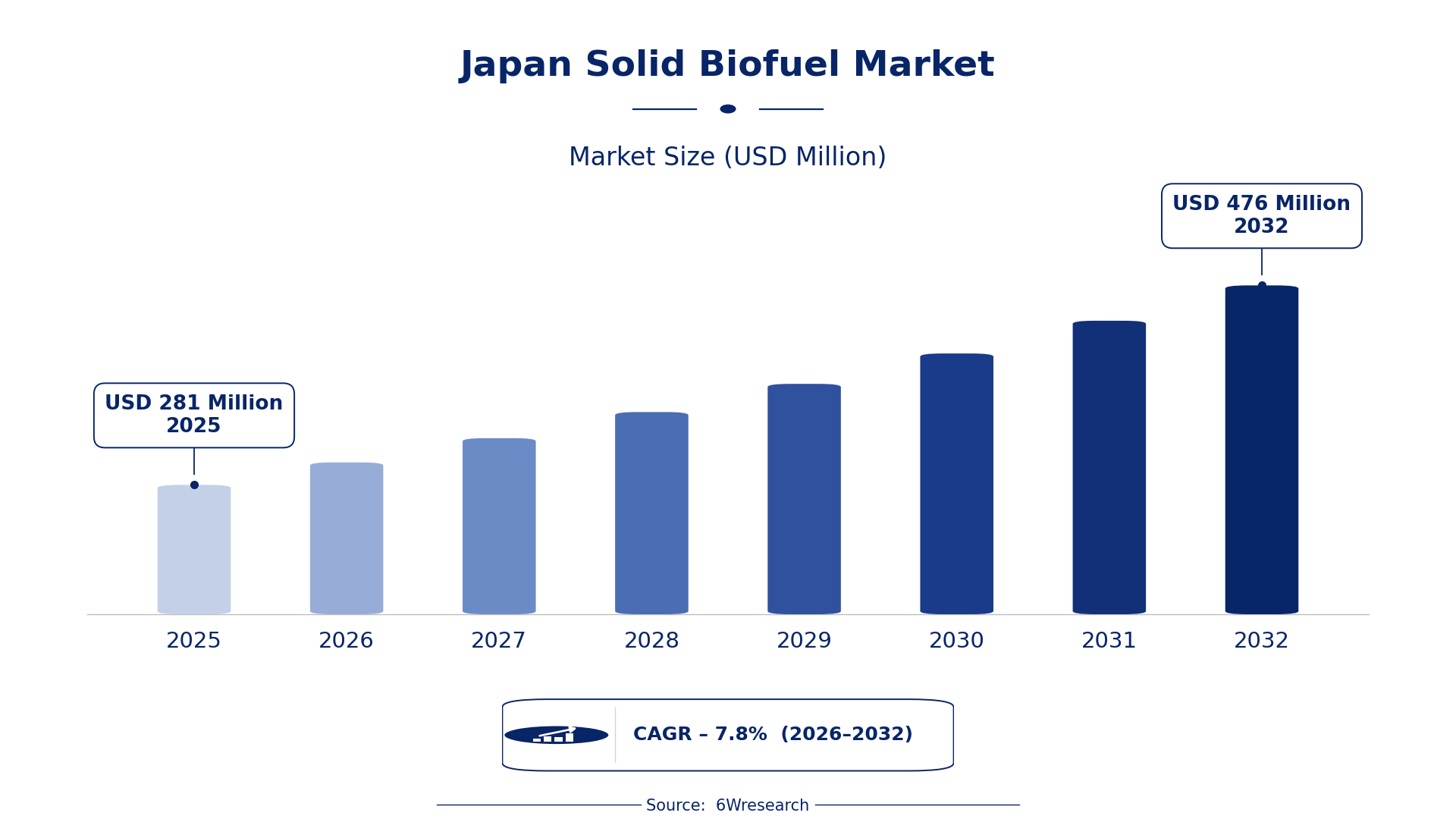
According to 6Wresearch internal database and industry insights, the Japan Solid Biofuel Market was valued at USD 281 Million in 2025 and is projected to reach USD 476 Million by 2032, growing at a CAGR of approximately 7.8% during 2026–2032.
Japan Solid Biofuel Market Highlights
| Report Metric | Details |
| Report Name | Japan Solid Biofuel Market (2026-2032) |
| Market Size 2025 | USD 281 Million |
| Market Size 2032 | USD 476 Million |
| Absolute Growth 2025–2032 | USD 195 Million |
| CAGR 2026–2032 | 7.8% |
| Peak Annual Growth | 8.4% in 2027 |
| Forecast Period | 2026–2032 |
| Historical Data | 2022–2025 |
| Base Year | 2025 |
| Leading Biofuel Type, 2025 | Wood Pellets (48% share) |
| Leading Source Material, 2025 | Forestry Residues (36% share) |
| Leading Form Factor, 2025 | Granular (48% share) |
| Leading End User, 2025 | Biomass Power Plants (44% share) |
| Fastest-Growing Biofuel Type | Briquettes (10.8% CAGR) |
| Fastest-Growing Source Material | Agricultural Waste (10.9% CAGR) |
| Fastest-Growing Form Factor | Block (11.2% CAGR) |
| Fastest-Growing End User | Industrial Boilers (10.1% CAGR) |
| Growing Sector | Industrial Boilers |
| Key End Users | Biomass Power Plants, Industrial Boilers, Residential Cooking, Agro-Energy Firms |
Japan Solid Biofuel Market Year-wise Growth Rate and Key Drivers (2022–2032)
This graph illustrates the annual growth rates of the market from 2022 to 2032, highlighting a steady upward trajectory and projected market expansion over the forecast period.
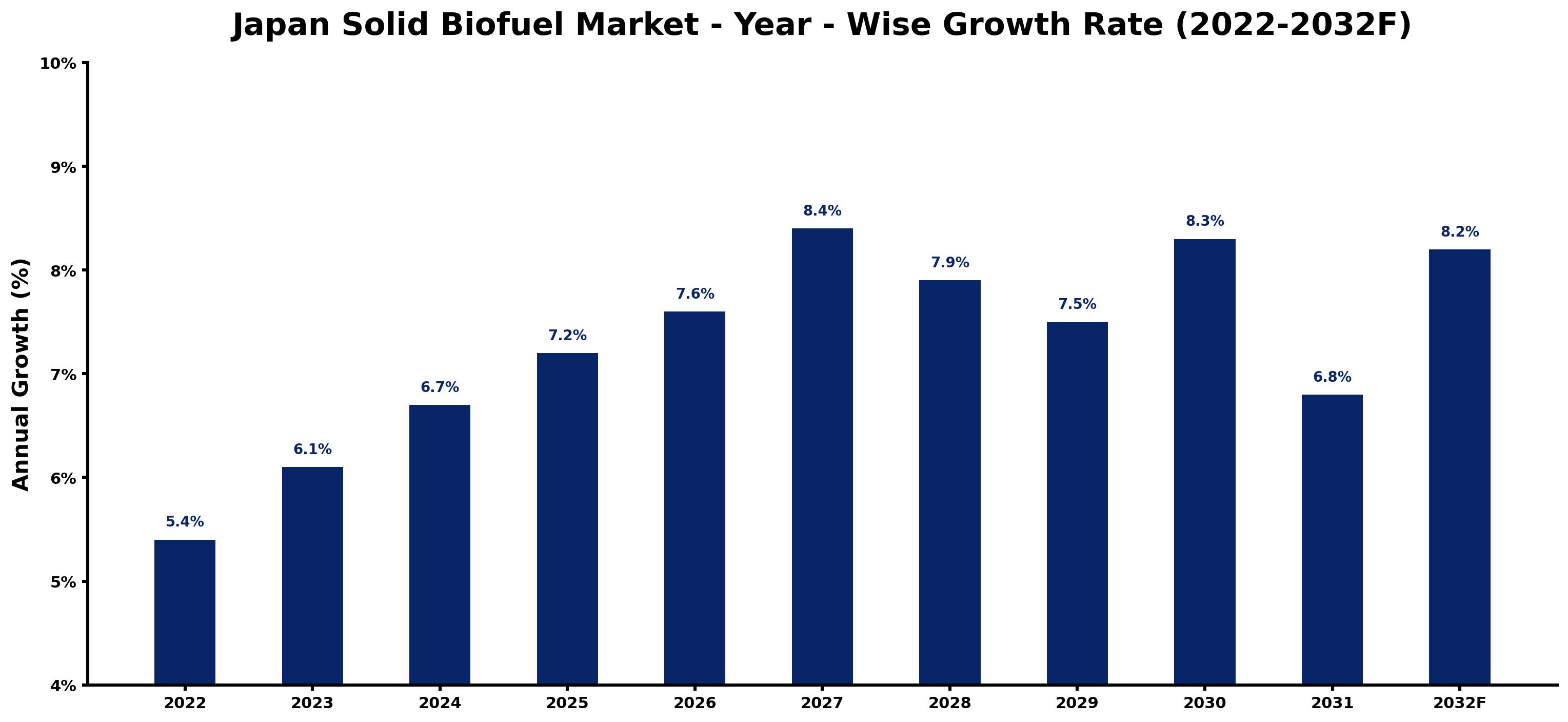
Below, each year's estimated growth is shown next to the factor that most influenced it.
| Year | Estimated Annual Growth (%) | Market Rationale |
| 2022 | 5.4 | The market showed steady growth as domestic energy needs increased. |
| 2023 | 6.1 | Growth accelerated due to rising biomass energy initiatives and investments. |
| 2024 | 6.7 | Demand continued to rise as biomass power plants expanded operations. |
| 2025 | 7.2 | The market reached a historical peak as adoption of solid biofuels grew. |
| 2026 | 7.6 | Growth remained strong as new biomass facilities came online and increased capacity. |
| 2027 | 8.4 | The market peaked with heightened investments in renewable energy sources. |
| 2028 | 7.9 | Growth slowed slightly as market maturity began to set in. |
| 2029 | 7.5 | Demand continued to grow, but at a more moderate pace compared to previous years. |
| 2030 | 8.3 | Growth picked up again as government targets for biomass energy were reinforced. |
| 2031 | 6.8 | The market experienced a slowdown as competition among energy sources intensified. |
| 2032 | 8.2 | Demand surged again as new technologies and facilities improved production capabilities. |
Note: Market size estimations and growth projections presented in this report are based on 6Wresearch's proprietary forecasting methodology, utilizing the latest available industry data, government publications, and primary research inputs.
Japan Solid Biofuel Market Synopsis
Solid biofuel consists of biomass materials like wood pellets and briquettes, produced through processes such as compression and drying. These fuels are primarily used in biomass power plants and industrial boilers for energy generation and heating. The Japan Solid Biofuel Market is growing due to rising energy needs, support for biomass initiatives, and increased adoption of renewable technologies. With a target to raise biomass energy share to 10% by 2030, demand is expected to rise steadily, driven by increasing investments in biomass facilities and government support.
Market Dynamics Impact Analysis (2026–2032)
| Factor | Type | Impact | Primary Segment Affected |
| Growing adoption of biomass energy initiatives | Driver | High | Biomass Power Plants |
| Increased production capacity from new facilities | Driver | High | Wood Pellets |
| Rising energy needs in residential heating | Opportunity | Medium | Residential Cooking |
| Growing interest in sustainable energy solutions | Opportunity | Medium | Industrial Boilers |
| High initial investment costs for biomass facilities | Restraint | High | Biomass Power Plants |
| Limited awareness among consumers about solid biofuels | Restraint | Medium | Residential Cooking |
| Compliance with stringent environmental regulations | Challenge | High | Wood Pellets |
| Capacity constraints in production and supply chains | Challenge | Medium | Biomass Power Plants |
Evaluation of Drivers in Japan Solid Biofuel Market (2026–2032)
These are the developments adding the most demand over the forecast period.
| Drivers | Primary Segment Affected | Why It Matters (Evidence) |
| Increased energy generation from biomass power plants | Biomass Power Plants | Biomass power plants generated around 10% of Japan's renewable energy in 2023, resulting in higher demand for solid biofuels. |
| Expansion of biomass production facilities | Wood Pellets | Japan produced 1.5 million tons of solid biofuels in 2022, with new facilities boosting output and demand. |
| Government initiatives promoting biomass utilization | Agricultural Waste | Government programs have increased the use of agricultural waste in biofuels, driving overall demand. |
| Rising residential heating needs | Residential Cooking | Residential biomass heating systems saw a notable increase in adoption in 2023, boosting demand for solid biofuels. |
| Growing environmental awareness among consumers | Industrial Boilers | With Japan targeting a significant reduction in greenhouse-gas emissions by 2030, industries are shifting towards renewable energy sources. |
Volumes increase due to heightened energy generation from biomass power plants, which accounted for around 10% of Japan's renewable energy in 2023. The production of solid biofuels reached 1.5 million tons in 2022, spurred by the expansion of biomass facilities. Rising residential heating needs are clear with a notable increase in the adoption of biomass heating systems in 2023. Environmental awareness is steering industries towards renewable energy solutions, aligning with national targets for emissions reduction. The emphasis on renewable technologies is prompting further investments in the solid biofuel sector, improving supply stability and buyer confidence.
Evaluation of Restraints in Japan Solid Biofuel Market
These are the pressures that could keep growth below its potential.
| Market Restraint | Primary Segment Affected | Why It Matters (Evidence) |
| Limited skilled workforce in biomass production | Biomass Power Plants | Many biomass power plants struggle to find skilled workers, delaying project timelines and increasing operational costs for producers. |
| Intense competition among biomass suppliers | Wood Pellets | Intense competition drives prices down, making it difficult for smaller producers to maintain profitability. |
| High production costs due to advanced technologies | Industrial Boilers | High production costs strain budgets, particularly in the industrial sector, raising energy expenses. |
| Fluctuating availability of agricultural waste | Agricultural Waste | Buyers face fluctuating availability of agricultural waste, complicating procurement strategies and raising costs. |
| Regulatory compliance costs | Residential Cooking | Compliance with environmental regulations increases operational costs for producers, affecting pricing and supply. |
Japan Solid Biofuel Market Challenges
Biomass power plants face challenges related to a shortage of skilled workers, as training programs are inadequate in Japan, delaying project timelines and increasing costs for producers. Intense competition among suppliers drives prices down, forcing smaller producers to cut output, which can lead to supply shortages for industrial buyers. High production costs arise from the necessity for advanced processing technologies, straining budgets for industrial buyers and inflating energy expenses. Buyers encounter inconsistent availability of agricultural waste, contributing around 30% of the solid biofuel supply, complicating procurement and escalating costs.
Trends in the Japan Solid Biofuel Market
Four trends stand out in the Japan Solid Biofuel Market.
- Shift towards Advanced Biomass Heating Systems: Recent advancements in biomass heating technology are leading to more efficient systems. In 2023, residential biomass heating systems saw a 15% increase in adoption, reflecting growing consumer interest in sustainable heating solutions.
- Expansion of Biomass Power Generation Capacity: Japan is increasing its biomass power generation capacity, with over 300 operational plants as of 2023. This expansion is expected to raise the share of biomass energy in the national energy mix.
- Increased Utilization of Agricultural Waste: The focus on sustainability is driving the increased use of agricultural waste in biofuel production. Approximately 30% of solid biofuel supply comes from agricultural waste, highlighting its importance in the market.
- Growth in Biomass Energy Initiatives: Various biomass energy initiatives are emerging, supported by government programs. The Japan Bioenergy Association is actively promoting biomass energy projects to improve collaboration among stakeholders.
Investment Opportunities in the Japan Solid Biofuel Market
Investors looking at the Japan Solid Biofuel Market should consider the following areas.
- Biomass Power Plants Seeking Reliable Suppliers: Biomass power plants require a consistent supply of solid biofuels to meet growing energy demands. The market is expected to grow, with over 300 operational plants in Japan as of 2023.
- Investment in Advanced Biomass Technologies: With the rising need for efficient energy solutions, investment in advanced biomass technologies is essential. The government aims to increase biomass energy share to 10% by 2030.
- Partnerships with Agro-Energy Firms: Agro-energy firms are looking for partnerships to boost biofuel production. Collaborating with local producers can help meet the increasing demand for solid biofuels.
- Expansion of Residential Biomass Heating Solutions: There is a growing market for residential biomass heating systems, with a notable increase in adoption. Suppliers can capitalise on this trend by offering innovative heating solutions.
Government Initiatives in the Japan Solid Biofuel Market
The Hydrogen Society Promotion Act, enacted in 2024, supports low-carbon hydrogen and ammonia supply chains, adding to previous laws that promote renewable energy. This measure encourages investments in biomass energy production, strengthening the overall market framework. The government aims to increase biomass energy share to 10% by 2030, which will benefit solid biofuel producers by expanding their market opportunities.
Biomass power plants benefit from government funding initiatives that support renewable energy projects. The Ministry of the Environment oversees these programs, ensuring that biomass energy initiatives receive the necessary approvals and resources, facilitating smoother operations for producers.
Future Insight of the Japan Solid Biofuel Market
New biomass power plants will begin operations by 2032, driven by government initiatives to increase renewable energy capacity. The Japan Bioenergy Association will expand its support for biomass projects, promoting collaboration among stakeholders. Research under the New Energy and Industrial Technology Development Organization will develop advanced crops, ensuring a more reliable supply. By 2030, biomass energy is expected to contribute to 10% of Japan's renewable energy, with residential heating systems projected to see a 15% increase in adoption, benefiting both buyers and suppliers.
Market Segmentation Analysis
Japan Solid Biofuel Market report covers a detailed analysis of the following market segments:
By Biofuel Type – Wood Pellets Lead, Briquettes Expected to Grow Fastest
According to Saurav Kr Singh, Senior Research Analyst at 6Wresearch, Wood Pellets accounted for 48% of the market by biofuel type in 2025. Wood pellets hold the largest share due to their widespread use in biomass power generation, which is a primary energy source in Japan. In 2023, biomass power plants generated approximately 10% of the country's renewable energy, highlighting the reliance on this biofuel type. Briquettes are set to record the highest CAGR in this split, 10.8% over 2026–2032. Briquettes are experiencing rapid growth as they are commonly used for heating applications, particularly in residential settings. The 15% increase in adoption of residential biomass heating systems in 2023 indicates a rising demand for this form of solid biofuel. Suppliers should focus on expanding briquette production to meet the growing heating demands of residential users.
By Source Material – Forestry Residues Lead, Agricultural Waste Expected to Grow Fastest
With 36% of source material revenue in 2025, Forestry Residues was the largest category. Forestry residues are the leading source material for solid biofuels, as they are widely sourced for biofuel production across Japan. This abundant availability supports a stable supply chain for biomass energy initiatives. The quickest growth will come from Agricultural Waste, forecast to expand at a CAGR of 10.9% between 2026 and 2032. Agricultural waste is the fastest-growing source material, contributing around 30% of the solid biofuel supply. The government's promotion of biomass utilization programs is driving increased utilisation of agricultural waste in biofuel production. Buyers should consider sourcing biofuels from agricultural waste to align with sustainability goals and government initiatives.
By Form Factor – Granular Leads, Block Expected to Grow Fastest
In 2025, Granular led the form factor split with a 48% share. Granular form is the standard for biomass fuels, making it the most widely used format in the market. Its compatibility with various biomass power generation systems ensures a consistent demand. Over 2026–2032, Block is expected to post the fastest growth, at a CAGR of 11.2%. Block form is gaining traction due to its specific application in heating systems, which are increasingly popular among industrial users. This trend suggests a shift towards more efficient heating solutions in the industry. Suppliers should invest in block form production to cater to the growing industrial heating market.
By End User – Biomass Power Plants Lead, Industrial Boilers Expected to Grow Fastest
Biomass Power Plants held 44% of the Japan Solid Biofuel Market by end user in 2025. Biomass power plants are the primary end users of solid biofuels, utilising these fuels for large-scale energy generation. The existence of over 300 operational biomass power plants in Japan underscores their essential role in the energy landscape. Industrial Boilers are projected to grow fastest, at a CAGR of 10.1% during 2026–2032. Industrial boilers are witnessing rapid growth as they are increasingly adopted for heating, reflecting the rising energy needs across various sectors. The 15% rise in residential biomass heating systems adoption indicates a broader shift towards sustainable energy solutions. Suppliers should prioritise industrial boiler applications to effectively address the growing demand for efficient heating solutions.
Key Attractiveness of the Report
- 10 Years of Market Numbers
- Historical Data Starting from 2022 to 2025
- Base Year 2025
- Forecast Data until 2032
- Key Performance Indicators Impacting the Market
- Major Upcoming Developments and Projects
Key Highlights of the Report:
- Japan Solid Biofuel Market Outlook
- Market Size of Japan Solid Biofuel Market, 2025
- Forecast of Japan Solid Biofuel Market, 2032
- Historical Data and Forecast of Japan Solid Biofuel Revenues & Volume for the Period 2022-2032F
- Japan Solid Biofuel Market Trend Evolution
- Japan Solid Biofuel Market Drivers and Challenges
- Japan Solid Biofuel Price Trends
- Japan Solid Biofuel Porter's Five Forces
- Japan Solid Biofuel Industry Life Cycle
- Historical Data and Forecast of Japan Solid Biofuel Market Revenues & Volume By Biofuel Type for the Period 2022-2032F
- Historical Data and Forecast of Japan Solid Biofuel Market Revenues & Volume By Wood Pellets for the Period 2022-2032F
- Historical Data and Forecast of Japan Solid Biofuel Market Revenues & Volume By Briquettes for the Period 2022-2032F
- Historical Data and Forecast of Japan Solid Biofuel Market Revenues & Volume By Charcoal for the Period 2022-2032F
- Historical Data and Forecast of Japan Solid Biofuel Market Revenues & Volume By Energy Crops for the Period 2022-2032F
- Historical Data and Forecast of Japan Solid Biofuel Market Revenues & Volume By Source Material for the Period 2022-2032F
- Historical Data and Forecast of Japan Solid Biofuel Market Revenues & Volume By Forestry Residues for the Period 2022-2032F
- Historical Data and Forecast of Japan Solid Biofuel Market Revenues & Volume By Agricultural Waste for the Period 2022-2032F
- Historical Data and Forecast of Japan Solid Biofuel Market Revenues & Volume By Coconut Shells for the Period 2022-2032F
- Historical Data and Forecast of Japan Solid Biofuel Market Revenues & Volume By Miscanthus/Switchgrass for the Period 2022-2032F
- Historical Data and Forecast of Japan Solid Biofuel Market Revenues & Volume By Form Factor for the Period 2022-2032F
- Historical Data and Forecast of Japan Solid Biofuel Market Revenues & Volume By Granular for the Period 2022-2032F
- Historical Data and Forecast of Japan Solid Biofuel Market Revenues & Volume By Block for the Period 2022-2032F
- Historical Data and Forecast of Japan Solid Biofuel Market Revenues & Volume By Powder/Chunks for the Period 2022-2032F
- Historical Data and Forecast of Japan Solid Biofuel Market Revenues & Volume By Compacted for the Period 2022-2032F
- Historical Data and Forecast of Japan Solid Biofuel Market Revenues & Volume By End User for the Period 2022-2032F
- Historical Data and Forecast of Japan Solid Biofuel Market Revenues & Volume By Biomass Power Plants for the Period 2022-2032F
- Historical Data and Forecast of Japan Solid Biofuel Market Revenues & Volume By Industrial Boilers for the Period 2022-2032F
- Historical Data and Forecast of Japan Solid Biofuel Market Revenues & Volume By Residential Cooking for the Period 2022-2032F
- Historical Data and Forecast of Japan Solid Biofuel Market Revenues & Volume By Agro-Energy Firms for the Period 2022-2032F
- Japan Solid Biofuel Import Export Trade Statistics
- Market Opportunity Assessment By Biofuel Type
- Market Opportunity Assessment By Source Material
- Market Opportunity Assessment By Form Factor
- Market Opportunity Assessment By End User
- Japan Solid Biofuel Top Companies Market Share
- Japan Solid Biofuel Competitive Benchmarking By Technical and Operational Parameters
- Japan Solid Biofuel Company Profiles
- Japan Solid Biofuel Key Strategic Recommendations
Market Covered
Segments analysed in this report are listed below.
By Biofuel Type
- Wood Pellets
- Briquettes
- Charcoal
- Energy Crops
By Source Material
- Forestry Residues
- Agricultural Waste
- Coconut Shells
- Miscanthus/Switchgrass
By Form Factor
- Granular
- Block
- Powder/Chunks
- Compacted
By End User
- Biomass Power Plants
- Industrial Boilers
- Residential Cooking
- Agro-Energy Firms































