Japan Sound Engineering Equipment Market Size & Growth Rate
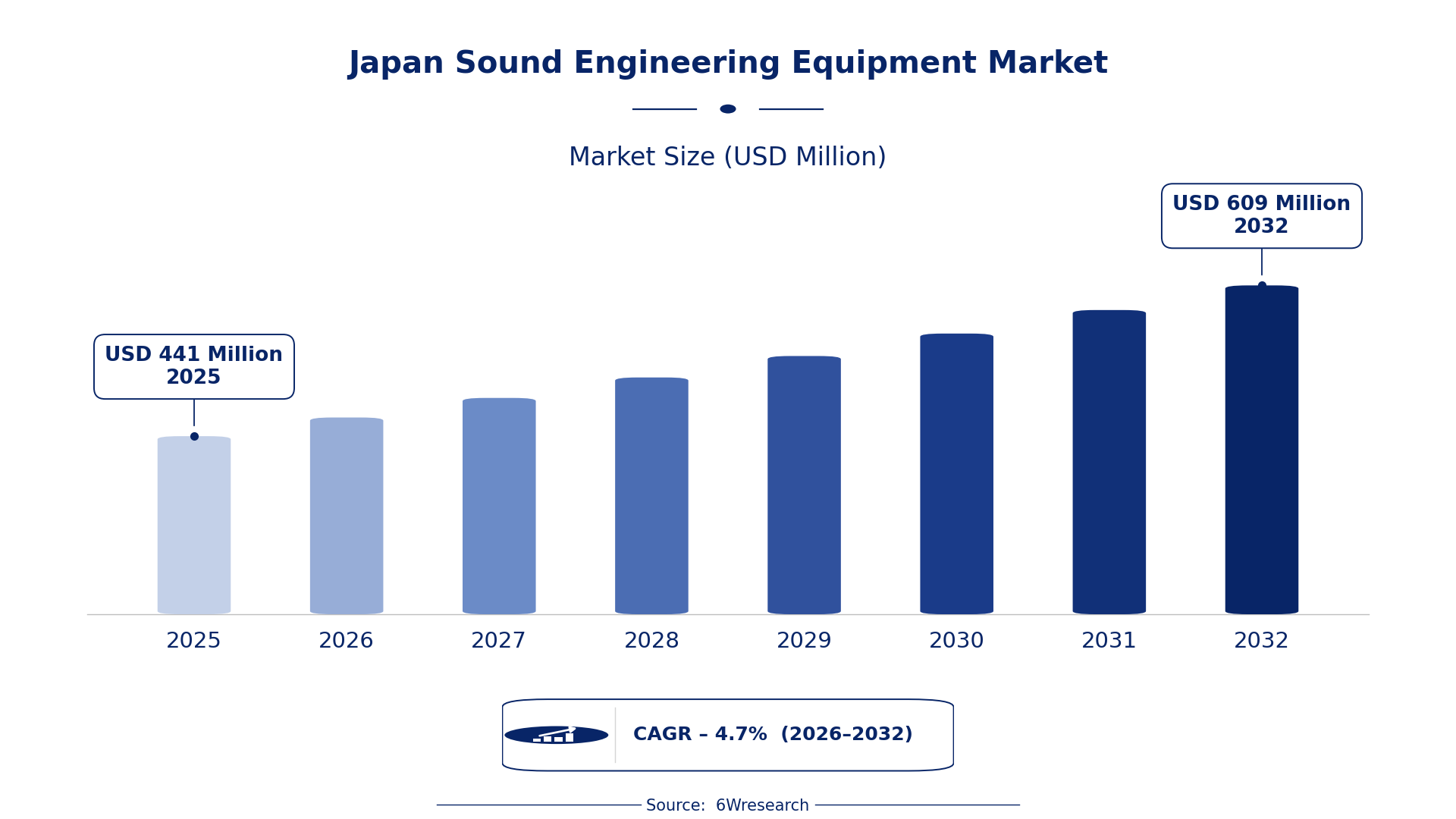
According to 6Wresearch internal database and industry insights, the Japan Sound Engineering Equipment Market was valued at USD 441 Million in 2025 and is projected to reach USD 609 Million by 2032, growing at a CAGR of approximately 4.7% during 2026–2032.
Japan Sound Engineering Equipment Market Highlights
| Report Metric | Details |
| Report Name | Japan Sound Engineering Equipment Market (2026-2032) |
| Market Size 2025 | USD 441 Million |
| Market Size 2032 | USD 609 Million |
| Absolute Growth 2025–2032 | USD 168 Million |
| CAGR 2026–2032 | 4.7% |
| Peak Annual Growth | 5.5% in 2028 |
| Forecast Period | 2026–2032 |
| Historical Data | 2022–2025 |
| Base Year | 2025 |
| Leading Equipment Type, 2025 | Audio Mixers (37% share) |
| Leading Usage Type, 2025 | Studio/Broadcast (46% share) |
| Leading Portability, 2025 | Rack-Mountable (41% share) |
| Leading End User, 2025 | Sound Engineers (44% share) |
| Fastest-Growing Equipment Type | Field Recorders (6.5% CAGR) |
| Fastest-Growing Usage Type | Outdoor Use (6.6% CAGR) |
| Fastest-Growing Portability | Handheld/Wireless (6.4% CAGR) |
| Fastest-Growing End User | Musicians & Podcasters (6.2% CAGR) |
| Growing Sector | entertainment and media |
| Key End Users | sound engineers, musicians, podcasters, recording studios |
Japan Sound Engineering Equipment Market Year-wise Growth Rate and Key Drivers (2022–2032)
This graph illustrates the annual growth rates of the market from 2022 to 2032, highlighting a steady upward trajectory and projected market expansion over the forecast period.
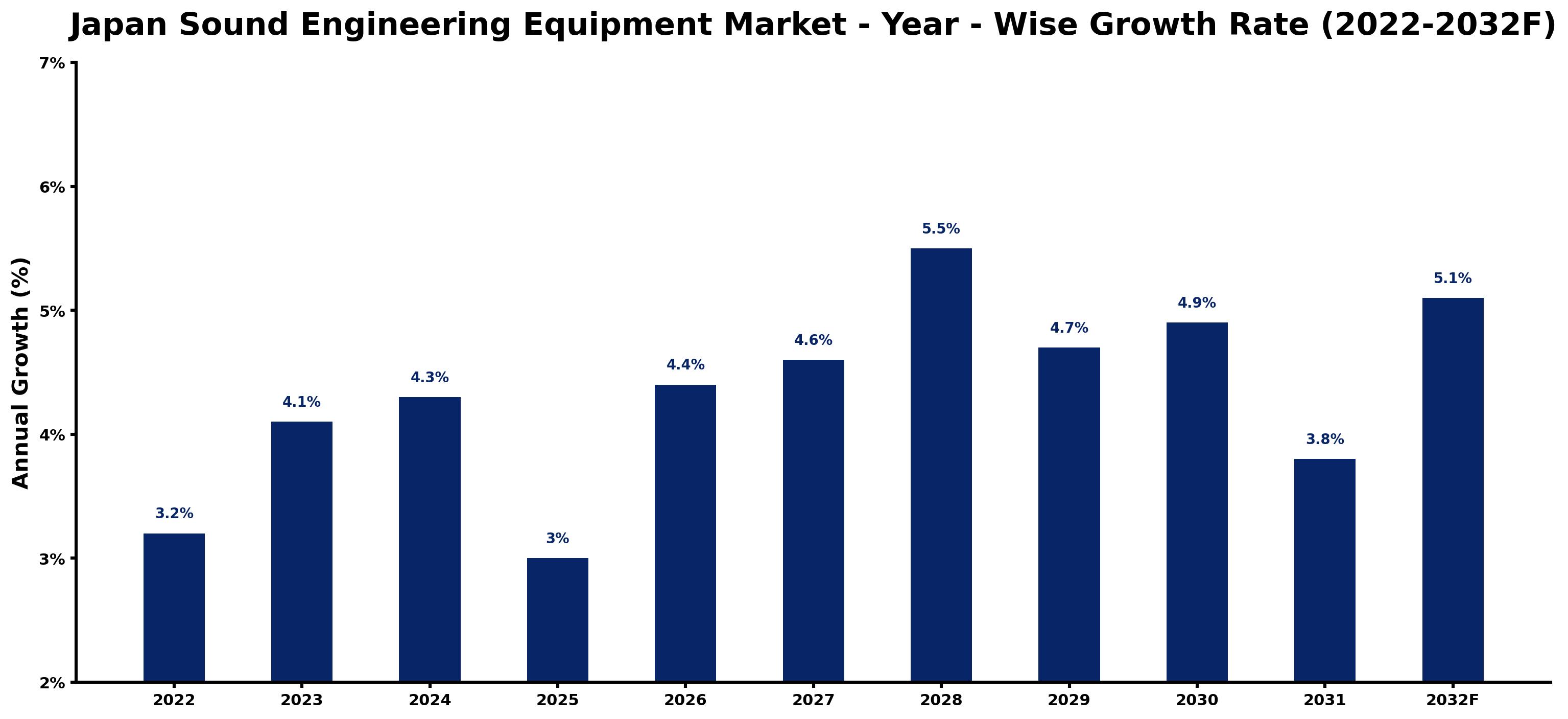
Annual growth estimates for each year appear below with the principal reason behind them, explaining the shifts that set the pace of the market.
| Year | Estimated Annual Growth (%) | Market Rationale |
| 2022 | 3.2 | The market experienced steady growth due to increasing domestic demand for sound engineering equipment. |
| 2023 | 4.1 | Growth accelerated as the entertainment sector expanded, driving higher purchases of audio equipment. |
| 2024 | 4.3 | The market continued to grow as investments in music production facilities increased. |
| 2025 | 3.0 | Growth slowed slightly as some buyers adjusted their budgets after previous expansions. |
| 2026 | 4.4 | Demand is expected to rise as technology adoption in studios becomes more prevalent. |
| 2027 | 4.6 | The market will see further growth driven by a surge in live events and performances. |
| 2028 | 5.5 | Peak growth is projected as the demand for high-quality audio equipment surges during major events. |
| 2029 | 4.7 | Growth is expected to slow again as the market stabilises after reaching peak levels. |
| 2030 | 4.9 | Demand will increase as more musicians and podcasters seek professional-grade equipment. |
| 2031 | 3.8 | Growth is projected to slow as the market adjusts to previous years' rapid expansions. |
| 2032 | 5.1 | Demand is expected to rise as new technologies in sound engineering equipment are adopted. |
Note: Market size estimations and growth projections presented in this report are based on 6Wresearch's proprietary forecasting methodology, utilizing the latest available industry data, government publications, and primary research inputs.
Japan Sound Engineering Equipment Market Synopsis
Sound engineering equipment encompasses devices for recording, mixing, and reproducing audio, designed with advanced electronics to ensure optimal sound fidelity. The Japan Sound Engineering Equipment Market is growing due to heightened demand from live events, increased investments in music production, and a rising number of active musicians and podcasters. Valued at approximately 300 billion yen, Tokyo serves as the central hub for production and innovation in this sector, further propelling market growth.
Market Dynamics Impact Analysis (2026–2032)
| Factor | Type | Impact | Primary Segment Affected |
| Rising number of live events | Driver | High | Microphones |
| Increased investments in music production | Driver | High | Studio Monitors |
| Growing demand for portable recording solutions | Opportunity | Medium | Field Recorders |
| Expansion of the podcasting industry | Opportunity | Medium | Microphones |
| High costs of advanced equipment | Restraint | High | Audio Mixers |
| Limited availability of certain specialized equipment | Restraint | Medium | Studio Monitors |
| Intense competition among manufacturers | Challenge | High | Field Recorders |
| Rapid technological changes in audio equipment | Challenge | Medium | Microphones |
Evaluation of Drivers in Japan Sound Engineering Equipment Market (2026–2032)
Demand rests on the following drivers, each shown with the segment it touches most.
| Drivers | Primary Segment Affected | Why It Matters (Evidence) |
| Increasing number of live events | Microphones | The annual 1.5 million live events drive higher microphone purchases, as they are essential for sound capture in these settings. |
| Growth of the podcasting industry | Field Recorders | With over 2 million active podcasters, demand for field recorders rises, as they are crucial for high-quality audio capture. |
| Investments in music production facilities | Studio Monitors | A 15% increase in studio monitor sales reflects investments in music production, as recording studios seek to enhance sound fidelity. |
| Technological advancements in audio mixing | Audio Mixers | Innovations in audio mixing technology attract buyers looking for improved capabilities in professional setups, boosting mixer sales. |
| Rising number of active musicians | Recording Studios | The growing pool of over 2 million musicians increases demand for recording studios, driving the need for sound engineering equipment. |
What keeps demand rising is the increasing number of live events, with approximately 1.5 million held annually, leading to a surge in microphone purchases. The growth of the podcasting industry, with over 2 million active podcasters, drives demand for field recorders, which are essential for high-quality audio capture. Investments in music production facilities have resulted in a 15% increase in studio monitor sales, as recording studios seek to improve sound fidelity. Technological advancements in audio mixing are attracting buyers looking for improved capabilities in professional setups.
Evaluation of Restraints in Japan Sound Engineering Equipment Market
These restraints slow adoption and weigh on supplier margins.
| Market Restraint | Primary Segment Affected | Why It Matters (Evidence) |
| High costs of advanced audio mixing equipment limit market access | Audio Mixers | The premium pricing of advanced mixers restricts purchases by smaller studios. |
| Limited availability of specialized sound engineering equipment hampers growth | Studio Monitors | Certain high-end studio monitors are difficult to source, affecting production capabilities. |
| Intense competition among manufacturers leads to price wars | Field Recorders | Price reductions may compromise quality, impacting buyer decisions. |
| Rapid technological changes require constant investment | Microphones | Manufacturers must frequently update products to meet evolving standards, increasing costs. |
| Market saturation in some audio equipment segments | Audio Mixers | A high number of similar products leads to reduced differentiation and buyer interest. |
Japan Sound Engineering Equipment Market Challenges
Producers in Japan face a skills shortage, as many audio engineers lack the advanced training required for modern sound engineering. This gap results from a limited number of specialised education programmes, causing project delays for recording studios and increasing costs by up to 20%. Regulatory compliance with the JIS Z 8701 standard complicates matters; rigorous testing can postpone product launches, frustrating producers who require timely access to new equipment. Additionally, fluctuating demand in live events creates excess inventory for producers, leading to cash flow challenges. Rising minimum wages, now at JPY 1,055 per hour, inflate operational costs for producers, forcing them to increase prices for buyers.
Trends in the Japan Sound Engineering Equipment Market
The following changes are redrawing the Japan Sound Engineering Equipment Market.
- Shift towards Portable Recording Solutions: The trend towards portable recording solutions began in 2023, driven by the rise of mobile content creation. Field recorders are increasingly popular among urban filmmakers, with a notable increase in usage in major cities.
- Transition from Traditional Studios to Home Studios: The transition from traditional studios to home studios has been significant, especially in Tokyo. With over 1,000 recording studios, many musicians now prefer home setups for convenience and cost savings.
- Emergence of High-Quality Audio Standards: The Japan Audio Society has promoted high-quality audio standards since 2023, influencing equipment purchases. This initiative has led to an increase in demand for studio monitors.
- Prioritisation of Live Sound Reinforcement Equipment: The prioritisation of live sound reinforcement equipment has accelerated since 2024, as events resumed. Microphones are a key component in the 1.5 million live events held annually.
Investment Opportunities in the Japan Sound Engineering Equipment Market
Investors looking at the Japan Sound Engineering Equipment Market should consider the following areas.
- Partner with Local Studios for Equipment Supply: Now is the time to collaborate with local recording studios in Tokyo, where demand for sound engineering equipment is growing, particularly in the entertainment sector.
- Invest in Portable Recording Technology: Investing in portable recording technology is essential as the demand for field recorders rises, particularly among urban filmmakers and podcasters seeking high-quality audio solutions.
- Expand Offerings for Musicians and Podcasters: With over 2 million active musicians and podcasters in Japan, suppliers can expand offerings tailored to this group, focusing on affordable yet high-quality equipment.
- Utilise Government Support for Music Production: Utilising government support from the Tokyo Metropolitan Government's 2023 programme can facilitate entry into the market, especially for new audio equipment manufacturers.
Government Initiatives in the Japan Sound Engineering Equipment Market
The Industrial Safety and Health Act (1972) mandates that producers ensure the safety of hazardous substances in sound engineering equipment, impacting manufacturers' compliance costs and product design. Additionally, the Act on the Rational Use of Energy (1979) requires large energy users to improve efficiency, affecting production practices in audio equipment manufacturing.
The Ministry of Economy, Trade and Industry oversees the implementation of energy efficiency standards, which require manufacturers to report energy use. This affects producers by necessitating investments in energy-efficient technologies to comply with regulations.
Future Insight of the Japan Sound Engineering Equipment Market
Musicians and podcasters will benefit from technological advancements by 2032, as the Ministry of Economy, Trade and Industry supports innovation in audio equipment. The Tokyo Metropolitan Government's programme for music production will encourage the establishment of new studios, enhancing competition and quality. Demand for audio equipment is expected to rise, with a projected increase in live events to 1.5 million annually, reflecting the expanding entertainment sector. The implementation of ISO 9001 certification will ensure improved quality standards, benefiting both buyers and suppliers.
Market Segmentation Analysis
Japan Sound Engineering Equipment Market report covers a detailed analysis of the following market segments:
By Equipment Type – Audio Mixers Lead, Field Recorders Expected to Grow Fastest
According to Saurav Kr Singh, Senior Research Analyst at 6Wresearch, in 2025, Audio Mixers led the equipment type split with a 37% share. Audio mixers are essential for audio mixing in studios and live events, solidifying their dominant position in the market. Their widespread adoption across Japan's over 1,000 recording studios highlights their importance in professional audio production. Field Recorders are set to record the highest CAGR in this split, 6.5% over 2026–2032. Field recorders are gaining traction in film production, particularly in urban areas, due to their ability to capture high-quality audio in various settings. The increasing number of live events, estimated at 1.5 million annually, drives the demand for portable recording solutions. Suppliers should focus on enhancing the functionality of field recorders to meet the rising demand in film and event production.
By Usage Type – Studio/Broadcast Leads, Outdoor Use Expected to Grow Fastest
The largest usage type category in 2025 was Studio/Broadcast, at 46% of revenue. The studio and broadcast segment serves as the core application for sound engineering equipment, underpinning professional audio production. Its prominence is reinforced by the concentration of recording studios and broadcasting facilities in major urban centres like Tokyo. Outdoor Use is projected to grow fastest, at a CAGR of 6.6% during 2026–2032. Outdoor use is quickly becoming popular as it caters to the needs of events and recordings outside traditional studio environments, driven by the significant rise in live events. This shift indicates a growing demand for versatile audio solutions. Buyers may need to invest in equipment that excels in diverse environments to keep pace with the increasing trend of outdoor recording.
By Portability – Rack-Mountable Leads, Handheld/Wireless Expected to Grow Fastest
Rack-Mountable accounted for 41% of the market by portability in 2025. Rack-mountable equipment is commonly used in professional setups, providing a reliable solution for sound engineers in studios and live events. Their popularity stems from the need for efficient space management in complex audio setups. Over 2026–2032, Handheld/Wireless is expected to post the fastest growth, at a CAGR of 6.4%. Handheld and wireless equipment is popular for convenience in live settings, allowing for greater mobility and flexibility during performances. This trend is likely to continue as events demand more adaptable audio solutions. Suppliers should consider expanding their range of handheld and wireless options to cater to the growing preference for portable audio solutions.
By End User – Sound Engineers Lead, Musicians & Podcasters Expected to Grow Fastest
Sound Engineers took 44% of end user revenue in 2025, more than any other category. Sound engineers are the primary users of sound engineering equipment, relying on it for their professional audio production needs. Their expertise and demand for high-quality tools play a crucial role in driving the market's growth. The quickest growth will come from Musicians & Podcasters, forecast to expand at a CAGR of 6.2% between 2026 and 2032. Musicians and podcasters represent a significant user group for recording and broadcasting, reflecting the rising trend of audio content creation. The expansion of this demographic indicates a promising market for tailored audio solutions. Suppliers should tailor their products to meet the specific needs of musicians and podcasters, who are becoming an increasingly important segment of the user base.
Key Attractiveness of the Report
- 10 Years of Market Numbers
- Historical Data Starting from 2022 to 2025
- Base Year 2025
- Forecast Data until 2032
- Key Performance Indicators Impacting the Market
- Major Upcoming Developments and Projects
Key Highlights of the Report:
- Japan Sound Engineering Equipment Market Outlook
- Market Size of Japan Sound Engineering Equipment Market, 2025
- Forecast of Japan Sound Engineering Equipment Market, 2032
- Historical Data and Forecast of Japan Sound Engineering Equipment Revenues & Volume for the Period 2022-2032F
- Japan Sound Engineering Equipment Market Trend Evolution
- Japan Sound Engineering Equipment Market Drivers and Challenges
- Japan Sound Engineering Equipment Price Trends
- Japan Sound Engineering Equipment Porter's Five Forces
- Japan Sound Engineering Equipment Industry Life Cycle
- Historical Data and Forecast of Japan Sound Engineering Equipment Market Revenues & Volume By Equipment Type for the Period 2022-2032F
- Historical Data and Forecast of Japan Sound Engineering Equipment Market Revenues & Volume By Audio Mixers for the Period 2022-2032F
- Historical Data and Forecast of Japan Sound Engineering Equipment Market Revenues & Volume By Microphones for the Period 2022-2032F
- Historical Data and Forecast of Japan Sound Engineering Equipment Market Revenues & Volume By Studio Monitors for the Period 2022-2032F
- Historical Data and Forecast of Japan Sound Engineering Equipment Market Revenues & Volume By Field Recorders for the Period 2022-2032F
- Historical Data and Forecast of Japan Sound Engineering Equipment Market Revenues & Volume By Usage Type for the Period 2022-2032F
- Historical Data and Forecast of Japan Sound Engineering Equipment Market Revenues & Volume By Studio/Broadcast for the Period 2022-2032F
- Historical Data and Forecast of Japan Sound Engineering Equipment Market Revenues & Volume By Vocal/Instrumental for the Period 2022-2032F
- Historical Data and Forecast of Japan Sound Engineering Equipment Market Revenues & Volume By Mixing/Mastering for the Period 2022-2032F
- Historical Data and Forecast of Japan Sound Engineering Equipment Market Revenues & Volume By Outdoor Use for the Period 2022-2032F
- Historical Data and Forecast of Japan Sound Engineering Equipment Market Revenues & Volume By Portability for the Period 2022-2032F
- Historical Data and Forecast of Japan Sound Engineering Equipment Market Revenues & Volume By Rack-Mountable for the Period 2022-2032F
- Historical Data and Forecast of Japan Sound Engineering Equipment Market Revenues & Volume By Handheld/Wireless for the Period 2022-2032F
- Historical Data and Forecast of Japan Sound Engineering Equipment Market Revenues & Volume By Nearfield/Farfield for the Period 2022-2032F
- Historical Data and Forecast of Japan Sound Engineering Equipment Market Revenues & Volume By Compact/Battery for the Period 2022-2032F
- Historical Data and Forecast of Japan Sound Engineering Equipment Market Revenues & Volume By End User for the Period 2022-2032F
- Historical Data and Forecast of Japan Sound Engineering Equipment Market Revenues & Volume By Sound Engineers for the Period 2022-2032F
- Historical Data and Forecast of Japan Sound Engineering Equipment Market Revenues & Volume By Musicians & Podcasters for the Period 2022-2032F
- Historical Data and Forecast of Japan Sound Engineering Equipment Market Revenues & Volume By Recording Studios for the Period 2022-2032F
- Historical Data and Forecast of Japan Sound Engineering Equipment Market Revenues & Volume By Filmmakers & Reporters for the Period 2022-2032F
- Japan Sound Engineering Equipment Import Export Trade Statistics
- Market Opportunity Assessment By Equipment Type
- Market Opportunity Assessment By Usage Type
- Market Opportunity Assessment By Portability
- Market Opportunity Assessment By End User
- Japan Sound Engineering Equipment Top Companies Market Share
- Japan Sound Engineering Equipment Competitive Benchmarking By Technical and Operational Parameters
- Japan Sound Engineering Equipment Company Profiles
- Japan Sound Engineering Equipment Key Strategic Recommendations
Market Covered
The study includes the following segmentation.
By Equipment Type
- Audio Mixers
- Microphones
- Studio Monitors
- Field Recorders
By Usage Type
- Studio/Broadcast
- Vocal/Instrumental
- Mixing/Mastering
- Outdoor Use
By Portability
- Rack-Mountable
- Handheld/Wireless
- Nearfield/Farfield
- Compact/Battery
By End User
- Sound Engineers
- Musicians & Podcasters
- Recording Studios
- Filmmakers & Reporters































