Japan Space-Based 5G Infrastructure Market Size & Growth Rate
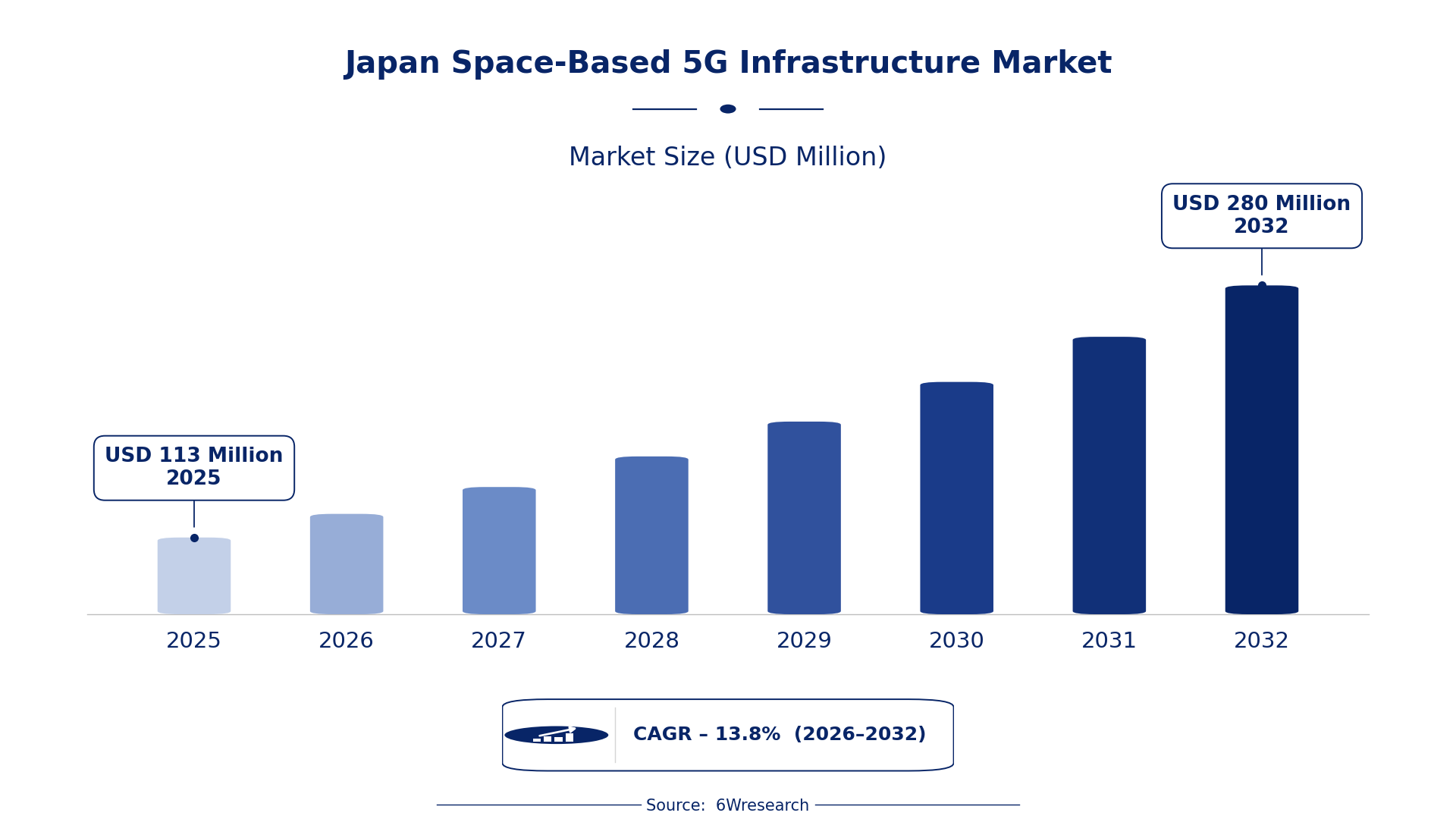
According to 6Wresearch internal database and industry insights, the Japan Space-Based 5G Infrastructure Market was valued at USD 113 Million in 2025 and is projected to reach USD 280 Million by 2032, growing at a CAGR of approximately 13.8% during 2026–2032.
Japan Space-Based 5G Infrastructure Market Highlights
| Report Metric | Details |
| Report Name | Japan Space-Based 5G Infrastructure Market (2026-2032) |
| Market Size 2025 | USD 113 Million |
| Market Size 2032 | USD 280 Million |
| Absolute Growth 2025–2032 | USD 167 Million |
| CAGR 2026–2032 | 13.8% |
| Peak Annual Growth | 15.2% in 2026 |
| Forecast Period | 2026–2032 |
| Historical Data | 2022–2025 |
| Base Year | 2025 |
| Leading Infrastructure Type, 2025 | LEO Satellite Constellations (38% share) |
| Leading Orbit Type, 2025 | Low Earth Orbit (39% share) |
| Leading Bandwidth Capability, 2025 | High-Speed Broadband (42% share) |
| Leading End User, 2025 | 5G Network Providers (44% share) |
| Fastest-Growing Infrastructure Type | Payload Modules (18.8% CAGR) |
| Fastest-Growing Orbit Type | Integrated Antennas (15.7% CAGR) |
| Fastest-Growing Bandwidth Capability | Ka/Ku Band (17.7% CAGR) |
| Fastest-Growing End User | Satellite Operators (17.6% CAGR) |
| Growing Sector | satellite communication |
| Key End Users | 5G Network Providers, Telecom Companies, Satellite Operators, Enterprise Connectivity |
Japan Space-Based 5G Infrastructure Market Year-wise Growth Rate and Key Drivers (2022–2032)
This graph illustrates the annual growth rates of the market from 2022 to 2032, highlighting a steady upward trajectory and projected market expansion over the forecast period.
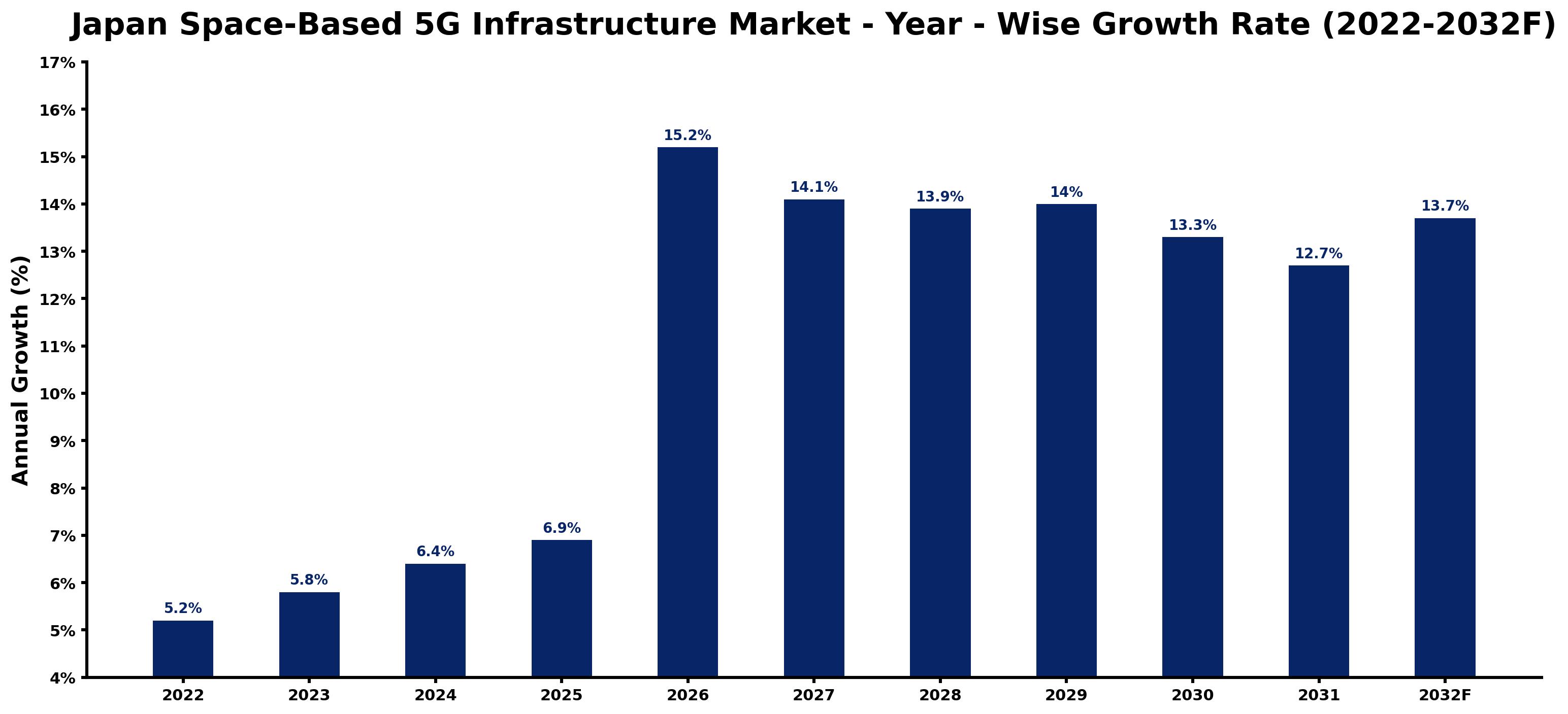
The table below sets out the estimated growth rate for each year and the main factor behind it.
| Year | Estimated Annual Growth (%) | Market Rationale |
| 2022 | 5.2 | The market experienced steady growth driven by increasing satellite launches and demand for connectivity. |
| 2023 | 5.8 | Growth accelerated as domestic telecom operators expanded their satellite integration efforts. |
| 2024 | 6.4 | Demand rose further with advancements in satellite technology and infrastructure capabilities. |
| 2025 | 6.9 | The market peaked due to heightened investments in satellite communication and broadband initiatives. |
| 2026 | 15.2 | Growth surged as 5G Network Providers increased their satellite integration investments. |
| 2027 | 14.1 | A slowdown occurred as the market adjusted to the rapid growth of the previous year. |
| 2028 | 13.9 | Growth continued but at a slower rate as market saturation began to take effect. |
| 2029 | 14.0 | The market rebounded with renewed investments in satellite technology and infrastructure. |
| 2030 | 13.3 | Growth decelerated as competition intensified among satellite operators and service providers. |
| 2031 | 12.7 | The market continued to grow, albeit at a slower pace, as new technologies emerged. |
| 2032 | 13.7 | Growth accelerated again as demand for high-speed internet in remote areas surged. |
Note: Market size estimations and growth projections presented in this report are based on 6Wresearch's proprietary forecasting methodology, utilizing the latest available industry data, government publications, and primary research inputs.
Japan Space-Based 5G Infrastructure Market Synopsis
Space-Based 5G Infrastructure enables high-speed communication via satellites, primarily through advanced satellite manufacturing and launching into Low Earth Orbit. This technology provides broadband connectivity in remote areas, strengthens mobile networks, and supports IoT applications. The Japan Space-Based 5G Infrastructure Market is expanding due to rising demand from domestic telecom operators and satellite service providers, alongside government initiatives aimed at achieving 100% broadband coverage by 2025.
Market Dynamics Impact Analysis (2026–2032)
| Factor | Type | Impact | Primary Segment Affected |
| Growing demand for high-speed internet in remote areas | Driver | High | LEO Satellite Constellations |
| Increased investment by 5G Network Providers in satellite integration | Driver | High | 5G Network Providers |
| Expansion of satellite broadband coverage initiatives | Opportunity | High | High-Speed Broadband |
| Rising collaborations between domestic and international satellite operators | Opportunity | Medium | Satellite Operators |
| Regulatory challenges in satellite communication standards | Restraint | High | Relay Satellites |
| Limited availability of skilled workforce for satellite manufacturing | Restraint | Medium | Payload Modules |
| High costs associated with satellite launches | Challenge | High | Space-Ground Interface |
| Technological complexities in satellite communication integration | Challenge | Medium | Integrated Antennas |
Evaluation of Drivers in Japan Space-Based 5G Infrastructure Market (2026–2032)
The table below links each growth driver to the segment it affects and the evidence for it.
| Drivers | Primary Segment Affected | Why It Matters (Evidence) |
| Increased satellite launches | LEO Satellite Constellations | Japan's population of approximately 125 million drives demand for improved connectivity, prompting over 20 active satellite operators to launch new satellites. |
| Investment in satellite integration by telecom companies | 5G Network Providers | 5G Network Providers are expected to invest heavily in satellite integration by 2026, improving their service offerings. |
| Government initiatives for broadband coverage | High-Speed Broadband | The government aims for 100% broadband coverage by 2025, increasing demand for satellite solutions. |
| Technological advancements in satellite communication | Relay Satellites | Updated policies promote advancements in satellite communication capabilities, driving innovation in the sector. |
| Growing IoT applications requiring connectivity | IoT Backhaul | The demand for IoT connectivity is rising, necessitating effective satellite backhaul solutions. |
Spending rises because Japan's population of approximately 125 million creates a strong demand for high-speed internet, prompting over 20 active satellite operators to launch new satellites. Telecom companies are expected to invest heavily in satellite integration by 2026, improving their service offerings. These factors are propelling the market's growth potential.
Evaluation of Restraints in Japan Space-Based 5G Infrastructure Market
These are the pressures that could keep growth below its potential.
| Market Restraint | Primary Segment Affected | Why It Matters (Evidence) |
| Regulatory challenges in satellite communication standards | Relay Satellites | The Ministry of Internal Affairs and Communications oversees regulations, complicating compliance for satellite operators. |
| Limited availability of skilled workforce for satellite manufacturing | Payload Modules | Japan's space industry faces a talent shortage, impacting production timelines and costs. |
| High costs associated with satellite launches | Space-Ground Interface | The average cost of satellite launches can exceed ¥10 billion, limiting operational budgets for smaller operators. |
| Technological complexities in satellite communication integration | Integrated Antennas | Integrating advanced technologies into existing systems can delay deployment and increase costs. |
| Market saturation among satellite operators | LEO Satellite Constellations | As competition increases, operators may struggle to differentiate their services, impacting profitability. |
Japan Space-Based 5G Infrastructure Market Challenges
High costs for buyers arise from intense competition among over 20 active satellite operators, which can lead to inflated service prices and reduced options. Regulatory hurdles from the Ministry of Internal Affairs and Communications delay satellite deployment timelines by as much as six months for suppliers, complicating market entry. Compliance with ISO 9001 standards raises manufacturing expenses by 15%, impacting suppliers' profitability. Limited broadband coverage in remote areas restricts connectivity for buyers, delaying IoT application rollouts by several months and affecting service delivery.
Trends in the Japan Space-Based 5G Infrastructure Market
The shifts below are changing how Japan Space-Based 5G Infrastructure Market products are bought and supplied.
- Shift towards Enhanced Satellite Communication Standards: The updated Space Development Strategy is driving improvements in satellite communication standards. This change aims to ensure better interoperability among satellite systems, which is essential for expanding broadband coverage across Japan, especially in rural areas.
- Transition from Traditional to Satellite-Based Broadband Solutions: The Tokyo region is experiencing a shift from traditional broadband to satellite-based solutions, with the government targeting 100% coverage by 2025. This transition is expected to improve connectivity in underserved areas, benefiting both consumers and businesses.
- Emerging Focus on IoT Connectivity Solutions: As IoT applications grow, the demand for reliable satellite backhaul solutions is increasing. The government has allocated ¥10 billion for satellite communication research in 2023, supporting innovations that improve IoT connectivity.
- Growth of Integrated Antennas for Urban Connectivity: Integrated antennas are being developed for better connectivity in urban areas, responding to the rising need for high-speed internet. These advancements are important for meeting the needs of densely populated regions.
Investment Opportunities in the Japan Space-Based 5G Infrastructure Market
Below are the investment opportunities with the strongest case in the Japan Space-Based 5G Infrastructure Market.
- Investment in Satellite Communication Research: The Tokyo region is a hub for satellite technology development, with the government allocating ¥10 billion for research in 2023. This funding presents opportunities for partnerships with local research institutions to innovate in satellite communication.
- Expansion of Broadband Services in Rural Areas: 5G Network Providers are focusing on expanding broadband services in rural areas, driven by the government's target for 100% coverage by 2025. Collaborating with local telecom companies can facilitate market entry.
- Development of IoT Solutions: The increasing need for IoT connectivity presents opportunities for investment in satellite backhaul solutions. Engaging with IoT service providers can improve market presence in this growing segment.
- Partnerships for Satellite Launches: The Japan Aerospace Exploration Agency collaborates with private sectors for satellite launches. Forming joint ventures can streamline access to launch capabilities and expand service offerings.
Government Initiatives in the Japan Space-Based 5G Infrastructure Market
The Electrical Appliance and Material Safety Act regulates the safety of satellite communication equipment standards in Japan. Compliance with this act ensures that satellite infrastructure meets safety requirements, promoting consumer confidence and market growth. The government allocated ¥10 billion for satellite communication research in 2023, supporting advancements in satellite technology and improving the capabilities of domestic operators.
The Digital Agency, established in September 2021, leads government digital transformation efforts. This agency supports initiatives that improve satellite communication capabilities, enabling buyers to access better broadband services and encouraging collaboration among stakeholders.
Future Insight of the Japan Space-Based 5G Infrastructure Market
A policy-driven shift will enhance satellite communication capabilities, prompting increased investment from telecom providers. The government aims for 100% broadband coverage by 2025, which will drive demand for advanced satellite solutions. Funding of ¥10 billion for satellite communication research will support technological advancements. Collaborations between the Japan Aerospace Exploration Agency and private sectors will streamline satellite launches, improving connectivity and service delivery.
Market Segmentation Analysis
Japan Space-Based 5G Infrastructure Market report covers a detailed analysis of the following market segments:
By Infrastructure Type – LEO Satellite Constellations Lead, Payload Modules Expected to Grow Fastest
According to Saurav Kr Singh, Senior Research Analyst at 6Wresearch, the largest infrastructure type category in 2025 was LEO Satellite Constellations, at 38% of revenue. LEO Satellite Constellations dominate the market as they are essential for providing global coverage and connectivity. Their importance is underscored by the increasing demand for high-speed internet across Japan, which is supported by over 20 active satellite operators. Over 2026–2032, Payload Modules are expected to post the fastest growth, at a CAGR of 18.8%. Payload Modules are witnessing rapid growth due to advancements in satellite technology that enhance overall satellite functionality. As Japan's space industry continues to expand, these modules will become increasingly critical for operational efficiency. Suppliers should focus on developing LEO Satellite Constellations to meet the rising demand for high-speed connectivity.
By Orbit Type – Low Earth Orbit Leads, Integrated Antennas Expected to Grow Fastest
In 2025, Low Earth Orbit led the orbit type split with a 39% share. Low Earth Orbit leads the segment because it offers optimal conditions for low-latency communication, which is crucial for applications like disaster management. The Japanese government's commitment to achieving 100% broadband coverage by 2025 further solidifies its importance in the market. Integrated Antennas are projected to grow fastest, at a CAGR of 15.7% during 2026–2032. Integrated Antennas are growing quickly as they significantly improve satellite communication capabilities. As urban connectivity demands rise, the need for these antennas will become increasingly vital in the coming years. Buyers will benefit from investing in technologies that utilise Low Earth Orbit for enhanced communication efficiency.
By Bandwidth Capability – High-Speed Broadband Leads, Ka/Ku Band Expected to Grow Fastest
High-Speed Broadband accounted for 42% of the market by bandwidth capability in 2025. High-Speed Broadband commands the largest share as it serves as the primary application for consumer and enterprise use, reflecting Japan's growing need for reliable internet access. The government's goal of achieving 100% broadband coverage by 2025 further emphasises its importance in the market. The quickest growth will come from Ka/Ku Band, forecast to expand at a CAGR of 17.7% between 2026 and 2032. The Ka/Ku Band is seeing rapid growth as these specific frequency bands are increasingly employed for satellite communication. This trend aligns with the overall expansion of Japan's satellite infrastructure, indicating a shift towards more efficient communication methods. Suppliers should prioritise High-Speed Broadband solutions to align with the government's broadband coverage objectives.
By End User – 5G Network Providers Lead, Satellite Operators Expected to Grow Fastest
5G Network Providers held 44% of the Japan Space-Based 5G Infrastructure Market by end user in 2025. 5G Network Providers are the primary end users of space-based infrastructure, necessitating robust connectivity solutions for their extensive services. The anticipated substantial investments in satellite integration by these providers highlight their crucial role in the market's evolution. Satellite Operators are set to record the highest CAGR in this split, 17.6% over 2026–2032. Satellite Operators are expanding rapidly as primary users of satellite technology, driven by the increasing demand for satellite-based communication solutions. Their growth will further strengthen the overall market environment and create new opportunities. Both suppliers and buyers should consider the changing requirements of 5G Network Providers to ensure alignment with emerging market trends.
Key Attractiveness of the Report
- 10 Years of Market Numbers
- Historical Data Starting from 2022 to 2025
- Base Year 2025
- Forecast Data until 2032
- Key Performance Indicators Impacting the Market
- Major Upcoming Developments and Projects
Key Highlights of the Report:
- Japan Space-Based 5G Infrastructure Market Outlook
- Market Size of Japan Space-Based 5G Infrastructure Market, 2025
- Forecast of Japan Space-Based 5G Infrastructure Market, 2032
- Historical Data and Forecast of Japan Space-Based 5G Infrastructure Revenues & Volume for the Period 2022-2032F
- Japan Space-Based 5G Infrastructure Market Trend Evolution
- Japan Space-Based 5G Infrastructure Market Drivers and Challenges
- Japan Space-Based 5G Infrastructure Price Trends
- Japan Space-Based 5G Infrastructure Porter's Five Forces
- Japan Space-Based 5G Infrastructure Industry Life Cycle
- Historical Data and Forecast of Japan Space-Based 5G Infrastructure Market Revenues & Volume By Infrastructure Type for the Period 2022-2032F
- Historical Data and Forecast of Japan Space-Based 5G Infrastructure Market Revenues & Volume By LEO Satellite Constellations for the Period 2022-2032F
- Historical Data and Forecast of Japan Space-Based 5G Infrastructure Market Revenues & Volume By Payload Modules for the Period 2022-2032F
- Historical Data and Forecast of Japan Space-Based 5G Infrastructure Market Revenues & Volume By Relay Satellites for the Period 2022-2032F
- Historical Data and Forecast of Japan Space-Based 5G Infrastructure Market Revenues & Volume By Space-Ground Interface for the Period 2022-2032F
- Historical Data and Forecast of Japan Space-Based 5G Infrastructure Market Revenues & Volume By Orbit Type for the Period 2022-2032F
- Historical Data and Forecast of Japan Space-Based 5G Infrastructure Market Revenues & Volume By Low Earth Orbit for the Period 2022-2032F
- Historical Data and Forecast of Japan Space-Based 5G Infrastructure Market Revenues & Volume By Integrated Antennas for the Period 2022-2032F
- Historical Data and Forecast of Japan Space-Based 5G Infrastructure Market Revenues & Volume By Data Handoff for the Period 2022-2032F
- Historical Data and Forecast of Japan Space-Based 5G Infrastructure Market Revenues & Volume By IoT Backhaul for the Period 2022-2032F
- Historical Data and Forecast of Japan Space-Based 5G Infrastructure Market Revenues & Volume By Bandwidth Capability for the Period 2022-2032F
- Historical Data and Forecast of Japan Space-Based 5G Infrastructure Market Revenues & Volume By High-Speed Broadband for the Period 2022-2032F
- Historical Data and Forecast of Japan Space-Based 5G Infrastructure Market Revenues & Volume By Ka/Ku Band for the Period 2022-2032F
- Historical Data and Forecast of Japan Space-Based 5G Infrastructure Market Revenues & Volume By Multi-Band for the Period 2022-2032F
- Historical Data and Forecast of Japan Space-Based 5G Infrastructure Market Revenues & Volume By Edge Integration for the Period 2022-2032F
- Historical Data and Forecast of Japan Space-Based 5G Infrastructure Market Revenues & Volume By End User for the Period 2022-2032F
- Historical Data and Forecast of Japan Space-Based 5G Infrastructure Market Revenues & Volume By 5G Network Providers for the Period 2022-2032F
- Historical Data and Forecast of Japan Space-Based 5G Infrastructure Market Revenues & Volume By Satellite Operators for the Period 2022-2032F
- Historical Data and Forecast of Japan Space-Based 5G Infrastructure Market Revenues & Volume By Telecom Companies for the Period 2022-2032F
- Historical Data and Forecast of Japan Space-Based 5G Infrastructure Market Revenues & Volume By Enterprise Connectivity for the Period 2022-2032F
- Japan Space-Based 5G Infrastructure Import Export Trade Statistics
- Market Opportunity Assessment By Infrastructure Type
- Market Opportunity Assessment By Orbit Type
- Market Opportunity Assessment By Bandwidth Capability
- Market Opportunity Assessment By End User
- Japan Space-Based 5G Infrastructure Top Companies Market Share
- Japan Space-Based 5G Infrastructure Competitive Benchmarking By Technical and Operational Parameters
- Japan Space-Based 5G Infrastructure Company Profiles
- Japan Space-Based 5G Infrastructure Key Strategic Recommendations
Market Covered
The report covers the following segments.
By Infrastructure Type
- LEO Satellite Constellations
- Payload Modules
- Relay Satellites
- Space-Ground Interface
By Orbit Type
- Low Earth Orbit
- Integrated Antennas
- Data Handoff
- IoT Backhaul
By Bandwidth Capability
- High-Speed Broadband
- Ka/Ku Band
- Multi-Band
- Edge Integration
By End User
- 5G Network Providers
- Satellite Operators
- Telecom Companies
- Enterprise Connectivity































