Japan Space-Based Telecom Market Size & Growth Rate
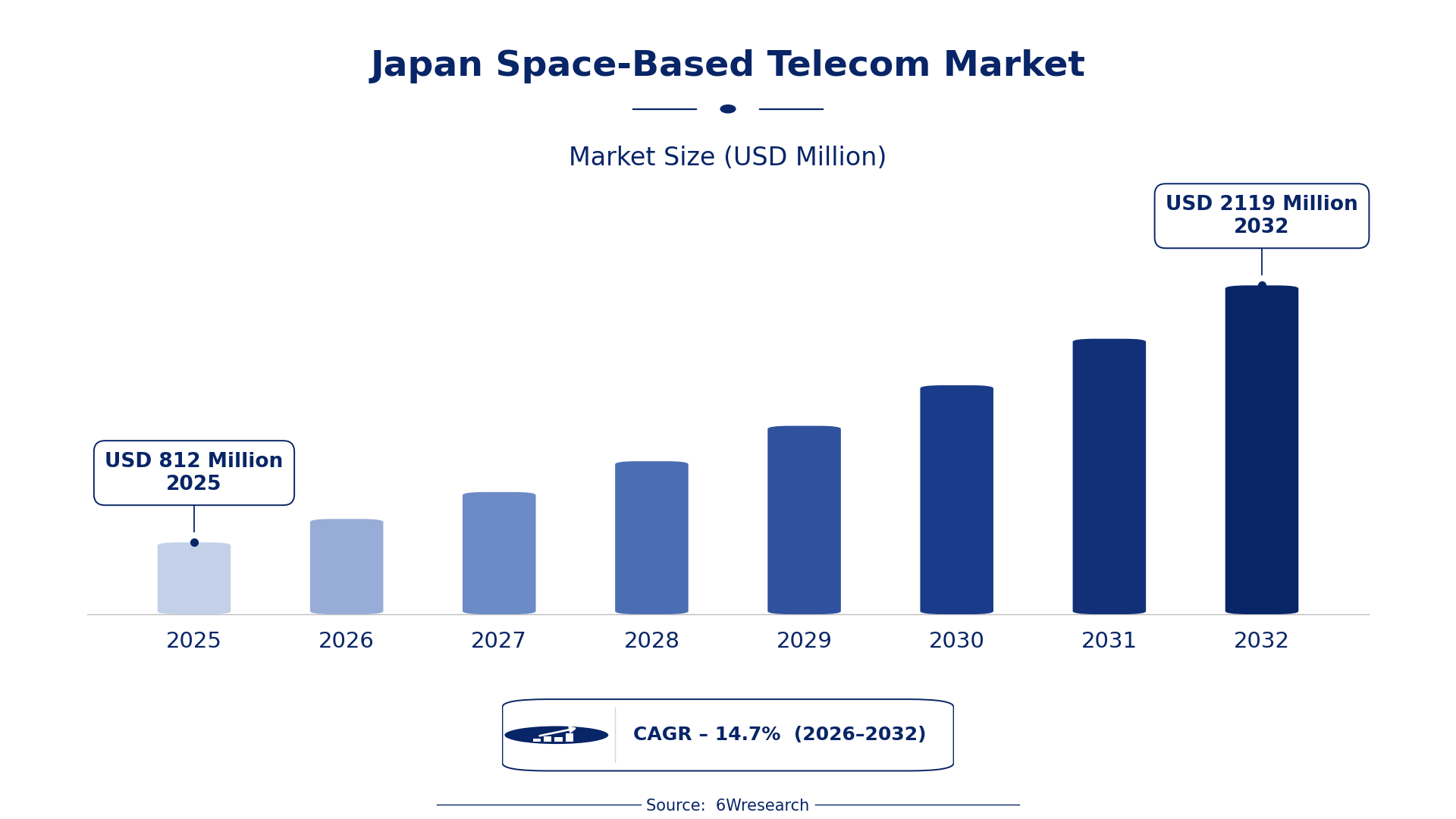
According to 6Wresearch internal database and industry insights, the Japan Space-Based Telecom Market was valued at USD 812 Million in 2025 and is projected to reach USD 2,119 Million by 2032, growing at a CAGR of approximately 14.7% during 2026–2032.
Japan Space-Based Telecom Market Highlights
| Report Metric | Details |
| Report Name | Japan Space-Based Telecom Market (2026-2032) |
| Market Size 2025 | USD 812 Million |
| Market Size 2032 | USD 2,119 Million |
| Absolute Growth 2025–2032 | USD 1,307 Million |
| CAGR 2026–2032 | 14.7% |
| Peak Annual Growth | 15.8% in 2032 |
| Forecast Period | 2026–2032 |
| Historical Data | 2022–2025 |
| Base Year | 2025 |
| Leading Communication Type, 2025 | VSAT (Very Small Aperture Terminals) (44% share) |
| Leading Application Segment, 2025 | Enterprise (49% share) |
| Leading Transmission Medium, 2025 | RF/Microwave (39% share) |
| Leading End User, 2025 | Remote Enterprises (43% share) |
| Fastest-Growing Communication Type | Inter-Satellite Links (16.1% CAGR) |
| Fastest-Growing Application Segment | Satellite Networking (19.6% CAGR) |
| Fastest-Growing Transmission Medium | Laser (20.7% CAGR) |
| Fastest-Growing End User | Satellite Network Firms (19.7% CAGR) |
| Growing Sector | Satellite Communication |
| Key End Users | Remote Enterprises, Government Agencies, Satellite Network Firms |
Japan Space-Based Telecom Market Year-wise Growth Rate and Key Drivers (2022–2032)
This graph illustrates the annual growth rates of the market from 2022 to 2032, highlighting a steady upward trajectory and projected market expansion over the forecast period.
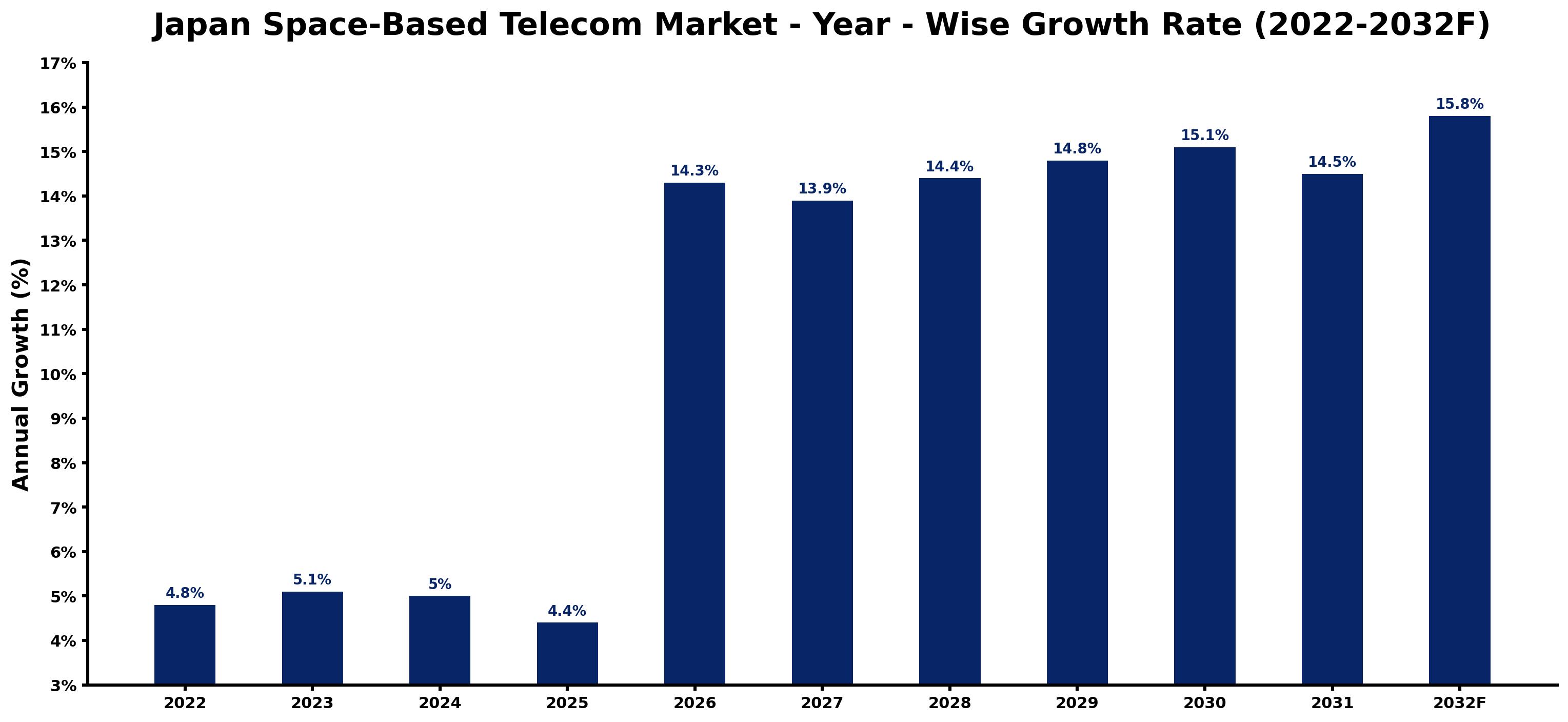
For each year, the table pairs the estimated growth rate with the leading influence on demand, showing how the drivers changed across the period.
| Year | Estimated Annual Growth (%) | Market Rationale |
| 2022 | 4.8 | Demand for satellite communication services remained stable, driven by connectivity needs. |
| 2023 | 5.1 | Growth accelerated as new satellite launches improved service capabilities. |
| 2024 | 5.0 | A slight slowdown occurred due to market saturation in certain areas. |
| 2025 | 4.4 | Continued demand for broadband services led to further growth, albeit at a slower pace. |
| 2026 | 14.3 | Investment in satellite technology surged, resulting in a growth spike. |
| 2027 | 13.9 | Growth moderated as the market adjusted to new service offerings. |
| 2028 | 14.4 | Demand increased again as new technologies improved communication efficiency. |
| 2029 | 14.8 | Further advancements in satellite technology spurred additional growth. |
| 2030 | 15.1 | Continued investment in infrastructure supported rising demand for services. |
| 2031 | 14.5 | Growth slowed slightly as the market matured and competition intensified. |
| 2032 | 15.8 | A peak in growth is anticipated as broadband penetration targets are achieved. |
Note: Market size estimations and growth projections presented in this report are based on 6Wresearch's proprietary forecasting methodology, utilizing the latest available industry data, government publications, and primary research inputs.
Japan Space-Based Telecom Market Synopsis
Space-Based Telecom encompasses satellite communication technologies that enable data transmission via satellites. In Japan, more than 120 satellites are currently in orbit, and a government initiative seeks to enhance rural connectivity by 2025. Key drivers of market growth include rising demand for internet access, especially in remote regions, alongside substantial investments in satellite technology, with ¥50 billion earmarked in 2023 to improve broadband services.
Market Dynamics Impact Analysis (2026–2032)
| Factor | Type | Impact | Primary Segment Affected |
| Increasing demand for internet connectivity in rural areas | Driver | High | VSAT (Very Small Aperture Terminals) |
| Government initiatives to enhance satellite communication capabilities | Driver | High | Ground Uplink Systems |
| Growing need for efficient communication between satellites | Opportunity | Medium | Inter-Satellite Links |
| Expansion of satellite services for disaster management | Opportunity | Medium | Satellite Networking |
| High costs associated with satellite technology development | Restraint | High | Direct-to-Mobile |
| Regulatory compliance requirements for satellite operations | Restraint | High | Consumer Telecom |
| Limited capacity for satellite launches due to regulatory constraints | Challenge | High | Remote Enterprises |
| Increased competition among satellite service providers | Challenge | Medium | Government Agencies |
Evaluation of Drivers in Japan Space-Based Telecom Market (2026–2032)
Below are the drivers that matter most for revenue growth, with supporting evidence.
| Drivers | Primary Segment Affected | Why It Matters (Evidence) |
| Growing investment in satellite technology | Ground Uplink Systems | In 2023, Japan invested ¥50 billion to improve satellite communication capabilities, increasing demand for ground infrastructure. |
| Rising consumer demand for satellite internet services | VSAT (Very Small Aperture Terminals) | Demand for satellite internet surged by 15% in the last year, prompting more purchases from service providers. |
| Government initiatives to improve rural connectivity | Satellite Networking | The target to increase satellite broadband penetration to 90% by 2025 drives demand for networking solutions. |
| Development of Inter-Satellite Links for efficiency | Inter-Satellite Links | These links facilitate communication between satellites, improving operational efficiency. |
| Expansion of satellite services for disaster management | Direct-to-Mobile | A program launched in 2023 to improve satellite communication for disaster management boosts demand in this area. |
Buyers are adding capacity as investment in satellite technology rises, with ¥50 billion allocated in 2023 to improve communication capabilities. The target to achieve 90% satellite broadband penetration by 2025 drives demand for networking solutions. Demand for satellite internet services has increased by 15% in the last year, prompting service providers to expand their offerings. The development of inter-satellite links is expected to improve communication efficiency, boosting operational capabilities. These factors stimulate purchasing activity across various segments.
Evaluation of Restraints in Japan Space-Based Telecom Market
The main factors holding the market back are set out below.
| Market Restraint | Primary Segment Affected | Why It Matters (Evidence) |
| High costs associated with satellite technology development | Direct-to-Mobile | The investment required for satellite technology limits the number of companies able to enter the market. |
| Regulatory compliance requirements for satellite operations | Consumer Telecom | Regulations can delay the launch of new satellite services, impacting market growth. |
| Limited capacity for satellite launches due to regulatory constraints | Remote Enterprises | Regulatory hurdles restrict the number of satellites that can be launched, impacting service availability. |
| Market saturation in certain areas leading to reduced growth potential | Satellite Networking | As competition increases, growth rates may decline in saturated markets. |
| Technological challenges in developing new satellite systems | Inter-Satellite Links | The complexity of developing efficient inter-satellite communication systems can slow down advancements. |
Japan Space-Based Telecom Market Challenges
Japan's satellite communication sector faces challenges due to outdated technology, which limits efficient data transmission and impacts service quality for users. High operational costs arise from maintaining existing satellite systems, leading to increased expenses for producers and delaying service rollouts. Buyers encounter difficulties stemming from limited access to affordable satellite internet, with only 75% of rural areas currently connected, leaving many without necessary services. A shortage of skilled professionals in satellite technology development constrains innovation, affecting companies' capacity to meet the growing demand for connectivity.
Trends in the Japan Space-Based Telecom Market
These developments are changing demand patterns in the Japan Space-Based Telecom Market.
- Shift from Traditional to Satellite-Based Communication: In 2023, Japan launched a new satellite to improve broadband services, reflecting a shift towards satellite-based communication. This transition is expected to increase connectivity options for users across the country.
- Emergence of Laser Communication Technology: Laser communication technology is being tested for future satellite applications in Japan, with promising results. This innovation could improve data transmission speeds, impacting service offerings.
- Increased Focus on Disaster Management Solutions: A program launched in 2023 to improve satellite communication for disaster management indicates a growing focus on emergency preparedness. This initiative is projected to increase demand for satellite services.
- Growth of Fiber & Satellite Hybrid Systems: Fiber & Satellite Hybrid systems are increasingly used in urban areas for reliable connectivity. This trend is driven by the need for dependable communication solutions, particularly in densely populated regions.
Investment Opportunities in the Japan Space-Based Telecom Market
The openings below show where demand in the Japan Space-Based Telecom Market is visible and how suppliers can enter.
- Investment in Satellite Communication Technology: With the Japanese government investing ¥50 billion in satellite communication technology in 2023, there is an opportunity for suppliers to improve infrastructure. This investment aims to enhance broadband services in rural areas.
- Expansion of VSAT Services for Remote Areas: The demand for VSAT services is growing, particularly among remote enterprises needing reliable connectivity. This presents an opportunity for providers to expand their service offerings in underserved regions.
- Development of Inter-Satellite Links: As the need for efficient communication between satellites grows, there is an opportunity to invest in developing inter-satellite links. This technology is essential for improving communication efficiency.
- Government Programs Supporting Satellite Services: The initiative to improve satellite communication for disaster management presents an opportunity for companies to supply related technologies. This program aims to enhance emergency response capabilities.
Government Initiatives in the Japan Space-Based Telecom Market
The Electrical Appliance and Material Safety Act regulates the safety of satellite communication equipment, ensuring that producers adhere to strict standards. Compliance with these regulations is essential for manufacturers to operate in the Japanese market, impacting their production processes and costs.
The Japan Aerospace Exploration Agency (JAXA) supports satellite technology development and approves various satellite projects. In 2023, JAXA funded initiatives aimed at improving communication capabilities, which benefits both producers and users by ensuring access to advanced technologies.
Future Insight of the Japan Space-Based Telecom Market
Investment in satellite communication technology will trigger a demand surge, with ¥50 billion allocated by 2032. Connectivity demand will rise as the government targets 90% broadband penetration by 2025. Emerging technologies, such as laser communication, will enhance data transmission efficiency, benefiting both buyers and suppliers. The development of inter-satellite links will improve communication reliability, enabling faster and more efficient connectivity across the nation.
Market Segmentation Analysis
Japan Space-Based Telecom Market report covers a detailed analysis of the following market segments:
By Communication Type – VSAT (Very Small Aperture Terminals) Leads, Inter-Satellite Links Expected to Grow Fastest
According to Saurav Kr Singh, Senior Research Analyst at 6Wresearch, with 44% of communication type revenue in 2025, VSAT (Very Small Aperture Terminals) was the largest category. VSAT holds the largest share because it is essential for providing connectivity to remote locations, which is critical for businesses and government operations. The extensive network of over 120 satellites in orbit supports reliable communication across Japan's diverse environments. Over 2026–2032, Inter-Satellite Links are expected to post the fastest growth, at a CAGR of 16.1%. Inter-Satellite Links are experiencing rapid growth as they enhance communication efficiency between satellites, which is vital for improving network performance. The Japanese government's substantial investment in satellite communication technology is a significant factor driving this segment's expansion. Suppliers should focus on developing advanced inter-satellite technologies to address the increasing market demand.
By Application Segment – Enterprise Leads, Satellite Networking Expected to Grow Fastest
Enterprise accounted for 49% of the market by application segment in 2025. The Enterprise segment leads the market as businesses increasingly rely on satellite communication for their operational needs, particularly in remote areas. Government initiatives aimed at improving connectivity for enterprises by 2025 further highlight this reliance. The quickest growth will come from Satellite Networking, forecast to expand at a CAGR of 19.6% between 2026 and 2032. Satellite Networking is the fastest-growing application segment, as it is crucial for linking various satellite systems, which are essential for modern communication infrastructure. The rising demand for integrated satellite solutions accelerates the growth of this segment. Buyers should prioritise partnerships with providers that offer robust satellite networking solutions to ensure reliable connectivity.
By Transmission Medium – RF/Microwave Leads, Laser Expected to Grow Fastest
RF/Microwave held 39% of the Japan Space-Based Telecom Market by transmission medium in 2025. RF/Microwave is the primary transmission medium, serving as the main technology for satellite communication in Japan. Its established infrastructure and reliability make it the preferred choice among many operators in the sector. Laser is projected to grow fastest, at a CAGR of 20.7% during 2026–2032. Laser technology is emerging as the fastest-growing medium, mainly due to its potential for high-speed data transmission in specific applications. As research and development advance, its adoption is expected to increase significantly in the near future. Suppliers must invest in the research and development of laser communication technologies to remain competitive.
By End User – Remote Enterprises Lead, Satellite Network Firms Expected to Grow Fastest
Remote Enterprises took 43% of end user revenue in 2025, more than any other category. Remote Enterprises represent the largest end user segment, as they heavily depend on satellite communication for operational continuity in isolated areas. This reliance is further supported by government efforts to enhance connectivity in rural regions. Satellite Network Firms are set to record the highest CAGR in this split, 19.7% over 2026–2032. Satellite Network Firms are the fastest-growing end user group, driven by the increasing demand for robust infrastructure to support satellite communications. The ongoing expansion of satellite networks across Japan fuels this growth. Buyers in this segment should seek reliable partnerships with satellite network providers to ensure infrastructure resilience.
Key Attractiveness of the Report
- 10 Years of Market Numbers
- Historical Data Starting from 2022 to 2025
- Base Year 2025
- Forecast Data until 2032
- Key Performance Indicators Impacting the Market
- Major Upcoming Developments and Projects
Key Highlights of the Report:
- Japan Space-Based Telecom Market Outlook
- Market Size of Japan Space-Based Telecom Market, 2025
- Forecast of Japan Space-Based Telecom Market, 2032
- Historical Data and Forecast of Japan Space-Based Telecom Revenues & Volume for the Period 2022-2032F
- Japan Space-Based Telecom Market Trend Evolution
- Japan Space-Based Telecom Market Drivers and Challenges
- Japan Space-Based Telecom Price Trends
- Japan Space-Based Telecom Porter's Five Forces
- Japan Space-Based Telecom Industry Life Cycle
- Historical Data and Forecast of Japan Space-Based Telecom Market Revenues & Volume By Communication Type for the Period 2022-2032F
- Historical Data and Forecast of Japan Space-Based Telecom Market Revenues & Volume By VSAT (Very Small Aperture Terminals) for the Period 2022-2032F
- Historical Data and Forecast of Japan Space-Based Telecom Market Revenues & Volume By Inter-Satellite Links for the Period 2022-2032F
- Historical Data and Forecast of Japan Space-Based Telecom Market Revenues & Volume By Direct-to-Mobile for the Period 2022-2032F
- Historical Data and Forecast of Japan Space-Based Telecom Market Revenues & Volume By Ground Uplink Systems for the Period 2022-2032F
- Historical Data and Forecast of Japan Space-Based Telecom Market Revenues & Volume By Application Segment for the Period 2022-2032F
- Historical Data and Forecast of Japan Space-Based Telecom Market Revenues & Volume By Enterprise for the Period 2022-2032F
- Historical Data and Forecast of Japan Space-Based Telecom Market Revenues & Volume By Satellite Networking for the Period 2022-2032F
- Historical Data and Forecast of Japan Space-Based Telecom Market Revenues & Volume By Consumer Telecom for the Period 2022-2032F
- Historical Data and Forecast of Japan Space-Based Telecom Market Revenues & Volume By Relay Communications for the Period 2022-2032F
- Historical Data and Forecast of Japan Space-Based Telecom Market Revenues & Volume By Transmission Medium for the Period 2022-2032F
- Historical Data and Forecast of Japan Space-Based Telecom Market Revenues & Volume By RF/Microwave for the Period 2022-2032F
- Historical Data and Forecast of Japan Space-Based Telecom Market Revenues & Volume By Laser for the Period 2022-2032F
- Historical Data and Forecast of Japan Space-Based Telecom Market Revenues & Volume By L/C Band for the Period 2022-2032F
- Historical Data and Forecast of Japan Space-Based Telecom Market Revenues & Volume By Fiber & Satellite Hybrid for the Period 2022-2032F
- Historical Data and Forecast of Japan Space-Based Telecom Market Revenues & Volume By End User for the Period 2022-2032F
- Historical Data and Forecast of Japan Space-Based Telecom Market Revenues & Volume By Remote Enterprises for the Period 2022-2032F
- Historical Data and Forecast of Japan Space-Based Telecom Market Revenues & Volume By Satellite Network Firms for the Period 2022-2032F
- Historical Data and Forecast of Japan Space-Based Telecom Market Revenues & Volume By Mobile Network Operators for the Period 2022-2032F
- Historical Data and Forecast of Japan Space-Based Telecom Market Revenues & Volume By Government Agencies for the Period 2022-2032F
- Japan Space-Based Telecom Import Export Trade Statistics
- Market Opportunity Assessment By Communication Type
- Market Opportunity Assessment By Application Segment
- Market Opportunity Assessment By Transmission Medium
- Market Opportunity Assessment By End User
- Japan Space-Based Telecom Top Companies Market Share
- Japan Space-Based Telecom Competitive Benchmarking By Technical and Operational Parameters
- Japan Space-Based Telecom Company Profiles
- Japan Space-Based Telecom Key Strategic Recommendations
Market Covered
Coverage by segment is as follows.
By Communication Type
- VSAT (Very Small Aperture Terminals)
- Inter-Satellite Links
- Direct-to-Mobile
- Ground Uplink Systems
By Application Segment
- Enterprise
- Satellite Networking
- Consumer Telecom
- Relay Communications
By Transmission Medium
- RF/Microwave
- Laser
- L/C Band
- Fiber & Satellite Hybrid
By End User
- Remote Enterprises
- Satellite Network Firms
- Mobile Network Operators
- Government Agencies































