Japan Space Heater Market Size & Growth Rate
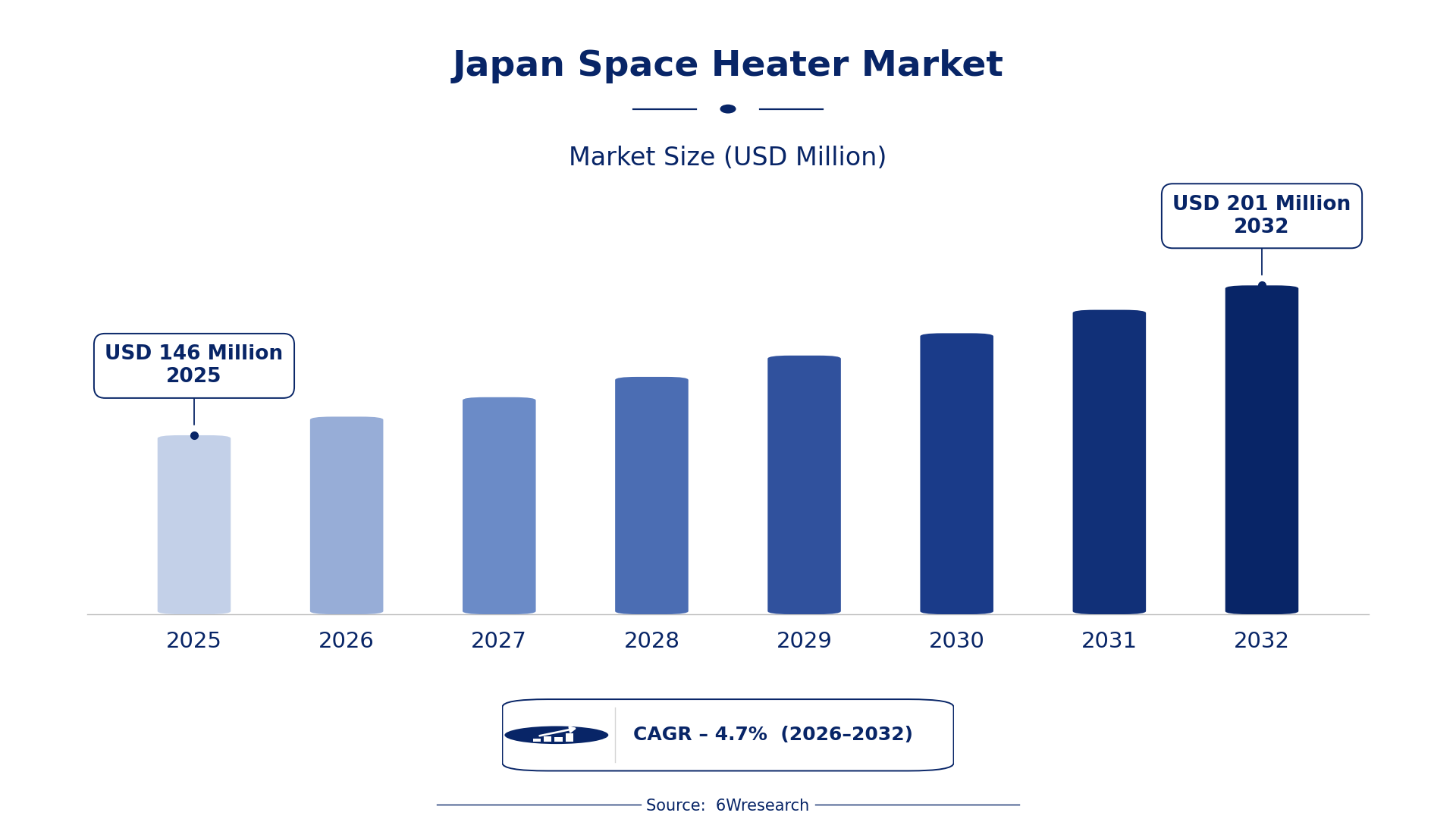
According to 6Wresearch internal database and industry insights, the Japan Space Heater Market was valued at USD 146 Million in 2025 and is projected to reach USD 201 Million by 2032, growing at a CAGR of approximately 4.7% during 2026–2032.
Japan Space Heater Market Highlights
| Report Metric | Details |
| Report Name | Japan Space Heater Market (2026-2032) |
| Market Size 2025 | USD 146 Million |
| Market Size 2032 | USD 201 Million |
| Absolute Growth 2025–2032 | USD 55 Million |
| CAGR 2026–2032 | 4.7% |
| Peak Annual Growth | 5.8% in 2026 |
| Forecast Period | 2026–2032 |
| Historical Data | 2022–2025 |
| Base Year | 2025 |
| Leading Heater Type, 2025 | Convection Heaters (42% share) |
| Leading Heating Method, 2025 | Electric Resistance (51% share) |
| Leading Mount Type, 2025 | Portable (48% share) |
| Leading End User, 2025 | Households (40% share) |
| Fastest-Growing Heater Type | Infrared Heaters (6.4% CAGR) |
| Fastest-Growing Heating Method | Radiant Heat (6.7% CAGR) |
| Fastest-Growing End User | Commercial Buildings (5.9% CAGR) |
| Growing Sector | Residential Heating |
| Key End Users | Households, Office Spaces, Commercial Buildings, Hotels |
Japan Space Heater Market Year-wise Growth Rate and Key Drivers (2022–2032)
This graph illustrates the annual growth rates of the market from 2022 to 2032, highlighting a steady upward trajectory and projected market expansion over the forecast period.
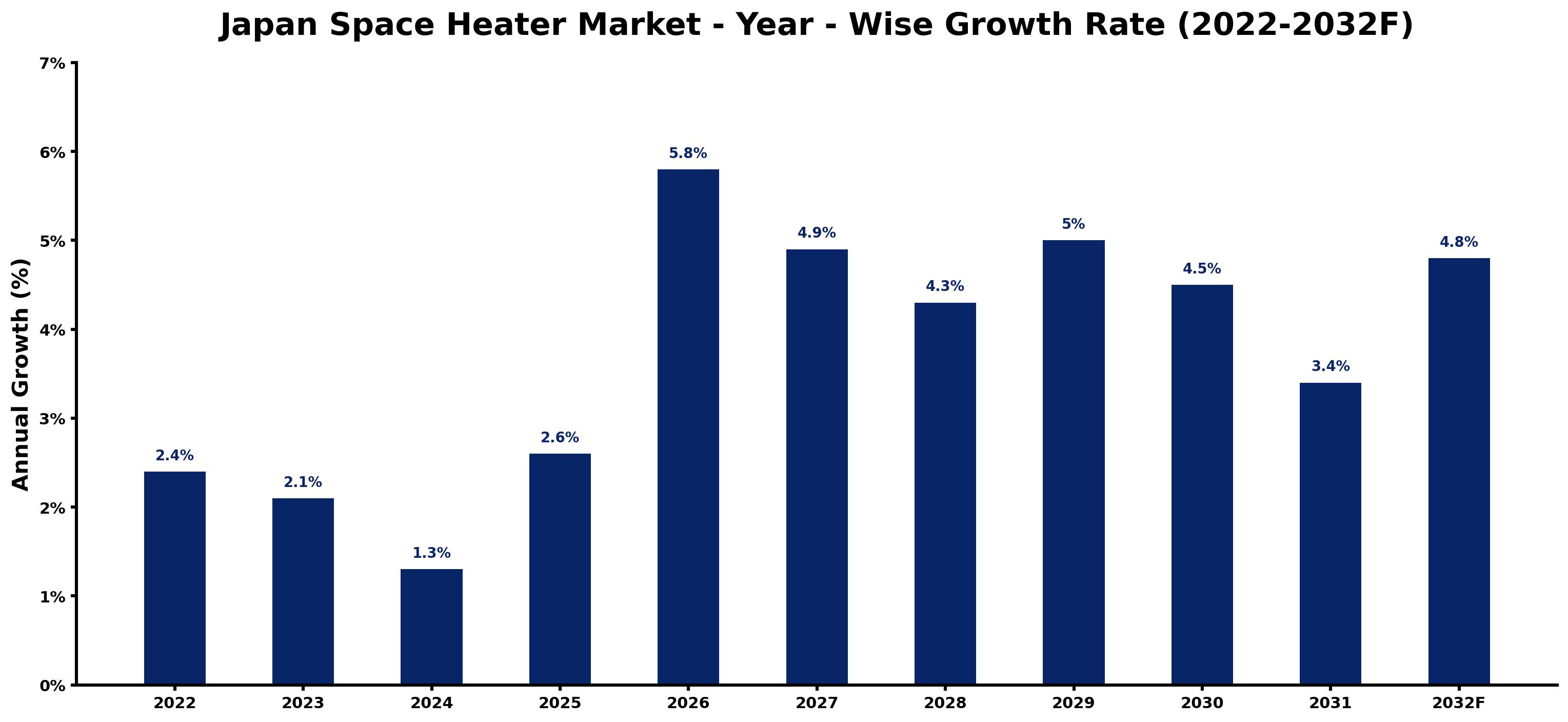
The yearly estimates that follow link every growth rate to its principal driver, so readers can see why the pace changed in each period.
| Year | Estimated Annual Growth (%) | Market Rationale |
| 2022 | 2.4 | The market showed steady growth due to consistent heating needs across households. |
| 2023 | 2.1 | Demand growth slowed as energy prices impacted consumer spending on heating solutions. |
| 2024 | 1.3 | The market continued to grow, albeit at a slower pace, influenced by rising energy costs. |
| 2025 | 2.6 | Growth accelerated as households sought efficient heating solutions amid colder winters. |
| 2026 | 5.8 | The market is expected to experience a surge as energy-efficient technologies gain traction. |
| 2027 | 4.9 | Demand growth will moderate as the market adjusts to previous high levels of investment. |
| 2028 | 4.3 | The market is projected to see further slowdown as consumers become cautious with spending. |
| 2029 | 5.0 | Growth will pick up again as businesses expand and require more heating solutions. |
| 2030 | 4.5 | Demand growth is expected to slow as the market stabilises after a period of rapid expansion. |
| 2031 | 3.4 | The market will continue to grow, albeit at a reduced rate due to market saturation. |
| 2032 | 4.8 | Growth is projected to accelerate again as new energy-efficient models enter the market. |
Note: Market size estimations and growth projections presented in this report are based on 6Wresearch's proprietary forecasting methodology, utilizing the latest available industry data, government publications, and primary research inputs.
Japan Space Heater Market Synopsis
Space heaters provide localized heating for residential and commercial spaces, utilising electric heating elements, ceramic materials, or oil-filled radiators. In Japan, demand arises from households and commercial buildings, particularly in regions like Tohoku, known for harsh winters. Government subsidies for energy-efficient systems and the growing popularity of portable heaters among urban dwellers are driving market expansion, with a strong outlook for future growth.
Market Dynamics Impact Analysis (2026–2032)
| Factor | Type | Impact | Primary Segment Affected |
| Increasing energy efficiency awareness among consumers | Driver | High | Electric Resistance |
| Harsh winter conditions in regions like Tohoku | Driver | High | Convection Heaters |
| Growing urban population requiring flexible heating solutions | Opportunity | High | Portable |
| Rising demand for energy-efficient heating systems | Opportunity | High | Infrared Heaters |
| High energy costs affecting consumer spending | Restraint | Medium | Oil-Filled Radiators |
| Limited awareness of advanced heating technologies | Restraint | Medium | Ceramic Heaters |
| Competition from alternative heating methods | Challenge | High | Air Circulation |
| Supply chain disruptions affecting availability of components | Challenge | High | Radiant Heat |
Evaluation of Drivers in Japan Space Heater Market (2026–2032)
Below are the drivers that matter most for revenue growth, with supporting evidence.
| Drivers | Primary Segment Affected | Why It Matters (Evidence) |
| Increased consumer focus on energy efficiency | Infrared Heaters | This focus leads to higher purchases of infrared heaters, known for quick heating and energy savings. |
| Harsh winter conditions in regions like Tohoku | Convection Heaters | The need for effective heating solutions during severe winters drives demand for convection heaters. |
| Urbanisation leading to smaller living spaces | Portable | As urban populations grow, the demand for portable heaters increases due to their flexibility and convenience. |
| Government subsidies for energy-efficient solutions | Electric Resistance | Subsidies encourage households to invest in electric resistance heaters, improving energy efficiency. |
| Rising awareness of environmental impacts | Ceramic Heaters | Increased environmental awareness promotes the adoption of ceramic heaters, which are energy efficient. |
Spending rises because consumer awareness of energy efficiency has increased, with 126 million residents seeking effective heating solutions. The harsh winters in the Tohoku region drive demand for convection heaters, which account for over 40% of the market. Urbanisation increases purchases of portable heaters, as urban dwellers favour flexibility. Growing environmental awareness promotes the adoption of ceramic heaters, known for their energy-saving capabilities.
Evaluation of Restraints in Japan Space Heater Market
The following restraints limit how fast demand can grow.
| Market Restraint | Primary Segment Affected | Why It Matters (Evidence) |
| High energy costs affecting consumer purchasing power | Oil-Filled Radiators | Rising energy prices limit consumer spending on oil-filled radiators, which are typically more expensive to operate. |
| Limited consumer knowledge about advanced heating technologies | Ceramic Heaters | A lack of awareness restricts the adoption of ceramic heaters, which offer rapid heating capabilities. |
| Competition from alternative heating methods such as central heating | Air Circulation | Central heating systems provide a more effective solution, reducing demand for air circulation heaters. |
| Supply chain disruptions impacting availability of components | Radiant Heat | Disruptions lead to delays in production and delivery of radiant heat systems, affecting market supply. |
| Seasonal demand fluctuations impacting sales consistency | Convection Heaters | Seasonal variations create unpredictable demand patterns, complicating inventory management for convection heaters. |
Japan Space Heater Market Challenges
Producers in Japan face higher costs due to a skills shortage in space heater manufacturing, which can delay production and lead to retail price increases. Local manufacturers encounter intense competition from imported heating solutions, compelling them to lower prices and reducing profit margins. Supply chain disruptions, particularly in sourcing essential components, can result in delays in product availability, causing buyers to wait longer for necessary heating devices. Technological advancements require substantial investment, which strains smaller manufacturers and limits their competitiveness in the market.
Trends in the Japan Space Heater Market
The trends below show where the Japan Space Heater Market is heading.
- Growing Preference for Energy-Efficient Solutions: Households are increasingly opting for energy-efficient heating solutions, with the government's subsidy program for energy-efficient systems leading to a 20% increase in adoption rates.
- Rising Popularity of Portable Heaters: Since 2022, portable space heaters have gained traction among urban dwellers, with sales increasing by 15%. This shift reflects a preference for flexible heating options in smaller living spaces.
- Transition from Traditional to Modern Heating Methods: The market is seeing a transition from traditional heating methods to modern solutions like infrared heaters, which experienced a 10% increase in market share in 2023. This change is driven by consumer demand for faster heating.
- Emergence of Smart Heating Technologies: In 2023, the integration of smart technologies in heating solutions has become a trend, with 30% of new models featuring smart controls. This trend caters to tech-savvy consumers seeking convenience.
Investment Opportunities in the Japan Space Heater Market
Below are the investment opportunities with the strongest case in the Japan Space Heater Market.
- Investment in Energy-Efficient Heating Systems: The Tohoku region presents an opportunity for investment in energy-efficient heating systems, with local partnerships facilitating market entry and a projected increase in demand.
- Expansion of Portable Heater Offerings: With a growing urban population, there is a gap in the market for portable heaters, projected to grow by 6.8% annually. Suppliers can enter through local partnerships to capture this demand.
- Development of Smart Heating Solutions: The rise of smart home technologies creates an opportunity to develop smart heating solutions, with a projected market growth of 30% by 2032. Collaborating with tech firms can improve product offerings.
- Focus on Commercial Building Heating Solutions: Commercial buildings in urban areas are increasingly seeking efficient heating solutions, with a projected growth rate of 5.9%. Suppliers can target this sector by offering tailored solutions.
Government Initiatives in the Japan Space Heater Market
The Electrical Appliance and Material Safety Act regulates safety standards for space heaters, ensuring that products meet safety requirements. Compliance with these standards is essential for manufacturers to market their products effectively, impacting buyer confidence in purchasing safe heating solutions. The Act mandates regular testing and certification, which helps maintain high safety standards across the industry.
The Building Energy Efficiency Act mandates energy efficiency standards for new buildings, encouraging the adoption of energy-efficient heating systems. This regulation benefits both producers and buyers by promoting sustainability and aims to reduce energy consumption in new constructions, supporting long-term environmental goals.
Future Insight of the Japan Space Heater Market
By 2032, a shift towards energy-efficient heating solutions will transform the space heater market. New government initiatives will drive suppliers to adopt advanced technologies, improving product efficiency and performance. Urban areas will see a surge in demand for compact heating devices, as residents seek convenience and effectiveness. The government's subsidy program for energy-efficient systems will motivate buyers to invest in modern solutions, creating a more sustainable market environment.
Market Segmentation Analysis
Japan Space Heater Market report covers a detailed analysis of the following market segments:
By Heater Type – Convection Heaters Lead, Infrared Heaters Expected to Grow Fastest
According to Saurav Kr Singh, Senior Research Analyst at 6Wresearch, with 42% of heater type revenue in 2025, Convection Heaters was the largest category. Convection heaters dominate the market due to their effectiveness in heating individual rooms, making them a preferred option for many households. Their widespread use in colder regions such as Tohoku, where winters are severe, solidifies their leading position. Infrared Heaters are set to record the highest CAGR in this split, 6.4% over 2026–2032. Infrared heaters are experiencing rapid growth as they offer quick heating for targeted areas, appealing to urban residents needing immediate warmth. Government initiatives promoting energy-efficient heating solutions are further encouraging their uptake. This trend indicates that suppliers should focus on increasing the availability of infrared heaters to meet rising consumer demand.
By Heating Method – Electric Resistance Leads, Radiant Heat Expected to Grow Fastest
In 2025, Electric Resistance led the heating method split with a 51% share. Electric resistance heaters hold a substantial share as they are simple to use and readily available in urban areas, where electricity supply is abundant. Their effectiveness in providing reliable warmth during the colder months makes them a staple in many households. Over 2026–2032, Radiant Heat is expected to post the fastest growth, at a CAGR of 6.7%. Radiant heat is experiencing rapid growth due to its ability to deliver direct warmth, making it appealing for specific applications. The increasing preference for energy-efficient solutions is also propelling this segment forward. Buyers may benefit from exploring radiant heat options for targeted heating needs.
By Mount Type – Portable Leads and Records the Fastest Growth
Portable accounted for 48% of the market by mount type in 2025. Portable heaters are the leading choice as they provide flexibility and ease of use, making them suitable for various living environments. Their widespread acceptance in urban settings, where space constraints are common, highlights their market strength. The same category is also set to grow fastest, at a CAGR of 6.8% during 2026–2032. The portable segment is also the fastest-growing, driven by the rising demand for adaptable heating solutions in both homes and offices. As consumer lifestyles evolve, the convenience of portable options will likely continue to attract more buyers. Suppliers should focus on developing portable models to meet the needs of this expanding market.
By End User – Households Lead, Commercial Buildings Expected to Grow Fastest
The largest end user category in 2025 was Households, at 40% of revenue. Households represent the largest segment as they are the primary users of space heaters for comfort during colder months. The average usage of space heaters for about five months annually in homes underscores their importance in residential settings. The quickest growth will come from Commercial Buildings, forecast to expand at a CAGR of 5.9% between 2026 and 2032. Commercial buildings are the fastest-growing segment as they require efficient heating solutions for larger spaces, especially in urban areas with high office density. The increasing focus on energy efficiency in commercial settings is driving this growth. Suppliers should tailor their offerings to meet the specific heating needs of commercial buildings.
Key Attractiveness of the Report
- 10 Years of Market Numbers
- Historical Data Starting from 2022 to 2025
- Base Year 2025
- Forecast Data until 2032
- Key Performance Indicators Impacting the Market
- Major Upcoming Developments and Projects
Key Highlights of the Report:
- Japan Space Heater Market Outlook
- Market Size of Japan Space Heater Market, 2025
- Forecast of Japan Space Heater Market, 2032
- Historical Data and Forecast of Japan Space Heater Revenues & Volume for the Period 2022-2032F
- Japan Space Heater Market Trend Evolution
- Japan Space Heater Market Drivers and Challenges
- Japan Space Heater Price Trends
- Japan Space Heater Porter's Five Forces
- Japan Space Heater Industry Life Cycle
- Historical Data and Forecast of Japan Space Heater Market Revenues & Volume By Heater Type for the Period 2022-2032F
- Historical Data and Forecast of Japan Space Heater Market Revenues & Volume By Convection Heaters for the Period 2022-2032F
- Historical Data and Forecast of Japan Space Heater Market Revenues & Volume By Infrared Heaters for the Period 2022-2032F
- Historical Data and Forecast of Japan Space Heater Market Revenues & Volume By Oil-Filled Radiators for the Period 2022-2032F
- Historical Data and Forecast of Japan Space Heater Market Revenues & Volume By Ceramic Heaters for the Period 2022-2032F
- Historical Data and Forecast of Japan Space Heater Market Revenues & Volume By Heating Method for the Period 2022-2032F
- Historical Data and Forecast of Japan Space Heater Market Revenues & Volume By Air Circulation for the Period 2022-2032F
- Historical Data and Forecast of Japan Space Heater Market Revenues & Volume By Radiant Heat for the Period 2022-2032F
- Historical Data and Forecast of Japan Space Heater Market Revenues & Volume By Liquid Convection for the Period 2022-2032F
- Historical Data and Forecast of Japan Space Heater Market Revenues & Volume By Electric Resistance for the Period 2022-2032F
- Historical Data and Forecast of Japan Space Heater Market Revenues & Volume By Mount Type for the Period 2022-2032F
- Historical Data and Forecast of Japan Space Heater Market Revenues & Volume By Wall/Floor for the Period 2022-2032F
- Historical Data and Forecast of Japan Space Heater Market Revenues & Volume By Portable for the Period 2022-2032F
- Historical Data and Forecast of Japan Space Heater Market Revenues & Volume By Standalone for the Period 2022-2032F
- Historical Data and Forecast of Japan Space Heater Market Revenues & Volume By Desk/Compact for the Period 2022-2032F
- Historical Data and Forecast of Japan Space Heater Market Revenues & Volume By End User for the Period 2022-2032F
- Historical Data and Forecast of Japan Space Heater Market Revenues & Volume By Households for the Period 2022-2032F
- Historical Data and Forecast of Japan Space Heater Market Revenues & Volume By Office Spaces for the Period 2022-2032F
- Historical Data and Forecast of Japan Space Heater Market Revenues & Volume By Hotels for the Period 2022-2032F
- Historical Data and Forecast of Japan Space Heater Market Revenues & Volume By Commercial Buildings for the Period 2022-2032F
- Japan Space Heater Import Export Trade Statistics
- Market Opportunity Assessment By Heater Type
- Market Opportunity Assessment By Heating Method
- Market Opportunity Assessment By Mount Type
- Market Opportunity Assessment By End User
- Japan Space Heater Top Companies Market Share
- Japan Space Heater Competitive Benchmarking By Technical and Operational Parameters
- Japan Space Heater Company Profiles
- Japan Space Heater Key Strategic Recommendations
Market Covered
The study includes the following segmentation.
By Heater Type
- Convection Heaters
- Infrared Heaters
- Oil-Filled Radiators
- Ceramic Heaters
By Heating Method
- Air Circulation
- Radiant Heat
- Liquid Convection
- Electric Resistance
By Mount Type
- Wall/Floor
- Portable
- Standalone
- Desk/Compact
By End User
- Households
- Office Spaces
- Hotels
- Commercial Buildings































