Japan Spare Parts Tracking Software Market Size & Growth Rate
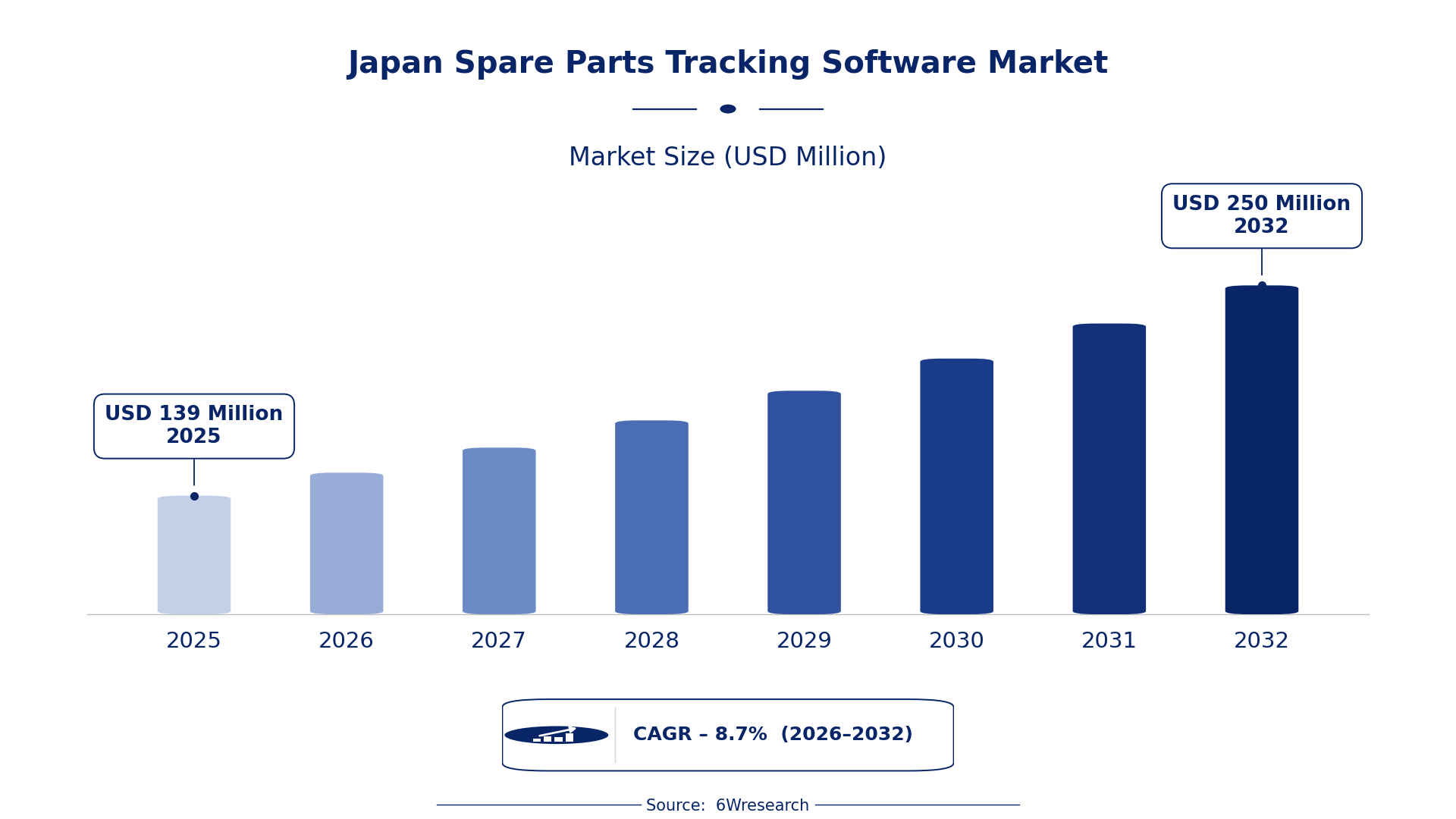
According to 6Wresearch internal database and industry insights, the Japan Spare Parts Tracking Software Market was valued at USD 139 Million in 2025 and is projected to reach USD 250 Million by 2032, growing at a CAGR of approximately 8.7% during 2026–2032.
Japan Spare Parts Tracking Software Market Highlights
| Report Metric | Details |
| Report Name | Japan Spare Parts Tracking Software Market (2026-2032) |
| Market Size 2025 | USD 139 Million |
| Market Size 2032 | USD 250 Million |
| Absolute Growth 2025–2032 | USD 111 Million |
| CAGR 2026–2032 | 8.7% |
| Peak Annual Growth | 11.1% in 2032 |
| Forecast Period | 2026–2032 |
| Historical Data | 2022–2025 |
| Base Year | 2025 |
| Leading Software Type, 2025 | ERP-Integrated (49% share) |
| Leading Feature Set, 2025 | Inventory/Alerts (43% share) |
| Leading Deployment Mode, 2025 | SaaS (43% share) |
| Leading End User, 2025 | Automotive OEMs (52% share) |
| Fastest-Growing Software Type | Predictive Maintenance (12.3% CAGR) |
| Fastest-Growing Feature Set | AI-Based Forecasting (12.6% CAGR) |
| Fastest-Growing End User | Aerospace Logistics (11.3% CAGR) |
| Growing Sector | automotive |
| Key End Users | automotive OEMs, warehouses, aerospace logistics, equipment service firms |
Japan Spare Parts Tracking Software Market Year-wise Growth Rate and Key Drivers (2022–2032)
This graph illustrates the annual growth rates of the market from 2022 to 2032, highlighting a steady upward trajectory and projected market expansion over the forecast period.
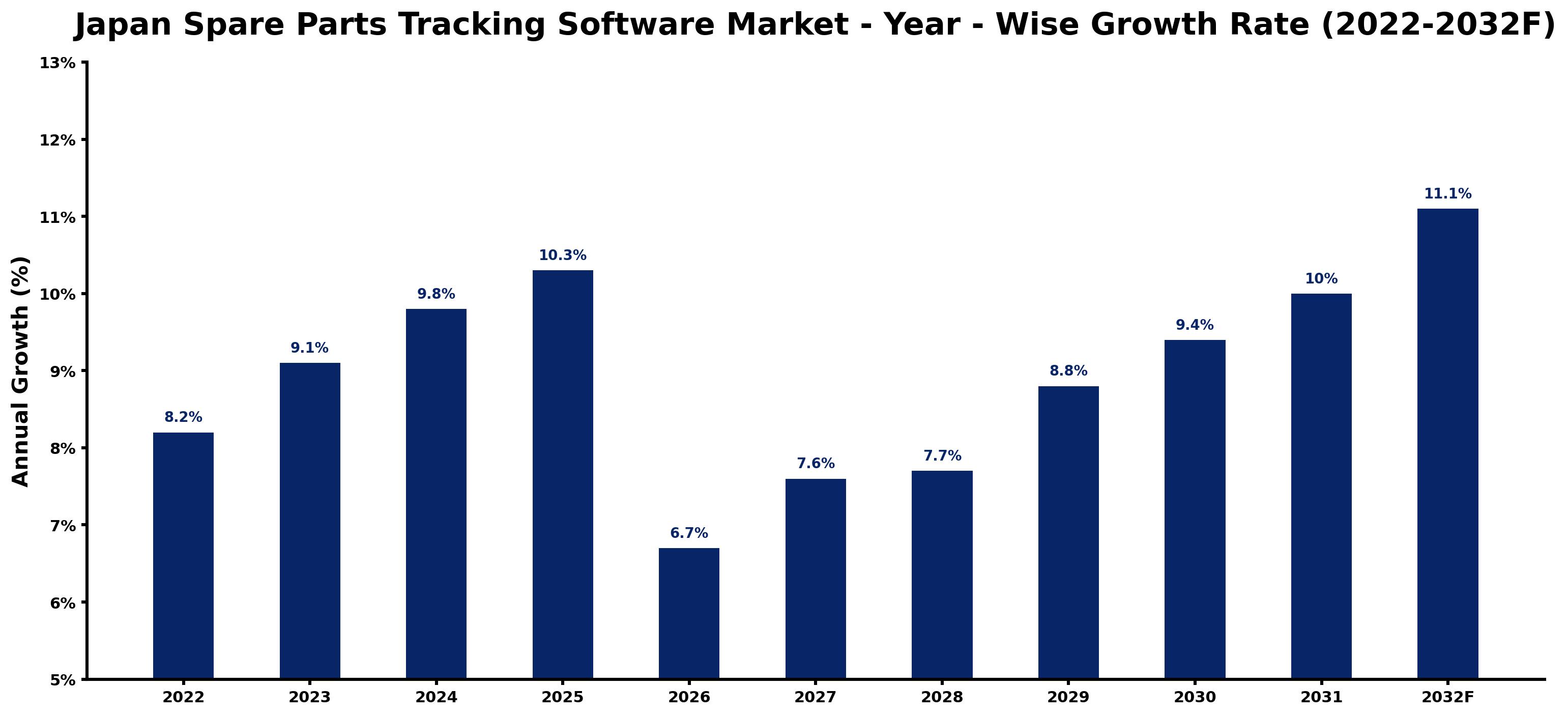
For each year, the table pairs the estimated growth rate with the leading influence on demand, showing how the drivers changed across the period.
| Year | Estimated Annual Growth (%) | Market Rationale |
| 2022 | 8.2 | The market showed steady growth due to ongoing demand from the automotive sector. |
| 2023 | 9.1 | Increased adoption of digital solutions contributed to faster growth than the previous year. |
| 2024 | 9.8 | Growing inventory management needs led to further acceleration in market growth rates. |
| 2025 | 10.3 | The automotive sector's strong performance supported the peak growth rate during this year. |
| 2026 | 6.7 | A slowdown in growth is expected as the market begins to stabilise after rapid expansion. |
| 2027 | 7.6 | Demand from logistics firms is projected to increase, resulting in a rise in growth rates. |
| 2028 | 7.7 | Technological advancements in tracking software will continue to benefit the market. |
| 2029 | 8.8 | Increased focus on efficiency in supply chains will drive further growth in demand. |
| 2030 | 9.4 | Adoption of AI-based solutions will contribute to a notable increase in market activity. |
| 2031 | 10.0 | The market is expected to see a resurgence as firms invest more in inventory management solutions. |
| 2032 | 11.1 | The peak growth rate is projected to be achieved due to heightened demand from the aerospace sector. |
Note: Market size estimations and growth projections presented in this report are based on 6Wresearch's proprietary forecasting methodology, utilizing the latest available industry data, government publications, and primary research inputs.
Japan Spare Parts Tracking Software Market Synopsis
Spare Parts Tracking Software serves as a technology solution that effectively manages spare parts inventory, optimising levels and minimising downtime. In 2023, the automotive sector propelled the Japan Spare Parts Tracking Software Market, accounting for 30% of its total value. This growth is driven by the increasing demand for digital solutions and the integration of AI-based forecasting tools, which improve inventory management across various industries.
Market Dynamics Impact Analysis (2026–2032)
| Factor | Type | Impact | Primary Segment Affected |
| Growing demand for efficient inventory management solutions | Driver | High | Inventory/Alerts |
| Increased integration of AI-based forecasting tools | Driver | High | AI-Based Forecasting |
| Expansion of the aerospace sector in Japan | Opportunity | High | Aerospace Logistics |
| Rising logistics needs in urban areas | Opportunity | Medium | Warehouses |
| Limited awareness of software benefits among smaller firms | Restraint | Medium | Standalone Tracking |
| High initial investment costs for advanced systems | Restraint | High | ERP-Integrated |
| Competition from traditional inventory management methods | Challenge | Medium | Real-Time Dashboard |
| Slow adoption of new technologies in some sectors | Challenge | High | Predictive Maintenance |
Evaluation of Drivers in Japan Spare Parts Tracking Software Market (2026–2032)
The table below links each growth driver to the segment it affects and the evidence for it.
| Drivers | Primary Segment Affected | Why It Matters (Evidence) |
| Increased vehicle production in the automotive sector | Inventory/Alerts | Japan has over 5 million vehicles requiring spare parts management annually, driving software demand. |
| Growing adoption of AI technologies | AI-Based Forecasting | The integration of AI-based forecasting tools into tracking solutions is improving efficiency across sectors. |
| Rising logistics operations in urban areas | Warehouses | The Tokyo region is a hub for logistics, boosting demand for tracking software with over 5 million vehicles needing parts management annually. |
| Implementation of ISO 9001 standards | ERP-Integrated | Many firms adopt ISO 9001, which necessitates efficient tracking solutions for compliance and quality assurance. |
| Demand for real-time inventory visibility | Real-Time Dashboard | The average inventory turnover ratio for automotive parts in Japan is 6 times per year, necessitating effective tracking. |
Orders keep climbing as the automotive sector in Japan accounted for 30% of the spare parts tracking software market in 2023. Vehicle production and the need for efficient inventory management drive demand for tracking solutions. Over 5 million vehicles require parts management annually, supporting this growth. The Tokyo region's logistics operations are expanding, prompting firms to invest in real-time visibility tools. The average inventory turnover ratio for automotive parts is six times per year, leading to increased investment in tracking solutions.
Evaluation of Restraints in Japan Spare Parts Tracking Software Market
The key brakes on demand, and where they bite hardest, are shown below.
| Market Restraint | Primary Segment Affected | Why It Matters (Evidence) |
| Limited awareness of software benefits among smaller firms | Standalone Tracking | Many smaller firms lack knowledge about the advantages of tracking software, hindering adoption. |
| High initial investment costs for advanced systems | ERP-Integrated | The costs associated with implementing tracking solutions can deter potential buyers. |
| Competition from traditional inventory management methods | Real-Time Dashboard | Some companies prefer established methods over new software, limiting market penetration. |
| Slow adoption of new technologies in some sectors | Predictive Maintenance | Certain industries are hesitant to upgrade systems, affecting overall market growth. |
| Inconsistent integration with existing systems | Inventory/Alerts | Challenges in integrating new software with legacy systems can delay implementation. |
Japan Spare Parts Tracking Software Market Challenges
Buyers in the automotive sector face immediate cost pressures due to Japan's minimum wage increase to JPY 1,055 per hour, which strains their operational budgets. Technology integration remains a hurdle, with many firms struggling to adopt AI-based forecasting tools, delaying efficiency improvements in inventory management. The average inventory turnover ratio of 6 times per year indicates inefficiencies, costing buyers potential sales and leading to increased excess stock. Skills shortages in digital transformation hinder firms' ability to fully utilise spare parts tracking software, impacting their competitiveness in a rapidly evolving market.
Trends in the Japan Spare Parts Tracking Software Market
The shifts below are changing how Japan Spare Parts Tracking Software Market products are bought and supplied.
- Growing Importance of Multi-Warehouse Views: Firms are increasingly acknowledging the need for multi-warehouse tracking capabilities. In 2023, 43% of software users reported enhanced inventory management through this feature, reflecting a shift towards more comprehensive tracking solutions.
- Rise of Real-Time Inventory Management: In 2023, 70% of warehouses in Japan opted for SaaS deployment due to its scalability. This transition allows for immediate visibility of inventory status, boosting operational efficiency and responsiveness to market demands.
- Transition from Standalone to Integrated Systems: The market is shifting towards ERP-integrated solutions, projected to capture 49% market share by 2025. This integration streamlines operations and improves tracking capabilities across various sectors, enhancing overall efficiency.
- Shift towards AI Integration in Logistics: The Tokyo region is increasingly incorporating AI-based forecasting tools in spare parts tracking. In 2023, 60% of logistics firms adopted QR/RFID technology to improve accuracy, thereby enhancing inventory management.
Investment Opportunities in the Japan Spare Parts Tracking Software Market
Several openings in the Japan Spare Parts Tracking Software Market merit attention from investors.
- Develop Inventory/Alerts Features: Investing in software that enhances inventory alerts can address the needs of automotive OEMs. The average inventory turnover ratio for automotive parts is six times per year, driving demand for effective solutions.
- Supply AI-Based Solutions: With the growing adoption of AI technologies, there is an opportunity to provide AI-based forecasting tools. The aerospace logistics sector is expected to grow by 5% annually, creating demand for advanced solutions.
- Invest in Partnerships with Logistics Firms: Now is an opportune time to forge partnerships with logistics firms that are increasingly adopting tracking solutions. The Tokyo Metropolitan Government supports technology adoption in logistics through funding initiatives.
- Target the Aerospace Sector: The aerospace industry in Japan is anticipated to experience substantial growth, presenting an opportunity to offer tailored tracking solutions. Collaborating with aerospace logistics firms can facilitate market entry.
Government Initiatives in the Japan Spare Parts Tracking Software Market
The Industrial Standardization Act, amended in 2019, governs product and test standards in Japan. This law ensures that spare parts tracking software meets necessary quality and safety requirements, promoting consumer trust and industry compliance. Additionally, the AI Promotion Act, established in 2025, provides a framework for AI research and development, encouraging software producers to integrate advanced technologies into their solutions.
In 2023, the Digital Agency allocated JPY 5 billion to support digital transformation initiatives in manufacturing. This agency oversees the implementation of common system standards, facilitating the adoption of effective software solutions among producers and buyers in the spare parts tracking sector.
Future Insight of the Japan Spare Parts Tracking Software Market
The introduction of advanced logistics facilities will enhance tracking capabilities by 2032, driven by government initiatives for technology adoption. Integration of AI will streamline inventory management, reducing downtime and improving operational efficiency. The aerospace sector's projected 5% annual growth will increase demand for sophisticated tracking solutions. As 70% of logistics firms prefer cloud-based deployment, this shift will simplify operations and improve data accessibility for buyers and suppliers.
Market Segmentation Analysis
Japan Spare Parts Tracking Software Market report covers a detailed analysis of the following market segments:
By Software Type – ERP-Integrated Leads, Predictive Maintenance Expected to Grow Fastest
According to Saurav Kr Singh, Senior Research Analyst at 6Wresearch, ERP-Integrated held 49% of the Japan Spare Parts Tracking Software Market by software type in 2025. The ERP-Integrated segment holds the largest share as it connects seamlessly with existing systems, making it essential for the automotive sector in Japan. This integration supports automotive OEMs that manage over 5 million vehicles requiring spare parts annually. Predictive Maintenance is projected to grow fastest, at a CAGR of 12.3% during 2026–2032. Predictive Maintenance is growing rapidly due to the rising adoption of advanced forecasting tools that improve maintenance strategies. This trend is crucial for automotive manufacturers aiming to minimise operational disruptions and enhance efficiency. Suppliers should prioritise integration capabilities to align with the needs of automotive OEMs.
By Feature Set – Inventory/Alerts Lead, AI-Based Forecasting Expected to Grow Fastest
Inventory/Alerts accounted for 43% of the market by feature set in 2025. The Inventory/Alerts feature set leads the market as it is vital for notifying users about stock levels and shortages, which is critical for effective spare parts management. This functionality is particularly important for automotive OEMs that rely on timely inventory updates to avoid production delays. The quickest growth will come from AI-Based Forecasting, forecast to expand at a CAGR of 12.6% between 2026 and 2032. AI-Based Forecasting is experiencing the fastest growth as it allows firms to better anticipate inventory needs, thus enhancing supply chain efficiency. The increasing complexity of inventory management in the automotive sector fuels this demand. Buyers should consider investing in advanced forecasting tools to improve their inventory management processes.
By Deployment Mode – SaaS Lead and Record the Fastest Growth
In 2025, SaaS led the deployment mode split with a 43% share. SaaS deployment dominates the market due to its accessibility and scalability, preferred by 70% of warehouses in Japan. This model facilitates easier updates and integration with other systems, which is essential for effective spare parts management. SaaS are also forecast to expand faster than any other category, at a CAGR of 10.7% over 2026–2032. SaaS is also the fastest-growing deployment mode as firms recognise the advantages of cloud-based solutions for real-time data access and collaboration. The ongoing digital transformation in manufacturing further propels this growth. Suppliers should prioritise SaaS offerings to align with market preferences for flexible and scalable solutions.
By End User – Automotive OEMs Lead, Aerospace Logistics Expected to Grow Fastest
With 52% of end user revenue in 2025, Automotive OEMs was the largest category. Automotive OEMs represent the largest user group as they are the primary consumers of spare parts tracking software, essential for managing extensive inventories. The automotive sector accounted for 30% of the market, highlighting its significance in Japan's economy. Over 2026–2032, Aerospace Logistics is expected to post the fastest growth, at a CAGR of 11.3%. Aerospace Logistics is the fastest-growing end user segment, driven by a projected 5% annual growth in the aerospace industry. This sector's complexity necessitates advanced tracking solutions to manage intricate supply chains effectively. Suppliers should tailor their solutions to meet the specific needs of aerospace logistics to capture this growing market.
Key Attractiveness of the Report
- 10 Years of Market Numbers
- Historical Data Starting from 2022 to 2025
- Base Year 2025
- Forecast Data until 2032
- Key Performance Indicators Impacting the Market
- Major Upcoming Developments and Projects
Key Highlights of the Report:
- Japan Spare Parts Tracking Software Market Outlook
- Market Size of Japan Spare Parts Tracking Software Market, 2025
- Forecast of Japan Spare Parts Tracking Software Market, 2032
- Historical Data and Forecast of Japan Spare Parts Tracking Software Revenues & Volume for the Period 2022-2032F
- Japan Spare Parts Tracking Software Market Trend Evolution
- Japan Spare Parts Tracking Software Market Drivers and Challenges
- Japan Spare Parts Tracking Software Price Trends
- Japan Spare Parts Tracking Software Porter's Five Forces
- Japan Spare Parts Tracking Software Industry Life Cycle
- Historical Data and Forecast of Japan Spare Parts Tracking Software Market Revenues & Volume By Software Type for the Period 2022-2032F
- Historical Data and Forecast of Japan Spare Parts Tracking Software Market Revenues & Volume By ERP-Integrated for the Period 2022-2032F
- Historical Data and Forecast of Japan Spare Parts Tracking Software Market Revenues & Volume By Standalone Tracking for the Period 2022-2032F
- Historical Data and Forecast of Japan Spare Parts Tracking Software Market Revenues & Volume By Predictive Maintenance for the Period 2022-2032F
- Historical Data and Forecast of Japan Spare Parts Tracking Software Market Revenues & Volume By Real-Time Dashboard for the Period 2022-2032F
- Historical Data and Forecast of Japan Spare Parts Tracking Software Market Revenues & Volume By Feature Set for the Period 2022-2032F
- Historical Data and Forecast of Japan Spare Parts Tracking Software Market Revenues & Volume By Inventory/Alerts for the Period 2022-2032F
- Historical Data and Forecast of Japan Spare Parts Tracking Software Market Revenues & Volume By QR/RFID Integration for the Period 2022-2032F
- Historical Data and Forecast of Japan Spare Parts Tracking Software Market Revenues & Volume By AI-Based Forecasting for the Period 2022-2032F
- Historical Data and Forecast of Japan Spare Parts Tracking Software Market Revenues & Volume By Multi-Warehouse View for the Period 2022-2032F
- Historical Data and Forecast of Japan Spare Parts Tracking Software Market Revenues & Volume By Deployment Mode for the Period 2022-2032F
- Historical Data and Forecast of Japan Spare Parts Tracking Software Market Revenues & Volume By On-Premise/Cloud for the Period 2022-2032F
- Historical Data and Forecast of Japan Spare Parts Tracking Software Market Revenues & Volume By SaaS for the Period 2022-2032F
- Historical Data and Forecast of Japan Spare Parts Tracking Software Market Revenues & Volume By Hybrid for the Period 2022-2032F
- Historical Data and Forecast of Japan Spare Parts Tracking Software Market Revenues & Volume By Web + Mobile for the Period 2022-2032F
- Historical Data and Forecast of Japan Spare Parts Tracking Software Market Revenues & Volume By End User for the Period 2022-2032F
- Historical Data and Forecast of Japan Spare Parts Tracking Software Market Revenues & Volume By Automotive OEMs for the Period 2022-2032F
- Historical Data and Forecast of Japan Spare Parts Tracking Software Market Revenues & Volume By Warehouses for the Period 2022-2032F
- Historical Data and Forecast of Japan Spare Parts Tracking Software Market Revenues & Volume By Aerospace Logistics for the Period 2022-2032F
- Historical Data and Forecast of Japan Spare Parts Tracking Software Market Revenues & Volume By Equipment Service Firms for the Period 2022-2032F
- Japan Spare Parts Tracking Software Import Export Trade Statistics
- Market Opportunity Assessment By Software Type
- Market Opportunity Assessment By Feature Set
- Market Opportunity Assessment By Deployment Mode
- Market Opportunity Assessment By End User
- Japan Spare Parts Tracking Software Top Companies Market Share
- Japan Spare Parts Tracking Software Competitive Benchmarking By Technical and Operational Parameters
- Japan Spare Parts Tracking Software Company Profiles
- Japan Spare Parts Tracking Software Key Strategic Recommendations
Market Covered
The report covers the following segments.
By Software Type
- ERP-Integrated
- Standalone Tracking
- Predictive Maintenance
- Real-Time Dashboard
By Feature Set
- Inventory/Alerts
- QR/RFID Integration
- AI-Based Forecasting
- Multi-Warehouse View
By Deployment Mode
- On-Premise/Cloud
- SaaS
- Hybrid
- Web + Mobile
By End User
- Automotive OEMs
- Warehouses
- Aerospace Logistics
- Equipment Service Firms































