Japan Spatial Computing Chips Market Size & Growth Rate
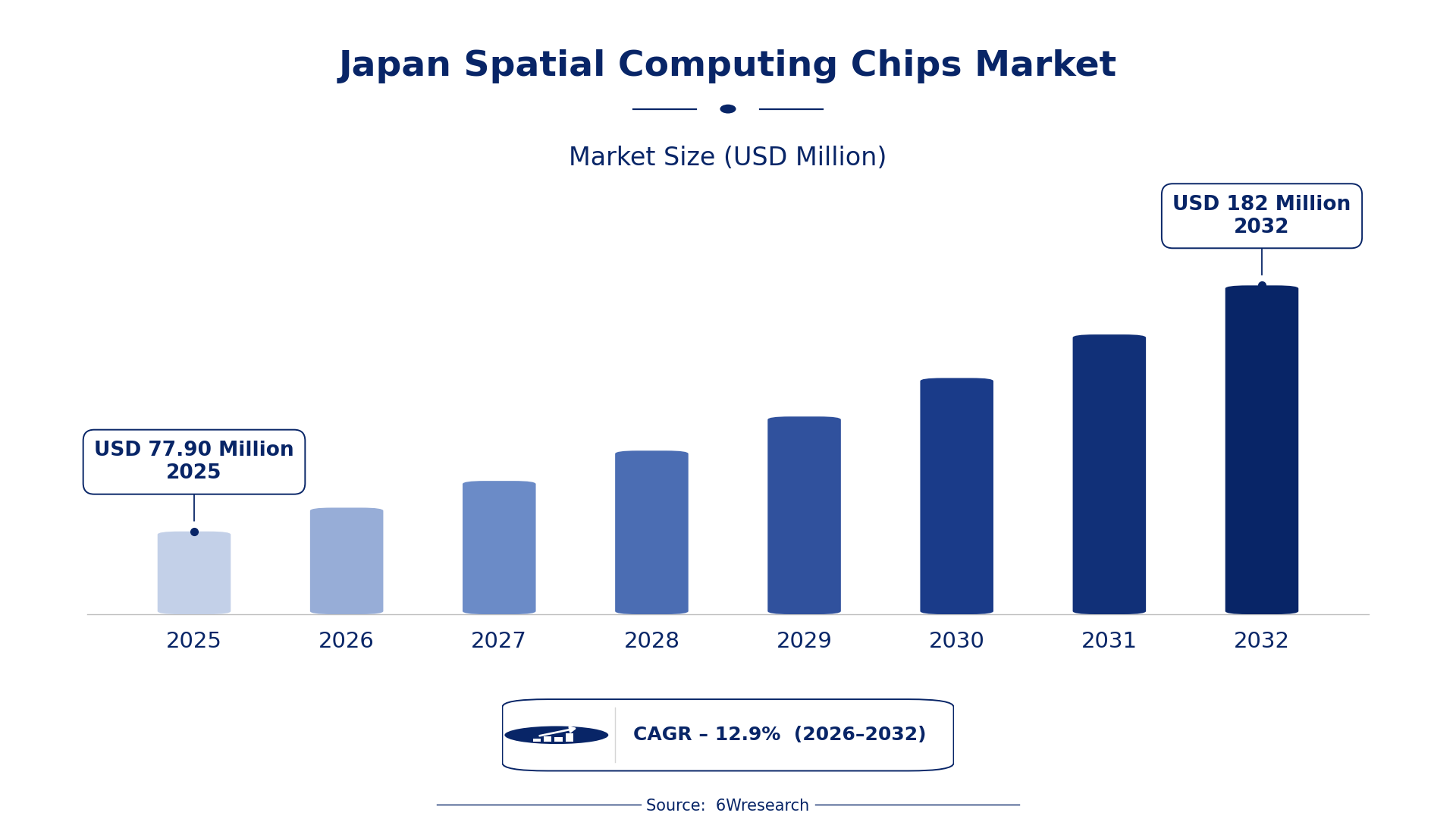
According to 6Wresearch internal database and industry insights, the Japan Spatial Computing Chips Market was valued at USD 77.90 Million in 2025 and is projected to reach USD 182 Million by 2032, growing at a CAGR of approximately 12.9% during 2026–2032.
Japan Spatial Computing Chips Market Highlights
| Report Metric | Details |
| Report Name | Japan Spatial Computing Chips Market (2026-2032) |
| Market Size 2025 | USD 77.90 Million |
| Market Size 2032 | USD 182 Million |
| Absolute Growth 2025–2032 | USD 104.10 Million |
| CAGR 2026–2032 | 12.9% |
| Peak Annual Growth | 15.8% in 2026 |
| Forecast Period | 2026–2032 |
| Historical Data | 2022–2025 |
| Base Year | 2025 |
| Leading Chip Type, 2025 | AR/VR Chips (40% share) |
| Leading Processing Capability, 2025 | SLAM + Object Detection (45% share) |
| Leading Form Factor, 2025 | SoC (38% share) |
| Leading End User, 2025 | Mixed Reality Device Makers (45% share) |
| Fastest-Growing Chip Type | AI Vision Chips (18.1% CAGR) |
| Fastest-Growing Form Factor | Wearable-Compatible (18.4% CAGR) |
| Fastest-Growing End User | Robotics Companies (16.5% CAGR) |
| Growing Sector | technology sector |
| Key End Users | mixed reality device makers, robotics companies, smart glasses OEMs, fitness device firms |
Japan Spatial Computing Chips Market Year-wise Growth Rate and Key Drivers (2022–2032)
This graph illustrates the annual growth rates of the market from 2022 to 2032, highlighting a steady upward trajectory and projected market expansion over the forecast period.
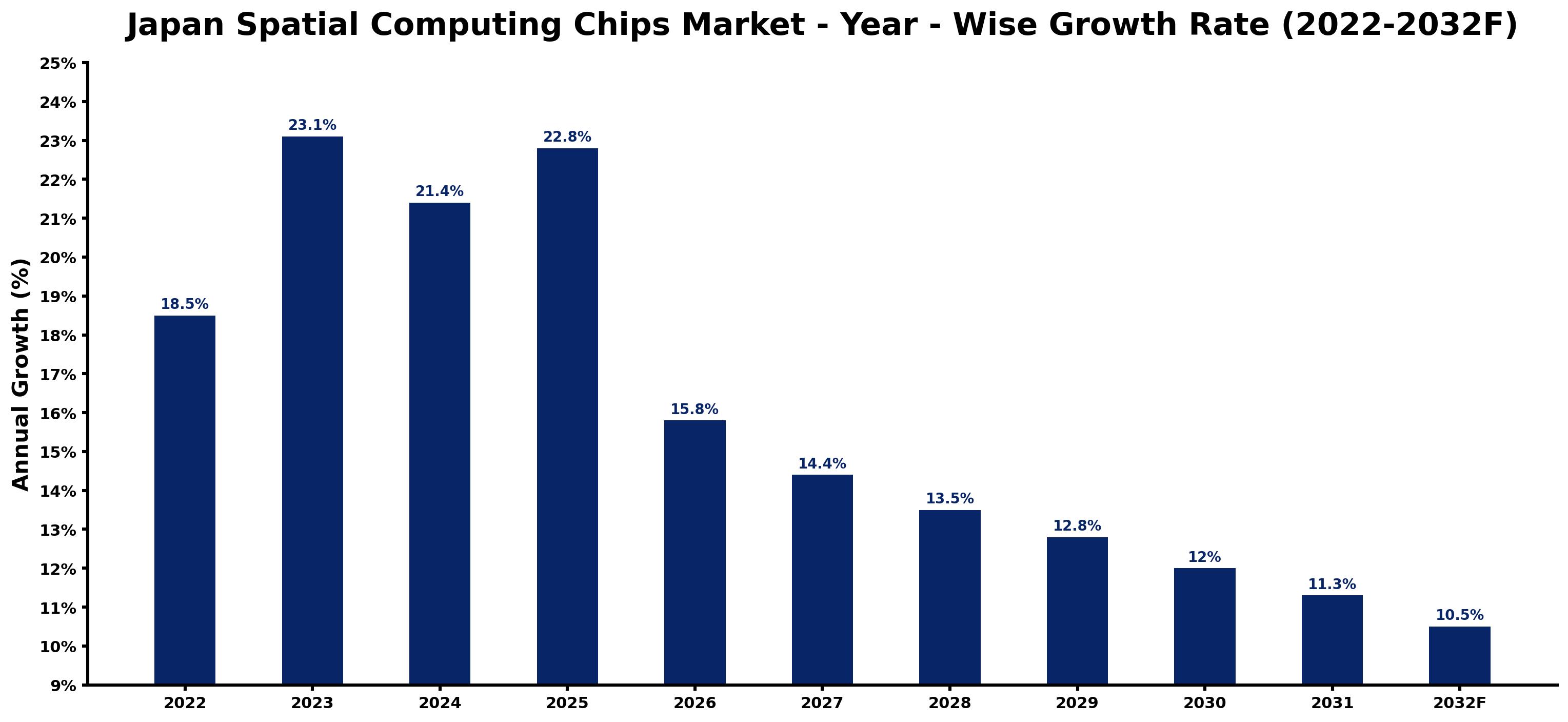
The yearly estimates that follow link every growth rate to its principal driver, so readers can see why the pace changed in each period.
| Year | Estimated Annual Growth (%) | Market Rationale |
| 2022 | 18.5 | The market exhibited strong growth due to rising interest in AR/VR technologies. |
| 2023 | 23.1 | Demand surged as Japan's AR/VR market is projected to expand to 1.2 trillion yen by 2025. |
| 2024 | 21.4 | Growth slowed as market adjustments occurred following rapid expansion in 2023. |
| 2025 | 22.8 | Increased investments in robotics and smart devices drove demand higher for spatial computing chips. |
| 2026 | 15.8 | A slowdown occurred as the market is expected to stabilise after peak growth. |
| 2027 | 14.4 | Continued interest in spatial computing is projected to maintain positive growth rates. |
| 2028 | 13.5 | Demand growth moderated as market saturation began to set in for certain segments. |
| 2029 | 12.8 | The market is expected to continue growing, albeit at a slower pace than before. |
| 2030 | 12.0 | Growth further slows as competition intensifies among local suppliers. |
| 2031 | 11.3 | A gradual slowdown in growth rate reflects market maturity and increased competition. |
| 2032 | 10.5 | The market is expected to maintain steady growth as new applications emerge. |
Note: Market size estimations and growth projections presented in this report are based on 6Wresearch's proprietary forecasting methodology, utilizing the latest available industry data, government publications, and primary research inputs.
Japan Spatial Computing Chips Market Synopsis
Spatial computing chips are advanced semiconductor devices designed to process spatial data for augmented reality, virtual reality, and robotics. The Japan Spatial Computing Chips Market is propelled by a flourishing technology sector, particularly in AR/VR and robotics, with the AR/VR market projected to reach 1.2 trillion yen by 2025. Key growth drivers include substantial investments in smart city projects and the integration of AI in education, stimulating demand for spatial computing solutions across various industries.
Market Dynamics Impact Analysis (2026–2032)
| Factor | Type | Impact | Primary Segment Affected |
| Growing investments in smart city initiatives | Driver | High | AR/VR Chips |
| Rising demand for immersive technologies in gaming and robotics | Driver | High | AI Vision Chips |
| Increasing focus on AI integration in education | Opportunity | High | Depth-Sensing Chips |
| Expansion of robotics companies in Tokyo | Opportunity | Medium | Motion Tracking Chips |
| Supply chain vulnerabilities affecting semiconductor availability | Restraint | High | SLAM + Object Detection |
| High costs associated with advanced chip manufacturing | Restraint | Medium | SoC |
| Intense competition among chip manufacturers | Challenge | High | Microprocessor/ASIC |
| Rapid technological advancements leading to obsolescence | Challenge | Medium | Integrated Circuit |
Evaluation of Drivers in Japan Spatial Computing Chips Market (2026–2032)
The table below links each growth driver to the segment it affects and the evidence for it.
| Drivers | Primary Segment Affected | Why It Matters (Evidence) |
| Increased investment in smart city projects | AR/VR Chips | Tokyo's investment of 10 billion yen in smart city initiatives is driving demand for AR/VR applications. |
| Rising consumer interest in immersive gaming experiences | AI Vision Chips | The gaming sector is projected to reach 1.2 trillion yen by 2025, boosting the need for advanced AI vision capabilities. |
| Expansion of robotics applications in various industries | Depth-Sensing Chips | The robotics industry in Japan is increasingly utilising depth-sensing technologies for navigation and interaction. |
| Growing adoption of wearable devices for fitness tracking | Motion Tracking Chips | The wearable technology market is expanding, increasing demand for motion tracking solutions among fitness device firms. |
| Government initiatives promoting AI and spatial computing | SLAM + Object Detection | Support from the Ministry of Economy, Trade and Industry is stimulating market growth for spatial computing technologies. |
Orders keep climbing as investments in smart city projects in Tokyo have surged, with over 500 robotics firms driving demand for AR/VR chips. The gaming sector is expanding, with the AR/VR market projected to reach 1.2 trillion yen by 2025, increasing the need for AI vision capabilities. Robotics applications are growing, leading to higher demand for depth-sensing technologies used for navigation in autonomous vehicles. The wearable technology market is also on the rise, increasing the need for motion tracking solutions.
Evaluation of Restraints in Japan Spatial Computing Chips Market
The main factors holding the market back are set out below.
| Market Restraint | Primary Segment Affected | Why It Matters (Evidence) |
| Supply chain vulnerabilities affecting semiconductor production | SLAM + Object Detection | Recent disruptions have caused delays in chip availability, impacting production timelines for robotics companies. |
| High manufacturing costs for advanced chips | SoC | The complexity of production processes increases costs, limiting market entry for new players in the industry. |
| Market saturation in certain chip segments | Microprocessor/ASIC | Intense competition has squeezed profit margins, affecting supplier viability in the market. |
| Rapid technological advancements leading to obsolescence | Integrated Circuit | Frequent updates in technology require constant investment to remain competitive in the industry. |
| Regulatory challenges in semiconductor manufacturing | AI Vision Chips | Compliance with stringent standards can delay product launches and increase costs for manufacturers. |
Japan Spatial Computing Chips Market Challenges
A shortage of skilled workers in semiconductor manufacturing hampers production timelines, causing delays for technology sector buyers. Many buyers face rising costs due to reliance on imported components, with some reporting price increases of 20%. Local suppliers contend with intense competition from global firms, which pressures them to reduce prices and diminishes profit margins. Escalating energy costs can raise operational expenses by 15% for producers, potentially leading to higher prices for buyers over time.
Trends in the Japan Spatial Computing Chips Market
The trends below show where the Japan Spatial Computing Chips Market is heading.
- Growing Interest in Wearable Technology: The wearable technology market in Japan is projected to grow, driven by health applications. This trend will boost demand for motion tracking chips, enhancing user experience for fitness device firms.
- Expansion of Robotics Applications: Tokyo's robotics sector is expanding, with over 500 firms contributing to advancements in spatial computing. This growth will drive demand for depth-sensing and motion tracking technologies, improving navigation capabilities.
- Increased AR/VR Patent Filings: Japan ranks among the top countries for AR/VR patent filings, with over 2,000 patents registered. This trend reflects a strong focus on innovation, driving demand for advanced spatial computing solutions in various sectors.
- Shift towards AI Integration in Education: Educational institutions are increasingly adopting AI technologies, with the government promoting AI and spatial computing integration in schools. In 2023, this initiative aims to enhance learning experiences, impacting the demand for spatial computing chips.
Investment Opportunities in the Japan Spatial Computing Chips Market
The following areas offer the clearest openings for investors and suppliers in the Japan Spatial Computing Chips Market.
- Timing for Investment in Smart City Projects: With Tokyo's investment of 10 billion yen in smart city initiatives, now is the ideal moment to supply spatial computing solutions to urban developers, improving infrastructure capabilities.
- Growing Demand from Robotics Companies: Robotics companies in Tokyo are increasingly seeking advanced spatial computing chips, presenting an opportunity for suppliers to collaborate with local firms and effectively meet their needs.
- Expansion of Wearable-Compatible Technologies: The wearable technology market is set to grow, driven by health applications. Suppliers should focus on developing wearable-compatible chips to cater to fitness device firms in Japan.
- Entry into the AR/VR Market: With the AR/VR market projected to reach 1.2 trillion yen by 2025, suppliers can enter through partnerships with mixed reality device makers to seize emerging opportunities.
Government Initiatives in the Japan Spatial Computing Chips Market
The Semiconductor and Digital Industry Strategy, established by the Ministry of Economy, Trade and Industry in June 2021, outlines measures to secure domestic semiconductor manufacturing. This strategy aims to improve Japan's competitiveness in the global semiconductor market, ensuring a stable supply of spatial computing chips for various applications. The government has allocated 10 billion yen for research in AI and spatial technologies by 2025, supporting innovation in the sector.
The Consumer Affairs Agency oversees regulations that prohibit misleading advertising of goods. This regulation ensures that buyers receive accurate information about spatial computing chips, building trust in the market. The agency also monitors compliance with the Industrial Standardization Act, which governs product and test standards for semiconductors, ensuring that manufacturers meet quality benchmarks.
Future Insight of the Japan Spatial Computing Chips Market
By 2032, smart city projects will integrate advanced spatial computing technologies to improve urban services. The government's investment of 10 billion yen in research will facilitate breakthroughs that benefit suppliers through enhanced product offerings. As the wearable technology market expands, buyers will gain access to improved health applications. With over 2,000 patents filed, innovations in AR/VR will deliver richer user experiences, driving demand for spatial computing chips.
Market Segmentation Analysis
Japan Spatial Computing Chips Market report covers a detailed analysis of the following market segments:
By Chip Type – AR/VR Chips Lead, AI Vision Chips Expected to Grow Fastest
According to Saurav Kr Singh, Senior Research Analyst at 6Wresearch, the largest chip type category in 2025 was AR/VR Chips, at 40% of revenue. AR/VR chips dominate the market as they are crucial for immersive experiences, particularly in gaming and entertainment. The projected growth of Japan's AR/VR market to 1.2 trillion yen by 2025 highlights the robust demand for these chips. AI Vision Chips are projected to grow fastest, at a CAGR of 18.1% during 2026–2032. AI vision chips are experiencing rapid growth due to their essential role in machine vision applications within robotics. The presence of over 500 robotics companies in Tokyo underscores the increasing need for these advanced chips, driving their market expansion. Suppliers should enhance their offerings in AI vision chips to capitalise on the growing robotics sector.
By Processing Capability – SLAM + Object Detection Leads and Records the Fastest Growth
SLAM + Object Detection accounted for 45% of the market by processing capability in 2025. SLAM and object detection technologies are vital for real-time environment mapping, making them the preferred choice among developers. Their significance in both AR and robotics applications ensures a strong installed base, reinforcing their market leadership. SLAM + Object Detection is also forecast to expand faster than any other category, at a CAGR of 15.0% over 2026–2032. The combination of SLAM and object detection is growing rapidly as it greatly improves the functionality of AR and robotics applications. As demand for immersive experiences increases, this segment's lead will continue to expand. Buyers should seek solutions that utilise SLAM and object detection for enhanced performance in spatial computing.
By Form Factor – SoC Leads, Wearable-Compatible Expected to Grow Fastest
With 38% of form factor revenue in 2025, SoC was the largest category. SoC technology leads the market by integrating multiple functions into a single device, which streamlines production and boosts performance. This integration is particularly advantageous for manufacturers focusing on compact and efficient designs, ensuring widespread adoption. Wearable-Compatible is set to record the highest CAGR in this split, 18.4% over 2026–2032. Wearable-compatible chips are gaining traction due to the increasing popularity of fitness and health applications in wearable technology. As consumer interest in health monitoring devices rises, this segment is expected to see accelerated adoption. Suppliers should consider developing more wearable-compatible solutions to meet the increasing demand from health-focused consumers.
By End User – Mixed Reality Device Makers Lead, Robotics Companies Expected to Grow Fastest
Mixed Reality Device Makers took 45% of end user revenue in 2025, more than any other category. Mixed reality device makers are the primary users of spatial computing chips, relying on these technologies to deliver immersive experiences. Their crucial role in the market is reinforced by the rising consumer interest in mixed reality applications, ensuring ongoing demand. Over 2026–2032, Robotics Companies are expected to post the fastest growth, at a CAGR of 16.5%. Robotics companies represent the fastest-growing segment, employing spatial computing chips for enhanced navigation and interaction capabilities. The robust growth of the robotics sector in Japan points to a strong future demand for these chips. Suppliers must adapt their strategies to meet the evolving requirements of robotics companies to remain competitive.
Key Attractiveness of the Report
- 10 Years of Market Numbers
- Historical Data Starting from 2022 to 2025
- Base Year 2025
- Forecast Data until 2032
- Key Performance Indicators Impacting the Market
- Major Upcoming Developments and Projects
Key Highlights of the Report:
- Japan Spatial Computing Chips Market Outlook
- Market Size of Japan Spatial Computing Chips Market, 2025
- Forecast of Japan Spatial Computing Chips Market, 2032
- Historical Data and Forecast of Japan Spatial Computing Chips Revenues & Volume for the Period 2022-2032F
- Japan Spatial Computing Chips Market Trend Evolution
- Japan Spatial Computing Chips Market Drivers and Challenges
- Japan Spatial Computing Chips Price Trends
- Japan Spatial Computing Chips Porter's Five Forces
- Japan Spatial Computing Chips Industry Life Cycle
- Historical Data and Forecast of Japan Spatial Computing Chips Market Revenues & Volume By Chip Type for the Period 2022-2032F
- Historical Data and Forecast of Japan Spatial Computing Chips Market Revenues & Volume By AR/VR Chips for the Period 2022-2032F
- Historical Data and Forecast of Japan Spatial Computing Chips Market Revenues & Volume By AI Vision Chips for the Period 2022-2032F
- Historical Data and Forecast of Japan Spatial Computing Chips Market Revenues & Volume By Depth-Sensing Chips for the Period 2022-2032F
- Historical Data and Forecast of Japan Spatial Computing Chips Market Revenues & Volume By Motion Tracking Chips for the Period 2022-2032F
- Historical Data and Forecast of Japan Spatial Computing Chips Market Revenues & Volume By Processing Capability for the Period 2022-2032F
- Historical Data and Forecast of Japan Spatial Computing Chips Market Revenues & Volume By 3D Rendering for the Period 2022-2032F
- Historical Data and Forecast of Japan Spatial Computing Chips Market Revenues & Volume By SLAM + Object Detection for the Period 2022-2032F
- Historical Data and Forecast of Japan Spatial Computing Chips Market Revenues & Volume By Time-of-Flight for the Period 2022-2032F
- Historical Data and Forecast of Japan Spatial Computing Chips Market Revenues & Volume By IMU-Based for the Period 2022-2032F
- Historical Data and Forecast of Japan Spatial Computing Chips Market Revenues & Volume By Form Factor for the Period 2022-2032F
- Historical Data and Forecast of Japan Spatial Computing Chips Market Revenues & Volume By SoC for the Period 2022-2032F
- Historical Data and Forecast of Japan Spatial Computing Chips Market Revenues & Volume By Microprocessor/ASIC for the Period 2022-2032F
- Historical Data and Forecast of Japan Spatial Computing Chips Market Revenues & Volume By Integrated Circuit for the Period 2022-2032F
- Historical Data and Forecast of Japan Spatial Computing Chips Market Revenues & Volume By Wearable-Compatible for the Period 2022-2032F
- Historical Data and Forecast of Japan Spatial Computing Chips Market Revenues & Volume By End User for the Period 2022-2032F
- Historical Data and Forecast of Japan Spatial Computing Chips Market Revenues & Volume By Mixed Reality Device Makers for the Period 2022-2032F
- Historical Data and Forecast of Japan Spatial Computing Chips Market Revenues & Volume By Robotics Companies for the Period 2022-2032F
- Historical Data and Forecast of Japan Spatial Computing Chips Market Revenues & Volume By Smart Glasses OEMs for the Period 2022-2032F
- Historical Data and Forecast of Japan Spatial Computing Chips Market Revenues & Volume By Fitness Device Firms for the Period 2022-2032F
- Japan Spatial Computing Chips Import Export Trade Statistics
- Market Opportunity Assessment By Chip Type
- Market Opportunity Assessment By Processing Capability
- Market Opportunity Assessment By Form Factor
- Market Opportunity Assessment By End User
- Japan Spatial Computing Chips Top Companies Market Share
- Japan Spatial Computing Chips Competitive Benchmarking By Technical and Operational Parameters
- Japan Spatial Computing Chips Company Profiles
- Japan Spatial Computing Chips Key Strategic Recommendations
Market Covered
The following segment groups are covered in the report.
By Chip Type
- AR/VR Chips
- AI Vision Chips
- Depth-Sensing Chips
- Motion Tracking Chips
By Processing Capability
- 3D Rendering
- SLAM + Object Detection
- Time-of-Flight
- IMU-Based
By Form Factor
- SoC
- Microprocessor/ASIC
- Integrated Circuit
- Wearable-Compatible
By End User
- Mixed Reality Device Makers
- Robotics Companies
- Smart Glasses OEMs
- Fitness Device Firms































