Japan Special Education Market Size & Growth Rate
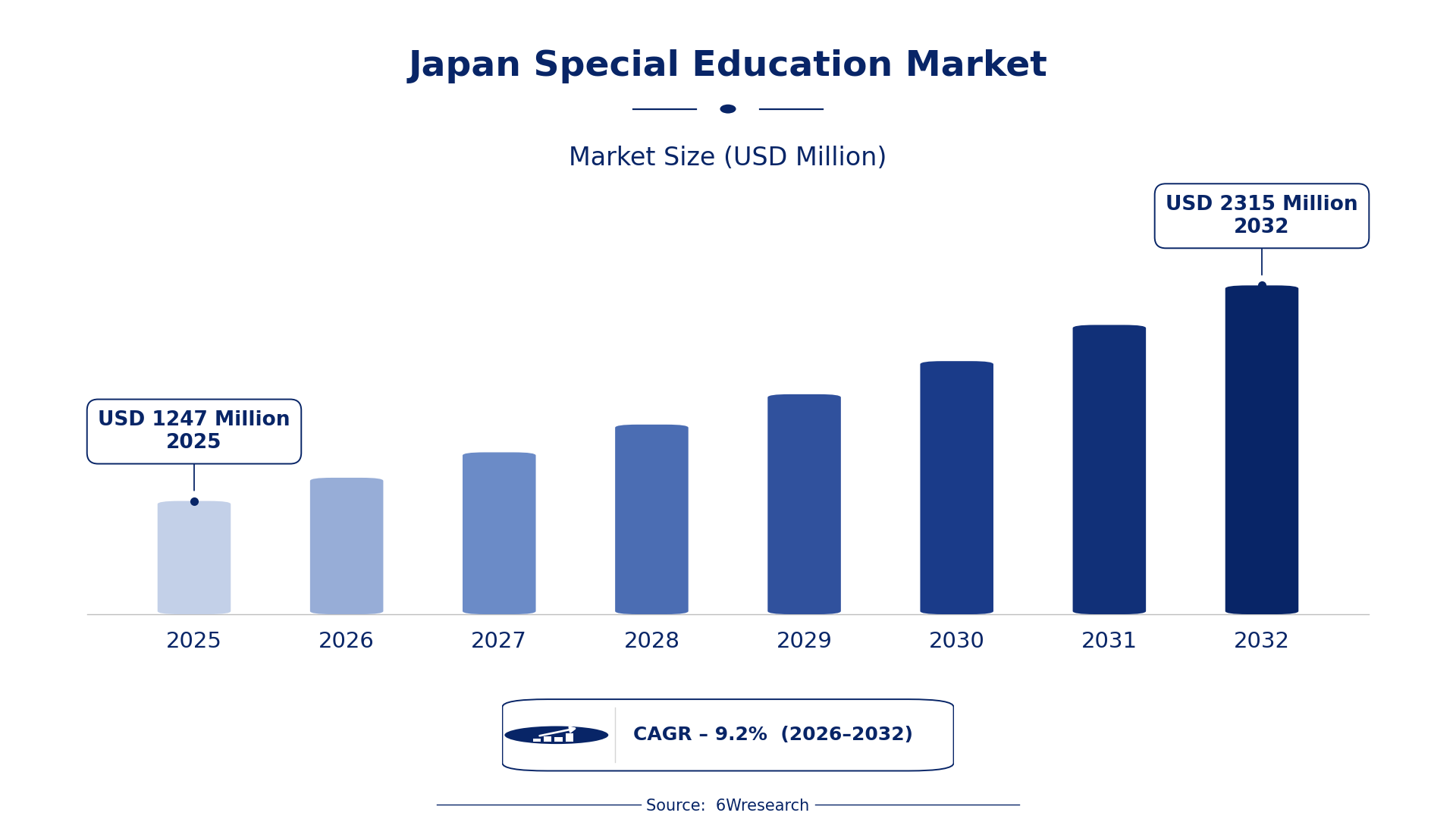
According to 6Wresearch internal database and industry insights, the Japan Special Education Market was valued at USD 1,247 Million in 2025 and is projected to reach USD 2,315 Million by 2032, growing at a CAGR of approximately 9.2% during 2026–2032.
Japan Special Education Market Highlights
| Report Metric | Details |
| Report Name | Japan Special Education Market (2026-2032) |
| Market Size 2025 | USD 1,247 Million |
| Market Size 2032 | USD 2,315 Million |
| Absolute Growth 2025–2032 | USD 1,068 Million |
| CAGR 2026–2032 | 9.2% |
| Peak Annual Growth | 10.0% in 2028 |
| Forecast Period | 2026–2032 |
| Historical Data | 2022–2025 |
| Base Year | 2025 |
| Leading Education Type, 2025 | Speech & Language (49% share) |
| Leading Disability Focus, 2025 | Learning Disabilities (46% share) |
| Leading Delivery Format, 2025 | In-Person (51% share) |
| Leading End User, 2025 | Special Needs Schools (42% share) |
| Fastest-Growing Education Type | Behavioral Training (12.9% CAGR) |
| Fastest-Growing Delivery Format | Hybrid (13.2% CAGR) |
| Fastest-Growing End User | Rehabilitation Centers (11.7% CAGR) |
| Growing Sector | special education services |
| Key End Users | schools, rehabilitation centres, NGOs, parents |
Japan Special Education Market Year-wise Growth Rate and Key Drivers (2022–2032)
This graph illustrates the annual growth rates of the market from 2022 to 2032, highlighting a steady upward trajectory and projected market expansion over the forecast period.
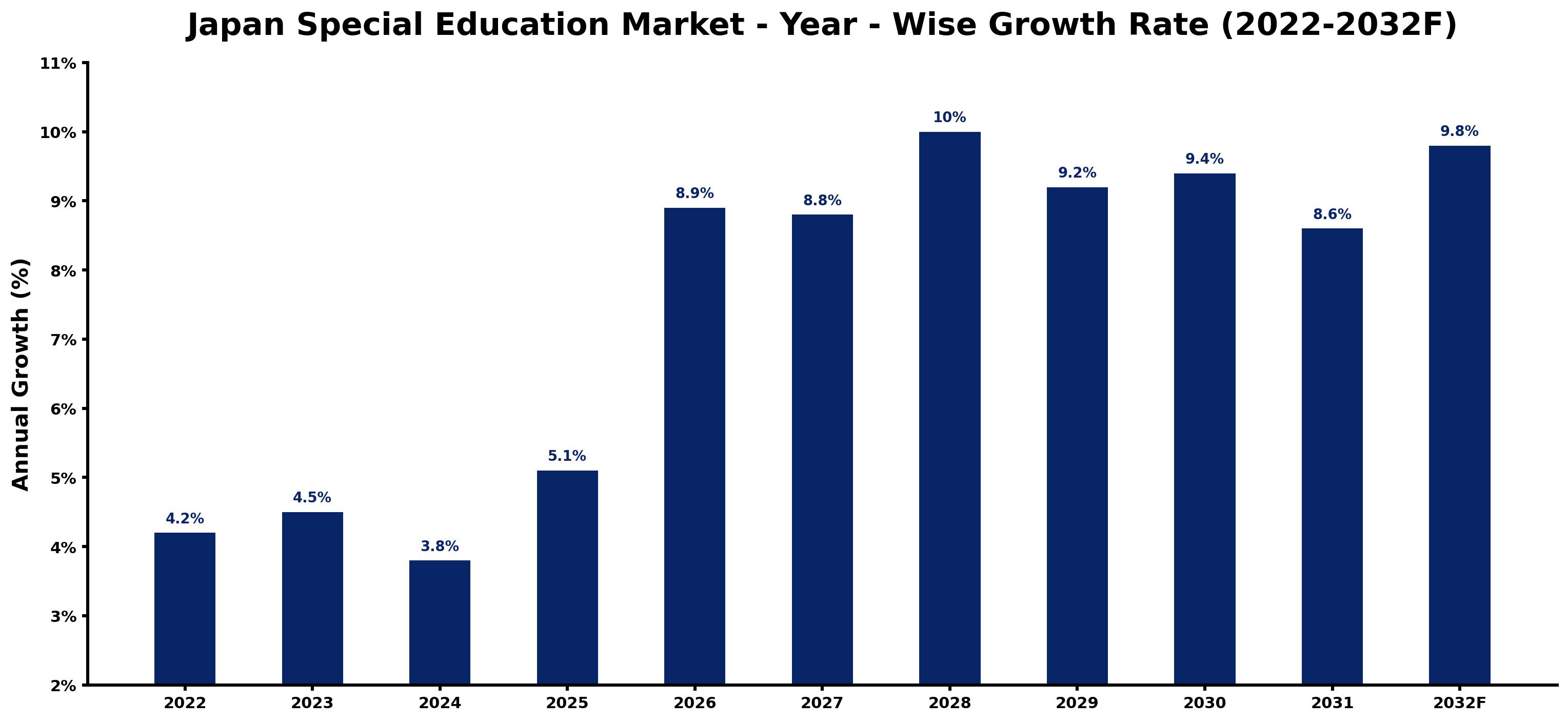
For each year, the table pairs the estimated growth rate with the leading influence on demand, showing how the drivers changed across the period.
| Year | Estimated Annual Growth (%) | Market Rationale |
| 2022 | 4.2 | The market experienced steady growth as awareness of special education increased among stakeholders. |
| 2023 | 4.5 | Demand rose due to enhanced support from educational institutions and NGOs focusing on special needs. |
| 2024 | 3.8 | Growth slowed slightly as market adjustments took place following previous expansions in services. |
| 2025 | 5.1 | The introduction of new educational programs spurred faster growth in special education services. |
| 2026 | 8.9 | Investment in online resources is projected to boost demand in this year, improving accessibility. |
| 2027 | 8.8 | Growth is expected to moderate as the market adjusts to the high demand levels of prior years. |
| 2028 | 10.0 | The peak growth rate will be achieved as new initiatives are launched nationwide to support students. |
| 2029 | 9.2 | A slight slowdown is anticipated as the market begins stabilising after rapid growth in previous years. |
| 2030 | 9.4 | Demand will increase again, driven by further investments in special education resources and training. |
| 2031 | 8.6 | Growth is projected to slow as the market matures and begins to stabilise with established practices. |
| 2032 | 9.8 | The market will continue to grow steadily, supported by ongoing policy initiatives and funding. |
Note: Market size estimations and growth projections presented in this report are based on 6Wresearch's proprietary forecasting methodology, utilizing the latest available industry data, government publications, and primary research inputs.
Japan Special Education Market Synopsis
Special education in Japan focuses on tailored strategies for individuals with disabilities, addressing their unique learning needs. In 2022, over 500,000 students were enrolled in special education programs, with demand driven by schools and rehabilitation centres. The Japanese government allocates substantial funding annually for special education initiatives, while recent programmes, including the enhancement of online resources in 2023, are expected to stimulate growth in this sector. The market is evolving with a focus on improving accessibility and quality of education for all students, reflecting a commitment to inclusivity.
Market Dynamics Impact Analysis (2026–2032)
| Factor | Type | Impact | Primary Segment Affected |
| Growing awareness of special education needs among parents and educators | Driver | High | Learning Disabilities |
| Investment in digital resources for special education | Driver | High | Online |
| Increased funding for special education initiatives | Opportunity | High | Special Needs Schools |
| Expansion of rehabilitation centres offering specialized programs | Opportunity | Medium | Rehabilitation Centers |
| Limited availability of trained special education teachers | Restraint | High | Special Needs Schools |
| Insufficient resources for online special education programs | Restraint | Medium | Online |
| High costs associated with implementing special education programs | Challenge | High | Rehabilitation Centers |
| Challenges in integrating special education within mainstream schools | Challenge | Medium | Inclusive Schools |
Evaluation of Drivers in Japan Special Education Market (2026–2032)
The table below links each growth driver to the segment it affects and the evidence for it.
| Drivers | Primary Segment Affected | Why It Matters (Evidence) |
| Increased enrolment in special education programs | Learning Disabilities | Approximately 500,000 students were enrolled in 2022, driving demand for tailored educational strategies. |
| Growing investment in digital educational resources | Online | The launch of new online programs in 2023 has expanded access to special education for students. |
| Support from government funding | Special Needs Schools | The government allocates substantial funding annually to improve facilities and resources for special needs education. |
| Rising awareness among parents about special education benefits | Rehabilitation Centers | More parents are seeking specialized services for their children, increasing demand for tailored support. |
| Development of training programs for special education teachers | Special Needs Schools | With over 100,000 certified teachers, the workforce is expanding to meet the growing needs of students. |
What keeps demand rising is the increased enrolment in special education programs, with around 500,000 students participating in 2022. This growth is supported by heightened awareness among parents regarding the benefits of special education, leading to more inquiries at rehabilitation centres. Government funding for special education initiatives improves resources in special needs schools, while the introduction of new online educational resources in 2023 has broadened access. Training programs for special education teachers are also being developed to ensure a growing workforce meets the rising demand for specialised services.
Evaluation of Restraints in Japan Special Education Market
The main factors holding the market back are set out below.
| Market Restraint | Primary Segment Affected | Why It Matters (Evidence) |
| Limited availability of trained special education teachers | Special Needs Schools | The shortage of qualified educators restricts the capacity to cater to all students' needs, impacting service delivery. |
| Insufficient resources for online special education programs | Online | Many programs lack the necessary materials, limiting their effectiveness and reach, affecting student engagement. |
| High costs associated with implementing special education programs | Rehabilitation Centers | Budget constraints hinder the ability to provide adequate services to all students, affecting program quality. |
| Challenges in integrating special education within mainstream schools | Inclusive Schools | Resistance from some educators and parents can limit the effectiveness of integration efforts, impacting student outcomes. |
| Inconsistent quality of special education across regions | Special Needs Schools | Variability in funding and resources leads to disparities in service quality, affecting student experiences. |
Japan Special Education Market Challenges
Limited competition among special education service providers restricts the adoption of modern teaching methods, affecting many students who may miss out on effective learning strategies. High operational costs associated with maintaining over 1,000 special needs schools strain local government budgets, reducing available resources for support. Regulatory requirements imposed by the Ministry of Education, Culture, Sports, Science and Technology create administrative burdens, consuming time and funds that could otherwise benefit educators directly. Supply chain issues for assistive products delay access to necessary tools, hindering timely support for students with disabilities in educational settings.
Trends in the Japan Special Education Market
Buyers and suppliers in the Japan Special Education Market are adjusting to the following trends.
- Shift towards Online Learning: In 2023, Japan launched new online special education resources, increasing accessibility for students. Approximately 20% of special education programs now incorporate online elements, reflecting a growing trend towards digital learning.
- Increased Focus on Autism Support: The Tokyo Metropolitan Government has implemented specific programs for autism support in schools, addressing the needs of approximately 1.5 million individuals with autism in Japan. This initiative highlights a shift towards targeted educational strategies.
- Expansion of Rehabilitation Centres: Rehabilitation Centres are increasingly offering specialised programs, with a 15% growth in facilities reported in 2022. This expansion reflects a rising demand for tailored support services for individuals with disabilities.
- Growth in Special Needs Schools: Japan has over 1,000 special needs schools catering to various disabilities, reflecting a commitment to inclusive education. This number has increased by 10% since 2020, indicating a positive trend in special education.
Investment Opportunities in the Japan Special Education Market
Below are the investment opportunities with the strongest case in the Japan Special Education Market.
- Timing for Investment in Online Resources: With the recent launch of online special education resources, there is an opportunity for investment in digital platforms. Schools and rehabilitation centres are seeking innovative solutions to improve access and engagement for students.
- Expansion of Rehabilitation Centres: The demand for specialised programs in rehabilitation centres is growing, driven by a rising population of individuals with disabilities. Investing in new facilities or services can meet this urgent need for tailored support.
- Investment in Training Programs for Educators: There is a pressing need for trained special education teachers, presenting an opportunity for educational institutions to develop targeted training programs. This can improve the quality of education provided in special needs schools and enhance student outcomes.
- Development of Inclusive Educational Materials: With the increasing focus on inclusive education, there is a need for tailored educational materials. Schools are looking for resources that cater to diverse learning needs, creating a market for specialised content.
Government Initiatives in the Japan Special Education Market
The Special Needs Education Promotion Law, enacted in 2007, mandates the provision of necessary educational resources for disabled students. This law complements the Industrial Standardization Act, which ensures quality and consistency in educational materials for special needs, benefiting both producers and buyers by setting standards for educational content.
The Digital Agency, established in September 2021, leads government efforts to improve digital education resources. This agency funds initiatives aimed at enhancing online special education, ensuring that students have access to quality learning materials and resources.
Future Insight of the Japan Special Education Market
Government initiatives will reshape special education by 2032, as increased funding will support innovative programmes. The rollout of new online resources will improve accessibility for students, allowing for more adaptable learning environments. Training initiatives from educational associations will elevate teaching standards, resulting in better educational outcomes. With over 100,000 certified teachers, the sector will foster a more inclusive atmosphere for the estimated 8 million individuals with disabilities in Japan.
Market Segmentation Analysis
Japan Special Education Market report covers a detailed analysis of the following market segments:
By Education Type – Speech & Language Leads, Behavioral Training Expected to Grow Fastest
According to Saurav Kr Singh, Senior Research Analyst at 6Wresearch, with 49% of education type revenue in 2025, Speech & Language was the largest category. Speech and language education holds the largest share due to its critical role in developing communication skills among students with disabilities, particularly in special needs schools. The high enrolment figures in special education programmes underscore the consistent demand for this essential service. Behavioral Training is projected to grow fastest, at a CAGR of 12.9% during 2026–2032. Behavioral training is rapidly growing as awareness increases regarding its importance in addressing behavioural challenges faced by students. The introduction of new programmes aimed at enhancing these skills is driving this growth further. Suppliers should focus on developing resources and training for behavioural training to align with the increasing demand.
By Disability Focus – Learning Disabilities Lead and Record the Fastest Growth
Learning Disabilities took 46% of disability focus revenue in 2025, more than any other category. Learning disabilities dominate the market, as they are specifically addressed through tailored instructional methods that cater to individual needs. With an estimated 8 million individuals with disabilities in Japan, many require specialised approaches to overcome learning challenges. Its lead should widen, with a projected CAGR of 11.8% during 2026–2032, the highest in this split. The growth for learning disabilities will continue to accelerate as educational institutions increasingly implement tailored strategies to support these students. Ongoing government initiatives further reinforce the importance of this segment. Buyers should seek specialised educational materials that specifically address learning disabilities to ensure effective teaching.
By Delivery Format – In-Person Leads, Hybrid Expected to Grow Fastest
The largest delivery format category in 2025 was In-Person, at 51% of revenue. In-person delivery remains the preferred format for special education as it facilitates personalised interaction between educators and students. This method is particularly effective in special needs schools where tailored approaches are essential for student success. Hybrid is set to record the highest CAGR in this split, 13.2% over 2026–2032. Hybrid formats are gaining popularity as they merge the advantages of both in-person and online methods, appealing to a wider audience. Recent enhancements in online resources are contributing to this shift in preference. Suppliers must invest in hybrid solutions to meet the evolving preferences of educational institutions.
By End User – Special Needs Schools Lead, Rehabilitation Centers Expected to Grow Fastest
In 2025, Special Needs Schools led the end user split with a 42% share. Special needs schools lead the market as they are the primary institutions providing tailored special education for various disabilities. With over 1,000 special needs schools in Japan, they play a vital role in the educational framework. Over 2026–2032, Rehabilitation Centers are expected to post the fastest growth, at a CAGR of 11.7%. Rehabilitation centers are experiencing rapid growth as they offer essential support services that complement educational efforts. Their increasing collaboration with special needs schools is enhancing the overall support for students with disabilities. Buyers should consider partnerships with rehabilitation centers to establish comprehensive support systems for students.
Key Attractiveness of the Report
- 10 Years of Market Numbers
- Historical Data Starting from 2022 to 2025
- Base Year 2025
- Forecast Data until 2032
- Key Performance Indicators Impacting the Market
- Major Upcoming Developments and Projects
Key Highlights of the Report:
- Japan Special Education Market Outlook
- Market Size of Japan Special Education Market, 2025
- Forecast of Japan Special Education Market, 2032
- Historical Data and Forecast of Japan Special Education Revenues & Volume for the Period 2022-2032F
- Japan Special Education Market Trend Evolution
- Japan Special Education Market Drivers and Challenges
- Japan Special Education Price Trends
- Japan Special Education Porter's Five Forces
- Japan Special Education Industry Life Cycle
- Historical Data and Forecast of Japan Special Education Market Revenues & Volume By Education Type for the Period 2022-2032F
- Historical Data and Forecast of Japan Special Education Market Revenues & Volume By Speech & Language for the Period 2022-2032F
- Historical Data and Forecast of Japan Special Education Market Revenues & Volume By Behavioral Training for the Period 2022-2032F
- Historical Data and Forecast of Japan Special Education Market Revenues & Volume By Physical Impairment Support for the Period 2022-2032F
- Historical Data and Forecast of Japan Special Education Market Revenues & Volume By Cognitive Development for the Period 2022-2032F
- Historical Data and Forecast of Japan Special Education Market Revenues & Volume By Disability Focus for the Period 2022-2032F
- Historical Data and Forecast of Japan Special Education Market Revenues & Volume By Communication Disorders for the Period 2022-2032F
- Historical Data and Forecast of Japan Special Education Market Revenues & Volume By Autism Spectrum for the Period 2022-2032F
- Historical Data and Forecast of Japan Special Education Market Revenues & Volume By Mobility Disabilities for the Period 2022-2032F
- Historical Data and Forecast of Japan Special Education Market Revenues & Volume By Learning Disabilities for the Period 2022-2032F
- Historical Data and Forecast of Japan Special Education Market Revenues & Volume By Delivery Format for the Period 2022-2032F
- Historical Data and Forecast of Japan Special Education Market Revenues & Volume By In-Person for the Period 2022-2032F
- Historical Data and Forecast of Japan Special Education Market Revenues & Volume By Online for the Period 2022-2032F
- Historical Data and Forecast of Japan Special Education Market Revenues & Volume By Hybrid for the Period 2022-2032F
- Historical Data and Forecast of Japan Special Education Market Revenues & Volume By One-on-One Coaching for the Period 2022-2032F
- Historical Data and Forecast of Japan Special Education Market Revenues & Volume By End User for the Period 2022-2032F
- Historical Data and Forecast of Japan Special Education Market Revenues & Volume By Special Needs Schools for the Period 2022-2032F
- Historical Data and Forecast of Japan Special Education Market Revenues & Volume By Rehabilitation Centers for the Period 2022-2032F
- Historical Data and Forecast of Japan Special Education Market Revenues & Volume By Inclusive Schools for the Period 2022-2032F
- Historical Data and Forecast of Japan Special Education Market Revenues & Volume By NGO Education Programs for the Period 2022-2032F
- Japan Special Education Import Export Trade Statistics
- Market Opportunity Assessment By Education Type
- Market Opportunity Assessment By Disability Focus
- Market Opportunity Assessment By Delivery Format
- Market Opportunity Assessment By End User
- Japan Special Education Top Companies Market Share
- Japan Special Education Competitive Benchmarking By Technical and Operational Parameters
- Japan Special Education Company Profiles
- Japan Special Education Key Strategic Recommendations
Market Covered
Segments analysed in this report are listed below.
By Education Type
- Speech & Language
- Behavioral Training
- Physical Impairment Support
- Cognitive Development
By Disability Focus
- Communication Disorders
- Autism Spectrum
- Mobility Disabilities
- Learning Disabilities
By Delivery Format
- In-Person
- Online
- Hybrid
- One-on-One Coaching
By End User
- Special Needs Schools
- Rehabilitation Centers
- Inclusive Schools
- NGO Education Programs































