Japan Special Education Technology Market Size & Growth Rate
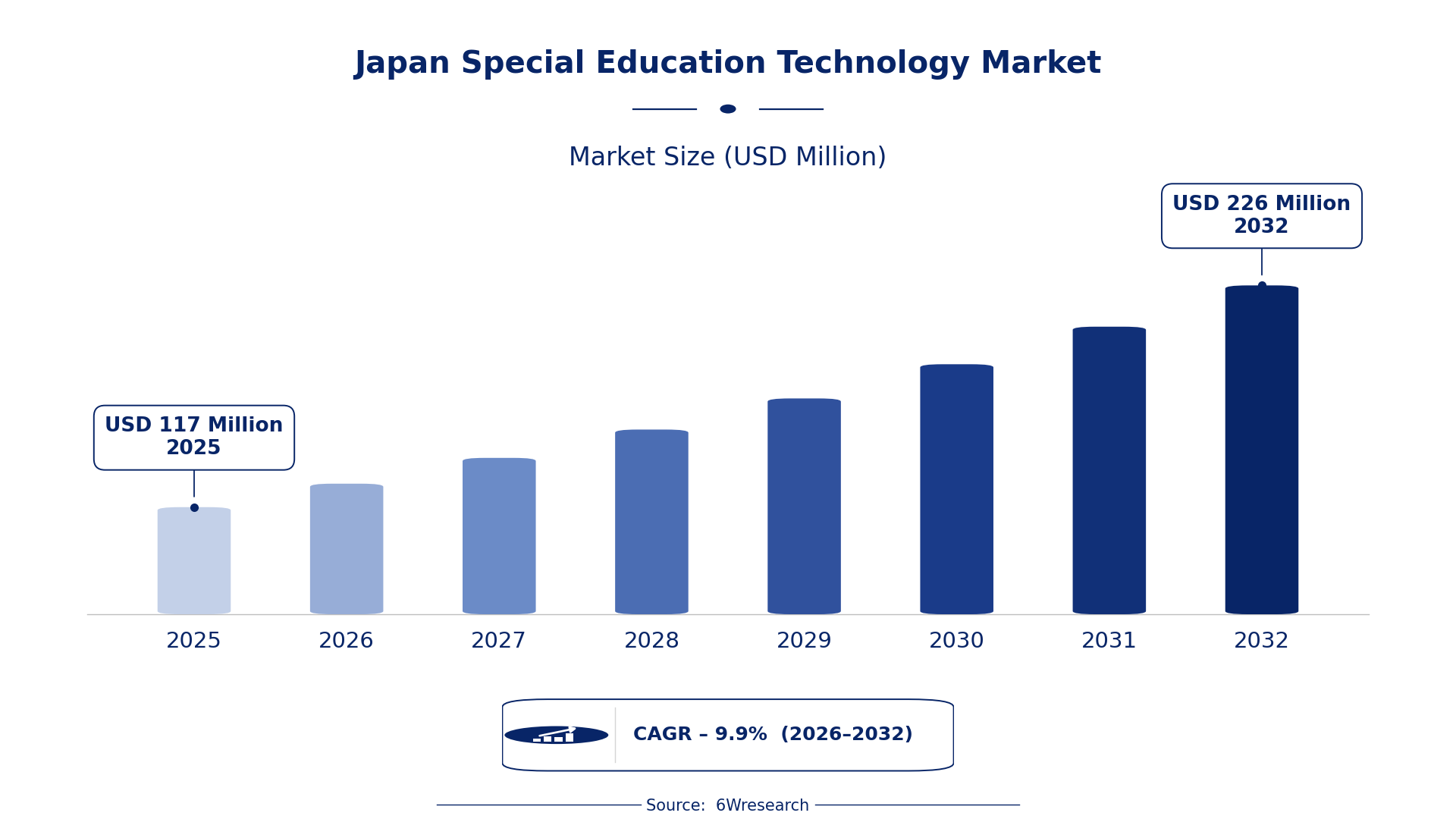
According to 6Wresearch internal database and industry insights, the Japan Special Education Technology Market was valued at USD 117 Million in 2025 and is projected to reach USD 226 Million by 2032, growing at a CAGR of approximately 9.9% during 2026–2032.
Japan Special Education Technology Market Highlights
| Report Metric | Details |
| Report Name | Japan Special Education Technology Market (2026-2032) |
| Market Size 2025 | USD 117 Million |
| Market Size 2032 | USD 226 Million |
| Absolute Growth 2025–2032 | USD 109 Million |
| CAGR 2026–2032 | 9.9% |
| Peak Annual Growth | 12.8% in 2026 |
| Forecast Period | 2026–2032 |
| Historical Data | 2022–2025 |
| Base Year | 2025 |
| Leading Technology Type, 2025 | AAC Devices (54% share) |
| Leading Learning Focus, 2025 | Communication Aid (40% share) |
| Leading Platform Type, 2025 | Hardware (34% share) |
| Leading End User, 2025 | Speech Therapists (36% share) |
| Fastest-Growing Technology Type | EdTech Software (13.7% CAGR) |
| Fastest-Growing Learning Focus | Visual/Auditory Learning (12.5% CAGR) |
| Fastest-Growing Platform Type | Cloud-Based (14.4% CAGR) |
| Fastest-Growing End User | Schools for Disabled (12.2% CAGR) |
| Growing Sector | Schools for Disabled |
| Key End Users | Speech Therapists, Schools for Disabled, EdTech Startups, Special Needs Users |
Japan Special Education Technology Market Year-wise Growth Rate and Key Drivers (2022–2032)
This graph illustrates the annual growth rates of the market from 2022 to 2032, highlighting a steady upward trajectory and projected market expansion over the forecast period.
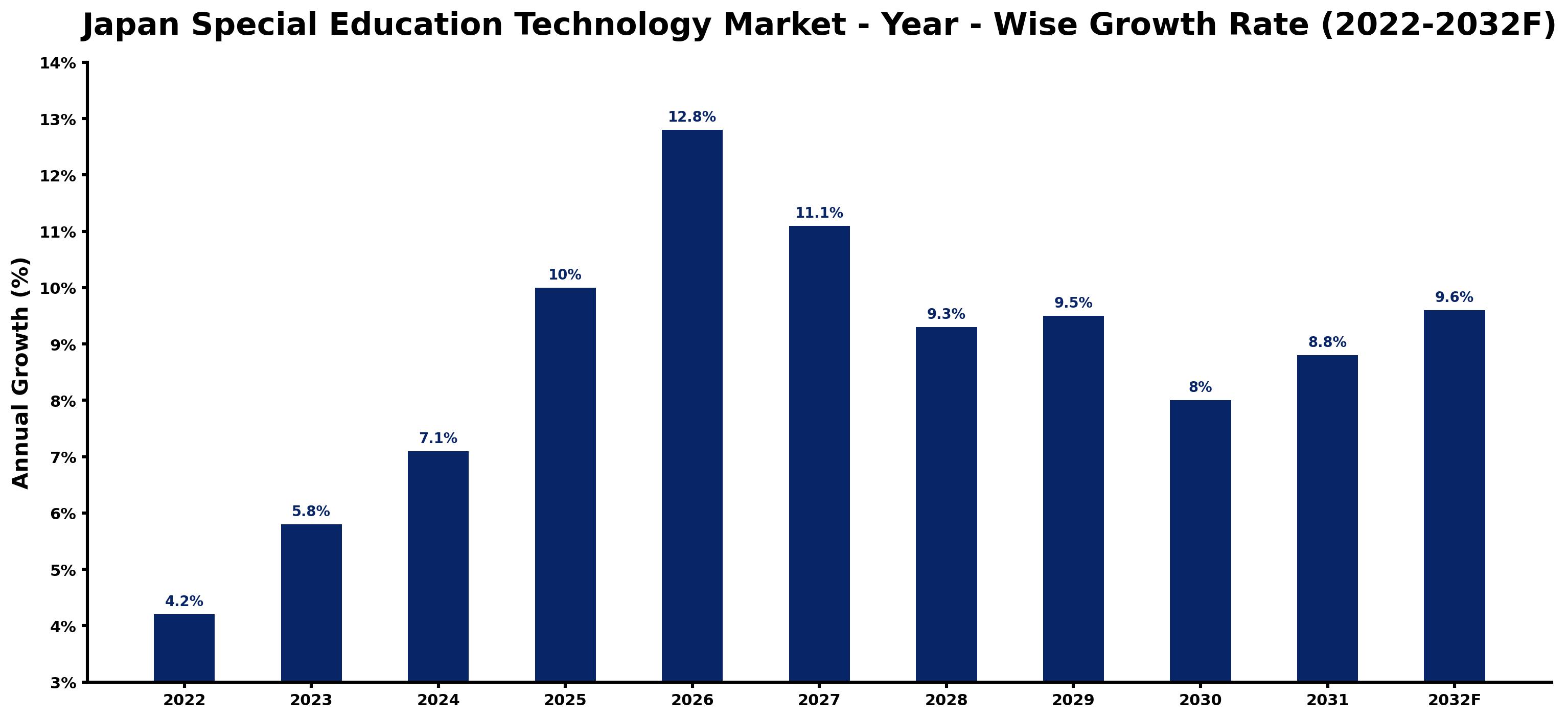
Year by year, the estimates below pair each growth rate with the development that shaped it.
| Year | Estimated Annual Growth (%) | Market Rationale |
| 2022 | 4.2 | The market experienced steady growth as educational institutions began integrating technology into special needs education. |
| 2023 | 5.8 | Demand accelerated due to increased awareness of the benefits of technology for individuals with disabilities. |
| 2024 | 7.1 | The introduction of new EdTech solutions contributed to a rise in adoption rates among schools and therapists. |
| 2025 | 10.0 | The market peaked as funding initiatives expanded access to special education technologies across Japan. |
| 2026 | 12.8 | Growth surged as the government is expected to allocate substantial resources to improve special education facilities and technologies. |
| 2027 | 11.1 | The growth rate is projected to slow as the market begins to stabilise following rapid expansion in previous years. |
| 2028 | 9.3 | A further slowdown is anticipated as the market adjusts to the influx of new technologies and funding. |
| 2029 | 9.5 | Demand is expected to increase again as schools for disabled students adopt more advanced technologies for learning. |
| 2030 | 8.0 | Growth is projected to slow as the market matures, with established players solidifying their positions. |
| 2031 | 8.8 | The growth rate will rise as new initiatives emerge to promote technology integration in special education. |
| 2032 | 9.6 | Continued investment in adaptive technologies is expected to sustain market growth. |
Note: Market size estimations and growth projections presented in this report are based on 6Wresearch's proprietary forecasting methodology, utilizing the latest available industry data, government publications, and primary research inputs.
Japan Special Education Technology Market Synopsis
Special Education Technology encompasses tools designed to assist individuals with disabilities in learning environments, including AAC devices and EdTech software. The Japan Special Education Technology Market is growing due to increased government funding and a rising population of individuals requiring special education services. In 2023, a government initiative allocated ¥2 billion for resources, while the Ministry of Education promotes EdTech through a national strategy. Key regions like Tokyo and Osaka are at the forefront of technology adoption, driving further demand for effective solutions.
Market Dynamics Impact Analysis (2026–2032)
| Factor | Type | Impact | Primary Segment Affected |
| Increased government funding for special education resources drives demand for adaptive technologies. | Driver | High | AAC Devices |
| Growing awareness of the benefits of technology in special education encourages investment in new solutions. | Driver | High | EdTech Software |
| The rising population of individuals requiring special education services presents significant market opportunities. | Opportunity | High | Schools for Disabled |
| The integration of AR/VR tools in therapy settings creates new avenues for experiential learning. | Opportunity | Medium | AR/VR Learning Tools |
| High costs associated with advanced technologies can limit accessibility for some educational institutions. | Restraint | High | Adaptive Input Tools |
| Limited awareness of available technologies among some educators may hinder adoption rates. | Restraint | Medium | Communication Aid |
| Compliance with safety regulations can increase operational costs for producers of special education technology. | Challenge | High | Hardware |
| Capacity constraints in local production may delay the availability of innovative solutions. | Challenge | Medium | Cloud-Based |
Evaluation of Drivers in Japan Special Education Technology Market (2026–2032)
The main growth drivers and the segments they affect most are set out below.
| Drivers | Primary Segment Affected | Why It Matters (Evidence) |
| Government funding initiatives improve access to special education technologies, leading to increased purchases by schools. | AAC Devices | In 2023, the government allocated ¥2 billion for special education resources, boosting demand. |
| The rise in individuals with disabilities prompts educational institutions to invest in tailored learning solutions. | EdTech Software | Approximately 1.5 million individuals with disabilities in Japan create a growing market. |
| The adoption of AR/VR tools in therapy settings provides immersive learning experiences, attracting more buyers. | AR/VR Learning Tools | These tools are increasingly used in therapy settings, enhancing engagement for diverse learners. |
| The integration of cloud-based solutions allows remote access to educational resources, appealing to EdTech startups. | Cloud-Based | Cloud-based solutions are gaining traction among EdTech startups, expanding their market reach. |
| The demand for adaptive input tools rises as schools seek to facilitate interaction for users with physical disabilities. | Adaptive Input Tools | Local government subsidies are funding the development of these essential technologies. |
Volumes grow on the back of increased funding for special education resources, with ¥2 billion allocated in 2023. The rising population of individuals with disabilities, approximately 1.5 million, drives educational institutions to invest in tailored solutions. Adoption of AR/VR tools in therapy settings provides immersive learning experiences, encouraging greater purchases by schools. Cloud-based solutions are gaining traction among EdTech startups, providing remote access to resources.
Evaluation of Restraints in Japan Special Education Technology Market
The following restraints limit how fast demand can grow.
| Market Restraint | Primary Segment Affected | Why It Matters (Evidence) |
| High costs associated with advanced technologies limit accessibility for some educational institutions. | Adaptive Input Tools | The financial burden can deter schools from investing in essential technologies. |
| Limited awareness of available technologies among educators may hinder adoption rates. | Communication Aid | Some educators remain unaware of the benefits of these tools, slowing market growth. |
| Compliance with safety regulations increases operational costs for producers of special education technology. | Hardware | Producers must invest in testing and certification, impacting pricing strategies. |
| Capacity constraints in local production may delay the availability of new solutions. | Cloud-Based | Limited manufacturing capabilities can hinder timely product launches. |
| The complexity of integrating new technologies into existing curricula can slow adoption. | EdTech Software | Educators may face challenges in adapting to new tools, affecting implementation. |
Japan Special Education Technology Market Challenges
High costs of special education technology impede widespread adoption, as some devices exceed ¥1 million, placing a burden on schools and families. A shortage of trained professionals delays implementation, with only 30% of educators feeling equipped to use these tools effectively. Inconsistent adherence to the JIS X 8341-3 standard complicates technology integration, leaving 1.5 million individuals with disabilities without adequate support. Buyers face a fragmented market, with over 300 special needs schools competing for limited resources, escalating procurement challenges and costs.
Trends in the Japan Special Education Technology Market
The following changes are redrawing the Japan Special Education Technology Market.
- Shift to AR/VR Learning Tools: The integration of AR/VR tools in therapy settings has gained traction since 2023, improving experiential learning for diverse learners. This trend is evident as schools for disabled students increasingly adopt these technologies, enhancing engagement.
- Rise of Cloud-Based Solutions: Since 2023, cloud-based solutions have gained popularity among EdTech startups, enabling remote access to educational resources. This shift allows schools to provide flexible learning environments, catering to the needs of special needs users.
- Increased Funding for Special Education: In 2023, the Japanese government allocated ¥2 billion for special education resources, reflecting a commitment to improving educational opportunities. This funding supports the development and integration of adaptive technologies in schools.
- Growing Use of Wearable Technologies: Wearable technologies have been piloted in schools for disabled students since 2023, facilitating improved learning experiences. This trend indicates a shift towards more portable solutions that enhance accessibility.
Investment Opportunities in the Japan Special Education Technology Market
The following areas offer the clearest openings for investors and suppliers in the Japan Special Education Technology Market.
- Invest in AAC Devices: With the rising demand for AAC devices, suppliers can focus on developing effective communication aids. The growing population of individuals with disabilities presents a market opportunity, with funding initiatives supporting development.
- Supply Cloud-Based Solutions: The increasing adoption of cloud-based solutions offers a chance to supply educational resources remotely. Schools for disabled students are actively seeking these technologies to improve learning experiences.
- Focus on AR/VR Learning Tools: The growing use of AR/VR tools in therapy settings creates an opportunity for investment. This trend is driven by the need for immersive learning experiences in schools, particularly in Tokyo and Osaka.
- Partner with EdTech Startups: Collaborating with EdTech startups can facilitate entry into the special education technology market. These startups are developing new solutions, backed by government funding and initiatives.
Government Initiatives in the Japan Special Education Technology Market
The AI Promotion Act (2025) establishes a national framework for AI research and development, improving the capabilities of special education technologies. This law complements existing regulations, such as the Electrical Appliance and Material Safety Act, which ensures safety and efficacy in educational tools.
The Ministry of Education, Culture, Sports, Science and Technology (MEXT) funds special education initiatives, including adaptive technologies. In 2023, MEXT allocated ¥2 billion for resources, directly benefiting schools and educators in their efforts to integrate technology into special education.
Future Insight of the Japan Special Education Technology Market
The Ministry of Education's national strategy will drive a policy shift towards improved special education resources, prompting suppliers to innovate in response. By 2032, advanced technologies will facilitate better accessibility in learning environments, allowing schools to optimise resource sharing. Government funding initiatives, including the ¥2 billion allocated in 2023, will support the development of adaptive tools. The growing use of wearable technologies in educational settings will reshape learning experiences for disabled students, creating new avenues for both buyers and suppliers.
Market Segmentation Analysis
Japan Special Education Technology Market report covers a detailed analysis of the following market segments:
By Technology Type – AAC Devices Lead, EdTech Software Expected to Grow Fastest
According to Saurav Kr Singh, Senior Research Analyst at 6Wresearch, the largest technology type category in 2025 was AAC Devices, at 54% of revenue. AAC devices are critical for enhancing communication among individuals with speech impairments, establishing their dominance in the market. Their inclusion in government assistive technology programs ensures they are widely adopted in educational settings. Over 2026–2032, EdTech Software is expected to post the fastest growth, at a CAGR of 13.7%. The rapid growth of EdTech software stems from its ability to provide personalised learning experiences tailored to individual needs. With around 1.5 million individuals with disabilities in Japan, the demand for such software is projected to increase significantly. Suppliers should focus on creating versatile EdTech software to address the rising needs in special education.
By Learning Focus – Communication Aid Leads, Visual/Auditory Learning Expected to Grow Fastest
Communication Aid held 40% of the Japan Special Education Technology Market by learning focus in 2025. Communication aids are essential for users facing communication challenges, making them a primary focus within special education. The increasing population of individuals requiring these aids in Japan drives their demand. Visual/Auditory Learning is set to record the highest CAGR in this split, 12.5% over 2026–2032. Visual and auditory learning tools are gaining popularity as they address diverse learning styles, enhancing engagement and understanding. The ongoing emphasis on inclusive education further accelerates the adoption of these methods. Providers should concentrate on developing visual and auditory learning resources to align with educational strategies.
By Platform Type – Hardware Leads, Cloud-Based Expected to Grow Fastest
In 2025, Hardware led the platform type split with a 34% share. Hardware serves as the foundation of special education technology, encompassing essential physical devices required for effective learning. The existence of over 300 special needs schools across Japan guarantees a consistent demand for hardware solutions. Cloud-Based is projected to grow fastest, at a CAGR of 14.4% during 2026–2032. Cloud-based platforms are swiftly gaining traction as they allow remote access to educational resources, which is increasingly vital in the current digital age. The emergence of EdTech startups focusing on cloud solutions indicates a shift towards more adaptable learning environments. Vendors should invest in cloud-based solutions to leverage the trend towards remote education.
By End User – Speech Therapists Lead, Schools for Disabled Expected to Grow Fastest
With 36% of end user revenue in 2025, Speech Therapists was the largest category. Speech therapists are pivotal users of special education technology, employing these tools to assist clients with various needs. Their reliance on technology for effective therapy sessions highlights the significance of this segment. The quickest growth will come from Schools for Disabled, forecast to expand at a CAGR of 12.2% between 2026 and 2032. Schools for disabled students are progressively incorporating technology into their curricula, demonstrating a broader commitment to inclusive education. This trend is bolstered by government initiatives aimed at improving special education facilities. Manufacturers should tailor products to meet the specific requirements of schools for disabled students to capture this growing market.
Key Attractiveness of the Report
- 10 Years of Market Numbers
- Historical Data Starting from 2022 to 2025
- Base Year 2025
- Forecast Data until 2032
- Key Performance Indicators Impacting the Market
- Major Upcoming Developments and Projects
Key Highlights of the Report:
- Japan Special Education Technology Market Outlook
- Market Size of Japan Special Education Technology Market, 2025
- Forecast of Japan Special Education Technology Market, 2032
- Historical Data and Forecast of Japan Special Education Technology Revenues & Volume for the Period 2022-2032F
- Japan Special Education Technology Market Trend Evolution
- Japan Special Education Technology Market Drivers and Challenges
- Japan Special Education Technology Price Trends
- Japan Special Education Technology Porter's Five Forces
- Japan Special Education Technology Industry Life Cycle
- Historical Data and Forecast of Japan Special Education Technology Market Revenues & Volume By Technology Type for the Period 2022-2032F
- Historical Data and Forecast of Japan Special Education Technology Market Revenues & Volume By AAC Devices for the Period 2022-2032F
- Historical Data and Forecast of Japan Special Education Technology Market Revenues & Volume By EdTech Software for the Period 2022-2032F
- Historical Data and Forecast of Japan Special Education Technology Market Revenues & Volume By AR/VR Learning Tools for the Period 2022-2032F
- Historical Data and Forecast of Japan Special Education Technology Market Revenues & Volume By Adaptive Input Tools for the Period 2022-2032F
- Historical Data and Forecast of Japan Special Education Technology Market Revenues & Volume By Learning Focus for the Period 2022-2032F
- Historical Data and Forecast of Japan Special Education Technology Market Revenues & Volume By Communication Aid for the Period 2022-2032F
- Historical Data and Forecast of Japan Special Education Technology Market Revenues & Volume By Visual/Auditory Learning for the Period 2022-2032F
- Historical Data and Forecast of Japan Special Education Technology Market Revenues & Volume By Experiential Learning for the Period 2022-2032F
- Historical Data and Forecast of Japan Special Education Technology Market Revenues & Volume By Physical Assistance for the Period 2022-2032F
- Historical Data and Forecast of Japan Special Education Technology Market Revenues & Volume By Platform Type for the Period 2022-2032F
- Historical Data and Forecast of Japan Special Education Technology Market Revenues & Volume By Hardware for the Period 2022-2032F
- Historical Data and Forecast of Japan Special Education Technology Market Revenues & Volume By Cloud-Based for the Period 2022-2032F
- Historical Data and Forecast of Japan Special Education Technology Market Revenues & Volume By Wearable/Tablet for the Period 2022-2032F
- Historical Data and Forecast of Japan Special Education Technology Market Revenues & Volume By Touchless/Wireless for the Period 2022-2032F
- Historical Data and Forecast of Japan Special Education Technology Market Revenues & Volume By End User for the Period 2022-2032F
- Historical Data and Forecast of Japan Special Education Technology Market Revenues & Volume By Speech Therapists for the Period 2022-2032F
- Historical Data and Forecast of Japan Special Education Technology Market Revenues & Volume By Schools for Disabled for the Period 2022-2032F
- Historical Data and Forecast of Japan Special Education Technology Market Revenues & Volume By EdTech Startups for the Period 2022-2032F
- Historical Data and Forecast of Japan Special Education Technology Market Revenues & Volume By Special Needs Users for the Period 2022-2032F
- Japan Special Education Technology Import Export Trade Statistics
- Market Opportunity Assessment By Technology Type
- Market Opportunity Assessment By Learning Focus
- Market Opportunity Assessment By Platform Type
- Market Opportunity Assessment By End User
- Japan Special Education Technology Top Companies Market Share
- Japan Special Education Technology Competitive Benchmarking By Technical and Operational Parameters
- Japan Special Education Technology Company Profiles
- Japan Special Education Technology Key Strategic Recommendations
Market Covered
The report covers the following segments.
By Technology Type
- AAC Devices
- EdTech Software
- AR/VR Learning Tools
- Adaptive Input Tools
By Learning Focus
- Communication Aid
- Visual/Auditory Learning
- Experiential Learning
- Physical Assistance
By Platform Type
- Hardware
- Cloud-Based
- Wearable/Tablet
- Touchless/Wireless
By End User
- Speech Therapists
- Schools for Disabled
- EdTech Startups
- Special Needs Users































