Japan Speciality Cleaning and Sanitation Market Size & Growth Rate
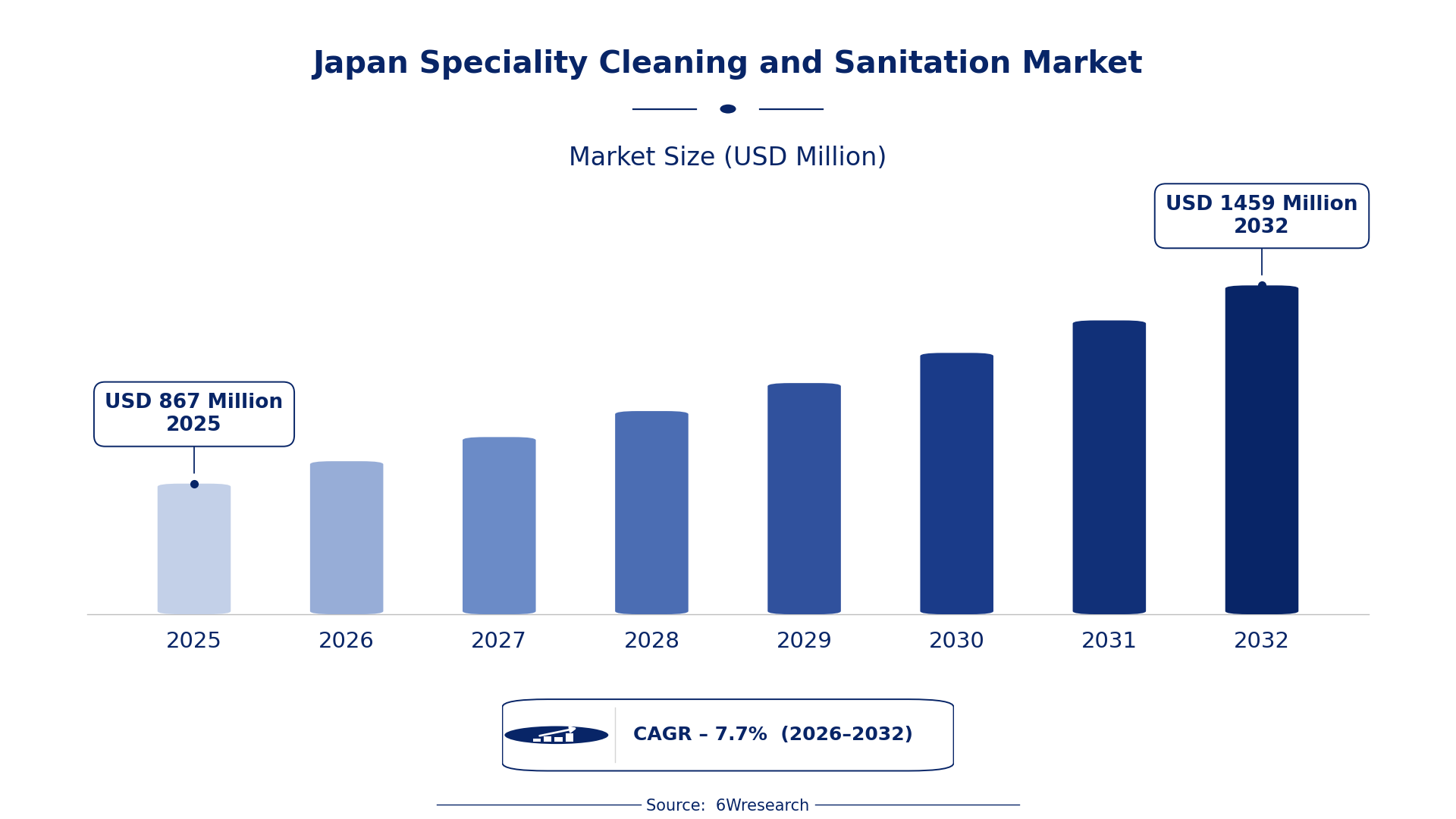
According to 6Wresearch internal database and industry insights, the Japan Speciality Cleaning and Sanitation Market was valued at USD 867 Million in 2025 and is projected to reach USD 1,459 Million by 2032, growing at a CAGR of approximately 7.7% during 2026–2032.
Japan Speciality Cleaning and Sanitation Market Highlights
| Report Metric | Details |
| Report Name | Japan Speciality Cleaning and Sanitation Market (2026-2032) |
| Market Size 2025 | USD 867 Million |
| Market Size 2032 | USD 1,459 Million |
| Absolute Growth 2025–2032 | USD 592 Million |
| CAGR 2026–2032 | 7.7% |
| Peak Annual Growth | 8.5% in 2028 |
| Forecast Period | 2026–2032 |
| Historical Data | 2022–2025 |
| Base Year | 2025 |
| Leading Type, 2025 | Acid cleaner (51% share) |
| Leading Applications, 2025 | Food industry (40% share) |
| Fastest-Growing Type | Alkaline cleaner (10.3% CAGR) |
| Fastest-Growing Applications | Pharmaceuticals industry (10.1% CAGR) |
| Growing Sector | Food industry |
| Key End Users | Food processing plants, households, pharmaceutical manufacturers, cleaning service providers |
Japan Speciality Cleaning and Sanitation Market Year-wise Growth Rate and Key Drivers (2022–2032)
This graph illustrates the annual growth rates of the market from 2022 to 2032, highlighting a steady upward trajectory and projected market expansion over the forecast period.
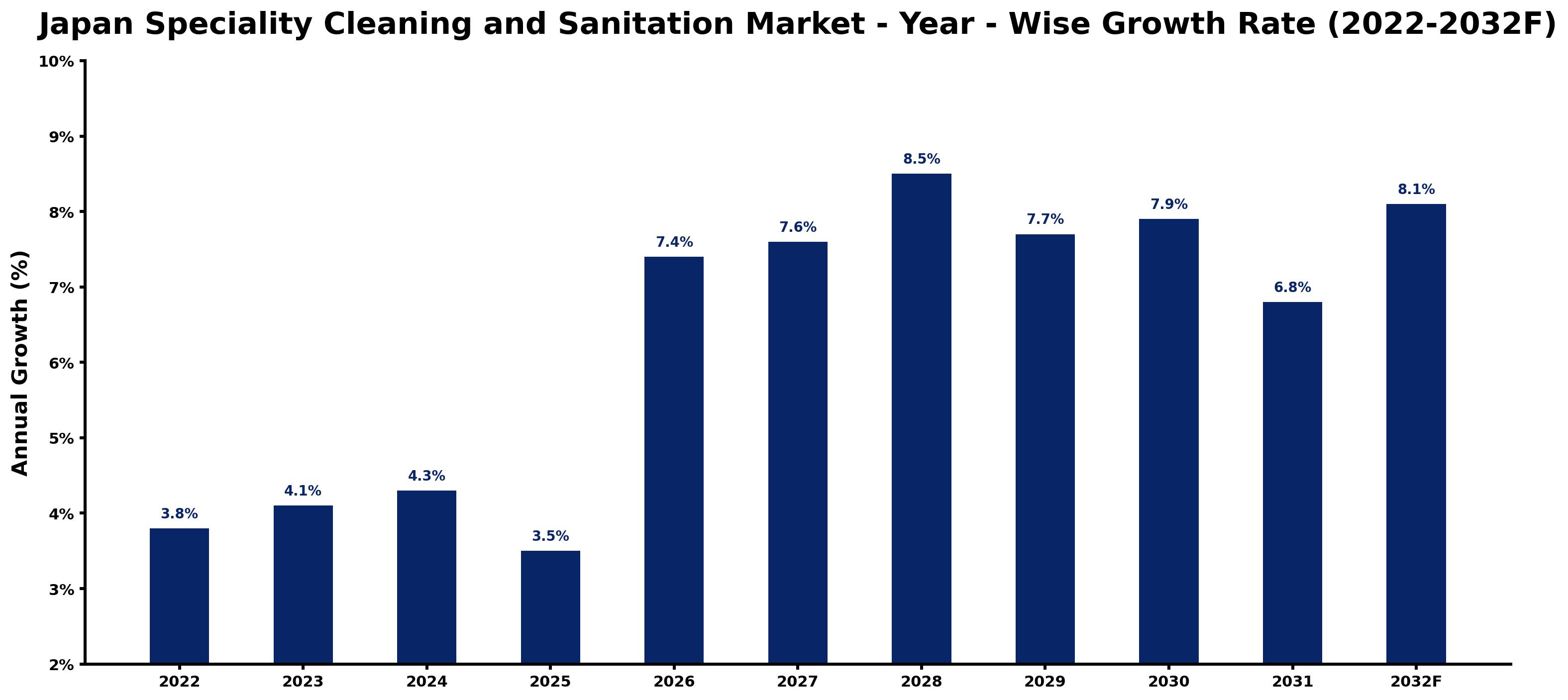
Below, each year's estimated growth is shown next to the factor that most influenced it.
| Year | Estimated Annual Growth (%) | Market Rationale |
| 2022 | 3.8 | The market experienced steady demand from the food industry, reflecting ongoing hygiene concerns. |
| 2023 | 4.1 | Growth was driven by increased household spending on cleaning products and sanitation. |
| 2024 | 4.3 | Demand accelerated as food processing plants upgraded their cleaning protocols. |
| 2025 | 3.5 | The market adjusted to previous high demand levels, resulting in slower growth. |
| 2026 | 7.4 | The introduction of eco-friendly products is expected to spur renewed interest and purchasing. |
| 2027 | 7.6 | Investment in healthcare facilities will boost demand for sanitation products. |
| 2028 | 8.5 | Advancements in cleaning technology will drive peak growth in this year. |
| 2029 | 7.7 | Growth will slow as market saturation begins to take effect in key sectors. |
| 2030 | 7.9 | New regulations will prompt upgrades in cleaning standards, increasing demand. |
| 2031 | 6.8 | Manufacturers will face challenges in sourcing raw materials, leading to slower growth. |
| 2032 | 8.1 | Rising awareness of hygiene standards will expand the market significantly. |
Note: Market size estimations and growth projections presented in this report are based on 6Wresearch's proprietary forecasting methodology, utilizing the latest available industry data, government publications, and primary research inputs.
Japan Speciality Cleaning and Sanitation Market Synopsis
Speciality cleaning and sanitation products are chemical formulations designed for specific cleaning tasks, made from surfactants, solvents, and other additives. The Japan Speciality Cleaning and Sanitation Market is expanding, driven by strong demand from the food industry, valued at approximately ¥20 trillion, and the pharmaceutical sector, which stands at about ¥10 trillion. The introduction of eco-friendly cleaning products and the implementation of new sanitation regulations are also key contributors to this growth.
Market Dynamics Impact Analysis (2026–2032)
| Factor | Type | Impact | Primary Segment Affected |
| Rising hygiene standards in food processing facilities | Driver | High | Food industry |
| Growing household spending on cleaning products | Driver | High | Household use |
| Increasing demand for eco-friendly products | Opportunity | Medium | Other |
| Expansion of pharmaceutical manufacturing facilities | Opportunity | Medium | Pharmaceuticals industry |
| Regulatory compliance costs for manufacturers | Restraint | High | Acid cleaner |
| Limited availability of raw materials for production | Restraint | Medium | Alkaline cleaner |
| Rising costs of compliance with new regulations | Challenge | High | Food industry |
| Capacity constraints in production facilities | Challenge | Medium | Pharmaceuticals industry |
Evaluation of Drivers in Japan Speciality Cleaning and Sanitation Market (2026–2032)
The table below links each growth driver to the segment it affects and the evidence for it.
| Drivers | Primary Segment Affected | Why It Matters (Evidence) |
| Increased hygiene standards in food processing | Food industry | The food industry, valued at ¥20 trillion, drives demand for cleaning products to maintain hygiene. |
| Growing household cleaning expenditures | Household use | Over 80% of households use cleaning products, reflecting a strong demand for effective solutions. |
| Rising demand for eco-friendly cleaning solutions | Other | In 2023, the government launched a campaign promoting eco-friendly products, boosting market interest. |
| Expansion of pharmaceutical production facilities | Pharmaceuticals industry | The pharmaceutical sector, valued at ¥10 trillion, requires stringent sanitation for sterile environments. |
| Adoption of JIS standards for cleaning chemicals | Acid cleaner | Compliance with JIS standards ensures safety and efficacy, influencing purchasing decisions in the market. |
The strongest pull on demand comes from the food industry, valued at approximately ¥20 trillion, which necessitates stringent hygiene practices. More than 80% of households in Japan use cleaning products, leading to substantial household expenditures on sanitation. The pharmaceutical sector, one of the largest in Asia at about ¥10 trillion, requires effective cleaning solutions to maintain sterile environments. In 2023, a campaign promoted eco-friendly products, boosting purchases. Compliance with JIS standards influences demand, as manufacturers strive to ensure product safety and efficacy.
Evaluation of Restraints in Japan Speciality Cleaning and Sanitation Market
The following restraints limit how fast demand can grow.
| Market Restraint | Primary Segment Affected | Why It Matters (Evidence) |
| High compliance costs associated with new regulations | Acid cleaner | Compliance with the Food Sanitation Act amendment increases operational costs for manufacturers. |
| Limited availability of raw materials for production | Alkaline cleaner | Supply chain disruptions have made sourcing raw materials more challenging and costly. |
| Pressure to meet stringent hygiene standards | Food industry | Food businesses must invest in advanced cleaning solutions to comply with regulations. |
| Increased competition among manufacturers | Pharmaceuticals industry | The growing number of suppliers has led to price wars, impacting profit margins. |
| Market saturation in household cleaning products | Household use | High competition has limited growth opportunities in the household segment. |
Japan Speciality Cleaning and Sanitation Market Challenges
Producers in the food processing sector face annual losses of up to ¥1 billion due to delays in product availability linked to stringent approval processes for new cleaning formulations. Buyers encounter increased costs from compliance with JIS standards, which can elevate production expenses by approximately 15%, particularly impacting smaller manufacturers. Suppliers incur annual costs of around ¥2 million for necessary quality assurance measures, hindering competitiveness for smaller firms. Supply chain disruptions in the Tokyo metropolitan area can delay deliveries, forcing buyers to hold excess inventory and increasing their holding costs by up to 10%.
Trends in the Japan Speciality Cleaning and Sanitation Market
Buyers and suppliers in the Japan Speciality Cleaning and Sanitation Market are adjusting to the following trends.
- Growing Demand for Specialty Cleaners: The demand for specialty cleaners is on the rise, particularly in the food industry. The annual demand for alkaline cleaners in this sector is estimated at 50,000 tons, reflecting the need for effective solutions.
- Shift Towards Eco-Friendly Cleaning Products: Households are increasingly adopting eco-friendly cleaning solutions, influenced by government campaigns promoting sustainability. In 2023, a campaign was launched to promote eco-friendly cleaning products, impacting consumer choices.
- Rise of Automation in Cleaning Processes: Food processing facilities are increasingly automating cleaning processes to improve efficiency. In 2024, several food plants in Osaka adopted automated cleaning systems, resulting in improved hygiene standards.
- Increased Focus on Hygiene in Pharmaceuticals: The pharmaceutical industry is prioritising stringent hygiene protocols to ensure product safety. In 2022, new regulations for sanitation in food handling were approved, impacting pharmaceutical cleaning practices.
Investment Opportunities in the Japan Speciality Cleaning and Sanitation Market
Investors looking at the Japan Speciality Cleaning and Sanitation Market should consider the following areas.
- Joint Ventures with Local Manufacturers: Local partnerships are essential for entering the Japanese market. With the food industry valued at ¥20 trillion, collaborating with local firms can improve market access and compliance.
- Investment in Eco-Friendly Product Development: The market gap for eco-friendly products is substantial, with increasing consumer demand. Investing in sustainable cleaning solutions can attract environmentally conscious buyers, especially in urban areas.
- Expansion of Cleaning Services in Pharmaceuticals: Pharmaceutical facilities are expanding, creating opportunities for cleaning service providers. The sector's market size of about ¥10 trillion indicates a strong demand for specialised cleaning services.
- Certification for JIS Standards: Obtaining JIS certification can improve product credibility in Japan. Manufacturers can gain market entry by ensuring compliance with these standards, particularly in the food industry.
Government Initiatives in the Japan Speciality Cleaning and Sanitation Market
The 2018 Food Sanitation Act amendment, enforced from June 2021, mandates HACCP-based hygiene management for food businesses, impacting cleaning product requirements. Compliance with this act ensures that food processing facilities maintain high sanitation standards, driving demand for effective cleaning solutions.
The Ministry of Health oversees the implementation of sanitation regulations, ensuring that food businesses adhere to the Food Sanitation Act. This agency approves cleaning products that meet safety and efficacy standards, directly influencing buyer choices in the food industry.
Future Insight of the Japan Speciality Cleaning and Sanitation Market
The introduction of new eco-friendly cleaning initiatives will reshape the market by 2032, driven by government support for sustainable practices. Stricter regulations will compel suppliers to create advanced cleaning formulations that adhere to high safety standards. By 2030, the annual demand for specialised sanitation products in healthcare facilities is expected to surpass 50,000 tons. The widespread implementation of ISO 9001 certification will enhance product quality, providing significant benefits for both buyers and suppliers.
Market Segmentation Analysis
Japan Speciality Cleaning and Sanitation Market report covers a detailed analysis of the following market segments:
By Type – Acid cleaner Leads, Alkaline cleaner Expected to Grow Fastest
According to Ravi Bhandari, Research Head at 6Wresearch, the largest type category in 2025 was Acid cleaner, at 51% of revenue. Acid cleaners hold the largest share due to their widespread use in food processing plants, particularly in regions like Hokkaido and Osaka. Their effectiveness in removing mineral deposits and rust makes them essential for maintaining equipment in these facilities. Over 2026–2032, Alkaline cleaner is expected to post the fastest growth, at a CAGR of 10.3%. Alkaline cleaners are experiencing rapid growth as the demand for effective grease and organic matter removal increases, particularly in the food industry where annual demand is estimated at 50,000 tons. This trend is likely to continue as food safety regulations become more stringent. Suppliers should focus on developing and marketing alkaline cleaners to capitalise on this growth opportunity.
By Applications – Food industry Leads, Pharmaceuticals industry Expected to Grow Fastest
In 2025, Food industry led the applications split with a 40% share. The food industry is the leading application segment, valued at approximately ¥20 trillion, which drives the demand for speciality cleaning products to maintain hygiene standards. This sector's critical need for effective cleaning solutions ensures a steady market for acid cleaners. Pharmaceuticals industry is set to record the highest CAGR in this split, 10.1% over 2026–2032. The pharmaceuticals industry is the fastest-growing application segment, essential for maintaining sterile environments, which has become increasingly important in recent years. This growth reflects the rising focus on health and safety standards in medical facilities. Buyers in the pharmaceuticals sector should prioritise suppliers that meet stringent cleaning standards to ensure compliance and safety.
Key Attractiveness of the Report
- 10 Years of Market Numbers
- Historical Data Starting from 2022 to 2025
- Base Year 2025
- Forecast Data until 2032
- Key Performance Indicators Impacting the Market
- Major Upcoming Developments and Projects
Key Highlights of the Report:
- Japan Speciality Cleaning and Sanitation Market Outlook
- Market Size of Japan Speciality Cleaning and Sanitation Market, 2025
- Forecast of Japan Speciality Cleaning and Sanitation Market, 2032
- Historical Data and Forecast of Japan Speciality Cleaning and Sanitation Revenues & Volume for the Period 2022-2032
- Japan Speciality Cleaning and Sanitation Market Trend Evolution
- Japan Speciality Cleaning and Sanitation Market Drivers and Challenges
- Japan Speciality Cleaning and Sanitation Price Trends
- Japan Speciality Cleaning and Sanitation Porter's Five Forces
- Japan Speciality Cleaning and Sanitation Industry Life Cycle
- Historical Data and Forecast of Japan Speciality Cleaning and Sanitation Market Revenues & Volume By Type for the Period 2022-2032
- Historical Data and Forecast of Japan Speciality Cleaning and Sanitation Market Revenues & Volume By Acid cleaner for the Period 2022-2032
- Historical Data and Forecast of Japan Speciality Cleaning and Sanitation Market Revenues & Volume By Alkaline cleaner for the Period 2022-2032
- Historical Data and Forecast of Japan Speciality Cleaning and Sanitation Market Revenues & Volume By Other for the Period 2022-2032
- Historical Data and Forecast of Japan Speciality Cleaning and Sanitation Market Revenues & Volume By Applications for the Period 2022-2032
- Historical Data and Forecast of Japan Speciality Cleaning and Sanitation Market Revenues & Volume By Food industry for the Period 2022-2032
- Historical Data and Forecast of Japan Speciality Cleaning and Sanitation Market Revenues & Volume By Household use for the Period 2022-2032
- Historical Data and Forecast of Japan Speciality Cleaning and Sanitation Market Revenues & Volume By Pharmaceuticals industry for the Period 2022-2032
- Historical Data and Forecast of Japan Speciality Cleaning and Sanitation Market Revenues & Volume By Others for the Period 2022-2032
- Japan Speciality Cleaning and Sanitation Import Export Trade Statistics
- Market Opportunity Assessment By Type
- Market Opportunity Assessment By Applications
- Japan Speciality Cleaning and Sanitation Top Companies Market Share
- Japan Speciality Cleaning and Sanitation Competitive Benchmarking By Technical and Operational Parameters
- Japan Speciality Cleaning and Sanitation Company Profiles
- Japan Speciality Cleaning and Sanitation Key Strategic Recommendations
Market Covered
The report covers the following segments.
By Type
- Acid cleaner
- Alkaline cleaner
- Other
By Applications
- Food industry
- Household use
- Pharmaceuticals industry
- Others































