Japan Specialty Beer Market Size & Growth Rate
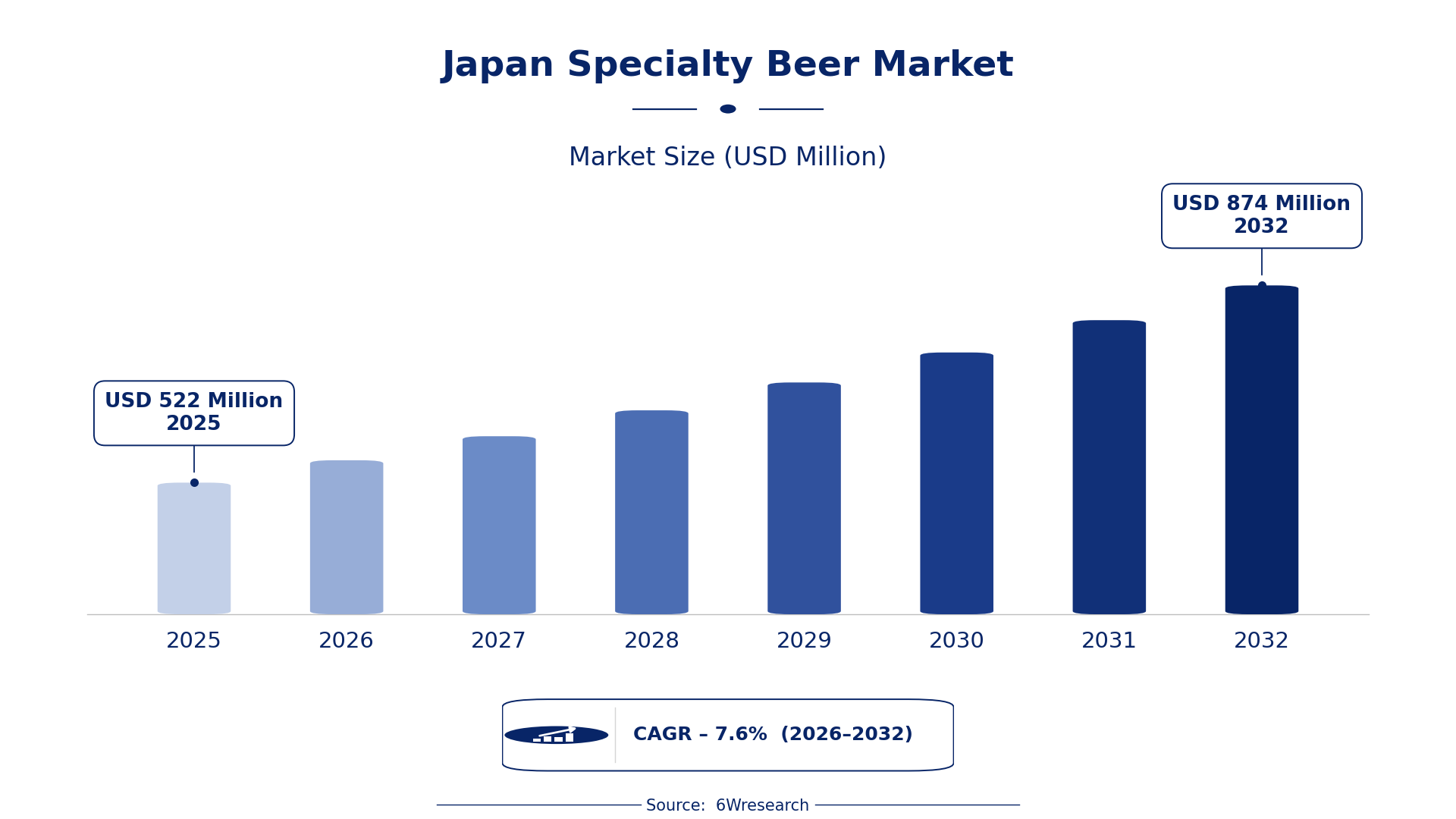
According to 6Wresearch internal database and industry insights, the Japan Specialty Beer Market was valued at USD 522 Million in 2025 and is projected to reach USD 874 Million by 2032, growing at a CAGR of approximately 7.6% during 2026–2032.
Japan Specialty Beer Market Highlights
| Report Metric | Details |
| Report Name | Japan Specialty Beer Market (2026-2032) |
| Market Size 2025 | USD 522 Million |
| Market Size 2032 | USD 874 Million |
| Absolute Growth 2025–2032 | USD 352 Million |
| CAGR 2026–2032 | 7.6% |
| Peak Annual Growth | 9.2% in 2032 |
| Forecast Period | 2026–2032 |
| Historical Data | 2022–2025 |
| Base Year | 2025 |
| Leading Beer Type, 2025 | Craft IPA (40% share) |
| Leading Flavor Profile, 2025 | Hoppy & Bitter (43% share) |
| Leading Packaging Format, 2025 | Bottles/Cans (44% share) |
| Leading End User, 2025 | Microbreweries (45% share) |
| Fastest-Growing Beer Type | Sour Beer (10.7% CAGR) |
| Fastest-Growing Flavor Profile | Fruity/Tart (10.6% CAGR) |
| Fastest-Growing Packaging Format | 6-Pack Cans (10.9% CAGR) |
| Fastest-Growing End User | Brewpubs & Taprooms (10.5% CAGR) |
| Growing Sector | Craft Beer |
| Key End Users | Microbreweries, Brewpubs & Taprooms, Specialty Beer Retailers |
Japan Specialty Beer Market Year-wise Growth Rate and Key Drivers (2022–2032)
This graph illustrates the annual growth rates of the market from 2022 to 2032, highlighting a steady upward trajectory and projected market expansion over the forecast period.
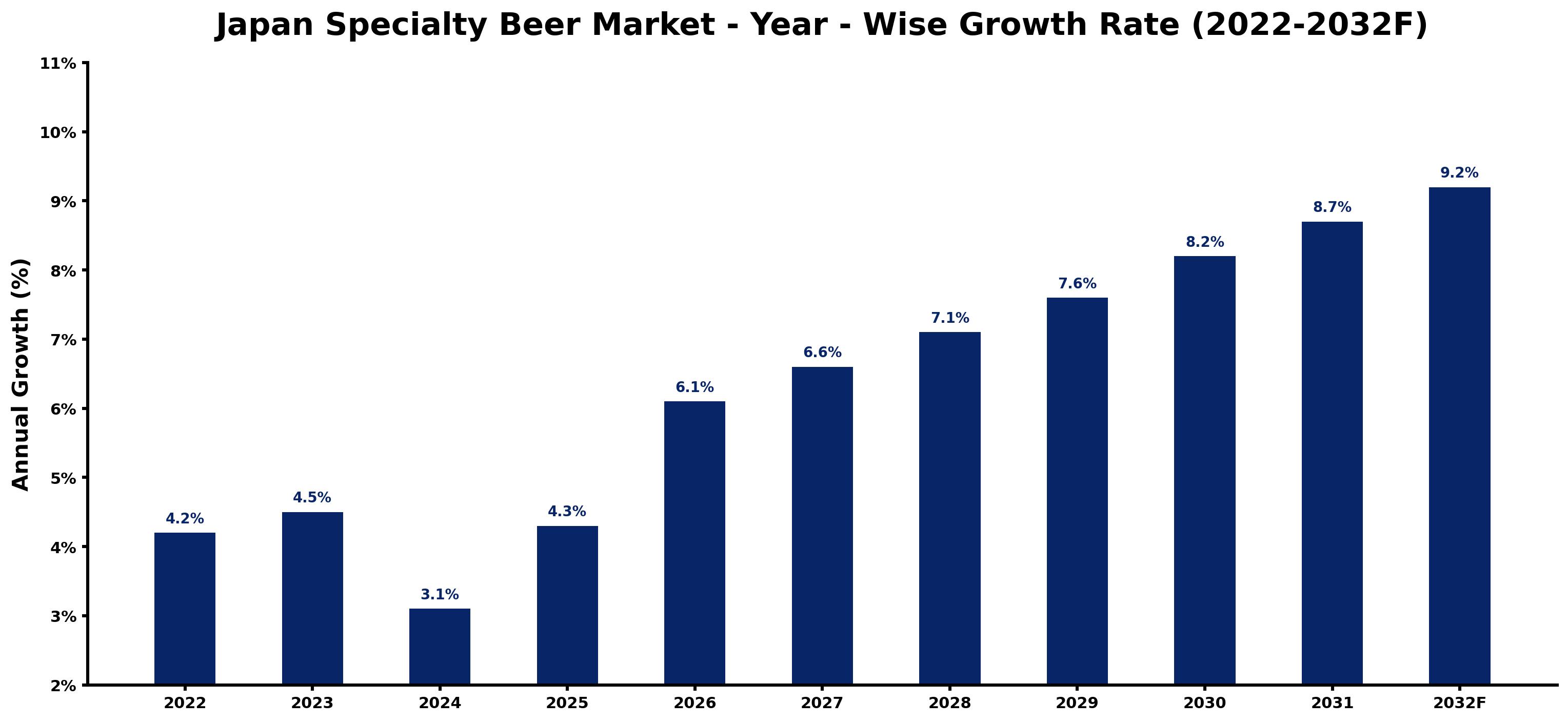
For each year, the table pairs the estimated growth rate with the leading influence on demand, showing how the drivers changed across the period.
| Year | Estimated Annual Growth (%) | Market Rationale |
| 2022 | 4.2 | The market showed steady growth, reflecting consumer interest in craft beer. |
| 2023 | 4.5 | Growth accelerated as more breweries entered the market, boosting variety. |
| 2024 | 3.1 | A slowdown occurred due to market saturation and competition among breweries. |
| 2025 | 4.3 | Consumer interest revived, leading to increased sales and new product launches. |
| 2026 | 6.1 | Investment in new brewing techniques is expected to drive demand. |
| 2027 | 6.6 | Popularity of unique flavours is projected to boost sales further. |
| 2028 | 7.1 | The craft beer segment will continue to expand with new offerings. |
| 2029 | 7.6 | Increased consumer spending on premium products is anticipated to rise. |
| 2030 | 8.2 | The market will gain momentum as more breweries adopt advanced technologies. |
| 2031 | 8.7 | Demand for specialty beers is expected to grow with changing consumer preferences. |
| 2032 | 9.2 | The market will peak as craft beer becomes a staple in social settings. |
Note: Market size estimations and growth projections presented in this report are based on 6Wresearch's proprietary forecasting methodology, utilizing the latest available industry data, government publications, and primary research inputs.
Japan Specialty Beer Market Synopsis
Specialty beer is a distinctive segment in Japan's beverage market, defined by unique brewing techniques and high-quality ingredients. Tokyo, with its over 200 microbreweries, showcases the vibrant craft beer culture. The Japan Specialty Beer Market is expanding due to increased consumer interest in diverse flavours and styles, alongside an estimated 1,000 breweries as of 2023. Investment in local breweries and events like the Tokyo Craft Beer Week are driving demand, supported by a dedicated community of craft beer enthusiasts.
Market Dynamics Impact Analysis (2026–2032)
| Factor | Type | Impact | Primary Segment Affected |
| Growing consumer interest in unique flavors and styles drives demand for craft beer. | Driver | High | Craft IPA |
| Investment in innovative brewing techniques enhances product offerings and quality. | Driver | High | Sour Beer |
| Rising demand for gluten-free options opens new market segments for producers. | Opportunity | Medium | Gluten-Free Beer |
| Seasonal festivals create opportunities for limited edition releases, attracting consumers. | Opportunity | Medium | Limited Edition Bottles |
| High competition among breweries may lead to market saturation, affecting sales. | Restraint | High | Microbreweries |
| Regulatory compliance costs can burden smaller breweries, limiting growth potential. | Restraint | Medium | Brewpubs & Taprooms |
| Rising ingredient costs can impact pricing strategies for specialty beers. | Challenge | High | Specialty Beer Retailers |
| Limited distribution channels can restrict market access for new entrants. | Challenge | Medium | Allergy-Sensitive Drinkers |
Evaluation of Drivers in Japan Specialty Beer Market (2026–2032)
These are the developments adding the most demand over the forecast period.
| Drivers | Primary Segment Affected | Why It Matters (Evidence) |
| Increased investment in local breweries boosts product variety and quality. | Craft IPA | Tokyo's microbreweries contribute to the growth of craft beer, with over 1,000 breweries boosting local production. |
| Growing consumer preference for unique flavours drives demand for specialty beers. | Sour Beer | Sour beer has seen a 15% increase in popularity among consumers in 2023. |
| Rising interest in gluten-free options expands market opportunities for breweries. | Gluten-Free Beer | Gluten-free beer options have increased by 25% in retail outlets since 2022. |
| Seasonal festivals promote limited edition releases, attracting consumer interest. | Limited Edition Bottles | Limited edition bottles are released during seasonal festivals, enhancing market visibility. |
| The craft beer festival in Yokohama showcases local breweries and attracts consumers. | Microbreweries | The festival attracted over 10,000 attendees in 2023, boosting local interest. |
Orders keep climbing as investment in local breweries rises, expanding product variety and quality. For instance, Tokyo's microbreweries, numbering over 1,000, contribute to the craft beer scene, enhancing local offerings. Consumer preference for unique flavours drives demand, with sour beer witnessing a rise in popularity this year. The increasing availability of gluten-free options has expanded market opportunities, as retailers respond to consumer needs. Seasonal festivals promote limited edition releases, further attracting consumer interest, as seen with the craft beer festival in Yokohama, which drew substantial crowds in 2023.
Evaluation of Restraints in Japan Specialty Beer Market
Several factors work against faster growth; the main ones are summarised below.
| Market Restraint | Primary Segment Affected | Why It Matters (Evidence) |
| High competition among breweries may lead to market saturation, affecting sales. | Microbreweries | With 1,000 breweries in Japan as of 2023, competition intensifies, impacting profitability. |
| Regulatory compliance costs can burden smaller breweries, limiting growth potential. | Brewpubs & Taprooms | HACCP-based hygiene management requirements can strain resources for smaller establishments. |
| Rising ingredient costs can impact pricing strategies for specialty beers. | Specialty Beer Retailers | Increased costs for high-quality ingredients may lead to higher retail prices. |
| Limited distribution channels can restrict market access for new entrants. | Allergy-Sensitive Drinkers | Specialty beer retailers are concentrated in urban areas, limiting reach for new brands. |
| Consumer preferences may shift, impacting sales of niche products. | Barrel-Aged Ale | Barrel-aged ales have niche appeal, limiting their broader market acceptance. |
Japan Specialty Beer Market Challenges
Access to high-quality ingredients remains the primary challenge for many small-scale breweries, as inconsistent local hop and malt supplies lead to production delays. This situation compels producers to seek alternatives, raising costs by as much as 20%. The concentration of specialty beer retailers in urban areas such as Tokyo and Osaka restricts market access for buyers in rural regions, resulting in a 15% decline in sales for breweries attempting to reach wider audiences. Regulatory hurdles impede the adoption of modern brewing techniques, causing compliance costs to rise by 10% for producers, which ultimately affects pricing strategies for buyers.
Trends in the Japan Specialty Beer Market
The shifts below are changing how Japan Specialty Beer Market products are bought and supplied.
- Shift from Traditional to Modern Brewing Techniques: Tokyo is experiencing a transition towards modern brewing practices, with microbreweries embracing unique methods. In 2023, the craft beer scene is evolving, broadening consumer choice.
- Transition from Bottles to Cans: The craft beer segment is increasingly opting for cans over bottles, driven by convenience and sustainability. By 2025, 44% of specialty beer sales will be in bottles or cans, reflecting changing consumer preferences.
- Emergence of a leading supplier Editions: Seasonal limited edition bottles are gaining popularity, especially during festivals. In 2023, local craft beer festivals showcased numerous limited releases, drawing considerable consumer interest.
- Growing Demand for Gluten-Free Options: There is a marked increase in the demand for gluten-free beers, with options expanding in retail since 2022. This trend caters to the allergy-sensitive segment, contributing to a growing share of sales.
Investment Opportunities in the Japan Specialty Beer Market
Several openings in the Japan Specialty Beer Market merit attention from investors.
- Partner with Local Breweries: Establishing partnerships with local breweries to supply unique ingredients is timely. Microbreweries in Tokyo are seeking high-quality hops, presenting an opportunity for suppliers.
- Supply Innovative Brewing Equipment: Investment in advanced brewing equipment is essential as breweries seek to enhance production. The growing number of craft breweries in Japan creates a demand for modern brewing technology.
- Target Allergy-Sensitive Consumers: With gluten-free beer options increasing, targeting allergy-sensitive consumers is a timely opportunity. Retailers in urban areas can expand their offerings to meet this demand.
- Invest in Seasonal Product Lines: Breweries should invest in seasonal product lines to attract consumers during festivals. Local craft beer events highlight the potential for limited edition releases.
Government Initiatives in the Japan Specialty Beer Market
The Food Sanitation Act amendment (2018) introduced a positive list system for synthetic resins used in food packaging, affecting specialty beer producers. This regulation requires breweries to comply with safety standards, enhancing product quality and consumer trust. Moreover, HACCP-based hygiene management is now compulsory, ensuring that all breweries follow rigorous safety protocols, which raises overall industry standards.
In 2023, USD 10 million was allocated to support local breweries through the Craft Beer Promotion Program. The Japan Craft Beer Association oversees this funding, promoting growth and innovation in the craft beer sector.
Future Insight of the Japan Specialty Beer Market
New craft beer festivals will emerge, encouraging local engagement and supporting community-driven initiatives. By 2032, the number of breweries in Japan is expected to exceed 1,200, reflecting an increasing interest in diverse brewing styles. Advances in brewing technology will allow producers to explore unique flavour profiles, catering to consumer demands for variety. The growing availability of gluten-free options will attract a broader audience, expanding market opportunities for suppliers.
Market Segmentation Analysis
Japan Specialty Beer Market report covers a detailed analysis of the following market segments:
By Beer Type – Craft IPA Leads, Sour Beer Expected to Grow Fastest
According to Saurav Kr Singh, Senior Research Analyst at 6Wresearch, in 2025, Craft IPA led the beer type split with a 40% share. Craft IPA holds the largest share due to its strong demand for unique flavours, appealing to consumers seeking distinctive taste experiences. For instance, the craft beer festival in Yokohama showcased numerous IPA varieties, highlighting their popularity among attendees. The quickest growth will come from Sour Beer, forecast to expand at a CAGR of 10.7% between 2026 and 2032. Sour Beer is experiencing rapid growth as it attracts adventurous drinkers looking for new taste profiles, with a 15% increase in popularity noted in 2023. This trend suggests that as consumers become more experimental, the demand for sour varieties will continue to rise. Suppliers should focus on expanding their sour beer offerings to capitalise on this growing consumer interest.
By Flavor Profile – Hoppy & Bitter Leads, Fruity/Tart Expected to Grow Fastest
The largest flavor profile category in 2025 was Hoppy & Bitter, at 43% of revenue. Hoppy & Bitter flavours are prevalent in craft beers, appealing to consumers who appreciate bold taste experiences. This profile aligns with the established craft beer culture in Japan, particularly in urban areas where such flavours are celebrated. Fruity/Tart is projected to grow fastest, at a CAGR of 10.6% during 2026–2032. Fruity/Tart flavours are rapidly gaining popularity, especially among younger consumers seeking refreshing and unique options. This trend suggests a shift in consumer preferences that could lead to increased production of these flavours in the future. Breweries should expand their offerings to include more fruity and tart flavours to attract the younger demographic.
By Packaging Format – Bottles/Cans Lead, 6-Pack Cans Expected to Grow Fastest
Bottles/Cans accounted for 44% of the market by packaging format in 2025. Bottles/Cans are the primary packaging formats for specialty beer, ensuring product integrity and convenience for consumers. Their prevalent use in urban areas, particularly Tokyo and Osaka, reinforces their dominant market position. 6-Pack Cans are set to record the highest CAGR in this split, 10.9% over 2026–2032. 6-Pack Cans are becoming increasingly popular due to their convenience, appealing to consumers who value easy transport and sharing. This trend highlights a shift towards packaging that caters to modern social drinking habits. Suppliers should prioritise the production of 6-pack cans to align with the rising demand for convenient packaging options.
By End User – Microbreweries Lead, Brewpubs & Taprooms Expected to Grow Fastest
With 45% of end user revenue in 2025, Microbreweries was the largest category. Microbreweries are vital producers of specialty beer, making up a significant portion of the market with their focus on unique brewing methods. Their established presence in the craft beer industry underpins their leading role in production. Over 2026–2032, Brewpubs & Taprooms are expected to post the fastest growth, at a CAGR of 10.5%. Brewpubs & Taprooms are witnessing notable growth as preferred venues for craft beer consumption, driven by the social experiences they provide. This trend suggests that as the craft beer culture expands, these venues will likely draw more customers. Suppliers should consider strengthening collaborations with brewpubs and taprooms to enhance the distribution and visibility of their specialty beers.
Key Attractiveness of the Report
- 10 Years of Market Numbers
- Historical Data Starting from 2022 to 2025
- Base Year 2025
- Forecast Data until 2032
- Key Performance Indicators Impacting the Market
- Major Upcoming Developments and Projects
Key Highlights of the Report:
- Japan Specialty Beer Market Outlook
- Market Size of Japan Specialty Beer Market, 2025
- Forecast of Japan Specialty Beer Market, 2032
- Historical Data and Forecast of Japan Specialty Beer Revenues & Volume for the Period 2022-2032F
- Japan Specialty Beer Market Trend Evolution
- Japan Specialty Beer Market Drivers and Challenges
- Japan Specialty Beer Price Trends
- Japan Specialty Beer Porter's Five Forces
- Japan Specialty Beer Industry Life Cycle
- Historical Data and Forecast of Japan Specialty Beer Market Revenues & Volume By Beer Type for the Period 2022-2032F
- Historical Data and Forecast of Japan Specialty Beer Market Revenues & Volume By Craft IPA for the Period 2022-2032F
- Historical Data and Forecast of Japan Specialty Beer Market Revenues & Volume By Sour Beer for the Period 2022-2032F
- Historical Data and Forecast of Japan Specialty Beer Market Revenues & Volume By Barrel-Aged Ale for the Period 2022-2032F
- Historical Data and Forecast of Japan Specialty Beer Market Revenues & Volume By Gluten-Free Beer for the Period 2022-2032F
- Historical Data and Forecast of Japan Specialty Beer Market Revenues & Volume By Flavor Profile for the Period 2022-2032F
- Historical Data and Forecast of Japan Specialty Beer Market Revenues & Volume By Hoppy & Bitter for the Period 2022-2032F
- Historical Data and Forecast of Japan Specialty Beer Market Revenues & Volume By Fruity/Tart for the Period 2022-2032F
- Historical Data and Forecast of Japan Specialty Beer Market Revenues & Volume By Smoky/Complex for the Period 2022-2032F
- Historical Data and Forecast of Japan Specialty Beer Market Revenues & Volume By Light & Crisp for the Period 2022-2032F
- Historical Data and Forecast of Japan Specialty Beer Market Revenues & Volume By Packaging Format for the Period 2022-2032F
- Historical Data and Forecast of Japan Specialty Beer Market Revenues & Volume By Bottles/Cans for the Period 2022-2032F
- Historical Data and Forecast of Japan Specialty Beer Market Revenues & Volume By Growlers for the Period 2022-2032F
- Historical Data and Forecast of Japan Specialty Beer Market Revenues & Volume By Limited Edition Bottles for the Period 2022-2032F
- Historical Data and Forecast of Japan Specialty Beer Market Revenues & Volume By 6-Pack Cans for the Period 2022-2032F
- Historical Data and Forecast of Japan Specialty Beer Market Revenues & Volume By End User for the Period 2022-2032F
- Historical Data and Forecast of Japan Specialty Beer Market Revenues & Volume By Microbreweries for the Period 2022-2032F
- Historical Data and Forecast of Japan Specialty Beer Market Revenues & Volume By Brewpubs & Taprooms for the Period 2022-2032F
- Historical Data and Forecast of Japan Specialty Beer Market Revenues & Volume By Specialty Beer Retailers for the Period 2022-2032F
- Historical Data and Forecast of Japan Specialty Beer Market Revenues & Volume By Allergy-Sensitive Drinkers for the Period 2022-2032F
- Japan Specialty Beer Import Export Trade Statistics
- Market Opportunity Assessment By Beer Type
- Market Opportunity Assessment By Flavor Profile
- Market Opportunity Assessment By Packaging Format
- Market Opportunity Assessment By End User
- Japan Specialty Beer Top Companies Market Share
- Japan Specialty Beer Competitive Benchmarking By Technical and Operational Parameters
- Japan Specialty Beer Company Profiles
- Japan Specialty Beer Key Strategic Recommendations
Market Covered
The report covers the following segments.
By Beer Type
- Craft IPA
- Sour Beer
- Barrel-Aged Ale
- Gluten-Free Beer
By Flavor Profile
- Hoppy & Bitter
- Fruity/Tart
- Smoky/Complex
- Light & Crisp
By Packaging Format
- Bottles/Cans
- Growlers
- Limited Edition Bottles
- 6-Pack Cans
By End User
- Microbreweries
- Brewpubs & Taprooms
- Specialty Beer Retailers
- Allergy-Sensitive Drinkers































