Japan Specialty Crop Harvesters Market Size & Growth Rate
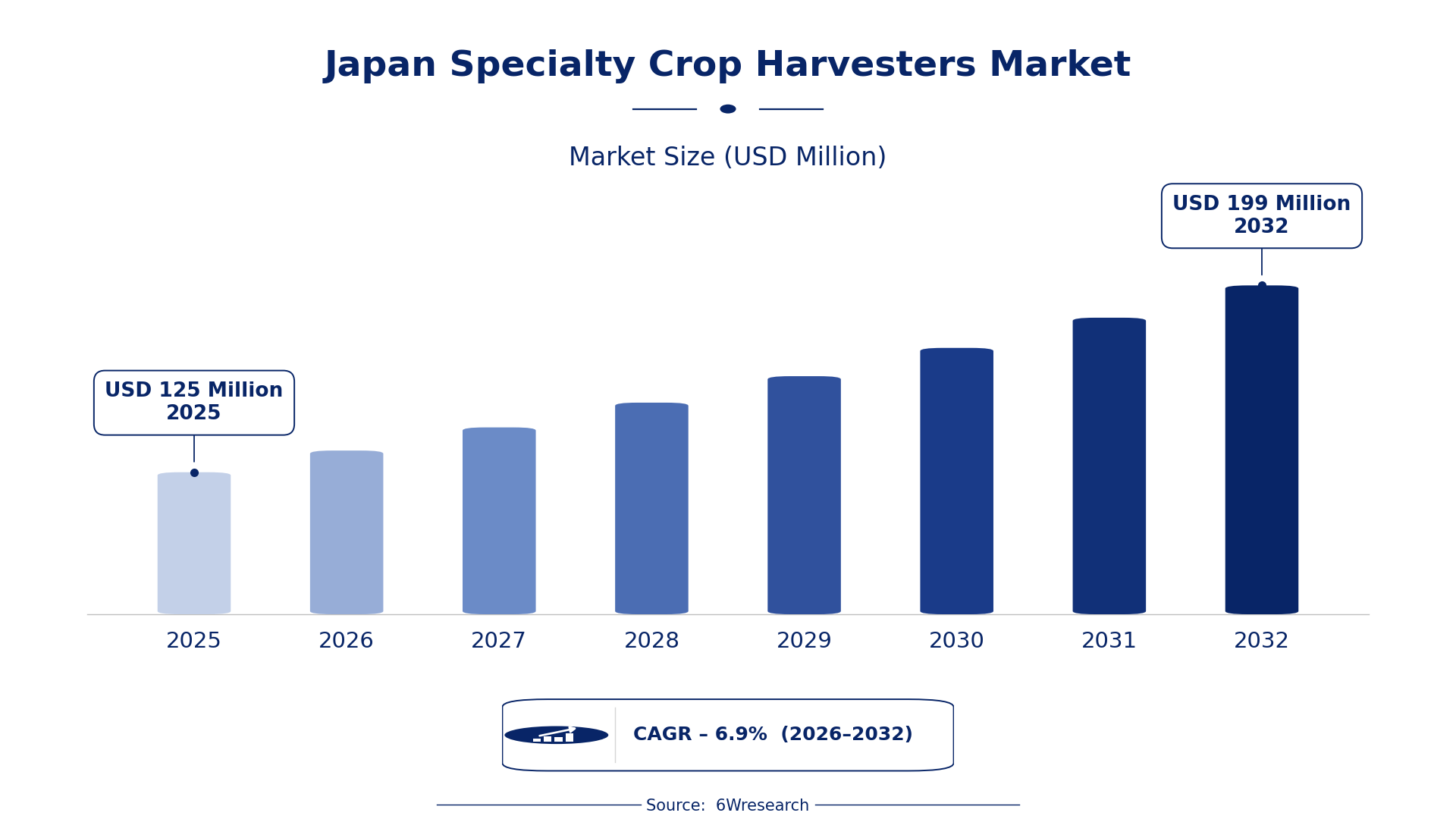
According to 6Wresearch internal database and industry insights, the Japan Specialty Crop Harvesters Market was valued at USD 125 Million in 2025 and is projected to reach USD 199 Million by 2032, growing at a CAGR of approximately 6.9% during 2026–2032.
Japan Specialty Crop Harvesters Market Highlights
| Report Metric | Details |
| Report Name | Japan Specialty Crop Harvesters Market (2026-2032) |
| Market Size 2025 | USD 125 Million |
| Market Size 2032 | USD 199 Million |
| Absolute Growth 2025–2032 | USD 74 Million |
| CAGR 2026–2032 | 6.9% |
| Peak Annual Growth | 8.2% in 2026 |
| Forecast Period | 2026–2032 |
| Historical Data | 2022–2025 |
| Base Year | 2025 |
| Leading Harvester Type, 2025 | Grape Harvesters (36% share) |
| Leading Crop Category, 2025 | Vineyards (44% share) |
| Leading Mechanism Type, 2025 | Shaking/Collecting (48% share) |
| Leading End User, 2025 | Wine Producers (41% share) |
| Fastest-Growing Harvester Type | Citrus Fruit Harvesters (9.8% CAGR) |
| Fastest-Growing Crop Category | Citrus Groves (9.0% CAGR) |
| Fastest-Growing End User | Orchard Operators (8.6% CAGR) |
| Growing Sector | Orchard Operators |
| Key End Users | Wine Producers, Orchard Operators, Agro Machinery Firms, Salad Producers |
Japan Specialty Crop Harvesters Market Year-wise Growth Rate and Key Drivers (2022–2032)
This graph illustrates the annual growth rates of the market from 2022 to 2032, highlighting a steady upward trajectory and projected market expansion over the forecast period.
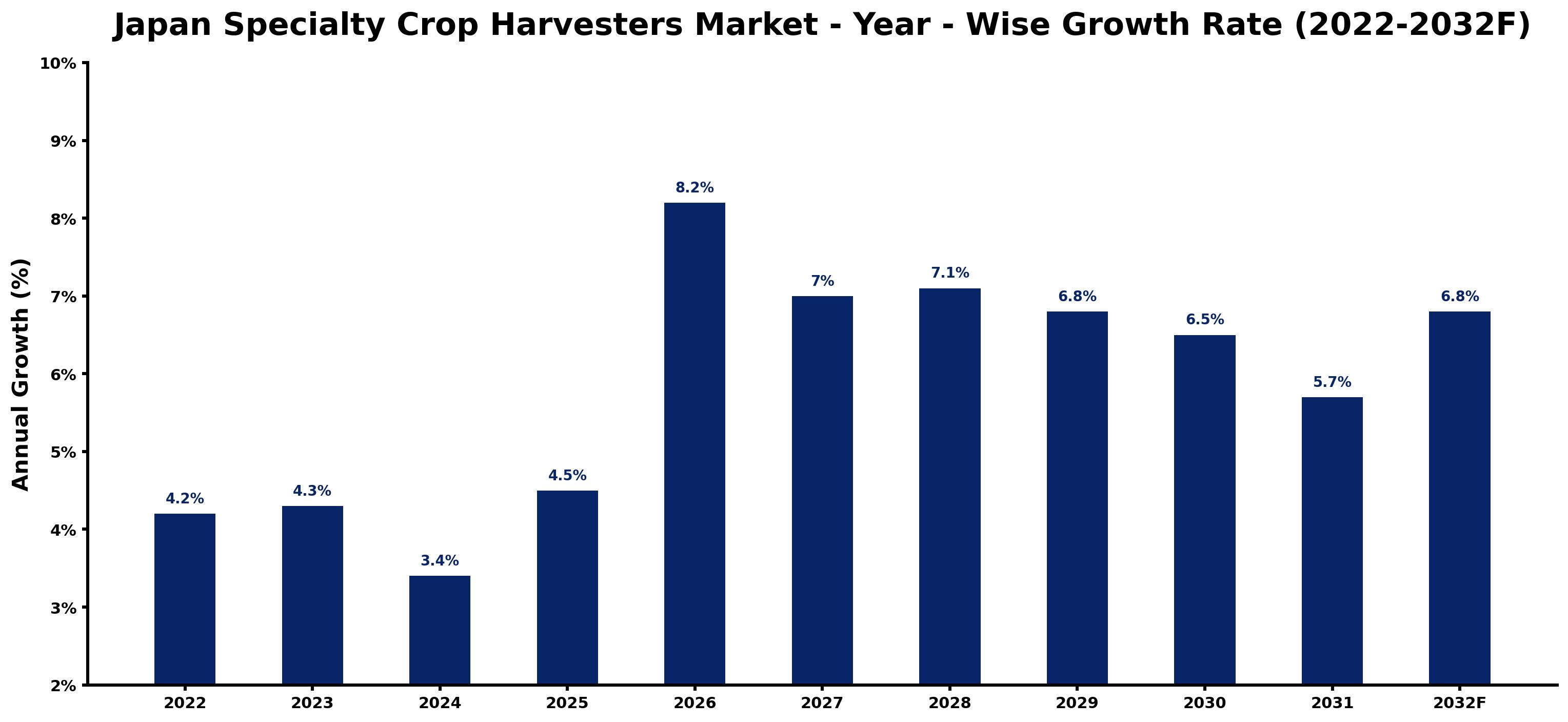
For each year, the table pairs the estimated growth rate with the leading influence on demand, showing how the drivers changed across the period.
| Year | Estimated Annual Growth (%) | Market Rationale |
| 2022 | 4.2 | The market showed steady growth due to existing demand for harvesting efficiency. |
| 2023 | 4.3 | Growth was slightly faster as producers invested in advanced harvesting technologies. |
| 2024 | 3.4 | Growth slowed as some buyers faced budget constraints amid rising costs. |
| 2025 | 4.5 | The market rebounded with increased investment in vineyard mechanization. |
| 2026 | 8.2 | The peak growth is expected to be driven by heightened demand for citrus harvesters. |
| 2027 | 7.0 | Growth is projected to slow as market saturation begins to impact new purchases. |
| 2028 | 7.1 | Growth is anticipated to pick up again as producers seek to modernise equipment. |
| 2029 | 6.8 | Growth will slow as the market stabilises with mature demand patterns. |
| 2030 | 6.5 | Growth is expected to continue slowing as competition increases among suppliers. |
| 2031 | 5.7 | Growth will remain steady as buyers adapt to new harvesting technologies. |
| 2032 | 6.8 | Growth is projected to accelerate again as sustainability initiatives gain traction. |
Note: Market size estimations and growth projections presented in this report are based on 6Wresearch's proprietary forecasting methodology, utilizing the latest available industry data, government publications, and primary research inputs.
Japan Specialty Crop Harvesters Market Synopsis
Specialty crop harvesters are advanced machines designed for efficient harvesting of specific crops such as grapes and citrus fruits. These machines improve productivity and reduce labor costs, making them essential in regions like Yamagata and Nagano, known for their vineyards. The Japan Specialty Crop Harvesters Market is expanding due to increasing mechanization driven by an aging farmer population and government support for agricultural modernization. In 2023, 10 billion yen was allocated to promote advanced harvesting technologies, further boosting demand from local agricultural firms and producers.
Market Dynamics Impact Analysis (2026–2032)
| Factor | Type | Impact | Primary Segment Affected |
| Increasing mechanization in agriculture | Driver | High | Grape Harvesters |
| Government support for agricultural innovation | Driver | High | Citrus Fruit Harvesters |
| Growing interest in sustainable agriculture practices | Opportunity | Medium | Leafy Green Harvesters |
| Expansion of vineyard areas in Yamagata | Opportunity | Medium | Vineyards |
| High costs of advanced machinery | Restraint | High | Root Crop Harvesters |
| Limited mechanization in certain crop categories | Restraint | Medium | Leafy Green Harvesters |
| Aging farmer population affecting labor availability | Challenge | High | Grape Harvesters |
| Competition from lower-cost harvesting solutions | Challenge | Medium | Citrus Fruit Harvesters |
Evaluation of Drivers in Japan Specialty Crop Harvesters Market (2026–2032)
Key forces behind demand, with the segment each one moves most, are listed below.
| Drivers | Primary Segment Affected | Why It Matters (Evidence) |
| Increased vineyard mechanization | Grape Harvesters | Japan has over 200,000 hectares of vineyards, driving demand for efficient grape collection. |
| Government funding for modernization | Citrus Fruit Harvesters | In 2023, 10 billion yen was allocated to promote agricultural modernization, boosting citrus harvester demand. |
| Aging farmer demographics | Grape Harvesters | The average age of farmers in Japan is over 67, necessitating mechanization to maintain productivity. |
| Rising citrus production | Citrus Fruit Harvesters | Japan produced approximately 1.2 million tons of citrus, increasing the need for specialized harvesters. |
| Focus on sustainable practices | Leafy Green Harvesters | Japan's emphasis on sustainable agriculture is driving the adoption of efficient harvesting technologies. |
The strongest pull on demand comes from the increasing mechanization of vineyards, with over 200,000 hectares in Japan requiring efficient grape collection. The aging farmer demographic, with an average age exceeding 67, necessitates modern solutions to maintain productivity. The rise in citrus production, particularly in Wakayama, increases the demand for specialized citrus harvesters. Additionally, the focus on sustainable practices is driving the uptake of efficient harvesting solutions in the leafy greens sector.
Evaluation of Restraints in Japan Specialty Crop Harvesters Market
These are the pressures that could keep growth below its potential.
| Market Restraint | Primary Segment Affected | Why It Matters (Evidence) |
| High initial investment costs for advanced machinery | Grape Harvesters | The cost of specialty crop harvesters can deter small-scale farmers from investing in new equipment. |
| Limited mechanization in certain crop categories | Leafy Green Harvesters | The total area for leafy greens is around 80,000 hectares, where mechanization remains low. |
| Aging infrastructure in rural areas | Citrus Fruit Harvesters | Inadequate infrastructure can hinder the effective use of advanced harvesting machines. |
| Competition from alternative harvesting methods | Root Crop Harvesters | Some farmers opt for traditional methods due to lower upfront costs compared to advanced machines. |
| Slow adoption of new technologies | Leafy Green Harvesters | Resistance to change among older farmers limits the uptake of new harvesting technologies. |
Japan Specialty Crop Harvesters Market Challenges
High costs of specialty crop harvesters burden producers, with prices exceeding 10 million yen per unit, limiting access for smaller farms. Local manufacturers contend with intense competition from imported machinery, compelling them to lower prices, which threatens profit margins and market viability. Buyers face challenges with an ageing farmer population, where the average age surpasses 67 years, leading to a declining workforce and increased reliance on mechanisation. Compliance with ISO 9001 standards imposes additional regulatory burdens on manufacturers, resulting in production delays that can extend lead times by up to six months for buyers needing new equipment.
Trends in the Japan Specialty Crop Harvesters Market
The shifts below are changing how Japan Specialty Crop Harvesters Market products are bought and supplied.
- Shift towards Mechanization in Vineyards: In Yamagata, the trend towards mechanization began in 2022, with an increase in vineyard mechanization leading to higher efficiency. Grape production reached approximately 1.2 million tons in 2022.
- Increased Demand for Citrus Harvesters: Orchard operators are increasingly adopting citrus harvesters, with a growth rate of 9.0% since 2026. This trend is supported by the concentration of citrus production in Wakayama and Ehime, improving operational efficiency.
- Growing Focus on Sustainable Agriculture: The Japanese government has promoted sustainable practices since 2023, encouraging the adoption of efficient harvesters. This shift aligns with the agricultural sector's goal of reducing environmental impact.
- Expansion of Agricultural Modernization Initiatives: In 2023, new funding programs were initiated to modernize agricultural practices. This expansion is expected to improve productivity and efficiency across various crop categories.
Investment Opportunities in the Japan Specialty Crop Harvesters Market
The openings below show where demand in the Japan Specialty Crop Harvesters Market is visible and how suppliers can enter.
- Partnerships for Modernization: Local agricultural firms are seeking partnerships to modernize equipment, particularly in regions like Nagano. With government support, this is an ideal time to invest in advanced harvesting technologies.
- Investment in Citrus Harvesting: Orchard operators in Wakayama require efficient citrus harvesters, presenting a strong investment opportunity. The current focus on modernization makes this an advantageous moment for suppliers.
- Expansion into Leafy Greens: The leafy greens sector is expanding, with a growing need for efficient harvesting solutions. Suppliers can enter this market by collaborating with local salad producers.
- Technological Upgrades in Vineyards: Vineyards are increasingly adopting advanced harvesting technologies. Investing in mechanization solutions now can yield strong returns as producers seek to improve efficiency.
Government Initiatives in the Japan Specialty Crop Harvesters Market
The New Robot Strategy, initiated in 2015, aims to expand robot use in agriculture, including specialty crop harvesters. This measure complements older laws by promoting technological advancements that improve productivity and efficiency in the agricultural sector.
In 2023, the Japanese government allocated 10 billion yen for agricultural modernization initiatives, administered by the Ministry of Agriculture, Forestry and Fisheries (MAFF). This funding supports the adoption of advanced harvesting technologies, benefiting local producers and improving overall agricultural efficiency.
Future Insight of the Japan Specialty Crop Harvesters Market
A policy-driven shift will accelerate the adoption of advanced harvesting technologies, leading to increased efficiency across the agricultural sector. Continued government funding for agricultural modernization will support greater mechanisation in key areas, including citrus production and root crops. Buyers will benefit from improved productivity and reduced labour costs as suppliers respond to these advancements. New manufacturing standards will promote higher quality and reliability in harvesting equipment, ensuring better performance for end users.
Market Segmentation Analysis
Japan Specialty Crop Harvesters Market report covers a detailed analysis of the following market segments:
By Harvester Type – Grape Harvesters Lead, Citrus Fruit Harvesters Expected to Grow Fastest
According to Saurav Kr Singh, Senior Research Analyst at 6Wresearch, Grape Harvesters held 36% of the Japan Specialty Crop Harvesters Market by harvester type in 2025. Grape harvesters dominate the market in Japan due to their critical role in vineyards, particularly in Yamagata and Nagano prefectures. The substantial grape production, amounting to approximately 1.2 million tons in 2022, ensures a strong demand for these machines. The quickest growth will come from Citrus Fruit Harvesters, forecast to expand at a CAGR of 9.8% between 2026 and 2032. Citrus fruit harvesters are experiencing rapid growth as the citrus production in Wakayama and Ehime increases, with the sector valued at 300 billion yen annually. This growth in citrus cultivation will further solidify the position of grape harvesters as the demand for efficient harvesting solutions expands. Suppliers should focus on enhancing their offerings for citrus harvesters to effectively capture the growing market.
By Crop Category – Vineyards Lead, Citrus Groves Expected to Grow Fastest
Vineyards took 44% of crop category revenue in 2025, more than any other category. Vineyards lead the crop category in Japan, primarily due to the country's significant grape production, which reached approximately 1.2 million tons in 2022. This robust production creates a consistent demand for specialised harvesting equipment tailored for vineyards. Citrus Groves are set to record the highest CAGR in this split, 9.0% over 2026–2032. Citrus groves are the fastest-growing segment as the emphasis on citrus cultivation intensifies, highlighting the need for advanced harvesting technologies. The government's agricultural modernization initiatives will further stimulate this growth, necessitating suppliers to adapt their strategies accordingly. Buyers in the citrus sector should prioritise investment in advanced harvesting technologies to improve operational efficiency.
By Mechanism Type – Shaking/Collecting Leads and Records the Fastest Growth
Shaking/Collecting accounted for 48% of the market by mechanism type in 2025. Shaking/collecting mechanisms are prevalent in grape harvesting, making them the leading mechanism type in the market. This method is specifically designed to minimise damage to grapes, which is critical for maintaining quality. The same category is also set to grow fastest, at a CAGR of 9.7% during 2026–2032. The shaking/collecting mechanism is also the fastest-growing type due to its effectiveness in both grape and citrus harvesting, ensuring that it remains a preferred choice among users. The dual application in different crop types solidifies its market position. Suppliers should prioritise the development of shaking/collecting mechanisms to meet the rising demand.
By End User – Wine Producers Lead, Orchard Operators Expected to Grow Fastest
With 41% of end user revenue in 2025, Wine Producers was the largest category. Wine producers are the main end users of grape harvesters, significantly impacting the demand for these machines. Their dependence on efficient harvesting methods is crucial for maintaining quality in the competitive wine market. Over 2026–2032, Orchard Operators are expected to post the fastest growth, at a CAGR of 8.6%. Orchard operators represent the fastest-growing end user group as the citrus sector expands, creating an urgent need for more efficient harvesting solutions. This growth is driven by increasing citrus production and a push for modernisation in harvesting practices. Suppliers must customise their offerings to meet the specific requirements of orchard operators to capitalise on this growth.
Key Attractiveness of the Report
- 10 Years of Market Numbers
- Historical Data Starting from 2022 to 2025
- Base Year 2025
- Forecast Data until 2032
- Key Performance Indicators Impacting the Market
- Major Upcoming Developments and Projects
Key Highlights of the Report:
- Japan Specialty Crop Harvesters Market Outlook
- Market Size of Japan Specialty Crop Harvesters Market, 2025
- Forecast of Japan Specialty Crop Harvesters Market, 2032
- Historical Data and Forecast of Japan Specialty Crop Harvesters Revenues & Volume for the Period 2022-2032F
- Japan Specialty Crop Harvesters Market Trend Evolution
- Japan Specialty Crop Harvesters Market Drivers and Challenges
- Japan Specialty Crop Harvesters Price Trends
- Japan Specialty Crop Harvesters Porter's Five Forces
- Japan Specialty Crop Harvesters Industry Life Cycle
- Historical Data and Forecast of Japan Specialty Crop Harvesters Market Revenues & Volume By Harvester Type for the Period 2022-2032F
- Historical Data and Forecast of Japan Specialty Crop Harvesters Market Revenues & Volume By Grape Harvesters for the Period 2022-2032F
- Historical Data and Forecast of Japan Specialty Crop Harvesters Market Revenues & Volume By Citrus Fruit Harvesters for the Period 2022-2032F
- Historical Data and Forecast of Japan Specialty Crop Harvesters Market Revenues & Volume By Root Crop Harvesters for the Period 2022-2032F
- Historical Data and Forecast of Japan Specialty Crop Harvesters Market Revenues & Volume By Leafy Green Harvesters for the Period 2022-2032F
- Historical Data and Forecast of Japan Specialty Crop Harvesters Market Revenues & Volume By Crop Category for the Period 2022-2032F
- Historical Data and Forecast of Japan Specialty Crop Harvesters Market Revenues & Volume By Vineyards for the Period 2022-2032F
- Historical Data and Forecast of Japan Specialty Crop Harvesters Market Revenues & Volume By Citrus Groves for the Period 2022-2032F
- Historical Data and Forecast of Japan Specialty Crop Harvesters Market Revenues & Volume By Potatoes/Beets for the Period 2022-2032F
- Historical Data and Forecast of Japan Specialty Crop Harvesters Market Revenues & Volume By Lettuce/Spinach for the Period 2022-2032F
- Historical Data and Forecast of Japan Specialty Crop Harvesters Market Revenues & Volume By Mechanism Type for the Period 2022-2032F
- Historical Data and Forecast of Japan Specialty Crop Harvesters Market Revenues & Volume By Shaking/Collecting for the Period 2022-2032F
- Historical Data and Forecast of Japan Specialty Crop Harvesters Market Revenues & Volume By Mechanical Clamps for the Period 2022-2032F
- Historical Data and Forecast of Japan Specialty Crop Harvesters Market Revenues & Volume By Blade & Conveyor for the Period 2022-2032F
- Historical Data and Forecast of Japan Specialty Crop Harvesters Market Revenues & Volume By Cutting Drums for the Period 2022-2032F
- Historical Data and Forecast of Japan Specialty Crop Harvesters Market Revenues & Volume By End User for the Period 2022-2032F
- Historical Data and Forecast of Japan Specialty Crop Harvesters Market Revenues & Volume By Wine Producers for the Period 2022-2032F
- Historical Data and Forecast of Japan Specialty Crop Harvesters Market Revenues & Volume By Orchard Operators for the Period 2022-2032F
- Historical Data and Forecast of Japan Specialty Crop Harvesters Market Revenues & Volume By Agro Machinery Firms for the Period 2022-2032F
- Historical Data and Forecast of Japan Specialty Crop Harvesters Market Revenues & Volume By Salad Producers for the Period 2022-2032F
- Japan Specialty Crop Harvesters Import Export Trade Statistics
- Market Opportunity Assessment By Harvester Type
- Market Opportunity Assessment By Crop Category
- Market Opportunity Assessment By Mechanism Type
- Market Opportunity Assessment By End User
- Japan Specialty Crop Harvesters Top Companies Market Share
- Japan Specialty Crop Harvesters Competitive Benchmarking By Technical and Operational Parameters
- Japan Specialty Crop Harvesters Company Profiles
- Japan Specialty Crop Harvesters Key Strategic Recommendations
Market Covered
This report examines the market across the segments below.
By Harvester Type
- Grape Harvesters
- Citrus Fruit Harvesters
- Root Crop Harvesters
- Leafy Green Harvesters
By Crop Category
- Vineyards
- Citrus Groves
- Potatoes/Beets
- Lettuce/Spinach
By Mechanism Type
- Shaking/Collecting
- Mechanical Clamps
- Blade & Conveyor
- Cutting Drums
By End User
- Wine Producers
- Orchard Operators
- Agro Machinery Firms
- Salad Producers































