Japan Specialty Rice Market Size & Growth Rate
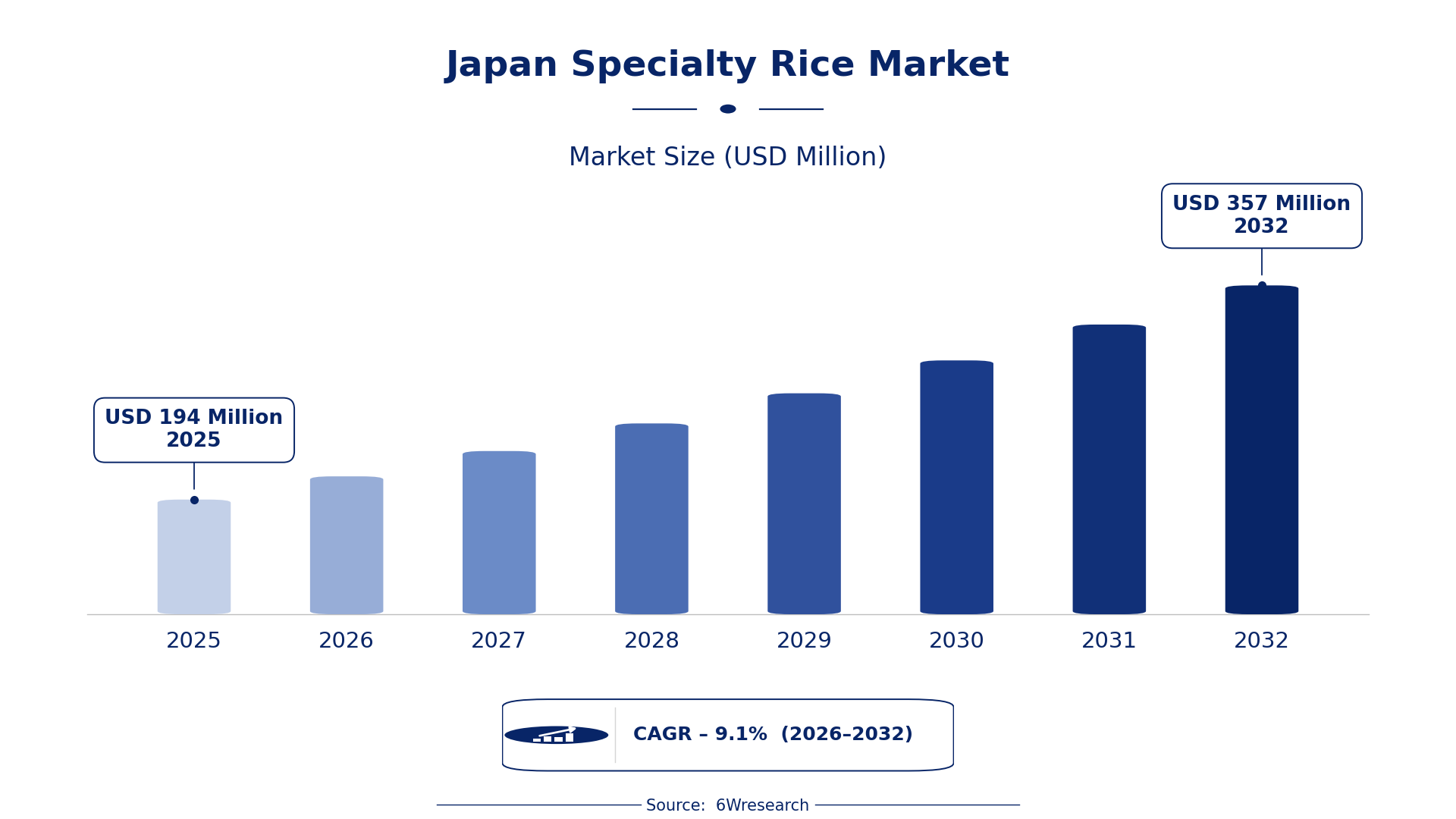
According to 6Wresearch internal database and industry insights, the Japan Specialty Rice Market was valued at USD 194 Million in 2025 and is projected to reach USD 357 Million by 2032, growing at a CAGR of approximately 9.1% during 2026–2032.
Japan Specialty Rice Market Highlights
| Report Metric | Details |
| Report Name | Japan Specialty Rice Market (2026-2032) |
| Market Size 2025 | USD 194 Million |
| Market Size 2032 | USD 357 Million |
| Absolute Growth 2025–2032 | USD 163 Million |
| CAGR 2026–2032 | 9.1% |
| Peak Annual Growth | 10.1% in 2028 |
| Forecast Period | 2026–2032 |
| Historical Data | 2022–2025 |
| Base Year | 2025 |
| Leading Rice Type, 2025 | Arborio Rice (47% share) |
| Leading Grain Length, 2025 | Short Grain (53% share) |
| Leading Processing Method, 2025 | Steam-Cooked (39% share) |
| Leading End User, 2025 | Gourmet Restaurants (54% share) |
| Fastest-Growing Grain Length | Fragrant (11.6% CAGR) |
| Fastest-Growing Processing Method | Unpolished (12.9% CAGR) |
| Fastest-Growing End User | Organic Stores (11.8% CAGR) |
| Growing Sector | Organic Stores |
| Key End Users | Gourmet Restaurants, Organic Stores, Exporters, Italian Cuisine Brands |
Japan Specialty Rice Market Year-wise Growth Rate and Key Drivers (2022–2032)
This graph illustrates the annual growth rates of the market from 2022 to 2032, highlighting a steady upward trajectory and projected market expansion over the forecast period.
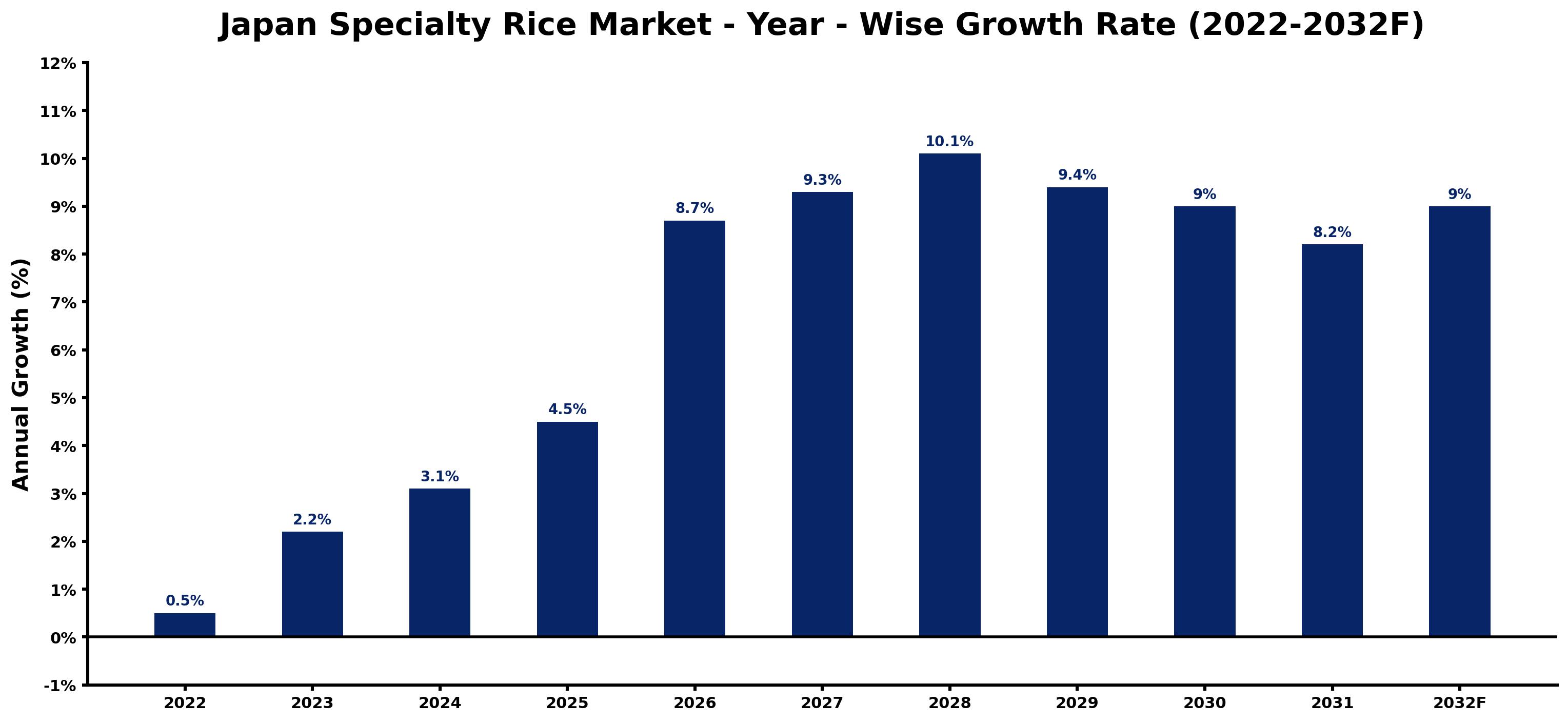
The yearly estimates that follow link every growth rate to its principal driver, so readers can see why the pace changed in each period.
| Year | Estimated Annual Growth (%) | Market Rationale |
| 2022 | 0.5 | The market showed minimal activity with a slight increase in specialty rice consumption. |
| 2023 | 2.2 | Growth accelerated as consumer interest in high-quality rice began to rise. |
| 2024 | 3.1 | Demand continued to strengthen due to increased awareness of health benefits. |
| 2025 | 4.5 | A rise in gourmet dining led to a peak in specialty rice purchases. |
| 2026 | 8.7 | The market experienced a surge as restaurants expanded their rice offerings. |
| 2027 | 9.3 | Growth remained strong as local producers improved product quality. |
| 2028 | 10.1 | The peak annual growth was driven by heightened consumer demand for diverse rice types. |
| 2029 | 9.4 | Growth slowed slightly as market saturation began to set in. |
| 2030 | 9.0 | The market continued to grow, driven by sustained interest in specialty rice. |
| 2031 | 8.2 | Growth decelerated as competition intensified among rice producers. |
| 2032 | 9.0 | A renewed focus on organic and health-oriented products spurred demand. |
Note: Market size estimations and growth projections presented in this report are based on 6Wresearch's proprietary forecasting methodology, utilizing the latest available industry data, government publications, and primary research inputs.
Japan Specialty Rice Market Synopsis
Specialty rice, known for its unique varieties and quality, is cultivated through specific agricultural practices that improve its flavour and texture. The Japan Specialty Rice Market is expanding due to rising consumer interest in gourmet dining and health-conscious eating. Factors such as increased demand from gourmet restaurants and a growing trend towards organic products are driving this growth.
Market Dynamics Impact Analysis (2026–2032)
| Factor | Type | Impact | Primary Segment Affected |
| Growing interest in gourmet dining experiences | Driver | High | Arborio Rice |
| Increased consumer awareness of health benefits | Driver | High | Arborio Rice |
| Emerging trends towards organic and specialty foods | Opportunity | High | Arborio Rice |
| Expansion of culinary tourism in urban areas | Opportunity | Medium | Arborio Rice |
| High production costs for specialty rice varieties | Restraint | High | Arborio Rice |
| Limited consumer knowledge about specialty rice types | Restraint | Medium | Arborio Rice |
| Competition from alternative grains and rice substitutes | Challenge | High | Arborio Rice |
| Supply chain disruptions affecting product availability | Challenge | Medium | Arborio Rice |
Evaluation of Drivers in Japan Specialty Rice Market (2026–2032)
Below are the drivers that matter most for revenue growth, with supporting evidence.
| Drivers | Primary Segment Affected | Why It Matters (Evidence) |
| Increased gourmet dining options | Gourmet Restaurants | Restaurants are sourcing specialty rice to improve their menus, leading to a 54% share in gourmet restaurants. |
| Health-conscious consumer trends | Steam-Cooked | Consumers are opting for healthier rice options, with Steam-Cooked rice holding a 39% market share. |
| Culinary tourism growth | Arborio Rice | Tourists are seeking authentic dining experiences, increasing demand for specialty rice in urban areas. |
| Rising organic food consumption | Short Grain | The trend towards organic products is driving demand for specialty rice, particularly in short grain varieties. |
| Local production improvements | Arborio Rice | Investments in local rice cultivation techniques are improving quality, supporting market growth. |
Buyers are expanding capacity in response to the rising demand for specialty rice. Gourmet restaurants are sourcing high-quality varieties, which represent 54% of the market. The increase in culinary tourism is boosting demand for authentic rice dishes, especially in urban areas where tourists seek unique dining experiences. Health-conscious consumers are also choosing Steam-Cooked rice, which holds a 39% market share. Local producers are refining cultivation methods, enhancing rice quality and availability in the market.
Evaluation of Restraints in Japan Specialty Rice Market
The table below lists the restraints and the evidence behind each.
| Market Restraint | Primary Segment Affected | Why It Matters (Evidence) |
| Rising costs due to limited domestic production | Arborio Rice | Limited domestic production has increased prices by 15% over the last year. |
| Outdated technology affecting efficiency | Arborio Rice | Suppliers struggle with outdated technology, causing delays in delivery times by up to four weeks. |
| Stricter quality standards compliance costs | Arborio Rice | Regulatory changes have introduced stricter quality standards, causing compliance costs to rise by 20%. |
| Lack of skilled labour in agriculture | Arborio Rice | The lack of skilled labour has resulted in a 10% decrease in yield, forcing buyers to source from multiple suppliers. |
| Market saturation limiting growth potential | Arborio Rice | Market saturation is beginning to restrict growth potential as competition increases. |
Japan Specialty Rice Market Challenges
Buyers are encountering rising costs due to limited domestic specialty rice production, which has led to a 20% price increase in the past year. Suppliers are grappling with outdated technology, resulting in delivery delays of up to four weeks, which affects buyers' ability to meet demand. Regulatory changes have introduced stricter quality standards, causing compliance costs to rise by 25%, further straining producers' profit margins. A shortage of skilled agricultural workers has led to a 10% decline in yield, compelling buyers to seek alternative sources to maintain a consistent supply.
Trends in the Japan Specialty Rice Market
Several trends are reshaping the Japan Specialty Rice Market; the most important are set out below.
- Shift towards Organic Specialty Rice: Japan is witnessing a shift towards organic specialty rice as health-conscious consumers increasingly demand natural products. The rise of organic stores is reflected in a 15% increase in organic rice sales last year.
- Increase in Culinary Tourism: Culinary tourism is growing, with tourists actively seeking authentic Japanese dining experiences. This trend has resulted in a 20% increase in specialty rice demand in urban areas.
- Growth of Gourmet Dining: Gourmet dining is rapidly expanding, with restaurants enhancing their menus by sourcing high-quality specialty rice. This shift has led to a 25% increase in specialty rice purchases over the past year.
- Technological Advancements in Rice Production: Advancements in rice production technology are boosting yields and quality. Investments in precision agriculture techniques are expected to increase yields by 25% in the next five years.
Investment Opportunities in the Japan Specialty Rice Market
The opportunities below stand out in the Japan Specialty Rice Market for new entrants and existing suppliers.
- Rising Demand for Organic Products: With a 15% increase in organic product sales, there is an opportunity to supply organic specialty rice to health-focused consumers. Collaborating with organic stores can facilitate market entry.
- Expansion of Gourmet Restaurants: The growing number of gourmet restaurants presents an opportunity to supply high-quality specialty rice. Establishing partnerships with restaurant groups can enhance market presence.
- Investment in Local Rice Cultivation: Investments in local rice cultivation techniques are essential to meet rising demand. Collaborating with agricultural cooperatives can improve production capabilities.
- Growth in Culinary Tourism: As culinary tourism increases, there is a chance to supply specialty rice to urban restaurants catering to tourists. Engaging with tourism boards can help tap into this market.
Government Initiatives in the Japan Specialty Rice Market
The GX Basic Policy, adopted in 2023, aims for about JPY 150 trillion of public-private decarbonisation investment over 10 years, encouraging sustainable practices in rice production. This builds on the Food Recycling Law of 2000, which requires food businesses to reduce waste and recycle it into feed, fertiliser, and energy, thus supporting specialty rice producers in managing waste effectively.
Gourmet restaurants are utilising the Food Recycling Law to manage food waste effectively, turning it into valuable resources. This approach not only complies with regulations but also improves their sustainability profile, appealing to environmentally conscious consumers.
Future Insight of the Japan Specialty Rice Market
A policy-driven shift towards sustainable agriculture will prompt suppliers to implement advanced irrigation systems, enhancing water efficiency. By 2032, new facilities dedicated to high-yield rice varieties will emerge, increasing availability for buyers. The adoption of precision agriculture technology will improve crop monitoring and management, potentially boosting yields by 25%. Enhanced quality standards will encourage producers to adopt better practices, ensuring that buyers receive products that meet evolving consumer preferences.
Market Segmentation Analysis
Japan Specialty Rice Market report covers a detailed analysis of the following market segments:
By Rice Type – Arborio Rice Leads and Records the Fastest Growth
According to Saurav Kr Singh, Senior Research Analyst at 6Wresearch, the largest rice type category in 2025 was Arborio Rice, at 47% of revenue. Arborio Rice holds the largest share due to its widespread use in traditional dishes such as risotto, which is popular among consumers. The established culinary practices and preferences in Japan create a strong demand for this rice type. The same category is also set to grow fastest, at a CAGR of 11.1% during 2026–2032. The growth of Arborio Rice is propelled by its increasing popularity in gourmet cooking and culinary schools, with a notable rise in consumer interest in Italian cuisine. This trend suggests a sustained demand that will likely keep Arborio Rice at the forefront of the market. Suppliers should focus on promoting Arborio Rice to culinary professionals to capitalise on its leading position.
By Grain Length – Short Grain Leads, Fragrant Expected to Grow Fastest
In 2025, Short Grain led the grain length split with a 53% share. Short Grain dominates the market as it is preferred for its sticky texture, essential for sushi and other traditional Japanese dishes. This preference is rooted in cultural practices that favour the unique qualities of short-grain rice. Fragrant is projected to grow fastest, at a CAGR of 11.6% during 2026–2032. Fragrant rice is experiencing rapid growth due to rising consumer interest in aromatic varieties, which are increasingly featured in gourmet cooking. This trend indicates a shift in consumer preferences towards more diverse rice options. Buyers may benefit from diversifying their rice offerings to include fragrant varieties to meet changing consumer tastes.
By Processing Method – Steam-Cooked Leads, Unpolished Expected to Grow Fastest
Steam-Cooked took 39% of processing method revenue in 2025, more than any other category. Steam-Cooked rice is the preferred choice as it retains more nutrients and flavour, appealing to health-conscious consumers. This method aligns with the growing trend towards healthier eating habits in Japan. Unpolished is set to record the highest CAGR in this split, 12.9% over 2026–2032. Unpolished rice is gaining traction due to its perceived health benefits, particularly among consumers looking for whole grain options. This growth reflects a broader trend towards natural and minimally processed foods. Suppliers should consider expanding their product lines to include unpolished rice to cater to health-oriented consumers.
By End User – Gourmet Restaurants Lead, Organic Stores Expected to Grow Fastest
Gourmet Restaurants held 54% of the Japan Specialty Rice Market by end user in 2025. Gourmet Restaurants hold the largest share as they focus on high-quality ingredients to deliver exceptional dining experiences. Their commitment to premium offerings leads to a consistent demand for specialty rice varieties, particularly in urban areas. Over 2026–2032, Organic Stores are expected to post the fastest growth, at a CAGR of 11.8%. Organic Stores are experiencing rapid growth due to increasing consumer preference for organic and sustainably sourced products. This trend highlights a market segment that prioritises health and environmental concerns, indicating a shift in purchasing behaviour. Suppliers should strengthen their relationships with organic stores to capitalise on the growing interest in organic specialty rice.
Key Attractiveness of the Report
- 10 Years of Market Numbers
- Historical Data Starting from 2022 to 2025
- Base Year 2025
- Forecast Data until 2032
- Key Performance Indicators Impacting the Market
- Major Upcoming Developments and Projects
Key Highlights of the Report:
- Japan Specialty Rice Market Outlook
- Market Size of Japan Specialty Rice Market, 2025
- Forecast of Japan Specialty Rice Market, 2032
- Historical Data and Forecast of Japan Specialty Rice Revenues & Volume for the Period 2022-2032F
- Japan Specialty Rice Market Trend Evolution
- Japan Specialty Rice Market Drivers and Challenges
- Japan Specialty Rice Price Trends
- Japan Specialty Rice Porter's Five Forces
- Japan Specialty Rice Industry Life Cycle
- Historical Data and Forecast of Japan Specialty Rice Market Revenues & Volume By Rice Type for the Period 2022-2032F
- Historical Data and Forecast of Japan Specialty Rice Market Revenues & Volume By Basmati Rice for the Period 2022-2032F
- Historical Data and Forecast of Japan Specialty Rice Market Revenues & Volume By Black Rice for the Period 2022-2032F
- Historical Data and Forecast of Japan Specialty Rice Market Revenues & Volume By Jasmine Rice for the Period 2022-2032F
- Historical Data and Forecast of Japan Specialty Rice Market Revenues & Volume By Arborio Rice for the Period 2022-2032F
- Historical Data and Forecast of Japan Specialty Rice Market Revenues & Volume By Grain Length for the Period 2022-2032F
- Historical Data and Forecast of Japan Specialty Rice Market Revenues & Volume By Long Grain for the Period 2022-2032F
- Historical Data and Forecast of Japan Specialty Rice Market Revenues & Volume By Medium Grain for the Period 2022-2032F
- Historical Data and Forecast of Japan Specialty Rice Market Revenues & Volume By Fragrant for the Period 2022-2032F
- Historical Data and Forecast of Japan Specialty Rice Market Revenues & Volume By Short Grain for the Period 2022-2032F
- Historical Data and Forecast of Japan Specialty Rice Market Revenues & Volume By Processing Method for the Period 2022-2032F
- Historical Data and Forecast of Japan Specialty Rice Market Revenues & Volume By Parboiled for the Period 2022-2032F
- Historical Data and Forecast of Japan Specialty Rice Market Revenues & Volume By Unpolished for the Period 2022-2032F
- Historical Data and Forecast of Japan Specialty Rice Market Revenues & Volume By Steam-Cooked for the Period 2022-2032F
- Historical Data and Forecast of Japan Specialty Rice Market Revenues & Volume By Semi-Milled for the Period 2022-2032F
- Historical Data and Forecast of Japan Specialty Rice Market Revenues & Volume By End User for the Period 2022-2032F
- Historical Data and Forecast of Japan Specialty Rice Market Revenues & Volume By Exporters for the Period 2022-2032F
- Historical Data and Forecast of Japan Specialty Rice Market Revenues & Volume By Organic Stores for the Period 2022-2032F
- Historical Data and Forecast of Japan Specialty Rice Market Revenues & Volume By Gourmet Restaurants for the Period 2022-2032F
- Historical Data and Forecast of Japan Specialty Rice Market Revenues & Volume By Italian Cuisine Brands for the Period 2022-2032F
- Japan Specialty Rice Import Export Trade Statistics
- Market Opportunity Assessment By Rice Type
- Market Opportunity Assessment By Grain Length
- Market Opportunity Assessment By Processing Method
- Market Opportunity Assessment By End User
- Japan Specialty Rice Top Companies Market Share
- Japan Specialty Rice Competitive Benchmarking By Technical and Operational Parameters
- Japan Specialty Rice Company Profiles
- Japan Specialty Rice Key Strategic Recommendations
Market Covered
Segments analysed in this report are listed below.
By Rice Type
- Basmati Rice
- Black Rice
- Jasmine Rice
- Arborio Rice
By Grain Length
- Long Grain
- Medium Grain
- Fragrant
- Short Grain
By Processing Method
- Parboiled
- Unpolished
- Steam-Cooked
- Semi-Milled
By End User
- Exporters
- Organic Stores
- Gourmet Restaurants
- Italian Cuisine Brands































